397 Kassia de Souza Medeiros Marinho
Professora Substituta
Universidade Federal de Ouro Preto – UFOP Escola de Minas
Departamento de Geologia Ouro Preto – Minas Gerais – Brasil [email protected]
Hanna Jordt-Evangelista
Professora Titular
Universidade Federal de Ouro Preto – UFOP Escola de Minas
Departamento de Geologia Ouro Preto – Minas Gerais – Brasil [email protected]
Marcelo de Souza Marinho
Pesquisador em Geociências Serviço Geológico do Brasil – CPRM Superintendência Regional de Belo Horizonte Belo Horizonte - Minas Gerais - Brasil [email protected]
Petrography and geochemistry
of the Pedra Dourada
Granulite, southeastern
Minas Gerais, Brazil
Abstract
The Pedra Dourada Granulite (PDG) occurs at the southeastern portion of the Araçuaí Belt, north of the town of Ponte Nova. It comprises bodies up to 45 km2
in-serted into amphibolite-facies gneisses of the Mantiqueira Complex. Motivated by the discrepancy of metamorphic grade with surrounding rocks, this paper presents results of the petrographic and geochemical investigation of the PDG. The unit is comprised of meta-igneous and metasedimentary rocks. Meta-igneous rocks dominate and in-clude felsic granulites (biotite ± garnet-bearing and orthopyroxene-bearing) and subor-dinate maic granulites. Metasedimentary rocks are aluminous granulites with Al-rich mineral assemblages (garnet, sillimanite, spinel). Geochemical data show that most of felsic protoliths are peraluminous rocks including granites, granodiorites and dio-rites of calc-alkaline character, chemically similar to granitoids of convergent tectonic settings. Maic protoliths are metaluminous rocks comprised of gabbros and subor-dinate diorites of tholeiitic afinity, compositionally similar to plate margin basalts. Aluminous protoliths may be peraluminous pelitic rocks and wackes, analogous to sediments from convergent environments. The mineral assemblages indicate that these rocks were metamorphosed under medium-P granulite-facies conditions. Coronitic
garnet textures suggest a near-isobaric cooling (IBC-path) after metamorphic peak.
Keywords: granulites, geochemistry, Pedra Dourada Granulite, Mantiqueira
Com-plex, Araçuaí Belt.
Geosciences
Geociências
http://dx.doi.org/10.1590/0370-44672014690192
1. Introduction
The Pedra Dourada Granulite (PDG) is located in the southeastern portion of the Araçuaí Belt, which was deined by Almeida (1977) as a Brasiliano fold-thrust belt developed along the southeastern edge of the São Francisco Craton. This belt is now viewed as the external domain of the Araçuaí Orogen (Alkmim et al., 2007).
The Araçuaí Orogen encom-passes the entire region between the São Francisco Craton and the Brazil-ian continental margin and is roughly limited by the 15º and 21º S parallels. This orogen displays an arbitrary boundary with the Ribeira Orogen to the south (Pedrosa-Soares & Wiede-mann-Leonardos, 2000) (Figure 1a). The Araçuaí Orogen is subdivided by the Abre Campo Shear Zone into two tectonic domains – the internal (east-ern) and the external (west(east-ern) (Figure
1b). The internal domain corresponds to the crystalline core of the orogen and comprises high amphibolite to granulite facies rocks of the Juiz de Fora Complex (Alkmim et al., 2007).
The external domain, which is correlated to the Araçuaí Belt, is dominantly composed of greenschist- to amphibolite-facies rocks. In south-eastern State of Minas Gerais, this belt encompasses a Paleoproterozoic basement, represented by the Man-tiqueira Complex, and supracrustal units (e.g. Grupo Dom Silvério) (Peres et al., 2004) (Figure 1b). The
Man-tiqueira Complex is mostly comprised of amphibolite-facies orthogneisses (Noce et al., 2007). The main
excep-tions consist of two granulite terrains that occur between the southeast-ern edge of São Francisco Craton and Abre Campo Shear Zone. The
western terrain corresponds to the Acaiaca Complex (AC) (Jordt-Evan-gelista, 1984,1985; Jordt-Evangelista & Muller, 1986a, 1986b; Teixeira
et al., 1987; Medeiros Júnior, 2009;
Medeiros Júnior & Jordt-Evangelista, 2010). The other is the PDG, origi-nally called Córrego Pedra Dourada Granulite by Brandalise (1991). This unit is located east of the metavolca-nosedimentary sequence of the Dom Silvério Group, in the region of the Dom Silvério, Rio Doce and Sem Peixe towns (Peres, 2000) (Figure 1b).
2. Materials and methods
The spatial distribution of the PDG was deined based on 120 geological sta-tions, in which 72 stations were visited during the ield studies from this work. The other ield data comes from stud-ies of Jordt-Evangelista (1992, 1996), Alcântara & Machado (2010) and Melo & Maia (2010). The petrographic and
microstructural characterization was based on the description of 102 thin sec-tions under polarized light microscope. Whole-rock geochemical analyses were carried out on 20 representative samples of the granulites. These samples were crushed and milled at the Departamento de Geologia of the Universidade Federal
de Ouro Preto. Major and trace element concentrations were determined using Inductively Coupled Plasma Emission Spectroscopy (ICP-ES) at the ACME Ana-lytical Laboratory LTDA, Canada. The samples from this study were combined with 17 published rock compositions by Jordt-Evangelista (1996).
3. Field characteristics and lithological constitution
The PDG occurs as a large body in the central part of the study area and also as isolated outcrops located in the
northern and southern portions of the study area (Figure 2). The ield studies show that the occurrence area of the
PDG is larger than originally deined by Brandalise (1991).
Figure 1
Geotectonic setting of the PDG. a) The Araçuaí Orogen and adjacents units (São Francisco Craton and Ribeira Orogen). The hatched rectangle corresponds to Figure 1b. Modified from Pedrosa-Soares et al. (2007); b) Regional geologic map of the Araçuaí Belt showing the location of the PDG.The dotted rectangle corresponds to Figure 2. Modified from Peres et al. (2004).
The PDG comprises meta-igne-ous and metasedimentary rocks of granulite-facies. The meta-igneous granulites dominate and include fel-sic granulites from granite-tonalitic to charnokite-enderbitic composi-tion and less abundant maic granu-lites of gabbroic composition. The metasedimentary rocks are alumi-nous granulites.
The contacts between felsic and mafic granulites are variable. The occurrence of the maic granulites as rounded, sub-angular or lens-shaped xenoliths in the felsic granulites is common (Figure 3a). However, dominantly maic outcrops intruded
by felsic rocks are also found. The two lithologies also coexist as alter-nating felsic and maic bands of few centimeters thick. These bands occur as folded or showing diffuse contacts (Figure 3b). No contacts between alu-minous granulites and orthogranulites were observed.
The felsic and the maic granu-lites may show both as well as isotro-pic textures as millimetric to centi-metric mineralogical banding, whilst the aluminous granulite exhibits a prominent banding (Figure 3c). Over-all, the granulites show a mylonitic foliation parallel to the compositional banding. Furthermore, centimetric
scale S-C shear zones were observed in some outcrops.
The granulite-facies rocks also present partial melting features deined by the presence of quartz-feldspathic leucossomes. The tex-tures vary from schlieren, schollen (Figure 3d), fleck (Figure 3e) to phlebitic (Figure 3f). The last oc-curs predominantly in aluminous granulites while the others are typi-cally found on metaigneous rocks. The leucossome may also contain maic anhydrous or hydrous mineral phases, like hornblende in mafic granulites (Figure 3e) or garnet in aluminous varieties.
399
Figure 2 Map of the study area with location of the
PDG and the analyzed granulite samples. Modified from Peres (2000)
Figure 3 Field aspects of the PDG (geological station in brackets). a) Mafic granulite xenoliths in felsic gra-nulite (K6). b) Folded banding defined by
felsic and mafic granulites (K6). c) Aluminous granulite showing millimetric banding and garnet porphyroblasts (K46). d) Schollen structure marked by mafic granulite blocks embedded in leucossome (K11). e) Fleck structure associated to ma-fic granulite consisting of hornblende cores
surrounded by leucossome (K52); (f) Aluminous granulite showing a phle-bitic structure characterized by irregular veins of leucossome (K58). Abbreviations: mg-mafic granulite; fg-felsic granulite; ag-aluminous granulite; Grt-garnet; ls-leucossome; Hbl-hornblende.
(a) (b) (c)
(e)
4. Petrography
Felsic granulites
Felsic granulites are the most abun-dant granulite-facies rocks in the study area. According to the mafic mineral content, these granulites were subdivided into two groups:
(i) biotite ± garnet-bearing felsic granulites, compositionally belonging to granite-tonalite series, and
(ii) orthopyroxene-bearing felsic granulites, belonging to charnockite-enderbite series.
Biotite ± garnet-bearing felsic granulites display a prevalent inequi-granular granoblastic fabric. This lithotype comprises coarse-grained por-phyroclasts embedded in a ine- to me-dium-grained matrix. It is characterized by the mineral assemblage orthoclase + plagioclase + quartz + biotite ± garnet. Zircon, titanite, apatite, allanite, mona-zite and opaque minerals are the com-mon accessory minerals, plus secondary minerals like chlorite, scapolite, sericite, epidote and carbonate.
Orthoclase (15 - 55% vol) and plagioclase (10 - 45%) occur both as porphyroclasts and as matrix constitu-ent. Porphyroclasts consist of anhedral to subhedral grains with interlobate or ameboid boundaries, suggesting grain boundary migration recrystallisa-tion. They commonly exhibit perthitic (alkali-feldspar) and antiperthitic (pla-gioclase) exsolutions (Figure 4a) and
also show evidences for intracrystalline deformation, like undulose extinction and deformation twins (plagioclase). Matrix grains exhibit anhedral crystal shape and often deine core-and-mantle structures in porphyroclasts. Quartz (20 - 35%) occurs as anhedral grains and may be equant or elongate. The grains form the matrix or compose monomineralic ribbons that wrap around feldspar porphyroclasts. The main deformation microstructures are undulose extinction, deformation bands and subgrains, which sometimes deine chessboard-type extinction. Biotite (1 - 15%) is reddish-brown (XMg = 0.57 and 0.33 apfu of Ti) and displays a weak orientation. Smaller secondary lakes are light-green and occur illing fractures in garnet or surrounding this mineral. Gar-net (0-5%) may occur as two generations. The primary is characterized by rounded porphyroblasts of alm69,1prp23,0grs4,6sps3,3 and contains quartz and feldspars inclu-sions. The late garnet forms symplectitic intergrowth with opaque minerals.
Orthopyroxene-bearing felsic granu-lites display inequigranular granoblastic fabric (Figure 4b). This lithotype compris-es coarse-grained feldspar porphyroclasts surrounded by a ine to medium-grained matrix. It's characterized by the mineral assemblage plagioclase + orthoclase + quartz + orthopyroxene + biotite ± clino-pyroxene ± garnet ± hornblende. Zircon,
titanite, apatite, monazite and opaque minerals are the main accessory miner-als, plus secondary minerals like chlorite, cummingtonite, epidote and sericite.
Plagioclase (25 - 50% vol), ortho-clase (<1 - 45%) and quartz (15 - 35%) are microstructurally similar to those described above. Plagioclase is andesine (An42-43) and orthoclase has a composition of An1Ab10Or89. Orthopyroxene (1 - 18%) is Fe-hypersthene (En46-48) and shows an anhedral to subhedral crystal shape and evidences of intracrystalline deformation,
e.g. undulose extinction. However, most
grains are partially or totally replaced by ine-grained aggregates of biotite ± cummingtonite ± quartz ± opaque miner-als. Biotite (<1 – 20%) is reddish-brown (XMg = 0.52 and 0.55-0.58 apfu of Ti) and displays undulose extinction. A sec-ondary generation is greenish-brown and replaces orthopyroxene. Clinopyroxene (0 - 12%) is usually better preserved than orthopyroxene but also exhibits replace-ment by symplectitic intergrowths of quartz + amphiboles. Garnet (0-10%) is alm65,4grs18,5prp12,0sps4,0uv0,1 and may compose symplectitic intergrowth with ilmenite or forms coronas around pla-gioclase (Figure 4c). Hornblende (0 - 8%) occurs both as individual brownish-green crystals of ferropargasite (15eNK esti-mate, Leake et al., 1997) as in aggregates
replacing pyroxenes.
Mafic granulites
Mafic granulites are the second most abundant granulite-facies rock in the study area. They have a gabbroic compo-sition and display inequigranular grano-blastic fabric. This lithotype is composed by the mineral assemblage plagioclase + biotite ± orthopyroxene ± clinopyroxene ± hornblende ± quartz ± garnet (Figure 4d). Zircon, titanite, apatite, allanite and opaque minerals are the common acces-sory minerals, plus secondary minerals like actinolite, cummingtonite, epidote, scapolite and sericite.
Plagioclase (15 - 40% vol) is an-desine (An41-43) and occurs as anhedral to subhedral antiperthitic grains. The
main deformation microstructures are undulose extinction, deformation twins, subgrains and core-and-mantle struc-tures. Orthopyroxene (0 - 35%) is hy-persthene (En56-57) and shows anhedral to subhedral crystal shape and is partially or totally replaced by ibrous aggregates of biotite and/or cummingtonite (Figure 4e). Clinopyroxene (0 - 30%) is diopside (Wo47En39Fe14) and occurs both in granu-lar aggregates with orthopyroxene or as coronas around this mineral. Commonly clinopyroxene exhibits replacement by actinolite and/or hornblende. Both bio-tite (<1 – 30%) and hornblende (0 – 45%) occur in two generations. The primary
consists of large reddish-brown crystals of biotite (XMg = 0.60-0.62 and 0.44-0.45 apfu of Ti) and brownish-green crystals of edenite (15eNK estimate, Leake et al., 1997). The secondary
generation occurs as ine-grained ag-gregates replacing pyroxenes. Quartz (<1 - 15%) usually forms monominer-alic aggregates and displays deforma-tion microstructures like undulose extinction and chessboard subgrains. Garnet (0 - 8%) has a composition alm58,5prp19,5grs18,5sps3,4uv0,1 and may constitute symplectitic intergrowth with ilmenite or coronitic textures at pyrox-ene-plagioclase contacts (Figure 4f).
Aluminous granulites
Aluminous granulites are charac-terized by the abundance of Al-rich min-erals like garnet and biotite and by the presence of sillimanite and spinel, which
occur only enclosed in garnet. The rock displays an inequigranular granoblastic to lepidoblastic fabric, characterized by coarse-grained garnet and
401
plagioclase + quartz + biotite ± ortho-clase ± orthopyroxene. Zircon, spinel, sillimanite, apatite and opaque minerals are the common accessory minerals, plus secondary minerals like chlorite, epidote and sericite.
Garnet (9 – 40% vol) occurs in two generations. The primary generation (alm63prp30grs5sps2) consists of poikilo-blastic anhedral porphyroblasts of up to 2 cm and contains ine-grained rounded or amoeboid inclusions of all other main minerals, besides acicular sillimanite and anhedral spinel (Figure 4g). The second-ary generation (alm67prp21grs8sps3uv1) forms symplectitic coronas around the
primary garnet and also around ilmen-ite (Figure 4h). Plagioclase (15 – 25%) is oligoclase-labradorite (An24-51) and occurs mainly as antiperthitic porphy-roclasts, which exhibit interlobate or ameboid grain boundaries and evidences for intracrystalline deformation, like undulose extinction and deformation twins. Orthoclase (0 – 40%) has a composition An1Ab8Or91 and often oc-curs as perthitic porphyroclasts. Quartz (10 – 30%) constitutes the matrix or oc-curs in monomineralic ribbons and shows the same deformation microstructures already described for others granulites. Biotite (2 – 25%) is reddish-brown
(XMg = 0.60-0.74 and 0.43-0.61 apfu of Ti) and deines the penetrative foliation which wraps around porphyroblasts and porphyroclasts. The grains show deformation features like undulose ex-tinction and kink bands. A secondary generation occurs illing fractures in or-thopyroxene or surrounding this mineral. Orthopyroxene (0 – 30%) is hypersthene (En57-66). It occurs as anhedral porphy-roblasts and shows the same deformation features as biotite (Figure 4i). Green spinel (<1%) has an average chemical formula (Mg0,3Fe0,5Zn0,2)(Al1,9Cr0,1)O4. Due to the prevalence of Fe content, this spinel was classiicated as hercynite (Figure 4g).
5. Geochemistry
Felsic granulites
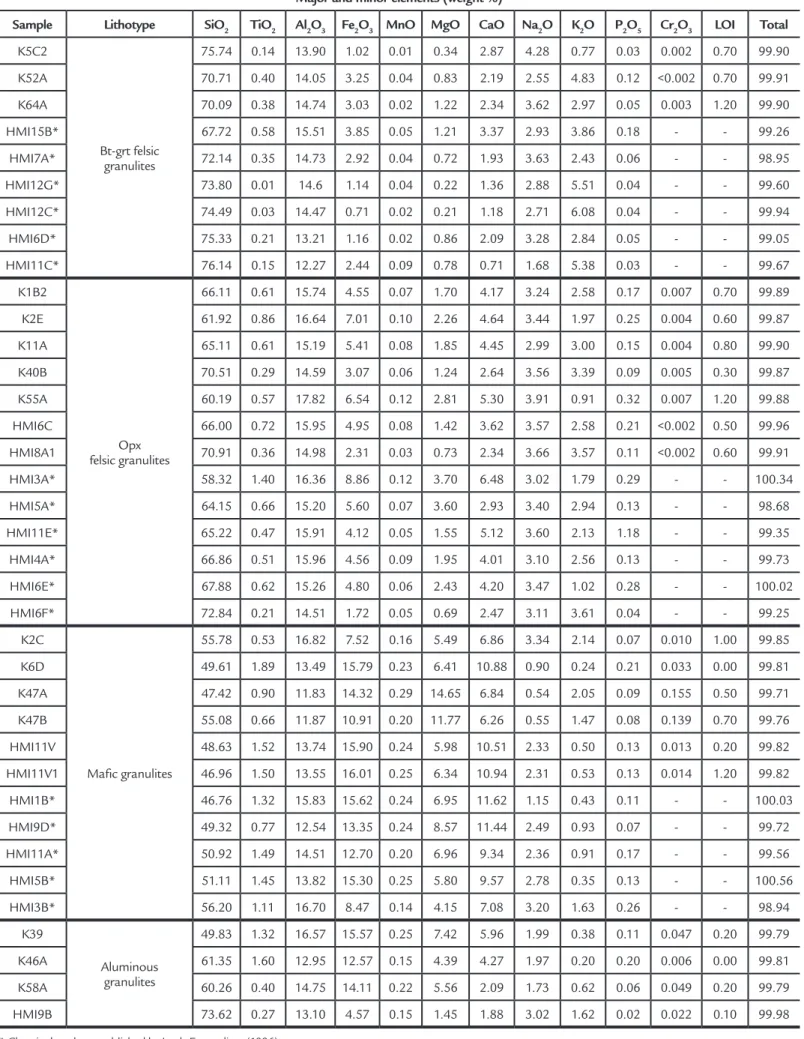
Felsic granulites are comprised of in-termediate to acid rocks (58.32 – 76.14% SiO2) (Table 1). In the TAS diagram (Cox
et al., 1979 modiied by Wilson, 1989),
most of the biotite ± garnet-bearing felsic granulites plot within the granite ield, with a few in the granodiorite ield, while most of the orthopyroxene-bearing felsic granulites fall in the granodiorite ield, with some of them in the diorite and gran-ite ield. According the same diagram, the felsic granulites belong to the subalkaline/ tholeiitic series (Figure 5a).
In the AFM plot of Irvine & Baragar (1971), the felsic granulites scatter around a calc-alkaline trend (Figure 5b). The
most differentiated terms, i.e., those that
plot near the vertex A (Na2O + K2O), correspond to biotite ± garnet-bearing felsic granulites. Regarding the aluminum saturation, the biotite ± garnet-bearing felsic granulites are peraluminous rocks, with Shand's index between 1.02 and 1.24. The orthopyroxene-bearing felsic granulites, in turn, plot between the ields of metaluminous and peraluminous rocks, with Shand's index range from 0.87 to 1.08 (Figure 5c).
According to the geochemical clas-siication of Frost et al. (2001) for granitic
rocks (not shown in this paper) the felsic granulites are magnesian granitoids and
belong to the calcic and calc-alkaline series. The same authors have associated these chemical signatures with Cordil-heran-type batholiths, island arcs plutons and plagiogranites.
The tectonic setting of the felsic granulites was characterized based on tectonic discrimination diagrams for granitoids. In the Nb vs. Y diagram of
Pearce et al. (1984), most of the felsic
granulites plot within the Volcanic arc + Syn-collisional granitoids ield (Figure 5e). The R1–R2 diagram of De La Roche et al. (1980) with
geo-tectonic implications after Batchelor & Bowden (1985) suggests that a
Figure 4 Photomicrographs of the granulite-facies rocks. A-C – Felsic granultes. a) Antiperthitic porphyroclastic
plagiocla-se with garnet inclusion, besides perthitic orthoclase of biotite ± garnet-bearing felsic granulite; b) Mineral assemblage of the orthopyroxene-bearing felsic granulite; c) Coronitic texture defined by symplectitic garnet around plagioclase in
orthopyroxene--bearing felsic granulite; D-F – Mafic granu-lites. d) Granoblastic fabric. e) Cumming-tonite pseudomorph after orthopyroxene.
Mafic granulites
Maic granulites comprise basic to intermediate rocks (46.76 – 56.20% SiO2) (Table 1). In the TAS diagram, most of these granulites plot within the gabbro ield and few of them in the diorite ield. According the same diagram, they belong to the subalka-line/tholeiitic series (Figure 5a).
The AFM diagram shows a tho-leiitic signature for most maic granu-lites, except for two samples that fall within the calc-alkaline ield (Figure
5b). According the Shand's diagram, all these granulites are metaluminous rocks, with ACNK values between 0.48 and 0.85 (Figure 5c).
The tectonic environment of the maic granulites was characterized based on tectonic discrimination dia-grams for basaltic rocks. According the Ti/Y vs. Zr/Y diagram of Pearce
& Gale (1977), which separates Within-plate basalts and Plate margin basalts, all the maic granulites show
a geochemical signature consistent with Plate margin basalts (Figure 5g). In the ternary diagram of Meschede (1986), the maic samples disperse in the ields of the E-type MORB – en-riched in incompatible trace elements, Within-plate tholeiites + Island arc basalts, and N-type MORB – deplet-ed in incompatible trace elements + Island arc basalts (Figure 5h). Again, no sample presents an exclusive intra-plate basalt signature.
Aluminous granulites
Aluminous granulites comprise basic, intermediate and acid rocks (49.83 – 73.62% SiO2) (Table 1). The Al content ranges from 12.95 to 16.57% and the Shand's diagram shows that all the samples are peraluminous rocks, with ACNK between 1.14 and 2.02 (Figure 5c).
The protoliths were
character-ized based on the discriminant dia-gram of Herron (1988), which relates log(Fe2O3(t)/K
2O) vs. log(SiO2/Al2O3)
(Figure 5d). According to this diagram, three samples have geochemical char-acteristics of Fe-shale and one of them has characteristics of wacke.
The tectonic environment of the aluminous granulites was characterized
according to the tectonic discrimina-tion diagram for sandstones and argil-lites of Roser & Korsch (1986), which is based on the K2O, Na2O and SiO2 content. This scheme suggests an oce-anic island arc margin setting for three pelitic rocks and an active continental margin setting for the wacke sample (Figure 5i).
6. Discussion
The field work showed that the granulite-facies rocks exhibit evidence for medium- to high-grade deformation, as manifested by folded banding and mylonitic fabric. At the microscope scale, high-grade defor-mation is characterized by lobates and amoeboid boundaries in quartz-feldspar grains and also chessboard subgrains in quartz. Medium-grade evidence is represented by core-and-mantle structures in feldspars wrapped by quartz ribbons.
The biotite ± garnet-bearing felsic granulites, despite the absence of orthopyroxene, were interpreted as belonging to the granulite-facies due the predominance of orthoclase instead microcline, the antiperthitic plagioclase, the Ti-rich biotite, the absolute absence of primary mosco-vite and, inally, the associated occur-rence in some outcrops with typical maic granulites. The orthopyroxene-bearing felsic granulites show the
same features as the former, besides the orthopyroxene content. The main reaction texture observed in this rock is the symplectitic coronas of garnet and ilmenite around plagio-clase. The origin of coronal garnet has been a subject of debate. Sen & Battacharya (1993) opine that a garnet-forming reaction is triggered during retrograde metamorphism as a consequence of near-isobaric cooling (IBC-path). On the other hand, Maji et al. (2008) advocate
a prograde growth of garnet at the expense of plagioclase + ilmenite ± biotite ± hornblende ± quartz.
On the maic rocks, the granu-lite-facies metamorphism is charac-terized by the paragenesis plagioclase + orthopyroxene + clinopyroxene, which is typical of medium-P
gran-ulite-facies metabasites (Green & Ringwood, 1967 in Yardley, 2004).
However, in some maic granulites only orthopyroxene occurs, while
in others only clinopyroxene is found. According to Best (2003), at higher P, orthopyroxene is con-sumed in garnet-forming reactions as orthopyroxene + plagioclase →
garnet + quartz and orthopyroxene + plagioclase → garnet + clinopy-roxene + quartz. The former reaction may have generated the coronitic garnet on orthopyroxene-plagioclase contacts, while the latter may have originated the clinopyroxene coronas on orthopyroxene. Harley (1989) associates both reaction textures to retrograde IBC-paths.
On the aluminous granulites, in turn, the high-grade metamorphic event is registered by mineral assem-blages with orthoclase, garnet, or-thopyroxene, spinel and sillimanite, which characterize moderate-P
con-ditions. According to Harley (1989), the symplectitic garnet coronas found around earlier garnet is indicative of an IBC-path in pelitic granulites. majority of the felsic granulites have
been derived from Pre-collision gran-itoids, although some samples plot in the Syn-collision and Mantle
fraction-ates ields (Figure 5f). According to the tectonic discrimination scheme of Maniar & Piccoli (1989) (not shown in this paper), the felsic granulites could
403
Major and minor elements (weight %)
Sample Lithotype SiO2 TiO2 Al2O3 Fe2O3 MnO MgO CaO Na2O K2O P2O5 Cr2O3 LOI Total
K5C2
Bt-grt felsic granulites
75.74 0.14 13.90 1.02 0.01 0.34 2.87 4.28 0.77 0.03 0.002 0.70 99.90 K52A 70.71 0.40 14.05 3.25 0.04 0.83 2.19 2.55 4.83 0.12 <0.002 0.70 99.91 K64A 70.09 0.38 14.74 3.03 0.02 1.22 2.34 3.62 2.97 0.05 0.003 1.20 99.90 HMI15B* 67.72 0.58 15.51 3.85 0.05 1.21 3.37 2.93 3.86 0.18 - - 99.26 HMI7A* 72.14 0.35 14.73 2.92 0.04 0.72 1.93 3.63 2.43 0.06 - - 98.95 HMI12G* 73.80 0.01 14.6 1.14 0.04 0.22 1.36 2.88 5.51 0.04 - - 99.60 HMI12C* 74.49 0.03 14.47 0.71 0.02 0.21 1.18 2.71 6.08 0.04 - - 99.94 HMI6D* 75.33 0.21 13.21 1.16 0.02 0.86 2.09 3.28 2.84 0.05 - - 99.05 HMI11C* 76.14 0.15 12.27 2.44 0.09 0.78 0.71 1.68 5.38 0.03 - - 99.67
K1B2
Opx felsic granulites
66.11 0.61 15.74 4.55 0.07 1.70 4.17 3.24 2.58 0.17 0.007 0.70 99.89 K2E 61.92 0.86 16.64 7.01 0.10 2.26 4.64 3.44 1.97 0.25 0.004 0.60 99.87 K11A 65.11 0.61 15.19 5.41 0.08 1.85 4.45 2.99 3.00 0.15 0.004 0.80 99.90 K40B 70.51 0.29 14.59 3.07 0.06 1.24 2.64 3.56 3.39 0.09 0.005 0.30 99.87 K55A 60.19 0.57 17.82 6.54 0.12 2.81 5.30 3.91 0.91 0.32 0.007 1.20 99.88 HMI6C 66.00 0.72 15.95 4.95 0.08 1.42 3.62 3.57 2.58 0.21 <0.002 0.50 99.96 HMI8A1 70.91 0.36 14.98 2.31 0.03 0.73 2.34 3.66 3.57 0.11 <0.002 0.60 99.91 HMI3A* 58.32 1.40 16.36 8.86 0.12 3.70 6.48 3.02 1.79 0.29 - - 100.34 HMI5A* 64.15 0.66 15.20 5.60 0.07 3.60 2.93 3.40 2.94 0.13 - - 98.68 HMI11E* 65.22 0.47 15.91 4.12 0.05 1.55 5.12 3.60 2.13 1.18 - - 99.35 HMI4A* 66.86 0.51 15.96 4.56 0.09 1.95 4.01 3.10 2.56 0.13 - - 99.73 HMI6E* 67.88 0.62 15.26 4.80 0.06 2.43 4.20 3.47 1.02 0.28 - - 100.02 HMI6F* 72.84 0.21 14.51 1.72 0.05 0.69 2.47 3.11 3.61 0.04 - - 99.25
K2C
Mafic granulites
55.78 0.53 16.82 7.52 0.16 5.49 6.86 3.34 2.14 0.07 0.010 1.00 99.85 K6D 49.61 1.89 13.49 15.79 0.23 6.41 10.88 0.90 0.24 0.21 0.033 0.00 99.81 K47A 47.42 0.90 11.83 14.32 0.29 14.65 6.84 0.54 2.05 0.09 0.155 0.50 99.71 K47B 55.08 0.66 11.87 10.91 0.20 11.77 6.26 0.55 1.47 0.08 0.139 0.70 99.76 HMI11V 48.63 1.52 13.74 15.90 0.24 5.98 10.51 2.33 0.50 0.13 0.013 0.20 99.82 HMI11V1 46.96 1.50 13.55 16.01 0.25 6.34 10.94 2.31 0.53 0.13 0.014 1.20 99.82 HMI1B* 46.76 1.32 15.83 15.62 0.24 6.95 11.62 1.15 0.43 0.11 - - 100.03 HMI9D* 49.32 0.77 12.54 13.35 0.24 8.57 11.44 2.49 0.93 0.07 - - 99.72 HMI11A* 50.92 1.49 14.51 12.70 0.20 6.96 9.34 2.36 0.91 0.17 - - 99.56 HMI5B* 51.11 1.45 13.82 15.30 0.25 5.80 9.57 2.78 0.35 0.13 - - 100.56 HMI3B* 56.20 1.11 16.70 8.47 0.14 4.15 7.08 3.20 1.63 0.26 - - 98.94
K39
Aluminous granulites
49.83 1.32 16.57 15.57 0.25 7.42 5.96 1.99 0.38 0.11 0.047 0.20 99.79 K46A 61.35 1.60 12.95 12.57 0.15 4.39 4.27 1.97 0.20 0.20 0.006 0.00 99.81 K58A 60.26 0.40 14.75 14.11 0.22 5.56 2.09 1.73 0.62 0.06 0.049 0.20 99.79 HMI9B 73.62 0.27 13.10 4.57 0.15 1.45 1.88 3.02 1.62 0.02 0.022 0.10 99.98
Table 1- Part I - Chemical analyses of selected samples of the Pedra Dourada Granulite.
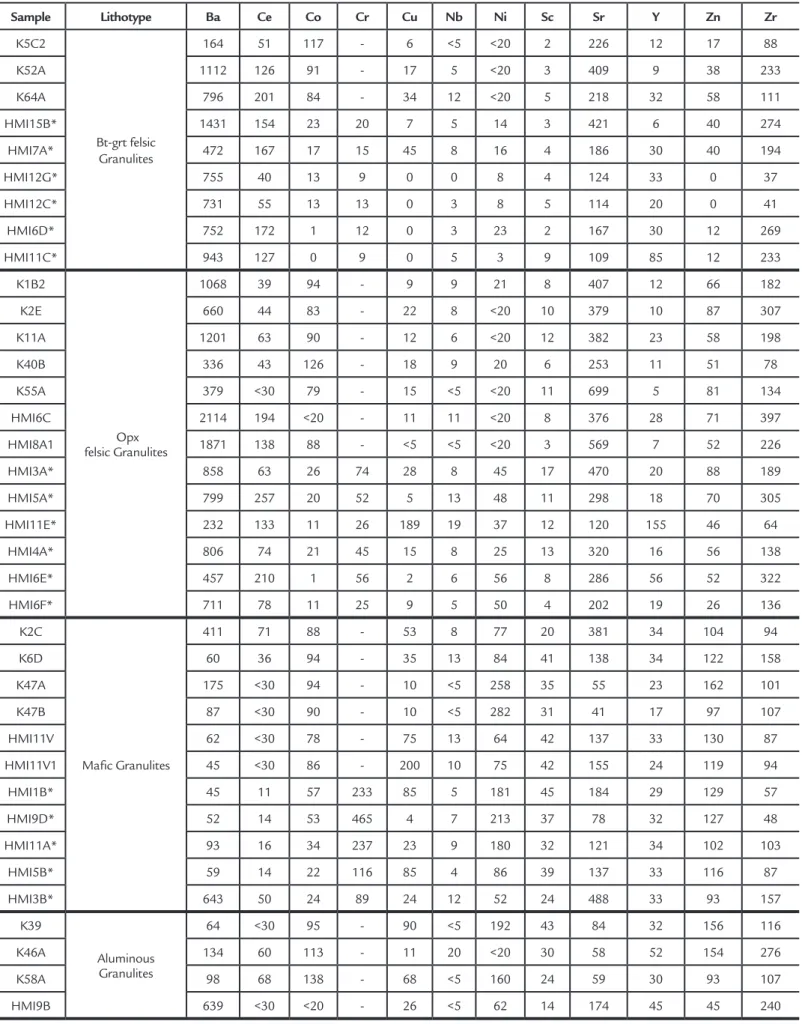
Trace elements (ppm)
Sample Lithotype Ba Ce Co Cr Cu Nb Ni Sc Sr Y Zn Zr
K5C2
Bt-grt felsic Granulites
164 51 117 - 6 <5 <20 2 226 12 17 88 K52A 1112 126 91 - 17 5 <20 3 409 9 38 233 K64A 796 201 84 - 34 12 <20 5 218 32 58 111 HMI15B* 1431 154 23 20 7 5 14 3 421 6 40 274 HMI7A* 472 167 17 15 45 8 16 4 186 30 40 194 HMI12G* 755 40 13 9 0 0 8 4 124 33 0 37 HMI12C* 731 55 13 13 0 3 8 5 114 20 0 41 HMI6D* 752 172 1 12 0 3 23 2 167 30 12 269 HMI11C* 943 127 0 9 0 5 3 9 109 85 12 233
K1B2
Opx felsic Granulites
1068 39 94 - 9 9 21 8 407 12 66 182 K2E 660 44 83 - 22 8 <20 10 379 10 87 307 K11A 1201 63 90 - 12 6 <20 12 382 23 58 198 K40B 336 43 126 - 18 9 20 6 253 11 51 78 K55A 379 <30 79 - 15 <5 <20 11 699 5 81 134 HMI6C 2114 194 <20 - 11 11 <20 8 376 28 71 397 HMI8A1 1871 138 88 - <5 <5 <20 3 569 7 52 226 HMI3A* 858 63 26 74 28 8 45 17 470 20 88 189 HMI5A* 799 257 20 52 5 13 48 11 298 18 70 305 HMI11E* 232 133 11 26 189 19 37 12 120 155 46 64
HMI4A* 806 74 21 45 15 8 25 13 320 16 56 138 HMI6E* 457 210 1 56 2 6 56 8 286 56 52 322 HMI6F* 711 78 11 25 9 5 50 4 202 19 26 136
K2C
Mafic Granulites
411 71 88 - 53 8 77 20 381 34 104 94 K6D 60 36 94 - 35 13 84 41 138 34 122 158 K47A 175 <30 94 - 10 <5 258 35 55 23 162 101 K47B 87 <30 90 - 10 <5 282 31 41 17 97 107 HMI11V 62 <30 78 - 75 13 64 42 137 33 130 87 HMI11V1 45 <30 86 - 200 10 75 42 155 24 119 94 HMI1B* 45 11 57 233 85 5 181 45 184 29 129 57 HMI9D* 52 14 53 465 4 7 213 37 78 32 127 48 HMI11A* 93 16 34 237 23 9 180 32 121 34 102 103
HMI5B* 59 14 22 116 85 4 86 39 137 33 116 87 HMI3B* 643 50 24 89 24 12 52 24 488 33 93 157
K39
Aluminous Granulites
64 <30 95 - 90 <5 192 43 84 32 156 116 K46A 134 60 113 - 11 20 <20 30 58 52 154 276 K58A 98 68 138 - 68 <5 160 24 59 30 93 107 HMI9B 639 <30 <20 - 26 <5 62 14 174 45 45 240
Table 1- Part I I - Chemical analyses of selected samples of the Pedra Dourada Granulite.
405
Figure 5 Chemical classification diagrams: a) TAS (Cox et al., 1979); b) AFM [(Na2O+K2O) – FeOt – MgO] (Irvine & Baragar, 1971); c) Aluminium sa-turation index (Shand, 1943); d) log(SiO2/ Al2O3) versus log(Fe2O3/K2O) (Herron, 1988); Tectonic discrination diagrams: e) Y x Nb (Pearce et al., 1984); f) R1-R2
(Batche-lor & Bowden, 1985); g) Ti/Y x Zr/Y (Pearce & Gale 1977); h) Zr-Nb-Y(Meschede, 1986). i) SiO2 x log(K2O/Na2O) diagram for
sands-tones and argilites (Roser & Korsch, 1986).
(a)
(f) (b)
(g)
(c)
(h) (e) (d)
(i)
IBC-paths are the retrograde segments of clockwise or counter-clockwise P-T paths (Best, 2003). The
clockwise type is associated to granulite terrains generated at the base of thick-ened crust (doubled-crust) and require a second orogeny to uplift and expose them. The counter-clockwise P-T path
is interpreted as a result of magmatic underplating or extension of a normal-thickness crust (single crust) (Ellis, 1987; Harley, 1989; Spear, 1992).
The chemical classification
dia-grams suggest that the felsic granulites protoliths are granodiorites, gran-ites and diorgran-ites. They are predomi-nantly peraluminous rocks belonging to calc-alkaline series. The tectonic discrimination diagrams point to con-vergent margin tectonic settings to the felsic granulites.
The mafic granulites protholits are gabbros and subordinate diorites. They are metaluminous rocks and have a tholeiitic character. The discriminant diagrams suggest that the maic
pro-tholits were associated to plate bound-ary environments. However, these plots could not deined if they were conver-gent or diverconver-gent tectonic settings, as the samples show both island arcs and MORB signatures.
The aluminous granulites are per-aluminous rocks with protholits that show compositional similarities with modern shales and wackes. According to the tectonic discrimination diagram, they have signatures analogous to con-vergent setting sediments.
7. Conclusions
The mineral assemblages indicate that the Pedra Dourada Granulite was meta-morphosed under medium-P
granulite-facies conditions and retrometamorphosed under greenschist- to amphibolite-facies conditions, as indicated by the second-ary mineral assemblages. The chemical composition of the studied samples shows that the protoliths are acid, intermediary, and basic igneous rocks of calcalkaline
or tholeiitic signature, besides the peralu-minous sedimentary rocks. The tectonic discrimination diagrams suggest that these lithologies could be associated with conver-gent tectonic settings, wherein the maic granulites may also be linked to extensional environments. The coronitic garnet textures present in the granulite-facies rocks suggest a near-isobaric cooling (IBC-path) after the metamorphic peak (Ellis, 1987; Harley,
1989). Based on the tectonic setting of the Pedra Dourada Granulite, this P-T path could be related to crustal thickening dur-ing the Transamazonian tectonothermal events (2,1-2,0 Ga) or the Brasiliano tec-tonothermal events (590-574 Ma) (Noce et al., 2007). Further petrological studies and
8. Acknowledgments
The authors are grateful to the Fundação de Desenvolvimento da Pesquisa de Minas Gerais
(FAPE-MIG) for inancial support (research project CRA-APQ-02206-11) and to the Departamento de Geologia of the
Universidade Federal de Ouro Preto for laboratory support. The irst author ac-knowledges CAPES for the scholarship.
9. References
ALCÂNTARA, A.M., MACHADO, R.A. Cartograia geológica da quadrícula 43-03-11, escala 1:25.000 da folha Dom Silvério, MG - Subprojeto Dom Silvério. Ouro Preto: Universidade Federal de Ouro Preto, 2010. 58p.
(Mo-nograia).
ALKMIM, F.F., PEDROSA-SOARES, A.C., NOCE, C.M., CRUZ, S.C.P. Sobre a evolução tectônica do Orógeno Araçuaí - Congo ocidental. Geonomos, v. 15,
n. 1, p. 25-43, 2007.
ALMEIDA, F.F.M. O Cráton do São Francisco. Revista Brasileira de Geociên-cias, v. 7, p. 349-364, 1977.
BATCHELOR, R.A., BOWDEN, P. Petrogenetic interpretation of granitoid rock series using multicationic parameters. Chemical Geology, v. 48, p. 43-55,
1985.
BEST, M.G. Igneous and metamorphic petrology. (2 ed.). Massachusetts:
Bla-ckwell Science Ltd., 2003. 729p.
BRANDALISE, L. A. Programa Levantamentos Geológicos Básicos do Brasil. Folha Ponte Nova, SF.23-X-B-II. Escala 1:100.000. Brasília: DNPM/CPRM,
1991. 194 p.
COX, K.G., BELL, J.D., PANKHURST, R.J. The interpretation of igneous ro-cks. London: George Allen & Unwin, 1979. 450p.
DE LA ROCHE, H., LETERRIER, J., GRANDCLAUDE, P., MARCHAL, M. A classiication of volcanic and plutonic rocks using R1R2 diagram and major--element analyses - Its relationships with current nomenclature. Chemical Ge-ology, v. 29, p. 183-210, 1980.
ELLIS, D.J. Origin and evolution of granulites in normal and thickened crusts.
Geology, v. 15, p. 167-170, 1987.
FROST, B.R., BARNES, C.G., COLLINS, W.J., ARCULUS, R.J., ELLIS, D.J., FROST, C.D. A geochemical classiication for granitic rocks. Journal of Petro-logy, v. 42, n. 11, p. 2033-2048, 2001.
HARLEY, S.L. The origins of granulites: a metamorphic perspective. Geological Magazine, v. 126, n. 3, p. 215-247, 1989.
HERRON, M.M. Geochemical classiication of terrigenous sands and shales from core of log data. Journal of Sedimentary Petrology, v. 58, n. 5, p. 820-
829, 1988.
IRVINE, T. N., BARAGAR, W.R.A. A guide to the chemical classiication of the common volcanic rocks. Canadian Journal of Earth Sciences, v. 8, p.
523-548, 1971.
JORDT-EVANGELISTA, H. Petrologische untersuchungen im Gebiete zwischen Mariana und Ponte Nova, Minas Gerais, Brasilien. Alemanha: Universidade
Técnica de Clausthal, 1984. 183p. (Ph.D. thesis).
JORDT-EVANGELISTA, H. Petrologia de fases, geotermometria e geobarome-tria do Complexo Granulítico de Acaiaca, Sudeste do Quadrilátero Ferrífero, MG. In: SIMPÓSIO DE GEOLOGIA DE MINAS GERAIS, 3. Anais... Belo
Horizonte: SBG/Núcleo MG, 1985. p. 165-178.
JORDT-EVANGELISTA, H. O Grupo Dom Silvério, SE de Minas Gerais: pe-trograia, metamorismo, geoquímica e geologia econômica. REM – Revista Escola de Minas, v. 45, n. 1-2, p.140-142, 1992.
JORDT-EVANGELISTA, H. Igneous charnockites in the southeastern transition zone between the São Francisco Craton and the Costeiro Mobile Belt, Brazil.
Revista Brasileira de Geociências, v. 26, n. 2, p. 93-102, 1996.
JORDT-EVANGELISTA, H., MULLER, G. Petrology of a transition zone betwe-en the Archean Craton and the Coast Belt, SE of the Iron Quadrangle, Brazil.
407
JORDT-EVANGELISTA, H., MULLER, G. Petrologia da Zona de Transição en-tre o Cráton do São Francisco e o Cinturão Móvel Costeiro na Região Sudeste do Quadrilátero Ferrífero, MG. In: CONGRESSO BRASILEIRO DE GEO-LOGIA, 34. Anais... Goiânia: SBG, 1986b. p. 1471-1479.
LEAKE, B.E., WOOLEY, A.R., ARPS, C.E.S., BIRCH, W.D., GILBERT, M.C., GRICE, J.D., HAWTHORNE, F.C., KATO, A., KISCH, H.J., KRIVOVI-CHEV, V.G., LINTHOUT, K., LAIRD, J., MANDARINO, J.A., MARES-CH, W.V., NICKEL, E.H., SCHUMACHER, J., SMITH, J.C., STEPHEN-SON, N.C. N., UNGARETTI, L., WHITTAKER, E.J.W., YOUZHI, G. Nomenclature of Amphiboles: Report of the Subcommittee on Amphiboles of the International Mineralogical Association Commission on New Minerals and Mineral Names. Mineralogical Magazine, v. 61, p. 295-321, 1997.
MAJI, A.K., GOONA, S., BHATTACHARYA, A., MISHRA, B., MAHATO, S., HEINZ-J., BERNHARDT. Proterozoic polyphase metamorphism in the Ch-hotanagpur Gneissic Complex (India), and implication for trans-continental Gondwanaland correlation. Precambrian Research, v. 162, p. 385-402, 2008.
MANIAR, P. D., PICCOLI, P. M. Tectonic discrimination of granitoids. Geolo-gical Society of America Bulletin, v. 101, p. 635-643, 1989.
MESCHEDE, M. A method of discriminating between different types of mid--ocean ridge basalts and continental tholeiites with the Nb–Zr–Y diagram.
Chemical Geology, v. 56, p. 207-218, 1986.
MEDEIROS JÚNIOR, E. B. Petrogênese do Complexo Acaiaca, MG. Ouro
Pre-to: Universidade Federal de Ouro Preto, 2009. 101p. (M.Sc. thesis).
MEDEIROS JÚNIOR, E.B., JORDT EVANGELISTA, H. Petrologia e geoquí-mica dos granulitos do Complexo Acaiaca, região centro-sudeste de Minas Gerais. REM – Revista Escola de Minas, v. 63, n. 2, p. 219-228, 2010.
MELO, M.G., MAIA, T.T. Cartograia geológica da quadrícula 43-03-14, es-cala 1:25.000 da folha Dom Silvério, MG - Subprojeto Dom Silvério. Ouro
Preto: Universidade Federal de Ouro Preto, 2010. 58p. (Monograia).
NOCE, C.M., PEDROSA-SOARES, A.C., SILVA, L.C., ALKMIM, F.F. O em-basamento arqueano e paleoproterozóico do Orógeno Araçuaí. Geonomos, v.
15, n. 1, p. 17-23, 2007.
PASSCHIER, C.W., TROUW, R.A.J. Microtectonics. Berlim: Springer-Verlag,
2005. 366p.
PEARCE, J. A., GALE, G.H. Identiication of ore-deposition environment from trace-element geochemistry of associated igneous host rocks. Geological So-ciety Special Publication, v. 7, p. 14-24, 1977.
PEARCE, J.A., HARRIS, N.B.W., TINDLE, A.G. Trace element discrimination diagrams for the tectonic interpretation of granitic rocks. Journal of Petrolo-gy, v. 25, p. 956-983, 1984.
PEDROSA-SOARES, A.C., WIEDEMANN-LEONARDOS, C.M. Evolution of the Araçuaí Belt and its connections to the Ribeira Belt. In: CORDANI, U.G., THOMAZ FILHO, A., CAMPOS NETO, D.A. (eds.) Tectonic Evolution of South America. Rio de Janeiro: International Geological Congress, 31, 2000. p. 265-268.
PEDROSA-SOARES, A.C., NOCE, C.M., ALKMIM, F.F., SILVA, L.C., BA-BINSKI, M., CORDANI, U., CASTAÑEDA, C. Orógeno Araçuaí: síntese do conhecimento 30 anos após Almeida 1977. Geonomos, v. 15, n. 1, p. 1-16,
2007.
PERES, G.G. O Grupo Dom Silvério na região leste de Minas Gerais: arcabou-ço estrutural e evolução tectônica. Ouro Preto: Universidade Federal de Ouro
Preto, 2000. 125p. (M.Sc. thesis).
PERES, G.G., ALKMIM, F.F., JORDT-EVANGELISTA, H. The southern Ara-çuaí belt and the Dom Silvério Group: geologic architecture and tectonic sig-niicance. Anais da Academia Brasileira de Ciências, v. 76, n. 4, p. 771-790,
2004.
ROSER, B. P., KORSCH, R. J. Determination of tectonic setting of sandstone--mudstone suites using SiO2 content and K2O/Na2O ratio. Journal of Geolo-gy, v. 94, p. 635-650, 1986.
Received: 26 September 2014 - Accepted: 26 May 2016.
Sciences India, v. 63, p. 282–306, 1993.
SHAND, S.J. Eruptive rocks. Their genesis, composition, classiication and their relation to ore-deposits with a chapter on meteorite. New York: John
Wiley & Sons, 1943. 444p.
SPEAR, F.S. Thermobarometry and P-T paths from granulite facies rocks: an introduction. Precambrian Research, v. 55, p. 201-207, 1992.
TEIXEIRA, W., JORDT EVANGELISTA, H., KAWASHITA, K., TAYLOR, P.N. 1987. Complexo granulítico de Acaiaca, MG: idade, petrogênese e implicações tectônicas. In: SIMPOSIO DE GEOLOGIA DE MINAS GERAIS, 4, Anais...
Belo Horizonte, SBG/Núcleo MG, 1987. v. 7, p. 58-71.
WILSON, M. Igneous Petrogenesis. A global tectonic aproach. London: Unwin
Hyman, 1989. 466p.
YARDLEY, B.W.D. Introdução à petrologia metamórica. (2ed.). Brasília: