Nondestructive Testing (NDT) techniques are useful tools for analyzing reinforced concrete (RC) structures. The use of Ultrasonic Pulse Velocity (UPV) measurements enables monitoring changes in some critical characteristics of concrete over the service life of a structure. Nonetheless, the current techniques for UPV data analysis are largely based on the sensitivity of the professionals who apply these tests. For accurate diagnosis it is necessary to consider the different factors and conditions that can affect the results. In order to properly control and inspect RC facilities it is essential to develop appropriate strategies to make the task of data interpretation easier and more accurate. This study is based on the idea that using Artiicial Neural Networks (ANNs) is a feasible way to generate workable estimation models correlating concrete characteristics, density and compressive strength. The study shows that this goal is achievable and indicates that neural models perform better than traditional statistical models.
Keywords: artiicial neural networks, nondestructive testing, concrete compressive strength estimate.
Os ensaios não destrutivos servem como uma importante ferramenta para a análise de estruturas de concreto armado. A utilização de ensaios de velocidade de propagação do pulso ultra-sônico (VPU) permite realizar um acompanhamento das características do material ao longo de sua vida útil. No entanto, as técnicas atuais para análise dos resultados coletados são, em grande parte, baseadas na sensibilidade dos proissionais que as aplicam. Para facilitar o controle e inspeção de estruturas de concreto armado é fundamental desenvolver estratégias para tornar esta análise mais simples e precisa. Este trabalho se baseou na hipótese de que a aplicação de Redes Neurais Artiiciais (RNAs) pode gerar modelos de relac-ionamento úteis e acurados entre as características do concreto, sua compacidade e sua resistência à compressão. Os resultados indicam que as RNAs podem ser usadas para gerar métodos numéricos robustos e lexíveis para estimativa da resistência à compressão a partir de dados de VPU.
Palavras-chave: redes neurais artiiciais, ensaios não destrutivos, estimativa da resistência do concreto.
Development of artiicial neural networks for interpreting
ultrasonic pulse velocity tests in concrete
Desenvolvimento de redes neurais artiiciais para
interpretação de ensaios de velocidade de propagação de
pulso ultrassônico no concreto
A. LORENZI a
L. C. P. SILVA FILHO b
J. L. CAMPAGNOLO c [email protected]
a Laboratório de Modelos e Ensaios Estruturais (LEME), Programa de Pós-graduação em Engenharia Civil (PPGEC), Universidade Federal
do Rio Grande do Sul (UFRGS), [email protected], Av. Osvaldo Aranha, 99 - Térreo, Porto Alegre/RS, Brazil
b Laboratório de Modelos e Ensaios Estruturais (LEME), Programa de Pós-graduação em Engenharia Civil (PPGEC), Universidade Federal
do Rio Grande do Sul (UFRGS), [email protected], Av. Osvaldo Aranha, 99 - Térreo, Porto Alegre/RS, Brazil
c Laboratório de Modelos e Ensaios Estruturais (LEME), Programa de Pós-graduação em Engenharia Civil (PPGEC), Universidade Federal
do Rio Grande do Sul (UFRGS), [email protected], Av. Osvaldo Aranha, 99 - Térreo, Porto Alegre/RS, Brazil
Received: 13 Jun 2011 • Accepted: 06 Sep 2011 • Available Online: 28 Nov 2011
Abstract
Resumo
1. Introduction
Concrete is an essential material in civil construction due to its molding and strength characteristics. It is widely used in developed countries and in most developing countries, including Brazil. The main current issue in concrete application is adapting design and its execution in order to comply with the increasing performance requirements and to ensure reasonable longevity. The design and building of concrete structures must ensure their safety, stability, and use capability during service time [1].
According to CEB-FIP Model Code 1990 [2], concrete structures should be designed, constructed and operated in such way that, under the expected environmental inluence, they maintain their safety, serviceability and acceptable appearance during an explicit or implicit time without requiring unforeseen high costs for mainte-nance and repair. The follow up of the evolution of strength in time, determining reliable estimates of the values effectively presented in the actual structure is, therefore, an essential requirement to as-sess the adequacy of a work.
It is important to determine the best way to estimate the strength of an existing concrete structure. As mentioned by Isaia [3]: “Ev-ery prediction aiming at estimating the service life of a concrete structure should be based on the mathematical modeling of the involved phenomena and properties as precisely as possible to produce a reliable result.” This requires relection on which is the best way to effectively control the strength of concrete structures. Test samples modeled during the process of concrete casting of structures are commonly used for this purpose.
However, the exposure and cure of test samples are usually very different from those to which actual structures are submitted, with di-rect effects on their strength. An interesting possibility to circumvent this problem is to estimate concrete strength using nondestructive testing methods (NDT) applied on the actual structure. Among the available nondestructive test, ultrasonic pulse velocity test (UPV) presents several advantages, as it is not expensive, easy, and fast. The challenge consists in establishing reliable relationships be-tween strength to compressive stresses and UPV test results. The statistical methods used in traditional modeling are not capable encompass the entire complexity of those relationships, which are inluenced by many factors. The use of artiicial intelligence tools, such as Artiicial Neural Networks (ANNs) allows handling poorly structured problems, allowing more consistent modeling. This con-sisted of the starting point of the conception of the present study. NDT tests were developed to aid obtaining information on the ef-fective properties of material used in actual structures. Strength estimated obtained by the use of NDT techniques may be an inter-esting control possibility. One of the essential features of NDT is that they allow performing repeated tests at the same or very close sites that enable following up variations in time [4].It is possible to monitor concrete status with the systematic use of these tests, generating a much richer body of information as compared to tests performed only when concrete is cast.
Among the NDT tests applied to concrete, UPV seems to have an excellent potential, as it allows characterizing the materials, evaluating their characteristics, and measuring important physical properties. Several studies have shown that UPV can signiicantly aid in the detection of concrete micro-cracks and changes before visible signs appear [5], [6]. However, in order obtain useful and
re-liable results, the technical parameter affecting this technique and proper strategies for its performance must be understood. In addi-tion, the proper interpretation of the results of NDT tests carried out in concrete structures is a complex and specialized activity due to the large amount of produced data and the variability of the factors that inluence the test.
Artiicial Intelligence (AI) tools may be used to standardize and an -alyze UPV data. There are two main research approaches to build artiicial intelligence systems: the connectionist approach and the symbolic approach. The connectionist approach proposes model-ing human intelligence by simulation brain components, i.e., neu-rons and their connections by using ANNs, whereas the symbolic approach follows the tradition of logics [7].
The connectionist approach is based on the idea that intelligent be-havior can only be achieved by a massive parallel system, similar to the neural connections of the Central Nervous System in human beings. This approach believes it is possible to model brain func-tion. Connectionist systems have been increasingly used in tasks that include, for instance, pattern classiication, intelligent controls, and image and signal processing. ANNs may be extremely useful to create complex non-linear systems with high degrees of uncer -tainty. As a function of their function characteristics, ANNs are not dependent of a mathematical model that relates input with output data; they are applied when there is signiicant non-linearity, which makes modeling very dificult. In addition, ANNs are capable of making the acquired knowledge available for further analyses, allowing their data sets to be continuously updated, and thereby generating new models.
This study explores the hypothesis that, with the use of ANN tools, it is possible to perform a non-linear analysis of the relationship between concrete strength and UPV, taking into consideration the parameters cement type, cure temperature, water to cement ratio, and concrete age. It is expected that the application of ANNs will generate non-linear relationship models that will allow estimating concrete compressive strength based on the knowledge of those basic parameters and on UPV test results [8].
According to Boukerche and Notare [9], ANNs are justiied as an option to build complex phenomenon analysis methods, such as estimating concrete compressive strength based on UPV read-ings, because they have an intrinsic learning capacity based on a set of input data, allowing generalization in further analyses; are non-parametric, making decisions more accurate; and are capable of creating highly non-linear decision limits within the scope of the evaluated characteristics.
2. The use of ultrasonic pulse
propagation in concrete
The UPV is based on the longitudinal determination of the propa-gation characteristics of an ultrasonic pulse through materials. It is widely use for the evaluation of concrete because it is eficient, simple to apply, and not expensive [10].
816 IBRACON Structures and Materials Journal • 2011 • vol. 4 • nº 5 cylindrical concrete test samples. Sound velocity depends, among other factors, of the propagation material. As velocity rapidly de-creases when propagating through liquids, and even faster in gas materials, mean propagation velocity can be used as an estimate of the amount of voids, and therefore, of material density. This characteristic is extremely important to understand and analyze the results of UPV tests [16].
According to the US standard ASTM E 114-95, UPV technique can be used for the detection of laws, thickness measurements, or characterization of the materials of a body [17]. The Brazilian standard NBR 8802 established that UPV testing should be used to check concrete uniformity, to detect possible internal laws of concrete casting, to monitor concrete characteristics during its life-time, to evaluate the depth of cracks or other defects, to evaluate the deformation module, as well as to estimate concrete compres-sive strength [18].
UPV can also be used for speciic purposes, such as controlling stripping time, evaluating the presence of casting laws or detect-ing damage caused by ire. As the equipment is relatively easy to use and not expensive, several researchers have studied new purposes for UPV testing.
The result of the test consists in measuring the time (t) the impulse takes to travel distance (L) between the emitter and receiver trans-ducers. The ultrasonic wave propagation velocity in the case of direct or semi-direct transmission is obtained by Equation 1:
(1)
610
L
V
t
-= ´
Where:V = wave propagation velocity, in m/s L = distance between two points, in m t = wave propagation time, in
µ
sThe use of UPV allows verifying structure heterogeneities that are not externally visible. These heterogeneities may indicate casting laws or defects, or higher porosity degree that are fre-quently found in concrete structures and that are not necessarily visible or detectable by the usual NDT methods [19]. Moreover, the test may also be useful to identify casting failures, cracks or issures in built structures.
It must be highlighted that, because it is a nondestructive tech-nique, UPV allows the performance of several tests in the same site to follow up changes associated with time. Due to the increas-ing incidence of early deterioration of concrete structures, the continuous monitoring of building conditions is important, allow-ing anticipatallow-ing maintenance requirements, thereby increasallow-ing the lifetime of such structures.
Theoretically, a relationship between concrete density, as ex-pressed by UPV, and compressive strength can be established. However, it is dificult to analyze using traditional statistical meth-ods. It is currently considered that a reliable correlation between compressive strength and UPV readings can only be established in concrete structures with well-deined characteristics, and therefore it cannot be extrapolated to concrete structures with different characteristics, except when establishing a model that correlates this variation in the characteristics with variations in compressive strength.
In dispersive media, such as concrete, the test provides three dif-ferent parameters for analyses: ultrasonic pulse propagation ve-locity and pulse amplitude and dispersion. Complex equipment that includes oscilloscopes allows the analyses of pulse amplitude and dispersion. However, most portable equipment record only pulse transmission velocity [12].
UPV testing is a useful tool for concrete evaluation because its re-sults are strongly inluenced by material compactness, which is as-sociated to its compressive strength [13]. UPV methods are easy to apply, are reliable and safe, providing quantitative information on the initial characteristics of concrete micro-structure and allow-ing the local evaluation of concrete conditions [14].
UPV testing has been increasingly employed in structure diagno-sis, as it allows characterizing the material, evaluating its integrity, and measuring important physical properties by monitoring the propagation velocity of high-frequency sound waves through the evaluated material [15].
As it is fast and nondestructive, UPV offer the opportunity of es-tablishing total control of the elements that compose the struc-ture, including during its service life. The results of this kind of analysis can be used for quality prognosis or for correction of technological processes.
UPV equipment includes a pulse generator that excites a piezoelectric transducer (emitter), which produces ultrasonic waves that are transmitted as pulses through the material un-der analysis. This means that a series of electric impulses gen-erated by the apparatus is applied on the transducer, which converts pulses into mechanic energy in for form of waves with nominal frequency in the range of tens of kilohertz. A second piezoelectric transducer is used as receptor, where sound pulses are transformed into electric impulses [8]. The time re-quired for the propagation of UPV inside the material is calcu-lated by controlling the interval of time between emission and reception and subtracting the interval of time spent through wires and transducers.
Figure 1 illustrates an ultrasonic pulse propagation velocity test in
n Compare ANN performance with traditional statistical model in the estimation of the compressive strength of concrete struc-tures with very different characteristics.
Considering these objectives, the present study was divided in three basic steps: data collection and generation, ANN modeling and training, and validation.
4.1 Step 1 – Data Collection and Generation
Networks are considered excellent tools to aid in the interpre-tation of UPV test results, particularly to obtain compressive strength estimates. However, in order to be eficient, the data set used to create these networks should include a wide variation in the parameters considered essential for ANN learning based on the analysis of previous experiences. This irst step of the study was dedicated precisely to obtain a high number of data correlat-ing UPV readcorrelat-ings with concrete compressive strength for ANN initial feeding and validation. In addition to collecting all available data found in literature survey, additional information were gen-erated, such as changes in concrete properties that could affect UPV readings. To this end, a set of test samples with different characteristics was cast, including different w/c ratios, cure, age, aggregate and cement types, which were considered relevant to the authors. Each test samples was submitted to UPV mea-surements before being broken by compression. These data, ob-tained in a controlled manner, allowed generating models on how the variation of determined characteristics affects UPV, and were later used as additional input data to train the ANN generated to estimate concrete compressive strength, which was performed in the second step of the study.
4.2 Modeling and Training of the Neural Networks
The objective of the second step of the study was to develop and test ANNs specialized in estimating concrete compressive strength based on UPV data and other additional input data related to the characteristics of the concrete under analysis. The experiments of this step were divided in two stages. During the preliminary stage, a small data set (130 data) was used. These data were generated by the author during his study to obtain his master’s degree and presented little variation in terms of concrete characteristics. Despite the reduced number of data of this phase to ensure the good performance of the network, the preliminary tests were used as a support to determine the basic structure that allowed building the ANNs that would be employed in the main stage. Different net-work conigurations were tested, with a variable number of hidden layers and different neuron numbers in each layer.
During the main stage, a larger data set was used, with 2018 records (representing approximately 90% of the available data, characterized by a wide variability of concrete types and char-acteristics. The input data derived from several studies carried out in other institutions and places in order to determine if a ge-neric ANN is adequate to represent a wide variety of collected data, that is, if it is possible to establish representative models that are not limited to the results obtained in a single study. This wide variety of input parameters theoretically allows the gener-ated networks to have high lexibility, and therefore, to be used to estimate the compressive strength of concrete structures with many different characteristics.
3. Factors that affect UPV and the
Mechanical Properties of Concrete
In the case of concrete, there are many parameters that can affect ultrasonic pulse velocity readings. The most important are mois-ture content, aggregate and cement type, and carbonation. In ad-dition, variation in the proportion of inputs to make concrete or the mixing method applied may signiicantly affect UPV readings. It must also be mentioned that material strength and porosity change with time due to the non-uniform progression of chemical reactions inside the material during hydration.
The factors affecting UPV readings can be divided in two main categories: a) factors that affect both concrete properties and UPV readings, such as coarse aggregate type, content, size, and gradu-ation, cement type, w/c ratio, sample size, and concrete age; and b) factors that affect only UPV measurements, but do not interfere in concrete properties, such as contact conditions between trans-ducers and concrete, concrete temperature, wave length, tension levels, and the presence of rebars [20].
4. Materials and Experimental Program
UPV tests were carried out using a portable apparatus with low-frequency surface transducers (54 kHz), model V-METER Mark II, manufactured by James Instrument Inc. This equipment allows reading the transmission time of an ultrasonic pulse from the emit-ter transducer to the receiver transducer with a resolution of 0.1 micro-seconds. It does not require a calibration bar because it has a microprocessor that records the values relative to transducer and cable delays when the system is turned on.
During the preliminary phase, ANNs based on data from 130 re-sults collected by Lorenzi [21] in the LMCC (Laboratório de Ma-teriais de Construção Civil – Civil Construction Materials Labora-tory) of the Federal University de Santa Maria (UFSM), Brazil, were assembled, trained, and tested. This preliminary data set included data from UPV tests carried out in tests samples at dif-ferent ages that were later submitted to compression. Despite the small size of the preliminary sample, it allowed analyzing the potential of utilization of the assembled ANNs to assess concrete using UPV results.
During the next phase, input data to feed the neural networks were generated by an experimental program of UPV and com -pressive strength tests of concrete samples with very different characteristics. These input data would allow changing, in a structured manner, the geometric parameters of the tested neu-ral networks in order to analyze their response capacity and pro-cessing speed.
A structured research strategy was adopted expecting that, based on a combination of literature survey, tests, and ANN modeling, with the aid of the software program Matlab, it would be possible to:
n Evaluate the effect of the variation of determined basic con-crete characteristics on UPV readings;
n Deine a basic structure to create ANNs, enabling them to
es-timate compressive strength based on UPV results, combined or not with data on other basic concrete characteristics;
818 IBRACON Structures and Materials Journal • 2011 • vol. 4 • nº 5
4.3 Validation
During the third step, the generated ANNs were submitted to two validation types. Firstly, in order to analyze their modeling ca-pacity and accuracy, estimates obtained with the networks were compared to those obtained with multiple non-linear regressions, which were generated with the same 2018 records used for net-work training. Estimate mean error (in MPa) was used to compare the performance of the two modeling alternatives.
In addition, 225 new input data, which were not used during training, were used to analyze the network capacity of estimating compressive strength. These data, comprising about 10% of the total records avail-able, were selected in a semi-random manner, that is, 1 of every 10 data was randomly taken, and the sample was subdivided to maintain data with very different characteristics in the subset used for validation. As previously explained in details, the objective to the main stage of the study was to generate and to test several ANN conigurations consist -ing of different numbers of neurons in each layer. Based on the prelimi-nary tests carried out with the reduced data set, we deined that:
n 3 hidden layers, instead of 2, would be used in the preliminary
phase in order to provide higher non-linear processing capacity to the tested networks;
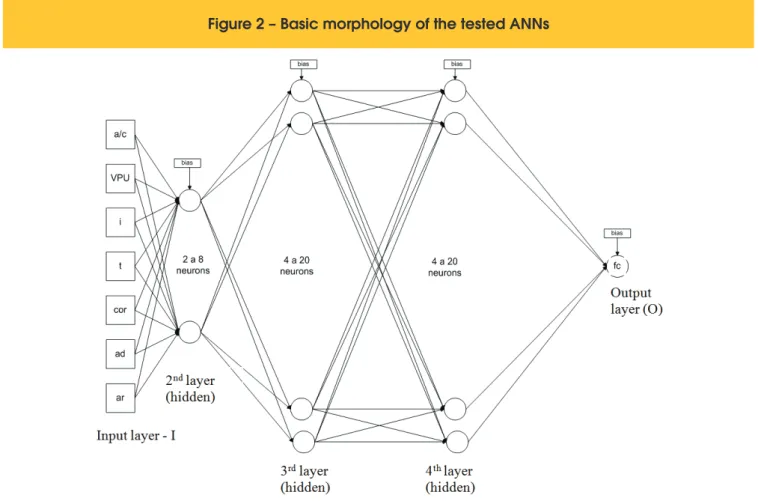
n The transference functions between the input and the hidden layers would be hyperbolic tangents, whereas the transference function of the output layers of the ANN would be linear. Therefore, the essential topology of the networks was established as perceptron consisting of ive layers (1 input layer, 3 hidden lay -ers, and 1 output layer). This morphology creates a large number of correlations among the neurons in the hidden layers, improving their capacity of non-linear estimation and conferring good lex-ibility and interpretation capacity to the network, with not very high computational processing efforts.
Once the topology was established, it was deined that ANNs with 2 to 8 neurons of the 1st hidden layer and 10 to 48 neurons of the
other hidden layers would be tested. These intervals were deter-mined considering that the number of neurons increases the quan-tity and the complexity of iteractions, which negatively affects the
time required for each simulation, but has a positive impact on the error level achieved during the simulations. Figure 1 illustrates the basic topology of the tested networks.
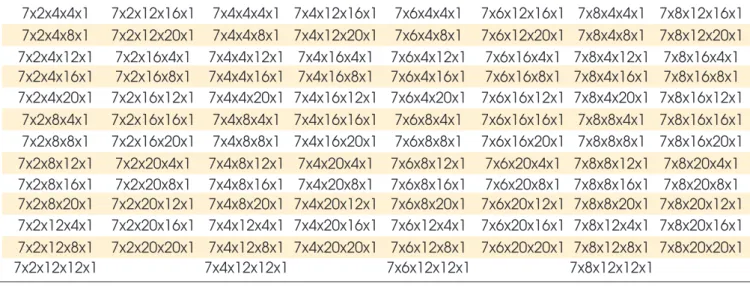
Therefore, the coniguration of the simplest ANN tested was type Ex2x4x4xS and that of the largest and most complex was type Ex8x20x20xS. Placing a higher number of neurons in layers more distant to the input provides higher processing lexibility. Table 1 illustrates all the different conigurations of the tested networks.
5. ANN Training
After normalization, the data set was divided in two groups:
n Main group: containing 2018 (two thousand and eighteen) or 90% of the data in the data set, which were used to train the networks;
n Test group: containing 225 (two hundred and twenty ive) or
10% of the data in the data set, which were extracted and used to validate the networks.
Groups were randomly deined, and care was taken to ensure that both groups contained data with high amplitudes. The Main Group was used for network training with the aid of the EBP (Er-ror Back Propagation) algorithm. Estimate er(Er-ror and computa-tional time were recorded during the process.
As previously emphasized, the process of ANN training is essen-tial to build good ANN models. Several issues are involved in this process, such as learning algorithm type and network stopping de-cisions, thereby preventing the loss of ANN generalization power. Based on the preliminary phase results, it was decided the training algorithm to be used during the main stage would be EBP, which was successfully used in the previous phase. The following train-ing parameters were also determined:
n Maximum of de 10,000 iteractions or training epochs; n Target error very close to zero (0.0001).
This ensured that all networks would be submitted to the same number of training epochs and that the recorded error would be as low as possible for the training conditions.
It must be noted here that the data set used to generate and train
Table 1 – Summary of the configurations of the networks
7x2x4x4x1
7x2x12x16x1
7x4x4x4x1
7x4x12x16x1
7x6x4x4x1
7x6x12x16x1
7x8x4x4x1
7x8x12x16x1
7x2x4x8x1
7x2x12x20x1
7x4x4x8x1
7x4x12x20x1
7x6x4x8x1
7x6x12x20x1
7x8x4x8x1
7x8x12x20x1
7x2x4x12x1
7x2x16x4x1
7x4x4x12x1 7x4x16x4x1
7x6x4x12x1
7x6x16x4x1
7x8x4x12x1
7x8x16x4x1
7x2x4x16x1
7x2x16x8x1
7x4x4x16x1 7x4x16x8x1
7x6x4x16x1
7x6x16x8x1
7x8x4x16x1
7x8x16x8x1
7x2x4x20x1
7x2x16x12x1
7x4x4x20x1 7x4x16x12x1
7x6x4x20x1
7x6x16x12x1
7x8x4x20x1
7x8x16x12x1
7x2x8x4x1
7x2x16x16x1
7x4x8x4x1
7x4x16x16x1
7x6x8x4x1
7x6x16x16x1
7x8x8x4x1
7x8x16x16x1
7x2x8x8x1
7x2x16x20x1
7x4x8x8x1
7x4x16x20x1
7x6x8x8x1
7x6x16x20x1
7x8x8x8x1
7x8x16x20x1
7x2x8x12x1
7x2x20x4x1
7x4x8x12x1 7x4x20x4x1
7x6x8x12x1
7x6x20x4x1
7x8x8x12x1
7x8x20x4x1
7x2x8x16x1
7x2x20x8x1
7x4x8x16x1 7x4x20x8x1
7x6x8x16x1
7x6x20x8x1
7x8x8x16x1
7x8x20x8x1
7x2x8x20x1
7x2x20x12x1
7x4x8x20x1 7x4x20x12x1
7x6x8x20x1
7x6x20x12x1
7x8x8x20x1
7x8x20x12x1
7x2x12x4x1
7x2x20x16x1
7x4x12x4x1 7x4x20x16x1
7x6x12x4x1
7x6x20x16x1
7x8x12x4x1
7x8x20x16x1
7x2x12x8x1
7x2x20x20x1
7x4x12x8x1 7x4x20x20x1
7x6x12x8x1
7x6x20x20x1
7x8x12x8x1
7x8x20x20x1
the networks contained research data from several laboratories, obtained by different operators, using different materials, with different curing conditions and temperatures. Thus, if presenting good resolution power, the generated networks would be useful in real situations requiring estimating concrete compressive strength.
Figures 2 to 7 show the training development of some ANNs gen-erated during this phase. In the graphs, the blue line (top) repre-sent the error value calculated at the end of each network training epoch and the black line (bottom) represents the maximum error determined for the network.
Figure 2 – Basic morphology of the tested ANNs
Figure 3 – ANN training evolution for
820 IBRACON Structures and Materials Journal • 2011 • vol. 4 • nº 5 The igures clearly show that, during the irst training epoch, syn
-aptic weights were adjusted faster, with a rapid reduction in error values. During subsequent training epochs, adjustments are less eficient, and the error values tend to stabilize.
It is interesting to recall that the applied training process aims at progressively reducing the error by the experimental analysis of a determined neighborhood around the training epoch. The software program tries several small changes in synaptic weights in order to determine which is the highest reduction in the error surface. The use of the EBP algorithm signiicantly reduces the computational effort. However, this type of training may lead to minimal error po-sitions, instead of minimal absolute error. This is why it is inter-esting to perform several trainings, changing the initial matrix of synaptic errors to make research in different error surface zones.
6. Results and discussion
6.1 Analysis of mean ANN error
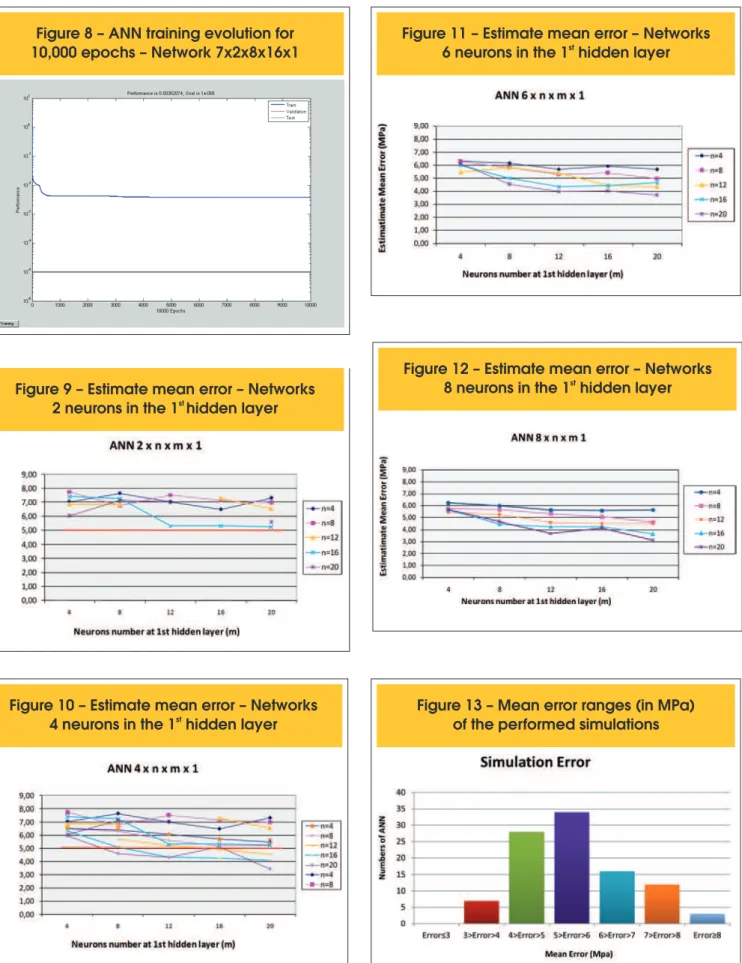
Figures 8 to 11 show the mean error obtained in the tested ANNs organized according to the basic geometry of each network (where n is the number of neurons in the second hidden layers and m the number of neurons of the third hidden layer.)
The igures show that several network conigurations obtained very low errors1, clearly showing the signiicant utilization potential of
this modeling tool. In some networks, mean errors reached values below 4 MPa (ANN 7x4x20x20x1, ANN 7x6x20x20x1 and ANN 7x8x20x20x1), with network 7x8x20x20x1 obtaining the lowest error (3.09 MPa) in this phase. It is evidenced that the increase in neu-ron numbers signiicantly contributed to reduce the mean error of the estimate. In some cases (ANN 7x2x12x12x1, 7x2x20x16x1 and 7x4x12x4x1), the result of the simulation was not satisfactory (mean error > 10 MPa, with generation of functions with low data adherence). These three networks presented few neurons in the irst hidden layer. The igures also show that none of the networks with only two neu-rons in the irst hidden layer reached the 5 MPa error limit, indi -cating that this type of network demands a very high number of
neurons in the following layers to obtain adequate results. Figure 12 demonstrates the error percentage obtained in the network simulations performed, organized in ranges. The range of training er-rors obtained for most of the tested networks (62) was between 4 and 6 MPa (in 28, it was between 4 and 5 MPa and in 34, between 5 and 6 MPa). Seven ANN conigurations obtained errors below 4 MPa, and the best performance was achieved by ANN 7x8x20x20x1 (3.09 MPa).
6.2 Analysis of Estimation Adequacy
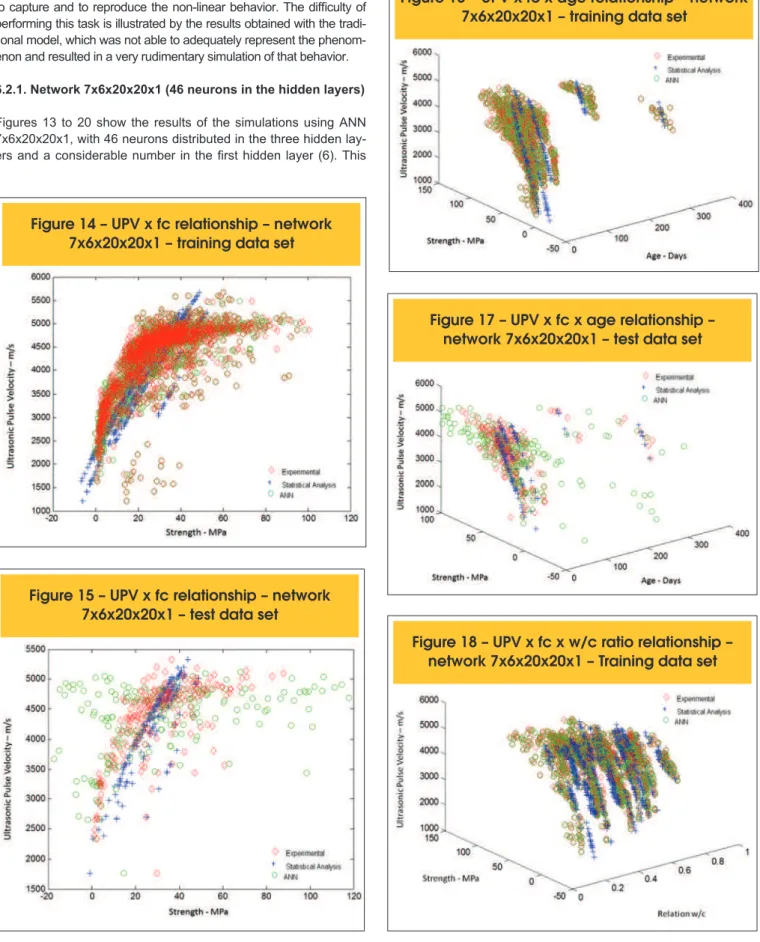
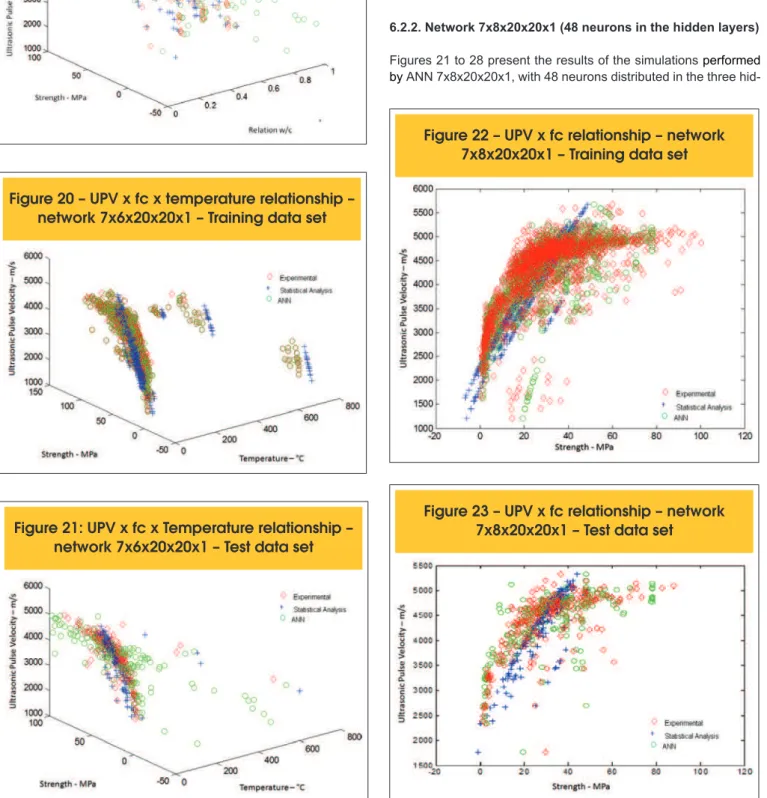
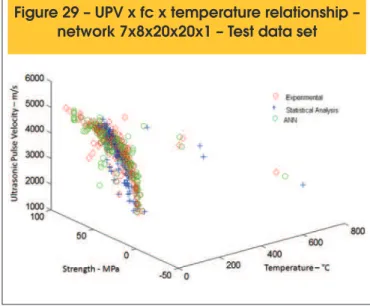
Figures 13 to 28 present the simulation results of some of the ANNs tested as compared to the statistical model of estima-tion by regression. In these igures, the red diamonds represent the original data; the green circles, the values estimated by the networks; and the blue crosses, the results obtained with tradi-tional modeling.
Figure 5 – ANN training evolution for
1500 epochs – Network 7x4x8x16x1
Figure 6 – ANN training evolution for
500 epochs – Network 7x2x8x16x17x6x12x20x1
Figure 7 – ANN training evolution for
10,000 epochs – Network 7x8x16x20x1
1 Errors lower than 5 MPa were considered low in an universe ranging between 5 and 100 MPa (i.and., an error corresponding to 5% of the maximal
Figure 8 – ANN training evolution for
10,000 epochs – Network 7x2x8x16x1
Figure 9 – Estimate mean error – Networks
st2 neurons in the 1 hidden layer
Figure 10 – Estimate mean error – Networks
st4 neurons in the 1 hidden layer
Figure 11 – Estimate mean error – Networks
st
6 neurons in the 1 hidden layer
Figure 12 – Estimate mean error – Networks
st
8 neurons in the 1 hidden layer
822 IBRACON Structures and Materials Journal • 2011 • vol. 4 • nº 5 A good adherence between the values estimated by the networks and
the actual values is observed, demonstrating that the networks are able to capture and to reproduce the non-linear behavior. The dificulty of performing this task is illustrated by the results obtained with the tradi-tional model, which was not able to adequately represent the phenom-enon and resulted in a very rudimentary simulation of that behavior.
6.2.1. Network 7x6x20x20x1 (46 neurons in the hidden layers)
Figures 13 to 20 show the results of the simulations using ANN 7x6x20x20x1, with 46 neurons distributed in the three hidden lay -ers and a considerable number in the irst hidden layer (6). This
Figure 14 – UPV x fc relationship – network
7x6x20x20x1 – training data set
Figure 15 – UPV x fc relationship – network
7x6x20x20x1 – test data set
Figure 16 – UPV x fc x age relationship – network
7x6x20x20x1 – training data set
Figure 17 – UPV x fc x age relationship –
network 7x6x20x20x1 – test data set
was coniguration was shown to be relatively adequate, as this network achieved a mean error value of 3.66 MPa in the resulting estimates using the training data set.
A high adherence of the estimated values with the training data is visually observed, demonstrating that the network was able to adequately simulate the behavior of concrete in this stage of the simulation. However, the results of the simulations carried out with the data set show that this network was not able to maintain its good performance. The graphs show that most of the estimates were distant from the actual data. The mean error was 6.90 MPa.
6.2.2. Network 7x8x20x20x1 (48 neurons in the hidden layers)
Figures 21 to 28 present the results of the simulations performed by ANN 7x8x20x20x1, with 48 neurons distributed in the three hid
-Figure 19 – UPV x fc x w/c ratio relationship –
network 7x6x20x20x1 – Test data set
Figure 20 – UPV x fc x temperature relationship –
network 7x6x20x20x1 – Training data set
Figure 21: UPV x fc x Temperature relationship –
network 7x6x20x20x1 – Test data set
Figure 22 – UPV x fc relationship – network
7x8x20x20x1 – Training data set
824 IBRACON Structures and Materials Journal • 2011 • vol. 4 • nº 5 den layers and a considerable number in the irst hidden layer (8).
This coniguration was adequate, and this was the network pre-senting the best result, with a mean error of only 3.09 MPa in the estimates using the training data set.
Moreover, the results of the simulations performed with the test data set were also very good, with a mean error of 3.59. The graphs show excellent adherence of the estimated values with actual data, showing that this network was able to adequately simulate the be-havior of concrete using the variables used for analysis. Therefore, this is a tool capable of estimating, with a low error index, the value of compressive strength of different concretes based on a neural model built with data from other concrete samples.
6.3 Investigation of Simulation Times
The results discussed in the previous section demonstrate that the estimation capacity of ANNs increases as the number of
neu-rons in the hidden layers increase. Among the tested networks, that containing 48 neurons, with a high number of neurons in each layer, had the best performance.
The problem associated with the increase in the number of neu-rons is that the network complexity exponentially increases, result -ing in increas-ing computational cost to adjust synaptic weights. Aiming at determining the computational cost derived from this increase in neuron numbers, Table 2 illustrates the times spent in the simulations performed by the different networks tests. It is observed that an increase in neuron numbers in any layer corresponds to an increase in the computational cost spent to perform the simulations. The increase in the complexity of the interrelationship among neurons signifi -cantly contributes for the increase in the computational time spent in the simulation.
The best results were obtained with largest network tested, 8x20x20x1. The time it spent for the simulation was of approxi
-Figure 24 – UPV x fc x Age relationship – network
7x8x20x20x1 – Training data set
Figure 25 – UPV x fc x Age relationship –
network 7x8x20x20x1 – Test data set
Figure 26 – UPV x fc x w/c ratio relationship –
network 7x8x20x20x1 – Training data set
Figure 28 – UPV x fc x temperature relationship –
network 7x8x20x20x1 – Training data set
Figure 29 – UPV x fc x temperature relationship –
network 7x8x20x20x1 – Test data set
mately 6h, which is high, but does not preclude its use for the
gen-eration of a broad-spectrum estimation model.
Considering that reductions in error values become increasing lower as the size of the networks increase and that the compu-tational structure available at the time this study was performed, we believed that further increases in the size of the networks was not recommendable, as this would require increasingly higher pro-cessing times for network training.
In order to measure performance gains and computational times for networks larger than those tested, an ANN with a 10x20x20x1 coniguration was evaluated and presented a mean error of 3.06 MPa and a simulation time of 12:40h. As compared with ANN 8x20x20x1, the reduction in mean error was only of 0.03 MPa, whereas the increase in simulation time almost doubled.
However, depending on the nature of the problem to be solved, it may be necessary to increase the number of neurons in the ANN layers. Simulation time obviously does not preclude the creation of ANNs, especially considering the continuous increase in the pro-cessing capacity of personal computers. However, considering the current computational processing capacity of personal computers and the acceptable standard error values adopted in the present study, it is suggested that the adequate neuron number to gen-erate a lexible and eficient network to estimate concrete com-pressive strength is approximately 50, provided there is a proper amount of neurons (>6) in each layer.
7. Conclusions
UPV tests are increasingly used in Civil Engineering, and have been shown to be useful to analyze homogeneity differences and to detect micro-crack patterns in deteriorated concrete structures. One important advantage of UPV tests is that their application does not cause any damage in structures being used, which is extreme-ly important for diagnosis and deinition of intervention strategies. This study aimed, in particular, to evaluate the possibility of using UPV testing also to estimate concrete compressive strength (fc), which is a dificult task because concrete is a very heterogeneous material and changes with time, hence making the relationship
be-tween compressive strength and UPV test results very complex. The amount of voids, w/c ratio, type of aggregate, etc. are factors that affect concrete compressive strength values, and this is why traditional methods to model the UPV x fc relationship usually do not yield good results.
The novel approach used the present study was the development of neural models. Considering the synergy of effects and the lack of knowledge on every parameter that affects fc, it is possible to conclude that this problem requires non-linear modeling of an al-most non-structured knowledge. The tool proposed to handle this type of data in the present study was the ANN modeling technique, which was shown to be eficient.
It was found that, due its high learning capacity and ability to gen-eralize the acquired knowledge, an ANN may be a fast and preci-sion tool for the interpretation of the results of complex phenom-ena. It was shown that networks, in general, may produce better compressive strength estimates than traditional methods, such as non-linear multiple regression. If well trained and having adequate coniguration, these networks may reach very low error levels (< 4 MPa).
The good results obtained here indicate that ANNs have a great potential for producing robust and lexible numerical methods to estimate concrete compressive strength suing UPV data. The simulations performed in the second and third phase of this study showed that the learning capacity of an ANN and its ability to gen-eralize the acquired knowledge directly depends on the amounts of neurons present in each hidden layer. The results also indicate that a minimum amount of neurons (preferably, more than 4) is required in each layer to allow the network to model complex phe-nomena. It was shown that the use of a high number of neurons considerably increases the explanatory power of the networks, but this requires increasing computational costs.
In general, it was found that:
826 IBRACON Structures and Materials Journal • 2011 • vol. 4 • nº 5
n It was found that the use of UPV tests for concrete assessment requires better methods to analyze the results, and that ANNs can be used for this purpose;
n UPV tests allowed generating adequate concrete compres-sive strength estimates, which can be sued in the analysis of the data obtained in these test, with adequate degree of conidence;
n The results show that it is possible to generate a non-linear
mapping of the relationship between concrete compressive strength and UPV readings by the use of ANNs. The modeling of this relationship should take into account parameters such as curing, cement, concrete temperature, w/c ratio, and con-crete age;
n The model including only concrete age and UPV readings as input variables was able to make estimations with mean errors below 4 MPa;
Table 2 – Simulation time
Network
Time (h)
Network
Time (h)
Network
Time (h)
Network
Time (h)
2x4x4x1
00:15
4x4x4x1
00:20
6x4x4x1
00:22
8x4x4x1
00:11
2x4x8x1
00:22
4x4x8x1
00:24
6x4x8x1
00:29
8x4x8x1
00:42
2x4x12x1
00:24
4x4x12x1
00:27
6x4x12x1
00:33
8x4x12x1
00:51
2x4x16x1
00:33
4x4x16x1
00:40
6x4x16x1
00:46
8x4x16x1
00:55
2x4x20x1
00:41
4x4x20x1
00:45
6x4x20x1
01:05
8x4x20x1
01:17
2x8x4x1
00:20
4x8x4x1
00:30
6x8x4x1
00:37
8x8x4x1
00:40
2x8x8x1
00:32
4x8x8x1
00:34
6x8x8x1
00:50
8x8x8x1
01:04
2x8x12x1
00:45
4x8x12x1
01:04
6x8x12x1
01:05
8x8x12x1
01:16
2x8x16x1
00:50
4x8x16x1
01:08
6x8x16x1
01:35
8x8x16x1
01:25
2x8x20x1
01:10
4x8x20x1
01:05
6x8x20x1
01:40
8x8x20x1
01:55
2x12x4x1
00:31
4x12x4x1
00:38
6x12x4x1
00:45
8x12x4x1
00:55
2x12x8x1
00:45
4x12x8x1
00:57
6x12x8x1
01:10
8x12x8x1
01:17
2x12x12x1
00:50
4x12x12x1
01:15
6x12x12x1
01:31
8x12x12x1
01:35
2x12x16x1
01:15
4x12x16x1
01:39
6x12x16x1
01:58
8x12x16x1
02:07
2x12x20x1
01:45
4x12x20x1
01:55
6x12x20x1
02:05
8x12x20x1
02:19
2x16x4x1
00:40
4x16x4x1
01:03
6x16x4x1
01:15
8x16x4x1
01:26
2x16x8x1
01:22
4x16x8x1
01:25
6x16x8x1
01:35
8x16x8x1
01:55
2x16x12x1
01:30
4x16x12x1
01:41
6x16x12x1
01:55
8x16x12x1
02:23
2x16x16x1
01:50
4x16x16x1
02:06
6x16x16x1
02:40
8x16x16x1
02:53
2x16x20x1
01:55
4x16x20x1
02:41
6x16x20x1
03:35
8x16x20x1
05:32
2x20x4x1
00:41
4x20x4x1
00:42
6x20x4x1
01:06
8x20x4x1
01:43
2x20x8x1
01:14
4x20x8x1
01:32
6x20x8x1
01:50
8x20x8x1
03:05
2x20x12x1
01:31
4x20x12x1
02:02
6x20x12x1
02:08
8x20x12x1
03:12
2x20x16x1
02:20
4x20x16x1
02:50
6x20x16x1
03:25
8x20x16x1
04:08
n The study demonstrated a clear improvement of the analysis results when ANNs were used relative to traditional statistical methods. Even the simplest ANN obtained better estimations than traditional statistical methods, which were shown to be limited as they were not able to yield a satisfactory relation-ship representing the actual relationrelation-ship among those vari-ables. When performing a simulation using the same results of the ANN data set, traditional methods did not produce an R² value higher than 0.40, whereas the ANNs produced R² values around 0.90;
n In addition of contributing for a better analysis in situations where concrete compressive strength or density are doubtful, ANN can eficiently organize and transfer the non-structured knowledge accumulated in this ield, in addition to providing the possibility of being used for training professionals involved in the application of ultrasonic tests;
n Due to their capacity of learning and generalizing the acquired knowledge, ANNs are a fast an accurate method to interpret results of complex phenomena.
These conclusions evidence the ANN potential to estimate con-crete compressive strength based on UPV readings, as well as to generate useful tools for structure inspections.
Considering this potential, a patent relative to a “Method to Deter -mine the Properties of Concrete by the Use of Non-Linear Com-plex System of Data Treatment and Device Using such Method” was requested to INPI – Instituto Nacional de Propriedade In-telectual (Brazilian Institute of Intellectual Property), and accept-ed. The patent was issued under number PI 0702238-7, depos-ited on 08/09/2007 and subject of Patent Request Publication on 03/24/2009.
8. References
[01] ASSOCIAÇÃO BRASILEIRA DE NORMAS TÉCNICAS. Projeto de Estruturas de Concreto. - NBR 6118, Rio de Janeiro, 2002.
[02] COMITÉ EURO-INTERNATIONAL DU BÉTON. CEB-FIP Model Code 1990. London: Thomas Telford, 1993.
[03] ISAIA, G. C. Sustentabilidade do Concreto ou das Estruturas de Concreto? Uma Questão de
Durabilidade. In: Congresso Brasileiro do Concreto, 44º, Belo Horizonte, 2002, Anais, São Paulo, 2002, V024, 16p, 1 CD-ROM.
[04] NEVILLE, A. M. Propriedades do Concreto. São Paulo: PINI, 1997. 828 p.
[05] ANTOCHEVES, R. C. A. Investigação do
comportamento de concretos em altas temperaturas, Porto Alegre, 2005, Tese (doutorado) – Programa de Pós-Graduação em Engenharia Civil, Universidade Federal do Rio Grande do Sul. Escola de Engenharia, 241p.
[06] HASPARYK, N. P. Investigação de concretos afetados pela reação álcali-agregado e
caracterização avançada do gel exsudado, Porto Alegre, 2005, Tese (doutorado) – Programa de Pós-Graduação em Engenharia Civil, Universidade Federal do Rio Grande do Sul. Escola de Engenharia, 326p.
[07] BITTENCOURT, G. Inteligência Artiicial: Ferramentas e Teorias. Florianópolis: Editora da UFSC, 2001, 2ed.
[08] LORENZI, A. Aplicação de redes neurais artiiciais para estimativa da resistência à compressão do concreto a partir da velocidade de propagação do pulso ultra-sônico, Porto Alegre, 2009, Tese (doutorado) – Programa de Pós-Graduação em Engenharia Civil, Universidade Federal do Rio Grande do Sul. Escola de Engenharia, 196p.
[07] BOUKERCHE, A., NOTARE, M. S. M. A., Behavior-Based Intrusion Detection in Mobile Phone Systems. Journal of Parallel and Distributed Computing, v.62, n. 9, 2002; p. 1476-1490.
[08] KOMLOS, K., POPOVICS, S., NÜRNBERGEROVÁ, T., BABÁL, B., POPOVICS, J. S., Ultrasonic Pulse Velocity Test of Concrete Properties as Speciied in Various Standards. Cement and Concrete Composites. [s.l.], v.18, p.357-364, 1996. [09] MACHADO, M. D., Curvas de Correlação para
Caracterizar Concretos usados no Rio de Janeiro por Meio de Ensaios Não Destrutivos. 2005. 265p. Dissertação (Mestrado) – Programa de
Pós-Graduação em Engenharia da Universidade Federal do Rio de Janeiro. Universidade Federal do Rio de Janeiro, Rio de Janeiro, 2005. [10] NOGUEIRA, C. L., Análise Ultra-Sônica da
Distribuição dos Agregados no Concreto através de Wavelets. In: XXI CONGRESSSO NACIONAL DE ENSAIOS NÃO DESTRUTIVOS, 2002, Salvador. Anais.... São Paulo: ABENDE, 2002. 1 CD-ROM. [11] BERRIMAN, J., PURNELL, P., HUTCHINS, D. A.,
NEILD, A., Humidity and Aggregate content Correction Factors for Air-coupled Ultrasonic Evaluation of Concrete. Ultrasonics. [s.l.], v.43, p. 211-217, 2005.
[12] PUNURAI, W., JARZYNSKI, J., QU, J., KIM, J., JACOBS, L. J., KURTIS, K. E., Characterization of Multi-Scale Porosity in Cement Paste by Advanced Ultrasonic Techniques. Cement and Concrete Research. [s.l.], v.37, p.38-46, 2007.
[13] LORENZI, A., SILVA FILHO, L.C.P., Estudo
Comparativo entre Sistemas Inteligentes para Auxílio da Análise de Estruturas de Concreto através de Ensaios Não Destrutivos. In: CONFERÊNCIA SOBRE TECNOLOGIA DE EQUIPAMENTOS (COTEC 2003), 7, 2003, Florianópolis. Anais.... São Paulo: Associação Brasileira de Ensaios Não Destrutivos e Inspeção, 2003. 9p.. 1 CD-ROM. [14] FIGUEIREDO, E. P., Inspeção e Diagnóstico de
Estruturas de Concreto com Problemas de Resistência, Fissuras e Deformações. In: ISAIA, G. C. (Editor), Concreto: Ensino, Pesquisa e Realizações. São Paulo: IBRACON, 2005. cap.33, vol.2, p.985-1015.
[15] AMERICAN SOCIETY FOR TESTING AND
828 IBRACON Structures and Materials Journal • 2011 • vol. 4 • nº 5 Standards, Vol. 03.03: Nondestructive Testing. West
Conshohocken: 1995, 920 p., p. 12-15. [16] ASSOCIAÇÃO BRASILEIRA DE NORMAS
TÉCNICAS. NBR 8802: Concreto Endurecido – Determinação da Velocidade de Propagação da Onda Ultra-sônica: Método de Ensaio. Rio de Janeiro: 1994b. [17] DORNELLES, F. L., PINTO, R. C. A., PADARATZ,
I. J., Detecção de Falhas Internas de Concretagem através do uso do Ultra-som. In: CONGRESSSO BRASILEIRO DO CONCRETO (COBRACON 2005), 47, 2005, Recife. Anais.... São Paulo: Instituto Brasileiro do Concreto, 2005. Volume VII, p.229-239. 1 CD-ROM.
[18] LORENZI, A. Aplicação de testes ultra-sônicos para avaliação de estruturas de concreto utilizando elementos de inteligência artiicial. 2000. 157p. Dissertação (Mestrado) - Programa de Pós Graduação em Engenharia Civil, Universidade Federal de Santa Maria. Santa Maria, 2000. [19] HAMASSAKI, L. T., Ensaios não-destrutivos: um
diagnóstico completo. Téchne – Revista de Tecnologia da Construção. São Paulo, Brasil, n. 06, p. 30-33, 1993.
[20] MENEGHETTI, L. C., PADARATZ, I. J., STEIL, R. O., Use of Ultrasound to Evaluate Concrete Strength in the Early Ages. In: INTERNATIONAL SYMPOSIUM ON NONDESTRUCTIVE TESTING CONTRIBUTION TO THE INFRASTRUCTURE SAFETY SYSTEMS IN THE 21ST CENTURY
(NDTISS 99), 1999, Torres. Proceedings…. Santa Maria: UFSM, 1999. p. 42-47.
[21] EVANGELISTA, A. C. J., Avaliação da Resistência do Concreto usando Diferentes Ensaios Não Destrutivos. 2002. 219p. Tese (Doutorado) – Programa de Pós-Graduação em Engenharia da Universidade Federal do Rio de Janeiro. Universidade Federal do Rio de Janeiro, Rio de Janeiro, 2002. [22] NAIK, T. R., MALHOTRA, V. M., The Ultrasonic Pulse
Velocity Method. In: MALHOTRA, V. M., CARINO, N. J. (Editores), Handbook on Nondestructive Testing of Concrete. Boca Raton: CRC Press, 1991. cap.7, p.169-201.
[23] RODRIGUES, G. S. S. Módulo de deformação estático do concreto pelo método ultra-sônico: estudo da correlação e fatores inluentes. 2003. 187p. Dissertação (Mestrado) – Mestrado em Engenharia Civil, Universidade Federal de Goiás. Goiânia, 2003. [24] POPOVICS, S., Effects of uneven moisture
Distribution on the Strength of and Wave Velocity in Concrete. Ultrasonics. [s.l.], v. 43, p.429-434, 2005. [25] MENEGHETTI, L. C., Avaliação da Resistência
à Compressão de Concretos nas Primeiras Idades através do Ultra-som. 1999. 163p. Dissertação (Mestrado) - Curso de Pós Graduação em Engenharia Civil, Universidade Federal de Santa Catarina. Florianópolis, 1999.