Original article (short paper)
Visual search strategy of soccer players according
to different age groups
Guilherme Machado Felippe Cardoso
Israel Teoldo
Centre of Research and Studies in Soccer, Universidade Federal de Vi̧osa, UFV, Vi̧osa, MG, Brazil
Abstract - Aims: The aim of this study was to assess the visual search strategy of soccer players from different age groups. Methods: The sample comprised 51 youth soccer players. The instrument used to collect and analyse data was the Mobile Eye. This system is used to verify gaze behaviour through visual focus. Players were grouped according to their age group: U-13 (17), U-15 (17), U-17 (17). Participants were presented with a video based test. Visual search stimuli were grouped into ive categories: “player in possession of the ball”; “ball”; “teammates”; “opponent”; “space”. The number and time of ixations made by players, in each stimuli category was analysed. One-way ANOVA was performed to compare the three groups. Results: Results displayed signiicant differences in one of the categories. The “space” category displayed signiicant differences in the number of ixations between U-13 (74.35±12.41) compared to U-15 (58.78±14.22) and U-17 (61.88±16.44) soccer players. No other signiicant differences were found in other categories. Conclusion: The U-13 players employed most of their visual search related with “space” compared with players from the U-15 and U-17 age groups. These indings are important for coaches and researchers to understand how visual search strategy change according to age group.
Keywords: youth, assessment, behavior, cognition, football
Introduction
The role of perceptual-cognitive skills in sports domain has been shown as an important process in order to predict perform-ance1, 2. As part of the perceptive system, visual search strategy has been considered one of the most important aspects within the process of decision-making in sports domain3. Literature shows that there are differences on visual search strategies between players from different competitive levels in different sports, such as cricket4, judo5 and soccer6, 7.
A study carried out by Vaeyens and colleagues8 comparing visual search in soccer players of different skill levels found differences in performance. These differences were related to various indicators, such as search rate, ixation order and ixation location, allowing differentiation between international and national soccer players. International players employed a higher search order and presented different pattern of visual search compared to national players. This evidence suggests that information may be processed in a different way between these two groups, impacting on players’ performance. Others studies found similar results, demonstrating a congruent pattern between visual search behaviour and the level of expertise6, 7.
It indicates the importance of understand the development of perceptual-cognitive skills in skilled youth players9.
In this regard, the development of such skills might be important for develop and select talented players10. However, although there are many studies in this ield comparing differ -ences regarding expertise level, few studies have evaluated differences and the development of perceptual-cognitive skills among different age groups. In this sense, the understanding
of how these patterns might change according to age appears to be an important factor in order to systematically evaluate the players in their sport developmental phase9. Previous research indicates that expertise inluences the visual search behaviour in soccer as early as nine years of age11, 12. It sug-gests an important role of perceptive skills since an early age, which might impact in how the players are able to receive and process the information from game related tasks, impacting on their performance.
During the development phase in youth soccer, an improve-ment in performance is expected for players. This performance several times is related to decision-making processes, such as in tactical aspects. Studies have shown that some cues are more important than others to make better decisions13, 14. Consequently, it is important to gather more relevant information from the environment to perform well. Moreover, there is evidence ofthe trainability of perceptual and anticipation skills15, 16. Therefore, to examine this development over the years it is necessary to understand what to expect from each age group. Acquiring knowledge about how visual search patterns occur in different ages may be a good indicator for clubs and coaches to evalu-ate players' development and leading the training process with respect to their decision-making capabilities.
In the current study the aim is to assess the visual search strategy of soccer players from different age groups. It is hypothesized that visual search patterns will change between the different age groups, where the older groups will use more relevant cues and more purposeful search behaviour, as used by expert players in previous studies13,14, for their
2 Motriz, Rio Claro, v.23, n.03, 2017, e101748 be used in a different quantitatively manner between groups,
with more ixations been spent in areas of free space and teammates as those areas may facilitate decision-making in the offensive phase.
Material and Methods
Participants
The participants comprised 51 male youth soccer players from a Brazilian Serie A club. Players were grouped accord -ing to their age level: U-13 (17), U-15 (17), U-17 (17). The inclusion criteria were that players should participate in sys-tematic training sessions, at least three times per week, with 1 hour and 30 minutes per session and should also participate in championships at national and/or international levels.
Ethical Procedures
All participants and tutors signed a consent form before the start of the experiments. All research procedures were conducted in accordance with the standards established by the National Health Council (466/2012) and by the Declaration of Helsinki (1996) for research on human beings. The project had the approval of the Research Ethics Committee of Universidade Federal de Viçosa (Protocol N. 412816-08/10/2013).
Instrument
The Mobile Eye Tracking-XG (Applied Science Laboratories, Bedford, MA, EUA) was used to analyse visual search data. This instrument is used to verify participant’s gaze behaviour through a camera system mounted on the glass.
Film Test
The participants were presented with a video based test17. This test consists of eleven soccer offensive video sequences, recorded from and watched through a third person perspec-tive. These scenes were edited from European professional matches from national championships. In these sequences, the interactions are shown six times between the player with the ball, teammates, defenders and goalkeeper and ive times the goalkeeper was not presented in the scene. It is due the video sequences were edited from television broadcasting, in which six times the offensive sequences were close to the opposing goal (including the opposite goalkeeper) and ive times it was far from the opposing goal (not including the opposite goalkeeper). Test scenes were presented to partici-pants via projection screen (TES – TRM 150V with a “Matte White” surface projection) on a 3,04 x 2,28m size. An HD projector (Epson PowerLite X14) was used to project the
scenes. Participants stood 2.5 meters away from the screen in a standing position.
Prior to starting the practical task the Mobile Eye Tracking-XG was adjusted and the calibration procedure was carried out. The test procedures were explained before the start of the task and them two trial scenes were presented in order to avoid task familiarity issues. Afterwards, the actual test was started. The calibration of the equipment was periodi-cally checked to ensure measurement accuracy. Each video sequence was presented, and was paused for a moment with the participants being instructed to respond as quickly as pos-sible to “What should the player with ball possession do?”. The answers were compared to the answer of a panel of ive experts (qualiied soccer coaches) that agreed in the correct solution for each sequence. The whole procedure took ap-proximately 30 minutes for each participant.
Visual Search Strategy
A mobile eye tracker measured the number of ixations and the time of ixation in pre-deined locations made by each participant in the video. In this experiment ive different locales of ixation were deined: i) player in possession of the ball; ii) ball; iii) teammates; iv) opponent and v) space (e.g. areas of free space on the soccer pitch in which no player is located). These location were chosen based in previous studies8, 13. Data was assessed using a 60 Hz frequency. The calibration method used was the 12 points, which was necessary nine valid points. This value is superior to recommendations by the fabricant, which use a calibration of nine points, been necessary ive valid points.
The dependent variable measured in this experiment was the number of ixations and the time of ixations made by par -ticipants in one of the ive different locales. The independent variable was the player age group (U-13; U-15; U-17). The data distribution was veriied through Shapiro-Wilk's test.
Data Analyses
Results
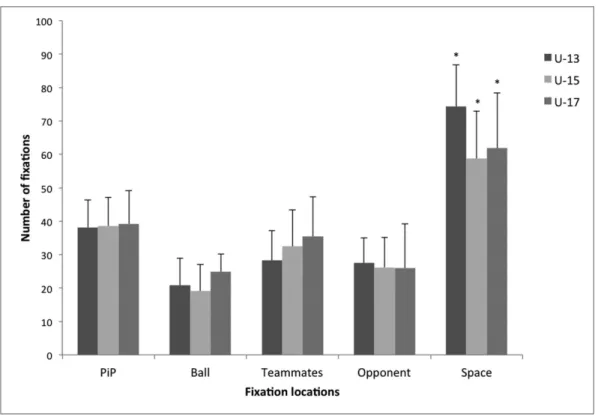
The results displayed signiicant differences in one of the cat -egories. The “space” category displayed signiicant differences
between U-13 (74.35±12.41) F(2,49) = 5.62, P = 0.006, η2 =
.47compared to U-15 (58.78±14.22) and U-17 (61.88±16.44) soccer players. No other signiicant differences were found in another category.
Figure 1. Means and standard deviation for the number of ixations made by each group in pre-deined locations in the video sequences.
4 Motriz, Rio Claro, v.23, n.03, 2017, e101748
There was found no signiicant differences for the mean and standard deviation of time of ixation according to the different age groups (P > 0.05). Players from the different age groups have spent a similar time ixating the different locations in the video.
Discussion
The aim of the present study was to assess the visual search strategy of soccer players according to different age groups. As hypothesized, the results showed that visual search strategy related to the number of ixations were able to discriminate U-13 players from the U-15 and U-17 age groups. The U-15 and U-17 players did not present signiicant differences in their visual search strategy for both number of ixation and time of ixation. This inding can be explained by two causes: irst, these two older age groups have a similar knowledge about soccer as shown in previous study19; second, the variables used to assess the visual search strategy were not sensitive enough to identify differences between U-15 and U-17 players. This study adds to the literature showing the inluence of age in visual search strategy.
The three age groups have performed more number of ixations at the “space” category, than any other location in the video. This result might be related with the importance to identify free space in the pitch to “read the game”, mainly in the offensive phase, in order to ind the best option for the upcoming action (e.g. passing, dribbling or shooting)3. Another explanation might be linked to the “visual pivot”, which is a behaviour of the gaze centred between points of interests (e.g. ball and teammates), thus enabling the optimal usage of both parafoveal and foveal vision20. In this study, the visual search for “space” could be have used also as pivot to facilitate the gaze switch to other areas of interests. This behaviour might facilitate players to pick up important cues and also relate such information based on structural relation, which is essential for tactical problem-solving21.
In relation to the age groups, the U-13 players were the group that employed more number of ixations related with “space” unlike the U-15 and U-17 age groups. These indings may be related to the speciic sports development phase of each group22 and the speciic knowledge of soccer, which is usually lower in younger players9, 23. Some researchers showed that the more knowledge about the task the participants have, the more able to recognize patterns linked with better decision-making they are8, 24. This advantage is seen to be related to the speciic knowledge memory, which is associated with the amount and quality of practice developed along the years25.
Ward and Williams11 found that players between 9 and 13 years of age are more likely to use task-irrelevant information when compared with U-15 and U-17 players. Our indings suggest that although of “space” looks to be the most impor -tant source of information in this task and also a visual pivot, spend too much time looking it might impairs player’s decision making, as a cost beneit between “reading” the game and act -ing20, 26, because the older categories used this information less frequently. Additionally, an alternative explanation is related
to the ilm task, which was used in an aerial perspective in our study. Mann and colleagues27 found that players exposed to this type of view look more frequently to the “space”, when compared with a player perspective view.
The U-15 and U-17 age groups were not discriminated by the number of ixations or ixation duration in each location. One explanation might be related to the task applied in this study, which did not include scenes with 11v11 players. Previous re-search demonstrated that scenes with 11v11 players were more likely to identify speciic knowledge than scenes with fewer players13, 28. Therefore, for players in the investment phase of sports development22 (>14 years of age), which are used to play oficial matches with 11v11 players, the videos including such coniguration could be more sensitive to ind differences between visual search behaviour of U-15 and U-17 age groups. Furthermore, these results might indicate that other cogni-tive process must be involved in the performance of players regarding their visual behaviour, such as peripheral vision and the attention process7, 29. Alternatively, it also has implications for the assessment or training of soccer players’ decision-making or tactical knowledge based on video tests. It might be interesting that the players are grouped according to their decision-making skills or tactical knowledge rather than their age groups. By their turn, decision-making and tactical knowledge may be assessed through players’ performance in laboratory or ield tasks for both research and training control purposes.
From a practical view, an important role of the coach in young athletes’ development is relating to improve the way these athletes “read the game”. From a training perspective, the understanding of how these athletes gathers information from the environment may help coaches to give more appropriate instruc-tions for athletes. Because mirroring the experts patterns is not easy, the skill development approach that focuses on integrated learning, such as the Teaching Games for Understanding, rather than an decontextualized skill acquisition30 is needed. The ind -ings of our study may help coaches to structure more speciic trainings by understanding perceptual-cognitive patterns of different age categories16.
For future research other perceptual-cognitive abilities might be evaluated, such as visual search rate, ixation order, visual pivot, peripheral vision and attention process. In terms of methods, ilms in irst person view and 11v11 videos also can be applied. This approach can help to understand if other ages present differences or similarities with respect to their visual search strategies so as to identify what are the best variables to discriminate the patterns of each age group.
Conclusion
References
1. Williams AM, Davids K, Burwitz L, Williams J. Cognitive knowledge and soccer performance. Percept Mot Skills. 1993;76(2):579-93.
2. Roca A, Williams AM. Expertise and the interaction between different perceptual-cognitive skills: Implications for testing and training. Front Psychol. 2016;7:doi: 10.3389/fpsyg.2016.00792. 3. Kannekens R, Elferink-Gemser MT, Visscher C. Positioning and
deciding: key factors for talent development in soccer. Scand J Med Sci Spor. 2011;21:846-52.
4. M̈ller S, Abernethy B, Farrow D. How do world-class cricket batsmen anticipate a bowler’s intention? Q J Exp Psychol A. 2006;29(4):457-78.
5. Piras A, Pierantozzi E, Squatrito S. Visual search strategy in judo ighters during the execution of the irst grip. Int J Sports Sci Coach. 2014;9(1):185-97.
6. Roca A, Ford PR, McRobert AP, Williams AM. Perceptual-cognitive skills and their interaction as a function of task constraints in soccer. J Sport Exerc Psychol. 2013;35:144-55.
7. Williams AM, Davids K. Visual search strategy, selective attention, and expertise in soccer. Res Q Exerc Sport. 1998;69(2):111-28. 8. Vaeyens R, Lenoir M, Williams AM, Mazyn L, Philippaerts RM.
The effects of task constraints on visual search behavior and deci-sion-making skill in youth soccer players. J Sport Exerc Psychol. 2007;29:147-69.
9. Roca A, Williams AM, Ford PR. Developmental activities and the acquisition of superior anticipation and decision making in soccer players. J Sports Sci. 2012;30(15):1643-52.
10. Williams AM, Reilly T. Talent identiication and development in soccer. J Sports Sci. 2000;18:657-67.
11. Ward P, Williams AM. Perceptual and cognitive skill development in soccer: The multidimensional nature of expert performance. J Sport Exerc Psychol. 2003;25(1):93-111.
12. French KE, McPherson SL. Adaptations in response selection processes used during sport competition with increasing age and expertise. Int J Sport Psychol. 1999;30:173-9.
13. Roca A, Ford PR, McRobert AP, Williams AM. Identifying the processes underpinning anticipation and decision-making in a dynamic time-constrained task. Cogn Process. 2011;12:301-10. 14. Vaeyens R, Lenoir M, Williams AM, Philippaerts RM. Mechanisms
underpinning successful decision making in skilled youth soccer players: An analysis of visual search behaviors. J Mot Behav. 2007;39(5):395-408.
15. Williams M, Ericsson A. Perceptual-cognitive expertise in sport: some considerations when applying the expert performance aproach. Hum Movement Sci. 2005;24:284-307.
16. Broadbent DP, Causer J, Williams AM, Ford PR. Perceptual-cognitive skill training and its transfer to expert performance in the ield: Future research directions. Eur J Sport Sci. 2014:doi: 10.1080/17461391.2014.957727.
17. Mangas CJ. Conhecimento declarativo no futebol: Estudo compara -tivo em praticantes federados e não-federados, do escalão Sub-14. Porto. [Master's Dissertation] - Universidade do Porto; 1999. 18. Tabachnick B, Fidell L. Using Multivariate Statistics. New York,
Harper Row Publishers, 2001.
19. Giacomini D, Silva E, Greco P. Comparação do conhecimento tático declarativo de jogadores de futebol de diferentes categorias e posições. Rev Bras Ciênc Esporte. 2011;33(2):445-63.
20. Piras A, Vickers JN. The effect of ixation transitions on quiet eye duration and performance in the soccer penalty kick: instep versus inside kicks. Cogn Process. 2011;12(3):245-55.
21. Williams A, Ford PR, Eccles DW, Ward JD. Perceptual-cognitive expertise in sport and its acquisition: Implications for applied cognitive psychology. Appl Cogn Psychol. 2011;25:432-42. 22. Côte J, Baker J, Abernethy B. Practice and play in the develop
-ment of sport expertise. In: Eklund R, Tenenbaum G, editors. Handbook of Sport Psychology. 3rd ed. New Jersey: John Wiley & Sons; 2007. p. 184-202.
23. Ford PR, Ward P, Hodges NJ, Williams AM. The role of deliberate practice and play in career progression in sport: the early engage-ment hypothesis. High Abil Stud. 2009;20(1):65-75.
24. Ericsson AK, Krampe RT, Tesch-Romer C. The role of deliberate practice in the acquisition of expert performance. Psychol Rev. 1993;33:363-406.
25. Ericsson AK, Kintsh W. Long-Term Working Memory. Psychol Rev. 1995;102(2):211-45.
26. Piras A, Lanzoni I, Rafi M, Persiani M, Squatrito S. The within-task criterion to determine successful and unsuccessful table tennis players. Int J Sports Sci Coach. 2016;11(4):523-31.
27. Mann DL, Damian F, Shuttleworth R, Hopwood M. The inluence of viewing perspective on decision-making and visual search be-haviour in an invasive sport. Int J Sport Psychol. 2009;40:546-64. 28. Burwits L, Davids K, Williams AM, Williams JG. Visual search
strategies in experienced and inexperienced soccer players. Res Q Exerc Sport. 1994;65:127-35.
29. Ryu D, Abernethy B, Mann DL, Poolton JM, Gorman AM. The role of central and peripheral vision in expert decision making. Perception. 2013;42:591-607.
30. Memert D, Almond L, Bunker D, Butler J, Fasold F, Grifin L, et al. Top 10 research questions related to Teaching Games for Understanding. Res Q Exerc Sport. 2015;00:1-13.
Acknowledgements
This study was funded by the State Department of Sport of Minas Gerais
(SEESP-MG) through the State Act of Incentive to Sports, by FAPEMIG, CAPES, CNPQ, FUNARBE, the Dean’s Ofice for Graduate and Research Studies and the Centre of
Life and Health Sciences from the Universidade Federal de Viçosa, Brazil.
Corresponding author
Guilherme F. Machado. Centre of Research and Studies in Soccer, Universidade
Federal de Viçosa, Brazil. Departamento de Educação Física, Av. P. H. Rolfs, S/N, Campus Universitário. Postcode: 36.570-900, Viçosa, Brazil
Email: [email protected]
Manuscript received on April 4, 2017 Manuscript accepted on September 4, 2017
6 Motriz, Rio Claro, v.23, n.03, 2017, e101748 ERRATUM
In the article “Visual search strategy of soccer players according to different age groups”, DOI: http://dx.doi.org/10.1590/S1980-6574201700030022, published in Motriz Journal, vol. 23(3), e101748, 2017.
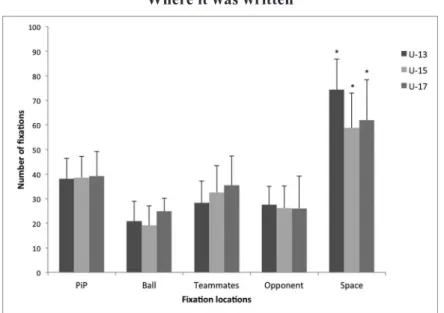
Where it was written
Figure 2. Means and standard deviation for the time of ixations made by each group in pre-deined locations in the video sequences
Should read