(1) Departamento de Fonoaudiologia da Universidade Federal
de Santa Maria, Santa Maria, RS, Brasil.
(2) Universidade Federal de Santa Maria, Santa Maria, RS,
Brasil.
(3) Laboratório de Voz da Universidade Federal de Santa
Maria, Santa Maria, RS, Brasil.
(4) Universidade Federal de Santa Maria, Santa Maria, RS,
Brasil.
Source of funding: CNPq Conlict of interest: non-existent
fundamental in social relations, as well as an integral part of people overall health. Still, as shown in the literature, there is a positive correlation between voice quality and quality of life2-6.
Thus, it is important to detect early voice disorders in a future voice professional, because they are a group of risk for developing dysphonia3,5,7-11. The
evaluation is the starting point for the detection of voice disorders and its importance is maintained throughout the treatment/melioration as a way to verify the changes of vocal behavior, ensuring the adequate time for the dischargement12-15.
Breathing is considered the activator of voice and any problem at this level may have a direct effect on speech and voice, in the aspects of amplitude, frequency and quality7-9. Evidences of respiratory
dynamics aim to verify individual breathing capacity,
the glottal eficiency, utilization and coordination
of breathing out during phonation7,15,16. Among
such evidences, it is highlighted the Adapted
INTRODUCTION
The communication is getting even more important role in the labor market, especially for the professionals who depend on it as a main instrument
of their profession. In this context, teachers, actors,
singers, receptionists, telemarketers, lawyers, ministers, health professionals, among others1-5.
For a satisfactory communication, voice needs to present acceptable quality by the listener, as it is
ADAPTED AIR FLOW AND PHONIC COEFFICIENTS
OF FUTURE VOICE PROFESSIONALS
Fluxo aéreo adaptado e coeicientes fônicos
de futuros proissionais da voz
Carla Aparecida Cielo (1), Mara Keli Christmann (2),Talita Marin Scherer(3), Carla Franco Hoffmann(4)
ABSTRACT
Purpose: to verify and correlate adapted air low (AAF), simple phonic coeficient (SPC) and composed
phonic coeficient (CPC) in young adult future voice professionals of both genders which have normal
voice as well as verifying frequency of sexes. Methods: 62 subjects between 18 and 35 years old (12
men, mean 24,25 years old and 50 women, mean 21,42 years old); vocal evaluation by means of the
RASATI scale with Kappa reliability coeficient; collecting of the maximum phonation time (MPT) of
/a,i,u,s,z/, counting of numbers, vital capacity and AAF; calculation of the SPC and CPC; Spearmann
test for correlations between variables and binomial test for the proportions of normal, diminished and increased values. Results: majority signiicantly feminine presented SPC and CPC normal, and
FAA normal and incresead when compared to the diminished values. Majority signiicantly masculine
presented SPC normal and increased, when compared to the diminished values; normal CPC and no statistically meaningful difference on AAF. There was moderate positive correlation between SPC and CPC for both genders. Conclusion: majoritysigniicantly of the studied future voice professionals presented SPC and CPC normal with moderate positive correlation between these measurements.
Majority signiicantly feminine obtained normal results AAF when compared increased values and AAF did not have correlation with SPC and CPC. Majority signiicantly of the group of future voice
professionals was women.
tension, posture and mobility of structures and its functions11,12,15,19.
Voice auditory perceptual assessment was performed by RASATI scale2,23. For the study, it
was established, as a criterion for normal voice, the
average degree of 0.9 maximum on the aspects
evaluated by the scale12. It was used Zoom H4n
professional digital recorder with stereo
unidi-rectional microphone (96KHz, 16bit), placed four
centimeters from mouth at 90°12,20,24. The recordings
were performed at a room where the ambient noise was below 50dB NPS, measured using digital level sound pressure measurer Instrutherm Dec-4802,24,25.
Three judges underwent voice analysis
indepen-dently, by the maximum phonation time (MPT) of the
vowel /a/ of each subject of the target population. The voices of the subjects were presented without
identiication, randomly arranged, with replication
for subsequent calculation of the concordance. The judges were also blinded as to the research objec-tives and the type of population18,23,24. This
evalu-ation rated the voices as normal or altered glottic level and it was considered as an inclusion criterion, since it was not possible to make the otorhinolaryn-gological evaluation in all subjects7,12,15,18,23.
It was performed the Kappa coeficient for each
of RASATI parameters and to the average value of
each judge, gathering the average coeficient from
inter and intra evaluation. To judge one, the average
Kappa coeficient was 0.7; judge two it was 0.68 and judge three 0.71. The irst and second judges had
inter concordance of 0.66; the judges one and three of 0.68 and judges two and three 0.62.
From the 86 subjects of the target population,
24 were excluded (one for hearing loss; ive under
18 years old, and 18 for middle grade upper to 0.9 in RASATI items). Thus, the study group was composed of 62 future voice professional, among which 12 men between 20 and 35 years old (mean 24.25), and 50 women between 18 and 29 years old (mean 21.42).
For data collection, timed up the MPT phonemes [a:], [i:], [u:], [i:], [z:], and counting numbers after deep inspiration, in loudness, pitch, quality, and habitual speech speed, in orthostatic position7,18.
Each of the MPT was performed three times, and it was considered the higher of the three values12,20,24-27.
The vital capacity (VC) was obtained with the subjects in orthostatic position, by performing
maximum inspiration and, soon after, maximal expiration in dry spirometer Fami-Ita®, positioned
at the height of the patient. The procedure was repeated three times with nasal occlusion and three times without nasal occlusion2,16. The value of VC
used for the calculation of SPC and CPC was the
highest value obtained from these six gathering2,16.
Airlow(AA), the Simple Phonic Coeficient (SPC), and Composite Phonic Coeficient (CPC), in order
to assess the coordination between breathing out and glottal vibration during phonation2.
It is afirmed the importance of the use of these
measures in speech clinic because they are easy to
perform, inexpensive, they provide more objective
data, and by allow the monitoring of patient progress throughout the therapeutic process or vocal improvement2,16. However, it was found lack of
scientiic studies in the literature with AA, SPC and
CPC measures in different populations and aged groups.
Thus, the present study aimed to verify and correlate the AA, SPC and CPC of young adults of both gender, without vocal changes, future voice professional, and to check the frequency of the gender.
METHODS
Analytical cross-sectional observational study, quantitative and contemporary feature. Target population consisting of subjects who sought speech medical-school to make improvements or vocal assessment, from July 2009 to July 2010. The study group was formed based on the criteria described as follow.
Inclusion criteria: accession to the Free and Enlighten Consent Form (FECF); student of a course which the future profession would require professional use of voice11,17; aged between 18 and
40, avoiding the vocal changes from adolescence, and the hormonal and structural changes of aging; normal auditory thresholds2,15,18-21, and average
degree of zero to 0.9 in the aspects evaluated by RASATI scale2,12,15.
Exclusion criteria: history of neurological,
endocrine, psychiatric, gastric and respiratory diseases for the performance or understanding during the evaluations were not affected15,19,20;
changing in stomatognathic system that could limit the articulation of emissions required in the evalu-ations15,19-21; lu and/or respiratory allergies2,15,19,20
and/or hormonal changes typical of pregnancy or menstruation and premenstrual periods on evalu-ations day; having done previous speech therapy and/or otorhinolaryngological treatments9,18-20, or
sing in choirs, to avoid that the subject had already trained coordination pneumophonoarticulatory19,20,22.
Among the evaluations, for applying the
criteria of inclusion and exclusion, audiometric
screening was performed in an acoustically treated
booth(Fonix, model FA-12, type I) and evaluation of
correlations between AA, SPC and CPC. To compare the proportions of normal results, decreased and increased from AA, CPC and SPC, it was used the
binomial test. The signiicance level used was 5% (p ≤ 0.05).
RESULTS
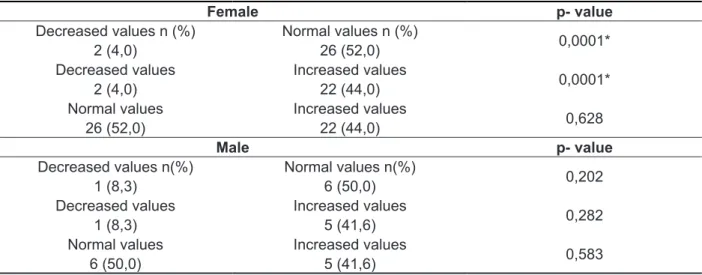
In Tables 1, 2 and 3, it is veriied that the most signiicant majority of females presented normal
SPC and CPC when compared to decreased values. Also, it showed increased value of SPC and CPC and normal and increased AA when compared to the decreased values.
Tables 1 to 3 also show that signiicant majority
of the males had normal and increased SPC, when compared to decreased values; normal CPC, when compared to reduced and increased values; and AA
without signiicant difference.
Regarding the correlations between the SPC, CPC and AA variables listed in Table 4, it is observed that there was a moderate positive corre-lation between the SPC and CPC (0.001) for both genders.
Table 5 shows that the signiicant majority of
subjects was composed of women. The calculation of SPC was conducted by
dividing the VC by MPT /a/. The normal range for females is between 105 and 256 ml/s and for males
between 90 and 260 ml/s. Higher values indicate large air low and short MPT, while lower values relect transglottic reduced airlow, which suggests extensive laryngeal constriction2.
The CPC is obtained dividing the VC by of the average MPT /a, i, u, s, z/ and counting numbers16. It
enables to evaluate the vocal behavior in connected
speech, expecting smaller values than the values
obtained on SPC. The same normal ranges of SPC are used2.
AA indicates approximately the air consumption
during phonation. The subject emits the vowel /u:/ in the spirometer mouthpiece with usual loudness, pitch and vocal quality extending the emission, while
it is timed and it is annotated the ml reached by the piston of the device. Subsequently, it is divided the amount in ml by the time supported. Considered values as normal values between 80 ml/s to 200 ml/s2.
The study was approved by the Research Ethics Committee from the source institution (016945/2010-76).
After being tested the normality of variables (Lilliefords), it was chosen the Spearman test for
Table 1 - Difference between normal values, increased and decreased for Simple Phonic Coeficient
in both sexes
Female p-value
Decreased values n (%) Normal values n (%)
0,0001*
0 (0,0) 42 (84,0)
Decreased values Increased values
0,208
0 (0,0) 8 (16,0)
Normal values Increased values
0,0002*
42 (84,0) 8 (16,0)
Male p-value
Decreased values Normal values
0,0001*
0 (0,0) 8 (66,7)
Decreased values Increased values
0,0005*
0 (0,0) 4 (33,3)
Normal values Increased values
0,299
8 (66,7) 4 (33,3)
Binomial test
Table 2 - Difference between normal values, increased and decreased for Composite Phonic
Coeficient in both sexes
Female p-value
Decreased values n (%) Normal values n (%)
0,0001*
1 (2,0) 45 (90,0)
Decreased values Increased values
0,628
1 (2,0) 4 (8,0)
Normal values Increased values
0,0001*
45 (90,0) 4 (8,0)
Male p-value
Decreased values Normal values
0,0051*
0 (0,0) 11 (91,6)
Decreased values Increased values
0,570
0 (0,0) 1 (8,4)
Normal values Increased values
0,0008*
11 (91,6) 1 (8,4)
Teste Binomial
* statistically signiicant values
Table 3 - Difference between normal values , increased and decreased for Adapted Airlow in both
sexes.
Female p- value
Decreased values n (%) Normal values n (%)
0,0001*
2 (4,0) 26 (52,0)
Decreased values Increased values
0,0001*
2 (4,0) 22 (44,0)
Normal values Increased values
0,628
26 (52,0) 22 (44,0)
Male p- value
Decreased values n(%) Normal values n(%)
0,202
1 (8,3) 6 (50,0)
Decreased values Increased values
0,282
1 (8,3) 5 (41,6)
Normal values Increased values
0,583
6 (50,0) 5 (41,6)
Teste Binomial
* statistically signiicant values.
Table 4 - Correlation between the variables Adapted Airlow, Simple Phonic Coeficient and Composite Phonic Coeficient
CFS
R p- value
CFC 0,673 0,001*
FAA 0,211 0,099
CFC
R p- value
FAA 0,218 0,089
Spearmann test
Although the age group differ from the present study, the results of SPC and CPC obtained are in agreement with the only study found in the literature
review on phonics coeficients, in which the average
CPC of the elderly group studied was 184.35 ml/s for males and 186.93 ml/s for females, within the
expected range for the adult population29.
The subjects of this study showed signiicant
results of SPC and CPC within normality, possibly due to the fact it is a vocal group without increased vocal demand and with normal voice.
Furthermore, it must be considered the fact that the
normal range of these coeficients is relatively large,
with a few research on such measures2.
A study showed the occurrence of increased pneumophonoarticulatory incoordination, as increased vocal demands, proved through evalu-ation of subjects at different times during the training course for professional voice users, but using the relationship s/z21. In this case, the risk interference
is evident that the future voice professional are
exposed when start their professional activities
without adequate preparation for the use of profes-sional voice, may developing laryngeal organofunc-tional disorders1-3,6,7,21.
It is also important to compare the results above
and below the normal range to indicate speciic
situations related to the imbalance between the three levels of vocal production, as mentioned earlier and that, in turn, require targeted therapeutic approaches2,29.
The signiicance of moderate positive correlation
between SPC and CPC variables (Table 4)
corrobo-rates the fact that both coeficients are proposed
to assess the interaction between the vocal levels production2,29.
The AA variable was not correlated to SPC and CPC. It is possible that the fact that the VC
measurement alone includes maximum inhalation and exhalation had favored the correlation between the coeficients, which did not happened on AA,
whose collection does not use deep inspiration2. Still,
the calculation of the coeficients use measures of
VC and MPT collected separately, at different times, and the calculation of AA uses the measurement
DISCUSSION
The balance of the inter-temporal relationship
between the breathing level, with the low and expiratory airway pressure; phonation level, with
adduction and vocal fold vibration; and the articu-lation and resonant level, with the changes of the vocal tract, is a result of a proper pneumophono-articulatory coordination . The emission balanced or coordinated transmits stability, self-control and harmony to the listener and encourages greater vocal resistance2,15,20,25,28, important qualities for
voice professionals.
The pneumophonoarticulatory coordination can be investigated by the use of procedures and calculations that provide information about the inter-action between the three levels involved in voice production (respiratory, phonation and articulatory/ resonant), as in the case of SPC and CPC and AA².
In the present study, the signiicant majority
of females from the group of future voice profes-sional showed normal SPC (Table 1) and CPC (Table 2) and normal and increased AA (Table 3), in comparison with the decreased values. The most
signiicant male presented normal and enlarged
SPC, in comparison to decreased values; normal
CPC and no signiicant difference AA.
For such measures, higher values in relation to normality can be found in cases of glottal closure
or vocal fold paralysis by increasing transglottic low resulting from insuficient coaptation of the vocal folds. In opposition, lower values relect transglottic reduced airlow with large laryngeal constriction.
Both situations create pneumophonoarticulatory incoordination2,29.
In this study, the subjects showed no suggestive vocal quality of air leakage and its increased measures, when compared to the decreased values, suggesting wispy control of the progressive
relaxation of the respiratory muscles, reducing
the MPT not because the air leaking by the glottic
level by glottic insuficiency, but yes, by dificulty in
breathing control level, also featuring a pneumopho-noarticulatory incoordination that can harm their professional vocal performance.
Table 5 - Comparison of two proportions of gender Sexo
p- value Female
n (%)
Male n (%)
50 (80,6) 12 (19,3) 0,001*
Binomial Test
incoordination. Thus, subjects previous assessment and vocal preparation, including the training of pneumophonoarticulatory coordination, before the start of the professional voice use, may minimize the occurrence of behavioral dysphonia or organo-functional caused by pneumophonoarticulatory incoordination.
Due to the ease of use of the measures studied
in the speech clinic; your chance of quantiication,
which allows more objective assessment and
monitoring of patients; and the scientiic research
literature gap on them, more studies are needed.
CONCLUSION
The most signiicant of the future voice profes
-sional studied showed normal values of SPC and CPC, and there was a moderate positive correlation between these measures. AA with normal and
increased results was signiicant only in females
and showed no correlation with SPC and CPC. The
most signiicant of the group of future voice profes -sional was composed by women.
of expiratory air low in ml during vocal emission
which is measured at the same time, in the same occasion2.
No studies were found in the literature referring to the AA measure for comparison and discussion of the results of this work, however it can be suggested that the AA is a complementary measure to the
phonic coeficients, since their results, in females, were approached to the coeficients results. In males, there was no statistical signiicance, possibly
due to being a small group.
Regarding the frequency of genders, a signif-icant majority of the study group (Table 5) was composed of women, in agreement to other studies involving professionals and future professionals and indicating the predominance of female gender1,10.
Vocal disorders may be linked to occupational
activity and directly inluence in the professional and
social life of the subject, harming the professional activities of those who depends on the voice to perform their profession1. The indings in this work
show that subjects, even without great vocal demand and normal voice, presented some results outside the normal range, suggesting pneumophonoarticulatory
RESUMO
Objetivo: veriicar e correlacionar o luxo aéreo adaptado (FAA), coeiciente fônico simples (CFS)
e coeiciente fônico composto (CFC) de adultos jovens de ambos os sexos, sem alterações vocais, futuros proissionais da voz, e veriicar a frequência dos sexos. Métodos: 62 sujeitos entre 18 e
35 anos (12 homens, média 24,25 anos e 50 mulheres, média 21,42 anos); avaliação vocal pela escala RASATI com coeiciente de coniabilidade Kappa; coleta dos tempos máximos de fonação (TMF) de /a,i,u,s,z/, contagem de números, capacidade vital e FAA; cálculo dos CFS e CFC; teste
de Spearmann para as correlações entre as variáveis e teste binomial para proporções de valores
normais, diminuídos e aumentados. Resultados: a maioria signiicante feminina apresentou CFS e
CFC normais, e FAA normal e aumentado, em comparação aos valores diminuídos. A maioria signii
-cante masculina apresentou CFS normal e aumentado, em comparação aos valores diminuídos; CFC
normal e FAA sem diferença estatisticamente signiicante. Houve correlação positiva moderada entre
o CFS e o CFC para ambos os sexos. Conclusão: a maioria signiicante dos futuros proissionais
da voz estudados apresentou CFS e CFC normais e com correlação positiva moderada. A maioria signiicante feminina obteve resultados de FAA normais e aumentados, em comparação aos valores diminuídos, e o FAA não apresentou correlação com CFS e CFC. A maioria signiicante do grupo de futuros proissionais da voz foi composta por mulheres.
DESCRITORES: Voz; Fonação; Qualidade da Voz; Laringe; Saúde do Trabalhador
REFERÊNCIAS
1. Fortes FSG, Imamura R, Tsuji DH, Sennes LU.
Peril dos proissionais da voz com queixas vocais atendidos em um centro terciário de saúde. Rev Bras Otorrinolaringol. 2007;73(1):27-31.
2. Behlau M, Madazio G, Feijó D, Pontes P. Avaliação
de voz. In: Behlau M. Voz: O livro do Especialista.
Rio de Janeiro: Revinter; 2008. p. 86-129.
3. Ueda KH, Santos LZ, Oliveira IB. 25 Anos de
cuidados com a voz proissional: Avaliando Ações.
16. Fabron EMG, Santos GR, Omote S, Perdoná
GC. Medidas da dinâmica respiratória em crianças
de quatro a dez anos. Pró-Fono. 2006;18(3):313-22. 17. Lierde KMV, D’haeseleer E, Wuyts FL, Ley S,
Geldof R, Vuyst J, Soie C. The Objective Vocal
Quality, Vocal Risk Factors, Vocal Complaints , and Corporal Pain in Dutch Female Students Training to be Speech-Language Pathologists During the 4 Years of Study. J Voice. 2008;24(5):592-8.
18. Gelfer MP, Pazera JF. Maximum Duration
of Sustained /s/ and /z/ and the s/z Ratio With Controlled Intensity. J Voice. 2006;20(3):369-79.
19. Roman-niehues G, Cielo CA. Modiicações
vocais acústicas produzidas pelo som hiperagudo. Rev CEFAC. 2009;12(3):462-70.
20. Kurtz LO, Cielo CA. Tempos máximos de
fonação de vogais em mulheres adultas com
nódulos vocais. Pró-fono. 2010; 22(4):451-4. 21. Grillo EU, Fugowski. Characteristics of female physical education student teachers. J Voice. No prelo. 2011.
22. Finger LS, Cielo CA, Schwarz K. Medidas
vocais acústicas de mulheres sem queixas de voz e com laringe normal. Braz J Otorhinolaryngol.
2009;75(3):432-40.
23. Pinho MR, Pontes P. Escala de avaliação
perceptiva da fonte glótica: RASAT. Vox Brazilis.
2002;3(1):11-3.
24. Costa JO, Gama ACC, Oliveira JBO, Neto ALR.
Avaliação acústica e perceptivo-auditiva da voz nos momentos pré e pós-operatório da cirurgia de implante de pré-fáscia do músculo temporal. Rev
CEFAC. 2008;10(1):76-83.
25. Cielo CA, Lasch SS, Miglioranzi SL, Conterno
G. Tempos máximos de fonação e características
vocais acústicas de mulheres com nódulos vocais. Rev CEFAC. No prelo. 2011
26. Carrasco ER, Oliveira G, Behlau M. Análise perceptivo-auditiva e acústica da voz de indivíduos gagos Rev CEFAC. 2010;12(6):925-35.
27. Beber BC, Cielo CA, Siqueira MA. Lesões de
borda de pregas vocais e tempos máximos de fonação. Rev CEFAC. 2009;11(1):134-41.
28. Cielo CA, Conterno G, Carvalho CDM, Finger
LS. Disfonias: relação s/z e tipos de voz. Rev
CEFAC. 2008;10(4):536-47.
29. Fabron EMG, Sebastião LT, Oliveira GAG,
Motonaga SM. Medidas da dinâmica respiratória em idosos participantes de grupos de terceira idade. Rev CEFAC. No prelo. 2011.
4. Fabrício MZ, Kasama ST, Martinez EZ. Qualidade de vida relacionada à voz de professores
universitários. Rev CEFAC. 2009;12(2):280-7.
5. Santana MCCP, Brandão KKCP, Goulart BNG,
Chiari BM. Fonoaudiologia e saúde do trabalhador:
vigilância é informação para a ação!. Rev
CEFAC. 2009;11(3):522-8.
6. Spina AL, Maunsell R, Sândalo R, Gusmão R,
Crespo A. Correlação da qualidade de vida e voz com atividade proissional. Brazilian J Otorhinolaryngol.
2009;75(2):275-9
7. Rossi DC, Munhoz DF, Nogueira CR, Oliveira
TCM, Britto ATBO. Relação do pico de luxo expiratório com o tempo de fonação em pacientes asmáticos. Rev CEFAC. 2006;8(4):509-17.
8. Tavares JG, Silva, EHAA. Considerações teóricas
sobre a relação entre respiração oral e disfonia. Rev
Soc Bras Fonoaudiol. 2008;13(4):405-10.
9. Gampel D, Karsch UM, Ferreira LP. Percepção de voz e qualidade de vida em idosos professores
e não professores. Ciênc. Saúde Coletiva.
2010;15(6):2907-16.
10. Gottliebson RO, Lee L, Weinrich B, Sanders J. Voice Problems of Future Speech-Language Pathologists. J Voice. 2007;21(6):699-704.
11. Farghaly SM, Andrade CRF. Programa de
treinamento vocal para locutores de rádio. Rev Soc
Bras Fonoaudiol. 2008;13(4):316-24.
12. Cielo CA, Cappellari VM. Tempo máximo de
fonação de crianças pré-escolares. Rev Bras Otorrino. 2008;74(4):552-60.
13. Speyer R, Bogaardt HCA, Passos VL,
Roodenburg NPHD, Zumach A, Heijnen MAM et al. Maximum Phonation Time: Variability and Reliability.
J Voice. 2010; 24(3):281-4.
14. Valentim, AF, Cortês MG, Gama ACC. Análise
espectrográica da voz: efeito do treinamento visual na coniabilidade da avaliação. Rev Soc Bras
Fonoaudiol. 2010;15(3):335-42.
15. Miglioranzi SL. Capacidade vital e tempos
máximos de fonação e /e/ áfono e /s/ em mulheres adultas. [dissertação] Santa Maria (RS):
Universidade Federal de Santa Maria; 2010.70f.
Received on: April 13, 2012 Accepted on: September 04, 2012
Mailing address: Carla Aparecida Cielo Rua Pedro Londero, 155 Santa Maria – RS CEP: 97095-530