Abst ract
Submitted: May 17, 2016 0RGL¿HG'HFHPEHU Accepted: March 20, 2017
,QÀXHQFHRIFXULQJSURWRFRODQG
ceram ic com posit ion on t he degree of
conversion of resin cem ent
Due t o increasing of aest het ic dem and, ceram ic crowns are widely used in different sit uat ions. How ever, t o obt ain long- t erm prognosis of rest orat ions, a good conver sion of r esin cem ent is necessar y. Obj ect ive: To evaluat e t he degree of conversion ( DC) of one light - cure and t w o dual- cure resin cem ent s under a sim ulat ed clinical cem ent at ion of ceram ic crow ns. Mat erial and Met hods: Prepared t eet h w ere random ly split according t o t he ceram ic’s m at erial, resin cem ent and curing prot ocol. The crow ns w ere cem ent ed as per m anufact urer ’s direct ions and phot oact ivat ed eit her from occlusal suface only for 60 s; or from t he buccal, occlusal and lingual surfaces, w it h an exposure t im e of 20 s on each aspect . Aft er cem ent at ion, t he specim ens were st ored in deionized wat er at 37° C for 7 days. Specim ens w ere t ransversally sect ioned from occlusal t o cervical surfaces and t he DC was det erm ined along t he cem ent line w it h t hree m easurem ent s t aken and averaged from t he buccal, lingual and approxim al aspect s using m icro- Ram an spect roscopy ( Alpha 300R/ WI Tec®) . Dat a w ere analyzed by 3- way ANOVA and Tukey t est DW 5HVXOWV6WDWLVWLFDODQDO\VLVVKRZHGVLJQL¿FDQWGLIIHUHQFHVDPRQJ cem ent s, curing prot ocols and ceram ic t ype ( p< 0.001) . The curing prot ocol 3x20 result ed in higher DC for all t est ed condit ions; lower DC was observed for Zr ceram ic crowns; Duolink resin cem ent culm inat ed in higher DC regardless ceram ic com posit ion and curing prot ocol. Conclusion: The DC of resin cem ent layers was dependent on t he curing prot ocol and t ype of ceram ic.
Ke y w o r d s: Resin cem en t . Micr o- Ram an sp ect r oscop y. Deg r ee of conversion. Ceram ics.
Marcos Daniel Septimio LANZA1
Marcello Rubens Barsi ANDREETA2
Thiago Amadei PEGORARO3
Luiz Fernando PEGORARO4
Ricardo Marins de CARVALHO5
1Universidade Federal de Minas Gerais, Departamento de Odontologia Restauradora, Belo Horizonte,
MG, Brasil.
2Universidade Federal de São Carlos, Departamento de Engenharia de Materiais, Laboratório de
Materiais Vítreos, São Carlos, SP, Brasil.
3Universidade do Sagrado Coração, Departamento de Prótese e Implantodontia, Bauru, SP, Brasil. 4Universidade de São Paulo, Faculdade de Odontologia de Bauru, Departamento de Prótese e
Periodontia, Bauru, SP, Brasil.
5University of British Columbia, Faculty of Dentistry, Department of Oral Biological and Medical
Sciences, Division of Biomaterials, Vancouver, Canada.
Corresponding address: Marcos Daniel S. Lanza Departamento de Odontologia Restauradora -
Faculdade de Odontologia -Universidade Federal de Minas Gerais. Av. Presidente Antonio Carlos, 6627 - Pampulha - Belo Horizonte - MG - Brazil.
I nt roduct ion
All- cer am ic r est or at ion s h av e becom e popu lar
f or ex cellen t aest h et ics, color st ab ilit y, ab r asion
resist ance and biological com pat ibilit y2. How ever, t o
obt ain rest orat ions w it h favorable prognosis, a high degree of conversion ( DC) of resin cem ent should be achieved1,21. I ncom plet e polym erizat ion of t he resin cem ent occurs by decreased energy from t he light sour ce t hr ough t he ceram ic m at er ial. The am ount of t his at t enuat ion has been show n t o be dir ect ly dependent on t he com posit ion, t hickness, opacit y and color of t he m at erials used as rest orat ion2.
Th er e ar e dif f er en t t y pes of cer am ics u sed in
d en t ist r y, w it h d if f er en t d eg r ees of t r an slu cen cy
LQÀXHQFLQJWKHGHSWKRIFXUHDQGKDUGQHVVRIUHVLQ
cem en t s as a f u n ct ion of ligh t at t en u at ion2 1. Th e
decrease in light int ensit y can be caused by absorpt ion
an d scat t er in g of ligh t by phy sical an d st r u ct u r al
differences of t he rest orat ions1. Ceram ic rest orat ions
are considered opt ical het erogeneous m at erials23 w it h
varying degrees of t ranslucency t hat can be changed
by t he t hickness, cryst al st ruct ure, porosit y bet w een
t h e lay er s, possible ch an ge in t h e con st it u t ion of
LQIUDVWUXFWXUHDQGDUHÀHFWLRQRIWKHLQIUDVWUXFWXUH
bet w een t h e in t er f ace an d t h e cer am ic cov er1 3, 1 4.
Furt herm ore, increased t hickness m ore t han 2 m m KDV D VLJQL¿FDQW HIIHFW RQ WKH WUDQVPLVVLRQ RI OLJKW and, consequent ly, t he hardness of resin cem ent s1,17.
2WKHUIDFWRUVWKDWFDQLQÀXHQFHWKHSRO\PHUL]DWLRQRI resin cem ent s are relat ed t o t he energy int ensit y of t he light source, wavelengt h, t im e and dist ance from t he energy source in relat ion t o t he com posit e5,18,30. Peut zfeldt and Asm ussen25 ( 2005) st at ed t hat t he
DPRXQW RI HQHUJ\ KDV VLJQL¿FDQW LQÀXHQFH RQ WKH DC, t he ext ent of crosslinking and t he physical and m echanical propert ies of t he com posit e being cured.
Dual- cure resin cem ents have been developed under t he concept t hat chem ical cure alone could achieve subst ant ial polym erizat ion in areas unreachable by t he light source. The light - cured port ion should opt im ize t he cure along t he exposed cem ent layer and provide in it ial st abilit y u n t il t h e self- cu r in g cou ld m at u r e. How ever, it is know n t hat t he t w o curing rout es are independent and t he rat e as t o each one cures varies am ong m at erials and is rat her an inherent aspect of t heir chem ist ry. Considering t his, we m ay say t hat t he curing rat e of som e cem ent s can be m ore dependent on light exposure t han ot hers20,22,24.
Am ong t he m et hods used t o det er m ine t he DC
of com posit es, t he Ram an spect r oscopy has been
show n t o be very suit able for being relat ively sim ple, reproducible, noninvasive, and for allow ing t he use of t hin specim ens wit hout requiring special preparat ion26.
Som e st udies have evaluat ed t he DC of resin cem ent s
w hen cured t hrough ceram ic slabs17. How ever, t here
is lack of dat a on t he DC of resin cem ent s w hen cured
t hr ough act ual cr ow ns, under a sim ulat ed clinical
set t ing. This is relevant because under a crow n, t he
cem ent layer is cover ed by a var y ing t hick ness of
ceram ic from cervical t o occlusal surfaces. Moreover,
lim it ed access and t he presence of neighboring t eet h
in t he m out h lead clinicians t o decide for a cur ing
pr ot ocol of t he ex posed ceram ic sur faces, w it hout
act ually know ing if t he DC w ould be affect ed. Thus,
WKLVVWXG\DLPHGWRHYDOXDWHWKHLQÀXHQFHRIDFWLYDWLRQ
prot ocols and different com posit ion of ceram ics in t he
DC of resin cem ent s under a sim ulat ed clinical set t ing.
The follow ing null hypot heses w ere t est ed: ( 1) t he
curing prot ocol does not affect t he DC of t he cem ent s;
WKHFHUDPLFFRPSRVLWLRQKDVQRLQÀXHQFHRQWKH
DC of t he cem ent s.
Mat erial and m et hods
Preparat ion of t he sam ples
This st udy w as appr ov ed by t he Baur u School
of Dent ist r y, Univer sit y of São Paulo ( pr ot ocol no.
150/ 2010) . Thirt y- six sound hum an prem olars t hat
w ere ext ract ed for ort hodont ic reasons received
full-crow n preparat ions adequat e for ceram ic rest orat ions
( 1. 5 m m ax ial and 2 m m occlusal r educt ion; and
6 ° an d 1 0 ° of dou ble conv er gen ce) . I m pr ession s
w er e t ak en fr om t he pr eparat ions ( I m pr egum / 3 M
ESPE, St Paul, Minnesot a, USA) and individual dies
creat ed w it h gypsum ( Type I V Velm ix Kerr, Rom ulus,
Michigan, USA) . The dies w ere random ly divided int o
t w o groups ( n= 18) . One group was used t o const ruct
m onolit hic ceram ic crow ns in lit hium disilicat e ( LD)
g l a ss ce r a m i c ( I PSe . m a x Pr e ss/ I v o cl a r Vi v a d e n t ,
Schaan, Liecht enst ein, Ger m any) . The ot her gr oup was used t o const ruct infrast ruct ures of high- st rengt h zir conium ox ide ( I PSe. m ax Zir CAD/ I voclar Vivadent ,
Schaan, Liecht enst ein, Germ any) , w it h 0.5 m m t hick
DQGNjPVSDFHIRUFHPHQWIROORZHGE\YHQHHULQJ ZLWKSUHVVHGFHUDPLFEDVHGÀXRUDSDWLWHFRDWLQJ,36H
Germ any) . For bot h ceram ic t ypes, t he t hicknesses
RIWKH¿QDOFURZQVZHUHVWDQGDUGL]HGDWPPDQG
2.0 m m for axial and occlusal surfaces, respect ively;
and w ere const ruct ed in shade A2.
Th e f it t in g of t h e cr ow n s w as t est ed in each
pr epar at ion w it h t h e aid of low v iscosit y silicon e
( Xant opr en® VL Plus/ Heraus Kulzer, Hanau, Hesse,
Germ any) . Cont act areas w ere rem oved by reducing
t he preparat ion t o avoid alt ering t he t hickness of t he
FURZQ7KH¿WWLQJWHVWZDVUHSHDWHGXQWLODXQLIRUP ¿OPRIVLOLFRQHZDVREWDLQHG&HUYLFDODGDSWDWLRQZDV
assessed w it h t he aid of an explorer # 05 ( Hu- Friedy,
Chicago, I llinois, USA) by an independent operat or
and was considered accept able w hen t he probe did
not det ect discrepancies at t he crow n- t oot h int erface.
Cem ent at ion and curing prot ocol
The m at erials used in t his st udy are list ed in Figure
1. The crit eria used t o choose t hese m at erials w ere
based on m anufact ur er ’s indicat ion for all ceram ic
crow ns cem ent at ion ( t w o dual cured resin cem ent ) ,
and t o validat e our m et hodology as a negat ive cont rol
( one light act ivat ed resin cem ent ) .
To sim u lat e t h e clin ical set t in g , t w o n at u r al,
ext ract ed t eet h ( one prem olar and one m olar) w ere
¿[HGE\WKHURRWVRQDSXWW\3962SWRVLO®/ Heraus
Ku lzer, Han au , Hesse, Ger m any ) m old allow in g a
GLVWDQFHEHWZHHQHDFKRWKHUWR¿WWKHSUHSDUHGWHHWK
t o receive t he cem ent at ion. The dist ance was set in
a m anner t hat t here w ould be proper int erproxim al
cont act of t he nat ural t eet h and t he cr ow n being
ce m e n t e d ( Fi g u r e 2 ) . Be f o r e ce m e n t a t i o n , t h e
pr eparat ions w er e cleaned w it h pum ice slur r y ( SS
Whit e Dent al Art icles Lt da, Rio de Janeiro, RJ, Brazil) ,
washed in running wat er and dried w it h air for 30 s.
For Choice 2 and Duolink resin cem ent , t he adhesive
syst em All Bond 2 ( Bisco/ I nc®, Chicago, I llinois, USA)
was used, followed by Prim eBond ( Bisco/ I nc®, Chicago,
I llinois, USA) applicat ion. For VariolinkI I resin cem ent ,
t h e adh esiv e sy st em Ex cit eDSC ( I v oclar Viv aden t ,
Sch aan , Liech t en st ein , Ger m an y) w as u sed . Th e
SUHSDUHGWHHWKZHUH¿[HGLQWKHVSDFHEHWZHHQWKH
nat ural t eet h and bot h t he dent in and t he int aglio
surface of t he crow n w ere t reat ed according t o t he
respect ive m anufact urer ’s direct ions ( Figures 3 and 4) .
Light curing of resin cem ent was perform ed ( LED;
Ult raled Dabi At lant e, Ribeirão Pret o, SP, Brazil) w it h
out put pow er densit y of 950 m W/ cm2, m onit ored for
consist ency w it h t he aid of a radiom et er ( Model 100,
Kerr Corporat ion, Orange, California, USA) before each
use. On som e m easures w e det ect ed a low er int ensit y
com pared wit h t hat provided by t he m anufact urer, but
QRWFOLQLFDOO\VLJQL¿FDQW7KHVDPSOHVHWZDVUDQGRPO\
divided int o subgroups ( n= 3) , according t o t he cem ent
and act ivat ion prot ocol select ed, as follow s:
1) Cur ing Pr ot ocol 3x20: phot oact ivat ion in t he
buccal, lingual and occlusal surfaces, w it h exposure
t im e of 20 s on each side, sequent ially;
2) Curing Prot ocol 1x60: phot oact ivat ion only by
occlusal surface w it h exposure t im e of 60 s.
Aft er cem ent ing, t he set was left undist urbed for
15 m i and t hen st ored in deionized wat er at a const ant
t em perat ure of 37° C for 7 days in a dark environm ent .
Aft er t his period t he specim ens were serially sect ioned
( I som et 2000 pr ecision saw – Buehler, Lake Bluff,
I llin ois, USA) in t h r ee r eg ion s: 2 m m b elow t h e
occlusal surface plane; at t he cent er of t he crow n;
and 2 m m below t he cervical m argin, t o obt ain t w o
discs of appr ox im at ely 2 m m t hick ness. The discs
w ere m anually polished for 1 m inut e using 1200 and
2000 grit SiC paper ( EXTEC – Erios I nt ernacional, São
Paulo, São Paulo, Brazil) , and ult rasonicat ed for 5 m in
Resin Cement/ Manufacturer / Lot
Composition Curing Mode Adhesive system/Manufacture/Lot
Choice2TM/ Bisco Inc 1000005368
DuolinkTM/ Bisco Inc 1000011303
BisGMA, strontium glass, Amorphous Silica
%LV*0$7(*'0$8'0$DQG¿EHUJODVV
Light-activated
Dual
All Bond 2/ Bisco Inc (100005177) Primer A: Acetone, ethanol, salts
PHWKDFU\ODWH3ULPHU%$FHWRQH HWKDQRO%3'0
Pre-Bond Resin: Bis-GMA, TEGDMA, benzoyl peroxide
VariolinkII®/ IvoclarVivadent
N50808
Bis-GMA, UDMA, TEGDMA, barium glass,
\WWHUELXPWULÀXRULGHJODVVÀXRUVLOLFDWH
barium and aluminum mixed oxide spheroidal. Catalysts, stabilizers and
pigments.
Dual Excite®DSC/IvoclarVivadent (N14938) EMA, di methacrylate, acrylate phosphonic acid, silicon dioxide, initiators stabilizers. Brush Coated
primers.
%LV*0$ ELVSKHQRO $ JO\FLG\OPHWKDFU\ODWH 7(*'0$ WULHWK\OHQHJO\FRO GLPHWKDFU\ODWH 8'0$ XUHWKDQH GLPHWKDFU\ODWH %3'0
bisphenil dimethacrylate
bet w een each, and aft er polishing. The experim ent al
design was perform ed in order t o evaluat e t he behavior
RIUHVLQFHPHQWVDQGWRUHDGWKHZKROHDUHD¿OOHGE\
resin cem ent .
Degree of conversion analysis
The DC was analyzed in a m icro- Ram an com bined
w it h a confocal opt ical m icroscope ( Alpha 300 A/
R-WI Tec®, D- 89081 Ulm , Germ any) , com posed of a laser
He: Ne w it h a wavelengt h of 632 nm . Each disc was
placed on t he plat form of t he m icroscope t o locat e t he
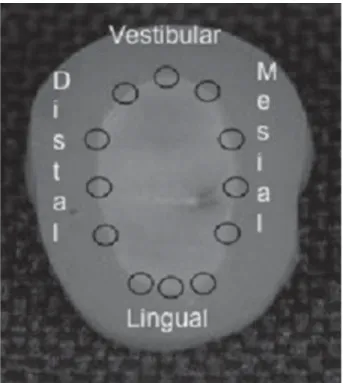
line of t he cem ent . Tw elve readings w ere perform ed
on each disc, t h r ee in each side ( bu ccal, m esial,
lingual and dist al) of each t hird ( occlusal, m edium and
cervical) as t ot al of 108 readings for each experim ent al
group ( Figures 5 and 6, respect ively) . To allow for t he
calculat ion of t he degree of conversion, sam ples of
t he uncured cem ent s w ere m anipulat ed, im m ediat ely
dispensed in a prefabricat ed st ainless st eel m at rix ( 4
m m x 1 m m ) and t he readings perform ed w it h t he
Ram an inst rum ent .
The Ram an inst rum ent was aligned for m easuring
t h e r elat iv e in t en sit y of t h e ar om at ic ban d, w it h
t he m ain peak at 1608 cm- 1, r elat ive t o t he band
w it h aliphat ic m aj or peak at 1638 cm- 1. All Ram an
m easu r em en t s w er e t ak en w it h f ou r acq u isit ion spect ra of 20 s each. The det erm inat ion of DC was per for m ed in accor dance w it h t he m ax im um peak
at 1638 cm- 1 com par ed w it h t he peak 1608 cm- 1,
according t o t he equat ion:
DC( % ) = 100x[ 1- Rcured/ Runcured) ]
w h er e R r ep r esen t s t h e r at i o b et w een 1 6 3 8
cm1/ 1 6 0 8 cm- 1 of poly m er ized and unpoly m er ized
cem ent15.
CERAMIC HYDROFLUORIC ACID 10%
SILANE (MONOBOND-S)
Z PRIME PLUS ADHESIVE SYSTEM
Lithium Disilicate 20 s + H2O washing One layer for 60 s NA One layer + curing/20 s.
Zirconium NA NA Apply 1-2 coats + drying
with air 3-5 sec
One layer + curing/20 s.
NA: Not applicable
Figure 3- Bonding procedures for the ceramic crowns
CEMENTS PHOSPHORIC ACID 37%
ADHESIVE SYSTEM HANDLING (CEMENTS)
CEMENTATION
VL 20 s dentin+ H2O washing + drying with air
without dehydration
3 layers of Excite DSC + curing 20 s
10 s mixing the base and catalyst pastes
Apply a thin layer on the inner
VXUIDFHVRIWKHFURZQVHDWLQJZLWK
manual pressure, removing excess and photo activation according to the
curing protocols in test
DL 5 layers of All-Bond 2 +
curing 20 s + 1 layer of Pre-Bond Resin
Dual self-mixing syringe
CH None
9/9DULROLQN,,'/'XROLQN&+&KRLFH
Figure 4- Bonding procedures for dentin and cementation
St at ist ical analysis
Dat a w ere analyzed by 3- way ANOVA ( Sigm a Plot
-DQGHO6FLHQWL¿F6DQ5DIDHO&DOLIRUQLD86$
for fact ors cem ent s X curing prot ocols X ceram ics, and
Tukey’s t est for all pairw ise m ult iple com parison w it h
DVLJQL¿FDQFHOHYHORID= 5% .
Result s
Th e a v e r a g e r e s u l t s ( % ) D C a n d s t a n d a r d
dev iat ion s of t h e gr ou ps ev alu at ed ar e sh ow n in
Ta b l e 1 . St a t i st i ca l a n a l y si s sh o w ed si g n i f i ca n t
d i f f e r e n ce s f o r ce m e n t s ( F= 3 9 5 . 9 2 , p < 0 . 0 0 1 ) ,
ceram ics ( F= 363.95, p< 0.001) , and curing prot ocols
) SZLWKDVWDWLVWLFDOO\VLJQL¿FDQW
in t er act ion bet w een f act or s ( F= 9 . 6 7 9 , p< 0 . 0 0 1 ) .
Pair- w ise com parisonsshow ed t hat t he DC of t he t w o
dual- cure resin cem ent s ( Duolink/ Bisco/ I nc®, Chicago,
I llinois, USA and Variolink I I / I voclarVivadent , Schaan,
Curing Protocol
1X60n 3X20u
Resin Cement DL VL CH DL VL CH
Ceramic
DSLT 85.8(4.3)A,a 75.5(5.8)A,b 67.8(8.5)A,c 86.7(3.2)A,a 77.4(2.9)A,x 74.4(6.0)A,y
ZR 76.3(3.2)B,a 61.4(10.9)B,c 65.5(12.2)A,b 78.3(3.6)B,ax 70.8(3.9)B,x 72.2(6.7)A,x
Means followed by different symbol for curing protocol, upper case for ceramic (column) and lower case for resin cement (row) differ
VWDWLVWLFDOO\E\7XNH\WHVWS
&(0(1769/9DULROLQN,,'/'XROLQN&+&KRLFH &(5$0,&6'6/7/LWKLXP'LVLOLFDWH=5=LUFRQLXP
Table 1-0HDQSRROHGYDOXHVLQ'&6'
Figure 5- Schematic diagram representing reading location related to the proximal aspects
Liech t en st ein , Ger m any ZDV DOZD\V VLJQL¿FDQWO\
higher under lit hium disilicat e crow ns, regardless of
t he curing prot ocol used. The except ion was observed
for t he light - cured resin cem ent ( Choice 2) for w hich
WKHGLIIHUHQFHVZHUHQRWVLJQL¿FDQW,QJHQHUDOWKH
3x20 curing prot ocol result ed in higher DC for each
individual com binat ion of ceram ic and resin cem ent .
This was even m ore evident for t he light - cured only
resin cem ent CH, and for t he ZR ceram ic syst em .
Discussion
This st udy innovat ively evaluat ed t he DC of resin cem ent s when cured at a clinical sim ulat ed set t ing. For t his purpose, act ual crow ns w ere creat ed from eit her lit hium disilicat e ( DLST) or Y-TZP ( ZR) and cem ent ed on t he originat ing preparat ion cut on ext ract ed t eet h, and respect ing a clinical scenario w here neighboring t eet h are present . Thus, w e evaluat ed t w o different cu r in g p r ot ocols t h at w ou ld lik ely b e ch osen b y clinicians in order t o ensure t he curing of t he cem ent under t he crow ns. Wit hout varying t he t ot al energy d eliv er ed , t h e cem en t w as cu r ed eit h er b y lig h t ex posing each one of t he t hr ee sur faces available ( bu ccal, lin gu al an d occlu sal) f or 2 0 s ( 3 x 2 0 ) or delivering a single exposure of 60 s from t he occlusal surface only. While t he t ot al energy delivered wit h bot h prot ocols rem ained unchanged, clinicians w ould t end t o t hink t hat t he m ult iple exposure prot ocol is m ore t im e consum ing8, t hus preferring t he single exposure
w it hout know ing if t his w ould affect t he act ual curing of different cem ent s under different ceram ic syst em s.
Th e r esu l t s sh o w ed t h at t h e cu r i n g p r o t o co l
LQÀXHQFHG WKH '& 7KHUHIRUH WKH ¿UVW K\SRWKHVLV
VKRXOGEHUHMHFWHG6LPLODU¿QGLQJVZHUHUHSRUWHG10
o n m i cr o h a r d n e ss o f r e si n co m p o si t e s u se d i n
class I I rest orat ions and show ed t hat t he fract ional
phot oact ivat ion prom ot ed superior result s t han t hose
obt ained wit h single phot oact ivat ion. When applying a
single, large am ount of power as t he prot ocol 1x60, t he
m onom ers appear t o be act ivat ed fast er and generat e
m ult iple grow t h cent ers, w hich m ay cause prem at ure
polym erizat ion of t he com posit e due t o t he decrease in
m obilit y of radicals, which, in t urn, prevent s m igrat ion
of act ive free radicals and t hus causes a low DC11,12.
Conv er sely, if t h e r eact ion pr ocess is slow er, t h e r esinous m at er ial m ay be capable of r em aining in
VWDWH³ÀXLG´IRUDORQJHUWLPHDQGSURYLGHKLJKHU'&
due t o t he great er m obilit y t hat occurs bet w een free
UDGLFDOVZKLFKLPSURYHVWKHHI¿FLHQF\RIUHDFWLRQ6,11.
Anot her fact or t hat m ay have cont ribut ed t o t he
low er DC w hen t he cem ent s w ere act ivat ed by t he
occlusal surface only ( 1x60) was t he dist ance from
t he t ip t o t he m ost cervical regions of t he crow ns.
Ou r ex per im en t al design allow ed f or det er m in in g
t he DC at different surfaces and t hirds of t he crow ns
( see Mat erial and Met hods) . We observed t hat w hile
t here w ere no differences am ong t he buccal, lingual
and approxim al aspect s at each individual t hird, w e
did observe low er DC at t he cervical t hird w hen t he
1 x 6 0 cu r in g pr ot ocol w as u sed ( dat a n ot sh ow n )
and t hat was m ore evident for t he m ore opaque ZR
syst em . Alt hough t he readings allow ed for analysis
of surfaces and t hirds, and did provide t he im port ant
inform at ion t hat cervical t hirds are at higher risk of
com pr om ised cu r in g w h en ligh t act ivat ion is on ly
delivered from occlusal surface, t hey are all regarded
as correlat ed for st at ist ical purposes and, t herefore,
ZHUHSRROHGIRUWKH¿QDODQDO\VLV. Resin cem ent s have
t aper ing poly m er izat ion accor ding t o t he dist ance
from light . Regarding curing prot ocol, Variolink and Duolink exhibit ed sim ilar DC values when cured under
lit hium disilicat e glass ceram ic, suggest ing t hat t he
dist ance from t he light for t hose cem ent s was not a
relevant fact or w hen using m ore t ranslucent ceram ic.
Th i s ar g u m en t f i n d s su p p o r t i n t h e l i t er at u r e1 9.
Furt herm ore, Duolink also present ed m ore uniform
DC w hen cured under t he m ore opaque ZR. I t has
been report ed t hat Duolink has low er concent rat ion
RI¿OOHUSDUWLFOHVDQGWKLVPD\IDFLOLWDWHWKHPRELOLW\
and react ivit y of curing m onom ers, t hus result ing in
m ore uniform curing, regardless of t he curing prot ocol
and ceram ic t ype24.
Th e o p t i m u m t i m e o f a ct i v a t i o n o f d i f f er en t
com posit es is not yet fully est ablished. I t is speculat ed
t hat longer light ex posur es pr om ot e gr eat er DC9.
Acco r d i n g t o so m e a u t h o r s2 7 , 2 8, a m i n i m u m o f
6 0 seco n d s o f p h o t o act i v at i o n t h r o u g h cer am i c
r est or at ion s w it h t h ick n ess 2 m m or m or e w ou ld
be needed t o prom ot e adequat e curing of t he resin
cem en t . Fu r t h er m or e, a decr ease in t h e DC w as
observed w it h opaque ceram ic w hen act ivat ed for 40
s3. I n t his st udy, w e chose t he t ot al exposure t im e of
60 s, regardless of t he curing prot ocol as an arbit rary
t im e t hat w ould cover m ost of t he concerns of st udies
and recom m endat ions of m anufact urers regarding t he
ZHDVVXPHGWKDWVZRXOGEHDFOLQLFDOO\MXVWL¿DEOH
exposure t im e w hen curing t hrough ceram ics.
Regarding t he com posit ion of t he ceram ics, our
UHVXOWVVKRZHGDVLJQL¿FDQWLQÀXHQFHRQWKH'&IRU
m ost resin cem ent s, t hus leading us t o part ially rej ect t he second hypot hesis. I n general, t he DC was always higher for t he lit hium disilicat e t han for t he zirconia-based ceram ics. Glass- ceram ics have few er cr yst al st ruct ure and great er t ranslucency w hen com pared w it h alum ina- based and zirconia- based ceram ics13,14.
Accordingly, t he higher t he light t ransm it t ance, t he great er t he polym erizat ion of cem ent21. An except ion
occurred wit h t he negat ive cont rol, light- cured cem ent ( Choice 2) t hat result ed in sim ilar DC for bot h ceram ics wit hQRVWDWLVWLFDOO\VLJQL¿FDQWGLIIHUHQFH:HH[SHFWHG
t hat cur ing of t his cem ent w ould be com pr om ised
by t he im posed lim it at ions of light t ransm it t ance.
How ever, since t his was not t he case, w e speculat e
t hat t he uniform curing observed in Choice 2 light
-cured cem ent was due t o t he applicat ion of Pre- Bond Resin aft er condit ioning w it h All- Bond 2 adhesive ( see
Mat erial and Met hods) . This st ep could enhance t he DC along t he int erface because of t he presence of benzoyl per ox ide in t he for m ulat ion of Pr e- Bond4, 15, 29. This
could also explain t he m ore uniform DC observed for Duolink, w hich also includes Pre- Bond in t he bonding procedure.
Because of inherent differences in t he form ulat ion and curing m ode of t he cem ent s, it was not expect ed t hat t hey w ould have sim ilar DC. How ever, post hoc t est did not show difference bet w een t he light - cured ( Ch oice 2 ) an d t h e d u al- cu r e ( Var iolin k 2 ) r esin cem ent s w hen used t o cem ent t he Zr cr ow ns and cured w it h t he 3x20 s prot ocol. This can be explained by t he rapid crosslinking polym er chain form at ion of som e cem ent s w hen exposed t o light due t o t he high concent rat ion of phot o init iat ors, w hich considerably increases t he radiat ion sensit ivit y, even w hen t his is at t enuat ed by t he rest orat ive m at erial15. Furt herm ore,
som e st udies have dem onst rat ed t hat VL resin cem ent is ver y dependent of radiat ion t o enhance opt im al DC15, and, probably t he low er DC could be relat ed t o
WKHLQVXI¿FLHQWDPRXQWRIOLJKWWKDWUHDFKHGWKHUHVLQ
cem ent . I n addit ion, as pr ev iously discussed, t he applicat ion of Pre- Bond Resin for Choice 2 enhances t he form at ion of free radicals t hat prom ot es increased DC16.
Conclusions
( 1) The cur ing pr ot ocol affect ed t he DC of t he
resin cem ent s. Superior and m ore uniform curing was
achieved by t he 3x20 prot ocol.
7KHFHUDPLFW\SHFRPSRVLWLRQLQÀXHQFHGWKH
DC of t he cem ent s. Higher DC was obt ained w hen t he
cem ent s w ere used t o cem ent t he lit hium dissilicat
e-based crow n.
( 3) Duolink always present ed higher DC regardless
of t he ceram ic com posit ion and curing prot ocol.
References
1- Acquaviva PA, Cerut t i F, Adam i G, Gagliani M, Ferrari M, Gherlone E, et al. Degree of conversion of t hree com posit e m at erials em ployed in t he adhesive cem ent at ion of indirect rest orat ions: a m icro- Ram an analysis. J Dent . 2009; 37( 8) : 610- 5.
$NJXQJRU*$NND\DQ%*DXFKHU+,QÀXHQFHRIFHUDPLFWKLFNQHVV and polym erizat ion m ode of a resin lut ing agent on early bond st rengt h and durabilit y wit h a lit hium disilicat e- based ceram ic syst em . J Prost het Dent . 2005; 94( 3) : 234- 41.
3- Archegas LR, Menezes Caldas DB, Rached RN, Soares P, Souza EM. Ef f ect of cer am ic v en eer opacit y an d ex posu r e t im e on t h e SRO\PHUL]DWLRQHI¿FLHQF\RIUHVLQFHPHQWV2SHU'HQW 9.
4- Arrais CA, Giannini M, Rueggeberg FA. Kinet ic analysis of m onom er conversion in aut o- and dual- polym erizing m odes of com m ercial resin lut ing cem ent s. J Prost het Dent . 2009; 101( 2) : 128- 36.
5- Arrais CA, Pont es FM, Sant os LP, Leit e ER, Giannini M. Degree of conversion of adhesive syst em s light - cured by LDE and halogen light . Braz Dent J. 2007; 18( 1) : 54- 9.
$VPXVVHQ ( 3HXW]IHOGW $ ,QÀXHQFH RI SXOVHGHOD\ FXULQJ RQ soft ening of polym er st ruct ures. J Dent Res. 2001; 80: 1570- 3. $VPXVVHQ(3HXW]IHOGW$7ZRVWHSFXULQJLQÀXHQFHRQFRQYHUVLRQ and soft ening of a dent al polym er. Dent Mat er. 2003; 19: 466- 70. 8- Bueno AL, Arrais CA, Jorge AC, Reis AF, Am aral CM. Light - act ivat ion t h r o u g h i n d i r ect cer am i c r est o r at i o n s: d o es t h e ov er ex p o su r e com pensat e for t he at t enuat ion in light int ensit y during resin cem ent polym erizat ion? J Appl Oral Sci. 2011; 19( 1) : 22- 7.
9- D'Alpino PH, Becht old J, Sant os PJ, Alonso RC, Di Hipólit o V, Silikas N, et al. Met hacr y lat e and silorane- based com posit e r est orat ions: hardness, dept h of cure and int erfacial gap form at ion as a funct ion of t he energy dose. Dent Mat er. 2011; 27( 11) : 1162- 9.
10- De Jong LC, Opdam NJ, Bronkhorst EM, Roet ers JJ, Wolke JG, Geit enbeek B. The effect iveness of different polym erizat ion prot ocols for class I I com posit e resin rest orat ions. J Dent . 2007; 35( 6) : 513- 20. 11- Dewaele M, Asm ussen E, Peut zfeldt A, Munksgaard EC, Benet t i $5)LQQp*HWDO,QÀXHQFHRIFXULQJSURWRFRORQVHOHFWHGSURSHUWLHV of light - curing polym ers: degree of conversion, volum e cont ract ion, elast ic m od u lu s, an d g lass t r an sit ion t em p er at u r e. Den t Mat er, 2009; 25( 12) : 1576- 84.
1 2 - Halv or son RH, Er ick son RL, Dav idson CL. En er gy depen den t polym erizat ion of resin- based com posit e. Dent Mat er. 2002; 18( 6) : 463-9.
14- Heffernan MJ, Aquilino SA, Diaz- Arnold AM, Haselt on DR, St anford CM, Vargas MA. Relat ive t ranslucency of six all- ceram ic syst em s. Part I I : core and veneer m at erials. J Prost het Dent . 2002; 88: 10- 5. 1 5 - I lie N, Hick el R. Cor r elat ion bet w een cer am ics t r an slu cen cy an d p oly m er izat ion ef f icien cy t h r ou g h cer am ics. Den t al Mat er. 2008; 24: 908- 14.
16- Kadom a Y, Fuj isawa S. Kinet ic evaluat ion of react ivit y of bisphenol A derivat ives as radical scavengers for m et hacrylat e polym erizat ion. Biom at erials. 2000; 21( 21) : 2125- 30.
17- Kilinc E, Ant onson SA, Hardigan PC, Kesercioglu A. The effect of ceram ic rest orat ion shade and t hickness on t he polym erizat ion of light - and dual- cure resin cem ent s. Oper Dent . 2011; 36( 6) : 661- 9. 18- Leloup G, Holvoet PE, Bebelm an S, Devaux J. Ram an scat t ering det er m inat ion of t he dept h of cur e of light - act ivat ed com posit es: LQÀXHQFH RI GLIIHUHQW FOLQLFDOO\ UHOHYDQW SDUDPHWHUV - 2UDO 5HKDE 2002; 29: 510- 5.
19- Lohbauer U, Pelka M, Belli R, Schm it t J, Mocker E, Jandt KD. Degree of conversion of lut ing resins around ceram ic inlays in nat ural deep cav it ies: a m icr o- r am an spect r oscopy an aly sis. Oper Den t . 2010; 35( 5) : 579- 86.
20- Moraes RR, Boscat o N, Jardim PS, Schneider LF. Dual and self-FXULQJ SRWHQWLDO RI VHOIDGKHVLYH UHVLQ FHPHQWV DV WKLQ ¿OPV 2SHU Dent . 2011; 36( 6) : 635- 42.
21- Noronha Filho JD, Brandão NL, Poskus LT, Guim arães JG, Silva EM. A crit ical analysis of t he degree of conversion of resin- based lut ing cem ent s. J Appl Oral Sci. 2010; 18( 5) : 442- 6.
22- Oliveira M, Cesar PF, Giannini M, Rueggeberg FA, Rodrigues J, Arrais CA. Effect of t em perat ure on t he degree of conversion and working t im e of dual- cured resin cem ent s exposed t o different curing condit ions. Oper Dent . 2012; 37( 4) : 370- 9.
23- Peixot o RT, Paulinelli VM, Sander HH, Lanza MD, Cury LA, Polet t o LT. Light t ransm ission t hrough porcelain. Dent Mat er. 2007; 23( 11) : 1363- 8. 24- Pereira SG, Fulgêncio R, Nunes TG, Toledano M, Osorio R, Carvalho RM. Effect of curing prot ocol on t he polym erizat ion of dual cured resin cem ent s. Dent Mat er. 2010; 26( 7) : 710- 8.
25- Peut zfeldt A, Asm ussen E. Resin com posit e propert ies and energy densit y of light cure. J Dent Res. 2005; 84( 7) : 659- 62.
26- Pianelli C, Devaux J, Bebelm an S, Leloup G. The Micro- Ram an spect roscopy, a useful t ool t o det erm ine t he degree of conversion of light- act ivat ed com posit es resins. J Biom ed Mat er Res. 1999; 48( 5) : 675-81.
27- Raset t o FH, Driscoll CF, von Fraunhofer JA. Effect of light source and t im e on t he polym erizat ion of resin cem ent t hrough ceram ic veneers. J Prost hodont . 2001; 10( 3) : 133- 9.
5XHJJHEHUJ)$&DXJKPDQ:)7KHLQÀXHQFHRIOLJKWH[SRVXUHRQ polym erizat ion of dual cure resin cem ent s. Oper Dent . 1993; 18( 2) : 48-55.
29- Schroeder WF, Vallo CI . Effect of different phot oinit iat or syst em s RQFRQYHUVLRQSUR¿OHVRIDPRGHOXQ¿OOHGOLJKWFXUHUHVLQ'HQW0DWHU 2007; 23( 10) : 1313- 21.