© Copernicus GmbH 2004
Advances in
Radio Science
On UWB beamforming
T. Kaiser
Duisburg-Essen University, Faculty of Engineering, Department of Communication Systems, Bismarckstraße 81,
47048 Duisburg, Germany
Abstract.
Ultra-Wideband (UWB) communication
sys-tems and Multi-Input-Multi-Output (MIMO) techniques rank
among the few emerging key technologies in wireless
com-munications.
For that reason the marriage of these two
complementary approaches should deserve attention.
Appar-ently, the extremely large ultra-wide bandwidth creates rich
multipath diversity which calls, at a first glance, additional
antenna elements into question. However, another point of
view is as follows. The attenuation by solid materials usually
increases with increasing frequency; e.g. frequencies above,
say, 10 GHz are considered to be blocked by walls etc. Since
UWB can occupy more than 7 GHz of bandwidth (according
to FCC regularisation) the performance of a communication
link can be physically extended only by adding spatial
infor-mation, i.e. multiple antennas, even if such extension may
play a minor role. From this point of view UWB& MIMO
presents an upper physical bound for indoor communications
and is therefore at least worth to be investigated. In order to
see the forest for the trees, we will focus in this limited
con-tribution on beamforming among all alternative MIMO
tech-niques (like space time coding or spatial multiplexing).
1
Introduction
In order to avoid strong interference of conventional
narrow-band transmission systems by ultra-widenarrow-band signals, the
power spectral density of UWB systems is fairly limited,
which leads – despite the enormous bandwidth – to a rather
restricted coverage. This weakness is opposite to one of the
main strengths of MIMO techniques; they are able to
in-crease the range. Such a reversal indicates the potential of
a marriage of these two complementary techniques.
Numerous other benefits can be envisaged. For
exam-ple, the capability of MIMO systems to spatially distinguish
among wavefronts impinging from different directions not
Correspondence to:
T. Kaiser
([email protected])
only facilitates the equalizer design of UWB systems by
re-duction of delay spread, but rather enables a further increase
of data rate – Gbit/s over air becomes feasible. Moreover,
by MIMO techniques, narrowband and broadband interferers
can be spatially suppressed so that the number of concurrent
users might be significantly increased. Last but not least a
reduction of electromagnetic radiation can be expected from
UWB & MIMO, which in turn may also save battery life.
However, a large number of different challenges do resist.
For example, digital beamforming seems to be prevented
due to the extremely high sampling rate. In contrast, analog
beamforming requires adjustable true time delays, such
de-lays exhibit noticeable tolerance and therefore less precision.
Besides these technology barriers, numerous challenges have
to be overcome in fundamental processing of UWB signals
by MIMO techniques.
2
An analogy
Without reinventing the wheel, some ideas can be borrowed
from speech or also from radar processing. The following
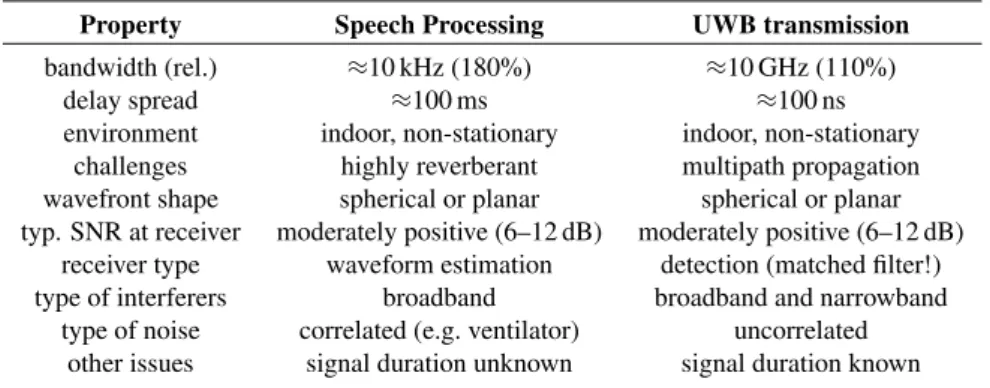
table shows the similarities and differences of broadband
beamforming for speech processing and UWB
communica-tion systems.
164
T. Kaiser: On UWB beamforming
Table 1.
An analogy between speech processing and UWB transmission.
Property
Speech Processing
UWB transmission
bandwidth (rel.)
≈
10 kHz (180%)
≈
10 GHz (110%)
delay spread
≈
100 ms
≈
100 ns
environment
indoor, non-stationary
indoor, non-stationary
challenges
highly reverberant
multipath propagation
wavefront shape
spherical or planar
spherical or planar
typ. SNR at receiver
moderately positive (6–12 dB)
moderately positive (6–12 dB)
receiver type
waveform estimation
detection (matched filter!)
type of interferers
broadband
broadband and narrowband
type of noise
correlated (e.g. ventilator)
uncorrelated
other issues
signal duration unknown
signal duration known
be moderately positive, say a 6–12 dB. This can be achieved
either in case of limited range or by spreading techniques.
All these mentioned aspects show the similarities between
speech and UWB spatial processing. The main differences
result from the fact that the UWB receiver knows the
prin-cipal waveform whereas in speech processing not only the
waveform is completely unknown but also when speech
be-gins and when it ends. From this point of view, UWB seems
to be easier to deal with because the transmit signal can be
designed adequately. For example, in order to estimate the
direction-of-arrival
θ
of an impinging wavefront (see Fig. 1),
the transmit signal can be repeated periodically so that at the
receiver the sampling rate can be distinctly reduced by
al-most arbitrary low undersampling techniques. Moreover, for
UWB transmission a matched filter (MF) can be principally
deployed that further boosts up the SNR. However, this
ap-proach tends to be a bit overrated, since in dense UWB
mul-tipath environments numerous reflections occur and each
in-dividual reflection will modify the transmitted impulse shape
simply because of the non-flat frequency response of the
re-flective material. One last major difference concerns the kind
of noise and interferers. While in speech processing
broad-band interferers dominate and the noise is most often
cor-related (e.g. ventilator), in UWB transmission the
interfer-ers can be broadband as well as narrowband and the noise is
mainly of thermal type and hence uncorrelated.
In conclusion, because of its affinity, some concepts – like
broadband beamforming – can be borrowed from speech
pro-cessing.
3
Broadband beamforming
As mentioned previously we will focus on beamforming of
UWB signals. The following figure illustrates a conventional
filter and sum beamformer.
Basically, each filter can be substituted by a delay in order
to compensate for the different signal travel time among the
antenna elements and to coherently summing up all branches.
This so-called array gain enhances the SNR by a factor of
N
(or 10 log
10
(N )
on a decibel scale) under perfect conditions.
Property Speeh Proessing UWB transmission
bandwidth(rel.) 10kHz(180%) 10GHz(110%)
delayspread 100ms 100ns
environment indoor,non-stationary indoor,non-stationary
hallenges highlyreverberant multipath propagation
wavefrontshape spherialorplanar spherialorplanar
typ. SNRat reeiver moderatelypositive(6-10dB) moderatelypositive(8-12dB)
reeivertype waveformestimation detetion(mathedlter!)
typeofinterferers broadband broadbandandnarrowband
typeofnoise orrelated(e.g. ventilator) unorrelated
other issues signaldurationunknown signaldurationknown
Table1: Ananalogybetweenspeeh proessingandUWBtransmission
tiobetweenantennaapertureandtransmitter-reeiver
distane. Inorder to guaranteeauseful transmission,
thesignaltonoiseratioatthereeiverhastobe
mod-erately positive, say a6-12 dB. This anbe ahieved
either in ase of limited range or by spreading
teh-niques.
All these mentioned aspets show the similarities
betweenspeehandUWBspatialproessing. Themain
dierenesresultfromthefatthat theUWBreeiver
knowsthe prinipal waveform whereasin speeh
pro-essing notonlythe waveformis ompletely unknown
but also when speeh beginsand when itends. From
thispointofview,UWBseemstobeeasiertodealwith
beausethetransmitsignalanbedesignedadequately.
Forexample,inordertoestimatethediretion-of-arrival
ofanimpingingwavefront(seeFig. 1),thetransmit
signal anbe repeated periodially sothat at the
re-eiver thesampling ratean be distintly redued by
almostarbitrarylowundersamplingtehniques.
More-over,forUWBtransmissionamathedlter(MF)an
beprinipallydeployedthatfurtherboostsuptheSNR.
However, this approah tends to be a bit overrated,
sine in dense UWB multipath environments
numer-ousreetionsourandeahindividualreetionwill
modifythetransmittedimpulse shapesimply beause
ofits non-atfrequenyresponse. Onelast major
dif-fereneonernsthekindofnoiseandinterferers. While
in speeh proessing broadband interferers dominate
andthenoiseismostoftenorrelated(e.g. ventilator),
inUWBtransmissiontheinterferersanbebroadband
aswellasnarrowbandandthenoiseismainlyof
ther-maltypeandheneunorrelated.
Inonlusion,beauseofitsaÆnity,someonepts
-likebroadbandbeamforming-anbeborrowedfrom
speeh proessing.
3. BROADBAND BEAMFORMING
As mentioned previouslyhere we will fous on
beam-forming of UWB signals. The following gure
illus-tratesaonventionallterandsumbeamformer.
g N
(t) y
N (t)
g 2
(t) y
2 (t)
g 1
(t) y
1 (t)
y(t) x(t)
Figure 1: Alterandsumbroadbandbeamformer
Basially, the lteran be substituted by delay in
ordertoompensateforthedierentsignaltraveltime
among the antenna elements and to oherently
sum-ming up all branhes. This so-alled array gain
en-hanes the SNR by a fator of N (or 10log 10
(N) on
adeibelsale)underperfet onditions. However,
in-terferersannotbesuppressedonlybydelays. Forthat
reason,theuseofltersbeomesjustied. Fig. 2shows
thebeampatterndenedas
B(; 0
)=max t
jy(t;; 0
)j 2
forafamilyofsinusoidalsignals
x(t)=sin(2ft); f =3:1GHz:::10:6GHz
and N =8 antennas, asteering diretion of 0
=0 Æ
,
an antennaspaingd=
=2,where
=
0 =f
,
0 is
speedoflightandf
=6:85GHzistheenterfrequeny
Fig. 1.
A filter and sum broadband beamformer.
However, interferers cannot be suppressed only by delays.
For that reason, the use of filters becomes justified. Figure 2
shows the beampattern defined as
B(θ, θ0)
=
max
t
|
y(t, θ, θ0)
|
2
for a family of sinusoidal signals
x(t )
=
sin
(
2
πf t ),
f
=
3
.
1GHz
...
10
.
6GHz
and
N
=
8 antennas, a steering direction of
θ
0
=
0
◦
, an
antenna spacing
d
=
λ
c
/
2, where
λ
c
=
c
0
/f
c
,
c
0
is speed of
light and
f
c
=
6
.
85 GHz is the center frequency according to
FCC
1
-regularisation.
Observe that while the location of the mainlobe is
frequency-independent, the locations of the sidelobes and the
nulls are frequency-dependent. This means that broadband
interferers cannot be completely suppressed by a simple
de-lay and sum beamformer. Filters represent a remedy and
al-low an almost arbitrary high interferer cancellation just by
adequately increase of the filter orders. In principle,
conven-tional beamformer techniques (e.g. the minimum variance
T. Kaiser: On UWB beamforming
165
3
aordingtoFCC 1 -regularisation.
−90
−45
0
45
90
3.1
5
6
7
8
9
10.6
x 10
9
−20
−10
0
10
20
f mainlobe sidelobes B(; 0 ) dBFigure 2: Beampattern of a delay and sum broadband
beamformer
Observethat while theloationofthemainlobe is
frequeny-independent, the loations of the sidelobes
andthenullsarefrequeny-dependent. Thismeansthat
broadbandinterferersannotbeompletelysuppressed
by asimpledelayandsumbeamformer. Filters
repre-sent a remedy and allow an almost arbitrary high
in-terfereranellationjust by adequatelyinreaseofthe
lter orders. In priniple, onventional beamformer
tehniques (e.g. the minimum variane distortionless
beamformer(MVDR))an bedeployedinorderto
de-signthelterandsumbeamformersimplyby
alulat-ing the weight vetor for a set of suitable frequenies
andtransformingtheresultingweightmatrixintotime
domain.
UWB measurements have shown, at least under
line-of-sight(LOS)onditions,thepropagationof
indi-vidualehoesarrivingatthereeiverin so-alled
lus-ters(seeforexamplethedesriptivevideosat[4℄). Due
to their ultrashort duration, these ehoes are
resolv-ableintimesothat theyalsobeomeresolvablein
an-gle; hene, the diretion-of-arrival an be prinipally
estimated. Moreover, the reorded signals seem tobe
delayedrepliasofeahothersothatbeamforming
be-omesfeasible. Evenforaspaingofafewten
entime-ters,therelevantehoesseemtobestonglyorrelated.
Inaddition,asmallspaing(e.g. 4m)doesnot ause
seriousoupling[3℄.
(Ultra)-broadbandbeamformingoersanadditional
benet opposite to narrowband beamforming.
Nar-rowband beamforming suers from so-alled grating
lobes. They our for antenna spaingsd larger than
=2andtheyleadtoanambiguityofthe
diretion-of-arrival. Forthatreason,ommonnarrowbandantenna
elementsshowaspaingofhalvethearrierwavelenght
1
FederalCommissionforCommuniations
orevensmallerthanthis. Takingintoaountthatthe
mainlobewidthdependsnotonlyonthenumberof
an-tennas but also from the spaing, narrowbandbeams
anonly benarrowedbyinreasingthenumber of
an-tennas. In turn, in (ultra)-broadband proessing also
thespaing an be inreasedfurther without
ambigu-ity. Inordertoillustratethisfat,thefollowinggures
(Fig. 3-6) show the squaredmagnitude of the
beam-former output and the beampattern for an antenna
spaing d =
in ase of two antennas, lower f l
=
3:1GHz and upper ut-o frequenies f u
= 10:6GHz
(!f
=6:85GHz),andaninputsignalx(t)=e j2f
t
(narrowband)or x(t)= e 2((f u f l )t) 2 e j2f t (broad-band). jy(t;)j 2 t=[ns℄
Figure3: Squared magnitudeof narrowbandbeamformer
outputford=,N =2
max t 20log 10 y(t;) max y(t;)
Figure4: Narrowbandnormalizedbeampatternford=,
N =2inlogarithmisale
Itanbeseenthatthenarrowbandbeamformerwill
suerfromthementionedambiguitysineitannot
dis-tinguishamongthe threepossible diretion-of-arrivals
Fig. 2.
Beampattern of a delay and sum broadband beamformer.
distortionless beamformer (MVDR)) can be deployed in
or-der to design the filter and sum beamformer simply by
calcu-lating the weight vector for a set of suitable frequencies and
transforming the resulting weight matrix into time domain.
UWB measurements have shown, at least under
line-of-sight (LOS) conditions, the propagation of
individ-ual echoes arriving at the receiver in so-called
clus-ters (see for example the descriptive videos at Whyless,
www.whyless.org/public/wp5.htm). Due to their ultrashort
duration, these echoes are resolvable in time so that they also
become resolvable in angle; hence, direction-of-arrival
esti-mation can be principally performed. Moreover, the recorded
signals seem to be delayed replicas of each other so that
beamforming becomes feasible. Even for a spacing of a few
ten centimeters, the relevant echoes seem to be stongly
corre-lated. In addition, a small spacing (e.g. 4 cm) does not cause
serious coupling (Sibille and Bories, 2003).
(Ultra)-broadband beamforming offers an additional
bene-fit opposite to narrowband beamforming. Narrowband
beam-forming suffers from so-called grating lobes. They occur
for antenna spacings
d
larger than
λ
c
/
2 and they lead to
an ambiguity of the direction-of-arrival. For that reason,
common narrowband antenna elements show a spacing of
half the carrier wavelength or even smaller than this.
Tak-ing into account that the mainlobe width depends not only
on the number of antennas but also on the spacing,
narrow-band beams can only be further narrowed by increasing the
number of antennas. In turn, in (ultra)-broadband
process-ing also the spacprocess-ing can be increased further without
ambi-guity. In order to illustrate this fact, the following figures
(Figs. 3–6) show the squared magnitude of the beamformer
output and the beampattern for an antenna spacing
d
=
λ
c
in case of two antennas, lower
f
l
=
3
.
1 GHz and upper
cut-off frequencies
f
u
=
10
.
6 GHz (
→
f
c
=
6
.
85 GHz),
and an input signal
x(t )
=
e
−j2
πf
c
t
(narrowband) or
x(t )
=
e
−2
π((f
u
−
f
l
)t )
2
e
−j2
πf
c
t
(broadband).
It can be seen that the narrowband beamformer will
suf-fer from the mentioned ambiguity since it cannot distinguish
aordingtoFCC 1 -regularisation. f mainlobe sidelobes B(; 0 ) dB
Figure 2: Beampattern of a delay and sum broadband
beamformer
Observe that whilethe loation of the mainlobeis
frequeny-independent, the loations of the sidelobes
andthenullsarefrequeny-dependent. Thismeansthat
broadbandinterferersannotbeompletelysuppressed
byasimpledelay andsumbeamformer. Filters
repre-sent aremedy and allowan almost arbitraryhigh
in-terfereranellationjust byadequatelyinreaseofthe
lter orders. In priniple, onventional beamformer
tehniques (e.g. the minimum variane distortionless
beamformer(MVDR))anbedeployedinorderto
de-signthelterandsumbeamformersimplyby
alulat-ingthe weight vetor fora set of suitable frequenies
andtransformingtheresultingweightmatrixintotime
domain.
UWB measurements have shown, at least under
line-of-sight(LOS)onditions,thepropagationof
indi-vidualehoesarrivingatthe reeiverinso-alled
lus-ters(seeforexamplethedesriptivevideosat[4℄). Due
to their ultrashort duration, these ehoes are
resolv-ableintimesothattheyalsobeomeresolvablein
an-gle; hene, the diretion-of-arrival an be prinipally
estimated. Moreover, the reordedsignals seemto be
delayedrepliasofeahothersothatbeamforming
be-omesfeasible. Evenforaspaingofafewten
entime-ters,therelevantehoesseemtobestonglyorrelated.
Inaddition,asmall spaing(e.g. 4m) doesnotause
seriousoupling[3℄.
(Ultra)-broadbandbeamformingoersanadditional
benet opposite to narrowband beamforming.
Nar-rowband beamforming suers from so-alled grating
lobes. They our forantenna spaings d larger than
=2andtheyleadtoanambiguityofthe
diretion-of-arrival. Forthatreason,ommonnarrowbandantenna
elementsshowaspaingofhalvethearrierwavelenght
1
FederalCommissionforCommuniations
orevensmallerthanthis. Takingintoaountthatthe
mainlobewidthdependsnotonlyonthenumberof
an-tennas but also from the spaing, narrowbandbeams
anonlybenarrowedbyinreasingthe numberof
an-tennas. In turn, in (ultra)-broadband proessing also
the spaing an beinreased further without
ambigu-ity. Inordertoillustratethisfat,thefollowinggures
(Fig. 3-6) show the squared magnitude of the
beam-former output and the beampattern for an antenna
spaing d =
in ase of two antennas, lower f l
=
3:1GHz and upper ut-o frequenies f u
= 10:6GHz
(!f
=6:85GHz),andaninputsignalx(t)=e j2ft
(narrowband)orx(t)=e 2((f u f l )t) 2 e j2f t (broad-band).
−90
−45
0
45
90
0
0.5
1
1.5
x 10
−9
0
1
2
3
4
5
jy(t;)j 2 t=[ns℄Figure3: Squaredmagnitudeofnarrowband beamformer
outputford=
,N =2
max t 20log 10 y(t;) maxy(t;)
Figure4: Narrowbandnormalizedbeampatternford=
,
N=2inlogarithmisale
Itanbeseenthatthenarrowbandbeamformerwill
suerfromthementionedambiguitysineitannot
dis-tinguishamongthe threepossible diretion-of-arrivals
Fig. 3.
Squared magnitude of narrowband beamformer output for
d
=
λ
c
,
N
=
2.
3
aordingtoFCC 1 -regularisation. f mainlobe sidelobes B(; 0 ) dB
Figure 2: Beampattern of a delay and sum broadband
beamformer
Observethatwhile theloationof themainlobe is
frequeny-independent, the loations of the sidelobes
andthenullsarefrequeny-dependent. Thismeansthat
broadbandinterferersannotbeompletelysuppressed
byasimpledelayandsum beamformer. Filters
repre-senta remedy andallowan almost arbitraryhigh
in-terfereranellationjust byadequatelyinreaseof the
lter orders. In priniple, onventional beamformer
tehniques (e.g. the minimum variane distortionless
beamformer(MVDR))anbedeployedinorderto
de-signthelterandsumbeamformersimplyby
alulat-ing the weight vetor for a set of suitable frequenies
andtransformingtheresultingweightmatrixintotime
domain.
UWB measurements have shown, at least under
line-of-sight(LOS)onditions,thepropagationof
indi-vidualehoesarrivingatthe reeiverinso-alled
lus-ters(seeforexamplethedesriptivevideosat[4℄). Due
to their ultrashort duration, these ehoes are
resolv-ableintimesothattheyalsobeomeresolvablein
an-gle; hene, the diretion-of-arrival an be prinipally
estimated. Moreover,the reorded signals seem tobe
delayedrepliasofeahothersothatbeamforming
be-omesfeasible. Evenforaspaingofafewten
entime-ters,therelevantehoesseemtobestonglyorrelated.
Inaddition,asmallspaing (e.g. 4m)doesnotause
seriousoupling[3℄.
(Ultra)-broadbandbeamformingoersanadditional
benet opposite to narrowband beamforming.
Nar-rowband beamforming suers from so-alled grating
lobes. They our for antenna spaings d largerthan
=2andtheyleadtoanambiguityofthe
diretion-of-arrival. Forthatreason,ommonnarrowbandantenna
elementsshowaspaingofhalvethearrierwavelenght
1
FederalCommissionforCommuniations
orevensmallerthanthis. Takingintoaountthatthe
mainlobewidthdependsnotonlyonthenumberof
an-tennas but also from the spaing, narrowband beams
an onlybenarrowedby inreasingthenumberof
an-tennas. In turn, in (ultra)-broadband proessing also
the spaing anbe inreasedfurther without
ambigu-ity. Inordertoillustratethisfat,thefollowinggures
(Fig. 3-6) show the squaredmagnitude of the
beam-former output and the beampattern for an antenna
spaing d =
in ase of two antennas, lower f l
=
3:1GHz and upper ut-o frequenies f u
= 10:6GHz
(!f
=6:85GHz),andaninput signalx(t)=e j2ft
(narrowband)orx(t)=e 2((f u f l )t) 2 e j2f t (broad-band). jy(t;)j 2 t=[ns℄
Figure 3: Squaredmagnitudeof narrowbandbeamformer
outputford=,N =2
−90
−45
0
45
90
−20
−15
−10
−5
0
max t 20log 10 y(t;) maxy(t;)Figure4: Narrowbandnormalizedbeampatternford=,
N =2inlogarithmisale
Itanbeseenthatthenarrowbandbeamformerwill
suerfromthementionedambiguitysineitannot
dis-tinguish among the threepossiblediretion-of-arrivals
Fig. 4.
Narrowband normalized beampattern for
d
=
λ
c
,
N
=
2 in
logarithmic scale.
among the three possible direction-of-arrivals
−
90
0
, 0
0
and
+
90
0
. In contrast, the broadband beamformer can clearly
resolve the 0
0
-DoA, because of no ringing of the received
impulse-shaped wavefront.
It is also of interest to study the effects caused by
increas-ing the spacincreas-ing and the number of antennas, see Figs. 7, 8.
Observe that extending the spacing leads to a narrowing
of the mainlobe, whereas more antennas not only further
decrease the mainlobe width but also increase the
main-to-sidelobe ratio. For example, in case of
d
=
2
λ
c
,
N
=
4,
the mainlobe width is approximately 15
0
so that with such a
linear array up to 180
0
/
15
0
=
12 spatially seperated users
can be ideally served.
Note also that for
d
=
2
λ
c
,
N
=
2 the array size is
8
.
76 cm, which might be implementable on a terminal. In
turn, for
d
=
2
λ
c
,
N
=
4 the array size becomes 26
.
28 cm,
166
T. Kaiser: On UWB beamforming
4−90
−45
0
45
90
0
0.5
1
x 10
−9
0
1
2
3
4
jy(t;)j 2 t=[ns℄Figure 5: Squared magnitude of broadband beamformer
outputford=,N =2
max t 20log 10 y(t;) max y(t;)
Figure6: Broadbandnormalizedbeampatternford=,
N =2inlogarithmi sale
90 0 , 0 0 and+90 0
. Inontrast,the broadband
beam-former an learly resolve the 0 0
-DoA, beause of no
ringingof thereeived impulse-shapedwavefront.
Itis alsoof interestto study the eetsaused by
inreasingthespaingandthenumberofantennas,see
Fig. 7,8.
Observethat extendingthespaingleadstoa
nar-rowing of the mainlobe, whereas more antennas not
onlyfurther derease the mainlobewidth but also
in-reasethemain-to-sideloberatio. Forexample,inase
of d = 2
, N = 4, the mainlobe width is
approx-imately 15 0
so that with suh a linear array up to
180 0
=15 0
=12spatiallyseperatedusersanbeserved.
Notealso thatford=2
, N =2the arraysize is
8:76m,whihmight beimplementableon aterminal.
In turn, for d = 2
, N = 4 the array size beomes
max t 20log 10 y(t;) maxy(t;)
Figure7: Broadbandnormalizedbeampatternford=2,
N =2inlogarithmisale
26:28m,eventhisisimplementable-nowonalaptop.
4. CONCLUSION ANDFUTURE WORK
Inthisontribution,wemotivatethemarriageofUWB
and multi-antenna tehnique by foussing on
beam-forming. Beside the omplementary lasses of
multi-antennaapproahes,i.e. spatialmultiplexingand
spae-timeoding,therearenumerousopenissuesinthisnew
andhighlymulti-disiplinaryeld:
adjustablepreiseanalogtruetimedelays(oreven
lters)
diretionof arrival,time delayestimation
beamformingforUWBhannels(model&data)
exploitingmultipathpropagationthanombating
pulseshaping,modulationforUWBmulti-antenna
systems
loalisation, synhronisation with UWB
multi-antennasystems
UWB antenna arrays, where the frequeny
re-sponsesamongtheelementsmaydier,butshould
overlap
broadbandbeamformingwithlownumberof
an-tennas
transmitbeamforming
Fig. 5.
Squared magnitude of broadband beamformer output for
d
=
λ
c
,
N
=
2.
4
jy(t;)j 2
t=[ns℄
Figure 5: Squaredmagnitude of broadband beamformer
outputford=
,N =2
−90
−45
0
45
90
−20
−15
−10
−5
0
max t 20log 10 y(t;) max y(t;)Figure6: Broadbandnormalizedbeampatternford=,
N =2inlogarithmisale
90 0 , 0 0 and+90 0
. Inontrast,thebroadband
beam-former an learly resolve the 0 0
-DoA, beause of no
ringing ofthe reeivedimpulse-shaped wavefront.
It is alsoof interest tostudy the eetsaused by
inreasingthespaingandthenumberofantennas,see
Fig. 7,8.
Observethatextendingthe spaingleadstoa
nar-rowing of the mainlobe, whereas more antennas not
only further dereasethe mainlobe widthbut also
in-reasethe main-to-sideloberatio. Forexample,inase
of d = 2
, N = 4, the mainlobe width is
approx-imately 15 0
so that with suh a linear array up to
180 0
=15 0
=12spatially seperatedusersan beserved.
Note alsothat ford=2
,N =2the arraysize is
8:76m,whihmightbe implementable on aterminal.
In turn, for d = 2
, N = 4 the array size beomes
max t 20log 10 y(t;) maxy(t;)
Figure7: Broadbandnormalizedbeampatternford=2,
N =2inlogarithmisale
26:28m,eventhisisimplementable-nowonalaptop.
4. CONCLUSION AND FUTURE WORK
Inthisontribution,wemotivatethemarriageofUWB
and multi-antenna tehnique by foussing on
beam-forming. Beside the omplementary lasses of
multi-antennaapproahes,i.e. spatialmultiplexingand
spae-timeoding,therearenumerousopenissuesinthisnew
andhighlymulti-disiplinaryeld:
adjustablepreiseanalogtruetimedelays(oreven
lters)
diretionof arrival,timedelayestimation
beamformingforUWB hannels(model&data)
exploitingmultipathpropagationthanombating
pulseshaping,modulationforUWBmulti-antenna
systems
loalisation, synhronisation with UWB
multi-antennasystems
UWB antenna arrays, where the frequeny
re-sponsesamongtheelementsmaydier,butshould
overlap
broadbandbeamformingwithlownumberof
an-tennas
transmitbeamforming
Fig. 6.
Broadband normalized beampattern for
d
=
λ
c
,
N
=
2 in
logarithmic scale.
4
Conclusion and future work
In this contribution, we motivate the marriage of UWB and
multi-antenna technique by focussing on beamforming.
Be-side the complementary classes of multi-antenna approaches,
i.e. spatial multiplexing and space-time coding, there are
nu-merous open issues in this new and highly multi-disciplinary
field:
–
adjustable precise analog true time delays (or even
fil-ters)
–
direction of arrival, time delay estimation
–
beamforming for UWB channels (model & data)
4
jy(t;)j 2
t=[ns℄
Figure 5: Squared magnitude of broadband beamformer
outputford=,N =2
max t 20log 10 y(t;) max y(t;)
Figure6: Broadbandnormalizedbeampatternford=,
N =2inlogarithmi sale
90 0 , 0 0 and+90 0
. Inontrast,the broadband
beam-former an learly resolve the 0 0
-DoA, beause of no
ringingof thereeived impulse-shapedwavefront.
Itis alsoof interestto study the eetsaused by
inreasingthespaingandthenumberofantennas,see
Fig. 7,8.
Observethat extendingthespaingleadstoa
nar-rowing of the mainlobe, whereas more antennas not
only furtherderease the mainlobewidth butalso
in-reasethemain-to-sideloberatio. Forexample,inase
of d = 2
, N = 4, the mainlobe width is
approx-imately 15 0
so that with suh a linear array up to
180 0
=15 0
=12spatiallyseperatedusersanbeserved.
Note alsothatford=2
, N =2the arraysize is
8:76m,whihmight beimplementableon aterminal.
In turn, for d = 2
, N = 4 the array size beomes
−90
−45
0
45
90
−20
−15
−10
−5
0
−90
−45
0
45
90
−20
−15
−10
−5
0
max t 20log 10 y(t;) maxy(t;)Figure7: Broadbandnormalizedbeampatternford=2,
N =2inlogarithmisale
26:28m,eventhisisimplementable-nowonalaptop.
4. CONCLUSION ANDFUTURE WORK
Inthisontribution,wemotivatethemarriageofUWB
and multi-antenna tehnique by foussing on
beam-forming. Beside the omplementary lasses of
multi-antennaapproahes,i.e. spatialmultiplexingand
spae-timeoding,therearenumerousopenissuesinthisnew
andhighlymulti-disiplinaryeld:
adjustablepreiseanalogtruetimedelays(oreven
lters)
diretionof arrival,timedelay estimation
beamformingforUWBhannels(model&data)
exploitingmultipathpropagationthanombating
pulseshaping,modulationforUWBmulti-antenna
systems
loalisation, synhronisation with UWB
multi-antennasystems
UWB antenna arrays, where the frequeny
re-sponsesamongtheelementsmaydier,butshould
overlap
broadbandbeamformingwithlownumberof
an-tennas
transmitbeamforming
Fig. 7.
Broadband normalized beampattern for
d
=
2
λ
c
,
N
=
2 in
logarithmic scale.
5
−90
−45
0
45
90
−20
−15
−10
−5
0
max t 20log 10 y(t;) maxy(t;)Figure8: Broadbandnormalizedbeampatternford=2
,
N =4inlogarithmisale
Of further interest is how the hannel apaity is
af-feted by UWBtransmission. Firstworktowardsthis
relevant topi an be found in [5℄, [6℄. It seems that
the numberof antennashas thesameimpatthanthe
bandwidth, infat, the equation known from
narrow-band MIMOsystemsfor theergodihannelapaity
C e
=BNlog 2
(1+SNR )
alsoholdsapproximatelytrueforUWBhannels. Suh
resultfurthermotivatethemergeofthesetwokey
teh-nologiesinwirelessommuniations.
REFERENCES
[1℄ J.M.Cramer,R.A.SholtzandM.Z.Win,On the
analysis of UWB ommunation hannels, IEEE
Military Communiation Conferene Proeedings
(MILCOM),Vol.2,1999,p.1191-1195
[2℄ H.Lee,H.Haan,Y.Shin,S.Im, Multipath
Char-ateristisofImpulseRadioChannels,Pro.IEEE
VTC, May 15-18, 2000, Tokyo, Japan, pp.
2487-2491.
[3℄ A.SibilleandS.Bories,Spae diversity forUWB
ommuniations, EPMCC, April 22-25, 2003,
Glasgow,UK
[4℄ www.whyless.org/publi/wp5.htm
[5℄ Z.Feng,T.KaiserandA.Czylwik,Onthe
Evalua-tionof Channel Capaityof Multi-AntennaUWB
Case, submitted to IEEE Transations on
Com-muniations
[6℄ Z.Feng,T.KaiserandA.Czylwik,Onthe
Evalua-tionof Channel Capaityof Multi-AntennaUWB
Indoor Wireless Systems{PartII: Frequeny
Se-letive Case, submittedtoIEEE Transationson
Communiations