Article
J. Braz. Chem. Soc., Vol. 26, No. 5, 851-859, 2015. Printed in Brazil - ©2015 Sociedade Brasileira de Química 0103 - 5053 $6.00+0.00
A
*e-mail: [email protected]
Molecular Electronic Topology and Fragmentation Onset via Charge Partition
Methods and Nuclear Fukui Functions: 1,1-Diamino-2,2-dinitroethylene
Tiago Giannerini and Itamar Borges Jr.∗
Departamento de Química, Instituto Militar de Engenharia, Praça General Tibúrcio, 80, 22290-270 Rio de Janeiro-RJ, Brazil
We investigatedtheoretically the ground state electronic structure and the onset of molecular fragmentation of 1,1-diamino-2,2-dinitroethylene (FOX-7) using density functional theory. The molecular charge density was analyzed via two partition methods: the distributed multipole analysis (DMA) and the deformed atoms in molecules (DAM). In this framework, the push-pull effect, hydrogen intra-molecular bonding and site acid-base properties of the molecule were discussed. Our analysis indicates that the molecular origin of the low measured impact sensitivity of FOX-7 is due to the magnitude of multipole values of the C−N bonds in the NO2 groups, the
delocalized electrons over the central C−C bond and the hydrogen bonds. The onset of FOX-7
decomposition and acid-base properties were examined with the nuclear Fukui functions. The results support nitro to nitrite rearrangement and direct release of a NO2 as a possible initial step
in FOX-7 decomposition process. The approach suggested is general and can be especially useful for very large molecules to examine in detail their electronic structure and to guide the search for the decomposition mechanisms.
Keywords: molecular charge partition methods, conceptual DFT, nuclear Fukui functions, molecular fragmentation, energetic materials, FOX-7,DADNE
Introduction
A complete investigation of the ground state properties of a molecule or a solid in the framework of density functional theory (DFT) can be achieved in principle from the knowledge of the quantum observable electron density; when the nuclei charges are included it is the
charge distribution.1 A very convenient way to analyze
those densities is by employing a physically and chemically justified method to divide them into atomic contributions. Methods that divide molecular charge densities into atomic contributions belong to a large family of charge density analysis approaches that provides detailed knowledge of topological bonding properties. These methods have undergone “a major renaissance in the last
two decades” according to a recent review.2 A textbook on
the subject with authoritative reviews has just been edited.3
The key idea of what is known as conceptual DFT is treating the response of a system to a perturbation as determining its reactivity, in this way providing an interpretative approach to a diversity of chemistry
phenomena.4-13 These response functions are derivatives
of the energy with respect to a perturbation that can be interpreted as reactivity indicators. According to conceptual DFT, fragmentation of the energetic material 1,3,5-trinitro-1,3,5-triazacyclohexane (RDX) was studied successfully with nuclear Fukui functions used as reactivity
indicators.14-16
Development of new energetic materials has the dual purpose of combining large release of energy (good performance) and great resistance to impact or friction (low impact sensitivity). There are several relevant and interesting issues related to the quantum chemistry research of energy-rich materials, and an important book on the
subject has just been released.17
The recently synthesized
1,1-diamino-2,2-dinitroethylene,18 FOX-7 or DADNE, when compared to the
widely used explosive RDX,16 exhibits similar performance
but a much lower sensitivity to impact. This new explosive is still not widely used due to its large production costs. FOX-7 is also a promising precursor in organic chemistry and despite its simple structure, this molecule has very unusual properties. We explored lately the excited states
oriented to applications and do not approach systematically
fundamental issues,20 an important motivation of this work.
FOX-7 has an electronic push-pull effect as the result of one side of the molecule bearing two electron-withdrawing nitro groups as a strong oxidation center whereas the
other side has two electron-donating amino groups.20
Politzer et al.,21 using B3P86/6-31+G**, assessed the role
of “push-pull” electronic delocalization and intramolecular hydrogen bonding effects in FOX-7 and analogous compounds according to the bond lengths in the inner skeleton of the molecules. Due to the push-pull effect, the electron distribution of FOX-7 is unbalanced.
There are three possible unimolecular decomposition
mechanisms of FOX-7:20,22-26 (i) nitro-nitrite rearrangement
followed by NO release, (ii) direct cleavage of the C−NO2
bond and, (iii) intra/intermolecular hydrogen transfer
followed by HONO release. Gindulyte et al.,22 using DFT
calculations with the B3LYP and B3P86 hybrid functionals and the 6-31+G(d,p) Gaussian basis set, proposed that nitro-nitrite rearrangement is the most probable outcome. They based the suggestion on the computation of an energy
barrier of 59.1 kcal mol−1 (B3LYP) for this step, in very good
agreement with the measured activation energy value of
58 kcal mol−1.27 However, because their C−NO
2 dissociation
value is only ca. 15 kcal mol−1 higher, this process cannot be
discarded for two reasons: in view of the involved energies in the decomposition of an energetic material and because the direct bond cleavage is a rather common process in these
materials. Rashkeev et al.23 combined DFT calculations
and periodic boundary conditions (PBC) in the generalized gradient approximation (GGA) to conclude that the direct
C−NO2 rupture hypothesis is more plausible. They found
a bond dissociation energy of 92 kcal mol−1 for a perfect
crystal, reduced to 59 kcal mol−1 by considering common
crystal defects. Kimmel et al.24-26 used DFT and embedded
cluster methods to propose that intra or intermolecular hydrogen transfer is not a feasible initiation step of FOX-7
decomposition. Instead, both C−NO2 bond fission and
nitro-nitrite rearrangement would be the competing mechanisms. In this work, we examine the onset of molecular FOX-7 fragmentation and discuss the three possible pathways through nuclear Fukui functions.
Concerning impact sensitivity of energetic materials, there have been several theoretical attempts to establish relationships between this important macroscopic property
and different molecular characteristics.28-39 Zaho-Xu and
Chen40 have just published a comprehensive account of
quantum chemistry derived criteria for impact sensitivity
and Politzer and Murray41 discussed the challenges
involved in predicting it. Among the quantum-mechanical molecular properties used to investigate impact sensitivity,
we can mention electrostatic potentials (ESPs),28-31,33,38
Mulliken charges of nitro groups,32,34,37 and Bader’s atoms
in molecules (AIM) method.42,43 According to Yau et al.,43
the AIM method cannot be used to build such correlations because this space partition scheme of the electron density is very sensitive to DFT functionals and type of basis sets.
In previous works, we used the distributed multipole analysis (DMA) method to analyze charge distributions and
sensitivity of energetic molecules36,39 as well as properties
of MoS2 catalysts.44-46 In contrast to the AIM approach,43
our results showed that DMA is quite stable with respect to DFT parameters and basis set size. In another work, we used the deformed atoms in molecules (DAM) method and nuclear Fukui functions to examine the influence of charge densities in the stability and decomposition pathways of
four different RDX conformers.16 It is important to note
that direct examination of the electron (charge) density is more accurate than inspection of the self-consistent field molecular orbitals because the former includes correlation
effects.9
In other works, we investigated the excited and ionized states of energetic molecules including possible
decomposition processes47-51 and FOX-7.19 These molecules
have in common X−NO2 bonds (X=N,C), a feature of
widely used energetic materials.
The main purpose of this paper is to show that physical and chemically motivated molecular charge density partition methods and conceptual DFT allows one to investigate in details topological molecular properties and onset of molecular fragmentation. We applied this approach to the FOX-7 molecule to analyze push-pull effects, hydrogen bonds, impact sensitivity, site properties and decomposition mechanisms.
Methodology
The ground state geometry of FOX-7 was optimized
with the hybrid functional B3LYP52 and the aug-cc-pVTZ
Gaussian basis set.53,54 Frequency calculations confirmed
the minimum character of the structure. The calculations
were made with the Gaussian 03 package.55
The computed DFT electron density was decomposed
according to the DMA using the GDMA2 software.56
For the DAM analysis, we used the DAMQT program.57
The Hellmann-Feynman forces, obtained from the DAM
analysis, were combined to calculate the Gi and Φi nuclear
Fukui vectors. The DMA molecular pictures were prepared
with the graphic program Gabedit.58
From the DAM partition of the electron density, one can compute the nuclear Fukui functions to analyze site
properties and the onset of molecular fragmentation.4,14-16,59,60
The idea of nuclear Fukui functions stems from the
Hellmann-Feynman electrostatic theorem.61 According to it,
the total electrostatic force Fi on a nucleus i in a molecule
due to the electrons and the remaining nuclei is given in atomic units by
3
3 3
( )r ij
i i j
i j≠ i
i
ij
R r
F Z d r Z
r R
= −
∫
∑
(1)
where r(r) is the electron density at position r, ri is the
separation vector between nucleus i and position r and
Rij is the separation vector between nuclei i and j with
Zi and Zj charges, respectively. From the
Hellmann-Feynman forces, Ordon and Komorowski59,60 define two
nuclear Fukui response functions. One is the derivative of
electronegativity (χ) over the nuclei distortion Qi, called
nuclear reactivity Φi:
(
)
1 Φ
2
i i i
i
F F
Q
χ + −
∂
= ≅ −
∂ (2)
The other is the derivative of hardness (η) over the
atomic displacements Qi, the nuclear stiffness Gi:
(
)
1 G
2
i i i
i
F F
Q
η + −
∂
= ≅ − +
∂ (3)
The Hellmann-Feynman forces F+ and F− are the total
forces acting on the ith nucleus when one electron is added
or removed, respectively, and are computed at the geometry of the neutral system. The nuclear Fukui functions are then
calculated from the above finite differences. The Gi and
Φifunctions are intrinsic molecular properties and form
a set of vectors in 3D space with origin on each atomic nuclei. Their components and magnitude for each atom are reported in Table S1 in the SI section.
Results and Discussion
Geometry
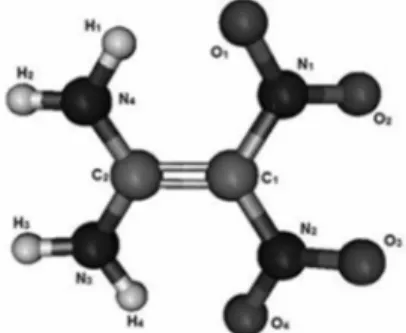
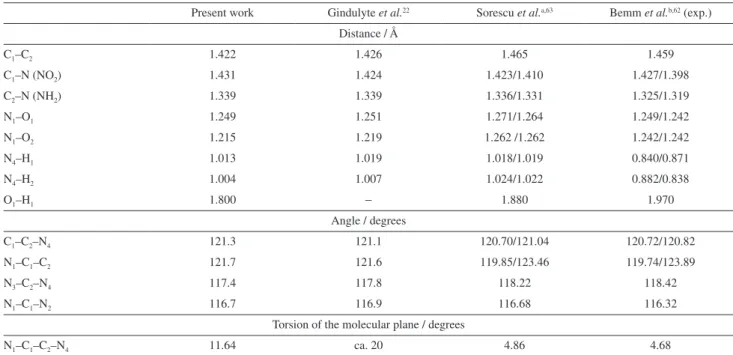
Figure 1 shows the B3LYP/aug-cc-pVTZ optimized structure. The main geometric parameters are presented in Table 1. The results are compared with X-ray data of Bemm
et al.62 and theoretical values of Sorescu et al.63 and Gindulyte et al.22 Sorescu et al.63 used PBC and the Perdew-Wang
86 GGA functional whereas Gindulyte et al.22 examined
the isolated molecule using B3P86/6-31G+(d,p). The
calculations of Sorescu et al.63 and the experimental results
of Bemm62 were obtained for a crystal. For this reason, the
corresponding columns in Table 1 can have two values.
The overall agreement is very good. Not surprisingly, the largest difference for the isolated molecule results
concerns the N1−C1−C2−N4 dihedral angle. Our angle
value is closer to experiment as compared to the results
of Gindulyte et al.,22 but it is still about 6° larger as
compared to measurements and PBC results. In gas phase, the molecule has greater freedom, so a different value of the torsional angle is expected. The reason for this non-planarity is the repulsion between the oxygen atoms of
the nitro groups. Sorescu et al.63 also performed
MP2/6-31+G** and B3LYP/6-MP2/6-31+G** calculations and obtained
a value of 16° for the dihedral angle, still farthest from
experiment and our value.
Analysis of molecular charge densities and derived properties
Figure 2a depicts the DMA multipoles centered on the FOX-7 sites. The DMA dipole vectors in FOX-7 (Figure 2a) clearly display the inductive over the entire molecule, with the vector components directed towards the electron withdrawing nitro groups, thus indicating the dislocation of electron density towards them. Furthermore, the size of the dipole vectors on distinct sites, combined with the charge and quadrupole values, indicate the local magnitude of the inductive effect and could be used to quantify it among different molecules. The large values of the site quadrupole moment on both carbon atoms,
especially on C1, which is bonded to the two nitro groups,
imply delocalized (π) electrons over the C−C bond. This
picture of charge distribution due to the presence of high electron density withdrawing groups on one side of a double bond and donating groups on the other side results is the
so-called push-pull effect.21,64
The large quadrupole values on the oxygen atoms of the nitro groups and on the nitrogen atoms of the
amine groups are due to their lone pairs. The oxygen atoms in the nitro groups have different types of charge separation depending on the position, as expressed by the DMA and DAM results displayed in Figure 2. The
O2 and O3 oxygen atoms, localized at the far right of
FOX-7 (Figure 2), have their dipole vectors aligned with
the N−O bond axis, opposing charge separation from the
corresponding nitrogen atom. The same situation, but of
larger magnitude, also occurs on the O1 and O4 atoms
although dipole vectors in this case are no longer totally
aligned with the N−O bond. This charge separation-bond
polarization effect seems rather general.65 Furthermore,
Table 1. Computed FOX-7 geometric parameters for FOX-7 and literature values
Present work Gindulyte et al.22 Sorescu et al.a,63 Bemm et al.b,62 (exp.)
Distance / Å
C1–C2 1.422 1.426 1.465 1.459
C1–N (NO2) 1.431 1.424 1.423/1.410 1.427/1.398
C2–N (NH2) 1.339 1.339 1.336/1.331 1.325/1.319
N1–O1 1.249 1.251 1.271/1.264 1.249/1.242
N1–O2 1.215 1.219 1.262 /1.262 1.242/1.242
N4–H1 1.013 1.019 1.018/1.019 0.840/0.871
N4–H2 1.004 1.007 1.024/1.022 0.882/0.838
O1–H1 1.800 − 1.880 1.970
Angle / degrees
C1–C2–N4 121.3 121.1 120.70/121.04 120.72/120.82
N1–C1–C2 121.7 121.6 119.85/123.46 119.74/123.89
N3–C2–N4 117.4 117.8 118.22 118.42
N1–C1–N2 116.7 116.9 116.68 116.32
Torsion of the molecular plane / degrees
N1–C1–C2–N4 11.64 ca. 20 4.86 4.68
aSome geometric parameters have two distinct computed values. See text for details; bsome geometric parameters have two distinct measured values. See
text for details.
Figure 2 (a) FOX-7 computed DMA multipole values. Numbers written in the upper position of each site are monopole values (black) in units of e (1.602 × 10⁻¹⁹ C). Those in the lower position (red) are the quadrupole values in (4.486 × 10−40 C m2) units. Site dipoles are represented by vectors drawn
the O2 and O3 oxygen atoms have different values of the
charge and quadrupole values as compared to the O1 and
O4 corresponding ones due to the intra-hydrogen bonds
formed by O2 and O3, as discussed below.
The O1 and O4 negative charge, dipole and quadrupole
values are larger compared with the corresponding values
on the O2 and O3 atoms. These larger multipole values
result from the attractive electrostatic interaction between
the H1 and O1 atoms and between H4 and O4. Due to this
interaction, the O1 and O4 atoms display more negative
charge in the corresponding nitro group in comparison with
the other two oxygen atoms, O2 and O3, farthest from the
hydrogen atoms in the molecule. This attractive electrostatic
interaction between the charges of the H1---O1 and H4---O4
pairs is characteristic of hydrogen bonds66 and the DMA
multipole values allows one to quantify their strengths in an electrostatic picture.
In FOX-7 there is also the displacement of electrons
on the N3−H3 and N4−H2 bonds involved in the hydrogen
bonds. These displacements are seen as a bump of electron accumulation (red) on the middle of the bonds computed according to the DAM method (Figures 2b and 2c). In the amine groups, the electron depletion regions (blue) on the
H1 and H4 atoms correspond to DMA positive charges and
small quadrupole values, whereas the N3 and N4 atoms
have negative charges and large quadrupole values. The latter are more than twice as large as compared to the
corresponding values on the nitrogen atoms (N1 and N2)
of the nitro groups.
The other partition approach, the DAM method, highlights pictorially the above results. In Figures 2b and
2c, charge accumulation along the C−C bond in FOX-7 is
displaced towards the carbon atom C1, with a bump around
the middle of the bond. Therefore, the C1 atom displays
a larger electron accumulation as compared with C2; in
fact, Figure 2b shows a region of electron depletion (blue)
over C2. In the DAM method, electron accumulation in a
double bond is observed as an out-of-plane deformation
of the electron accumulation region (red) over the C−C
bond (Figures 2b and 2c). This picture is also confirmed
by the large value of the corresponding C1 and C2 DMA
quadrupole moment values (Figure 2a).
The results just discussed can be related to the low
impact sensitivity of FOX-7. For molecules having NO2
groups, this property is connected to the feasibility of
breaking the C−NO2 out C −NO2 bonds, the so called
trigger linkage.40,41,67 The “trigger” bonds are the ones
likely to be broken by an external stimulus having the necessary energy. These bond ruptures then trigger the further exothermic and self-sustaining decomposition
processes that characterizes the detonation or explosion.41
In another work, we confirmed the already existing indications that charge values on the nitro groups are
directly related to the impact sensitivity.39 Moreover, we
showed that explosives with large delocalized electron densities and positive charge values on the aromatic ring of nitroaromatics correspond to more insensitive materials.
Politzer et al.,41,68 by examining the molecular electrostatic
potential in different investigations, identified that the
balance between charge delocalization and NO2
electron-withdrawing is determinant for the impact sensitivity of
an energetic material. Our results39 also agreed with the
work of Rice and Hare30 that associated the magnitude
of sensitivity to impact to the degree of positive charge build-up (i.e., electron deficiency) over covalent bonds within the inner framework of explosives. Therefore, very sensitive explosives display large electron depletion over the covalent bonds of the molecules whereas the insensitive ones do not have it.
The impact sensitivity of FOX-7 can be discussed according to the ideas of the last paragraph. In FOX-7, the C=C bond can be thought to play the role of the central structure of the molecule (i.e., as the aromatic ring in nitroaromatics). The carbon atoms have large DMA quadrupole values (Figure 2a), thus large delocalized electron densities; both carbon atoms also have positive
charge values. Furthermore, note that: (i) the quadrupole
values on the N atom localized in the nitro groups are about half the values on the N atoms in the amine groups
and, (ii) the charge values are positive on the N atoms of
the nitro groups in contrast with the negative values on the N atoms of the amines. Therefore, because the charges on the carbon atoms are positive, in the framework of the Coulombic charge bond model (see SI section), the strength
of the C−NO2 bonds are about 3 times smaller and of
repulsive nature when compared with the C−NH2 bonds.
Moreover, from a purely electrostatic view, the C−NO2
bonds are repulsive (both charges are positive) whereas
the C−NH2 bonds are attractive. Therefore, the barriers to
break the C−NO2 bonds should be smaller when compared
to the C−NH2 bonds, as they are in fact.41
self sustaining exothermal chemical decomposition).41
Therefore, all the aforementioned molecular properties imply that FOX-7 is rather insensitive, as it is in fact.
We now discuss qualitatively acid-base site properties.
The region around the C1 atom is by far the one with the
greatest electron accumulation in the molecule (Figures 2b and 2c), being, for this reason, the main Lewis basic site of FOX-7. This site has also (Figure 2a) a large value of the DMA quadrupole moment and almost null values of DMA charge and dipole, another indication of electron accumulation in the region. This behavior is confirmed
in halogenation and nitration electrophilic reactions:20 in
the first reaction step, the strong electrophiles Cl+, Br+ and
NO2+ attack the C1 carbon atom. Therefore, the C1 site has
electrophilic character.
In the first report of FOX-7 synthesis,18 a low
nucleophilicity of the amino groups was found. This property is confirmed by examining the region around
the C2 atom, where there is clearly electron depletion
(Figure 2b). Moreover, this is also verified by the DMA
multipoles: in comparison with the C1 atom, C2 has over
three times a positive charge and about a 35% smaller quadrupole value (Figure 2a).
Both the large susceptibility of the C1 atom to
electrophilic attack and the low nucleophilicity of the C2
atom are related to the push-pull behavior of FOX-7. In the next section, we show that the nuclear Fukui functions also provide similar insights on acid-base properties.
Onset of molecular fragmentation and reactivity behavior of the carbon sites
From the Hellmann-Feynman forces, we computed
the nuclear Fukui functions stiffness Gi and reactivity
Φi. As described above, these atomic vectors indicate the
most favorable displacements for the onset of molecular decomposition.
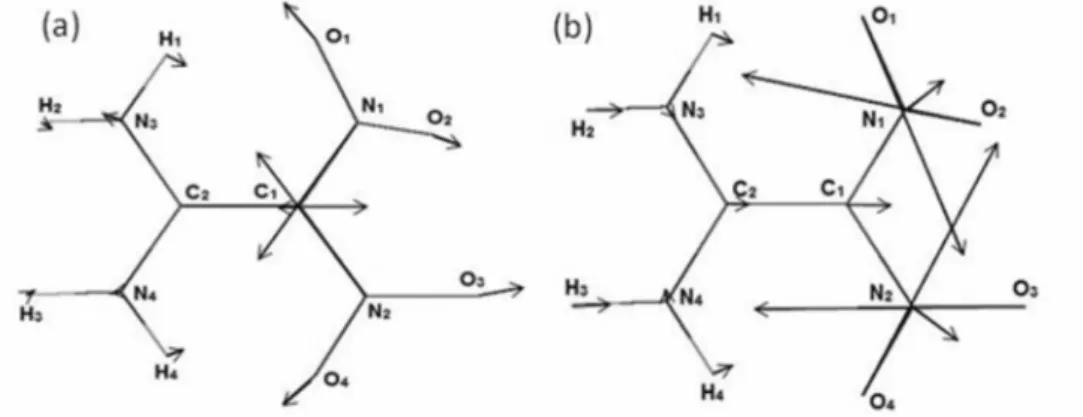
Figure 3 depicts the computed nuclear Fukui response functions of FOX-7. In Table S1, in the SI section, the component values and the total magnitude of the nuclear Fukui vectors on each site are reported.
It can be noted that both response functions in the nitro
group atoms are the most prominent, especially the Gi
vectors on the oxygen atoms. This picture agrees with the aforementioned three proposed decomposition mechanisms in the sense that a nitro group is always involved.
Both Φi vectors on the carbon atoms are along the C−C
bond and in opposite directions. However, because the
magnitude of the C2Φi vector is much larger as compared
to the C1 Φi vector, by a factor of about 6, a C−C bond
strengthening is much favored. On the other hand, the
C1Gi vector magnitude as compared to the C2Gi value,
although could seem to imply the weakening of the C−C
bond, because the ratio between these Gi vectors is only
ca. 2 and the magnitude of the C1Φi vector is the largest of
the vectors on the carbon atoms (see Table S1), this is not
so. Therefore, as expected, the strength of the C−C bond
is large and the decomposition processes in FOX-7 do not involve its cleavage.
The typical dissociation process of nitro-containing
compounds is the cleavage of a N−NO2 or C−NO2
bond.22,51 The C−NH
2 bond is known to have a very high
dissociation energy;22 note the very small magnitudes of
the corresponding response function vectors (Figure 3 and Table S1) and its large bond strength according to the Coulombic model discussed above. Previous analysis of
nuclear Fukui functions for the RDX decomposition14-16
indicates that onset of decomposition in 3 out of 4
conformers was a direct N−NO2 bond dissociation. In
RDX, the nuclear reactivity Φi vectors of the two nitrogen
atoms in the NO2 groups point to opposite directions,
away from each other and outwards the molecule. In
contrast to RDX, in FOX-7 the reactivity vector Φi on
the nitrogen atom of each nitro group implies a NO bond
Figure 3. Computed nuclear Fukui functions determined as vectors for each atomic site. (a) Nuclear reactivity vectors Φi and (b) the nuclear stiffness
length decrease, thus a strengthening of the C−N bonds.
Conversely, the projection of the nitrogen Gi vectors
over the C−N bonds indicates their stretch, thus their
weakening leading to the possibility of a direct NO2
dissociation. However, because the magnitude of the
nitrogen Gi vectors is ca. 12% larger as compared to the
corresponding Φi vectors, the direct NO2 release is favored
over the converse (Table S1).
According to the overall distribution of the Φi vectors,
especially the large vectors on the oxygen atoms, the rearrangement path (nitro-to-nitrite) is also possible. The
Gi nuclear stiffness vectors of FOX-7 oxygen atoms are
much larger than all the others in the molecule including
the Φi vectors (Table S1), a picture also supporting the
rearrangement path (Figure 4b). Therefore, there is an appreciable probability of oxygen atoms being involved in the onset of a fragmentation reaction, thus reinforcing the idea that a rearrangement process may be the most probable decomposition pathway. However, as discussed
above, the Gi vectors in the N1 and N2 atoms points
outwards this way, also implying the possibility of direct
C−NO2 bond breaking as happens in RDX, nitroethylene
and other energetic molecules having the explosophore
NO2 groups. The third possible decomposition process,
the intramolecular hydrogen transfer followed by HONO
release, according to the very small magnitude of the Φi
and Gi vectors on the H1 and H4 hydrogen atoms, is very
unlikely.
The reactivity behavior of the carbon sites can also be examined with the nuclear Fukui functions. The largest
carbon Φi vector is on the C2 atom, which is bonded to the
amine group. This large value of the Φi vector indicates
a large variation of the site electronegativity, thus the C2
atom is a better electron acceptor site as compared to C1.
Therefore, as experimentally verified before18,20 and seen
above with the partition methods, the C2 site is a better
electron acceptor, thus has a small nucleophilicity.
Conversely, the large Gi vector on the C1 site indicates a
large variation of the site hardness, thus electron acceptance is hindered. Therefore, attack of strong electrophiles is very favored, a property which was also experimentally
verified.18,20
Conclusions
The electronic structure of the energetic molecule 1,1-diamino-2,2-dinitroethylene (FOX-7) was thoroughly examined using two different partition methods, which provided a very complete and accurate picture of the topology of the molecular charge distribution. We also calculated two nuclear Fukui functions and employed
them to discuss the onset of molecular fragmentation and reactivity properties.
The distribution of the DMA dipole vectors on the atomic sites showed a displacement of FOX-7 charge density towards the nitro groups, a signature of the push-pull effect. The two carbon atoms have distinct properties, a feature rationalized from the DMA quadrupole values and the DAM picture of electron accumulation; both methods showed the displacement of the electron density towards
the carbon atom C1, which is bonded to the nitro groups,
thereby decreasing its positive charge.
We discussed how intra-molecular hydrogen bonds overall affects the charge distribution topology in FOX-7. The charge values of the hydrogen and oxygen atoms directly involved in these bonds are marked different from the ones not involved, as indicated by DMA dipole vectors and DAM regions of charge accumulation. The large DMA multipole values and the DAM electron accumulation bumps clearly
represent the double-bond character of the C−C bond. We
also considered the multipole values of the C−N bonds in
the NO2 groups. These facts explain the lower sensitivity to
impact of FOX-7 and its behavior as energetic material, since
the C−NO2 bonds are involved in the material decomposition.
The acid-base properties of the carbon atoms, which are involved in electrophilic and nucleophilic reactions were discussed using both the decomposed charge densities and the nuclear Fukui functions. Considering the onset of decomposition, both sets of nuclear Fukui functions support a nitro to nitrite rearrangement as the initial step in the decomposition process and the possibility of a direct
C−NO2 bond cleavage.
Supplementary Information
Supplementary information (tables of the components of the nuclear Fukui function vectors and discussion of the DMA and DAM partition methods) are available free of charge at http://jbcs.sbq.org.br as PDF file.
Acknowledgments
We thank CNPq, CAPES, Faperj and the Brazilian Army for supporting this research. T. G. thanks Instituto Federal de Educação, Ciência e Tecnologia do Rio de Janeiro for a leave of absence to carry on this work as part of his PhD dissertation.
References
1. Koch, W.; Holthausen, M. C.; A Chemist’s Guide to Density Functional Theory, 2nd ed.; Wiley-VCH: Weinheim, 2002.
2. Chopra, D.; J. Phys. Chem. A 2012, 116, 9791.
3. Gatti, C.; Macchi, P.; Modern Charge-Density Analysis, Springer: New York, 2012.
4. Balawender, R.; De Proft, F.; Geerlings, P.; J. Chem. Phys. 2001, 114, 4441.
5. Geerlings, P.; De Proft, F.; Langenaeker, W.; Chem. Rev. 2003, 103, 1793.
6. Geerlings, P.; De Proft, F.; Phys. Chem. Chem. Phys. 2008, 10, 3028.
7. Liu, S. B.; Acta Phys.-Chim. Sin. 2009, 25, 590.
8. Martinez, J.; Toro-Labbe, A.; J. Math. Chem. 2009, 45, 911. 9. Johnson, P. A.; Bartolotti, L. J.; Ayers, P. W.; Fievez, T.;
Geerlings, P.; Charge Density and Chemical Reactions: A Unified View from Conceptual DFT Modern Charge-Density
Analysis; Gatti, C.; Macchi, P., eds.; Springer: Netherlands, 2012.
10. Geerlings, P.; Ayers, P. W.; Toro-Labbe, A.; Chattaraj, P. K.; De Proft, F.; Acc. Chem. Res. 2012, 45, 683.
11. Giri, S.; Echegaray, E.; Ayers, P. W.; Nunez, A. S.; Lund, F.; Toro-Labbe, A.; J. Phys. Chem. A 2012, 116, 10015.
12. Chakraborty, D.; Cardenas, C.; Echegaray, E.; Toro-Labbe, A.; Ayers, P. W.; Chem. Phys. Lett. 2012, 539, 168.
13. Geerlings, P.; Fias, S.; Boisdenghien, Z.; De Proft, F.; Chem. Soc. Rev. 2014, 43, 4989.
14. Luty, T.; Ordon, P.; Eckhardt, C. J.; J. Chem. Phys. 2002, 117, 1775.
15. Swadley, M. J.; Li, T. L.; J. Chem. Theory Comput. 2007, 3, 505.
16. Moraes, T. F.; Borges, I.; Int. J. Quantum Chem. 2011, 111, 1444.
17. Sabin, J. R.; Advances in Quantum Chemistry, Energetic Materials, Volume 69; Academic Press: Oxford, 2014.
18. Latypov, N. V.; Bergman, J.; Langlet, A.; Wellmar, U.; Bemm, U.; Tetrahedron 1998, 54, 11525.
19. Borges, I.; J. Mol. Model. 2014, 20, 1.
20. Simkova, L.; Liska, F.; Ludvik, J.; Curr. Org. Chem. 2011, 15, 2983.
21. Politzer, P.; Concha, M. C.; Grice, M. E.; Murray, J. S.; Lane, P.; Habibollazadeh, D.; Theochem-Journal of Molecular Structure
1998, 452, 75.
22. Gindulyte, A.; Massa, L.; Huang, L. L.; Karle, J.; J. Phys. Chem. A 1999, 103, 11045.
23. Rashkeev, S. N.; Kuklja, M. M.; Zerilli, F. J.; Appl. Phys. Lett.
2003, 82, 1371.
24. Kimmel, A. V.; Sushko, P. V.; Shluger, A. L.; Kuklja, M. M.; J. Chem. Phys. 2007, 126, 10.
25. Kimmel, A. V.; Sushko, P. V.; Shluger, A. L.; Kuklja, M. M.; J. Phys. Chem. A 2008, 112, 4496.
26. Kimmel, A. V.; Ramo, D. M.; Sushko, P. V.; Shluger, A. L.; Kuklja, M. M.; Phys. Rev. B: Condens. Matter Mater. Phys.
2009, 80, 134108.
27. Östmark, H.; Langlet, A.; Bergman, H.; Wingborg, U.; Wellmar, U.; Bemm, U.; FOX-7 – a new explosive with low sensitivity and high performance. In 11th International Symposium on Detonation, Snow Mass, Colorado, 1998. 28. Murray, J. S.; Lane, P.; Politzer, P.; Mol. Phys. 1995, 85, 1. 29. Murray, J. S.; Lane, P.; Politzer, P.; Mol. Phys. 1998, 93, 187. 30. Rice, B. M.; Hare, J. J.; J. Phys. Chem. A 2002, 106, 1770. 31. Murray, J. S.; Concha, M. C.; Politzer, P.; Mol. Phys. 2009, 107,
89.
32. Zhang, C. Y.; Shu, Y. J.; Huang, Y. G.; Zhao, X. D.; Dong, H. S.; J. Phys. Chem. B 2005, 109, 8978.
33. Politzer, P.; Murray, J. S.; J. Mol. Struct. 1996, 376, 419. 34. Zhang, C. Y.; Propellants, Explos., Pyrotech. 2008, 33, 139. 35. Meents, A.; Dittrich, B.; Johnas, S. K. J.; Thome, V.; Weckert,
E. F.; Acta Crystallogr., Sect. B: Struct. Sci. 2008, 64, 42. 36. Borges, I.; Int. J. Quantum Chem. 2008, 108, 2615. 37. Zhang, C. Y.; J. Hazard. Mater. 2009, 161, 21.
38. Pospisil, M.; Vavra, P.; Concha, M. C.; Murray, J. S.; Politzer, P.; J. Mol. Model. 2010, 16, 895.
39. Anders, G.; Borges, I.; J. Phys. Chem. A 2011, 115, 9055. 40. Chen, Z.-X.; Xiao, H.-M.; Propellants, Explos., Pyrotech. 2014,
39, 487.
41. Politzer, P.; Murray, J. S. In Advances in Quantum Chemistry; Sabin, J. R., ed.; Academic Press: Oxford, 2014, ch. 1. 42. Najafpour, J.; Zohari, N.; Iran. J. Chem. Chem. Eng. 2011, 30,
113.
43. Yau, A. D.; Byrd, E. F. C.; Rice, B. M.; J. Phys. Chem. A 2009,
113, 6166.
44. Borges, I.; Silva, A. M.; Aguiar, A. P.; Borges, L. E. P.; Santos, J. C. A.; Dias, M. H. C.; J. Mol. Struct.: THEOCHEM 2007, 822, 80.
46. Borges, I.; Silva, A. M.; J. Braz. Chem. Soc. 2012, 23, 1789. 47. Borges, I.; Theor. Chem. Acc. 2008, 121, 239.
48. Borges, I.; Chem. Phys. 2008, 349, 256.
49. Borges, I.; Aquino, A. J.; Barbatti, M.; Lischka, H.; Int. J. Quantum Chem. 2009, 109, 2348.
50. Borges, I.; Barbatti, M.; Aquino, A. J. A.; Lischka, H.; Int. J. Quantum Chem. 2012, 112, 1225.
51. Borges, I.; Aquino, A. J. A.; Lischka, H.; J. Phys. Chem. A 2014,
118, 12011.
52. Becke, A. D.; J. Chem. Phys. 1993, 98, 5648. 53. Dunning, T. H.; J. Chem. Phys. 1989, 90, 1007. 54. Feller, D.; J. Comput. Chem. 1996, 17, 1571.
55. Frisch, M. J.; Trucks, G. W.; Schlegel, H. B.; Scuseria, G. E.; Robb, M. A.; Cheeseman, J. R.; Montgomery, J. A.; Vreven, T.; Kudin, K. N.; Burant, J. C.; Millam, J. M.; Iyengar, S. S.; Tomasi, J.; Barone, V.; Mennucci, B.; Cossi, B.; Scalmani, G.; Rega, N.; Petersson, G. A.; Nakatsuji, H.; Hada, M.; Ehara, M.; Toyota, K.; Fukuda, R.; Hasegawa, J.; Ishida, M.; Nakajima, T.; Honda, Y.; Kitao, O.; Nakai, H.; Klene, M.; Li, X.; Knox, J. E.; Hratchian, H. P.; Cross, J. B.; Adamo, C.; Jaramillo, J.; Gomperts, R.; Stratmann, R. E.; Yazyev, O.; Austin, A. J.; Cammi, R.; Pomelli, C.; Ochterski, J. W.; Ayala, P. Y.; Morokuma, K.; Voth, G. A.; Salvador, P.; Dannenberg, J. J.; Zakrzewski, J.; Dapprich, S.; Daniels, A. D.; Strain, M. C.; Farkas, O.; Malick, D. K.; Rabuck, A. D.; Raghavachari, K.; Foresman, J. B.; Ortiz, J. V.; Cui, Q.; Baboul, A. G.; Clifford, S.; Cioslowski, J.; Stefanov, B. B.; Liu, G.; Liashenko, A.; Piskorz, P.; Komaromi, I.; Martin, R. L.; Fox, D. J.; Keith, T. J.; Al-Laham, M. A.; Peng, C. Y.; Nanayakkara, A.; Challacombe, M.; Gill, P. M. W.; Johnson, B.;
Chen, W.; Wong, M. W.; Gonzalez, C.; Pople, J. A.; Gaussian 03, Revision C.02, Gaussian Inc.: Pittsburgh, 2003.
56. Stone, A. J.; J. Chem. Theory Comput. 2005, 1, 1128. 57. Lopez, R.; Rico, J. F.; Ramirez, G.; Ema, I.; Zorrilla, D.;
Comput. Phys. Commun. 2009, 180, 1654. 58. Allouche, A. R.; J. Comput. Chem. 2011, 32, 174.
59. Komorowski, L.; Ordon, P.; J. Mol. Struct.: THEOCHEM 2003, 25.
60. Ordon, P.; Komorowski, L.; Chem. Phys. Lett. 1998, 292, 22. 61. Levine, I. N.; Quantum Chemistry, Prentice Hall: Englewood
Cliffs, 1991.
62. Bemm, U.; Ostmark, H.; Acta Crystallogr., Sect. C: Cryst. Struct. Commun. 1998, 54, 1997.
63. Sorescu, D. C.; Boatz, J. A.; Thompson, D. L.; J. Phys. Chem. A 2001, 105, 5010.
64. Baum, K.; Bigelow, S. S.; Nguyen, N. V.; Archibald, T. G.; Gilardi, R.; Flippenanderson, J. L.; George, C.; J. Org. Chem.
1992, 57, 235.
65. Price, S. L.; Chem. Phys. Lett. 1985, 114, 359.
66. Arunan, E.; Desiraju, G. R.; Klein, R. A.; Sadlej, J.; Scheiner, S.; Alkorta, I.; Clary, D. C.; Crabtree, R. H.; Dannenberg, J. J.; Hobza, P.; Kjaergaard, H. G.; Legon, A. C.; Mennucci, B.; Nesbitt, D. J.; Pure Appl. Chem. 2011, 83, 1619.
67. Mathieu, D.; J. Phys. Chem. A 2013, 117, 2253.
68. Politzer, P.; Laurence, P. R.; Abrahmsen, L.; Zilles, B. A.; Sjoberg, P.; Chem. Phys. Lett. 1984, 111, 75.
Submitted: November 10, 2014