Review
J. Braz. Chem. Soc., Vol. 26, No. 5, 837-850, 2015. Printed in Brazil - ©2015 Sociedade Brasileira de Química 0103 - 5053 $6.00+0.00
*e-mail: [email protected]
Recent Syntheses of Frog Alkaloid Epibatidine
Ronaldo E. de Oliveira Filho and Alvaro T. Omori*
Centro de Ciências Naturais e Humanas, Universidade Federal do ABC, 09210-580 Santo André-SP, Brazil
Many natives from Amazon use poison secreted by the skin of some colorful frogs (Dendrobatidae) on the tips of their arrows to hunt. This habit has generated interest in the isolation of these toxins. Among the over 500 isolated alkaloids, the most important is undoubtedly (−)-epibatidine. First isolated in 1992, by Daly from Epipedobates tricolor, this compound is highly toxic (LD50 about 0.4 µg per mouse). Most remarkably, its non-opioid analgesic activity was found to be about 200 times stronger than morphine. Due to its scarcity, the limited availability of natural sources, and its intriguing biological activity, more than 100 synthetic routes have been developed since the epibatidine structure was assigned. This review presents the recent formal and total syntheses of epibatidine since the excellent review published in 2002 by Olivo et al.1 Mainly, this review is summarized by the method used to obtain the azabicyclic core.
Keywords: epibatidine, organic synthesis, azanorbornanes
1. Introduction
At an expedition to Western Ecuador in 1974, Daly and Myers isolated traces of an alkaloid with potential biological
activity from the skin of the species Epipedobastes tricolor.
Twenty years later, 750 frogs collected near a cocoa plantation, led to a total of 60 mg of a complex mixture of alkaloids. From this mixture, 500 µg of relatively pure
(−)-epibatidine 1 was isolated. Tests with mice showed the
analgesic activity of this compound to be 200 times stronger
than that of morphine.2
The mechanism of action of epibatidine was only elucidated after the determination of the molecular
structure by Daly in 1992.3 Biological assays confirmed
the analgesic activity by non-opioid mechanisms4 through
the nicotinic receptor antagonist acetylcholine (nAChR)5
with analgesic activity at doses of 0.01 µmol kg−1. Higher
doses are considered highly toxic.
To date, many epibatidine analogs are synthesized and investigated as potential drugs for the treatment of diseases,
such as Alzheimer’s disease (AD).4 Epiboxidine (Figure 1),
for example, was shown to be more selective to ganglionic
nicotinic receptors and much less toxic than epibatidine.6
The most recent review about epibatidine synthesis was
published by Olivo et al.,1 who synthesized epibatidine in a
chemoenzymatic fashion.7 Since then, fewer reports about
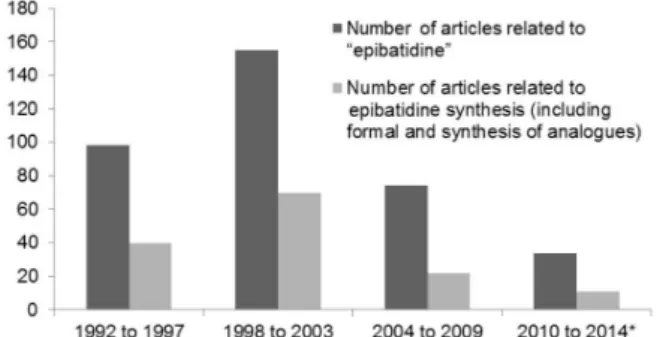
epibatidine synthesis have appeared (Figure 2). However, the number of articles is still impressive, and therefore, an update seems appropriate.
This review attempts to cover epibatidine synthesis research (total and formal synthesis) since 2001. Despite the few available synthetic approaches for the construction of the azabicyclo ring (cycloaddition reactions, intramolecular nucleophilic substitution reactions, intramolecular SN, and rearrangement reaction) (Figure 3), this review presents new and modern strategies efficiently employed
H N
N Cl
(–)-Epibatidine( )1
H N
Epiboxidine (1a) N O
Figure 1. Structures of (−)-epibatidine and epiboxidine.
to obtain the cyclohexylamine core or to incorporate the 2-chloropyridyl moiety, including ring-closing metathesis, Suzuki/Negishi coupling reactions, and rearrangements. Within each of these categories, the content in this review will be presented in chronological order.
2. Cycloaddition Reactions
An efficient and short synthesis of optically
pure (+)-N-Boc-azabicyclo[2.2.1]hept-2-one, (tert
-butyloxycarbonyl, Boc), 10 was reported by Pandey
(Scheme 1).8 The method involves the cycloaddition
of ethynyl phenyl sulfone (3) with N-methoxycarbonyl
pyrrole (2),9 followed by the introduction of the second
phenyl sulfone group to the cycloadduct 4 by β-metalation.
The desymmetrization of the bisphenylsulfonyl byciclic
compound 5 was carried out by stirring with the disodium
salt of meso-hydrobenzoin, giving 6 as a single diastereomer,
indicated by nuclear magnetic resonance (NMR) and high performance liquid chromatography (HPLC) analysis. The reductive elimination of the phenyl sulfone group using
Na-Hg amalgam gave the acetal 7. Simple acetal hydrolysis
would lead to the corresponding N-acetylazabicyclo[2.2.1]
hept-2-one, but the removal of the chiral acetal moiety was possible only by changing the acetyl protecting group to the
t-butylacetyl group. Thus, the N−CO2Me bond was cleaved
with trimethylsilyl chloride (TMSCl), and the amine 8 was
reprotected with di-tert-butyl dicarbonate (Boc2O), giving
the N-Boc compound 9. The ketone 10 was obtained by
catalytic hydrogenation with Pd/C. The specific rotation
([α]D) of ketone 10 corresponds to that reported by Fletcher
and Trudell10 in their total synthesis of (−)-epibatidine.
In 1998, Pandey’s group reported a [3+2]-cycloaddition
strategy in the racemic synthesis of epibatidine (Scheme 2).11
Years later, the same group reported an asymmetric
approach using Oppolzer’s sultam as a chiral auxiliary.12
The key step of cycloaddition involves the reaction of
the N-alkyl-bis(trimethylsilyl) cyclic amine 14 with the
dipolarophile (−)-17 using AgF as a one-electron oxidant.
The bis-silylated amine was prepared by double lithiation of
pyrrolidine 11. Heck-coupling reaction between
2-chloro-5-iodopyridine 16 and chiral camphorsultam derivative 15
gave the desired dipolarophile (−)-17. Surprisingly, the
cycloaddition preferably gave the 2-chloropyridyl moiety
in exo-stereochemistry, differently from the results obtained
with model compounds. The authors did not mention any reasonable explanation for this favorable inversion
of the exo/endo ratio. Careful separation of 18 followed
H N
N Cl
Cycloaddition Intramolecular
Intramolecular
SN, type 1
SN, type 2
1
4
Pandey (2001,2002) Vogel (2003) Node (2006) Evans (2001)
Loh (2005) Takemoto (2006) Stevenson (2012) Jorgensen (2012) Blakemore (2013)
Maycock (2001) Avenoza (2001) Aggarwal (2005) Gómez-Sanchez (2006) Lautens (2010)
Rearrangement Armstrong (2007)
Figure 3. Recent synthetic approaches to form the azabicyclo ring during the synthesis of epibatidine.
CO2Me N
SO2Ph
a
CO2Me N
SO2Ph
CO2Me N d
2 3 4
8
Steps: 7 (formal) Overall yield: 30% CO2Me
N +
SO2Ph
6 7
g
Boc N
O
9 (+)-10
(-)-1
CO2Me N
SO2Ph
SO2Ph 5
b
e
c
f
(4 steps) ref . 10
O O
Ph
Ph
O O
Ph
Ph
H N
O O
Ph
Ph
Boc N
O O
Ph
Ph
Scheme 1. (a) 85-90 °C; (b) n-BuLi, −78 °C, tetrahydrofuran (THF), PhSO2F, rt (43%, 2 steps); (c) meso-hydrobenzoin, NaH, THF, 0 °C → rt (85%); (d) 6% Na/Hg, NaH2PO4.H2O, 0 °C (95%); (e) TMSCl, NaI, CH3CN, rt; (f) Boc2O, Et3N, CH2Cl2, rt (95%, 2 steps); (g) Pd/C, H2, 55 psi, EtOH/EtOAc, rt (90%) (adapted from reference 8).
CO2Me N
SO2Ph a
CO2Me N
SO2Ph
CO2Me N d
2 3 4
8
Steps: 7 (formal) Overall yield: 30% CO2Me
N +
SO2Ph
6 7
g
Boc N
O
9 (+)-10
(-)-1 CO2Me N
SO2Ph
SO2Ph 5
b
e
c
f
(4 steps) ref . 10 O
O Ph
Ph
O O
Ph
Ph
H N
O O
Ph
Ph
Boc N
O O
Ph
by removal of the chiral auxiliary and methylation of
the acid 19 gave the compound 20. Starting from this
compound, the synthesis of (±)-epibatidine was reported.11
The formal synthesis of (−)-epibatidine reported by
Vogel13 uses the “naked aza-sugar” methodology for an
efficient resolution of a racemic ketone by amination using
(R,R)-1,2-diphenylethylenediamine (Scheme 3). Starting
with the Diels-Alder adduct (±)-23,14 the tosyl group
was removed with SmI2, giving the ketone (±)-24. The
resolution of (±)-24 gave a separable mixture of compounds
(+)-25 and (+)-26, which gives back the ketones (+)-24
and (−)-24 in optically active formsafter acid hydrolysis.
Reduction of the double bond led to (−)-10 and (+)-10 in
quantitative yield. The total synthesis of (−)-1 and (+)-1
from compound 10 was reported by Fletcher and Trudell.10
Node and co-workers15 reported a second-generation
route for the formal synthesis of (−)-epibatidine (Scheme 4).
Diels-Alder reaction between the chiral dienophile di-(l
)-menthyl (R)-allene-1,3-dicarboxylate 27 and the N
-Boc-pyrrole 21 gives the endo-adduct 28 as the sole product.
The authors mention the high endo/exo selectivity could
be attributed to the steric repulsion between the Boc group
of 21 and the l0-menthyl group in the dienophile 27.
Consecutive reductions of the bicyclic double bond and
the menthyl diester give the diol 30. Ozonolysis of the
remaining double bond generates the β-keto alcohol 31.
The alcohol was oxidized by Jones oxidation to carboxylic
acid 32, which was decarboxylated with reflux in toluene,
giving the (−)-N-Boc-7-azabicyclo[2.2.1]heptan-2-one
(10). Again, the total synthesis of 1 from compound 10 was
already reported by Fletcher and Trudell.10
3. Intramolecular SN-Type 1
An asymmetric exo-selective hetero Diels-Alder
reaction mediated by Lewis acid and an unusual ring-opening fragmentation were the key steps for the
asymmetric synthesis of (−)-epibatidine reported by
Bn N N
S O
O O
N I
Cl
N S
O
O O
N Cl
Bn N
TMS TMS
N Cl
O N S
O O
Bn N
CO2H N
Cl
(-)-17
H N
a, b
Boc
N TMS
c, d e
H
N TMS
TMS
f
g h
11 12 14
16 15
18
19
Bn N
CO2Me N
Cl
i
20
(±) -1 13
(-)-17
+
14(9:1)
+
+
N S
O O
O Bn N
N Cl
(2 steps)
ref . 11 Steps:9 (formal)
Overall yield: 23%
Scheme 2. (a) Boc-N3, Et3N, dioxane, rt (90%); (b) s-BuLi, TMSCl, TMEDA, −78 °C (90%); (c) s-BuLi, TMSCl, TMEDA, −50 → −30 °C (68%); (d) TFA, CH2Cl2, rt (quant.); (e) PhCH2Cl, K2CO3, CH3CN, rt (80%); (f) K2CO3, Pd(OAc)2, PPh3, CH3CN, reflux (85%); (g) AgF, CH2Cl2 (58%); (h) LiOH.H2O, THF:H2O, 35 °C; (i) SOCl2, MeOH, 0 °C → rt (90%, 2 steps) (adapted from reference 12).
Bn N N
S O
O O
N I
Cl
N S
O
O O
N Cl Bn N
TMS TMS
N Cl
O N S
O O
Bn N
CO2H N
Cl
(-)-17 H
N
a, b
Boc
N TMS
c, d e
H
N TMS
TMS
f
g h
11 12 14
16 15
18
19
Bn N
CO2Me N
Cl
i
20
(±) -1 13
(-)-17
+
14(9:1)
+
+
N S
O O
O Bn N
N
Cl
(2 steps)
ref . 11 Steps:9 (formal)
Evans (Scheme 5).16 Dienophile 35 was formed by a
Horner-Wadsworth-Emmons reaction of aldehyde 33 and
phosphonate containing the chiral auxiliary 34. The
hetero-diene 36 was synthesized by treatment of glutarimide with
triethylsilyl triflate under basic conditions. Evidenced by
NMR, the exo selectivity of the cycloaddition reaction
was rationalized based on steric interactions between the
triethylsilyloxy substituents of 36 and the Lewis acid-acyl
oxazolidinone complex. Removal of the chiral auxiliary
by samarium(III) trifluoromethanesulfonate [Sm(OTf)3]
gave the methyl ester 38. Cleavage of the C1−N bond
was accomplished by O-acylation with Boc2O followed
by treatment with tetrabutylammonium fluoride (TBAF)
to produce the nitrile 40. Krapcho decarboxylation of 40
provided the ketone 41. The required transposition of the
nitrogen atom was accomplished by the conversion of nitrile
41 to amide 42, followed by Hofmann rearrangement to
afford the amine 43. Several reducing agents were tested
for the stereoselective reduction of the ketone 43 to the
desired axial alcohol for SN2 displacement. However,
all reactions gave a mixture of inseparable alcohols with equatorial alcohol as a major isomer. Therefore,
Boc N
O
Ts
Boc N
O
Boc N Boc
N
N H HN
HN NH Ph
Ph Ph Ph
+
(+)-25
(+)-26
(±)-23 (±)-24
a b
c
Boc N
(-)-24
d BocN
O
(+)-24
O
(-)-10
(+)-10
Boc N
Ts Br
+
c
(-)-1
(+)-1
d
22 21
(4 steps) ref. 10 (2 steps)
ref. 11
(4 steps) ref. 9
Steps: 4 (formal)
Overall yield: 31% for (+)-10; 32% for (−)-10
Scheme 3. (a) SmI2, THF/MeOH, −78 °C (75%); (b) (R,R)-1,2-diphenylethylenediamine, 4Å molecular sieves, CH2Cl2, room temperature (rt) (42% for (+)-25 and 43% for (+)-26); (c) H3PO4/THF, 20 °C (95% for (+)-24 and 96% for (−)-24); (d) 10% Pd/C, H2, MeOH, rt (> 99%) (adapted from reference 13).
b
29
30
d Boc
N O
31
OH
Boc N
O O
O O
Boc N
OH OH (-)-10
Boc N
O
CO2H
32
f (+)-1
C O2C
H
CO2 H +
21
27
a
Boc N
O O
O O
28
c
e (4 steps)
ref. 10
6 (formal) Steps:
Overall yield: 39%
Scheme 4. (a) AlCl3, CH2Cl2, −78 °C (88%); (b) Pd-C, H2, EtOAc, rt (99%); (c) LiAlH4, THF, rt (90%); (d) O3, CH2Cl2, −78 °C, Me2S, rt (93%); (e) Jones reagent, acetone, 0 °C; (f) toluene, reflux (54%, 2 steps) (adapted from reference 15).
Boc N
O
Ts
Boc N
O
Boc N Boc
N
N H HN
HN NH Ph
Ph Ph Ph
+
(+)-25
(+)-26
(±)-23 (±)-24
a b
c
Boc N
(-)-24
d BocN
O
(+)-24
O
(-)-10
(+)-10
Boc N
Ts Br
+
c
(-)-1
(+)-1
d
22 21
(4 steps) ref. 10 (2 steps)
ref. 11
(4 steps) ref. 9
Steps: 4 (formal)
Overall yield: 31% for (+)-10; 32% for (−)-10
b
29
30 d
Boc N
O
31 OH
Boc N
O O
O O
Boc N
OH OH (-)-10
Boc N
O
CO2H 32 f
(+)-1
C O2C
H
CO2 H +
21
27
a
Boc N
O O
O O
28
c
e (4 steps)
ref. 10 6 (formal) Steps:
to complete the synthesis, the alcohol 44 was converted
into the corresponding mesylate 45, and subsequent SN2
displacement with LiBr provided the bromide 46. Removal
of the Boc group with trifluoroacetic acid (TFA) followed
by reflux of amine 47 for 3 days afforded (−)-epibatidine
in 13 steps and 13% overall yield.
A practical 13-step process for the synthesis of
(−)-epibatidine was reported by Loh (Scheme 6).17 The
entire synthetic route is straightforward and convenient for gram-scale synthesis. The synthesis commenced from the reduction of commercially available chloro
methylnicotinate 48 to the aldehyde derivative 50 in two
steps, followed by Grignard addition with a vinyl group
to provide the allylic alcohol 51. Bromination of 51
provided the desired terminal bromide 52 necessary for
another allylic rearrangement under Barbier conditions.
The “aza” Barbier reaction between 52 and the imine
55 (carrying a chiral auxiliary) provided only one single
isomer, the diene 56. Using Grubbs 2nd generation catalyst
of this diene provided the desired product 57. For the
intramolecular cyclization, the alkene 57 was brominated,
and two isomers were obtained. Single X-ray structure confirmed that the minor isomer was the desired one, and the authors had to recycle by converting back the
major isomer to the alkene 57. Deprotection of the chiral
auxiliary group provided the amine 60, which underwent
the intramolecular cyclization by heating, affording the
azabicyclo compound 61. The completion of the synthesis
involved radical debromination followed by epimerization
of the endo-epibatidine.
Takemoto’s research group developed a protocol to synthesize chiral 4-nitrocyclohexanones through an enantioselective tandem Michael addition between
nitroalkenes and γ,δ-unsaturated β-ketoesters catalyzed
by chiral thiourea 74.18 This protocol was applied to
synthesize (−)-epibatidine in 10 steps at 19% overall
N Cl CHO
+ N
O O
P MeO O
MeO
Bn
a N O
O O
Bn N
33 34 35
N OTES
OTES 36
b
HN
N O O
N Cl
O
Bn
OTES
O
37
c
HN
OMe N
Cl O
OTES
O
38
d N
OMe N
Cl O
OTES
O
39 Boc
e CN f
N
Cl
CN
N Cl
O O
H
OMe O
40 41
g N
Cl
O O NH2
h BocHN
N Cl
O
42 43
i BocHN
N Cl
44 OH
j BocHN
N Cl
OMs 45
k BocHN
N Cl
46 Br
NH2
N Cl
47 Br
l m
(-)-1 1
Cl
Steps: 13 (total)
Overall yield: 13%
Scheme 5. (a) LiCl, i-Pr2EtN, CH3CN, rt (81%); (b) Me2AlCl, CH2Cl2, −78 °C (79%); (c) Sm(OTf)3, MeOH, reflux (84%); (d) Boc2O, p-dimethylaminopyridine (DMAP), Et3N, CH2Cl2, rt (98%); (e) n-Bu4NF, THF/H2O, rt (81%); (f) dimethyl sulfoxide (DMSO), H2O, 130 °C (99%); (g) Me3SiOK, toluene, 70 °C (72%); (h) Pd(OAc)4, tert-butyl alcohol, 50 °C (70%); (i) NaBH4, MeOH, −40 °C, (89%, 92% enantiomeric excess (ee)); (j) MsCl, Et3N, CH2Cl2, rt (92%); (k) LiBr, THF, 50 °C (84%); (l) TFA, CH2Cl2, rt (91%); (m) CHCl3, reflux (95%) (adapted from reference 16).
N
Cl CHO
+ N
O O
P
MeO O
MeO
Bn
a N O
O O
Bn N
33 34 35
N OTES
OTES 36
b
HN
N O
O N
Cl
O
Bn
OTES
O
37
c
HN
OMe N
Cl O
OTES
O
38
d N
OMe N
Cl O
OTES
O
39 Boc
e CN f
N
Cl
CN
N Cl
O O
H
OMe O
40 41
g N
Cl
O
O NH2
h BocHN
N Cl
O
42 43
i BocHN
N Cl
44 OH
j BocHN
N Cl
OMs 45
k BocHN
N Cl
46 Br
NH2 N
Cl
47 Br
l m
(-)-1 1
Cl
yield (Scheme 7). The route commenced by treatment of
enone 63 with lithium bis(trimethylsilyl)amide (LHMDS),
followed by the addition of allylcyanoformate to obtain 64.
The Michael addition between 64 and 65 in the presence
of chiral thiourea 74 gave 66 in lower enantioselectivity
(75% ee) compared to the model compounds. The second
Michael addition occurred with KOH in ethanol and
provided the cyclic ketoester 67. Decarboxylation of 67
under Tsuji conditions gave 68 in quantitative yield. The
remaining tasks were the stereoselective reduction of carbonyl group and the configuration inversion of the nitro group. For this purpose, the axial methoxy group assisted
the stereoselective reduction of the ketone 68 by lithium
tri-sec-butylborohydride (L-selectride), and the alcohol 69 was
giving. After several attempts, the authors found that the
best result to remove the OMe group was the treatment of 69
with NaOMe in t-butanol. At this stage, the ee was improved
by recrystallization of compound 70. Finally, 1,4-hydride
reduction of 70 with NaBH3CN followed by mesylation
of the remaining alcohol afforded the axial nitroalkane 72
as the major product. Successive treatment of 72 with zinc
dust and refluxing in CHCl3 gave (−)-epibatidine.
Stevenson and co-workers19 described an excellent
route for the total synthesis of (−)-epibatidine through
enzymatic cis-dihydroxylation of bromobenzene using the
microorganism Pseudomonas putida UV (Scheme 8).19,20
The cis-dihydrodiol (+)-76 was giving with > 98% ee,
and its chemoselective hydrogenation produced the
tetrahydrodiol (−)-77 with 90% yield. The hydroxyl
group in C-2 prefers to occupy a pseudo-axial position to minimize allylic 1,2-strain with the substituent on the alkene, while the hydroxyl group in C-1 is equatorial.
The silylation of (−)-77 was chemoselective with the
hydroxyl group in the equatorial position with 86% yield.
The alcohol (−)-78 was converted to urethane 79 using
Ichikawa’s conditions, with 90% yield. The urethane 80
was dehydrated, providing the intermediate cyanate 80,
which underwent a rapid [3,3]-sigmatropic rearrangement under the reaction conditions to furnish the intermediate
isocyanate 81. This intermediate was protected with
48
a
(-)-1 N
Cl
MeO2C
49
b N
Cl
HO
50
c N
Cl
O
51
d N
Cl
OH
52 N
Cl
Br H2N Ph
CO2Me
+
H O
e
53 54
N Ph CO2Me
H
N Ph CO2Me
N
Cl
55
56
+
f
g
N Cl
NH CO2Me
Ph
57
h N
Cl NH
CO2Me
Ph
58
i
Br Br
N Cl NH2
Br Br
60
k
61 H N
N
Cl
N Cl NH
Ph
59 Br
Br HO
Br l
endo-1 H N
N
Cl
j m
H
N N
Ru
P Cl
Cl
Ph
Steps: 13 (total)
Overall yield: 21% Grubbs catalyst, 2ndgeneration (62)
Scheme 6. (a) NaBH4, THF:MeOH (3:1), 0 °C (99%); (b) (COCl)2, DMSO, Et3N, CH2Cl2, −78 °C (99%); (c) vinyl magnesium bromide, THF, 0 °C (96%); (d) PBr3, Et2O, 0 °C (98%); (e) NaSO4, CH2Cl2, 0 °C (99%); (f) Zn, THF, 0 °C (93%);. (g) 10% 62, CH2Cl2, 25 °C (94%); (h) Br2, Et4N+Br−, CH2Cl2, −78 °C (92%, dr 66:34); (i) diisobutylaluminium hydride (DIBAL-H), CH2Cl2, 0 °C (88%); (j) Pb(OAc)4, CH2Cl2:MeOH (2:1), 0 °C (65%); (k) CH3CN, 82 °C (85%); (l) Bu3SnH, azobisisobutyronitrile (AIBN), benzene, reflux (99%); (m) t-BuOK, t-BuOH, reflux (58%) (adapted from reference 17).
48
a
(-)-1 N
Cl
MeO2C
49
b N
Cl
HO
50
c N
Cl
O
51
d N
Cl
OH
52 N
Cl
Br H2N Ph
CO2Me +
H O
e
53 54
N Ph
CO2Me
H
N Ph
CO2Me
N
Cl
55
56
+
f
g
N Cl
NH CO2Me
Ph
57
h N
Cl NH
CO2Me
Ph
58
i
Br Br
N Cl NH2
Br Br
60
k
61 H N
N
Cl
N Cl NH
Ph
59 Br
Br HO
Br l
endo-1 H N
N
Cl
j m
H
N N
Ru
P Cl
Cl
Ph
Steps: 13 (total)
N-protective group Boc by the Bruckner protocol with 76%
yield for three steps in a one pot reaction.
The alkenyl bromide (+)-82 was subjected to Suzuki cross
coupling with commercially available 6-chloropyridin-3-yl
boronic acid, giving the compound (+)-83 with 93% yield.
Deprotection of O-silyl was induced by fluoride, giving the
alcohol (+)-84 with 95% yield. The next step involved a
stereoselective catalytic reduction with the addition of the
hydrogens in anti in relation to the hydroxyl and the amine,
giving the compound (−)-44 with 60% yield. The alcohol
(µ)-44 was made by Evan’s protocol, giving the bromide
(−)-46 with 91% yield for mesylation and 78% yield for
bromination. The compound (−)-46 was deprotected with
TFA, giving the amine (−)-47 with 94% yield, which was
then cyclized (95% yield), giving the (−)-epibatidine with
an overall yield of 18% and 14 steps.
Huang et al.21 described a fast and practical synthetic
route involving seven steps for diastereoselective synthesis
for (±)-endo-1, leaving the 6-choro-3-pyridinecarboxaldeide
86 (Scheme 9). Henry’s reaction catalyzed by KF generates
a β-nitro alcohol, which was treated with DMAP and acetic
anhydride, giving the precursor 88 by means of desidratation
with 76% yield for two steps. The next step was using the intramolecular Michael’s reactions between the ketone and
the pyridinylnitroolefin catalyzed with L-proline, giving the
key intermediated 90 with 81% yield and dr ≥ 97%. The
compound 90 was asymmetrically reduced by
(4R,5R)-2-phenyl-1,3,2-dioxaborolane-4,5-dicarboxylic acid - 91
(TarB-H) and NaBH4, building three chiral centers with 95%
yield for compound 71. The alcohol giving was mesylated
with 94% yield. The group nitro was reduced to amine with
Zn/H+. The compound was refluxed with chloroform, giving
(±)-endo-1 with 78% yield for two steps. The conversion of
compound (±)-endo-1 to (±)-epibatidine was reported using
t-BuOK/t-BuOH under reflux.17,22
J o rg e n s e n a n d c o - w o r k e r s2 3 d eve l o p e d a
diastereoisomeric and enantioselective intramolecular Michael addition using a chiral organocatalyst for formal
synthesis of (−)-epibatidine (Scheme 10). The Wittig
reaction of ylide 92 and aldehyde 86 gave the γ-nitroenone
93 with 98% yield. The intramolecular cyclization by
Michael addition using 10 mol% catalyst and hindered
protic solvent gave the trans-4-nitrocyclohexanone 90 with
80% yield (96% ee, 14:1 dr). The compound 90 has been
reduced with NaBH4 to the 4-nitrocyclohexanone 71 with
87% yield (10:1 dr). The total synthesis of (−)-epibatidine
from compound 71 was reported by Szántay,24 involving
over 4 steps with 22% yield.
MeO O
63
a
MeO O
O O
65
b
64
N Cl
NO2 MeO
O
O O
N Cl NO2
H
66
c
67
NO2
OMe
HO
N Cl
O O
d
68
e
69
NO2
OMe
HO
N Cl NO2
OMe
O
N Cl
f
70
NO2
HO
N Cl g
71
NO2
HO
N Cl h
72
NO2
MsO
N Cl i
(-)-1
H N H N
S
NMe2
CF3
F3C
(R,R)-thiourea (74) 73
NH2
MsO
N Cl j
+
Steps: 10 (total)
Overall yield: 19%
Scheme 7. (a) LiN(SiMe3)2, THF, −78 °C, vinyl 2-cyanoacetate, hexamethylphosphoramide, THF, rt (73%); (b) 10% (R,R)-74, toluene, 0 °C (90%, 75% ee); (c) KOH, EtOH, 0 °C (85%, 75% ee); (d) Pd(OAc)2, Ph3P, HCO2H, Et3N, THF, rt (99%); (e) L-selectride®, THF, −78 °C → 0 °C (71%); (f) NaOMe, t-BuOH, rt (71%); (g) NaBH3CN, CH3CO2H, MeOH, −20 °C (87%, 90% dr); (h) MsCl, Et3N, DMAP, CH2Cl2, 0 °C (91%); (i) CH3CO2H, Zn, THF, rt; (j) CHCl3, 60 °C (85%, 2 steps) (adapted from reference 18).
MeO O
63
a
MeO O
O O
65
b
64
N
Cl
NO2 MeO
O
O O
N Cl
NO2 H
66
c
67
NO2 OMe
HO
N Cl
O O
d
68
e
69
NO2 OMe
HO
N Cl
NO2 OMe
O
N Cl
f
70
NO2
HO
N Cl
g
71
NO2
HO
N Cl
h
72
NO2
MsO
N Cl
i
(-)-1
H N H N
S
NMe2
CF3 F3C
(R,R)-thiourea (74) 73
NH2
MsO
N Cl
j
+
(+)-76 b OH OH Br (-)-77 c 1 2 OH OH Br (-)-78 d OH OTBS Br 79 e O OTBS Br CONH2
(+)-82 h OTBS Br H N Boc O OTBS Br C OTBS Br N N C O 80 81 f g (+)-83 i OTBS H N Boc N Cl (+)-84 j OH H N Boc N Cl Br 75 a BocHN N Cl 44 OH k BocHN N Cl OMs 45 l BocHN N Cl 46 Br NH2 N Cl 47 Br m n (-)-1
PdCl2(dppf ) (85)
Steps: 14 (total)
Overall yield: 18%
Scheme 8. (a) Pseudomonas putida UV4 (> 98% ee); (b) H2 (1,5 bar), 5% Rh-graphite catalyst, MeOH, rt (90%); (c) TBSCl, Py, rt (86%); (d) trichloroacetyl isocyanate, CH2Cl2, 0 °C, Na2CO3, Et2O:MeOH:H2O (4:4:1:), rt (90%); (e) Ph3P, Et3N, CBr4, CH2Cl2, −10 °C; (f) [3,3] sigmatropic rearrangement; (g) 1% MoCl2O2, CH2Cl2, t-BuOH, rt (76%, 3 steps); (h) 6-chloropyridin-3-ylboronic acid, 2% 85, PhMe:EtOH:H2O (1:1:1), Na2CO3, 100 °C (93%); (i) TBAF, THF (95%); (j) PtO2, H2 (1 bar), EtOH, rt (60%); (k) Et3N, MsCl, CH2Cl2, 0 °C (91%); (l) LiBr, THF, 60 °C (78%); (m) TFA, CH2Cl2, rt (94%); (n) CHCl3, 55 °C (95%) (adapted from reference 19).
N Cl CHO + O NO2 N Cl O NO2 N Cl O NO2 H N N Cl (±)-endo-1
86 87
89
90
a c
d e f
(±)-1
(1 step) ref . 17
71 NO2 OH N Cl 72 NO2 OMs N Cl g 73 NH2 OMs N Cl
TarB-H (91) N Cl OH O NO2 88 b B O O COOH COOH Steps: 7 (formal)
Overall yield: 43%
Scheme 9. (a) KF.H2O, i-PrOH/THF, rt; (b) DMAP, Ac2O, CH2Cl2, rt (76%, 2 steps); (c) L-proline, 2,5-dimethoxybenzoic acid, DMSO, rt (81%, dr > 97%); (d) 91, NaBH4, THF, 0 °C (95%); (e) MsCl, Et3N, CH2Cl2, 0 °C (94%); (f) Zn, CH3CO2H/THF, rt; (g) CHCl3, reflux (78%, 2 steps) (adapted from reference 21). (+)-76 b OH OH Br (-)-77 c 1 2 OH OH Br (-)-78 d OH OTBS Br 79 e O OTBS
Br CONH2
(+)-82 h OTBS Br H N Boc O OTBS Br C OTBS Br N N C O 80 81 f g (+)-83 i OTBS H N Boc N Cl (+)-84 j OH H N Boc N Cl Br 75 a BocHN N Cl 44 OH k BocHN N Cl OMs 45 l BocHN N Cl 46 Br NH2 N Cl 47 Br m n (-)-1
PdCl2(dppf ) (85)
Steps: 14 (total) Overall yield: 18%
N Cl CHO + O NO2 N Cl O NO2 N Cl O NO2 H N N Cl (±)-endo-1
86 87
89
90
a c
d e f
(±)-1 (1 step)
ref . 17
71 NO2 OH N Cl 72 NO2 OMs N Cl g 73 NH2 OMs N Cl
TarB-H (91)
N Cl OH O NO2 88 b B O O COOH COOH Steps: 7 (formal)
Blakemore and co-workers25 investigated the
functionalizing of α-chloroalkylllithiums, generating
in situ the sulfoxide-lithium for stereospecific
reagent-controlled homologation with available
6-chloropyridin-3-yl boronic acid for the formal synthesis of (−)-epibatidine, 1
(Scheme 11). The reaction of p-thiocresol (95) with
acrolein generates the aldehyde 96 with 95% yield, which
was treated with ethylene glycol, generating the thioether
99. The two enantiomers of syn-chlorosulfoxide 99 were
prepared by Ellamn-Bolm enantioselective oxidation using
the appropriate enantiomer of Jackson’s tert-leucinol
derived ligand 109, giving 80% yield (> 98% ee) for the
sulfoxidation and non-racemizung chlorination with 86% yield (95:5 dr).
The epimerization of syn-chlorosulfoxide was
conducted by sodium bis(trimethylsilyl)amide (NaHMDS)
and [D4]methanol, giving the anti-D-chlorosulfoxide 100
with 85% yield and 86% dr. There was a double one-pot reaction between the 6-chloropyridin-3-yl boronic acid
and sulfoxide-lithium (generated from the anti-D-100
in situ), which led to two reactional cycles, the first using
the enantiomer (S)-anti-D-100 and the second using
(R)-anti-D-100. The alcohol (R,S)-D,D-101 was obtained
with 49% yield (97% ee and 79% dr).
The alcohol 101 was mesylated and substituted by azide
group, and acetal was hydrolysed, generating the compound
104 with 52% yield for three steps. The compound 104
was converted to dialdehyde 105, which was used without
purification and converted to dienyl amide 107 by exposure
to methylenetriphenylphosphorane (generated in situ with
n-BuLi and PPh3CH3I), giving 12% yield for two steps. The
compound 107 was cyclized by Grubbs’ first-generation
catalyst, giving the compound 108 with 85% yield. The
total synthesis of (−)-epibatidine from compound 108 was
reported by Corey.26
4. Intramolecular SN-Type 2
In 1999, Maycock and co-workers27 reported a formal
synthesis of (+)-epibatidine starting from (−)-quinic acid
(Scheme 12).27,28 Analogously, the same authors revealed
years later that the same precursor (quinic acid) can be used for the formal synthesis of the corresponding levorotary epibatidine by the synthesis of the enantiopure
R-4-hydroxy-2-cyclohexen-1-one (116).29
Avenoza et al.30,31 described a synthetic route to
7-azabicyclo[2.2.1]heptane containing a carboxylic acid group at the bridgehead carbon atom (Scheme 13). The synthesis begins with preparation of the dienophile
120 from racemic serine through esterification followed
by double benzoylation in the presence of base.
Diels-Alder reaction between 120 and Danishefsky’s diene
gave a mixture of cycloadducts, which was treated under dilute HCl and
1,8-diazabicyclo[5.4.0]undec-7-ene (DBU) to afford the enone 125. Hydrogenation of
this product followed by reduction with L-selectride
and mesylation gave the compound 127. Internal
nucleophilic displacement with t-BuOK gave the desired
compound 128 with the 7-azabicyclo[2.2.1]heptane core.
Selective hydrolysis of the ester gave 129, which was
used to prepare the Barton ester derivative 130. Simple
decarboxylation of the Barton ester was achieved using tin hydride as a source of hydrogen radical, yielding the
N-benzoyl-7-azabicyclo[2.2.1]heptane 131, the precursor
for Olivo’s synthesis of epibatidine.32
Aggarwal and Olofsson33 described a good methodology
of direct asymmetric arylation for the cicloexanone 139,
applying it for the total synthesis of (−)-epibatidine
(Scheme 14). The electrophile pyridyl iodonium salt (135)
was synthetized in two steps: obtaining the compound 134
from acetylene gas with 21% yield, which was reacted with
+ Ph3P O
NO2 a
N Cl
O
NO2 86
92
93
b
90
71
c
(-)-1
(4 steps) ref. 24
N NH2
N OMe
Cinchona-alkaloid-sabed primary aminocatalyst (94)
N Cl
O
NO2
Steps: 3 (formal)
Overall yield: 75%
Scheme 10. (a) 1,2-dicloroethane, 50 °C (98%); (b) 94(2×(S)-N-BocPhGly), t-BuOH, 75 °C (88%, 14:1 dr, 96% ee); (c) NaBH4, MeOH, 0 °C (87%, 10:1 dr) (adapted from reference 23).
+ Ph3P O
NO2 a
N Cl
O
NO2 86
92
93
b
90
71 c
(-)-1 (4 steps)
ref. 24
N NH2
N OMe
Cinchona-alkaloid-sabed primary aminocatalyst (94) N
Cl
O
NO2
Steps: 3 (formal)
S O
Cl O O
D
SH S
CHO S
O
O S
O O O
S
O O O
Cl
N Cl
MeO OMe
OMe
OMe D
N3 D
(R,S)-DD-101
(Ss)-anti-D-100 Cl N
O
O
O O D
OH D
N Cl
OHC
CHO D
N3 D
N Cl
D
NH
D COCF3 N Cl
D
F3COCHN D
a b c
d e f g
j
k m
(Ss)-syn-H-99
95 96 97
(Ss)-98
107 105
104
108
N Cl
O
O
O O D
OMs
D h
N Cl
O
O
O O D
N3
D i
102 103
(-)-1
(4 steps) ref. 26
P Ru P
Cl
Cl Ph
Grubbs catalyst, 1 generation (st 110) l
N Cl
D
NH2
D
106
I
HO I N OH
tBu
Jackson's ligand (109)
Steps: 12 (formal)
Overall yield: 1%
Scheme 11. (a) Acrolein, Et3N, CH2Cl2, 0 °C; (b) ethylene glycol, p-TsOH·H2O, benzene, reflux (95%); (c) 109, [VO(acac)2], aq. H2O2, CHCl3, 0 °C (80%, > 98% ee); (d) NCS, K2CO3, CH2Cl2, 0 °C (86%, 95:5 dr); (e) NaHMDS, CD3OD, THF, −78 °C (85%, 86% dr); (f) (i) 6-chloro-3-pyridineboronic acid pinacol ester, (S)-anti-D-100, PhLi, THF, −78 °C → rt; (ii) (R)-anti-D-100, PhLi, THF, −78 °C → rt, then KOOH (49%, 97% ee, 79% dr); (g) MsCl,
Et3N, CH2Cl2, 0 °C; (h) NaN3, DMF, 80 °C; (i) TsOH, MeOH, reflux (52%, 3 steps); (j) aq. TFA, CHCl3, rt; (k) Ph3PCH3I, n-BuLi, THF, −10 °C → reflux; (l) (CF3CO2)2O, Et3N, rt (12%, 3 steps); (m) 10% 110, CH2Cl2, reflux (85%) (adapted from reference 25).
c O O
115
OMe OMe O
d
OH
116
O
OTBDMS
117
O OH
OH HO
HO CO2H
(-)-quinic acid (111)
a O
O O
b
OH
113
O
OTBDMS
114
O
(8 steps) ref. 29
(+)-1
(−)-1
(5 steps) ref. 27
(6 steps) ref. 28
112
(8 steps) ref. 29
Scheme 12. (a) (i) K-Slectride, THF, −78 °C; (ii) aq. 0.5 mol L−1 NaOH, THF, 0 °C; (b) tert-butyldimethylsilyl chloride (TBDMSCl), (i-Pr)
2NEt, DMAP, CH2Cl2, 0 °C → rt (51%, 3 steps); (c) TFA, H2O, CH2Cl2, reflux (85%); (d) TBDMSCl, (i-Pr)2NEt, DMAP, CH2Cl2, 0 °C → rt (98%) (adapted from reference 29).
S O
Cl O
O
D
SH S
CHO S
O
O S
O O O
S
O O O
Cl
N Cl
MeO OMe
OMe
OMe D
N3 D
(R,S)-DD-101
(Ss)-anti-D-100 Cl N
O
O
O O D
OH D
N Cl
OHC
CHO D
N3 D
N Cl
D
NH
D COCF3 N
Cl
D
F3COCHN D
a b c
d e f g
j
k m
(Ss)-syn-H-99
95 96 97
(Ss)-98
107 105
104
108
N Cl
O
O
O O D
OMs
D h
N Cl
O
O
O O D
N3
D i
102 103
(-)-1
(4 steps) ref. 26
P Ru P
Cl
Cl Ph
Grubbs catalyst, 1 generation (st 110) l
N Cl
D
NH2 D
106
I
HO I N OH
tBu
Jackson's ligand (109)
2-chloro-5-bromopyridine, generating the electrophile 135
with approximately 70% yield.
The carbamate 136 was protected with 100% yield. The
ketone 137 was transformed in 2-pyridyl ketone 139 with
41% yield (> 20:1 dr). The base 138 was used to generate
the enolate, favoring the coupling between 137 and 135.
The 2-pyridyl ketone was reduced to alcohol 140 with
83% yield (10:1 dr). The alcohol was mesylated, giving the
compound 141. This was deprotected, giving the amine 73,
which was cyclized, giving the (−)-epibatidine with 90%
yield for three steps.
Gómez-Sánchez and Marco-Contelles34 reported a
direct base-catalyzed heterocyclization of N-Boc protected
3,4-dibromocyclohex-1-yl amine (144) as a key-step for
the synthesis of the azabicycloheptane core (Scheme 15).
Starting from cyclohex-3-enecarboxylic acid 142, the
N-Boc cyclohexene derivative 143 was obtained by Curtius
rearrangement by diphenylphosphoryl azide (DPPA) under reflux of toluene. Bromination of the alkene gave the
dibromo compound 144 in cis configuration as a major
product. The authors found that NaH in dimethylformamide (DMF) is the best condition for the intramolecular
cyclization of 144, affording the known compound 145,
which gave the azabicycloheptene 146 after reaction with
potassium t-butoxide. This azanorbornene is a known
intermediate for the synthesis of epibatidine.35
Lautens and Bexrud36 developed a highly selective
catalyst for the asymmetric hydroarylation of azabicycles and applied it to the synthesis of epibatidine (Scheme 16).
Initially, the reaction of N-Boc-7-azanorbornene 146 with
2-chloropyridine-5-boronic acid 147 generated less than
12% of protected epibatidine 149. To circumvent the low
reactivity of boronic acid, the authors used the potassium
trifluoroborate 148 to produce the desired compound 149
Bz N
MeO2C
Bz N
HO2C
Bz N
O
O
N S
Bz N HO NH2
CO2H
HO NH2•HCl
CO2H CO2Me
NHBz
OTMS
MeO
CO2Me
BzHN
+
OTMS
MeO
CO2Me
BzHN
OTMS
CO2Me
BzHN
O
CO2Me BzHN
O
CO2Me BzHN
a b c d
118 119 120
125
122 124
121 123
e
f
h
OH
CO2Me BzHN
126
i k l
m
(±) -1
128 129
130
131
O
O Si
Danishefsky´s diene (132)
(7 steps) ref. 32
g
OMs
CO2Me
BzHN
127
j
122
Steps: 10 (formal)
Overall yield: 30%
Scheme 13. (a) HCl, MeOH, 0 °C → reflux (> 99%); (b) BzCl, Et3N, CH2Cl, rt, DBU, MeOH, rt (94%); (c) 2-trimethylsiloxy-1,3-butadiene, ZnI2, CH2Cl2, reflux; (d) aq. HCl, THF, rt (94%, 2 steps); (e) 132, toluene, reflux; (f) aq. HCl, THF, rt, DBU, MeOH, 5 °C (55%, 2 steps); (g) H2, Pd/C, CH2Cl2, rt (95%); (h) L-selectride, THF, −78 °C; (i) MsCl, N,N-diisopropylethylamine (DIPEA), CH
2Cl2, rt (68%, 2 steps); (j) t-BuOK, THF, rt (81%); (k) LiOH. H2O, MeOH:H2O, rt (99%); (l) (i) (COCl)2, DMF, CH3CH2Cl2; (ii) N-hydroxypyridine-2-thione, Et3N, THF, 0 °C; (m) Bu3SnH, THF, light, rt (61%, 3 steps) (adapted from reference 31).
Bz N
MeO2C
Bz N
HO2C
Bz N
O
O
N S
Bz N
HO NH2
CO2H
HO NH2•HCl
CO2H CO2Me
NHBz
OTMS
MeO
CO2Me BzHN
+
OTMS
MeO
CO2Me BzHN
OTMS
CO2Me BzHN
O
CO2Me BzHN
O
CO2Me BzHN
a b c d
118 119 120
125
122 124
121 123
e
f
h
OH
CO2Me BzHN
126
i k l
m
(±) -1
128 129
130
131 O
O Si
Danishefsky´s diene (132)
(7 steps) ref. 32
g
OMs
CO2Me BzHN
127
j
122
O
N(Boc)2 137
d Ph N
Li Ph
138
ii)
133 N
I
N
Cl Cl
Cl
O
N(Boc)2
139
N Cl
e
OH
N(Boc)2
140
N Cl
f
(-)-1
H
H a Cl ICl2
b
134
135
135
OMs
N(Boc)2 141
N Cl
g
OMs
NH2 73
N Cl
h i)
O
NHBoc
136
c
Steps: 9 (total)
Overall yield: 5%
Scheme 14. (a) ICl3, HCl, H2O, 0 °C → rt (21%); (b) 2-chloro-5-bromopyridine, BuLi, Et2O, −78 °C → rt (ca. 70%); (c) Boc2O, DMAP, THF, reflux (> 99%); (d) (i) THF, −118 °C; (ii) DMF, −45 °C (41%, > 20:1 dr, 94% ee, 2 steps); (e) NaBH4, MeOH, −98 °C (83%, 10:1 dr); (f) MsCl, Et3N, CH2Cl2, rt; (g) TFA, CH2Cl2, rt; (h) CHCl3, reflux (90%, 3 steps) (adapted from reference 33).
CO2H NHBoc
NHBoc Br Br
Boc N
Br
Boc N
a b c d
142 143
144
145 146
(±)-1
(2 steps) ref. 35
Steps: 4 (formal)
Overall yield: 17%
Scheme 15. (a) DPPA, Et3N, toluene, reflux, t-BuOH, reflux (85%); (b) Br2, Et4NBr, CH2Cl2, −78 °C (50%); (c) NaH, DMF, rt (52%); (d) t-BuOK, THF, rt (78%) (adapted from reference 34).
in moderate yield, but with high enantiomeric excess.
The steps a to d were reported by Gomez-Sanchez.37 The
deprotection of N-Boc was reported by Armstrong.38
5. Rearrangement
Armstrong et al.38 accomplished the racemic synthesis
of epibatidine from commercial
2-methoxy-3,4-dihydro-2H-pyran. The key step consisted of the construction of
the 7-azabicyclo[2.2.1]heptane (154) through an elegant
and exo-selective aza-Prins-pinacol rearrangement
(Scheme 17). The bicyclic was obtained in only three
steps from the pyran (151) (sulfonamidation using cheap
chloramine-T),39 the addition of vinyl Grignard reagent, and
treatment with SnCl4.40 Attempts for a de novo synthesis of
the chloropyridine group using the aldehyde moiety through a [4+2] cycloaddition approach failed, and the authors had to convert the aldehyde into a bromine group with aims at a cross-coupling approach. Thus, Jones oxidation of
compound 154 followed by Barton bromodecarboxylation
under sunlight gave the desired bromide 158. Changing
the protecting group was necessary, with the authors commenting that the tosyl group interferes with the desired Suzuki coupling, and an unexpected intramolecular cyclization through a radical mechanism was observed.
Deprotection of tosylate 158 with HBr and protection
with Boc2O led to the bromide 145. Suzuki coupling using
bis(1,5-cyclooctadiene)nickel (Ni(COD)2) in combination
with bathophenanthroline yielded the N-Boc protected
racemic (±)-epibatidine.
6. Conclusions
The number of articles published from 2001 to 2014 about the synthesis of epibatidine is still significant. However, strategies for building azabicyclic systems are still limited due to its relatively low structural complexity. Therefore, the syntheses presented in this review focused
O
N(Boc)2
137
d Ph N
Li Ph
138
ii)
133 N
I
N
Cl Cl
Cl
O
N(Boc)2 139
N Cl
e
OH
N(Boc)2 140
N Cl
f
(-)-1 H
H a Cl ICl2
b
134
135
135
OMs
N(Boc)2
141 N
Cl
g
OMs
NH2
73 N
Cl
h i)
O
NHBoc
136 c
N (HO)2B
Cl 146
(±)-1 N
KF3B
Cl
+
Boc N
N Cl
147 148
149
b
ref. 38 a
Rh N N
O O
CO OC
Cl
Rh(IBiox[(-)-menthyl](CO)2Cl (150)
Steps: 6 (formal)
Overall yield: 6%
Scheme 16. (a) KHF2, MeOH, H2O (71%); (b) Cs2CO3, 10% 150, THF/H2O, 80 °C (45%) (adapted from reference 36).
Ts
N TsN
CHO CO2H
e
Ts N
Br f h
H N
Br i
154 157
158 159
149
O OMe a
151
N Ts
OMe O
N Ts
OMe HO
b c
152 153
d
(±)-1
g 145 N Ts HO
Ts N
aza-Prins
pinacol OH
156 155
Steps: 9 (total)
Overall yield: 3%
Scheme 17. (a) NBS, TsNClNa, CH3CN, rt (79%); (b) vinyl magnesium bromide, Et2O, −30 °C → rt (56%); (c) SnCl4, CH2Cl2, 0 °C → rt (32%); (d) Jones reagent, acetone, 0 °C → rt (92%); (e) (COCl)2, CH2Cl2, reflux, 2-mercaptopyridine-1-oxide, BrCCl3, 90 °C, sunlight (61%); (f) aq. HBr, phenol, reflux; (g) NaHCO3, Boc2O/THF, H2O (67%, 2 steps); (h) Ni(COD)2, bathophenanthroline, KO‘Bu, BuOH, rt, 6-chloropyridin-3-yl boronic acid, 60 °C (56%); (i) TFA, CH2Cl2 (89%) (adapted from reference 38).
on modern methods to obtain the cyclohexylamine ring or to incorporate the 4-chloropyridyl ring, including Pd catalyzed reactions and metathesis reactions.
Among the syntheses covered in this review, the
synthesis reported by Jorgensen23 seems to be the most
attractive in terms of the number of steps. However, if the overall yield is evaluated, the Huang’s route cannot be tolerated.
Concomitantly, advances in synthesis and biological activity studies of epibatidine analogs such as epiboxidine are ongoing.
7. Acknowledgments
The authors gratefully acknowledge financial support from the Fundação de Amparo à Pesquisa do Estado de São Paulo - FAPESP (2009/00617-2 and 2013/18700-9).
Álvaro Takeo Omori is Bachelor in Chemistry at São Paulo University (2000) and PhD in Organic Chemistry under guidance of Prof João Valdir Comasseto at the Chemistry Institute of São Paulo Univeristy (2005). He was supervised by Prof Tomas Hudlicky in his post-doctoral at Brock University (Canada, 2006). He has experience in Organic Chemistry, acting on the following topics: biocatalysis, total synthesis (morphinanes), palladium chemistry and selenium/tellurium chemistry. Currently, he is associate professor at Universidade Federal do ABC, working with total syntheses of epibatidine and oseltamivir phosphate.
Ronaldo Epifanio de Oliveira Filho is Bachelor of Industrial Chemistry at Universidade São Francisco (2012)
N (HO)2B
Cl 146
(±)-1 N
KF3B
Cl +
Boc N
N Cl
147 148
149 b
ref. 38 a
Rh N N
O O
CO OC
Cl
Rh(IBiox[(-)-menthyl](CO)2Cl (150) Steps: 6 (formal)
Overall yield: 6%
Ts
N TsN
CHO CO2H
e
Ts N
Br f h
H N
Br i
154 157
158 159
149 O OMe
a
151
N Ts
OMe O
N Ts
OMe HO
b c
152 153
d
(±)-1 g 145
N Ts HO
Ts N aza-Prins
pinacol OH
156 155
Steps: 9 (total)
and Master of Science and Technology/ Chemistry at Universidade Federal do ABC (2015). He has experience in Organic Chemistry, acting on the following topics: organic synthesis (alkaloids), biocatalysis and polymers.
References
1. Olivo, H. F.; Hemenway, M. S.; Org. Prep. Proced. Int.2002,
34, 1 and references therein.
2. Daly, J. W.; Garraffo, H. M.; Spande, T. F.; Decker, M. W.; Sullivan, J. P.; Williams, M.; Nat. Prod. Rep.2000, 17, 131. 3. Spande, T. F.; Garraffo, H. M.; Edwards, M. W.; Yeh, H. J. C.;
Lewis, P. U.; Daly, J. W.; J. Am. Chem. Soc.1992, 114, 3415. 4. Garraffo, H. M.; Spande, T. F.; Williams, M.; Heterocycles
2009, 79, 207.
5. Falkenberg, M. B.; Pereira, P. A.; Lat. Am. J. Pharm.2007, 26,
614.
6. Badio, B.; Garraffo, H. M.; Plummer, C. V.; Padgett, W. L.; Daly, J. W.; Eur. J. Pharmacol. 1997, 321, 189.
7. Olivo, H. F.; Colby, D. A.; Hemenway, M. S.; J. Org. Chem.
1999, 64, 4966.
8. Pandey, G.; Tiwari, S. K.; Singh, R. S.; Mali, R. S.; Tetrahedron Lett.2001, 42, 3947.
9. Jones, C. D.; Simpkins, N. S.; Giblin, G. M. P.; Tetrahedron Lett.1998, 39, 1021.
10. Fletcher, S. R.; Baker, R.; Chambers, M. S.; Herbert, R. H.; Hobbs, S. C.; Thomas, S. R.; Verrier, H. M.; Watt, A. P.; Ball, R. G.; J. Org. Chem. 1994, 59, 1771; Zhang, C.; Trudell, M. L.; J. Org. Chem.1996, 61, 7189.
11. Pandey, G.; Bagul, T. D.; Sahoo, A. K.; J. Org. Chem. 1998,
63, 760.
12. Pandey, G.; Laha, J. K.; Lakshmaiah, G.; Tetrahedron2002,
58, 3525.
13. Moreno-Vargas, A. J.; Vogel, P.; Tetrahedron Asym.2003, 14,
3173.
14. Zhang, C.; Ballay II, C. J.; Trudell, M. L.; J. Chem. Soc., Perkin Trans. 1 1999, 1, 675.
15. Kimura, H.; Fujiwara, T.; Katoh, T.; Nishide, K.; Kajimoto, T.; Node, M.; Chem. Pharm. Bull.2006, 54, 399.
16. Evans, D. A.; Scheidt, K. A.; Downey, W.; Org. Lett.2001, 3,
3009.
17. Lee, C-L. K.; Loh, T-P.; Org. Lett., 2005, 7, 2965.
18. Hoashi, Y.; Yabuta, T.; Yuan, P.; Miyabe, H.; Takemoto, Y.;
Tetrahedron 2006, 62, 365.
19. Boyd, D. R.; Sharma, N. D.; Kaik, M.; McIntyre, P. B. A.; Stevenson, P. J.; Allen, C. C. R.; Org. Biomol. Chem.2012, 10,
2774.
20. Boyd, D. R.; Dorrity, M. R. J.; Malone, J. F.; McMordie, R. A. S.; Sharma, N. D.; Dalton, H.; Williams, P.; J. Chem. Soc., Perkin Trans. 11990, 1, 489.
21. Huang, X.; Shi, H.; Ren, J.; Liu, G.; Tang, Y.; Zeng, B.; Chin. J. Chem.2012, 30, 1305.
22. Szántay, C.; Kardos-Balogh, Z.; Moldvai, I.; Szántay Jr., C.; Temesvári-Major, E.; Blaskó, G.; Tetrahedron Lett. 1994, 35, 3171.
23. Jensen, K. L.; Weise, C. F.; Dickmeiss, G.; Morana, F.; Davis, R. L.; Jorgensen, K. A.; Chem. - Eur. J. 2012, 18, 11913.
24. Szántay, C.; Kardos-Balogh, Z.; Moldvai, I.; Szántay Jr., C.; Temesvári-Major, E.; Blaskó, G.; Tetrahedron1996, 52, 11053.
25. Emerson, C. R.; Zakharov, L. N.; Blakemore, P. R.; Chem. - Eur. J. 2013, 19, 16342.
26. Corey, E. J.; Loh, T-P.; AchyuthaRao, S.; Daley, D. C.; Sarshar, S.; J. Org. Chem. 1993, 58, 5600.
27. Barros, M. T.; Maycock, C. D.; Ventura, M. R.; Tetrahedron Lett. 1999, 40, 557.
28. Barros, M. T.; Maycock, C. D.; Ventura, M. R.; J. Org. Chem.
1997, 62, 3984.
29. Barros, M. T.; Maycock, C. D.; Ventura, M. R.; J. Chem. Soc., Perkin Trans. 1 2001, 1, 166.
30. Avenoza, A.; Cativiela, C.; Busto, J. H.; Fernández-Recio, M. A.; Peregrina, J. M.; Rodríguez, F.; Tetrahedron2001, 57,
545.
31. Avenoza, A.; Busto, J. H.; Cativiela, C.; Peregrina, J. M.;
Tetrahedron2002, 58, 1193.
32. Olivo, H. F.; Hemenway, M. S.; J. Org. Chem. 1999, 64, 8968.
33. Aggarwal, V. K.; Olofsson, B.; Angew. Chem., Int. Ed.2005,
44, 5516.
34. Gómez-Sánches, E.; Marco-Contelles, J.; Lett. Org. Chem.
2006, 3, 827.
35. Che, C.; Petit, G.; Kotzyba-Hibert, F.; Bertrand, S.; Bertrand, D.; Grutter, T.; Goeldner, M.; Bioorg. Med. Chem. Lett.2003, 13,
1001.
36. Bexrud, J.; Lautens, M.; Org. Lett.2010, 12, 3160.
37. Gómez-Sánchez, E.; Soriano, E.; Marco-Contelles, J.; J. Org. Chem. 2007, 72, 8656.
38. Armstrong, A.; Bhonoah, Y.; Shanahan, S. E.; J.Org. Chem.
2007, 72, 8019.
39. Armstrong, A.; Cumming, G. R.; Pike, K.; Chem. Commun.
2004, 812.
40. Armstrong, A.; Shanahan, S. E.; Org. Lett. 2005, 7, 1335.
Submitted: November 25, 2014
Published online: February 24, 2015