Article
J. Braz. Chem. Soc., Vol. 22, No. 2, 257-263, 2011. Printed in Brazil - ©2011 Sociedade Brasileira de Química
0103 - 5053 $6.00+0.00
A
*e-mail: [email protected]
Chlorination of Isatins with Trichloroisocyanuric Acid
Bárbara V. Silva,* Pierre M. Esteves and Angelo C. Pinto
Instituto de Química-CT, Universidade Federal do Rio de Janeiro, Cidade Universitária, 21945-970 Rio de Janeiro-RJ, Brazil
A isatina e seus derivados são conhecidos na literatura por possuírem uma diversidade de propriedades biológicas. O método de Sandmeyer é o mais utilizado para síntese de diferentes isatinas substituídas, geralmente com altos rendimentos. Apesar de eiciente, este método apresenta algumas limitações, tais como a formação de uma mistura de regioisômeros e baixos rendimentos dependendo do tipo e posição do substituinte presente no material de partida, a anilina. Para superar estas limitações, é preferível que alguns derivados de isatina sejam obtidos por métodos alternativos. Este artigo descreve a cloração de derivados da isatina empregando ácido tricloroisocianúrico [1,3,5-tricloro-1,3,5-triazina-2,4,6-(1H,3H,5H)-triona ou TCCA) em diferentes condições reacionais.
Isatin and its derivatives have been extensively reported in the literature as having range of potential pharmacological compounds. The Sandmeyer method is the most widely used for isatin synthesis and furnishes different substituted isatins, usually with high yields. Although eficient, the Sandmeyer route has certain limitations, such as the formation of a mixture of regiosiomers and low yields depending on the type and position of the substituent. Thus, overcome these limitations, it is preferable that some derivative isatins be obtained by alternative methods. This article has investigated the chlorination of isatin derivatives using trichloroisocyanuric acid [1,3,5-trichloro-1,3,5-triazine-2,4,6-(1H,3H,5H)-trione or TCCA] at different reaction conditions.
Keywords: isatin, trichloroisocyanuric acid, chlorination
Introduction
Isatin is a natural compound found in plants of the genus Isatis1 and in mammalian body luids and tissues.
This compound is distributed throughout the central nervous system and may be an endogenous modulator of food intake.2-4
Isatin and its derivatives have been reported to possess antiviral, antinlammatory, antitumoral, anticonvulsant and sedative-hypnotic activities,5-8 and can be considered
as versatile buildings blocks for the synthesis of a variety of pharmacologically active compounds.
The Sandmeyer method is the most common route to prepare isatins.9 Despite its eficiency this method has
some limitations, such as the formation of a mixture of regioisomers10 and low yields, depending on the type
and position of the substituent. But it fails whenever the isonitrosoacetanilides bearing electrodonating groups is used. In this case ring sulfonation occurs instead.11
We have recently developed a new, eficient and fast methodology for the preparation of methoxyisatins in the presence of Lewis or Brønsted acids catalysts in different imidazolium based ionic liquids.12
In continuation to our interest in the synthesis of chloroisatins, we describe herein the study of the chlorination of several substituted isatins with trichloroisocyanuric acid (TCCA).13
Results and Discussion
The aromatic chlorination of the isatin with trichloroisocyanuric acid (TCCA) using sulfuric acid as a catalyst, was previously studied,14,15 which showed
Chlorination of Isatins with Trichloroisocyanuric Acid J. Braz. Chem. Soc. 258
Thus, we have replaced the H2SO4 by acetic acid (HOAc) in order to get a milder reaction conditions. The chlorination of (1), in HOAc, varying time and proportion isatin:TCCA furnished product N-chlorinated (1a) at different rates (Table 1).
As seen in the Table 1, using the proportion TCCA 1:0.5 (entry 1), the conversion was 46%. The decrease of the molar ratio (entry 2) leads to an increase in the conversion.
To obtain higher conversions, the molar ratio 1:2 was used, varying the temperature and the reaction time (entries 3-6). These experiments showed that increases in the molar ratio and time do not inluence the conversion rate. However, higher temperature (entry 6) resulted in lower conversion compared with the experiment in entry 3. The conversion does not change signiicantly with the increase of the molar ratio isatin:TCCA from 1:1 to 1:2.5 (entries 7-9).
Initially, the aromatic chlorination of (1) in position 7, using HOAc as catalyst was expected. The analysis of the mass spectrum of the product (Figure 1) revealed the occurrence of N-chlorination, rather than aromatic chlorination.
The reaction was also monitored by thin layer chromatography. The retention coefficient (Rf) of the
compound N-chlorinated (0.48) is much higher than the substrate (0.24) using hexane/ethyl acetate 50% as eluent.
As the literature reported the N-chlorination of amides, carbamates and lactams with TCCA in acetone or chloroform,16 we have examined the application of theses
solvents in the chlorination of (1) with molar ratio 1:2 (isatin:TCCA). The conversion in acetone was 84% and 74% in chloroform. These conversions were equivalent to those obtained with HOAc. Although the conversions are similar, the procedure using HOAc is simpler and faster, since the addition of ice to the reaction medium at the end of the reaction affords a precipitate, which is iltered off.
We have next tested the same reaction in HOAc with isatin derivatives (Scheme 2 and Table 2) and the fragmentation standard of the products obtained again
Table 1. Chlorination of (1) with TCCA in HOAc
H O O N AcOH TCCA Cl O O N 1 1a
entry Isatin:TCCA Temperature (°C) time (h) GC Conversiona
1 1:0.5 25 0.5 46%
2 1:1 25 2 79%
3 1:2 25 1 82%
4 1:2 25 2 69%
5 1:2 25 6 74%
6 1:2 80-90 1 59%
7 1:2.5 25 0.5 76%
8 1:2.5 25 1 78%
9 1:2.5 25 6 78%
aGas chromatograph equipped with a flame ionization detector. Approximately 1 μL of sample was injected with a split ratio of 1/20, column DB-5. Initial temperature was 100 °C at 12°C min-1 until 210 °C for 10 min. The injector and detector temperature was 280 °C.
H O O
N
H2SO4
TCCA H O O N 1 Cl
Mixture of chlorinated products
1 2 3 4 5 6 7
Scheme 1. Chlorination of (1) with TCCA in H2SO4.
TCCA Solvent N O O R1 R R2 N O O R1 R R2
2 R = H, R1 = Br, R2 = H
3 R = H, R1 = NO2, R2 = H
4 R = H, R1 = H, R2 = CF 3
5 R = Me, R1 = H, R2 =H
6 R = H, R1 =H, R2 = Me
2a R = Cl, R1 = Br, R2 = H
4b R = H, R1 = Cl, R2 = CF3
5b R = Me, R1 = Cl, R2 = H
6b R = H, R1 = Cl, R2 = Me
Scheme 2. Chlorination reaction of isatin derivatives with TCCA in HOAc or acetone..
Silva et al. 259 Vol. 22, No. 2, 2011
showed the N-chlorination for isatin (2). Nitroisatin with the nitro group at position 5 (3) did not react. The deactivated isatin 4 reacted at higher temperature (80-90 °C), but with low conversion. The fragmentation standard of (4b) revealed chlorination occurs at the aromatic ring. On the other hand N-methylisatin (5) and 7-methylisatin (6) gave excellent conversions (entries 7-10) at room temperature.
The fragmentation proposal of the product (4b)and (5b)is showed in Scheme 3.
The irst report of N-chlorination of isatins was done by Berti and Greci.17 They also used HOAc, but the
Table 2. Results of chlorination reaction of isatin derivatives with TCCA in HOAc or acetone
entry Isatin Isatin:TCCA Temperature (°C) time (h) Solvent GC Conversiona
1 2 1:0.5 25 0.5 HOAc 44%
2 2 1:1 25 5 HOAc 45%
3 2 1:2 25 1 HOAc 61%
4 3 1:2 25 2 HOAc NR
5 4 1:2 25 2 HOAc NR
6 4 1:2 80-90 1 HOAc 12%
7 5 1: 2 25 2 HOAc 96%
8 5 1:0.5 25 2 Acetone 51%
9 5 1: 2 25 2 Acetone 91%
10 6 1:1 25 1 HOAc 100%
aSame conditions shown in the footnote of Table 1; NR: no reaction.
N Me O O Cl .+ NMe Cl O .+ C O NMe Cl .+ NMe Cl -CO
m/z 195 m/z 167
m/z 167 m/z 139 -CO N H O O .+ NH
O .+ C
O
NH .+ - CO
m/z 249 m/z 221 m/z 221
-CO CF3 Cl Cl CF3 -HCN Cl CF3 C=O Cl
F3C
+ m/z 194 + m/z 166 b) a) .+ Cl
F3C
. . .
. .
. .
Scheme 3. Fragmentation proposal of (4b)(a) and (5b) (b).
chlorination agent was 7% sodium hypochlorite (NaClO). This reagent was described as a new convenient oxidant. Whenever the isatin derivative presents a NH bond without substituent in position 7, the N-chlorination is favored (entries 1-3). The experiments carried out with the
N-methylisatin (5) and 7-methylisatin (6) (entries 7-10) suggested that the use of acids promotes ring chlorination of isatin. Previous works showed that superelectrophiles could be involved in such processes.15
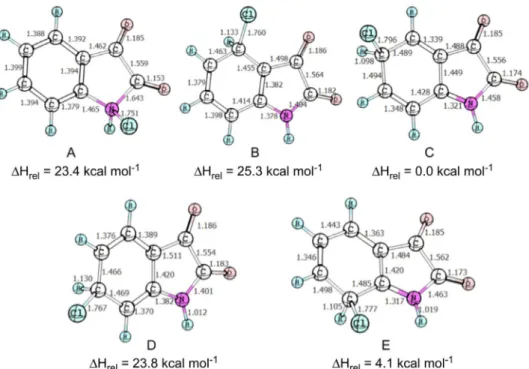
In order to better understand the chlorination process of isatins with TCCA, we have carried out DFT calculations, at M06-2x/6-311++G(d,p) level, for the chlorination of parent isatin by TCCA (see supporting information for computational details). Figure 2 shows the computed van der Waals complex between TCCA and isatin.
Despite the original coniguration the outcome of the optimization of the geometry leads to a complex involving
Chlorination of Isatins with Trichloroisocyanuric Acid J. Braz. Chem. Soc. 260
the N−H and the carbonyl group of the isatin. This complex
is 2.4 kcal mol-1 more stable in relation to the separated
isatin and TCCA. The amide carbonyl group pointing into the TCCA ring indicates that this complex can be a donor-acceptor complex. Thus, this preliminary complex can lead to the preferred formation of the N-chloroisatin. For this purpose we have computed the relative stability of the several intermediates formed through the electrophilic addition of Cl+ to isatin. Figure 3 presents these structures,
with their relative energies.
It can be seen from the calculations that the most stable intermediate is C. The N-chlorination of the isatin leads to intermediate A, which is 23.4 kcal mol-1 higher in energy
than C. This indicates that the N-chlorination should be a kinetically driven process. Considering that the relative stability of the arenium ions relect the relative stability in the transition state prior to them, it can be seen that the pattern for the ring substitution is followed, i.e., ortho-para
substituion in relation to the nitrogenated substituent. Because of the possibility of involvement of superelectrophiles in the process when the reaction takes place at more acid solvents, we decided to go back to our investigations for the chlorination of some isatin derivatives in concentrated H2SO4. The results are showed in Table 3.
When the isatins reacts in the presence of H2SO4 the aromatic ring chlorination always occurs. Conversely, in HOAc, the N-chlorination takes place. In order to explain this result, we proceeded to the following experiment: (1a), the 5-methyl-N-chloroisatin obtained from the reaction of 5-methylisatin (1) in HOAc, was treated with H2SO4
concentrated and stirred at room temperature for 4 h. After this period, ice was added to the reaction medium and the solid precipitate was iltered under vacuum and analyzed by gas chromatography mass spectrometry (GC-MS). The chromatogram and mass spectrum showed that under this condition, the reaction furnished a mixture of mono and dichlorinated products in the aromatic ring.
Therefore, we conclude that the N-chlorinated product should be formed as an intermediate for the reaction of chlorination in the aromatic ring. Once the acetic acid is not acid enough for lead to further protonate this chlorinated intermediate, the transfer of “Cl+” probably
becomes dificult. Further evidence that the N-chlorinated isatin is actually a reaction intermediate is the tendency of the N-chloroisatins have of turning, in a few days, into their respective parent isatins. In order to conirm the formation of N-chlorinated compound and its reactivity toward other nucleophiles, an experiment of chlorination of anisole was performed, using isatin (1a) in HOAc. The products were analyzed by GC-MS and showed the formation of mono and dichlorinated methoxybenzene and isatin (1).
The halogens Br and F are weak electron withdrawing groups. Thus, the isatin (2) and (7) had their aromatic rings (entries 2 and 4) chlorinated only at position 7 with molar ratio isatin:TCCA 1:1.
The triluoromethyl group strongly deactivates the aromatic ring for electrophilic substitution aromatic and no product was formed in an attempt to chlorination isatin (4) at room temperature (entry 3).
Silva et al. 261 Vol. 22, No. 2, 2011
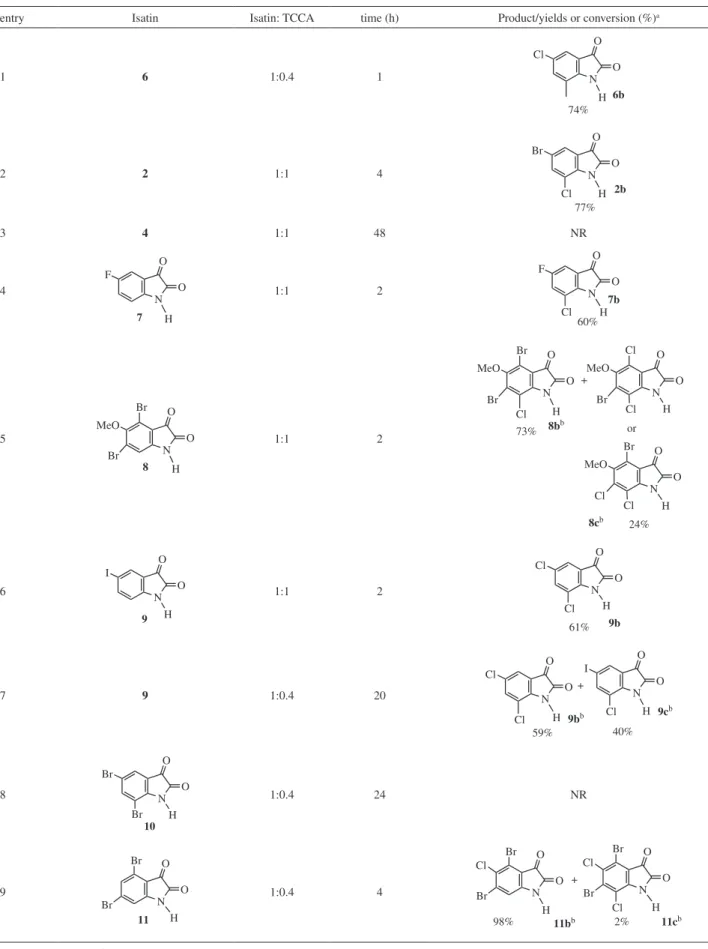
Table 3. Chlorination of isatin derivatives with TCCA in concentrated H2SO4 at room temperature
entry Isatin Isatin: TCCA time (h) Product/yields or conversion (%)a
1 6 1:0.4 1
H O O N Cl 6b 74%
2 2 1:1 4
H O O N Br Cl 77% 2b
3 4 1:1 48 NR
4 H O O N F 7 1:1 2 H O O N F Cl 60% 7b 5 H O O N MeO Br Br 8 1:1 2 H O O N MeO Br Br Cl H O O N MeO Cl Br Cl + 8bb 8cb 73% 24% or H O O N MeO Br Cl Cl 6 H O O N I 9 1:1 2 H O O N Cl Cl 61% 9b
7 9 1:0.4 20
H O O N Cl + H O O N I Cl 59% 40% 9cb 9bb Cl 8 H O O N Br Br 10
1:0.4 24 NR
9 H O O N Br Br 11 1:0.4 4 H O O N Br Br Cl H O O N Br Br Cl Cl + 11bb
98% 2% 11cb
Chlorination of Isatins with Trichloroisocyanuric Acid J. Braz. Chem. Soc. 262
Scheme 4. Mechanism of ipso substitution for isatin (8) and (9). H O O N I H O O N + I Cl H O O N Cl H O O N MeO Br Br H O O N MeO Br + Br Cl H O O N MeO + Br Br Cl H O O N MeO Cl Br H O O N MeO Br Cl
"Cl+" "Cl+"
"Cl+" or
8
9
Ipso substitution on the aromatic ring was observed in isatins (8) and (9)(entries 5-7) (Scheme 4). Reaction with isatin (8) resulted in mixture of products. The product (8b) was expected (substitution at position 7) and product (8c) resulted from the ipso substitution at position 4 or 6.
Isatin (9) suffered cleavage of C–I bond furnishing product (9b),substituted in positions 5 and 7, when the molar ratio isatin:TCCA was 1:1. Mixture of products was obtained when the molar ratio was decreased to 1:0.4. In this case an ipso substitution also occurs providing the product (9b) and a common electrophilic aromatic substituition conducted to new product (9c) in 59% conversion.
Since we found that the substitution at the ipso position competes with the unsubstituted positions when the isatin has a bromine atom, we have investigated the same reaction with isatins (10) and (11) (entries 8 e 9). We could not detect products coming from ipso substitution in such cases. Isatin (10) did not react and isatin (11) resulted in substitution at positions 5 and 7, as expected.
The electron donating methoxy group in isatin (8) is probably, essential for the ipso substitution. For the isatin (9), the substitution at ipso position can be explained in terms of the high lability of the C−I bond.
Conclusions
In conclusion, we performed a study on the behavior of substituted isatins in H2SO4 and HOAc with TCCA. In HOAc we found that the formation of N-chlorinated products occurs at different reaction conditions since the isatin nitrogen has not replaced by a methyl group or a substituent in position 7. In H2SO4 always occurs the chlorination of the aromatic ring. The methyl group in position 5 strongly activates the aromatic ring, resulting in a mixture of chlorinated products when the substrate is 5-methylisatin (1). Isatins with substituents electron withdrawing yield 1 product, except when there
was competition for ipso substitution. The proposed methodology furnished the new pure compound (2b) and mixture of products also not previously reported in the literature, (8b), (8c), (9c), (11b) and (11c). The substances already reported (6b) and (7b)were obtained pure. Thus, we have shown that TCCA, a non toxic and inexpensive reagent, is an interesting alternative for the preparation of chlorinated isatins.
Supplementary Information
Supplementary information associated with this paper contains the spectroscopic data, NMR spectra (1H and 13C),
mass spectrum and infrared of the synthesized compounds. These data are available free of charge at http://jbcs.sbq. org.br, as a PDF ile.
Acknowledgments
The authors thank the Brazilian agencies Conselho Nacional de Desenvolvimento Cientíico e Tecnológico (CNPq) and Fundação de Amparo à Pesquisa do Estado do Rio de Janeiro (FAPERJ).
References
1. Guo, Y.; Chen, F.; Zhongcaoyao 1986, 17, 8. (CA 104:213068f). 2. Tozawa, Y.; Ueki, A; Manabe, S.; Matsushima, K.; Biochem.
Pharmacol.1998, 56, 1041.
3. Glover, V.; Bhattacharya, S. K.; Chakrabarti, A.; Sandler, M.; Stress Med.1998, 14, 224.
4. Morley, J. E.; Farr, S. A.; Flood, J. F.; Eur. J. Pharm. 1996, 305, 23.
5. Vine, K. L.; Matesic, L.; Locke, J. M.; Ranson, M.; Skropeta, D.; Anti-Cancer Agents Med. Chem.2009, 9, 397.
6. Silva, J. F. M.; Garden, S. J.; Pinto, A. C.; J. Braz. Chem. Soc.
Silva et al. 263 Vol. 22, No. 2, 2011
7. Hall, M. D.; Salam, N. K.; Hellawell, J. L.; Fales, H. M.; Kensler, C. B.; Ludwig, J. A.; Szakács, G.; Hibbs, D. E.; Gottesman, M. M.; J. Med. Chem. 2009, 52, 3191.
8. Zapata-Sudo, G.; Pontes, L. B.; Gabriel, D.; Mendes, T. C. F.; Ribeiro, N. M.; Pinto, A. C.; Trachez, M. M.; Sudo, R. T.; Pharmacol., Biochem. Behav.2007, 86, 678.
9. Sandmeyer, T.; Helv. Chim. Acta1919, 2, 234.
10. Almeida, M. R.; Leitão, G. G.; Silva, B. V.; Barbosa, J. P.; Pinto, A. C.; J. Braz. Chem. Soc.2010, 21, 764.
11. Prinz, W.; Kaile, A.; Levy, P. R.; J. Chem. Res.(S) 1978, 116; Prinz, W.; Kaile, A.; Levy, P. R.; J. Chem. Res.(M) 1978, 1347. 12. Pinto, A. C.; Lápis, A. A. M.; Silva, B. V.; Bastos, R. S.; Dupont,
J.; Neto, B. A. D.; Tetrahedron Lett.2008, 49, 5639.
13. Vasconcellos, M. L. A. A.; Junior, C. G. L.; Quim. Nova2009, 32, 244; Mendonça, G. F.; Mattos, M. C. S.; Quim. Nova2008, 31, 798; Cunha, A. C.; Paixão, F. M.; Souza, M. C. B. V.; Ferreira, V. F. Quim. Nova2006, 29, 520; Bastos, R. S.; Cunha, A. S.; Silva, L. C.; Oliveira, C. C. P.; Rezende, C. M.; Pinto, A. C.; Quim Nova, 2008, 31, 172; Barros, J. C.; Synlett2005, 13, 2115.
14. Ribeiro, N. M.; Silva, B. V.; Violante, F. A.; Rezende, C. M.; Pinto, A. C.; Org. Prep. ProcedInt.2005, 37, 265.
15. Mendonça, G. F.; Magalhães, R. R.; Mattos, M. C. S.; Esteves, P. M.; J. Braz. Chem. Soc.2005, 16, 695.
16. De Luca, L.; Giacomelli, G.; Nieddu, G.; Synlett2005, 223. 17. Berti, C.; Greci, L.; Synth. Commun.1981, 11, 681.
Submitted: June 5, 2010
Supplementary Information
J. Braz. Chem. Soc., Vol. 22, No. 2, S1-S20, 2011. Printed in Brazil - ©2011 Sociedade Brasileira de Química
0103 - 5053 $6.00+0.00
S
I
*e-mail: [email protected]
Chlorination of Isatins with Trichloroisocyanuric Acid
Bárbara V. Silva,* Pierre M. Esteves and Angelo C. Pinto
Instituto de Química-CT, Universidade Federal do Rio de Janeiro, Cidade Universitária, 21945-970 Rio de Janeiro-RJ, Brazil
Synthesis and characterization of the chloroisatins
Typical procedure for the reaction in HOAc
To a suspension of TCCA and HOAc the isatin derivative was added. The reaction medium was kept stirring at different temperatures and times (Tables 1 and 2). The mixture was then poured over cracked ice. The precipitate was iltered under vacuum and washed thoroughly with water. Subsequently, the product was solubilized in ethyl acetate, filtered and the solution evaporated at reduced pressure to separate the isocyanuric acid formed as byproduct.
Typical procedure for the reaction in H
2SO4
To a suspension of TCCA and H2SO4 was added the isatin derivative in an ice bath. After the complete addition of the isatin, the ice bath was removed, and the mixture was kept stirring during the time described in Table 3. The mixture was then poured over cracked ice. The precipitate was iltered under vacuum and washed thoroughly with water. Subsequently, the product was solubilized in ethyl acetate, iltered and the solution evaporated at reduced pressure to separate the isocyanuric acid formed as byproduct. The products (9b) and (9c) were separated by high performance liquid chromatography (HPLC) and analyzed separately by 1H and 13C NMR.
Separation by HPLC
Separation by HPLC of (9b) and (9c) was performed on Agilent 1100 series chromatograph detection by ultraviolet (UV, λ
max/nm 280). Semi-preparative method in a reversed phase column C-18 (Agilent Zorbax Eclipse, 9.4 mm (diameter) × 250 mm (length), 5 micron) under isocratic conditions using 45% water and 55% methanol as mobile phase, low 3 mL/min, with 30 min elution was employed.
Computational details
All calculations were carried out with the Gaussian 09 package1 using the M06-2X functional with the 6-311++G** basis set. The optimized geometries were characterized as minima on the potential energy surface by the absence of imaginary vibrational frequencies. All energy differences correspond to enthalpies differences at 298K and 1 atm.
Spectroscopic data
1a: IR (ilm) ν
max/cm
-1: 3085, 2923, 1764, 1729, 1614,
1596, 1483, 1315, 1294, 1176, 1126, 950, 427. 1H NMR d (200 MHz, CDCl3): 3.23 (3H, s), 6.85 (1H, d, J 8.0 Hz), 7.51-7.57 (2H, m); 13C NMR d(50 MHz, CDCl
3): 26.5 (CH3), 111.4 (CH), 118.3 (q), 125.2 (CH), 129.7 (q), 137.9 (CH), 149.8 (q), 157.8 (q), 182.4 (q); MS (70 eV) m/z 195 [M]+, 197 [M+2]+, 160, 104.
2a: IR (ilm) ν
max/cm
-1: 3060, 1770, 1743, 1606, 1456,
1423, 1307, 1270, 1178, 1160, 827, 717, 466. 1H NMR d (200 MHz, CDCl3): 7.07 (1H, d, J 8.0 Hz), 7.71 (1H, d, J 2.0 Hz), 7.81 (1H, dd, J 2.0 and 8.0 Hz); 13C NMR d(50 MHz, CDCl3): 113.0 (CH), 118.0 (q), 120.5 (q), 127.9 (CH), 141.2
Chlorination of Isatins with Trichloroisocyanuric Acid J. Braz. Chem. Soc. S2
(CH), 148.0 (q), 154.7 (q), 176.8 (q), 182.4 (q); MS (70 eV)
m/z 259 [M]+, 261, [M+2]+, 263 [M+3]+, 168, 226.
2b: IR (ilm) ν
max/cm
-1: 3471, 3174, 3110, 1754, 1610,
1457, 1425, 1290, 1224, 1168, 837; 1H NMR d(200 MHz, CDCl3+DMSO): 7.47 (1H, s), 7.58 (1H, s), 11.43 (1H, br s, NH); 13C NMR d(50 MHz, CDCl
3+DMSO): 114.8 (q), 118.2 (q), 119.5 (q), 125.5 (CH), 139.1 (CH), 146.8 (q), 158.3 (q), 182.1 (q); MS (70 eV) m/z 259 [M]+, 261, [M+2]+, 263 [M+3]+, 233, 205.
5b: IR (ilm) ν
max/cm
-1: 3467, 3423, 1751, 1727, 1608,
1457, 1467, 1326, 1176, 1108, 827; 1H NMR d (200 MHz, CDCl3+DMSO): 3.16 (3H, s), 6.89 (1H, d, J 8.0 Hz), 7.43 (1H, s), 7.52 (1H, d, J 8.0 Hz), 11.43 (1H, br s, NH); 13C NMR d(50 MHz, CDCl
3+DMSO): 25.4 (CH3), 116.6 (CH), 123.1 (q), 129.5 (CH), 134.0 (q), 142.6 (CH), 154.6 (q), 162.6 (q), 187.3 (q); MS (70 eV) m/z 195 [M]+, 197 [M+2]+, 167, 139.
6b: IR (film) ν
max/cm
-1: 3452, 3415, 3178, 3102,
1743, 1616, 1469, 1297, 889, 700; 1H NMR d (200 MHz, CDCl3+DMSO): 2.15 (3H, s), 7.20 (1H, br s), 7.27 (1H, br s), 11.13 (1H, br s, NH); 13C NMR d(50 MHz, CDCl3+DMSO): 14.2 (CH3), 117.0 (q), 120.3 (CH), 122.8 (q), 126.3 (CH), 137.2 (CH), 146.9 (q), 158.3 (q), 182.6 (q); MS (70 eV) m/z 195 [M]+, 197 [M+2]+, 167, 139, 104.
7b: IR (ilm) ν
max/cm
-1: 3488, 3473, 3180, 3114, 1743,
1754, 1621, 1600, 1479, 1299, 1211, 1099, 925, 867, 796; 1H NMR d (200 MHz, CDCl
3+DMSO): 6.92 (1H, d
J 7.0 Hz), 7.04 (1H, d J 7.0 Hz), 11.04 (1H, br s, NH); 13C NMR d(50 MHz, CDCl3+DMSO): 110.1 (CH, d J 27 Hz), 117.7 (q, d J 7.0 Hz), 118.6 (q, d, J 7.0 Hz) 124.4 (CH, d,
J 27 Hz), 144.3 (q, d, J 2.5 Hz), 157.7 (q, d, J 246.5 Hz), 158.9 (q), 182.8 (q, d J 2.5 Hz). MS (70 eV) m/z 199 [M]+, 201 [M+2]+, 171, 143.
9c: IR (ilm) ν
max/cm
-1: 3193, 3182, 3099, 1770, 1745,
1610, 1450, 1164, 983, 688; 1H NMR d (200 MHz, CDCl3+DMSO): 7.71 (1H, d J 1.5 Hz), 7.77 (1H, d
J 1.5 Hz), 10.78 (1H, br s, NH); 13C NMR d(50 MHz, CDCl3+DMSO): 84.79 (q), 118.97 (q), 120.36 (q), 132.03 (CH), 145.34 (CH), 147.48 (q), 158.23 (q), 182.14 (q); MS (70 eV) m/z 307 [M]+, 309 [M+2]+, 279, 251.
11b: IR (film) ν
max/cm
-1: 3479, 3465, 3268, 3087,
1766, 1791, 1594, 1558, 1388, 1247, 958; 1H NMR d (200 MHz, CDCl3+DMSO): 6.29 (1H, s), 10.40 (1H, br s, NH); 13C NMR d (50 MHz, CDCl
3+DMSO): 114.3 (CH), 118.7 (q), 126.3 (q), 127.8 (q), 129.5 (q), 148.6 (q), 156.4 (q), 178.5 (q); MS (70 eV) m/z 337 [M]+, 339 [M+2]+, 341 [M+3]+, 343 [M+4]+, 311, 284, 204.
1H and 13C NMR spectra
Silva et al. S3 Vol. 22, No. 2, 2011
Figure S2. 13C NMR of 1a.
Chlorination of Isatins with Trichloroisocyanuric Acid J. Braz. Chem. Soc. S4
Figure S4. 13C NMR of 2a.
Silva et al. S5 Vol. 22, No. 2, 2011
Figure S6. 13C NMR of 2b.
Chlorination of Isatins with Trichloroisocyanuric Acid J. Braz. Chem. Soc. S6
Figure S8. 13C NMR of 5b.
Silva et al. S7 Vol. 22, No. 2, 2011
Figure S10. 13C NMR of 6b.
Chlorination of Isatins with Trichloroisocyanuric Acid J. Braz. Chem. Soc. S8
Figure S12. 13C NMR of 7b.
Silva et al. S9 Vol. 22, No. 2, 2011
Figure S14. 13C NMR of 9c.
Chlorination of Isatins with Trichloroisocyanuric Acid J. Braz. Chem. Soc. S10
Figure S16. 13C NMR of 11b.
Figure S17. FTIR spectra of 1a.
Silva et al. S11 Vol. 22, No. 2, 2011
Figure S18. FTIR spectra of 2a.
Chlorination of Isatins with Trichloroisocyanuric Acid J. Braz. Chem. Soc. S12
Figure S20. FTIR spectra of 5b.
Silva et al. S13 Vol. 22, No. 2, 2011
Figure S22. FTIR spectra of 7b.
Chlorination of Isatins with Trichloroisocyanuric Acid J. Braz. Chem. Soc. S14
Figure S24. FTIR spectra of 11b.
Mass Spectra
Silva et al. S15 Vol. 22, No. 2, 2011
Figure S26. Mass spectrum of 2a.
Chlorination of Isatins with Trichloroisocyanuric Acid J. Braz. Chem. Soc. S16
Figure S28. Mass spectrum of 4b.
Silva et al. S17 Vol. 22, No. 2, 2011
Figure S30. Mass spectrum of 6b.
Chlorination of Isatins with Trichloroisocyanuric Acid J. Braz. Chem. Soc. S18
Figure S32. Mass spectrum of 8b.
Silva et al. S19 Vol. 22, No. 2, 2011
Figure S34. Mass spectrum of 9b.
Chlorination of Isatins with Trichloroisocyanuric Acid J. Braz. Chem. Soc. S20
Figure S36. Mass spectrum of 11b.