459
Metallurgy and materials
Metalurgia e materiais
Abstract
The use of alumina as a reinforcement in metallic and ceramic matrix is well-known. The purpose of this study was to investigate the effect of alumina addition according to its amount on the microstructural and mechanical behavior of tricalcium phosphate ceramic (TCP), more speciically the β-TCP. Although β-TCP has excel-lent bioactive and biocompatible properties, it presents low fracture resistance and load bearing capacity, which limits its use in the monolithic form. The route used for the β-TCP/alumina composite production was powder metallurgy. The powders were milled in a high energy ball mill with the following parameters: 5, 10, 15 and 20 hours, mass/sphere relation of 1:20 and speed of 150 rpm. After the milling process, the powders of both compositions were uniaxially pressed and sintered. Two of the compositions were processed containing 90% and 50% of β-TCP, respectively. The results indicated that composition 1 with a smaller percentage of alumina in its mi-crostructure presented 62.4 % smaller particle size after the high energy ball milling process, which provided higher densiication after pressing and sintering. These results implied in increased mechanical resistance, with 4.6 GPa of elastic modulus and 140 MPa of compressive strength, against 3.6 GPa of elastic modulus and 117 MPa of compressive strength obtained in composition 2.
Keywords: beta tricalcium phosphate, alumina, composites, powder metallurgy.
Bruna Horta Bastos Kuffner Doutoranda em Materiais para Engenharia Universidade Federal de Itajubá – UNIFEI Instituto de Física e Química – IFQ Itajubá – Minas Gerais – Brasil [email protected]
Andreia Ditzel Facci
Graduada em Engenharia de Materiais Universidade Federal de Itajubá – UNIFEI Instituto de Engenharia Mecânica – IEM Itajubá – Minas Gerais – Brasil [email protected]
Daniela Sachs
Professora Doutora em Ciências Universidade Federal de Itajubá – UNIFEI Instituto de Física e Química – IFQ Itajubá – Minas Gerais – Brasil [email protected]
Gilbert Silva
Professor Doutor em Engenharia Biomédica Universidade Federal de Itajubá – UNIFEI Instituto de Engenharia Mecânica – IEM Itajubá – Minas Gerais – Brasil [email protected]
Study of the microstructure
and mechanical properties of
beta tricalcium phosphate-based
composites with alumina addition
produced by powder metallurgy
http://dx.doi.org/10.1590/0370-44672017700082
1. Introduction
The calcium phosphate ceramics (CPCs) are a class of biocompatible and bioactive materials often used as synthetic bone substitute. It happens due to the great similarity that they have with the mineral phase of the bone. The four CPCs more commonly used are: Hydroxyapatite (HAP), amorphous calcium phosphate (ACP), biphasic cal-cium phosphate (BCP) and tricalcal-cium phosphate (TCP). The TCP occurs in two different phases, α and β. However,
β-TCP is more widely used in bone re-generation than α-TCP (Parent et al.,
2017; Dorozhkin and Epple, 2002). Despite the excellent bioactive and biocompatible properties, the CPCs have low fracture resistance and load bearing capacity, which limits their use in the monolithic form. While the CPCs present Young’s modulus cor-responding to a range of 35-120 MPa, the bone tissue has superior value of 300 MPa. Since CPCs must have mechanical resistance as similar as possible to the surrounding tissue, it is recommended to increase its mechanical properties to avoid failure. Thus, to increase the
CPCs load bearing capacity and resis-tance, other biocompatible materials are used as reinforcement. In short, most imitations of bioactive CPCs powders refer to its low fracture toughness which can restrict its biomedical application as, for example, in the production of load bearing implants (Canillas et al.,2017; Shirazi et al., 2015).
460
material widely used as reinforcement, especially as a result of its high hardness combined with good lexion resistance, excellent dynamic, impact fatigue, subcritical cracking and compression resistance. In fact, the alumina par-ticles can increase the HAP hardness, demonstrating the role of reinforcement (Bhattacharyya and Behera, 2017; Yan et al., 2017; Askari et al., 2012).
The powder metallurgy (PM) is a suitable technique for metallic matrix composite fabrication. Also, it can be used in the confection of ceramic ma-trix composites. In comparison with the traditional melting process, one of
the most prominent advantages related to PM is the low process temperature, which prevents the formation of un-desirable phases between the matrix and the reinforcement. In addition, the reinforcement particles can be found homogeneously distributed in the matrix, providing better mechanical results. Other advantages of PM include less cost for large scale production, the possibility to create workpieces in various shapes, and practically no waste of materials, being also considered a clean process. The process includes the powders obtainment, compaction of those powders in a die and sintering
over a controlled atmosphere. Through sintering, the powders acquire mechani-cal strength through atomic diffusion (Bolzoni et al., 2017; Kuffner et al., 2015; Suryanarayana, 2001; Nassar and Nassar, 2017).
However, little research has been destined to investigate the effective role of bioinert materials as an addi-tion in bioactive materials in terms of mechanical behaviour. As a result, this work evaluated the inluence of alumina addition and its amount in the micro-structure and mechanical properties of
β-TCP based composites produced by powder metallurgy.
2. Materials and methods
For the biocomposites production used were: Beta tricalcium phosphate
(β-TCP) and alumina (Al2O3), both as powder. Table 1 details the materials
percentage for each composition.
Composition β-TCP Al2O3
1 90% 10%
2 50% 50%
Table 1
Compositions used
in the biocomposites production.
In the high energy ball milling pro-cess of the compositions, a Noah Nuoya®
0.2 L planetary ball mill was used. The parameters used in the milling include mass/sphere relation of 1:20, speed of 150 rpm and times of 5, 10, 15 and 20 hours. After the milling process, the powders were uniaxially pressed with
175 MPa of pressure in a cylindrical ma-trix with diameter of 12 mm and sintered in a Fortelab® conventional atmosphere
oven. The heating rate used was 5ºC/ minute until 1200ºC, with 2 hours of permanence.
For the powders and sintered sam-ples characterization, a Microtrac®
Tur-botrac SDC laser granulometer, a Carl Zeiss® Evo MA 15 scanning electron
microscope in the back-scatter mode, a Panalitycal® X Pert PRO x-ray
diffractom-eter with copper tube (λ = 1,5418 Ǻ) with scanning of 0.02º and 2θ = 10º a 90º and a EMIC 23-30 universal testing machine were used.
3. Results and discussion
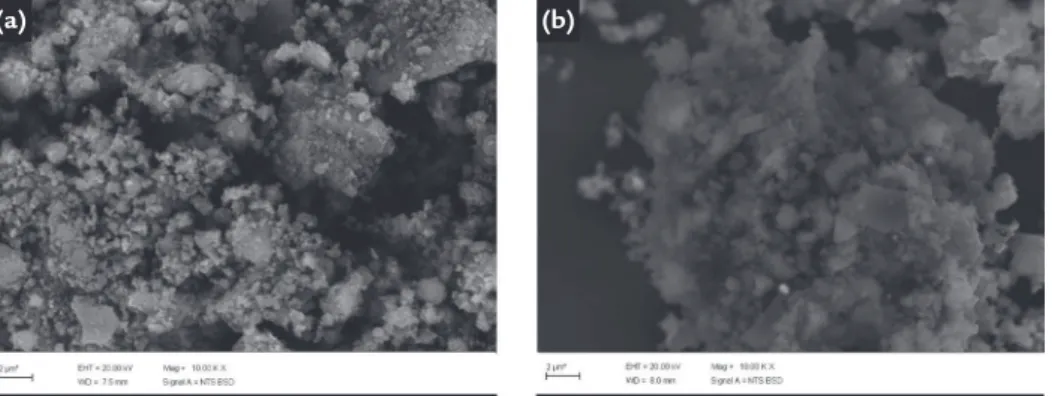
Figure 1 shows compositions 1 and 2 after 5 hours of milling. It is possible to observe that composition 1 with 90% β-TCP (Figure 1a)
pre-sented particles located in a range of 8 – 0.4 µm, while composition 2 with 50% β-TCP (Figure 2a) presented a range of 11 – 0.5 µm. Both
composi-tions obtained predominantly irregular particle morphology, with cluster for-mation, being this more pronounced in composition 2.
Figure 1
Photomicrographs of compositions 1 (a) and 2 (b) after 5 hours of milling.
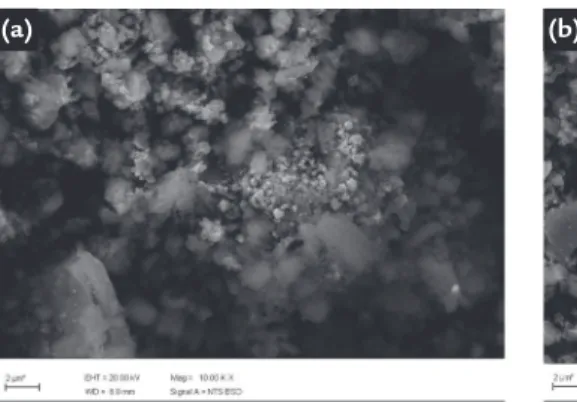
After 10 hours of milling, it is ob-served that the particles of composition 1 (Figure 2a) suffered granulometric reduction, changing their size from a range of 8 – 0.4 µm (5 hours of
ing) to 7 – 0.3 µm (10 hours of mill-ing). Composition 2 (Figure 2b) also obtained reduction, from a range of 11 – 0.5 µm (5 hours of milling) to 9 – 0.5 µm. The particle morphology
main-tained irregular for both compositions, being observed in composition 1 a higher volume of clusters in comparison with composition 2 which had signiicantly reduction in this volume.
461
(a) (b)
Figure 2 Photomicrographs of compositions 1 (a) and 2 (b) after 10 hours of milling.
Increasing the milling time to 15 hours, it is observed that the particle size of both compositions continued to reduce. In composition 1 (Figure 3a), the particle size was located in a range of 3 – 0.3 µm, smaller than the range
of 7 – 0.3 µm with 10 hours of milling. Composition 2 (Figure 3b) obtained a particle size in a range of 4 – 0.3 µm, also smaller than 9 – 0.5 µm obtained with 10 hours of milling. The morphology was maintained irregular for both
tions, being composition 1 the composi-tion that still obtained higher cluster volume. However, a higher homogeneity is noted in the particles distribution for both compositions, in comparison with 5 and 10 hours of milling.
Figure 3 Photomicrographs of compositions 1 (a) and 2 (b) after 15 hours of milling.
(a) (b)
For the last milling time, corre-sponding to 20 hours, it is possible to observe that composition 1 (Figure 4a) obtained a inal particle size in a range of 3 – 0.1 µm and composition 2 (Figure 4b) obtained a inal particle size in a range
of 4 – 0.3 µm. This result evidences the efficiency of the high-energy milling process to reduce the granulometry of both compositions, being very notable the difference of particles size from 5 hours to 20 hours of milling time (from
8 – 0.4 µm to 3 – 0.1 µm in composition 1 and from 11 – 0.5 µm to 4 – 0.3 µm in composition 2). The particle morphology was maintained irregular and composi-tion 1 presented a higher volume of clusters during the whole process
Figure 4 Photomicrographs of compositions 1 (a) and 2 (b) after 20 hours of milling.
(a) (b)
At the end of the process, it is veriied that the high energy ball mill-ing of both compositions was shown as eficient, since that resulted in signii-cantly granulometric reductions. Over the 20 hours of milling, the particles of larger size got 63% of reduction for both compositions 1 and 2, being that irst, composition 2 presented particles in higher scale. For the particles of smaller size, there was observed a reduction of
75 % for composition 1 and 40 % for composition 2. Besides the granulometry, it is also noted through the micrographs that for all milling times, a few particles presented larger size than their medium values, which is attributed to the no-table cluster presence formed due to the high tensions and cold welding that the material suffered in the high energy ball milling process (Suryanarayana, 2001). In general, it is veriied that composition
462
Figure 5
Particle size distribution curve for composition 1 after 20 hours of milling.
Figure 6
Particle size distribution curve for composition 2 after 20 hours of milling.
The results obtained in both granulometric curves are also resumed in Table 2.
Particle Size Composition 1 Composition 2
50 – 60 µm 37.6 % 44.5 %
11 µm 36.6 % 35.9 %
1.5 µm 25.8 % 19.6 %
Table 2
Volumetric fraction versus
particles volume for each composition.
It is possible to observe by the pre-sented results that composition 1 prepre-sented a higher percentage of particle volume in the range of 11 µm (0.7 %) and 1.5 µm (6.2 %) and a smaller percentage of particle volume in the range of 50 – 60 µm (6.9 %) in comparison with composition 2. This is
beneicial, since that higher particles vol-ume in submicrometer or nanometric scale implies in better composite densiication.
Table 3 shows the values found for density, elastic modulus and ultimate tensile strength. These results prove again that composition 1 presented higher
ef-iciency during the process. Its density was shown as 10.68% higher than the density found in composition 2. In respect to the tensile test, composition 1 presented elastic modulus value of 21.74 % and compressive strength 16.3 % higher than composition 2.
Table 3
Mechanical properties values for each composition.
Composition Density (g/cm³) Elastic Modulus (GPa)
Compressive Strength (MPa)
1 2.34 4.6 140
2 2.09 3.6 117
Composition 1 is justiied as more effective in terms of mechanical properties as a result of two main factors. First of all, its smaller particle size (higher volume in submicrometer scale) obtained in the high energy ball milling process provided ter compaction during pressing and
bet-ter densiication afbet-ter sinbet-tering, since the diffusional process becomes facilitated due to the larger supericial area of the powders and consequently, larger contact between particles. The second factor that occurs is that, increasing the alumina percentage in composition 2, the
tempera-463 ture (1050 ºC), which forces the composite
to be sintered according to the material with lower sintering temperature. The lower temperature creates a pre-sintering phase formed by alumina, which weakens the material. Thus, the composition with a higher percentage of alumina obtains the worst sintering and mechanical behav-ior (Eskandari et al., 2012; Rahimiam et al., 2010; Li et al., 2017).
Even with these two factors, the alumina addition in different percentages proved to be satisfactory as
reinforce-ment in beta tricalcium phosphate-based composites. Comparing the values obtained in Table 3, it is possible to highlight that the density (2.34/2.09 g/ cm³), elastic modulus (4.6/3.6 GPa) and compressive strength (140/117 MPa) of both compositions were smaller from those found in the precursor materials (3.07/ 3.9 g/cm³), (80/400 GPa) and (650/2800 MPa). This is a consequence of higher pore volume that materials produced by powder metallurgy usu-ally have. For biomaterials, porosity is
a desirable property. Porous materials present a rough surface, which have been proved to promote higher osseointegra-tion than materials with smooth surface. It happens as a result of the biological response of macrophages over the bio-material. Macrophages are body cells which induce bone growth, and their re-sponse is scientiically proved as better in biomaterials with pores and consequent rough surface, such as those produced by the powder metallurgy route (Silva et al., 2014; Silva, 2001; Anderson et al., 2016).
4. Conclusions
The powder metallurgy was shown as an effective route to produce beta tricalcium phosphate–based composites with alumina
addition. From the two compositions stud-ied in this work, the composition 1 with smaller percentage of alumina presented
itself as most effective, since it demonstrated better results for particles size, and conse-quently, mechanical resistance.
Acknowledgments
The authors would like to thank FAPEMIG, CAPES and the company ALCOA from Poços de Caldas – MG.
References
ANDERSON, J. A., LAMICHHANE, S., MANI, G. Macrophage responses to 316L stainless steel and cobalt chromium alloys with different surface topographies. Journal of Biomedical Materials Research A, v. 104, p. 2658–2672, 2016.
ASKARI, E., MEHRALI, M., METSELAAR, I. H. S. C., KADRI, N. A., RAH-MAN, M. M. Fabrication and mechanical properties of functionally graded material by electrophoretic deposition. Journal of The Mechanical Behavior of Biomedical Materials, v. 12, p. 144–150, 2012.
BHATTACHARYYA, S., BEHERA, P. S. Synthesis and characterization of nano--sized α-alumina powder from kaolin by acid leaching process. Applied Clay Science, v. 146, p. 286–290, 2017.
BOLZONI, L., RUIZ-NAVAS, E. M., GORDO, E. Quantifying the properties of low-cost powder metallurgy titanium alloys. Materials Science & Engineering A, v. 687, p. 47–53, 2017.
CANILLAS, M., PENA, P., AZA, A. H., RODRÍGUEZ, M. A. Calcium phospha-tes for biomedical applications. Boletín de la Sociedad Espanõla de Cerámica y Vidrio, v. 56, p. 91–112, 2017.
DOROZHKIN, S. V., EPPLE, M. Biological and medical signiicance of calcium phos-phates. Angewandte Chemie International Edition, v. 41, p. 3130–3146, 2002. ESKANDARI, A., AMINZARE, M., HESABI, Z. R., ABOUTALEBI, S. H.,
SADRNEZHAAD, S. K. Effect of high energy ball milling on compressibili-ty and sintering behavior of alumina nanoparticles. Ceramics International, v. 38, p. 2627–2632, 2012.
KUFFNER, B. H. B., DIOGO, W. S., AMANCIO, D. A., RODRIGUES, G., SILVA, G. Evaluation of the milling eficiency increase of AISI 52100 steel using niobium carbide addition through high energy ball milling. REM: Revista Escola de Minas, v. 68, p. 295-300, 2015.
NASSAR, A. E., NASSAR, E. E. Properties of aluminum matrix Nano composites prepared by powder metallurgy processing, Journal of King Saud University – Engineering Sciences, v. 29, p. 295–299, 2017.
PARENT, M., BARADARI, H., CHAMPION, E., DAMIA, C., VIANA-TRECANT, M. Design of calcium phosphate ceramics for drug delivery applications in bone diseases: a review of the parameters affecting the loading and release of the thera-peutic substance. Journal of Controlled Release, v. 252, p. 1–17, 2017.
ma-464
trix composite made by powder metallurgy. Materials Science and Engineering A, v. 527, p. 1031–1038, 2010.
SHIRAZI, F. S., MEHRALI, M., OSHKOUR, A. A., METSELAAR, H. S. C., KA-DRI, N. A., ABU OSMAN, N. A. Characterization and mechanical properties of calcium silicate/citric acid–based polymer composite materials. International Journal of Applied Ceramic Technology, v. 12, p. 371–376, 2015.
SILVA, M. V., STAINER, D., AL-QURESHI, H. A., HOTZA, D. Blindagens cerâ-micas para aplicações balísticas: Uma revisão. Cerâmica, v. 60, p. 323–331, 2014. SILVA, V. V., LAMEIRAS, F. S., DOMINGUES, R. Z. Microstructural and mecha-nical study of zirconia-hydroxyapatite (ZH) composite ceramics for biomedical ap-plications. Composites Science and Technology, v. 61, p. 301–310, 2001.
SURYANARAYANA, C. Mechanical alloying and milling. Progress in Materials Science, v. 46, p. 1–184, 2001.
YAN, X., LI, X., WANG, X., YAN, H. Synthesis of nano-diamond/alumina compo-site by detonation method. Diamond & Related Materials, v. 77, p. 79–83, 2017.