451
Abstract
Herein is presented the results of a study on the hydrometallurgic extraction and recovery of aluminum and silicon by leaching of kaolinitic clays with HF. The studied extraction parameters were: temperature, reaction time, solid/liquid ra-tio, concentration, and precipitating agent mass. In the leaching process, mineral dissolutions near 100% were obtained when working at 348 K, solid/liquid ratio 2% w/v, HF 12% v/v, for 120 minutes. The HF leach liquor generated from the dissolution of kaolinitic clays contains H2SiF6 and H3AlF6. Studies were conducted to recover the two valuable luorides as K2SiF6 and Na3AlF6 by precipitation with alkaline salts from the leach liquor. Phases of precipitated luorides were identiied by XRD and surface morphology by SEM. The purity of the K2SiF6 precipitate was 98.8%, whereas for Na3AlF6, it was 89.3%. Also, both synthesized solids are of high commercial value due to their industrial applications.
Keywords: extraction, kaolinitic clays, aluminum, synthesis, cryolite.
Eliana G. Pinna
Licenciada, Facultad de Ciencias Exactas y Naturales Universidad Nacional de Cuyo - Laboratorio de Metalurgia Extractiva y Síntesis de Materiales
Mendoza – Argentina [email protected]
Daniela S. Suarez
Maestrado, Facultad de Ciencias Exactas y Naturales
Universidad Nacional de Cuyo - Laboratorio de Metalurgia Extractiva y Síntesis de Materiales Mendoza – Argentina
Gustavo D. Rosales
Doutor, Facultad de Ciencias Exactas y Naturales Universidad Nacional de Cuyo - Laboratorio de Metalurgia Extractiva y Síntesis de Materiales Mendoza – Argentina
Mario Humberto Rodriguez
Doutor, Universidad Nacional de Cuyo Facultad de Ciencias Exactas y Naturales Padre contreras – Mendoza - Argentina [email protected]
Hydrometallurgical extraction
of Al and Si from kaolinitic clays
http://dx.doi.org/10.1590/0370-44672017700006
1. Introduction
Metallurgy and materials
Metalurgia e materiais
Kaolin is a mineral widely used in dif-ferent industries, among which the ceramics industry is highlighted, which uses it for the manufacture of a wide variety of products, such as tableware, sanitary ware, stone-ware, tiles, electrical porcelain, ornamental ceramics and refractory (Rivera et al.,
2016). Also, kaolin is a widespread source of aluminum, whose aluminum mass con-tent is between 10-20%. The industrial production of aluminum is carried out by the Bayer and Hall-Herault processes, using bauxitic rocks as raw materials, which con-tain an aluminum mass content between 20 and 30% (Habashi, 1997).
A large number of studies have de-scribed the dissolution reaction of silicates with different inorganic acids. Terry (1983a and 1983b) classiied the silicates according to their reactivity with acids in the following
way: those that are not readily decomposed by acids; those from which the cations, but not the silica, can be readily dissolved; and those from which the cations and silica are readily dissolved. Further researchers studied the dissolution of metakaolin using HCl (Hulbert et al., 1970, Altiokka et al.,
2003, Bazin et al., 2007), HNO
3 (Hulbert
et al., 1970) and H
2SO4 (Altiokka et al., 2010, Colina et al., 2002).
Furthermore, there are a series of studies concerning the effect of luoride ions as additives on different acid leaching clays. Gajam and Raghavan (1985) and Bailey and Chapman (1987) looked into the effect of adding luoride ions on the dissolu-tion of clays with HCl, and concluded that its addition increases the dissolution rate. Adams and van Dalen (1979) found that the addition of luorsilicic acid, leads to an
increase in the dissolution rate of silicate ores with H2SO4. Kline and Fogler (1981) have studied the relationships between the kinetics of dissolution of silicates, and the chemical species present in aqueous hydroluoric acid. They concluded that the measured rates of dissolution are attributed entirely to the attack by the HF molecules, rather than by F- or HF
2- ions. The rate of reaction is proportional to the concentra-tion of HF molecules adsorbed at surface lattice bonds.
Kumar et al. (2010) reported
(Rosales et al., 2013).
The hieratite (K2SiF6) is a compound especially used in the manufacture of special glasses and vitreous enamels, in-secticides and wood preservatives. Cryolite (Na3AlF6) is mainly used as a lux in the
production process of metallic aluminum; other minor applications are as enamel bleaches, glass opaciier and insecticide’s active agent (Rosales et al., 2013).
Herein, a new process for the synthe-sis of cryolite and hieratite from leach liquor
obtained by dissolution of calcined kaolin with HF is proposed, wherein the operating parameters of the dissolution reaction were optimized. Furthermore, this process can be applied to calcined kaolin and also to waste from the ceramic industry.
2. Experimental
2.1 Equipment and materials
The reagents used were HF, KCl and NaCl, all being of analytical grade. The mineral used was commercial kaolin, with particle size minor to 75 μm, extracted from “Sur del Río” deposit located in the province of Chubut (Argentina). The ex-perimental tests were performed in a closed
batch reactor of 500 mL built in Telon®, and equipped with magnetic stirring and temperature control systems.
The sample was characterized by X-ray luorescence (XRF) using a Philips PW 1400 equipment and X-ray diffraction (XRD) was carried out in a Rigaku D-Max
III C diffractometer. Morphological analy-sis was done by SEM with a LEO 1450 VP microscope which was equipped with an X-ray dispersive spectrometer EDAX, Genesis 2000, used to determine the semi-quantitative composition of the synthesized compounds by EPMA analysis.
2.2 Preparation and characterization of the sample
The sample was calcined in a mufle furnace at 1073 K for 3 hours, causing its transformation from the crystalline phase kaolinite, to the amor-phous phase metakaolinite; according to Gajam and Raghavan (1985) this phase
exhibits greater reactivity towards acid dissolution. The characterization of the sample by thermogravimetry shows two zones of mass loss, the irst zone exhibits a mass loss, between 373 and 423 K approximately, of 2% w/w that
corresponds to the removal of physically adsorbed water on the kaolin surface and the second region corresponds to kaolinite dehydroxylation that begins at 723 and ends at 1073 K approximately, according to Equation (1).
Al
2Si
2O
5(OH)
4(s)→
Al
2O
32SiO
2(s)+ 2H
2O
(g) (1)Kaolinite mineral is composed by tetrahedral (SiO4) and octahedral (AlO6) sheets. These sheets form elemental clusters based on the tetrahedral-octahedra combi-nation. The combination among n elemental
clusters through the hydrogen bond provided by OH- ions of the octahedral sheet builds
up the mineral structure. This structure exhibits an order along a, b, and c axes. During the process of transformation of kaolinite into metakaolinite by calcination, the hydrogen bond is broken followed by a process of dehydroxylation and a change in the co-ordination of aluminum from
six to four. Order is maintained along the axes a and b, but disappears along the axis c (according to Gastuche et al., 1963); this
alteration explains the greater reactivity of metakaolinite towards chemical reagents.
The bulk composition of the ore is shown in Table 1, as determined by XRF.
Component SiO2 Al2O3 Fe2O3 TiO2 K2O Na2O CaO MgO Other
% w/w 65.20 22.30 1.07 0.27 0.51 0.28 0.66 0.21 9.50 Table 1
The bulk composition of the ore.
Figure 1
XRD (a) and SEM (c) of kaolin and XRD (b) and SEM (d) of metakaolin.
(a)
(b)
(c)
(d)
453
2.3 Experimental procedure
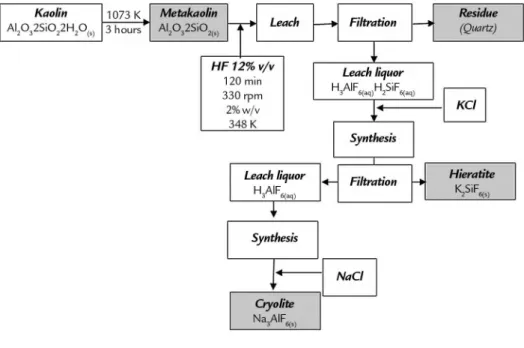
The experimental procedure was shown in Figure 2.
Figure 2 Flow sheet of the proposed process.
2.3.1 Leaching experiments
In accordance with the bibliography, (Rosales et al. 2013, 2014), we found that
the dissolution reaction of metakaolin in HF occurs as follows:
Al
2O
32SiO
2(s)+ 24HF
(aq)⎯→
2H
3AlF
6(aq)+ 2H
2SiF
6(aq)+ 7H
2O
The dissolution eficiency (Rosales et al. 2013, 2014) was calculated by using Equation (3):
X(%) = [(m
0- m
r) / (m
0)] 100
where: X is the dissolution eficiency; m0is
the initial mass of the solid reactant and
mr is the mass that remains unreacted after
the reaction.
The studied parameters were: con-centration of HF (6-15% v/v), temperature
(288-363 K), reaction time (0-120 min) and solid/liquid ratio (1-5% w/v) at two temperatures (308 and 348 K).
2.3.2 Recovery experiments
The leach liquor used for the synthe-sis was prepared by leaching metakaolin with HF, within the optimal operational variables, as studied in section 3.1 "Leach-ing of metakaolin". Recoveries of Al and Si from the leach liquor were performed via
chemical precipitation with alkaline salts. The studied parameter was the precipitat-ing agent’s mass.
The recovery tests were conducted in two steps; in the irst one, the precipitation of Si was studied by adding KCl,
accord-ing to reaction step 1. This salt was pre-cipitated as K2SiF6 and then separated by iltration. The second step was performed with the liquor obtained in step 1 (without Si) by addition of NaCl as reaction step, in order to precipitate Na3AlF6.
Step 1: Recovery of silicon
2
KCl
(s)+ H
2SiF
6(aq)+ H
3AlF
6(aq)→
K
2SiF
6(s)+ H
3AlF
6(aq)+ 2HCl
(aq)Step 2: Recovery of aluminum
3NaCl
(s)+ H
3AlF
6(aq)→
Na
3AlF
6(s)+ 3HCl
(aq)3. Results and discussion
3.1 Leaching of Metakaolin
3.1.1 Effect of concentration leaching agent
(2) (3)
(4) (5)
shown in Figure 1. The Figure 1 (a) shows diffraction lines of kaolinite (ICDD 01-072-2300) and as accessory minerals, quartz and pyrophillite (JCP-DS 033-1161 and JCP(JCP-DS 012-0203,
respectively). In Figure 1 (b) lines of quartz and pyrophillite can be observed more clearly because the metakaolinite does not have a crystalline structure. The morphological analysis of kaolin,
3.1.2 Effect of reaction temperature
The dissolution tests for studying the effect of temperature were performed under the following conditions: concentra-tion of HF 12% v/v; reacconcentra-tion time 60 min; stirring speed, 330 rpm and solid-liquid ratio, 2% v/w. The results are presented in Fig. 3 b), an augmentation in the tem-perature increases the dissolution of the mineral; these experiments agree with
the known fact that the heterogeneous reaction between a mineral and a luid reactant, either an acid or a base, is gener-ally slow and sensitive to temperature. In addition the increase of the temperature increases the reactivity of the solid and the solubility of the formed products (Ha-bashi, 1980 and Quiroga et al., 1996,
Ro-sales et al., 2013, Rodriguez et al., 2015).
Even though higher leaching, around 92%, is obtained at temperatures above 348 K, important extractions, about 70%, are also achieved at room temperature, 298 K (Habashi, 1980 and Quiroga et al., 1996).
This is of great importance for carrying out the process on a larger scale because energy consumption decreases considerably in the mineral dissolution step.
3.1.3 Effect of reaction time
The experiments were carried out at 348 K, 330 rpm, 2% w/v solid/liquid ratio and 12% v/v HF. The results of test performances are shown in Figure 3 c). It can be observed that for the same leach-ing temperature, increased reaction time
leads to an increase in the dissolution of metakaolin. Therefore, the increase in the contact time between solid and luid phases increases the dissolution of the mineral (Habashi, 1980, Quiroga
et al., 1996 and Rodriguez et al., 2004
and 2015). The maximum value of dis-solution, 96%, was obtained in 120 min of reaction. Additionally, important dis-solutions of the mineral (around 90%) working at lower reaction times (< 60 min) are achieved.
3.1.4 Effect of solid/liquid ratio
Experiments were performed with a solid/liquid ratio in the range of 1 to 5% w/v, while other parameters remained constant at the following values: temperature, 308 K; HF concentration, 12% v/v; reaction time, 30 min and stirring speed 330 rpm. The obtained results are plotted in Figure 3 d) and show that at a low solid/liquid ratio, dissolution of the solid is high. These results were expected since the magnitude
of the complexation depends not only on the values of the formation constants but also on the concentration of the active form of the complexing reagent (Inczédy, 1976, Rodriguez et al., 2004). Therefore, with
increasing solid/liquid ratios the available, concentration of the complexing agent is lower, and the magnitude of dissolution decreases. In addition, the extraction for the S/L ratio to 2% w/v corresponding to 30
min and 308 K, is lower than its analogue at 348 K and 60 min, although the operating conditions at which this leaching value is obtained, considerably decreases energy con-sumption not only with the operating param-eter related with the temperature increase but indirectly with the stirring speed parameter, since the reaction time is lower. In addition, operating at a lower temperature and time decreases the corrosion of the equipment.
Figure 3
Effect of: a) concentration, b) temperatu-re, c) time and d) solid/liquid ratio on the dissolution of metakaolin.
(a) (b)
(c) (d)
Tests for leaching metakaolin with dif-ferent concentrations of HF were performed at: 348 K, 330 rpm and 60 min. The leaching agent (HF) concentrations used were: 6, 8, 10, 12 and 15% v/v. The results shown in Figure 3 a), demonstrate that when the HF
concentration increases, the metakaolin dissolution also increases, which is because more reagents are available to react with the mineral and form the products (Ha-bashi, 1980), and the plateau of this curve is reached at an HF concentration value of
455
The leach liquor used in the as-says for the recovery and synthesis of compounds of aluminum and silicon was performed using the data obtained from the study of operating parameters "section 3.1. Leaching metakaolin". The selected operating conditions were: 50 g
of metakaolin were dissolved in 2.5 L of a solution of HF obtaining a mineral dis-solution of 96%.
To determine the recovery values of K2SiF6 and Na3AlF6, precipitation tests were carried out by adding different amounts of KCl and NaCl to the leach
liquor, in a range above and below the stoichiometric values necessary for the oc-currence of the reactions of the steps 1 and 2. The assays were performed by adding KCl in the irst step; thus synthesizing hi-eratite. After all the silicon was recovered, NaCl was added to precipitate cryolite.
Figure 4 (a) Step 1, effect of KCl addition and (b) step 2, effect of NaCl addition.
In Figure 4, it can be seen that increasing the addition of the mass of both the salts, leads to an increase in the recovery of Si and Al. The best recoveries of Si, > 99% as hieratite, are obtained by adding amounts of KCl greater than 7 g. Whereas for Al, the best recoveries for cryolite (70%) are obtained by adding a NaCl mass greater than 6 g.
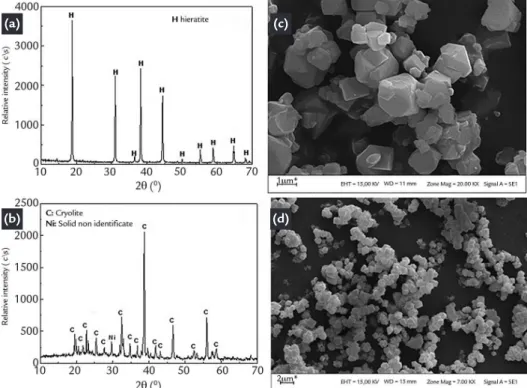
In Figures 5 a) and b), the character-izations by XRD and SEM of the solids
obtained in step 1 are shown. It can be ob-served that the only crystalline structure present corresponds to hieratite, K2SiF6, (ICDD 01-085-1382) as proposed; where-as, in the micrograph, it is seen that the particles have an isometric hexoctahedral shape with sharp edges, coinciding with the crystalline structure of the hieratite. In Figures 5 c) and d), characterizations of the solids obtained in step 2 are pre-sented; XRD shows that the only crystal
structure detected corresponds to cryolite, Na3AlF6 (ICDD 01-082-0217) and SEM analysis shows that these particles have a monoclinic prismatic shape and well deined edges.
T h e r e s u lt i n g c o mp o u n d s Na3AlF6 and K2SiF6 were analyzed by microanalysis EPMA and XRF to determine the purity of the solid pre-cipitates. Table 2 shows the purity of these compounds.
Figure 5 a) XRD and c) SEM of solid precipitated step 1, b) XRD and d) SEM of solid precipitated step 2.
(a)
(b)
(c)
(d)
The results shown in Table 2 are in agreement with the analysis by XRD (Figures 5a and c). Furthermore, it was established that the precipitate in step 1 (hieratite) solid has a purity of 98.8% and the compound obtained in step 2 (cryolite) has a purity of 89.3%. Kumar et al., 2010
obtained a precipitate of Na2SiF6 (mal-ladrite) and Na3AlF6 (cryolite) from the leach liquors of low-grade molybdenite
containing alumino-silicates. The near complete recovery of Na2SiF6 and the cryolite was found to be contaminated with sodium ferric-luoride and recovery about 95%. Rosales et al. 2013 obtained,
by precipitation with NaOH, a mixture of cryolite and malladrite, from spodumene liquors, achieving a recovery of 92% of aluminum and silicon.
The high purity hieratite and
tech-nical grade cryolite obtained with the leach liquor from metakaolin with HF, is presented. These products, K2SiF6 and Na3AlF6, have numerous industrial appli-cations, as already mentioned in the intro-duction. In addition, the SiO2 generated as a byproduct, is used as an abrasive agent in the cutting of rocks, as well as a lux in smelting operations. Also, it is used for manufacturing porcelain and sandpaper.
4. Conclusions
References
From the experimental results, it can be inferred that the dissolution process of metakaolin with HF is an eficient way to extract Al and Si. The best obtained value of the mineral
dis-solution, 96%, was achieved, working at 330 rpm, HF concentration of 12% v/v, solid/liquid ratio of 2% w/v for 120 min and 348 K. The recovery of aluminum and silicon by the chemical precipitation
methodology with alkali salts is a viable method, achieving 99% recovery of sili-con, as hieratite with a purity of 98.8% and about 70% aluminum, as cryolite, with an 89.3% purity.
ADAMS, M.J., Van DALEN, E. Effect of adding luoride on the sulphuric acid extrac-tion of alumina from silicate ores. Light Met., W.S. Peterson (Ed.), TMS, p.205-216, 1979.
ALTIOKKA, M.R., AKALIN, H., MELEK, N., AKYALÇIN, S. Investigation of the dissolution kinetics of meta-kaolin in H2SO4 solution. Ind. Eng. Chem. Res., v.49, p.12379-12382, 2010.
ALTIOKKA, M.R., HOŞGÜN, H.L. Investigation of the dissolution kinetics of kao-lin in HCl solution. Hydrometallurgy, v.68, p.77-81, 2003.
BAILEY, N.T., CHAPMAN, R.J. The use of coal spoils as feed material for alumina recovery by acid leaching routes V: the effect of luoride additions on the extraction of aluminum with hydrochloric acid. Hydrometallurgy, v.18, p.337-350, 1987. BAZIN, C., EL-OUASSITI, K., OUELLET, V. Sequential leaching for the recovery of
alumina from a Canadian clay. Hydrometallurgy, v.88, p.196-201, 2007.
COLINA, F.G., ESPUGLAS, S., COSTA, J. High-temperature reaction of kaolin with sulfuric acid. Ind. Eng. Chem. Res., v.41, p.4168-4173, 2002.
GAJAM, S.Y., RAGHAVAN, S. A kinetic model for the hydrochloric acid leaching of kaolinite clay in the presence of luoride ions. Hydrometallurgy, v.15, p.143-158, 1985.
GASTUCHE, M.C., TOUSSAINT, F., FRIPIAT, J.J., TOUILLEAUX, R., Van ME-ERSCHE, M. Study of intermediate stages in the kaolin → metakaolin transforma-tion. Clay Miner., v.5, p. 227-236, 1963.
HABASHI, F. Principles of Extractive Metallurgy, v I. New York: Gordon and Brea-ch Science Publishers Inc., 1980.
HABASHI, F. Handbook of Extractive Metallurgy. Germany: Wiley-VCH, 1997. HULBERT, S.F., HUFF, D.E. Kinetics of alumina removal from a calcined kaolin with
nitric, sulphuric and hydrochloric acids. Clay Miner., v.8, p.337-345, 1970. INCZÉDY, J. Analytical applications of complex equilibria. Budapest: Ellis
Horwood, 1976.
KLINE, W.E., FOGLER, H.S. Dissolution of silicate minerals by hydroluoric acid. Ind. Eng. Chem. Fundam., v.20, p.155-161, 1981.
Figure Compounds Purity %F %Na %K %Si %Al %O %Fe Other
5c) K2SiF6 98.8 47.00 --- 35.30 16.70 1.20 --- 0.40 0.60
5d) Na3AlF6 89.3 40.01 33.80 1.80 2.50 15.69 4.20 0.21 1.79 Table 2Analysis of the solid precipitate
457
KUMAR, M., NANI BABU, M., MANKHAND, T.R., PANDEY, B.D. Precipitation of sodium silicoluoride (Na2SiF6) and cryolite (Na3AlF6) from HF/HCl leach liqu-ors of alumino-silicates. Hydrometallurgy, v.104, p.304-307, 2010.
QUIROGA, O.D., AVANZA, J.R., FUSCO, A.J. Modelado cinético de las transfor-maciones luido-sólido reactivo. Argentina: EUDENE, 1996. (In Spanish). RIVERA, O., PAVEZ, O., LI KAO, J., NAZER, A. Metallurgical characterization of
kaolin from Atacama, Chile. REM: Int. Eng. J., v.69, 4, p.473-478, 2016.
RODRIGUEZ, M.H., RIVAROLA J., RUIZ, M. C. The effects of carboxylic acid addition on hydroluoric acid autoclave leaching of a ferrocolumbite. Hydrome-tallurgy, v.74, p.39-46, 2004.
RODRIGUEZ, M.H., ROSALES, G.D., PINNA, E.G., SUAREZ, D.S. Extraction of niobium and tantalum from ferrocolumbite by hydroluoric acid pressure leaching. Hydrometallurgy, v.156, p.17-20, 2015.
ROSALES, G.D., RUIZ, M. C., RODRIGUEZ, M.H. Alkaline metal luoride synthe-sis as a subproduct of β–spodumene leaching. Hydrometallurgy, v.139, p.73-78, 2013.
ROSALES, G.D., RUIZ, M. C., RODRIGUEZ, M.H. Novel process for the extrac-tion of lithium from β-spodumene by leaching with HF. Hydrometallurgy, v.147, p.1-6, 2014.
TERRY, B. The acid decomposition of silicate minerals. Part I: reactivities and modes of dissolution of silicates. Hydrometallurgy, v.10, p.135-150, 1983a.
TERRY, B. The acid decomposition of silicate minerals. Part II: hydrometallurgical applications. Hydrometallurgy, v.10, p.151-171, 1983b.