Rosa Perestrelo Michael Caldeira Freddy Rodrigues JosØ S. Câmara
Centro de Qumica da Madeira, Departamento de Qumica, Universidade da Madeira, Campus Universitrio da Penteada, Funchal, Portugal
Original Paper
Volatile flavour constituent patterns of
Terras
Madeirenses
red wines extracted by dynamic
headspace solid-phase microextraction
A suitable analytical procedure based on static headspace solid-phase microextrac-tion (SPME) followed by thermal desorpmicroextrac-tion gas chromatography – ion trap mass spectrometry detection (GC –ITDMS), was developed and applied for the qualitative
and semi-quantitative analysis of volatile components of Portuguese Terras Madeir-ensesred wines. The headspace SPME method was optimised in terms of fibre coat-ing, extraction time, and extraction temperature. The performance of three com-mercially available SPME fibres,viz.100lm polydimethylsiloxane; 85lm polyacry-late, PA; and 50/30lm divinylbenzene/carboxen on polydimethylsiloxane, was eval-uated and compared. The highest amounts extracted, in terms of the maximum sig-nal recorded for the total volatile composition, were obtained with a PA coating fibre at 308C during an extraction time of 60 min with a constant stirring at 750 rpm, after saturation of the sample with NaCl (30%, w/v). More than sixty vola-tile compounds, belonging to different biosynthetic pathways, have been identified, including fatty acid ethyl esters, higher alcohols, fatty acids, higher alcohol ace-tates, isoamyl esters, carbonyl compounds, and monoterpenols/C13-norisoprenoids.
Keywords:GC –ITMS / Headspace solid-phase microextraction / PCA analysis / Red wines / Volatile compounds/
Received: November 5, 2007; revised: December 19, 2007; accepted: December 20, 2007
DOI 10.1002/jssc.200700568
1 Introduction
Wine production is currently spread all over the world and misuse of brand names, copying of processes, and product adulteration are generating an increased demand for quality studies and authenticity investiga-tions. Identification of wine aroma components and the relationships between their relative contents may be a useful tool in differentiating wines of different varieties and establishing genuineness criteria to improve the quality of wines, prevent fraud, and guarantee their ori-gin.
Wine is a highly complex mixture of compounds which largely define its appearance, aroma, flavour, and
mouth-feel properties. These characteristics are the most important parameters responsible for wine character and quality, and hence for consumer acceptance. Their volatile fraction can be composed of more than 800 different compounds [1, 2]. However, only several tens of these will be odour-active [3] and must be considered for differentiation purposes. These compounds belong to several chemical families, including higher alcohols, ethyl esters, fatty acids, higher alcohol acetates, isoamyl esters, carbonyl compounds, sulphur compounds, fur-anic compounds, monoterpenols, C13-norisoprenoids,
and volatile phenols, which present different polarities, volatilities, and, moreover, are found in a wide range of concentrations from ng/L to mg/L. They derive from four major sources,viz.(i) grapes; (ii) processing of the grapes (namely crushing, pressing) by chemical, enzymatic-chemical, and thermal reaction in the grape must; (iii) microbes; and (iv) chemical reactions during maturation of wine (wood, commonly oak).
Some of the wine volatile compounds are present in high concentration (hundreds of mg/L), but most of them are found at the low ng/L level [4, 5]. Therefore some com-ponents need to be extracted and concentrated before analysis, while others can be analysed by high resolution
Correspondence:Professor Jos S. Cmara, Centro de Qumica da Madeira, Departamento de Qumica, Universidade da Ma-deira, Campus Universitrio da Penteada, 9000-390 Funchal, Portugal
E-mail:[email protected] Fax:+351 291705149
chromatography with direct injection. Separation of the target compounds from the sample matrix is a challenge to many analytical chemists. The extraction process is generally the step at which most analyte loss occurs; therefore, efficient methods of extraction are continu-ally being sought.
Traditional analytical methods employing organic sol-vents such as liquid – liquid extraction [6], simultaneous distillation – extraction (SDE) [7], supercritical fluid extraction (SFE) [8], solid phase extraction (SPE) [9], and ultrasound extraction [10] were commonly used. These are hazardous since they require large amounts of toxic and expensive solvents, are labour-intensive and time-consuming, and require pre-concentration of the extract. Each procedure of sample preparation is subject to vari-ous sources of inconvenience, but offers specific advan-tages under certain circumstances. Nowadays, easier and more selective alternatives are used, which may over-come the disadvantages of these classical methods. These include solid-phase microextraction (SPME) developed by Pawliszynet al.[11,12] in the early 1990s, and the more recent technique of stir bar sorptive extraction (SBSE) developed in the late 1990s by Baltussenet al.[13]. The lat-ter technique uses a so-called Twislat-ter, a glass stir bar onto which is bonded a sorptive phase, often polydime-thylsiloxane (PDMS), in quantities far in excess of those found on SPME fibres [14].
Since the first SPME fibres became commercially avail-able, the technique has been more and more widely used and the fields of application have been continuously growing, now including a wide range of food analysis, namely the volatile composition of wines [14 – 19], beers [20], whiskeys [21 – 23], several kinds of fruits [24, 25] and foods [26, 27], clinical chemistry [28, 29], environmental chemistry [30, 31], and pharmaceutical analysis [32, 33], with about 3000 research papers having been published so far. The technique is gaining growing acceptance and increasing use in routine laboratories and industrial applications.
This work aims to present a fast and sensitive method based on manual dynamic headspace SPME sampling with polyacrylate (PA) fibre and subsequent GC –ITDMS for
the qualitative and quantitative analysis of volatile com-position of the most representative Terras Madeirenses
young red wines (Madeira Island, Portugal). Three com-mercially available SPME fibres: 100lm polydimethylsi-loxane, PDMS, apolar; 85lm polyacrylate, PA, polar; and 50/30lm divinylbenzene/carboxen on polydimethylsi-loxane, DVB/CAR/PDMS (StableFlex) polar, were tested. After selecting the fibre, other factors affecting recovery efficiency of volatiles – including extraction time and temperature – were investigated. A comparison between the performance of the three sorbent materials is given. The selectivity of the method for specific classes of fla-vour compounds is evaluated. Linearity, detection and
quantification limits, and precision of the overall analyt-ical procedure have also been calculated. Finally, the optimised SPME procedures were applied to obtain the volatile patterns of the five most importantTerras Madeir-ensesred wines.
2 Experimental
2.1 Chemicals and materials
All reagents used were of analytical quality and all sol-vents were of HPLC grade. Absolute ethanol and sodium chloride were supplied by Panreac (Barcelona, Spain). The C8– C20n-alkane series, the pure reference
com-pounds, and the chemical standards used as internal standards, octan-3-ol and 4-methylpentan-2-ol, were sup-plied by Sigma – Aldrich (Spain). The purity of all stand-ards was above 98%. Methanol, sodium chloride, andL(+ )-tartaric acid were purchased from Merck (Darmstadt, Germany).
Individual standard solutions for volatiles were pre-pared in ethanol – methanol (1:1) solution. Working solu-tions, containing the analytes, used in further studies were prepared by diluting different amounts of each standard solution in a synthetic wine solution (Milli-Q water containing 12% (v/v) ethanol, 5 g/L of L(+)-tartaric acid, pH adjusted to 3.3). Ultrapure water was obtained from a Milli-Q purification system (Millipore, Bedford, MA, USA). All the standard and working solutions were stored in darkness at – 288C.
2.2 Wine samples
Twenty samples from five (VT1 – VT5) different Portu-guese red wines (Terras Madeirenses) of 2005 vintage, origi-nating from different grape varieties (Table 1) and all belonging to the Appellation region “Regi¼o Demarcada da Madeira”, were investigated following the proposed method. The wine samples were supplied by the Madeira Wine Institute, and were produced in Adega de S¼o Vice-nte (North of Madeira Island) on an industrial scale using traditional winemaking methods for red wines. Grapes from different varieties were crushed, de-stemmed, racked, and pressed. The musts were fermented in stain-less-steel containers, with spontaneous yeast. Alcoholic fermentation was carried out at 248C. The codes of the analysed wines and the varietal composition of the differ-ent wine samples are presdiffer-ented in Table 1. All samples were taken from bottled wines (750 mL) ready for sale and were stored at – 288C until analysis.
2.3 HS-SPME procedure
extraction time; and extraction temperature. The VT1 wine sample was selected as the matrix for comparison of the performance of the three fibres. The fibre that pre-sented the most complete profile of VT1 wine volatile compounds was chosen to optimise the sampling proce-dure and the operating conditions. To determine the opti-mal extraction conditions, the profiles of adsorption/ absorption kinetics were evaluated for four exposure times (5, 15, 30, 60 min) of the fibre in the headspace. The extraction was carried out at 308C (controlled tempera-ture) and each measurement was repeated three times. The VT1 wine sample was also tested at three heating tem-peratures (room temperature, 308C, and 408C) with a fibre exposure time of 60 min. The PA fibre, the most suitable, was chosen for further method development.
For headspace sampling, a hermetically sealed 60-mL ambar glass vial containing 30 mL of standard or sample, spiked with 250lL of octan-3-ol and 1 mL of 4-methyl-pentan-2-ol (Sigma – Aldrich) used as internal standards (at 422 mg/L), was placed in a thermostatic bath on a stir-rer. Extractions were carried out at wine pH (3.3) and the ionic strength was increased to improve the extraction efficiency using NaCl (30%, w/v). The fibre was then exposed to the gaseous phase for an appropriate time at the different temperatures tested. As stirring usually improves the extraction, all the experiments were per-formed at constant stirring velocity (750 rpm). After sam-pling, the SPME fibre was withdrawn into the needle, removed from the vial, and inserted for 6 min into the hot injector port (2408C) of the GC –ITDMS system where
the extracted analytes were thermally desorbed and transferred directly to the analytical column.
2.4 Gas chromatography – ion trap mass spectrometry detection (GC –ITDMS)
The volatile compounds extracted by the HS-SPME proce-dure from standards andTerras Madeirenses wines were tentatively identified by GC – MS using a Varian STAR 3400Cx series II gas chromatograph, fitted with a
DBWaxterfused silica capillary column (30 m60.5 mm
id; film thickness 0.25lm; J&W Scientific, USA), con-nected to an ion-trap mass spectrometer (Varian Saturn III), according to the method described by Cmaraet al.
[34]. Helium (Helium N60, Air Liquide, Portugal) was used as the carrier gas at a flow rate ofca.1 mL/min (col-umn-head pressure: 13 psi =ca. 90 kPa). An insert of 0.75 mm id was used and the injector temperature was set at 2608C. Splitless injection was used. The tempera-ture was programmed as follows: initial temperatempera-ture of 408C was held for 1 min and then increased in three steps: 408C to 1208C at 18C/min; 1208C to 1808C at 28C/ min; and 1808C to 2208C at 258C/min. Each step was pre-ceded by a small period at constant temperature for 2 min, 1 min, and 10 min, respectively. The manifold, GC –ITDMS interface, and ion-trap temperatures were
held at 1808C, 2208C, and 1808C, respectively. Detection was performed by a Saturn III mass spectrometer in elec-tronic impact (EI) mode (ionisation energy, 70 eV; source temperature, 1808C). The electron multiplier was set to the autotune procedure. The mass acquisition range, made in full scan mode, was 30 – 300m/z; 1.9 spectra/s. Identification of all constituents was achieved by com-paring the mass spectra of the unknown peaks with those stored in the NIST GC/MS library, from retention times of the pure standards, and from Kovts retention indices (RI). A C8– C20 n-alkanes series was used for the
determination of the RI.
2.4 Statistical Analysis
Significant differences among the Terras Madeirenses
wines were determined by one-way analysis of variance (Anova) using an SPSS Program, version 14.0 (SPSS Inc., 2006). Principal component analysis (PCA) and stepwise linear discriminant analysis (SLDA) were performed using the same SPSS program. These techniques were applied to the normalised total peak areas from different chemical families.
3 Results and Discussion
3.1 Selection of SPME fibre coating
The fibre coating used influences the chemical nature of the extracted analyte that is established by its character-istic polarity and volatility. To evaluate the extraction efficiency of volatile compounds from red wines, and tak-ing account of the physicochemical characteristics of the targets under consideration, we tested three types of fibre (PDMS, PA, and DVB/CAR/PDMS) among those used most routinely for assaying wine volatiles. At this evalua-tion stage, the extracevalua-tion time was set at 60 min (in order to assure that equilibrium could be established or a large amount of analytes would be extracted) and the extrac-tion temperature at 308C. All tests were done on the
Table 1.Varietal composition of PortugueseTerras Madeir-ensesred wines (bold character indicates the main variety).
Wine samples
Varietal composition Alcohol
(%, v/v)
VT-1 Tinta Negra Mole 12
VT-2 Tinta Negra Mole, Cabernet
Sau-vignon, Merlot 12.5
VT-3 Tinta Negra Mole, Cabernet
Sau-vignon, Merlot, Complexa 12.5
VT-4 Cabernet Sauvignon, Merlot, Touriga
Nacional, Touriga Barroca 12.5
VT-5 Touriga Nacional, Merlot, Cabernet
Sauvignon
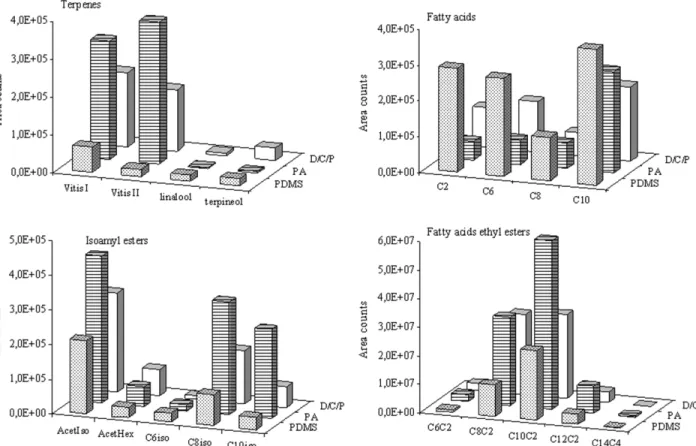
same bottle of VT1 wine. Each SPME fibre performance was evaluated in terms of extraction efficiency, number of identifiable compounds in the extract, and reproduci-bility. As shown in Table 2, PA fibre showed the best extraction efficiency for volatile compounds. Under these conditions DVB/CAR/PDMS fibre had a low sorption capacity. The results obtained using the three fibres on the same wine sample (VT1), under rigorously repro-duced temperature and exposure time conditions, are reported in Fig. 1. The more polar fibre, PA, shows a more effective extraction for polar compounds such as higher alcohols and fatty acids while PDMS favours the extrac-tion of less polar compounds like ethyl esters, monoter-penols/C13-norisoprenoids, acetates, and isoamyl esters
(Fig. 2).
3.2 Effect of extraction time
The amount of the volatiles adsorbed on the stationary phase of the SPME fibre is strongly influenced by the exposure time of the fibre to the headspace. In order to investigate the sorption behaviour of wine volatiles on the PA fibre, different extraction times ranging from 5 min to 60 min, namely, 5, 15, 30, and 60 min, were examined for 30 mL of VT1 wine sample at 308C. Table 3 shows the effect of adsorption time on the extraction per-formance of the volatile compounds. Ethyl esters and higher alcohols reach equilibrium within 30 min, but acetates, C13-norisoprenoids, acetates, isoamyl esters only
within 60 min. For most volatiles, adsorption equili-brium is reached between 45 min and 60 min, while for
some other components this equilibrium is still not reached after 60 min. Therefore it can be concluded that the highest recovery was obtained after 60 min although
the reproducibility was higher after an extraction time of 30 min. 60 min was selected as an adequate extraction time because some analytes had already reached equili-brium and also because the sensitivity obtained for the analytes was acceptable.
3.3 Effect of extraction temperature
The SPME process is greatly influenced by the tempera-ture parameter. It controls the phenomena of diffusion of analyte from the liquid to the gaseous phase as well as adsorption/absorption onto the coating fibre. The influ-ence of the extraction temperature on the amount of vol-atiles extracted by HS-SPMEPAwas investigated with VT1
wine samples extracted for 60 min at room temperature (rT: 22 l 18C), 308C, and 408C. Table 4 illustrates the effects of solution temperature in the rangerTto 408C on the peak areas, demonstrating the different behaviour of the different chemical classes. No significant differences were observed betweenrTand 308C, but for the highest temperature, 408C, a dramatic decrease in extraction effi-ciency was observed. As the temperature rises, more
ana-Figure 2.Comparison of the performance of different SPME coatings on the extraction of monoterpenols/C13-norisoprenoids,
fatty acids, isoamyl esters, and fatty acid ethyl esters, obtained by extracting the same VT1 sample. (D/C/P: DVB/CAR/PDMS coating; Vitis I and II: vitispirane isomers; C2: acetic acid; C6: hexanoic acid; C8: octanoic acid; C10: decanoic acid; AcetIso: Isoamyl acetate; AcetHex: hexyl acetate; C6iso: isoamyl hexanoate; C8iso: isoamyl octanoate; C10iso: isoamyl decanoate; C6C2: ethyl hexanoate; C8C2: ethyl octanoate; C10C2: ethyl decanoate; C12C2: ethyl dodecanoate; C14C2: ethyl tetradeca-noate).
Table 2.Sorption capacity of different fibres for extraction of VT1 wine volatile compounds during dynamic HS-SPME extraction, expressed as peak area (60 min at 308C with salt saturation; n= 3; TER: monoterpenols and C13
-norisopre-noids).
Class of compounds SPME fibre
PA DVB/CAR/
PDMS PDMS
Higher alcohols 1.186107 3.33
6107 2.626107
Fatty acids 4.746105 1.25
6106 5.60
6105
Ethyl esters 3.496108 4.13
6107 6.566107
TER 1.736106 5.92
6105 1.256106
Acetates 2.256106 5.626105 9.966105
Isoamyl esters 6.016105 1.49
6105 2.256105 Carbonyl compounds 1.396105 1.52
6104 8.50
6104
Miscellaneous 9.176104 8.29
6104 1.62
6105
Sum 3.666108 7.73
6107 9.526107
lytes are released into the headspace, but due to the decrease of partition coefficients the absorption of ana-lytes is reduced. The chemical families that are most affected by the rise in temperature are ethyl esters of fatty acids and higher alcohols. On average, a good repro-ducibility was achieved for the extraction of wine vola-tile compounds at each studied temperature (Table 4). Therefore 308C was employed due to better chromato-graphic reproducibility and maximum extraction effi-ciency was achieved.
3.4 Study of volatile compounds in wine samples
The proposed HS-SPME method, previously optimised and validated, was applied to determine the content of volatile compounds in five different red wines produced in Adega de S¼o Vicente (Madeira Island). Each wine was analysed four times using the best sampling conditions. More than 60 volatile compounds belonging to several chemical classes were positively identified, including higher alcohols, fatty acid ethyl esters, fatty acids, ace-tates, isoamyl esters, and monoterpenol/C13
-norisopre-noid compounds. The major fermentation compounds, such as ethyl esters, higher alcohols, and fatty acids, con-stitute a main part of the flavour of the young red wines. Most of the volatile compounds were identified by a NIST library search. In some cases, a comparison with authen-tic compounds was performed. The Kovts retention indi-ces were calculated for each peak and compared with the literature [35] in order to ensure correct identification of the compounds. The relative composition of every fla-vour compound was calculated as the percent ratio of the respective peak area relative to the total peak area.
The fatty acid ethyl esters, ethyl octanoate (47.57% VT3 to 53.22% VT5), and ethyl decanoate (19.33% VT5 to 26.03% VT4), were the main components found in each wine analysed, followed by 3-methylbutan-1-ol (4.57% VT4 to 8.56% VT3),b-phenylethanol (2.47% VT4 to 4.79% VT3), isoamyl acetate (0.77% VT4 to 3.26% VT1), ethyl ace-tate (1.71% VT1 to 2.58% VT5), octanoic acid (1.57% VT3 to 1.98% VT5) and ethyl dodecanoate (0.85% VT5 to 2.33% VT2).
As seen in Fig. 3, there were no significant qualitative and quantitative differences between the volatile
compo-Table 3.Influence of the extraction time on absorption of wine flavour compounds during HS-SPME extraction with a PA fibre (60 min of extraction at 308C, headspace sampling mode with salt saturation; TER: monoterpenols and C13-norisoprenoids).
Class of compounds Extraction time (min)
5 15 30 60
Higher alcohols 4.966106 7.426106 8.266106 1.186107
Fatty acids 1.756104 4.94
6104 8.426104 4.746105
Ethyl esters 1.666107 4.37
6107 6.30
6107 3.49
6108
TER 1.806105 5.41
6105 8.156105 1.736106
Acetates 5.456105 5.926105 6.84
6105 2.25
6106
Isoamyl esters 5.456105 5.92
6105 6.846105 6.016105
Carbonyl compounds 9.216104 9.93
6104 1.126105 1.396105
Miscellaneous 2.226104 7.00
6104 1.656105 9.176104
Sum 2.296107 5.30
6107 7.36
6107 3.66
6108
%RSD (n = 3) on sum 17.42 6.03 2.02 4.45
Table 4.Influence of the extraction temperature on absorption of different wine flavour compounds during HS-SPME extraction with PA fibre (60 min of extraction time with salt saturation;n= 3; TER: monoterpenols and C13-norisoprenoids).
Class of wine volatile
compounds Extraction temperature
Room temperature 308C 408C
Peak area RSD(%) Peak area RSD(%) Peak area RSD(%)
Higher alcohols 1.246107 9.25 1.18
6107 5.93 1.77
6107 16.41
Fatty acids 3.746105 11.28 4.74
6105 8.47 5.55
6105 6.37
Ethyl esters 1.066108 6.53 3.49
6108 6.75 4.08
6107 9.83
TER 1.756106 9.93 1.736106 2.65 5.826105 7.83
Acetates 2.416106 6.09 2.25
6106 9.61 2.39
6106 12.67
Isoamyl esters 3.626105 2.56 6.01
6105 2.91 1.69
6105 12.25
Carbonyl compounds 1.166105 6.42 1.39
6105 6.17 1.23
6105 5.21
Miscellaneous 5.586105 7.28 9.17
6104 6.22 2.85
6105 0.69
sition of the studied wines, which may be a consequence of the similarity of the grape varieties used (Table 1) and the vinification processes of VT1 – VT5 wines. VT4 wine presents higher amounts of volatile compounds than VT1 wines, which in turn was higher than with VT2, VT3, and VT5 wines. VT1 wines are characterised by the presence of monoterpenols/C13-norisoprenoids, fatty acids, higher
alcohol acetates, and isoamyl esters, correlating with the typical floral and fruity nuances of these wines. VT4 wines show the highest values of ethyl esters and high levels of fatty acids and carbonyl compounds. VT3 wines are char-acterised for their high content of higher alcohols, due to the presence of significant quantities of 3-methylbutan-1-ol andb-phenylethanol. In contrast, they have the lowest levels of fatty acids. The contents of higher alcohol ace-tates and isoamyl esters found in VT2 wines are higher than those of other wines. Fatty acids and carbonyl com-pounds are predominant in VT5 wine samples.
The fatty acid ethyl esters are quantitatively the largest group of volatile compounds found in theTerras Madeir-enseswines. Ethyl octanoate, ethyl decanoate, ethyl ace-tate, ethyl dodecanoate, ethyl hexanoate, and ethyl tetra-decanoate were dominant. These compounds, namely C4– C10compounds, when present at higher
concentra-tion than their limits of olfactive percepconcentra-tion, make a pos-itive contribution to the general quality of wines being responsible for their “fruity” and “flowery” sensory proper-ties. It can be seen that ethyl esters of fatty acids were more abundant than the acetates of higher alcohols.
The second most abundant isolated group were the higher alcohols, which correspond to 10.32, 11.84, 14.98, 7.61, and 11.38% of all volatiles analysed by SPMEPA– GC – ITDMS, for VT1, VT2, VT3, VT4, and VT5 wines, respectively.
At concentrations above 300 mg/L, they are regarded as negative quality factors. The main components of this group are 3-methylbutan-1-ol, whose presence may cause “bitter, harsh, alcohol, fusel” character, b-phenylethanol which may impart “pollen,roses,floral” notes, and hexan-1-ol which supplies “herbaceous, vegetal” nuances to the wine when its concentration surpasses the odour thresh-old values.
Fatty acids have been described as giving rise tofruity,
cheese,fatty,andrancidnotes. Among these compounds, higher contents of octanoic acid and decanoic acid were present in the five wines analysed. Hexanoic acid, 3-methylbutanoic acid and dodecanoic acid were also present in the five analysed wines but in much lower lev-els. Their mean values were very similar and they did not present significant differences (Fig. 3). The highest con-tent was observed for octanoic acid while 3-methylbuta-noic acid showed the lowest levels. Although the pres-ence of C6– C10fatty acids is usually related to the
appear-ance of negative odours, they are very important for the aromatic equilibrium in wines because they oppose the hydrolysis of the corresponding esters.
Carbonyl compounds are present in high amounts in VT5 and VT4 wines when compared to VT1 – VT3 wines. Acetaldehyde and other carbonyl compounds considered to be off-flavours and related to young wine oxidation were detected.
The monoterpenols have been reported as playing a determinant role in the wine aroma profile due to their very pleasant aroma and very low olfactory thresholds, so that they can be perceived during wine tasting even in low concentrations due to several synergic as well as antagonist effects observed between them. This group
showed the lowest values in the studied wines. Using dynamic headspace SPME only 0.43% (VT4) to 1.03% (VT1) of the monoterpenols and C13-norisoprenoids were
iden-tified in all extracted compounds. Many of the monoter-penols and C13-norisoprenoids identified in this study are
typical constituents of different wines. Thusb-linalool,b -ocimene, linalool (citrus-like, flowery) and a-terpineol (pine, flowery), have been reported previously as constit-uents of wines fromVitis viniferaL. varieties [20, 36, 37]. The presence of C13-norisoprenoids, vitispirane isomers,
1,1,6-trimethyl-1,2-dihydro-naphthalene (TDN), and b -damascenone is also considered to be a quality factor, as they supply an agreeable scent offlowers,fruits,tea, honey-like,black currant, orcassisnotes, except for TDN, which exhibits akerosene-likeodour. They are present in free and odourless glycosidically bound forms in grapes and wines, and can be liberated by acid-catalysed hydrolysis during conservation. The major compounds of this chemical family found in Terras Madeirenses wines were linalool,b-damascenone, and nerolidol.
3.5 Multivariate analysis
Although the volatile compounds studied provide impor-tant data for characterisation ofTerras Madeirenseswines, differentiation by direct observation of the results is quite difficult (Fig. 3). Multivariate techniques of data analysis represent a powerful statistical tool facilitating such differentiation [36, 37]. The total peak area of each chemical group, higher alcohols (HA), fatty acids (FA), ethyl esters (EE), monoterpenols/C13-norisoprenoids
(TER), higher alcohol acetates (ACET), isoamyl esters (ISOE), carbonyl compounds (CC), and miscellaneous (VTM), were used as variable vectors for multivariate
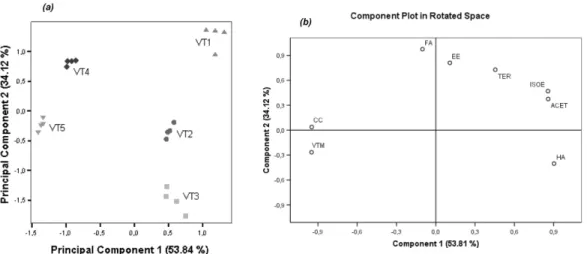
analysis in order to obtain more detailed information. When PCA was applied to the total peak area of different chemical classes, two factors were extracted and 87.96% of the total variance was explained. As can be seen, a clear separation can be observed (Fig. 4a). Considering the factor loadings of the variables, the most influential variables (chemical groups) for the first component (53.81%) are carbonyl compounds, higher alcohols, and higher alcohol acetates, while fatty acids and ethyl esters are the variables that most contribute to principal com-ponent 2 (34.12%). Figure 4a shows the scores scatter plot of the first two principal components (54.83% of the total variability) that represents the distinction among the red wine samples. Fig. 4b represents the corresponding load-ings plot that established the relative importance of each chemical group. The VT1 wines (first quadrant) are char-acterised by the higher alcohols acetates (ACET), isoamyl esters (ISOE) and to a lower extent by monoterpenols/C13
-norisoprenoids (TER). The VT2 and VT3 wines are related to the negative PC1 side. Higher alcohols is the variable which characterises them. VT4 wine samples represented in the second quadrant are characterised by carbonyl compounds (CC) and fatty acids (FA), while VT5 wines are associated with the miscellaneous volatile group (VTM) (Fig. 4b).
After PCA, a linear discriminant analysis (LDA) was run, using the above mentioned variables, in order to obtain suitable classification rules. Figure 5 shows a pro-jection of the wines in two-dimensional space, generated by the two first discriminate functions that explain 99.00% of the total variance. Five groups representing each wine, VT1, VT2, VT3, VT4, and VT5, were clearly observed. The good agreement achieved indicates that very acceptable classification functions can be deduced.
Figure 4.Principal component 1vs.principal component 2 scatter plot of the main sources of variability betweenTerras Madeir-ensesred wines (VT1 – VT5). (a) Distinction between the samples (scores); (b) relation between the chemical classes (loadings); Variables identification: HA: higher alcohols; ACET: higher alcohols acetates; ISOE: isoamyl esters; TER: monoterpenols/C13
Theleave-one-outmethod was used as cross-validation pro-cedure to evaluate the classification performance
4 Concluding remarks
From the results it can be concluded that headspace SPME coupled to GC –ITDMS and chemometrics is a very
appropriate sampling technique to distinguish the differentTerras Madeirenseswines studied based on their volatile profile. It is a simple extraction procedure with a great concentration capacity and combines extraction with rapid, sensitive, and solvent-free method suitable for determination of volatile and semi-volatile com-pounds in wine samples. The chromatographic profiles obtained after extraction with PDMS, PA, and Stableflex coatings suggested that PA is the most suitable fibre coat-ing for SPME analysis of these wine volatiles. The optimal extraction conditions for the selected fibre were: 30 mL of sample, extraction time 60 min; extraction tempera-ture 308C; headspace extraction of a stirred sample
satur-ated with NaCl (30%, w/v). Independently of temperature, the PA fibre extracts higher alcohols and fatty acids more efficiently than the other studied fibres. Ethyl esters, higher alcohol acetates, isoamyl esters, and monoterpe-nols/C13-norisoprenoids are better extracted with PDMS.
In general the volatile compositions determined in Ter-ras Madeirenseswines present very similar profiles and only few differences are observed with regard to the aver-age content. Nevertheless, on using a chemometric (PCA and LDA) approach, the volatile composition provides a suitable way of differentiating between the analysed wines.
The authors would like to thank the Madeira Wine Institute and Madeira Wine Company for the supply of wine samples and INTERREG III B – MAC for financial support (ANTIVINMAC proj-ect).
The authors declared no conflict of interest.
5 References
[1] Rapp, A., Mandery, H.,Experientia1986,42, 873 – 484.
[2] Arrhenius, S. P., McCloskey, L., Sylvan, M.,J. Agric. Food Chem. 1996,44, 1085 – 1089.
[3] Ferreira, V., Lopez, R., Cacho, J. F.,J. Sci. Food Agric.2000,80, 1659 – 1667.
[4] Romano, P., Fiore, C., Paraggio, M., Carus, M., Capece, A.,Int. J. Food Microbiol.2003,86, 169 – 176.
[5] Rapp, A.,Fresenius J. Anal. Chem.1990,337, 777 – 785.
[6] Ferreira, V., Ortin, N., Escudero, A., Lopez, R., Cacho, J. F.,J. Agri. Food Chem.2002,50, 4048 – 4054.
[7] Nuez, J. M., Bemelmans, H.,J. Chromatogr.1984,294, 361 – 366. [8] Blanch, G. P., Reglero, G., Herraiz, M.,J. Agric. Food Chem.1995,43,
1251 – 1258.
[9] Lpez, R., Aznar, M., Cacho, J. F., Ferreira, V.,J. Chromatogr. A 2002,966, 166 – 177.
[10] Cocito, C., Gaetano, G., Delfini, C.,Food Chem.1995,52, 311 – 320. [11] Lord, H., Pawliszyn, J.,J. Chromatogr. A2000,885, 153 – 193. [12] Arthur, L., Pawliszyn, J.,Anal. Chem.1990,62, 2145 – 2148. [13] Baltussen, E., Sandra, P., David, F., Cramers, C.,J. Microcol. Sep.
1999,11, 737 – 747.
[14] Alves, R. F., Nascimento, A. M. D., Nogueira, J. M. F.,Anal. Chim. Acta2005,546, 11 – 21.
[15] Coelho, E., Rocha, S. M., Delgadillo, I., Coimbra, M. A.,Anal. Chim. Acta2006,563, 204 – 214.
[16] Rocha, S. M., Coutinho, P., Barros, A., Delgadillo, I., Coimbra, M. A.,J. Chromatogr. A2006,1114, 188 – 197.
[17] Demyttenaere, J. C. R., Dagherb, C., Sandra, P., Kallithraka, S., Verh, R., Kimpe, N.,J. Chromatogr. A2003,985, 233 – 246. [18] Perestrelo, R., Fernandes, A., Albuquerque, F. F., Marques, J. C.,
Cmara, J. C.,Anal. Chim. Acta, 2006,563, 154 – 164.
[19] Burmeister, M. S., Drumond, C. J., Pfiesterer, E. A., Hysert, D. W., J. Am. Soc. Brew. Chem.1992,50, 53 – 59.
[20] Pinho, O., Ferreira, I. M. P. L. V. O., Santos, L. H. M. L. M.,J. Chroma-togr. A2006,1121, 145 – 153.
[21] Cmara, J. S., Marques, J. C., Perestrelo, R., Rodrigues, F., Oli-veira, L., Andrade, P., Caldeira, M.,J. Chromatogr. A2007,1150, 198 – 207.
[22] Demyttenaere, J. C. R., Dagherb, C., Sandra, P., Kallithraka, S., Verh, R., Kimpe, N.,J. Chromatogr. A2003,985, 221 – 232. [23] Pino, J. A., Mart, M. P., Mestres, M., Prez, J., Busto, O., Guasch, J.,
J. Chromatogr. A2002,954, 51 – 57.
[24] Gioacchini, A. M., Menotta, M., Bertini, L., Rossi, I., Zeppa, S., Zambonelli, A., Piccoli, G., Stocchi, V.,Rapid Commun. Mass Spec-trom., 2005,19, 2365 – 2370.
[25] Augusto, F., Valente, A. L. P., Tada, E. D., Rivellino, S. R.,J. Chroma-togr. A2000,873, 117 – 127.
[26] Pinho, O., Ferreira, I. M. P. L. V. O., Ferreira, M. A.,Anal. Chem. 2002,74, 5199 – 5204.
[27] Pinho, O., Prs, C., Ferreira, I. M. P. L. V. O.,J. Chromatogr. A2003, 1011, 1 – 9.
[28] Deng, C., Zhang, X., Rapid Commun. Mass Spectrom. 2004, 18, 1715 – 1720.
[29] Yo, H., Xu, L., Wang, P.,J. Chromatogr. B2005,826, 69 – 74. Figure 5.Differentiation between VT1, VT2, VT3, VT4, and
[30] balos, M., Bayona, J. M., Pawliszyn, J.,J. Chromatogr. A2000,873, 107 – 115.
[31] Ternes, T. A.,Water Res.1998,32, 3245 – 3260.
[32] Deng, C., Li, N., Zhang, X.,J. Chromatogr. B2004,808, 269 – 277. [33] Deng, C., Zhang, X., Li, N.,J. Chromatogr. B2004,813, 47 – 52. [34] Cmara, J. S., Alves, M. A., Marques, J. C.,Anal. Chim. Acta2006,
555, 191 – 200.
[35] Eight Peak Index of Mass Spectra, 2nd Edit., The Mass Spectra Data
Centre. Nottingham, UK, 1974.
[36] Cmara, J. S., Alves, M. A., Marques, J. C.,Food Chem.2007,101, 475 – 484.