www.atmos-chem-phys.net/11/4149/2011/ doi:10.5194/acp-11-4149-2011
© Author(s) 2011. CC Attribution 3.0 License.
Chemistry
and Physics
Aura MLS observations of the westward-propagating
s
=1, 16-day
planetary wave in the stratosphere, mesosphere and lower
thermosphere
K. A. Day1, R. E. Hibbins2,3, and N. J. Mitchell1
1Centre for Space, Atmospheric and Oceanic Science, Department of Electronic and Electrical Engineering,
The University of Bath, BA2 7AY, UK
2British Antarctic Survey, Cambridge, CB3, 0ET, UK
3Department of Physics, Norwegian University of Science and Technology, (NTNU), Trondheim, Norway
Received: 11 August 2010 – Published in Atmos. Chem. Phys. Discuss.: 7 October 2010 Revised: 1 April 2011 – Accepted: 1 May 2011 – Published: 5 May 2011
Abstract.The Microwave Limb Sounder (MLS) on the Aura satellite has been used to measure temperatures in the strato-sphere, mesosphere and lower thermosphere. The data used here are from August 2004 to December 2010 and latitudes 75◦N to 75◦S. The temperature data reveal the regular pres-ence of a westward-propagating 16-day planetary wave with zonal wavenumber 1. The wave amplitudes maximise in win-ter at middle to high latitudes, where monthly-mean ampli-tudes can be as large as∼8 K. Significant wave amplitudes are also observed in the summer-time mesosphere and lower thermosphere (MLT) and at lower stratospheric heights of up to∼20 km at middle to high latitudes. Wave amplitudes in the Northern Hemisphere approach values twice as large as those in the Southern Hemisphere. Wave amplitudes are also closely related to mean zonal winds and are largest in regions of strongest eastward flow. There is a reduction in wave am-plitudes at the stratopause. No significant wave amam-plitudes are observed near the equator or in the strongly westward background winds of the atmosphere in summer. This be-haviour is interpreted as a consequence of wave/mean-flow interactions. Perturbations in wave amplitude summer MLT are compared to those simultaneously observed in the winter stratosphere of the opposite hemisphere and found to have a correlation coefficient of +0.22, suggesting a small degrees of inter-hemispheric coupling. We interpret this to mean that some of the summer-time MLT wave may originate in the winter stratosphere of the opposite hemisphere and have been ducted across the equator. We do not observe a significant QBO modulation of the 16-day wave amplitude in the polar
Correspondence to:K. A. Day ([email protected])
summer-time MLT. Wave amplitudes were also observed to be suppressed during the major sudden stratospheric warm-ing events of the Northern Hemisphere winters of 2006 and 2009.
1 Introduction
Planetary waves with periods of∼2–16 days are an important component in the coupling between the lower and middle at-mosphere. Planetary waves play a key role in the transport of energy, momentum and chemical species, both vertically and horizontally. The waves interact very strongly with the background winds of the atmosphere because their horizon-tal phase speeds tend to be similar to the wind speeds, thus promoting wave/mean-flow interactions. Planetary waves are also known to modulate the gravity-wave field of the middle atmosphere and consequently modulate the fluxes of gravity-wave energy and momentum that drives the en-tire global circulation of the upper middle atmosphere (e.g. Forbes et al., 1991; Miyahara and Forbes, 1991a; Thayaparan et al., 1995; Nakamura et al., 1997; Manson et al., 2003). These modulated gravity-wave momentum fluxes can result in planetary-wave signatures penetrating to the thermosphere (Meyer, 1999).
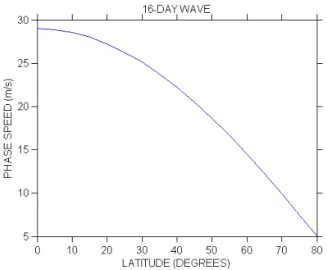
Fig. 1.Zonal phase speed as a function of latitude for a 16-day wave of zonal wavenumber 1.
A major class of planetary waves are the so-called normal modes, which have periods near 2, 5, 10 and 16 days (Salby, 1981a,b). These waves can be generated in the lower atmo-sphere and propagate from the tropoatmo-sphere into the strato-sphere and the mesostrato-sphere and lower thermostrato-sphere (MLT).
In this paper we will consider the 16-day planetary wave. Salby (1981a) suggested on theoretical grounds that the 16-day planetary wave is a manifestation of the gravest symmet-rical wavenumber 1, westward-travelling Rossby wave. The period of the 16-day wave has, in fact, been observed to lie between about 12–20 days. The wave has been reported to have wind amplitudes of up to about∼15 m s−1and temper-ature amplitudes reaching∼10 K in the MLT (e.g. Williams and Avery, 1992; Forbes et al., 1995; Day and Mitchell, 2010).
Previous studies of the 16-day wave have concentrated in particular on its manifestation in the MLT region. This seems to be partly because meteor and medium-frequency radars and airglow spectrometers are able to make extended mea-surements at these heights (e.g. Forbes et al., 1995; Mitchell et al., 1999; Luo et al., 2002a; Lima et al., 2006). How-ever, a number of modelling studies have suggested that the wave can also reach large amplitude in the stratosphere (e.g. Miyoshi, 1999; Luo et al., 2002b; Forbes et al., 1995).
These and other studies of the 16-day wave have reported a clear seasonal cycle in wave amplitudes in the MLT at mid-dle and low latitudes. Largest wave amplitudes generally occur the winter-time. However, a secondary maximum in the summer-time MLT is also sometimes observed (e.g., Luo et al., 2000; Espy et al., 1997; Mitchell et al., 1999). Lower polar-stratosphere studies of planetary-wave activity also re-port the 16-day wave in the winter-time with larger ampli-tudes in the Northern Hemisphere than the Southern Hemi-sphere (e.g. Alexander and Shepherd, 2010).
There have been only a limited number of studies of the 16-day planetary wave in the polar atmosphere (e.g. Williams and Avery, 1992; Luo et al., 2002b; Hibbins et al., 2009; Day and Mitchell, 2010). These studies have also revealed a winter-time maximum in wave amplitudes and a weaker secondary maximum in summer.
The presence of the wave in winter is fully consistent with its having propagated upwards from sources in the lower at-mosphere to the MLT. The propagation of a planetary wave in the atmosphere is controlled by the wave’s interaction with the background winds (Charney and Drazin, 1961). From Charney and Drazin theorem, in order to propagate vertically a planetary wave must obey 0<u¯−cx<Uc, whereu¯ is the zonal wind speed, cx is the zonal phase speed of the plan-etary wave at the latitude in question and Uc is the critical Rossby speed. For example, the westward-propagatings=1
16-day wave at latitudes of 25, 50 and 75◦, has phase speeds cxof−26,−19 and−8 m s−1respectively. The mean zonal wind speed,u¯, must therefore be greater than−26,−19 and −8 m s−1, respectively, for these three latitudes for the wave to propagate.
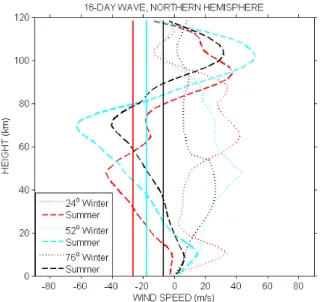
However, the summer-time 16-day wave reported in the MLT cannot have propagated upwards through the strato-sphere to the MLT from source regions in the tropostrato-sphere and lower stratosphere. This is because the zonal phase speed of the 16-day wave is less than the zonal winds of the middle atmosphere. To illustrate this, Fig. 1 presents the zonal phase speed of a 16-day wave as a function of latitude. Figure 2 presents for comparison climatological zonal winds from the UARS Reference Atmosphere Project (URAP) for the tabu-lated latitudes of 24◦, 52◦and 76◦N. Also indicated on the figures are lines corresponding to the zonal phase speed of the 16-day wave at these latitudes. From Fig. 2 it can be seen that the wave cannot propagate above heights of about 32, 38 and 38 km, respectively in summer. However, the wave can propagate at MLT heights in summer where the zonal winds have increased to values that again allow propagation. In winter the zonal winds are strongly eastward at all latitudes and so the wave can propagate vertically through the entire depth of the atmosphere.
There must therefore be a mechanism to explain the pres-ence of the 16-day wave observed in the summer-time MLT. Two principle mechanisms have been proposed for the exci-tation of the summer-time 16-day wave in the MLT. These are:
Fig. 2. URAP winds for latitudes of 24◦, 52◦and 76◦N for both winter (January) and summer (July). Also plotted are the zonal phase speeds of the 16-day wave for these latitudes.
this in situ forcing of planetary-scale disturbances due to variations in gravity-wave drag caused by stratospheric filtering. The modelling study by Smith (2003) further showed that such a mechanism can produce significant planetary-wave amplitudes in the MLT, at least in the case of stationary planetary waves.
2. Cross-equatorial propagation has been suggested, where the winter-time wave crosses the equator to the summer hemisphere MLT at heights above the strong westward zonal mean flow of the summer-time middle atmosphere through which wave propagation is prohib-ited. This mechanism has been investigated in the mod-elling studies of Miyahara et al. (1991b); Forbes et al. (1995).
Observational studies by Espy et al. (1997); Jacobi et al. (1998); Jacobi (1998); Hibbins et al. (2009) considered the cross-equatorial propagation mechanism and attributed year-to-year fluctuations in the amplitude of the 16-day wave in the summer-time MLT to a modulation of the ducting process by the equatorial QBO. These authors proposed that the am-plitude of the 16-day wave was greater in the middle- to high-latitude summer MLT during the eastward (westerly) phase of the QBO. This is because when the QBO is in the negative (easterly) phase the QBO winds in the middle atmosphere reduce the winds of the background circulation yielding a more westward total wind which, through Charney-Drazin theorem, prevents the cross-equator propagation of the wave. Note that here we are defining the QBO by the equatorial stratospheric zonal mean wind.
Finally, we should note that the amplitude of the 16-day wave and other planetary waves has been observed to be suppressed in the winter hemisphere after major SSW (e.g. Baldwin et al., 2003; Chshyolkova et al., 2006; Alexander and Shepherd, 2010; Mbatha et al., 2010).
Here, we present observations of wave temperature ampli-tudes of the 16-day wave in the global atmosphere at heights of∼20–100 km made using Aura Microwave Limb Sounder (MLS). The data set is about 7 yr long, spanning the interval from August 2004 to December 2010. In the first part of this study we present a representative climatology of the 16-day wave. In the second part of the study we investigate the oc-currence of the summer-time 16-day wave in the polar MLT and its connection to the winter stratosphere of the opposite hemisphere and the possible role of the QBO in modulating the amplitude of the wave in the summer-time MLT.
2 Data alysis
Data from the MLS instrument on the NASA EOS Aura satellite are used in this study. Data have been recorded al-most continuously since 15 July 2004. Aura MLS is a limb-scanning emission microwave radiometer which measures radiation in the GHz and THz frequency range (millimetre and sub-millimetre wavelengths). The instrument measures the vertical profile of temperature in the middle atmosphere. Aura MLS provides daily global coverage. The satellite is in a high inclination, sun-synchronous orbit. It repeats the ground track every 16 days, providing atmospheric measure-ments over virtually the whole globe in a repeated pattern. The Limb instruments are designed to observe roughly along the orbit plane. MLS is on the front of Aura and so observes in a forward-velocity direction.
MLS temperatures from the Version 2.2 Temperature Analysis are used in this study. This version has data avail-able from 8 August 2004 (Livesey et al., 2008). The data are recorded on 34 pressure levels ranging from 316–0.001 hPa (∼10–96 km). The vertical resolution is 7–8 km from 316– 100 hPa, 4 km at 31–6.8 hPa, 6 km at 1 hPa and 9 km above 0.1 hPa. We converted the pressure levels to approximate heights and will present the results as a function of this ap-proximate height. This is done to facilitate comparisons with measurements made by ground-based radars.
The standard product for temperature is taken for the Core retrieval (118 GHz only) from 316 to 1.41 hPa and from the Core + R2A (118 GHz and 190 GHz) retrieval from 1 hPa to 0.001 hPa. The temperature precision is∼±1 K from 316– 0.1 hPa and degrades to ∼3 K at 0.01 hPa Schwartz et al. (2008). The data are assigned a “flag” to comment on the quality of the data. Quality is computed from aχ2statistic
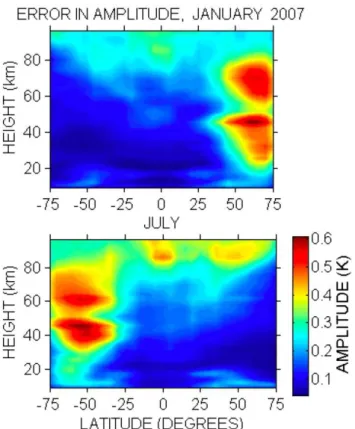
Fig. 3. Least-squares fit error in the wave amplitudes for January and July 2007 using a 95 % confidence level.
The 16-day planetary wave has been observed to occur with a wide range of periods between∼12 to 20 days, as de-scribed in Sect. 1. Here, we will consider all planetary-scale wave fluctuations within the period range 12 to 20 day and of westward travelling wavenumber 1 to be attributable to the “16-day wave”. This range of periods has also been used in the majority of studies of the 16-day wave, (e.g. Forbes et al., 1995; Miyoshi, 1999; Luo et al., 2002a; Jiang et al., 2005; Lima et al., 2006; Day and Mitchell, 2010). Our results should thus be directly comparable with these other studies.
The least-square fitting method of Wu et al. (1995) was used to calculate wave amplitudes. Wu et al. (1995) discuss the advantages and disadvantages of the method in depth. This method has been used previously for Aura MLS temper-ature and geopotential data analysis (e.g. Limpasuvan et al., 2005; Baumgaertner et al., 2008; Limpasuvan and Wu, 2009; McDonald et al., 2011). The advantage of this method is that it can utilise a non-uniform or irregular sampling pattern, but is less computationally intensive than alternative methods such as FFT or asynoptic transforms.
Here, the temperature data are sorted into 10◦ latitude bands and the least-squares fitting of a westward-propagating zonal wavenumber 1 wave is applied to the monthly data within each latitude band. The data are then gridded into 31 latitude bins, in steps of 5◦ from 75◦N to 75◦S. Wave
periods of 12–20 days are fitted in hourly steps. The largest amplitude signal within this period range is then identified as the 16-day wave for a particular latitude band and month. For each height and latitude bin we have thus produced a time series of the temperature amplitude of the 16-day wave. The error in the least-squares fit amplitude was calculated using the standard deviations on the least-squares periodic fitting of the data with a 95 % confidence level. Figure 3 presents height-latitude contours of this error for the example months of January and July 2007 (not all years and months are shown for reasons of space). As can be seen the errors are generally 0.6 K or smaller and this was true for all months examined.
To investigate the role of the QBO in modulat-ing the summer-time MLT 16-day wave, we considered monthly-mean equatorial zonal winds at 10 hPa. The QBO data product was obtained from Freie Univerist¨at Berlin (FUB) (http://www.geo.fu-berlin.de/en/met/ag/strat/ produkte/qbo/index.html). This data set has been produced from the Singapore radiosonde data, January 1987 to Decem-ber 2010.
3 Results
3.1 Climatology
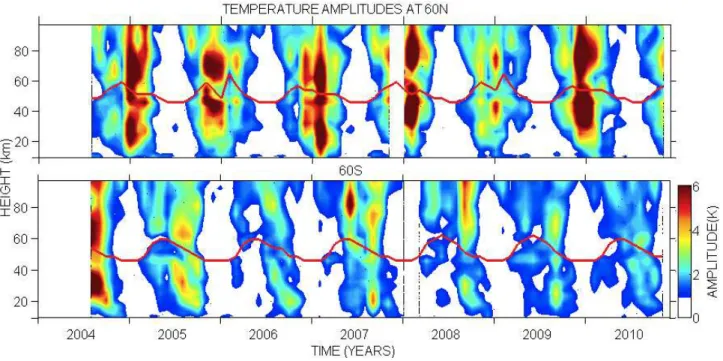
In this section we will present a representative climatology of the 16-day wave. Firstly, we will consider the variation of wave amplitudes from year-to-year. Figure 4 presents the monthly-mean amplitude of the wave at a latitude of 60◦for the northern and Southern Hemisphere. The height of the stratopause is indicated by a line on each figure. The approx-imate position of the stratopause, has been derived using a 4th order polynomial fit to the Aura temperature profile as per McDonald et al. (2011).
From the figure it can be seen that there is a clear seasonal cycle in wave amplitude that approximately repeats from year to year. In particular, the wave amplitude maximises in winter and has a minimum in summer, but with small ampli-tudes present in the MLT for most years observed. There is considerable interannual variability evident. For example, in most of the winters the peak northern-hemisphere wave am-plitudes were∼6 K, but is still weakly present in the summer at the greater heights. The wave is generally present through-out the year at heights greater than abthrough-out 80 km where it can reach up to∼3 K in the northern summer-time.
Fig. 4.Time series of monthly-mean temperature amplitudes from 2004 to 2010 for the 16-day wave at a latitude 60◦for both hemispheres. Also plotted is the stratopause height as a red contour line.
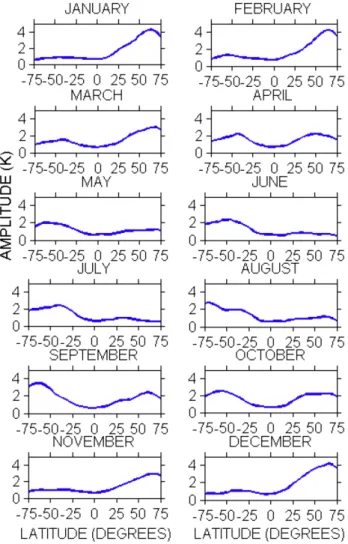
To investigate the seasonal structure of the wave further, Fig. 5 presents the monthly-mean wave amplitude in the MLT (65–95 km) as a function of latitude for 2005. The figure reveals that wave amplitudes have an equatorial min-imum in all months. Around the equinoxes the wave is si-multaneously present in both hemispheres and maximises at latitudes of∼60◦. Near the solstices, the wave is largely con-fined to the winter hemisphere and appears much reduced in the summer hemisphere. It is notable that, despite the largest amplitudes occurring in the winter hemisphere, there is still small but some small wave amplitudes in summer, e.g., in the Southern Hemisphere in December and February and in the Northern Hemisphere in August. Similar behaviour is observed for other years of data (not shown for reasons of space).
The seasonal and long-term variability suggested above can be investigated further by considering latitude-height contour plots of monthly-mean wave amplitude. An exam-ple representative year of this analysis is presented here in Fig. 6. Figure 6 shows the monthly-mean Aura temperature amplitudes for 2005, with monthly-mean UKMO zonal wind contours and the stratopause height over plotted.
The summer-time wave can be seen to maximise in August and December for the northern and souther hemisphere re-spectively at MLT heights of∼80–100 km. The winter-time wave in both hemispheres maximises in both the stratosphere and the MLT, polewards of∼25◦ latitude. The stratopause height, plotted in red on Fig. 6 generally shows the separa-tion between the stratosphere and MLT maxima. Amplitudes
are generally greater in the Northern Hemisphere reaching
∼6 K c.f.∼4 K in the Southern Hemisphere. The tendency for wave amplitudes to decrease at heights above ∼80 km was also reported in the radar studies of the polar MLT 16-day wave by Day and Mitchell (2010).
Larger temperature wave amplitudes correspond to stronger zonal winds, as can be seen in Fig. 6. For example, in January and December Northern Hemisphere the ampli-tudes reach∼6 K where the winds exceed 50 m s−1.
In the summer hemisphere the wave is largely absent. However, some wave activity is present at heights above
∼80 km at middle and high latitudes and also at heights be-low the stratopause at high latitudes. With regard to these observations of the 16-day wave below the stratopause, we note that Williams and Avery (1992) also reported significant wave amplitudes at heights below 30 km throughout most of the year measured at Poker Flat (65◦N).
Fig. 5. The monthly-mean temperature amplitude of the 16-day wave as a function of latitude at heights of∼65–95 km for 2005.
From the figure it can be seen that:
1. Wave amplitudes are largest in the winter hemisphere and are larger in the Northern Hemisphere than the Southern Hemisphere.
2. Stratospheric wave amplitudes in winter tend to max-imise at the heights and latitudes where the zonal winds are the most strongly eastward. For example, in De-cember the strongest zonal winds of∼50 m s−1 occur at a latitude of∼55◦N and a height of∼45 km which coincides with the largest-amplitude occurrence of the wave. Similar behaviour in the stratosphere can be seen in all months.
3. The wave is usually less than 1 K in amplitude in re-gions of westward zonal wind, which accounts for the wave’s absence in the summer stratosphere and lower mesosphere.
4. Throughout the year the largest wave amplitudes tend to occur at latitudes near 60◦.
5. In all months the wave amplitudes are usually very small at the equatorial latitudes.
6. In most months of winter, spring and autumn there is a minimum in wave amplitude around the stratopause. 7. In most summer months in both hemispheres small but
significant wave amplitudes are evident in the upper mesosphere and lower stratosphere (above and below the region of strong westward winds).
8. Near the equinoxes, the wave is present in both hemi-spheres simultaneously. At these times the zonal winds are either eastward or weakly westward in both hemi-spheres.
3.2 Interannual variability
The above results show that there is considerable interannual variability in the observed amplitude of the wave. We will now consider three particular aspects of this variability. The first is to investigate the suggestion that the wave observed in the summer-time MLT has been ducted across the equator from the stratosphere of the winter hemisphere and so might display a correlation in wave amplitude between the two re-gions. The second is to investigate the observationally-based suggestion that the amplitude of the wave in the summer-time MLT varies from year to year in response to a filtering effect caused by the winds of the equatorial QBO (a mech-anism that, of course, requires that the summer-time wave is actually being ducted from the winter hemisphere). The third aspect investigated is the suggestion that major sudden stratospheric warmings (SSWs) have a suppressing effect on the wave amplitudes (See Sect. 1).
Firstly, we will consider the relationship between the wave amplitudes observed simultaneously in the summer-time MLT and the winter stratosphere. If the summer-summer-time wave is indeed ducted across from the winter hemisphere, then we might expect a correlation between wave amplitudes in the two regions. Examination of the amplitudes can thus provide a simple test of this ducting hypothesis. To carry out the test, we calculated wave amplitudes for each month as an average amplitude measured within a representative height-latitude “box” covering, (i) heights of 80–96 km and height-latitudes of 50–75◦to represent the summer MLT at the heights where radar and satellite observations show the wave to reach max-imum amplitude, and (ii) heights of 35–45 km and latitudes of 50–75◦for the winter stratosphere. This process allows a simple measure of wave amplitude to be estimated for each region for each month.
Fig. 6.Monthly-mean temperature amplitudes of the 16-day wave for 2005. Also plotted are the 2005 UKMO monthly-mean zonal winds (m s−1) as contour lines and the stratopause height as a red contour line.
the entire data set yielding amplitudeperturbationsfor each month in each year. We then correlated these perturbations for each summer season to see if, for example, larger than average amplitudes in the winter stratosphere were accom-panied by larger than average amplitudes in the mesosphere of the opposite hemisphere.
Figure 8 presents the monthly-mean summer-time MLT wave amplitude perturbations for the Northern Hemisphere plotted against the simultaneously-observed winter strato-spheric amplitude perturbations for the months of June, July
and August. The correlation between the two regions is +0.17, suggesting that there is a small connection between the amplitude of the wave in the two regions.
Figure 9 presents an identical analysis for the summer months of December–February in the Southern Hemisphere. Here the correlation is +0.29, suggesting that there is a small connection between wave amplitudes in the two regions.
Fig. 7.Composite-month temperature amplitudes for the 16-day wave in each month of the year, August 2004–May 2010. Also plotted are the UKMO composite monthly-mean zonal winds (m s−1) as contour lines and the stratopause height as a red contour line.
Fig. 8. Northern summer-time wave amplitudes for the winter stratosphere and summer mesosphere.
MLT c.f. all winter stratosphere) is calculated to be +0.22, suggesting that there is a small correlation between the am-plitude of the wave in the two regions.
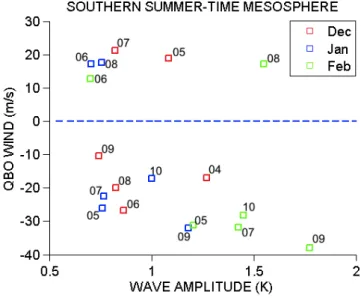
The second aspect of interannual variability that we in-vestigated is the suggestion that the summer-time wave am-plitudes are influenced by the phase of the QBO such that larger summer-time wave amplitudes occur when the QBO winds are eastward. A simplistic but clear method to test for a possible QBO modulation is to sort the MLT summer-time wave amplitudes by the phase of the QBO. Here we used QBO winds at a height of 10 hPa calculated from the FUB
Fig. 9. Southern summer-time wave amplitudes for the winter stratosphere and summer mesosphere.
database. This measure of QBO winds is used because it en-ables direct comparison with the results of Espy et al. (1997); Hibbins et al. (2009), although we also examined how the re-sults varied using winds for pressure levels between 70 and 10 hPa. The wave amplitudes were calculated in “boxes”, as described above for the summertime MLT.
Fig. 10. Mean summer-time temperature amplitudes of the 16-day wave in the MLT at heights from∼80–96 km and latitudes of 50– 75◦N as a function of QBO zonal winds at 10 hPa.
is the same, the mean wave amplitudes for the eastward and westward phases of the QBO, respectively, are 0.86 K and 0.71 K for June, 0.61 K and 0.68 K for July, 1.67 K and 1.19 K for August. The seasonal means for the ampli-tudes sorted by QBO phase are 1.17±0.19 K for the
east-ward phase of the QBO and 0.86±0.09 K for the westward
phase (the uncertainty being the standard error on the mean). From these results we conclude that in the Northern Hemi-sphere there was no significant difference in the amplitude of the summertime mesospheric 16-day wave between eastward and westward phases of the QBO in the years 2004–2010.
Figure 11 presents an identical analysis applied to data from the Southern Hemisphere. This analysis yields mean amplitudes for eastward phase and westward phases of the QBO, respectively, of 0.95 K and 0.93 K for December, 0.73 K and 0.93 K for January and 1.13 K and 1.46 K for February. The seasonal means sorted by QBO phase are 0.94±0.14 K for the eastward phase of the QBO and 1.11±
0.10 K for the westward phase. This might suggest a small
but significant tendency for larger summer-time MLT ampli-tudes to occur during westward phases of the 10 hPa QBO (i.e., opposite to the results of Espy et al. (1997)). How-ever, for reasons we will explore below, we believe that in February 2006 and February 2009 the amplitude of the 16-day wave in the Northern Hemisphere throughout the strato-sphere and MLT was suppressed by the influence of a major SSW that occurred there in the previous month. On the as-sumption that reduced wave amplitudes in the winter hemi-sphere would in turn lead to reduced amplitudes in any wave observed in the summer MLT after being ducted across the equator, we therefore recalculated the seasonal mean
ampli-Fig. 11. Mean summer-time temperature amplitudes of the 16-day wave in the MLT at heights from∼80–96 km and latitudes of 50– 75◦S as a function of QBO zonal winds at 10 hPa.
tudes with February 2006 and 2009 removed. In this case, the seasonal-mean MLT wave amplitudes become 0.98±0.16 K
for the eastward phase of the QBO and 1.05±0.08 K for the
westward phase – not significantly different.
Considering the above analysis, we therefore conclude that the observations we have presented do not demonstrate a significant modulation of the amplitude of the summer-time MLT 16-day wave by the equatorial QBO winds (note that we also explored the impact on the analysis of sorting the amplitudes by the phase of the QBO winds at different pres-sure levels, but found this did not significantly change this conclusion).
Finally, as mentioned, we note that two major SSW oc-curred in the Northern Hemisphere in January 2006 and Jan-uary 2009 (a major warming being defined as a reversal of the winds at 10 hPa at a latitude of 60◦). It is known that major SSW can have dampening effect on planetary waves at high latitudes. In particular, it has been observed that planetary-wave amplitudes can be suppressed after major SSW events (e.g. Alexander and Shepherd, 2010). If the ducting hypoth-esis is correct, then the MLT summer-time wave originates in the winter hemisphere and so any changes in wave am-plitude due to major SSW may be reflected in reduced wave amplitudes in the summer MLT of the opposite hemisphere.
Fig. 12. Daily UKMO temperatures for the major SSW’s in the Northern Hemisphere winters of 2004/2005 to 2009/2010. Also plotted are the UKMO daily zonal winds (m s−1) as contour lines.
be seen that in January 2006 and 2009, the zonal winds re-versed and temperatures increased considerably.
Figure 13 presents the sequence of wave amplitudes, UKMO background winds and stratopause heights for Jan-uary in the successive years observed. From the figure it can be seen that, although wave amplitudes are not particularly high in the winter hemisphere in January of 2006 and 2009, they are at least comparable to those in January of 2007 and 2008.
Figure 14 presents an identical treatment of the successive Februarys observed. In this case, however, it can be seen that wave amplitudes in the winter hemisphere in 2006 and 2009 were reduced to about half compared to the other years. Us-ing the same analysis as above, the wave amplitudes in the winter hemisphere stratospheric “box” were 1.5 K and 2.3 K in 2006 and 2009, compared with 4.7, 6.1, 9.9 and 3.4 K in 2005, 2007, 2008 and 2010. We therefore conclude that, at least for the two major SSW observed, the stratospheric wave amplitudes in the winter hemisphere were significantly re-duced in the month following a major SSW.
Fig. 13. Monthly-mean Aura temperature amplitudes for post Northern Hemisphere major SSW’s, January 2005–2010. Also plot-ted are the UKMO composite monthly-mean zonal winds (m s−1) as contour lines and the stratopause height as a red contour line.
4 Discussion
Fig. 14. Monthly-mean Aura temperature amplitudes for post Northern Hemisphere major SSW’s, February 2005–2010. Also plotted are the UKMO composite monthly-mean zonal winds (m s−1) as contour lines and the stratopause height as a red con-tour line.
in winter and 5 K in summer. These reported summer-time temperature amplitudes are larger than those presented here measured by Aura MLS. However, this difference is very likely because these studies reported temperature amplitude related to short-lived maxima, whereas our results are based on monthly means.
A number of modelling studies have examined the 16-day wave in the middle atmosphere. Forbes et al. (1995); Miyoshi (1999); Luo et al. (2002b) used a variety of differ-ent models and reported significant wave amplitudes presdiffer-ent in both the stratosphere and MLT of the winter hemisphere. All show an approximately similar latitudinal structure with maximum amplitudes occurring at middle to high latitudes. However, wave amplitude is either absent or significantly re-duced in the summer in all three models, (see below for fur-ther discussion).
As noted earlier, the 16-day wave is largely absent (less than 1 K in amplitude) from the summer-time middle
atmo-sphere. However, there are two relatively restricted regions of the summer-time atmosphere where wave activity is nev-ertheless present in our observations.
The first of these is in the lower stratosphere at middle and high latitudes. We suggest that the presence of the wave here is because the zonal background winds are less than the zonal phase speed for a particular latitude and the wave is thus trapped below this height, but free to propagate below. Similar behaviour is observed in the Northern Hemisphere in June-August. The ground-based observations of Williams and Avery (1992) made by a Mesosphere-Stratosphere-Tropsphere (MST) radar at Poker Flat (65◦N) reported sig-nificant wave activity around the summer tropopause, rein-forcing the suggestion that the wave is present in the lower stratosphere in summer. The models of Forbes et al. (1995); Miyoshi (1999) also indicate small but significant wave ac-tivity in the high-latitude summer-time lower stratosphere. This wave activity most likely arises because the zonal winds of this region of the atmosphere are not sufficiently strong to prevent the wave from propagating.
The second region where the wave is observed in summer is in the MLT at heights above those where the zonal wind speed is likely to be greater than the zonal phase speed.
As discussed earlier, the 16-day summer-time wave can-not have propagated upward through the atmosphere to the MLT where we observe it because its propagation would be prevented by the blocking effect of the zonal background wind. To explain the observations of a summer-time MLT 16-day wave it has been hypothesised that the wave must have been cross-equatorially ducted (e.g. Espy et al., 1997; Jacobi, 1998; Luo et al., 2000; Hibbins et al., 2009).
Our results for the correlation of perturbations around the mean wave amplitude between the summer-time MLT wave and that of the winter stratospheric wave in the opposite hemisphere reveal a small correlation, suggesting that larger wave amplitude in the winter stratosphere are accompanied by larger wave amplitudes in the summer hemisphere. This may suggest that there is some degree of ducting from the winter stratosphere to the summer MLT, since if there were no ducting we might expect no correlation. However, the fact that the correlation is small suggest that there maybe other sources of excitation of the wave in the summer-time MLT.
in nature and this may be why the QBO modulation is not observed in our data set.
Finally, our observation of reduced wave amplitudes im-mediately after the major SSW events of 2006 and 2009 is in good agreement with the similar observation reported by Alexander and Shepherd (2010) for 2006.
5 Conclusions
The 16-day wave is a persistent, large-amplitude feature of the winter stratosphere and MLT – at least in the seven years of observations reported here. Monthly-mean wave ampli-tudes exceed 6 K in most northern winters and 4 K in most southern winters. Large wave amplitudes are confined to lati-tudes poleward of∼25◦. Smaller wave amplitudes are never-theless observed in both hemispheres in the summer months, where they reach∼3 K. Summer-time wave amplitudes are observed at heights up to∼30 km in the lower stratosphere and again at heights above ∼70 km in the MLT. This be-haviour is interpreted as a consequence of wave/mean-flow interactions. The wave in the summer-time MLT can there-fore not have propagated from below.
There is a small correlation between the perturbations in wave amplitude of the summer-time MLT and the winter stratosphere of the opposite hemisphere. This suggest some degree of inter hemispheric coupling and perhaps ducting of the wave from winter to summer hemisphere.
Our observations do not suggest that the QBO modulates the amplitude of the wave in the polar summer-time MLT. The absence of such a QBO modulation maybe a conse-quence of our comparatively short data set or an intermit-tency in the modulation.
The major SSW events of the Northern Hemisphere winter of 2006 and 2009 have an influence on the winter-time wave amplitudes following the warming, in which they decrease wave amplitudes to values of about half of those observed in undisturbed years.
Edited by: W. Ward
References
Alexander, S. P. and Shepherd, M. G.: Planetary wave activity in the polar lower stratosphere, Atmos. Chem. Phys., 10, 707–718, doi:10.5194/acp-10-707-2010, 2010.
Baldwin, M., Hirooka, T., O’Neill, T., and Yoden, S.: Major strato-spheric warming in the Southern Hemisphere in 2002: Dynami-cal aspects of the ozone hole split, SPARC Newsletter, 20, 24–26, 2003.
Baumgaertner, A. J. G., McDonald, A. J., Hibbins, R. E., Fritts, D. C., Murphy, D. J., and Vincent, R. A.: Short-period planetary waves in the antartic middle atmosphere, J. Atmos. and Solar-Terr. Phys., 70, 1336–1350, 2008.
Charney, J. G. and Drazin, P. G.: Propagation of planetary-scale disturbances from lower into the upper atmosphere, J. Geophys. Res., 66, 83–109, 1961.
Chshyolkova, T., Manson, A. H., Meek, C. E., Avery, S. K., Thorsen, D., MacDougall, J. W., Hocking, W., Murayama, Y., and Igarashi, K.: Planetary wave coupling processes in the mid-dle atmosphere (30–90km): A study involving MetO and MFR data, J. Atmos. and Solar-Terr. Phys., 68, 353–368, 2006. Day, K. A. and Mitchell, N. J.: The 16-day wave in the Arctic and
Antarctic mesosphere and lower thermosphere, Atmos. Chem. Phys., 10, 1461–1472, doi:10.5194/acp-10-1461-2010, 2010. Espy, P. J. and Witt, G.: Observation of a quasi 16-day oscillation
in the polar summer mesospheric temperature, Geophys. Res. Letts., 23, 1071–1074, 1996.
Espy, P. J., Stegman, J., and Witt, G.: Interannual variations of the quasi-16-day oscillation in the polar summer mesospheric tem-perature, J. Geophys. Res., 102, 1983–1990, 1997.
Forbes, J. M., Jun, G., and Miyahara, S.: On the interactions be-tween gravity waves and the diurnal propagating tides, Planet. Space Sci., 39, 1249–1257, 1991.
Forbes, J. M., Hagan, M. E., Miyahara, S., Vial, F., Mason, A. H., Meek, C. E., and Portnyagin, Y. I.: Quasi 16-day oscillation in the mesosphere and lower thermosphere, J. Geophys. Res., 100, 9149–9163, 1995.
Hibbins, R. E., Jarvis, J. M., and Ford, E. A. K.: Quasi-biennial oscillation influence on long-period planetary waves in the Antarctic upper mesosphere, J. Geophys. Res., 114, DO9109, doi:10.1029/2008JD011174, 2009.
Jacobi, C.: The Quasi 16-day Wave in the Summer Midlatitude Mesopause Region and its Dependence on the Equatorial Quasi-Biennial Oscillation, Report of the LIM and the IFT9, Leipzig, 117–129, 1998.
Jacobi, C., Schminder, R., and K¨urschner, D.: Long-period (12-25 days) oscillations in the summer mesopause region as measured at Collm (52◦N, 15◦E) and their dependence on the equatorial quasi-biennial oscillation, Atmos. Phys., 1, 461–464, 1998. Jiang, G.-Y., Xiong, J.-G., Wan, W.-X., Ning, B.-Q., Liu, L.-B.,
Vincent, R. A., and Reid, I.: The 16-day waves in the meso-sphere and lower thermomeso-sphere over Wuhan (30.6◦N, 114.5◦E) and Adelaide (35◦S, 138◦E), Advances in Space Research, 35, 2005–2010, 2005.
Lima, L. M., Batista, P. P., Clemasha, B. R., and Takahashi, H.: 16-day wave observed in the meteor winds at low latitudes in the southern hemisphere, Advances in Space Research, 38, 2615– 2620, 2006.
Limpasuvan, V. and Wu, D. L.: Anomalous two-day wave behav-ior during the 2006 austral summer, Geophys. Res. Letts., 36(4), doi:10.1029/2008GL036387, 2009.
Limpasuvan, V., Wu, D. L., Schartz, M. J., Wates, J. W., Wu, Q., and Killeen, T. L.: The two-day wave in eso mls temperature and wind measurements during 2004–2005 winter, Geophys. Res. Letts., 32(17), doi:10.1029/2005GL023396, 2005.
and Webster, C.: Validation of Aura Microwave Limb Sounder O3 and CO observations in the upper troposphere and lower stratosphere, J. Geophys. Res., 113, doi:10.1029/2007JD008805, 2008.
Luo, Y., Manson, A. H., Meek, C. E., Meyer, C. K., and Forbes, J. M.: The quasi 16-day oscillation in the mesosphere and lower thermosphere at Saskatoon (52◦N, 107◦W), 1980–1996, J. Geo-phys. Res., 195, 2125–2138, 2000.
Luo, Y., Manson, A. H., Meek, C. E., Thayaparan, T., MacDougall, J., and Hocking, W. K.: The 16-day wave in the mesosphere and the lower thermosphere: simultaneous observations at Saskatoon (52◦N, 107◦W), London (43◦N, 81◦W), Canada, J. Atmos. and Solar-Terr. Phys., 64, 1287–1307, 2002a.
Luo, Y., Manson, A. H., Meek, C. E., Meyer, C. K., Burrage, M. D., Fritts, D. C., Hall, C. M., Hocking, W. K., MacDougall, J., Rig-gin, D. M., and Vincent, R. A.: The 16-day planetary waves: multi-MF radar observations from the arctic to equator and com-parisions with the HRDI measurements and the GSWM model-ing results, Ann. Geophys., 20, 691–709, 2002b,
http://www.ann-geophys.net/20/691/2002/.
Manson, A. H., Meek, C. E., Luo, Y., Hocking, W. H., MacDougall, J., Riggin, D. M., Fritts, D. C., and Vincent, R. A.: Modulation of gravity waves by planetary waves (2 and 16 d): observations with the North American-Pacic MLT-MFR radar network, J. Atmos. and Solar-Terr. Phys., 65, 85–104, 2003.
Mbatha, N., Sivakumar, V., Malinga, S. B., Bencherif, H., and Pil-lay, S. R.: Study on the impact of sudden stratosphere warm-ing in the upper mesosphere-lower thermosphere regions uswarm-ing satellite and HF radar measurements, Atmos. Chem. Phys., 10, 3397–3404, doi:10.5194/acp-10-3397-2010, 2010.
McDonald, A. J., Hibbins, R. E., and Jarvis, J. M.: Properties of the quasi-16 day wave derived from EOS MLS observations, J. Geophys. Res., 116(479), D06112, doi:10.1029/2010JD014719, 2011.
Merkel, A. W., Thomas, G. E., Palo, S. E., and Bailey, S. M.: Obser-vations of the 5-day planetary wave in PMC measurements from the Student Nitric Oxide Explorer Satellite, Geophys. Res. Lett., 30, 1196, doi:10.1029/2002GL016524, 2003.
Merkel, A. W., Garcia, R. R., Bailey, S. M., and Russell III, J. M.: Observational studies of planetary waves in PMCs and meso-spheric temperature measured by SNOE and SABER, J. Geo-phys. Res., 113, D14202, doi:10.1029/2007JD009396, 2008. Meyer, C. K.: Gravity wave interactions with mesospheric
plane-tary waves: A mechanism for penetration into the thermosphere-ionosphere system, J. Geophys. Res.-Space Phys., 104, 28181– 28196, 1999.
Mitchell, N. J., Middleton, H. R., Beard, A. G., Williams, P. J. S., and Muller, H. G.: The 16-day planetary wave in the mesosphere and lower thermosphere, Ann. Geophys., 17, 1447–1456, 1999, http://www.ann-geophys.net/17/1447/1999/.
Miyahara, S. and Forbes, M.: Interactions between gravity waves and the diurnal tide in the mesosphere and lower thermosphere, J. Meteorol. Soc. Jpn., 69, 523–531, 1991a.
Miyahara, S., Portnyagin, Y. I., Forbes, J. M., and Solovjeva, T. V.: Mean zonal acceleration and heating of the 70- to 100-km region, J. Geophys. Res., 96, 1225–1238, 1991b.
Miyoshi, Y.: Numerical simulations of the 5-day and 16-day waves in the mesopause region, Earth Planets Space, 51, 763–772, 1999.
Morris, R. J., Klekociuk, A. R., and Holdsworth, D. A.: Low lat-itude 2-day planetary wave impact on austral polar mesopause temperatures: revealed by a January diminution in PMSE above Davis, Antarctica, Geophys. Res. Letts., 36, L11807, doi:10.1029/2009GL037817, 2009.
Nakamura, T., Fritts, D. C., Isler, J. R., Tsuda, T., Vincent, R. A., and Reid, M.: Short-period fluctuations of the diurnal tide ob-served with low-latitude MF and meteor radars during CADRE: Evidence for gravity wave/tidal interactions, J. Geophys. Res.-Atmos., 102, 26225–26238, 1997.
Nielsen, K., Siskind, D. E., Eckermann, S. D., Hoppel, K. W., Coy, L., McCormack, J. P., Benze, S., Randall, C. E., and Hervig, M. E.: Seasonal variation of the quasi 5-day plan-etary wave: Causes and consequences for polar mesospheric cloud variability in 2007, J. Geophys. Res., 115, D18111, doi:10.1029/2009JD012676, 2010.
Salby, M. L.: Rossby Normal Modes in Nonuniform Background Configurations. Part I: Simple fields, J. Atmos. Sci., 38, 1803– 1826, 1981a.
Salby, M. L.: Rossby Normal Modes in Nonuniform Background Configurations. Part II: Equinox and Solstice Conditions, J. At-mos. Sci., 38, 1827–1840, 1981b.
Schwartz, M. J., Lambert, A., Manney, G. L., Read, W. G., Livesey, N. J., Froidevaux, L., Ao, C. O., Bernath, P. F., Boone, C. D., Cofield, R. E., Daffer, W. H., Drouin, B. J., Fetzer, E. J., Fuller, R. A., Jarnot, R. F., Jiang, J. H., Jiang, Y. B., Knosp, B. W., Kr¨uger, K., Li, J.-L. F., Mlynczak, M. G., Pawson, S., III, J. M. R., Santee, M. L., Snyder, W. V., Stek, P. C., Thurstans, R. P., Tompkins, A. M., Wagner, P. A., Walker, K. A., Waters, J. W., and Wu, D. L.: Validation of the Aura Microwave Limb Sounder temperature and geopotential height measurements, J. Geophys. Res., 113, D15S11, doi:10.1029/2007JD008783, 2008. Smith, A. K.: Longitudinal variations in mesospheric winds:
Ev-idence for gravity wave filtering by planetary waves, J. Atmos. Sci., 53, 1156–1173, 1996.
Smith, A. K.: The origins of stationary planetary waves in the up-per mesosphere, American Meteorological Society, 3033–3041, 2003.
Thayaparan, T., Hocking, W. H., and MacDougall, J.: Observa-tional evidence of tidal/gravity wave interactions using the UWO 2 MHz radar, Geophys. Res. Lett., 22, 373–376, 1995.
Williams, C. R. and Avery, S. K.: Analysis of long-period waves us-ing the mesosphere-stratosphere-troposphere radar at poker flats, Alaska, J. Geophys. Res., 97, 20855–20 861, 1992.