Article
Printed in Brazil - ©2017 Sociedade Brasileira de Química0103 - 5053 $6.00+0.00
*e-mail: [email protected], [email protected]
Tailored Degree of Functionalization and Length Preservation of Multiwalled
Carbon Nanotubes by an Optimized Acid Treatment Process
Vinícius G. Castro,a,b Ingrid B. Costa,a Magnovaldo C. Lopes,a Rodrigo L. Lavall,a Kátia C. S. Figueiredob and Glaura G. Silva*,a
aDepartamento de Química, Instituto de Ciências Exatas and bDepartamento de Engenharia Química, Escola de Engenharia,
Universidade Federal de Minas Gerais, 31270-901 Belo Horizonte-MG, Brazil
The introduction of oxygen groups in carbon nanotubes is considered crucial for many applications. However, there is a lack of controlled functionalization methods which ensure nanotubes with specific property values according to each interest. In this work, acid treatments of multiwalled carbon nanotubes (MWCNTs) employing an optimized ultrasound process with moderate heating and stirring were studied by means of a factorial design. The functionalized nanotubes were characterized by thermogravimetry, elemental analysis, Raman spectroscopy, electron microscopy and water stability tests. Statistic models were fitted for the degree of functionalization and length reduction of MWCNTs. Temperature was identified as a key parameter to produce more functionalized MWCNTs with less structural damage. The properties of the functionalized MWCNTs can be tailored by the choice of parameters exploited in the statistical models developed to enable different end-use requests, such as for polymeric composites or bio-related applications, which is the original contribution of this work.
Keywords: carbon nanotubes, functionalization, length distribution, factorial design, statistical modeling
Introduction
The potential applications of carbon nanotubes (CNTs) are widely recognized, including areas such as sensing,1 biomedicine,2 energy storage3,4 and polymeric
composites.3-5 Many products using CNTs are already on
the market and the price reduction of CNTs in recent years, especially for multiwalled carbon nanotubes (MWCNTs), is contributing for their use in large-scale.3,4 However, the poor
dispersion and weak interfacial interactions of CNTs with other materials are the major limitations to its dispersion and fabrication of composites with enhanced properties.3,5
There are several studies of surface modifications of CNTs to improve its dispersion and chemical compatibility.6,7 The different methodologies involve
covalent modifications and non-covalent approaches. Non-covalent modifications present the advantage of altering in a lower degree the structure of the CNTs, but the interaction between the CNTs and the modifier molecules are based on weak forces such as van der Waals and π-π bonds.7,8
Among the different approaches for covalent modification, acid treatments are the most reported in literature, generally using nitric acid (HNO3) or a mixture of HNO3 and sulfuric
acid (H2SO4).9-12 The acid treatments introduce oxygen
functional groups on the surface of the CNTs, especially carboxyls, phenolic hydroxyls and lactones/lactols.7,10,13,14
The inserted functional groups, particularly carboxyls, are also basis for subsequent functionalization, such as amidation, alkylation, esterification and thiolation.6,7,15,16
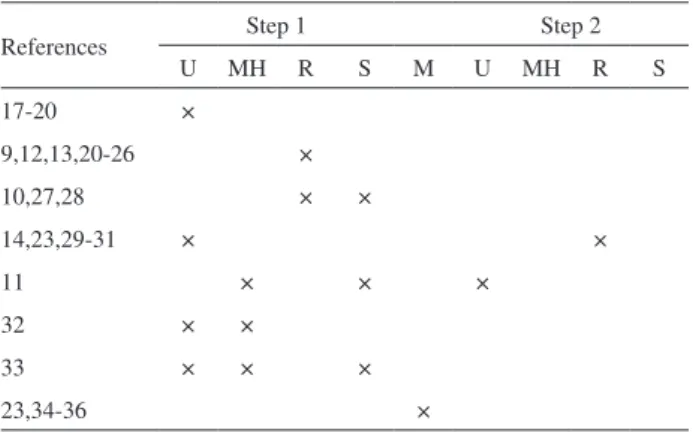
Table 1 presents the main techniques reported in the literature for reacting CNTs with HNO3 or HNO3/H2SO4,
which are based on a single step treatment or a two-step sequence. The most common processes use ultrasonic bath,17-20 reflux at high temperatures9,12,13,20-26 (occasionally
under magnetic stirring)10,27,28 or ultrasonic bath followed
by reflux.14,23,29-31 Most documents that describe the use of
ultrasonic bath does not cite any heating or occasionally mention the temperature of 40 °C,17 which can be naturally
achieved due to the ultrasonic power delivered from some equipment. There are few references that describe the use of ultrasound with moderate heating.32,33 Some researches
Besides the functionalization of CNTs, acid treatments also result in damages to its structure with introduction of defects, reduction of length7,19 and formation of
oxygenated carbonaceous fragments.13,34 Thus, the
development of methodologies that combine a high degree of functionalization with proper preservation of CNTs is of great importance.10,11 Despite the length being
one of the main parameters to define the applications of CNTs, the statistical evaluation of its distribution after functionalization is addressed by few studies in the literature.19,26 Furthermore, the most appropriate set of length
and degree of functionalization varies with each application of MWCNTs. For instance, highly functionalized and short MWCNTs with narrow length distribution are preferable for bio-related applications.19,37 MWCNTs with
a substantial functionalization and a higher preservation of its aspect ratio are desirable for polymeric composites.5,38
In the present work, we statistically evaluated the advantages of an acid treatment process of MWCNTs with integration of ultrasound, moderate heating and mechanical stirring. The correlation between degree of functionalization and length reduction was analyzed, as well as the applicability of the method to larger scales. Some representative MWCNTs samples, by considering the statistical analysis results, were characterized by Raman spectroscopy, transmission electron microscopy (TEM) images and by dispersion stability in water for 30 days. Thermogravimetric analysis (TGA) and elemental analysis were used as basic methods to determine degree of functionalization. Scanning electron microscopy (SEM) images were analyzed with ImageJ to access length distribution. The quantitative analysis of these variables intends to provide a valuable contribution to researchers and developers looking to apply MWCNTs with the potential to tailor the MWCNTs characteristics based on the modeling of a wide range of experimental parameters.
Experimental
Materials
The MWCNTs used in this study were provided by the Nanomaterials Laboratory from the Physics Department of Federal University of Minas Gerais (UFMG), Brazil, with purity higher than 95%, average diameter of 17 nm, length distribution from few micrometers until 30 µm, average length of 5 µm by arithmetic mean and 10 µm by weighted mean. Nitric and sulfuric p.a. acids were supplied by Synth.
Acid treatments of MWCNTs
Acid treatments were initially conducted in ultrasonic bath (sonication power of 220 W, frequency of 37 kHz) at 50 °C for 3 h to analyze the scalability of the process and the necessity of stirring. The process was evaluated for 0.8 g of MWCNTs with 48 mL of concentrated H2SO4/HNO3 (3:1 by volume) and for a proportional
scale-up to 3.0 g and 176 mL of the same materials. It was analyzed the necessity of including mechanical stirring at 430 rpm for the treatment of 3.0 g.
To evaluate the statistical influence of the main variables involved (time, temperature and stirring) in the ultrasonic assisted acid treatments, it was performed a full 23 factorial
design (3 factors in 2 levels) with addition of center point in triplicate. The factors and levels are described in Table 2. The two levels are represented as −1 and +1 and the center point is represented as 0. There were a total of 11 experiments run in random order, 8 associated with all combinations of levels −1 and +1 plus the triplicate at the center point (0). For all treatments 3 g of MWCNTs and 176 mL of concentrated H2SO4/HNO3 (3:1 by volume) were used.
The washing and separation of the functionalized MWCNTs suspensions were conducted by its dilution in deionized water, filtration on sintered glass with pore diameter of 10-16 µm and continuous washing with deionized water until reaching pH 7. The material in the filtration system was constantly stirred to increase the flow rate. Although the literature usually reports the
Table 1. Main techniques used for acid treatment of CNTs
References Step 1 Step 2
U MH R S M U MH R S
17-20 ×
9,12,13,20-26 ×
10,27,28 × ×
14,23,29-31 × ×
11 × × ×
32 × ×
33 × × ×
23,34-36 ×
U: ultrasound; MH: moderate heating; R: reflux; S: stirring; M: microwave.
Table 2. Factors and levels of the factorial design
Factor Level
–1 0 +1
T / °C 45 50 55
t / h 2 3 4
S / rpm 290 430 570
use of polymeric membranes with pore diameter lower than 1 µm, which represent higher costs, sintered glass is generally efficient for the filtration of MWCNTs due to its aggregation during filtration. The retained MWCNTs were dried at 100 °C for 8 h.
Characterization
TGA was performed on a Q5000 apparatus (TA instruments) under synthetic air atmosphere with a heating rate of 5 °C min-1 from 20 to 900 °C. Elemental
analysis was conducted on a Thermo Flash 2000 Analyser and the average of three measurements for each sample was determined. SEM was carried out on a cannon emission field effect Quanta 200 - FEG/FEI, with samples prepared by ultrasonicating the MWCNTs in isopropyl alcohol and dripping them onto a 200 mesh Holey Carbon copper grid. The length distribution of MWCNTs was determined by the software ImageJ based on SEM images. The statistical analyses were conducted through data processing on Minitab software (Minitab Inc.), considering the degree of functionalization (obtained from TGA) and length reduction (obtained from SEM images) as the response variables.
Raman spectroscopy was carried out on a Micro-Raman Senterra Bruker equipped with a liquid nitrogen-cooled CCD detector, Ar-Kr laser at excitation in 514.5 nm and acquisition of scan with duration of 60 s. TEM was conducted on a FEI TECNAI G2 microscope with a tungsten filament electron gun of 200 kV and the same sample preparation used for SEM. The dispersion stability of the nanotubes was investigated by ultrasonicating 5 mg of MWCNTs in 15 mL of deionized water for 15 min and taking photographs of the state of dispersion after 30 days by a digital camera to ensure a long-term evaluation. The yield of the treatments was assessed by weighing the dry MWCNTs before and after each treatment.
Results and Discussion
Thermogravimetric analysis
TGA provides useful information about functionalized CNTs and is usually performed in air11,12,15,18,32 or
nitrogen.11,17,19,32 The analyses in both atmospheres are
relevant, but the evaluation in air has the advantage of also exhibit the decomposition of CNTs. The TGA results obtained in air generally present decomposition in three stages. The first stage is related with the presence of adsorbed water/gases. The second one is attributed to the decomposition of functional groups generated in the acid treatments, which we assume as the degree of
functionalization of the modified nanotubes. The final stage, at higher temperatures, corresponds to the thermoxidation of CNTs. The temperature defined for the end of water removal and the initial decomposition of functional groups (especially carboxyl groups) is generally in the range between 100 and 150 °C.15,21,26 An usual range to analyze the
degree of functionalization is from 120 to 400 °C,15 which
was used in this work once no weight loss was observed in this temperature range for the pristine MWCNTs.
The degree of functionalization was reduced from 7.7 to 5.1 mass% with the scaling of 0.8 to 3.0 g of MWCNTs without presence of stirring, which represents a decrease of 34% in the functionalization. Nevertheless, when mechanical stirring was introduced in the treatment with 3 g, a similar degree of functionalization (7.8 mass%) was obtained. Therefore, the ultrasonic process with moderate heating is sufficient to promote substantial functionalization for small masses of MWCNTs, but the presence of stirring is necessary to maintain the results in larger scales.
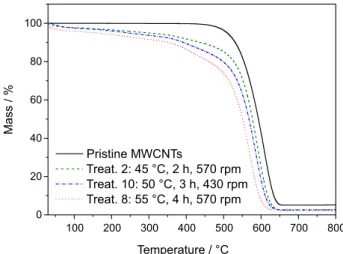
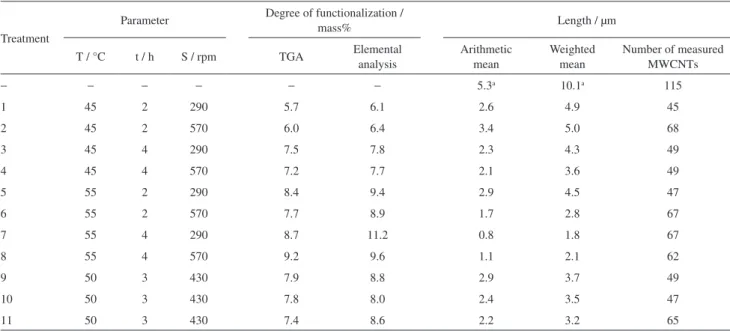
Figure 1 shows the TGA curves for specific treatments of the factorial design and Table 3 lists the degree of functionalization for all oxidized MWCNTs involved in this design.
The degree of functionalization varied from 5.7 to 9.2 mass%, with increased values for higher temperature and time conditions. The stirring did not show significant influence in the range analyzed (290-570 rpm), which indicates that its presence is important for the homogenization and scale-up of the process, but an accurate value is not necessary.
Elemental analysis
The obtained values (mass%) of the degree of functionalization determined by elemental analysis,
considering the oxygen and hydrogen contents, are presented in Table 3. It can be observed a good correlation between the results from both evaluations (except for sample 7), with the values determined by elemental analysis higher in ca. 10% compared to the TGA data, which is an acceptable difference according to the error associated with both analyses. Therefore, the elemental analysis confirms the influence observed from TGA for the studied variables.
Scanning electron microscopy
SEM was used to investigate the fragmentation occurred during the different acid treatments performed for the factorial design, as it is well known that the oxidation
shortens the tubes.7,11,12 The length of MWCNTs was
evaluated by the observation of isolated nanotubes in SEM micrographs (see examples in Figure 2). Hundreds of SEM images were used in this study. The average length by both arithmetic and weighted means were determined by measuring 115 pristine MWCNTs and 55 MWCNTs in average after each acid treatment (from 45 to 70 MWCNTs). The weighted mean is relevant due to the greater weight contribution of longer nanotubes.
The percentage reduction of MWCNTs length can be inferred from Table 3 that shows the average length values for the different treatments and for the pristine sample. It can be noticed that different stirring rates did not significantly influence the length of MWCNTs, the same behavior is
Table 3. Effect of temperature, time and stirring of the factorial design in the degree of functionalization and length of the oxidized MWCNTs
Treatment
Parameter Degree of functionalization /
mass% Length / µm
T / °C t / h S / rpm TGA Elemental
analysis
Arithmetic mean
Weighted mean
Number of measured MWCNTs
− − − − − − 5.3a 10.1a 115
1 45 2 290 5.7 6.1 2.6 4.9 45
2 45 2 570 6.0 6.4 3.4 5.0 68
3 45 4 290 7.5 7.8 2.3 4.3 49
4 45 4 570 7.2 7.7 2.1 3.6 49
5 55 2 290 8.4 9.4 2.9 4.5 47
6 55 2 570 7.7 8.9 1.7 2.8 67
7 55 4 290 8.7 11.2 0.8 1.8 67
8 55 4 570 9.2 9.6 1.1 2.1 62
9 50 3 430 7.9 8.8 2.9 3.7 49
10 50 3 430 7.8 8.0 2.4 3.5 47
11 50 3 430 7.4 8.6 2.2 3.2 65
aPristine MWCNTs. T: temperature; t: time; S: stirring; TGA: thermogravimetric analysis.
observed for the degree of functionalization. Treatments 1 and 2, carried out with lower time and temperature (45 °C, 2 h), resulted in MWCNTs with a greater preservation of length, about 3 µm by arithmetic mean and 5 µm by weighted mean. The more severe treatments (7 and 8), with higher time and temperature (55 °C, 4 h), cut the MWCNTs down to short tubes, about 1 µm by arithmetic mean and 2 µm by weighted mean. The other treatments resulted in intermediate and very similar length averages.
Besides the average length values, it is important to analyze the length distributions of the MWCNTs. The pristine MWCNTs exhibit a length distribution with nanotubes mainly up to 10 µm, but with presence of MWCNTs until 30 µm. After the different acid treatments, lengths greater than 10 µm were no longer observed. Figure 3 shows the length distribution of pristine and oxidized MWCNTs until 15 µm to facilitate visualization.
It can be noticed a good preservation of the MWCNTs exposed to treatments at 45 °C and 2 h, with the presence of MWCNTs until 10 µm. The MWCNTs after treatments
at 50 °C and 3 h presented a length distribution up to 7 µm. Almost all MWCNTs exposed to the most aggressive conditions (55 °C and 4 h) exhibit length less than 3 µm.
Statistical evaluation
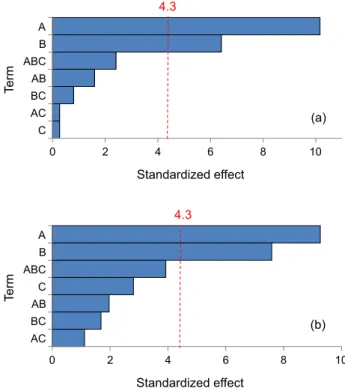
The analysis of variance (ANOVA), related to the influence of the studied variables on degree of functionalization (determined by TGA) and length reduction (determined by weighted mean) based on the factorial design results, was conducted and is presented in Figure 4 in the form of a Pareto chart.
The extent of the bar is proportional to the significance of the variables. When the columns exceed the vertical line in the graph, it is inferred that the variables are significant at a confidence level of 95%, which occurs for both temperature (A) and time (B). It was not found influence of the stirring rate (C) and possible interactions of the variables (AB, AC, BC and ABC). Similar results were obtained for the degree of functionalization calculated by elemental analysis and length reduction based on arithmetic mean (data not shown).
The p-values indicate the significance of the effects. If the p-values are lower than 0.05, the effects are considered significant with 95% of probability. It was found a p-value lower than 0.003 for the influence of both temperature and
Figure 4. Pareto chart of standardized effect with (a) degree of functionalization and (b) reduction in length as the response variables with significance level (α) of 0.05. A: temperature; B: time; C: stirring.
time in all first-degree polynomial models obtained after eliminating the non-significant terms, which indicates the high significance of these variables. Equations 1 and 2 describe the models for the degree of functionalization calculated by TGA and the length reduction based on weighted mean. The value of R2 was 0.93 for the degree of
functionalization, thus with 93% of the observed variation explained by the variables of the model (temperature, T, and time, t). The determined R2 was 0.81 for the length
reduction, indicating an inferior fit than the obtained for the degree of functionalization, which was expected due to the largest error involved in measuring the length of MWCNTs.
Degree of functionalization / mass% = (7.6 ± 0.1) +
(1.0 ± 0.1)T + (0.6 ± 0.1)t (1)
Reduction in length / % = (64 ± 2) + (8 ± 2)T +
(7 ± 2)t (2)
The numerical coefficients for T and t on equations 1 and 2 can assume values from –1 to +1 (levels of the factorial design, see Table 1). Equation 1 indicates that an increase of 5 °C or 1 h provides a degree of functionalization 1.0 and 0.6% larger, respectively, which highlights that a slight increase of temperature has a high effect in the process. By equation 2, it cannot be noticed a significant difference between the effects of 5 °C and 1 h in the length reduction at the ranges studied. Thus, a variation of only 5 °C promotes a higher increase in the degree of functionalization compared to a variation of 1 h, but with the same reduction in length, indicating that temperature is a better parameter of choice to produce more functionalized MWCNTs with less structural damage.
Similar results were obtained for specific treatment conditions employed for MWCNTs from different batches and suppliers. The numerical responses and the coefficient values for the statistical models oscillate with the characteristics of the pristine MWCNTs (as the defects density, length and diameter). However, the trend of the important role of temperature for a faster functionalization with less structural damage compared to time was maintained.
Raman spectroscopy
Figure 5 shows the Raman spectra for pristine MWCNTs, oxidized MWCNTs after the mildest treatment (45 °C, 2 h) and oxidized MWCNTs after the more severe treatment (55 °C, 4 h) of the factorial design.
The characteristic D-band at 1330 cm-1 and G-band
at 1580 cm-1 can be identified, which are related to the
presence of defects in the graphitic structure and the stretching vibration of sp2 carbon atoms, respectively.14,20,27
Therefore, the ratio between the D-band and G-band, noted as ID/IG, is associated to the degree of defects on the
MWCNTs.18,20 The D’ band can also be observed in Figure 5
as a small shoulder positioned at higher frequencies on the G-band (ca. 1615 cm-1), which is associated with disorder
of the MWCNTs.27 The I
D/IG ratio was calculated between
the intensity of D-band and G-band, without considering the D’ band.12,18 This ratio increased from 1.19 (pristine
MWCNTs) to 1.32 and 1.39 after the treatments 2 (45 °C, 2 h) and 8 (55 °C, 4 h), respectively. This increase can be attributed to an enhanced proportion of sp3 carbon after
the oxidation, as the insertion of functional groups creates defect sites in the MWCNTs.11,18,32 The highest I
D/IG ratio
of MWCNTs after treatment at 55 °C and 4 h indicates a more functionalized product, as verified by TGA and elemental analysis.
Transmission electron microscopy
TEM was used to examine the surface morphology change of MWCNTs produced by the acid treatments applied with the conditions of the factorial design. Figure 6 shows representative images for pristine MWCNTs and MWCNTs after the center point treatment (50 °C, 3 h).
micrographs for these MWCNTs are given in Figures S1-S2 (Supplementary Information).
Dispersion analysis
The analysis of dispersion stability of CNTs in aqueous and organic media is a common method to qualitatively assess the presence of functional groups.10,11,17,18,25 Figure 7
shows photographs of the MWCNT/water dispersions for the main experiments of the factorial design.
It can be noticed that practically all pristine MWCNTs (Figure 7a) sedimented, while the MWCNTs after acid treatment for 2 h at 45 °C partially sedimented (Figure 7b) and the other modified MWCNTs remained well-dispersed after 30 days (Figures 7c-7f). As the presence of oxygen-containing groups improves the stability of MWCNTs in polar media,32,37 these results are in agreement with the
observation by TGA and elemental analysis, which revealed a superior percentage of functional groups for treatments with higher temperature and time. Therefore, the degree of functionalization obtained by the treatment with 2 h and
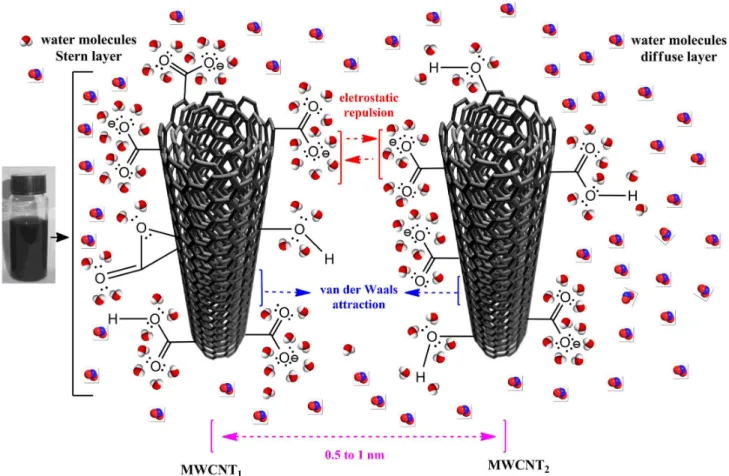
45 °C promoted only a partial dispersion, but all treatments with higher temperature and/or time were sufficient to guarantee a long-term dispersion. The electrostatic repulsion between the functional groups inserted in these treatments and the interactions with water prevailed over the van der Waals forces, forming the Stern layer around the MWCNTs surrounded by a diffuse layer of water molecules (Figure 8). The presence of carboxyl groups is especially important due to its higher acidity compared to phenolic hydroxyls and lactones/lactols.10
Yield evaluation
The yield obtained for treatments with higher temperature and time (55 °C, 4 h) was 95 mass% and the yields for the remaining experiments were between 100 and 104 mass%. The mass loss for the treatments with the highest factor values arises from increased fragmentation of MWCNTs and passage of a small fraction through the filter medium during washing, which is in agreement with the reduction of length observed from SEM. The
Figure 6. TEM images for (a) pristine MWCNTs and (b) MWCNTs after acid treatment at the center point (50 °C, 3 h).
yields greater than 100 mass% are due to the insertion of functional groups on the surface of MWCNTs. As literature generally reports yields between 70 and 90%,11,19,32 the
process presented in this work has a high efficiency in the production of functionalized MWCNTs.
Conclusions
According to the obtained results, the acid treatment method using ultrasound, moderate heating and mechanical stirring can be successfully applied for an effective functionalization of MWCNTs with high yield. The process is scalable due to the presence of stirring and the degree of functionalization and reduction in length are proportional to both temperature and time. A slight variation of 5 °C increases the degree of functionalization in 1 mass%, an enhanced effect compared to 1 h longer, with the same impact on the fragmentation of nanotubes. This kind of result was not yet clearly established in the field. Therefore, temperature is an important variable to promote a fast functionalization of MWCNTs with enhanced preservation of its structure.
By the statistical modeling developed, the functionalization process can be adjusted to achieve a set
of properties for each specific end-use application, like polymeric composites or biological systems. The control of degree of functionalization and length distribution of MWCNTs is extremely useful for the fabrication of several polymeric composites,5,38 which request an effective
functionalization with less structural damage of MWCNTs. Treatments with enhanced temperature and time, which produce highly functionalized and short MWCNTs with narrow length distribution, can be employed for different bio-related applications.19,37
Supplementary Information
Supplementary information (TEM micrographs of pristine and modified MWCNTs, Figures S1-S2) is available free of charge at http://jbcs.org.br as PDF file.
Acknowledgments
The authors acknowledge the Petrobras Company for the funding and the elemental analysis, the CNPq for the financial support and the Microscopic Center (UFMG) for the electron microscopy images.
References
1. Meyyappan, M.; Small 2016, 12, 2118.
2. Mehra, N. K.; Jain, K.; Jain, N. K.; Drug Discovery Today2015,
20, 750.
3. Zhang, Q.; Huang, J.; Qian, W.; Zhang, Y.; Wei, F.; Small2013,
9, 1237.
4. De Volder, M. F. L.; Tawfick, S. H.; Baughman, R. H.; Hart, A. J.; Science2013, 339, 535.
5. Spitalsky, Z.; Tasis, D.; Papagelis, K.; Galiotis, C.; Prog. Polym. Sci. 2010, 35, 357.
6. Karousis, N.; Tagmatarchis, N.; Tasis, D.; Chem. Rev. 2010,
110, 5366.
7. Kim, S. W.; Kim, T.; Kim, Y. S.; Choi, H. S.; Lim, H. J.; Yang, S. J.; Park, C. R.; Carbon2012, 50, 3.
8. Bilalis, P.; Katsigiannopoulos, D.; Avgeropoulos, A.; Sakellariou, G.; RSC Adv. 2014, 4, 2911.
9. Hanelt, S.; Orts-Gil, G.; Friedrich, J.; Meyer-Plath, A.; Carbon
2011, 49, 2978.
10. Chen, J.; Chen, Q.; Ma, Q.; J.Colloid Interface Sci. 2012, 370, 32.
11. Avilés, F.; Cauich-Rodriguez, J.; Moo-Tah, L.; May-Pat, A.; Vargas-Coronado, R.; Carbon 2009, 47, 2970.
12. Worsley, K. A.; Kalinina, I.; Bekyarova, E.; Haddon, R. C.; J. Am. Chem. Soc.2009, 131, 18153.
13. Wang, Z.; Shirley, M. D.; Meikle, S. T.; Whitby, R. L.; Mikhalovsky, S. V.; Carbon2009, 47, 73.
14. Scheibe, B.; Borowiak-Palen, E.; Kalenczuk, R. J.; Mater. Charact. 2010, 61, 185.
15. Silva, W. M.; Ribeiro, H.; Seara, L. M.; Calado, H. D.; Ferlauto, A. S.; Paniago, R. M.; Leite, C. F.; Silva, G. G.; J. Braz. Chem. Soc. 2012, 23, 1078.
16. Bertoncini, M.; Hoepfner, J. C.; Pezzin, S. H.; Curr. Org. Chem.
2013, 17, 1838.
17. Vukovic’, G.; Marinkovic, A.; Obradovic, M.; Radmilovic, V.; Miodrag, C.; Aleksic, R.; Uskokovic, P. S.; Appl. Surf. Sci.
2009, 255, 8067.
18. Osorio, A. G.; Silveira, I. C. L.; Bueno, V. L.; Bergmann, C. P.;
Appl. Surf. Sci. 2008, 255, 2485.
19. Samorì, C.; Sainz, R.; Ménard-Moyon, C.; Toma, F. M.; Venturelli, E.; Singh, P.; Ballestri, M.; Prato, M.; Bianco, A.;
Carbon2010, 48, 2447.
20. Wepasnick, K. A.; Smith, B. A.; Schrote, K. E.; Wilson, H. K.; Diegelmann, S. R.; Fairbrother, D. H.; Carbon2011, 49, 24. 21. Farahani, B. V.; Behbahani, G. R.; Javadi, N.; J. Braz. Chem.
Soc. 2016, 27, 694.
22. Mazov, I.; Kuznetsov, V. L.; Simonova, I. A.; Stadnichenko, A. I.; Ishchenko, A. V.; Romanenko, A. I.; Tkachev, E. N.; Anikeeva, O. B.; Appl. Surf. Sci. 2012, 258, 6272.
23. Smith, B.; Wepasnick, K.; Schrote, K. E.; Cho, H.; Ball, W. P.; Fairbrother, D. H.; Langmuir2009, 25, 9767.
24. Chiang, Y.; Lin, W.-H.; Chang, Y.; Appl. Surf. Sci. 2011, 257, 2401.
25. Zhao, Z.; Yang, Z.; Hu, Y.; Li, J.; Fan, X.; Appl. Surf. Sci. 2013,
276, 476.
26. Cho, J.; Boccaccini, A. R.; Shaffer, M. S.; Carbon2012, 50, 3967.
27. Datsyuk, V.; Kalyva, M.; Papagelis, K.; Parthenios, J.; Tasis, D.; Siokou, A.; Kallitsis, I.; Galiotis, C.; Carbon2008, 46, 833. 28. Zhang, X.; Deng, C.; Xu, R.; Wang, D.; J. Mater. Sci. 2007, 42,
8377.
29. Li, Y.; Li, H.; Petz, A.; Kunsági-Maté, S.; Carbon2015, 19, 515.
30. Blanchard, N.; Hatton, R.; Silva, S.; Chem. Phys. Lett. 2007,
434, 92.
31. Yu, H.; Jin, Y.; Peng, F.; Wang, H.; Yang, J.; J. Phys. Chem. C
2008, 112, 6758.
32. Kitamura, H.; Sekido, M.; Takeuchi, H.; Ohno, M.; Carbon
2011, 49, 3851.
33. Zhou, W.; Sasaki, S.; Kawasaki, A.; Carbon2014, 78, 121. 34. Wu, Z.; Hamilton, R. F.; Wang, Z.; Holian, A.; Mitra, S.; Carbon
2014, 68, 678.
35. Hojati-Talemi, P.; Cervini, R.; Simon, G. P.; J. Nanopart. Res.
2010, 12, 393.
36. Ciambelli, P.; Sannino, D.; Sarno, M.; Leone, C.; Thin Solid Films2011, 519, 2121.
37. Heister, E.; Lamprecht, C.; Neves, V.; Tilmaciu, C.; Datas, L.; Flahaut, E.; Soula, B.; Hinterdorfer, P.; Coley, H. M.; Silva, S. R. P.; ACS Nano2010, 4, 2615.
38. Byrne, M. T.; Gun’ko, Y. K.; Adv. Mater. 2010, 22, 1672.