Article
Printed in Brazil - ©2017 Sociedade Brasileira de Química0103 - 5053 $6.00+0.00*e-mail: [email protected]
Easy and Simple SiO
2Immobilization of Lipozyme CaLB-L: Its Use as a Catalyst in
Acylation Reactions and Comparison with Other Lipases
Mateus Mittersteiner,a Tayani M. Machado,a Paulo Cesar de Jesus,*,a Patrícia B. Brondani,b Dilamara R. Scharfa and Renato Wendhausen Jr.ª
aDepartamento de Química, Universidade Regional de Blumenau, Antônio da Veiga 140,
89019-917 Blumenau-SC, Brazil
bDepartamento de Ciências Exatas e Educação, Universidade Federal de Santa Catarina,
João Pessoa 2750, 89036-256 Blumenau-SC, Brazil
In this study, lipase from Candida antarctica B (Lipozyme CaLB-L) was successfully immobilized on SiO2 through adsorption and used to obtain (R)-(+)-esters derived from
(R,S)-1-phenylethanol. The new immobilized enzyme was compared with commercially immobilized lipases (Novozyme 435, Lipozyme 435 and Pseudomonas cepacia (PSC-II and PSD-I)). Lipozyme CaLB-L adsorbed onto SiO2 was found to be a good catalyst and, under
optimal conditions, esters could be obtained with conversion 44%, enantiomeric excess of product (eep) > 99%, enantiomeric excess of substract (ees)77% and enantiomeric ratio (E) > 200. The
lipase maintained enantioselectivity under adverse conditions, such as in organic solvents, with an excess of substrate and at different temperatures. The immobilized lipase could be reused five times with no significant loss of the activity.
Keywords: lipases, immobilization, silica gel, enzymatic resolution, acylation reactions
Introduction
Enzymes are very efficient catalysts and typically the rates of enzyme-mediated processes are faster (by a factor of approximately 1012) than chemical catalyzed
processes.1 In addition, enzyme-catalyzed reactions are
environmentally friendly, occurring under mild conditions.2
Lipases represent the class of enzymes most commonly used in organic synthesis. The main advantages of these enzymes are: high specificity, commercial availability and versatility to catalyze a range of different reactions, such as esterification, transesterification and interesterification.1,3
Lipases are considered stable and robust enzymes, but they can be sensitive to reaction conditions like pressure, temperature or pH. Immobilization techniques can be used to overcome common problems associated with a free enzyme medium, related to stability, reusability and productivity.1,4
The type of support and method of immobilization can reduce or improve enzymatic activity. Many different agents have been used for lipase immobilization and were applied in enantioselective acylation reactions,
such as blends of corn starch film/dextran, agar gel, nanopolystyrene, loofa sponge, octyl-sepharose and cashew bagasse.5-8 Immobilization can be performed
by covalent attachment, cross-linking, entrapment in gel, adsorption and ionic binding.4 Covalent binding of
lipases onto the support surface may increase the lifetime of enzymes. In this manner, in a recent study lipase from Candida antarctica B (CaLB) was immobilized in modified phenyl-functionalized and aminoalkyl-modified silica gels and the specific activity of the lipase increased. Also, the mixture of the two types of silica resulted in a higher productivity of CaLB. Esters could be obtained with a conversion of 46.8% and enantiomeric excess of product (eep) > 99%.
9 Zhang et al.10 immobilized CaLB
in ZnO nanowires introduced into macroporous SiO2 and
the supported lipase could be reused fifteen times without significant losses. (R)-2-Octanol acetate was obtained with a conversion of 49.1% and eep of 99%.
The resolution of racemic 1-phenylethanol is usually chosen to evaluate enantioselectivity and conversion rates when working with new lipases or new-supported lipases.11 Secondary alcohols are usually a better choice to
selectivity to this class of alcohols than the primary and tertiary ones.12 The enantiopure forms of 1-phenylethanol
represents a versatile building block in the synthesis of complex pharmaceuticals, agrochemicals and fine-chemistry derivatives.13 For instance, (R)-1-phenylethanol
has a solvatochromic property in the chemical industry, it is used as a fragrance in the cosmetic industry and as an inhibitor of cholesterol intestinal adsorption in the industry of pharmaceuticals.14 Moreover, this alcohol is the major
endogenous volatile compound in flowers, being a model to study distribution, transformation and metabolites of natural compounds in plants.15
In this context, commercially available silica gel could represent a cheap and easy support to improve the performance of lipases. In this study, we explored a simple methodology for the immobilization of Lipozyme CaLB-L on SiO2 without the need of controlled pH and longer
periods of contact between the support and enzyme, as it is usually reported in the literature,5,16,17 providing a catalyst
to be used right away. Among the advantages by the usage of this support is that SiO2 is highly resistant to the organic
media and has a high capacity in adsorption. It was also performed a comparison with the commercially available immobilized lipases, evaluating the following aspects in the media: acyl donor, solvent’s effect, molar ratio, amount of the biocatalyst and temperature.
Experimental
Chemicals and enzymes
The alcohol (R,S)-1-phenylethanol (98%) was
purchased from Sigma-Aldrich. The solvents 1,4-dioxan (99%), cyclohexane (99%), iso-octane (99.5%), heptane (99%) and ethyl acetate (99.5%) were obtained from Vetec,
n-hexane (98.5%) and dichloromethane (99.5%) were
obtained from Dinâmica, tetrahydrofuran (THF) (99%) was obtained from Carlo Erba and petroleum ether (99%) was obtained from Synth. The solvents were used without previous purification. The vinyl esters (vinyl acetate (99%), propionate (98%), butyrate (99%) and stearate (95%)) were obtained from Sigma-Aldrich. Butanoic (99%), hexanoic (98%) and dodecanoic (99%) acids were obtained from Vetec, heptanoic (99%), octanoic (99.5%), decanoic (99%) acids were obtained from Fluka and pentanoic acid (99%) and p-nitrophenyl acetate (99%) were obtained from Sigma-Aldrich. Silica gel (0.063-0.200 mm; 70-230 mesh) was obtained from Machaery-Nagel.
Lipases from Candida antarctica B (Novozyme 435) immobilized in resin (10 U mg-1), Lipozyme 435 and
Lipozyme CaLB-L were kindly donated by Novozymes
and lipases originating from Pseudomonas cepacia, PSD-I immobilized on diatomaceous earth (30 U mg-1) and PSC-II
immobilized on celite (30 U mg-1) were donated by Amano
Pharmaceuticals Co.
Determination of activity of the immobilized lipases
The activity assay of the lipases was measured by performing the enzymatic hydrolysis of p-nitrophenyl acetate (p-NPA) monitoring the absorbance increase at 400 nm due to the p-nitrophenol released using a Shimadzu UV-Vis 1800 spectrophotometer.17,18 Firstly, 3 mL of p-NPA 0.2 mM in
phosphate buffer (pH 7.2) was placed in a 3.5 mL quartz cuvette. The reaction was started by the addition of the immobilized or free lipase and monitored for 5 min. One unit of lipase activity (U) was defined as the amount of the enzyme that released 1 µmol of p-nitrophenol per min at 25 °C.
Immobilization of Lipozyme CaLB-L on SiO2
Lipozyme CaLB-L is a liquid lipase commercially distributed by Novozymes. The enzyme was immobilized on 0.063-0.200 mm (70-230 mesh) silica gel (SiO2) by
adsorption. In order to perform the immobilization, 1 mL of the lipase was added to 1.5 g of SiO2 and the mixture
was vigorously stirred with a spatula at room temperature during 2 minutes, providing an uniform solid.
General procedure for the enzymatic resolution
The immobilized lipase was placed in a 125 mL Erlenmeyer flask containing the organic solvent (25 mL), 1-phenylethanol (1 mmol) and the acyl donor in the acid form (butyric, pentanoic, hexanoic, heptanoic, octanoic, decanoic and dodecanoic acids) or in the vinyl ester form (vinyl acetate, propionate, butyrate and stearate) (1 mmol). The reaction mixture was then placed in an orbital shaker (Technal TE-420) at 150 rpm and 37 °C for 48 h. The formation of the products were followed by thin layer chromatography (TLC) using n-hexane and ethyl acetate (15:1 v:v) as eluent. Control reactions were carried out in the absence of the lipases and no product was detected under the same experimental conditions. The reactions were interrupted, the enzyme was filtered and the reaction medium was analyzed by 1H nuclear magnetic resonance (NMR) and
gas chromatography-flame ionization detector (GC-FID).
Analytical methods
operating at the frequency of 300 MHz (1H NMR) using
CDCl3 and TMS as external standard.
GC analysis for the determination of the enantiomeric excesses was carried out using a GC Agilent 7890 B (FID detector). A β-DEX 120 column (30 m × 0.25 mm × 0.25 µm) (Supelco) was used and the method applied was: column temperature program of 90-235 °C (10 °C min-1). The
injector and detector temperatures were set at 250 and 220 °C, respectively. The flow rate of the carrier helium gas was 2 mL min-1, resulting in an analysis time of 25 min. The
retention times under these conditions were 6.37 min for (R)-1-phenylethanol and 6.43 min for (S)-1-phenylethanol. The absolute configuration was determined by comparison with previously reported data for Novozyme 435.19
The scanning electron microscopy (SEM) was carried out in a microscope TESCAN, model VEGA 3 SEM, using a sample metalizing from Quorum, model Q150R ES.
Results and Discussion
In this study, Lipozyme CaLB-L (lipase produced by Aspergillus niger expressing a gene encoding lipase from Candida antarctica) was immobilized on SiO2 using
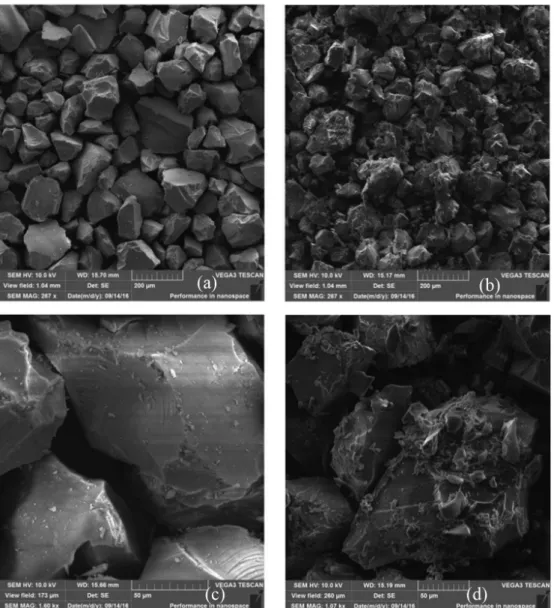
a simple stirring technique to allow the adsorption of aqueous lipase (1 mL) directly onto the support (1.5 g). Figure 1 shows the SEM analysis for SiO2 before lipase
immobilization (Figure 1a) and after (Figure 1b) in a 270 times magnification and Figures 1c and 1d show the magnification in 1200 times.
The interaction of Lipozyme CaLB-L before and after
covalent binding with SiO2 was observed using SEM
technique, magnifying 270 and 1200 times, respectively. Figures 1a and 1c show the smooth surface of the support before immobilization. An uneven distribution of the lipase in the support’s surface can be observed in Figures 1b and
Figure 1. SEM analyses for the surface of SiO2 before (a) and after (b) immobilization of Lipozyme CaLB-L. Magnification: ×270 (a) and (b); ×1200 (c)
1d, demonstrating the irregularly filling of the support by the lipase.
In order to compare the source of this lipase, different grades of commercial immobilized CaL were used (Lipozyme 435 - food grade CaL, and Novozyme 435 - technical grade CaL). Previous studies in which Lipozyme 435 and Lipozyme CaLB-L were used in enantioselective resolution of secondary racemic alcohols could not be found in the literature. However, Novozyme 435 is the most commonly used enzyme in organic synthesis. Lastly,
Pseudomonas cepacia lipase commercially immobilized on celite (PSC-II) or on diatomaceous earth (PSD-I) was applied in the same reaction for the comparison. (R,S)-1-Phenylethanol was chosen as a model substrate, since studies using this alcohol are widely reported in the literature.20-23
Several variables were evaluated in the acylation reaction of (R,S)-1-phenylethanol with different acyl donors, such as the size of the alkyl chain added to the ester, the molar ratio, the effect of the solvent and the reutilization of the biocatalyst. The conversion, enantiomeric excesses and enantioselectivity of the lipases were evaluated.
Activity assays of the enzymes
Firstly, activity assays were carried out for all enzymes.
A value of 7.6 U mg-1 was obtained for Lipozyme
CaLB-L immobilized on SiO2 and 14.9 U mg-1 in the
free form. Fujiwara et al.18 obtained 0.17 U mg-1 for the
immobilized Burkholderia cepacia in microcapsules of sodium carbonate against 2.63 U mg-1 in the free form,
using a similar methodology for the determination of the enzyme activity. The initial activity of Lipozyme 435 was 16.7 U mg-1. The activity value of 10 U mg-1 for Novozyme
435 was informed by the supplier.
Influence of acyl donor
It is reported in the literature that the acyl donors can affect the reaction yield, conversion and enantioselectivity in acylation reactions catalyzed by lipases.24,25 In order to
evaluate these effects different vinyl esters and carboxylic acids were used (Table 1).
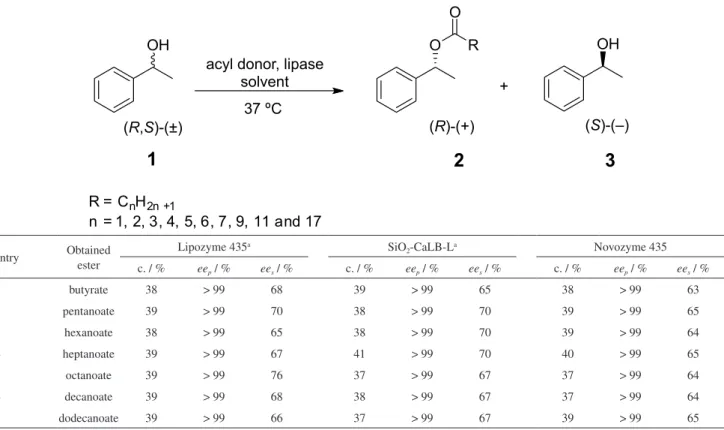
As shown in Table 1, all lipases were able to convert the alcohol into the (R)-(+)-esters. Good conversions (c.), enantiomeric excesses (ee) and enantiomeric ratio (E) values
Table 1. Effect of acid acyl donors on the acylation reaction of (R,S)-1
entry Obtained ester
Lipozyme 435a SiO
2-CaLB-La Novozyme 435
c. / % eep / % ees / % c. / % eep / % ees / % c. / % eep / % ees / %
1 butyrate 38 > 99 68 39 > 99 65 38 > 99 63
2 pentanoate 39 > 99 70 38 > 99 70 39 > 99 65
3 hexanoate 38 > 99 65 38 > 99 70 39 > 99 64
4 heptanoate 39 > 99 67 41 > 99 70 40 > 99 65
5 octanoate 39 > 99 76 37 > 99 67 37 > 99 64
6 decanoate 39 > 99 68 38 > 99 67 37 > 99 64
7 dodecanoate 39 > 99 66 37 > 99 67 39 > 99 65
aReaction conditions: 1 mmol acyl acid donor, 1 mmol 1-phenylethanol, immobilized lipase (100 mg Lipozyme 435 or Novozyme 435 or 1.5 g SiO 2
containing 1 mL of Lipozyme CaLB-L), 25 mL of n-hexane, 37 °C, 48 h. Enantiomeric ratio (E) > 200 in all cases, calculated using the formula
E = {ln [eep(1 −ees)] / (eep+ ees)} / {ln [eep(1 + ees)] / (eep+ ees)}.1 c.: Conversion; eep: enantiomeric excess of product; ees: enantiomeric excess of
were obtained with all of the lipases tested. SiO2-CaLB-L
and Lipozyme 435 (eep > 99% and enantiomeric excess of substract(ees) of 70% for all carboxylic acids) were slightly better in terms of substrate selectivity than Novozyme 435 (eep > 99% and ees of 65%). Similar results for esterification reactions with immobilized lipases were obtained by Jesus et al.26 where ee
p values > 90% and conversions near to 50% for the enantioselective esterification of the secondary alcohols (±)-2-hexanol and (±)-2-octanol, obtaining the (−)-esters and (±)-1-phenylethanol, obtaining the (+)-ester, using lipases from Pseudomonas sp.,
Microbial and Chromobacterium viscosum immobilized in microemulsion-based gels.
Whenvinyl acetate, propionate, butyrate and stearate were used as acyl donors all data were maintained the same as esterification reactions for SiO2-CaLB-L (c. 37-39%,
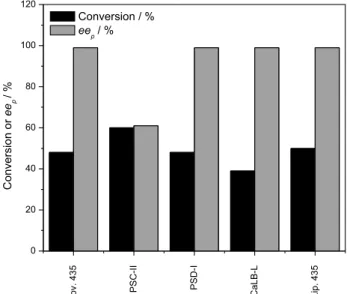
eep > 99% and ees 68-70%), but when using Lipozyme 435 the esters 1-phenylethyl acetate, propionate, butyrate and stearate were obtained with 49.9% of conversion and both the eep and ees values were > 99%. Thus, these two lipases were chosen in order to perform the subsequent reactions. (R)-(+)-1-Phenylethyl acetate was also prepared using other lipases, such as Novozyme 435, PSC-II, and PSD-I. The results are shown in Figure 2.
As it can be observed in Figure 2, all the lipases catalyzed the formation of (R)-(+)-1-phenylethyl acetate through transesterification with great selectivity, with the exception of PSC-II, which was obtained with 61% of eep. Using SiO2-CaLB-L a conversion of 39% and eep > 99% were obtained in 48 h of reaction. These are good results according with the ones found in the literature when it was used Pseudomonas cepacia,27Burkholderia cepacia23
and Aspergillus niger19 lipases for enantioselective
transesterification reactions, with high selectivity.
The specific optical rotation was determined by polarimetric analyses and it was observed a value of [α]D25 = +45 (1.0, CHCl3) for 1-phenylethyl acetate ester
and [α]D25 = −40 (1.0, CHCl3) for the residual alcohol
using Lipozyme 435; all other esters showed the same preference. Absolute configuration of the products were determined by GC-FID analyses using (R)-1-phenylethanol
as standard. In this manner, it was determined as (R) the absolute configuration for the obtained esters and (S) for the non-reactive 1-phenylethanol.
Effect of molar ratio
The effect of the substrate concentration was investigated using a constant concentration of butyric acid (1 mmol) and different concentrations of the alcohol (0.5; 1; 1.5 and 2.0 mmol). As shown in Table 2, when the molar ratio was 0.5, the conversion and ees values for both lipases increased and when the medium was saturated with alcohol a decrease in these valueswas observed. Enzymes SiO2-CaLB-L and
Lipozyme 435 showed comparable results.
The obtained results can be explained considering that by saturating the medium with racemic alcohol, the active sites of the lipases were also saturated and unable to differentiate the enantiomers to promote selective catalysis.
Effect of organic solvent
The log P value, which indicates the polarity
of the solvent, considerably affects the activity Figure 2. Selectivity comparison of SiO2-CaLB-L with other lipases in
the formation of (R)-(+)-1-phenylethyl acetate.
Table 2. Effect of molar ratio on the acylation reaction of (R,S)-1
entry Molar ratio Lipozyme 435
a SiO
2-CaLB-La
c. / % eep / % ees / % c. / % eep / % ees / %
1 0.5 45 > 99 83 44 > 99 77
2 1.0 37 > 99 68 39 > 99 68
3 1.5 26 > 99 72 30 > 99 59
4 2.0 21 > 99 52 24 > 99 49
aReaction conditions: 1 mmol butyric acid, corresponding amount of 1-phenylethanol, lipase, 25 mL n-hexane, 37 °C, 48 h. Enantiomeric ratio (E) > 200
and enantioselectivity of enzymes.17 Thus, organic
solvents with different log P values, that is, petroleum ether (PE) (log P = 5.10), iso-octane (ISO) (log P = 4.4), heptane (HEP) (log P = 4.0), n-hexane (HEX) (log P = 3.50), cyclohexane (CYHEX) (log P = 3.2), dichloromethane (DCM) (log P = 0.93), tetrahydrofuran (THF) (log P = 0.45) and 1,4-dioxane (DIOX) (log P = −1.1), were chosen to evaluate the influence of the solvent polarity on the preparation of (R)-(+)-1-phenylethyl butyrate through esterification. Table 3 shows a higher conversion for solvents with log P > 3, confirming the activity of lipases in non-polar solvents.28,29 Again, the two lipases showed
similar behavior: i.e., stability in all solvents and providing enantiopure products.
The results occurred as expected, once it is well established in the literature that the enzyme activity is highly influenced by the choice of the organic solvent.30,31
Several biocatalytic studies have shown that reactions using solvents with log P > 3.0 are usually more efficient, once these non-polar solvents can trap water around the enzyme, creating a micro-aqueous layer, maintaining the conformation of the lipase, therefore preserving its catalytic activity. Polar solvents, on the other hand, tend to alter the amount of water that surrounds the enzyme, promoting a destabilization of the biocatalyst.5,30,31
Effect of temperature and quantity of biocatalyst
With regard to the effect of temperature, the (R)-(+ )-1-phenylethyl butyrate was prepared at different temperatures (25, 37 and 50 °C) using Lipozyme CaLB-L immobilized on SiO2 and Lipozyme 435, with no significant change
in the conversions rate (39%) and enantiomeric excesses (eep > 99%, ees 65%).
The amount of lipase added to the reaction medium was also investigated. For commercially available Lipozyme 435
amounts of 50, 100 or 200 mg of enzyme were used. As in the case of Lipozyme CaLB-L, 0.5, 1 or 2 mL of free lipase was immobilized on 1.5 g of SiO2 and applied to the reaction. No
changes in the conversion and enantiomeric excesses were observed on using different amounts of enzymes.
Reutilization of the lipases
An important feature of immobilization is the potential for the repeated reuse of the enzyme. The SiO2-immobilized
CaLB-L was reused five times in the preparation of (R)-(+)-1-phenylethyl butyrate through esterification maintaining enantioselectivity in the five cycles with only a small decrease in the ees. This result is comparable with the reuse of commercially immobilized Lipozyme 435, as can be observed in Figure 3.
As it can be seen from Figure 3, SiO2 showed to be
a robust support for various cycles of reaction. The eep
Figure 3. Reuse of ( ) Lipozyme 435 and ( ) SiO2-Lipozyme CaLB-L
for 5 cycles and the corresponding ees values.
Table 3. Influence of organic solvents on the esterification reaction for the formation of (R)-(+)-1-phenylethyl butyrate
entry Solvent log P Lipozyme 435
a SiO
2-CaLB-La
c. / % eep / % ees / % c. / % eep / % ees / %
1 DIOX −1.1 19 > 99 45 6 > 99 40
2 THF 0.45 6 > 99 39 6 99 4
3 DCM 1.5 12 > 99 23 8 > 99 18
4 CYHEX 3.2 40 > 99 71 45 > 99 72
5 HEX 3.5 38 > 99 68 40 > 99 68
6 HEPT 4.0 41 > 99 77 43 > 99 70
7 ISO 4.4 41 > 99 67 21 > 99 67
8 PE 5.1 40 > 99 67 20 > 99 65
aReaction conditions: 1 mmol butyric acid, 1 mmol 1-phenylethanol, immobilized lipase (100 mg Lipozyme 435 or 1.5 g SiO
2 containing 1 mL of
was maintained through the cycles and a low decrease in conversion was observed. In this manner, the SiO2
immobilized lipase did not suffer a desorption process, maintaining its high catalytic activity.
Lastly, the free Lipozyme CaLB-L was used in the preparation of (R)-(+)-1-phenylethyl butyrate and in comparison with the SiO2 immobilized lipase the same
conversions (39%) and enantiomeric excesses (eep > 99% and ees 65%) were obtained. Thus, the support did not affect the enzyme performance.
Conclusions
In this study, a simple methodology for the immobilization of Lipozyme CaLB-L on commercially available SiO2 was
developed. This enzyme was successfully applied in the resolution of (R,S)-1-phenylethanol, and the results were comparable with those obtained for other immobilized lipases which are commercially available.
The solid support (SiO2)used for the immobilization
of Lipozyme CaLB-L was found to be a good adsorbent for this lipase. In addition, SiO2 is cheap, widely available
and highly resistant to the organic media maintaining the selectivity and catalytic activity of the lipase, in contrast to other supports used for lipase immobilization.
The enantioselectivity of the SiO2-immobilized
lipase was maintained after five cycles, and also with the use of different amounts of enzyme or substrate and different temperatures. Under optimal conditions (R)-(+)-1-phenylethyl butyrate was prepared through direct esterification with c. 44%, eep > 99%, ees 77% and E > 200.
This methodology was shown to be a good alternative for the fast and easy immobilization of lipases and its application in the obtention of enantiomerically pure compounds.
Acknowledgments
This study was supported by PIPe/FURB (in the form of a scholarship) and INCT-Catalysis, Brazil. The authors are also grateful to the Chemistry Department at the Universidade Regional de Blumenau (FURB), Novozymes Latin America and Amano Pharmaceutical Co. (Japan) for donating the lipases and Prof Maria da Graça Nascimento (UFSC, Florianópolis-SC, Brazil) for the polarimetric analyses and Prof Adilson Pinheiro (FURB) for the SEM analyses.
References
1. Faber, K.; Biotransformations in Organic Chemistry; Springer Berlin Heidelberg: Berlin, Heidelberg, 2011.
2. Pazmiño, D. E. T.; Dudek, H. M.; Fraaije, M. W.; Curr. Opin. Chem. Biol.2010, 14, 138.
3. Kapoor, M.; Gupta, M. N.; Process Biochem.2012, 47, 555. 4. Sheldon, R. A.; Van Pelt, S.; Chem. Soc. Rev. 2013, 42,
6223.
5. Nascimento, M. G.; Silva, J. M. R.; Silva, J. C.; Alves, M. M.;
J. Mol. Catal. B: Enzym.2015, 112, 1.
6. Velasco-Lozano, S.; López-Gallego, F.; Rocha-Martin, J.; Guisán, J. M.; Favela-Torres, E.; J. Mol. Catal. B: Enzym.2016,
130, 32.
7. Souza, T. C.; Fonseca, T. S.; Costa, J. A.; Rocha, M. V. P.; Mattos, M. C.; Fernandez-Lafuente, R.; Gonçalves, L. R. B.; Santos, J. C. S.; J. Mol. Catal. B: Enzym.2016, 130, 58. 8. Bukhari, A.; Idris, A.; Atta, M.; Loong, T. C.; Chin. J. Catal.
2014, 35, 1555.
9. Boros, Z.; Weiser, D.; Márkus, M.; Abaháziová, E.; Magyar, A.; Tomin, A.; Koczka, B.; Kovács, P.; Poppe, L.; Process Biochem.
2013, 48, 1039.
10. Shang, C. Y.; Li, W. X.; Zhang, R. F.; Enzyme Microb. Technol.
2014, 61-62, 28.
11. Shah, S.; Gupta, M. N.; Bioorg. Med. Chem. Lett.2007, 17, 921.
12. Ghanem, A.; Aboul-Enein, H. Y.; Chirality2005, 17, 1. 13. Singh, M.; Singh, R. S.; Banerjee, U. C.; Process Biochem.
2010, 45, 25.
14. Suan, C.; Sarmidi, M. R.; J. Mol. Catal. B: Enzym.2004, 28, 111.
15. Dong, F.; Yang, Z.; Baldermann, S.; Kajitani, Y.; Ota, S.; Kasuga, H.; Imazeki, Y.; Ohnishi, T.; Watanabe, N.; J. Plant Physiol.
2012, 169, 217.
16. Silva, J. C.; Nascimento, M. G.; J. Braz. Chem. Soc., DOI: 10.5935/0103-5053.20160115.
17. Wang, J. Y.; Ma, C. L.; Bao, Y. M.; Xu, P. S.; Enzyme Microb. Technol.2012, 51, 40.
18. Fujiwara, M.; Shiokawa, K.; Yotsuya, K.; Matsumoto, K.;
J. Mol. Catal. B: Enzym.2014, 109, 94.
19. Hoffmann, I.; Silva, V. D.; Nascimento, M. G.; J. Braz. Chem. Soc.2011, 22, 1559.
20. Bordón, D. L.; Villalba, L. D.; Aimar, M. L.; Cantero, J. J.; Vázquez, A. M.; Formica, S. M.; Krapacher, C. R.; Rossi, L. I.; Biocatal. Agric. Biotechnol.2015, 4, 493.
21. Bai, W.; Yang, Y. J.; Tao, X.; Chen, J. F.; Tan, T. W.; J. Mol. Catal. B: Enzym.2012, 76, 82.
22. Li, X.; Xu, L.; Wang, G.; Zhang, H.; Yan, Y.; Process Biochem.
2013, 48, 1905.
23. Kawakami, K.; Ueno, M.; Takei, T.; Oda, Y.; Takahashi, R.;
Process Biochem.2012, 47, 147.
24. Athawale, V.; Manjrekar, N.; Athawale, M.; J. Mol. Catal. B: Enzym.2001, 16, 169.
26. Jesus, P. C.; Rezende, M. C.; Nascimento, M. G.; Tetrahedron: Asymmetry1995, 6, 63.
27. Xue, P.; Yan, X. H.; Wang, Z.; Chin. Chem. Lett.2007, 18, 929. 28. Tanino, T.; Ohno, T.; Ogino, C.; Fukuda, H.; Kondo, A.;
J. Biosci. Bioeng.2009, 108, 369.
29. Silva, J. M. R.; Bitencourt, T. B.; Moreira, M. A.; Nascimento, M. G.; J. Mol. Catal. B: Enzym.2013, 95, 48.
30. Laane, C.; Boeren, S.; Vos, K.; Veeger, C.; Biotechnol. Bioeng.
1987, 30, 81.
31. Herbst, D.; Peper, S.; Niemeyer, B.; J. Biotechnol.2012, 162, 398.
Submitted: July 29, 2016