*e-mail: [email protected]
Microstructural Characterization of As-cast Hf–B Alloys
João Carlos Jânio Gigolottia,b*, Paulo Atsushi Suzukia,
Carlos Angelo Nunesa, Gilberto Carvalho Coelhoa,b
aDepartamento de Engenharia de Materiais – DEMAR, Escola de Engenharia de Lorena – EEL, Universidade de São Paulo – USP, CP 116, CEP 12600-970, Lorena, SP, Brazil bNúcleo de Pesquisa, Centro Universitário de Volta Redonda – UniFoa, Campus Três Poços, Av. Paulo Erlei Alves Abrantes, 1325, Três Poços, CEP 27240-560, Volta Redonda, RJ, Brazil
Received: November 28, 2010; Revised: December 2, 2011
An accurate knowledge of several metal–boron phase diagrams is important to evaluation of higher order systems such as metal–silicon–boron ternaries. The refinement and reassessment of phase diagram data is a continuous work, thus the reevaluation of metal–boron systems provides the possibility to confirm previous data from an investigation using higher purity materials and better analytical techniques. This work presents results of rigorous microstructural characterization of as-cast hafnium–boron alloys which are significant to assess the liquid composition associated to most of the invariant reactions of this system. Alloys were prepared by arc melting high purity hafnium (minimum 99.8%) and boron (minimum 99.5%) slices under argon atmosphere in water-cooled copper crucible with non consumable tungsten electrode and titanium getter. The phases were identified by scanning electron microscopy, using back-scattered electron image mode and X-ray diffraction. In general, a good agreement was found between our data and those from the currently accepted Hafnium–Boron phase diagram. The phases identified are αHfSS and B-RhomSS, the intermediate compounds HfB and HfB2 and the liquide L. The reactions are the eutectic L ⇔αHfSS + HfB and L ⇔ HfB2 + B-Rhom, the peritectic L + HfB2⇔ HfB and the congruent formation of HfB2.
Keywords: Hafnium–Boron, phase diagram, borides
1. Introduction
Metal-silicon-boron (Me–Si–B) alloys have been intensively studied due to their potential for the development of high temperature structural materials1–5. Considering
that these materials are highly demanded in service, multicomponent based alloys seems to be the only possibility to satisfy all the requirements for structural integrity6. In this sense, phase diagram information becomes
extremely important. We have investigated several Me–Si–B systems from the point of view of phase stability and, as part of this work, the evaluation of binaries metal–silicon (Me– Si) and metal–boron (Me–B) became necessary. We have verified inconsistencies in binary systems such as Nb–B7,
V–B8 and Ta–B9, what demonstrates that the refinement and
reassessment of phase diagram data is a continuous work. In this investigation, the microstructural characterization of as-cast (AC) hafnium–boron (Hf–B) alloys has been carried out. Revisiting the Hf–B system provides the opportunity to confirm previous data from an investigation using higher purity materials and better analytical techniques. Among other issues, it contributes to understand the solidification pathway of more complexes hafnium–silicon–boron (Hf– Si–B) alloys, helping the goal of establishing the liquidus projection of this ternary system.
The currently accepted Hf–B phase diagram, from the work of Rudy and Windisch10, based on results of XRD
analysis by means of Debye-Scherrer photographs and metallography of the samples, is shown in Figure 1. This diagram indicates the stability of the phases βHf body-centered cubic (BCC), αHf hexagonal compact (HCP), rhomboedric boron (B-Rhom) and liquid (L), as well as the intermediate phases HfB and HfB2.
Rogl and Potter11 assessmed the Hf–B system based on
the experimental results of Rudy and Windisch10 and Portnoi
and Romashov12,13. Bitterman and Rogl14 repeated the same
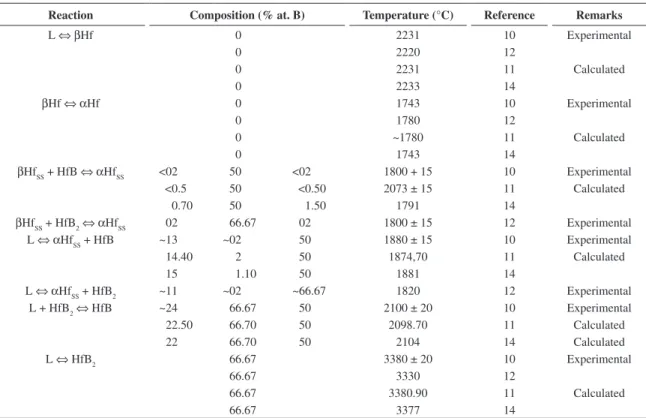
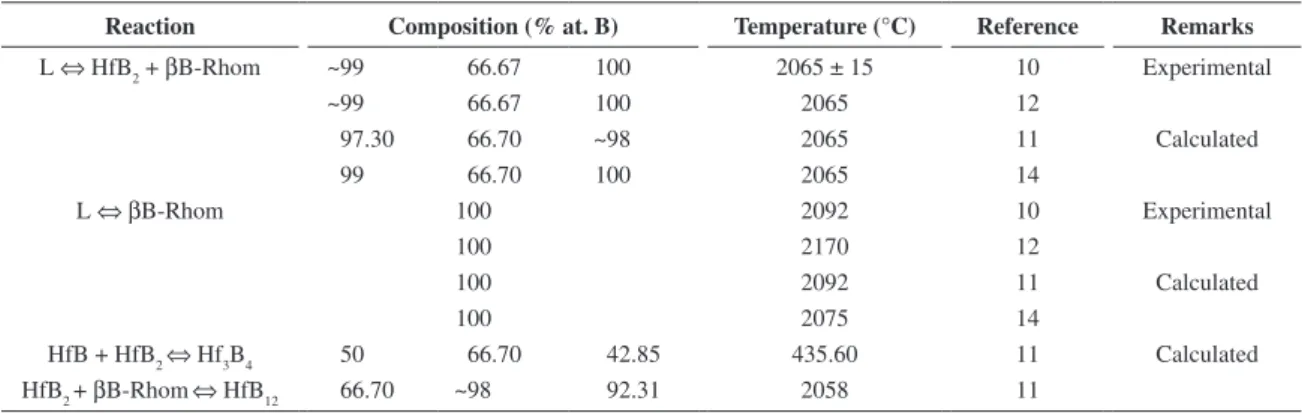
assessment into the study of the Hf–B–C ternary system. Table 1 shows the proposals of Rudy and Windisch10, Rogl
and Potter11, Portnoi and Romashov12 and Bitterman and
Rogl14 for the reactions in the Hf–B system.
2. Experimental Procedure
Table 1. Proposals of Rudy and Windisch10, Rogl and Potter11, Portnoi and Romashov12 Bitterman and Rogl14 for the reactions in the Hf–B system.
Reaction Composition (% at. B) Temperature (°C) Reference Remarks
L ⇔ βHf 0 2231 10 Experimental
0 2220 12
0 2231 11 Calculated
0 2233 14
βHf ⇔αHf 0 1743 10 Experimental
0 1780 12
0 ~1780 11 Calculated
0 1743 14
βHfSS + HfB ⇔αHfSS <02 50 <02 1800 + 15 10 Experimental
<0.5 50 <0.50 2073 ± 15 11 Calculated
0.70 50 1.50 1791 14
βHfSS + HfB2⇔αHfSS 02 66.67 02 1800 ± 15 12 Experimental
L ⇔αHfSS + HfB ~13 ~02 50 1880 ± 15 10 Experimental
14.40 2 50 1874,70 11 Calculated
15 1.10 50 1881 14
L ⇔αHfSS + HfB2 ~11 ~02 ~66.67 1820 12 Experimental
L + HfB2⇔ HfB ~24 66.67 50 2100 ± 20 10 Experimental
22.50 66.70 50 2098.70 11 Calculated
22 66.70 50 2104 14 Calculated
L ⇔ HfB2 66.67 3380 ± 20 10 Experimental
66.67 3330 12
66.67 3380.90 11 Calculated
66.67 3377 14
Reaction Composition (% at. B) Temperature (°C) Reference Remarks
L ⇔ HfB2 + βB-Rhom ~99 66.67 100 2065 ± 15 10 Experimental
~99 66.67 100 2065 12
97.30 66.70 ~98 2065 11 Calculated
99 66.70 100 2065 14
L ⇔βB-Rhom 100 2092 10 Experimental
100 2170 12
100 2092 11 Calculated
100 2075 14
HfB + HfB2 ⇔ Hf3B4 50 66.70 42.85 435.60 11 Calculated
HfB2 + βB-Rhom⇔ HfB12 66.70 ~98 92.31 2058 11
Table 1. Continued...
Table 2. Crystalographic data of the phases of the Hf–B system. Phase Structure
type
Space group
Pearson symbol
Wyckhoff position
Simetry Occupation x y z Ref. a (Å) b (Å) c (Å)
βHf W Im3m cI2 2a m3m Hf 0 0 0 16, 17
3.2260
αHf Mg P63/mmc hP2 2c 6m2 Hf 0.33330 0.66670 0.25000 17, 18
3.1980 5.0610
HfB FeB Pnma oP8 4c .m. B 0.03600 0.25000 0.61000 19
4c .m. Hf 0.18000 0.25000 0.12500
6.5185 3.2160 4.9190
HfB2 AlB2 P6/mmm hP3 1a 6/mmm Hf 0 0 0 17, 20
2d 6m2 B 0.33330 0.66670 0.50000
3.1390 3.4730
B-Rhom B R-3mh hR423 36i 1 B 0.00203 0.17779 0.32317 21
36i 1 B 0.01424 0.37071 0.03783
36i 1 B 0.04431 0.26123 0.08013
36i 1 B 0.25163 0.01528 0.15315
18h .m B 0.38876 0.61124 0.11076
18h .m B 0.41969 0.58032 0.17999
18h .m B 0.44408 0.55592 0.05327
18h .m B 0.50326 0.49674 0.19449
18h .m B 0.53676 0.46323 0.06706
18h .m Cr 0.53881 0.46120 0.34031
18h .m B 0.56428 0.43571 0.13520
18h .m B 0.61025 0.38975 0.27838
18h .m B 0.72309 0.27692 0.16006
18h .m B 0.75685 0.24315 0.23192
6c 3m B 0 0 0.11483
6c 3m Cr 0 0 0.36549
3a –3m B 0 0 0
10.9637 23.8477
been calculated the composition interval for each alloy from the mass losses associated to the melting steps, supposing that all mass losses were either from Hf or B volatilization. The composition adopted for each alloy is expressed by the mean value of this interval. The alloys were characterized via scanning electron microscope in the back-scattered electron mode, and X–ray diffraction were performed in a
Table 3. Alloy compositions, identified phases in each alloy and type of invariant reaction observed.
Composition
(at.%) Phases present Observed reaction Hf88B12 αHfSS and HfB L ⇔αHfSS + HfB Hf77B23 αHfSS and HfB L ⇔αHfSS + HfB Hf75B25 αHfSS, HfB and HfB2 L + HfB2⇔ HfB Hf50B50 αHfSS, HfB and HfB2 L + HfB2⇔ HfB Hf33.4B66.6 αHfSS, HfB and HfB2 L ⇔ HfB2
Hf7.7B92.3 HfB2 and B-Rhom L ⇔ HfB2 + B-Rhom Hf01B99 HfB2 and B-Rhom L ⇔ HfB2 + B-Rhom
Figure 2. X–ray diffractograms of as-cast: a) Hf88B12; b) Hf77B23; c) Hf75B25; d) Hf50B50; e) Hf33,4B66,6; f) Hf7,7B92,3 and g) Hf01B99 alloys.
instrument. For the X-ray diffraction experiment the samples were mechanically ground and sieved to below 80 mesh. The measurement conditions were: 10° < 2θ 90°; 0.05° (2θ step) and 2 seconds integration time. The phases in each sample were identified based on the simulated diffractions patterns obtained from the program PowderCell for Windows®
(version 2.3)15 using crystallographic data shown in Table 2.
3. Results and Discussion
Table 3 shows the phases present in each alloy as well as the type of invariant reaction observed in each microstructure.
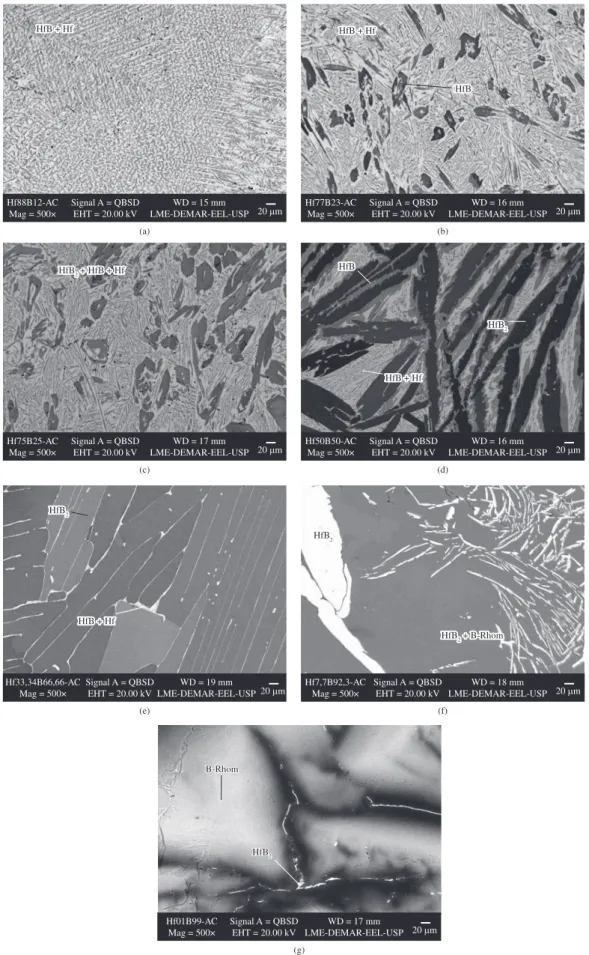
The Figure 2 shows X–ray diffractograms and the Figure 3 the micrographs of the Hf88B12 (a), Hf77B23 (b), Hf75B25 (c), Hf50B50 (d), Hf33,4B66,6 (e), Hf7,7B92,3 (f) and Hf01B99 (g) in the as-cast condition.
The alloy with composition 12 at.% B intended to verify the composition of the liquid in the eutectic transformation L ⇔ αHfSS + HfB in Hf-rich region, as proposed by Rudy and Windisch10. The diffractogram of the Hf88B12
alloy (Figure 2a) has indicated the presence of αHf solid solution (αHfSS) and HfB phases while the micrograph of this alloy (Figure 3a) shows essentially a typical eutectic microstructure composed of αHfSS and HfB phases, which confirms the Rudy and Windisch’s proposal10 (Figure 1) for
the composition of the liquid that participates of the reaction L ⇔αHfSS + HfB at approximately 13 at.% B, close to the composition calculated by Rogl and Potter11 and Bitterman
and Rogl14, respectively, at 14.4 at.% B and 15 at.% B.
The alloys with compositions between 20 at.% B and 50 at.% B intended to verify the composition of the liquid in the peritetic transformation L + HfB2⇔ HfB, as proposed by Rudy and Windisch10. The diffractogram of
the Hf77B23 alloy (Figure 2b) has indicated the presence of αHfSS and HfB phases. It is noted a relative increase in the intensity of the HfB peaks compared to the previous alloy. The micrograph of this alloy (Figure 3b) indicates primary precipitation of HfB and the αHfSS + HfB eutectic microstructure in the remaining region, in agreement with the previous result.
The diffractograms of the Hf75B25 (Figure 2c) and Hf50B50 (Figure 2d) alloys have indicated the presence of
αHfSS, HfB and HfB2 phases. In the microstructure of the Hf75B25 alloy (Figure 3c), precipitation of HfB is observed with a typical αHfSS + HfB eutectic microstructure in the
remaining region. Due to the small amount of HfB2 phase and a low contrast with respect to HfB, it is not possible to point the HfB2 phase in the micrograph. On the other hand, the microstructure of the Hf50B50 alloy (Figure 3d) shows clearly the primary precipitation of HfB2, which is involved by HfB, an evidence of the peritectic formation of HfB, with a typical αHfSS + HfB eutectic microstructure in the remaining region. The absence of HfB2 phase in the Hf77B23 alloy (Figure 2b) and its presence in the Hf75B25 alloy (Figure 2c) indicates that the transition from HfB primary to HfB2 primary should occur between 23 at.% B and 25 at.% B, which correspond to the liquid composition of the peritectic reaction L + HfB2⇔ HfB. This is in agreement with the proposal of Rudy and Windisch10 at approximately
24 at.% B (Figure 1) and slightly in disagreement with the composition calculated by Rogl and Potter11 and Bitterman
and Rogl14, respectively, 22.5 at.% B and 22 at.% B.
The alloy with composition 66.6 at.% B intended to verify the composition of the liquid in the congruent transformation L ⇔ HfB2, as proposed of Rudy and Windisch10. The diffractogram of the Hf33.4B66.6 alloy
results, the microstructure of this alloy (Figure 3e) shows large amount of primary HfB2, the αHfSS and HfB phases being present in the last regions to solidify. In addition, these results confirm the congruent formation of HfB2 as considered for Rudy and Windisch10 (Figure 1), Rogl and
Potter11 and Bitterman and Rogl14.
The alloys with compositions between 70 at.% B and 100 at.% B intended to verify the composition of the liquid in the eutectic transformation L HfB2 + B-RhomSS, as proposed of Rudy and Windisch10. The diffractograms of the
Hf7.7B92.3 alloy (Figure 2f) and Hf01B99 alloy (Figure 2g) have indicated the presence of HfB2 and B-RhomSS phases. In the microstructure of the Hf7.7B92.3 alloy (Figure 3f), primary precipitation of HfB2 is observed with a typical HfB2 + B-RhomSS eutectic microstructure in the remaining region. On the other hand, the Hf01B99 alloy (Figure 3g) presents a large amount of primary B-RhomSS phase, and the presence of the HfB2 phase in the last parts to solidify, possibly formed by the HfB2 + B-RhomSS eutectic. These results indicate that the liquid composition of the L HfB2 + B-RhomSS eutectic reaction should be around 99
at.% B, as proposed by Rudy and Windisch10, Figure 1, and
Bitterman and Rogl14, but slightly in disagreement with the
composition calculated by Rogl and Potter11 at 97.3 at.% B.
4. Conclusions
In this investigation we have carried out a detailed microstructural characterization of as-cast Hf–B alloys which allowed the evaluation of the invariant reactions involving the liquid phase in this system. The phases identified are αHfSS and B-RhomSS, the intermediate HfB and HfB2 compounds and the liquid L. The reactions are the eutectic L ⇔αHfSS + HfB and L ⇔ HfB2 + B-RhomSS, the peritectic L + HfB2⇔ HfB and the congruent formation of HfB2. In general, a good agreement was found between our data and those of the currently accepted Hf–B phase diagram as proposed by Rudy and Windisch10.
Acknowledgements
The authors acknowledge FAPESP through grant 2007/05206-5.
References
1. Jackson MR, Bewlay BP, Rowe RG, Skelly DW and Lipsitt HA. A high-temperature refractory metal-intermetallic composites.
Journal of Metals. 1996; 48:39-43.
2. Subramanian PR, Mendiratta MG and Dimiduk DM. The Development of Nb–Based Advanced Intermetallic Alloys for Structural Applications. Journal of Metals. 1996; 48:33-38. 3. Shah DM, Anton DL, Chin S and Pope DP. In-situ refractory
intermetallic-based composites. Materials Science and Engineering. 1995; 192-193:658-672. http://dx.doi. org/10.1016/0921-5093(95)03318-1
4. Bewlay BP, Jackson MR, Zhao J-C and Subramanian PR. A rewiew of very-high-temperature Nb-silicide-based composites.
Metallurgical and Materials Transactions A. 2003; 34A:2043-52. http://dx.doi.org/10.1007/s11661-003-0269-8
5. Zhao J-C and Westbrook JH. Ultrahigh-temperature materials for jet engines. MRS Bullettin. 2003; 622-30.
6. Ward-Close CM, Minor R and Doorbar PJ. Intermetallic-matrix composites – A Review. Intermetallics. 1996; 4:217-219. http:// dx.doi.org/10.1016/0966-9795(95)00037-2
7. Ferreira F. Thermodynamic modeling of the systems Nb-Si-B and Mo-Si-B. [Tese]. Lorena: Faculdade de Engenharia Química de Lorena; 2003.
8. Lima BB. Experimental determination of the isothermal section 1600ºC and the Liquidus Projection in the rich region in V of the V-Si-B system. [Tese]. Lorena: Faculdade de Engenharia Química de Lorena; 2004.
9. Fernandes PB. Experimental evaluation and thermodynamic modeling of the system Ta-Si-B in the rich region in tantalum. [Tese]. Lorena: Escola de Engenharia Química de Lorena; 2009.
10. Rudy E and Windisch S. Ternary Phase Equilibria in Transition Metal-Boron-Carbon-Silicon Systems. Technical Report, AFML-TR-62-2. Ohio: Air Force Materials Lab, Wright-Patterson AFB; 1969. v. 4, 689 p.
11. R o g l P a n d P o t t e r P E . A C r i t i c a l R ew i ew a n d Thermodynamic Calculation of the Binary System Hafnium-Boron. CALPHAD. 1988; 12(3):207-218. http://dx.doi. org/10.1016/0364-5916(88)90001-6
12. Portnoi KI and Romashov VM. Binary Constituition Diagrams of System Composed of Various Elements and Boron.
Poroshkovaya Metallurgiya. 1972; 113(5):48-56.
13. Portnoi KI, Romashov VM, Romanovich IV, Levinskii Yu V, Prokofev SA. Phase Diagram of the Hafnium-Boron system. Inorganic Materials, translated from Izvestiya Akademii Nauk SSSR. Neorganicheskie Materialy. 1971; 7:1769-1772.
14. Bitterman H and Rogl P. On the Ternary System Hafnium-Boron-Carbon. Journal of Solid State Chemistry. 2000; 154:257-262.
15. Kraus W and Nolze G. PowderCell for Windows. version 2.3. Berlim: Federal Institute for Materials research and testing; 1999.
16. Ross RG and Hume-Rothery W. High Temperature X-Ray Metallography – III Applications to the Study of Chromium, Hafnium, Molybdenum, Rhodium, Ruthenium and Tungsten.
Journal of the Less-Common Metals. 1963; 5:258-270. http:// dx.doi.org/10.1016/0022-5088(63)90031-6
17. Vilars P. Pearson’s handbook of crystallographic data for intermetallic phases. 2th ed. ASM International; 1991.
18. Romans PA, Paashe OG and Kato H. The Transformation Temperature of Hafnium. Journal of the Less-Common Metals. 1965; 8:213-215. http://dx.doi.org/10.1016/0022-5088(65)90048-2
19. Rudy E and Windisch S. Ternary Phase Equilibria in Transition Metal-Boron-Carbon-Silicon Systems, Compendium of Phase Diagram Data, part. I, vol. IX, AFML-TR-65-2. Ohio: Air Force Materials Lab, Wright-Patterson AFB; 1966. p. 1-42.
20. Kugai LN. Chemical Stability of Borides of Transition Metals of Groups IV-VI in Alkaline Solutions. Inorganic Materials, translated from Izvestiya Akademii Nauk SSSR.
Neorganicheskie Materialy. 1972; 8(4):669-670.