ISSN 0104-6632 Printed in Brazil
www.abeq.org.br/bjche
Vol. 32, No. 02, pp. 577 - 584, April - June, 2015 dx.doi.org/10.1590/0104-6632.20150322s00002681
Brazilian Journal
of Chemical
Engineering
ADSORPTION OF MANGANESE FROM ACID
MINE DRAINAGE EFFLUENTS USING BONE
CHAR: CONTINUOUS FIXED BED COLUMN AND
BATCH DESORPTION STUDIES
D. C. Sicupira
1, T. Tolentino Silva
1, A. C. Q. Ladeira
2and M. B. Mansur
1*1
Departamento de Engenharia Metalúrgica e de Materiais, Universidade Federal de Minas Gerais, UFMG,
Av. Antônio Carlos 6627, Campus Pampulha, 31270-901, Belo Horizonte - MG, Brazil. Phone: + (55) (31) 3409-1811, Fax: + (55) (31) 3409-1716
E-mail: [email protected] 2
Centro de Desenvolvimento da Tecnologia Nuclear, CNEN,
Av. Antônio Carlos 6627, Campus Pampulha, 31270-901, Belo Horizonte - MG, Brazil.
(Submitted: May 3, 2013 ; Revised: February 18, 2014 ; Accepted: June 27, 2014)
Abstract - In the present study, continuous fixed bed column runs were carried out in an attempt to evaluate the feasibility of using bone char for the removal of manganese from acid mine drainage (AMD). Tests using a laboratory solution of pure manganese at typical concentration levels were also performed for comparison purposes. The following operating variables were evaluated: column height, flow rate, and initial pH. Significant variations in resistance to the mass transfer of manganese into the bone char were identified using the Thomas model. A significant effect of the bed height could only be observed in tests using the laboratory solution. No significant change in the breakthrough volume could be observed with different flow rates. By increasing the initial pH from 2.96 to 5.50, the breakthrough volume was also increased. The maximum manganese loading capacity in continuous tests using bone char for AMD effluents was 6.03 mg g-1, as compared to 26.74 mg g-1 when using the laboratory solution. The present study also performed desorption tests, using solutions of HCl, H2SO4, and water, aimed at the reuse of the adsorbent; however, no promising
results were obtained due to low desorption levels associated with a relatively high mass loss. Despite the desorption results, the removal of manganese from AMD effluents using bone char as an adsorbent is technically feasible and attends to environmental legislation. It is interesting to note that the use of bone char for manganese removal may avoid the need for pH corrections of effluents after treatment. Moreover, bone char can also serve to remove fluoride ions and other metals, thus representing an interesting alternative material for the treatment of AMD effluents.
Keywords: Manganese; Bone char; Acid mine drainage; Continuous fixed bed column; Adsorption/desorption.
INTRODUCTION
Among the main environmental aspects and im-pacts of mining activities, those associated with the contamination of surface and ground waters by acid mine drainage (AMD) are possibly the most
signifi-cant. AMD generation is normally associated with the presence of sulfides, like pyrite (FeS2), as can be
wastes from such operations is crucial to preventing and/or minimizing their generation. In addition to waste rock piles, AMD may also occur in open or underground pit mines, the storage of tailings, and ore stockpiles. AMD often contains high concentra-tions of SO42- ions, and the high acidity of such
solu-tions may promote the dissolution of metals, such as Zn, Cu, Cd, As, Fe, U, Al, and Mn (Bamforth et al., 2006; Robinson-Lora and Brennan, 2009). This type of metal dissolution represents one of the most dele-terious effects of AMD contamination, given that streams that are subsequently contaminated by acids and metals can adversely impact both humans and wildlife.
In Brazil, AMD has been identified in the mining region of Poços de Caldas, in the state of Minas Gerais. The drainage generated in this region con-tains radionuclides (U, Th, among others) as well as species of Mn, Zn, Fe, and F- ions at concentration levels above those permitted by Brazilian law re-garding their direct discharge into the environment. The current treatment of such acidic waters consists of metals precipitation with lime, followed by pH correction. Most metal species are precipitated, but the removal of manganese ions from AMD is notori-ously difficult due to their complex chemistry (Bam-forth et al., 2006; Robinson-Lora and Brennan, 2010). For a complete precipitation of manganese, the pH must be raised to around 11, and such an operation involves a significant consumption of lime (Ladeira and Gonçalves, 2007). In addition, after the manga-nese has been removed, the pH must be neutralized for discharge. Therefore, this type of treatment is costly, generates large volumes of sludges, and quires the consumption of large quantities of re-agents to be effective. As a result, new technologies to treat such effluents containing manganese are highly recommended.
A number of alternative materials have been in-vestigated as adsorbent for the removal of metal species from wastewaters (Giraldo and Moreno-Pira-ján, 2008; Kumar et al., 2010; Martins et al., 2014; Vieira et al., 2014). In this light, a promising method based on the removal of manganese using bone char as an adsorbent was recently proposed by Sicupira et al. (2013). According to this method, manganese was quantitatively removed from AMD at pH values of near 6.0 to 7.0. One advantage is that no pH correc-tion of the treated effluent is necessary due to the buffer effect of the bone char. Batch equilibrium and kinetic-batch tests revealed that the adsorption of manganese when using bone char was also influ-enced by the solid/liquid ratio. The particle size and temperature studied produced almost no effect on the
manganese adsorption within the evaluated operating range. The maximum value of qm found for
manga-nese adsorption, based on the Langmuir model, was 22 mg g-1.
Considering the above, the present work sought to evaluate the feasibility of treating AMD solutions containing manganese with bone char in continuous fixed bed systems in an attempt to reach the levels required by Brazilian law regarding the direct dis-charge of effluents. According to CONAMA (2005), the limit of fully dissolved manganese concentration in effluents is 1.0 mg L-1, with a pH ranging from 6.0 to 9.0. Fixed bed tests were carried out using AMD effluents and laboratory solutions containing manga-nese at typical concentrations for comparative analy-ses. Desorption studies were also carried out using bone char that had previously been loaded with man-ganese through a laboratory solution to evaluate the possibility of reuse.
EXPERIMENTAL
Reagents
The bone char used in this study was supplied by Bone Char do Brasil Ltda (Maringá, Brazil) and basically contained hydroxyapatite Ca10(PO4)6(OH)2
and calcite CaCO3. SEM-EDS analysis showed a
significant presence of calcium and phosphorus, as expected. In addition, manganese and other metals could be identified on the bone char surface after coming into contact with AMD, thus suggesting that such metals had in fact been removed from the efflu-ent, possibly due to some adsorptive and/or precipi-tating process. The main characteristics of the bone char used in this study are as follows: real density = 2.9 g cm-3, total pore volume = 0.275 cm3 g-1, surface area = 93 m2 g-1, and particle size = 417-833 µm.
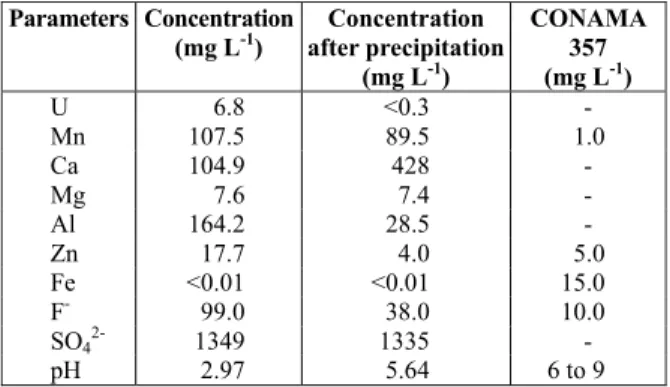
The AMD effluent used in this study was col-lected in an area near a closed uranium mine in the city of Poços de Caldas, Brazil. Its metal composi-tion is shown in Table 1, which includes the limiting concentrations for discharge in Brazil according to CONAMA (2005). It can be observed that the man-ganese concentration in the AMD exceeds the maxi-mum value permitted by Brazilian law, the same occurring with zinc and acidity, but not with iron. After precipitation with 30% Ca(OH)2, the
Adsorption of Manganese from Acid Mine Drainage Effluents Using Bone Char: Continuous Fixed Bed Column and Batch Desorption Studies 579
comparative analysis. This specific solution was pre-pared using chemicals of analytical reagent grade dissolved in distilled water.
Table 1: Chemical characterization of the AMD effluent.
Parameters Concentration (mg L-1)
Concentration after precipitation
(mg L-1)
CONAMA 357 (mg L-1)
U 6.8 <0.3 -
Mn 107.5 89.5 1.0
Ca 104.9 428 -
Mg 7.6 7.4 -
Al 164.2 28.5 -
Zn 17.7 4.0 5.0
Fe <0.01 <0.01 15.0
F- 99.0 38.0 10.0
SO42- 1349 1335 -
pH 2.97 5.64 6 to 9
* All parameters are expressed in mg L-1
, except pH. - Permissible level not defined by Brazilian law.
Instrumentation
An atomic emission spectrometer with induc-tively coupled plasma (ICP-AES, Perkin Elmer, model Optima 7300DV) was used to assess the con-centration of manganese in the aqueous solutions. Sulfate, phosphate, and fluoride analyses were per-formed using a DX500 Dionex ion chromatograph. The pH measurements were carried out using a pH meter (Digimed, model DM-22). A scanning electron microscope (SEM, FEI, model Inspect S50) was employed to analyze the surface morphology of the bone char.
Continuous Fixed Bed Column Runs
Continuous fixed bed column runs were con-ducted to determine the adsorption capacity of bone char under continuous flow conditions. All column runs were performed in down flow mode. The col-umn was filled with 40 g of bone char with a particle size of 417-833 µm. The effluent (pHi = 2.96 or 5.50)
was continuously fed into the column using a peri-staltic pump (Cole-Parmer, Masterflex); in the case of the laboratory solution, pHi = 5.76 was used. The
range of initial pH was chosen based on previous batch equilibrium and kinetic-batch studies, and the AMD effluent sample presented a typical pH value of approximately 3.0. The diameter of the column’s adsorptive bed was 2.2 cm, and a hydraulic flow rate of 7.5 mL min-1 was maintained constant. Effluent samples were collected from the column at deter-mined contact times, filtered and acidified using
HNO3 before being analyzed by ICP-AES. The fixed
bed studies were also carried out at a flow rate of 3.0 mL min-1 to evaluate the effect of the flow rate within the fixed bed column, and the effect of the bone char mass was evaluated using 20 g of bone char. All continuous runs were carried out at room temperature. Breakthrough curves were plotted showing the concentration ratio Ct/C0 (manganese
concentration at time t divided by the initial concen-tration of manganese) versus the number of bed volumes (BV), which is defined as the eluted volume divided by the volume of bed voids (Cussler, 2007).
Modeling
The Thomas model was chosen to evaluate the adsorption characteristics of manganese from AMD effluents in continuous column operation due to its simplicity. It is widely used in the modeling of fixed bed breakthrough curves (Unuabonah et al., 2010). The Thomas model assumes a Langmuir (favorable) isotherm, which is in agreement with prior investiga-tions on the adsorption of manganese onto bone char, which is represented by the following equation (Chu, 2010):
0 0 0
1
1 T
T
t
k q M k C t Q C
C
e
⎛ ⎞
−
⎜ ⎟
⎝ ⎠
=
+
(1)
The linearized form of the Thomas model can be expressed as follows:
0 0
0 1 T
T t
C k q M
ln k C t
C Q
⎛ ⎞
− = −
⎜ ⎟
⎝ ⎠ (2)
in which kT (L mg -1
min-1) is the Thomas rate con-stant, q0 is the sorption capacity of the adsorbent per
unit mass (mg g-1), M is the mass of adsorbent (g), and Q is the flow rate (L min-1). The kinetic coeffi-cient kT and the adsorption capacity q0 can be
ob-tained from the plot of ln(C0/Ct – 1) against time (t)
at a given flow rate using linear regression (Cavas et al., 2011).
Desorption Studies
Metal desorption was evaluated using selected elu-ents: HCl (0.01M, 0.001M, 0.0001M), H2SO4 (0.01M,
0.001M, 0.0001M), and H2O. Desorption was carried
volume of eluent (100 mL) under agitation (150 rpm) at 25 ºC using a mechanical shaker (New Brunswick, model Innova 44). Samples (1 mL) were collected at fixed contact times, diluted, and filtered before being analyzed by ICP-AES.
RESULTS AND DISCUSSION
Fixed Bed Sorption Runs
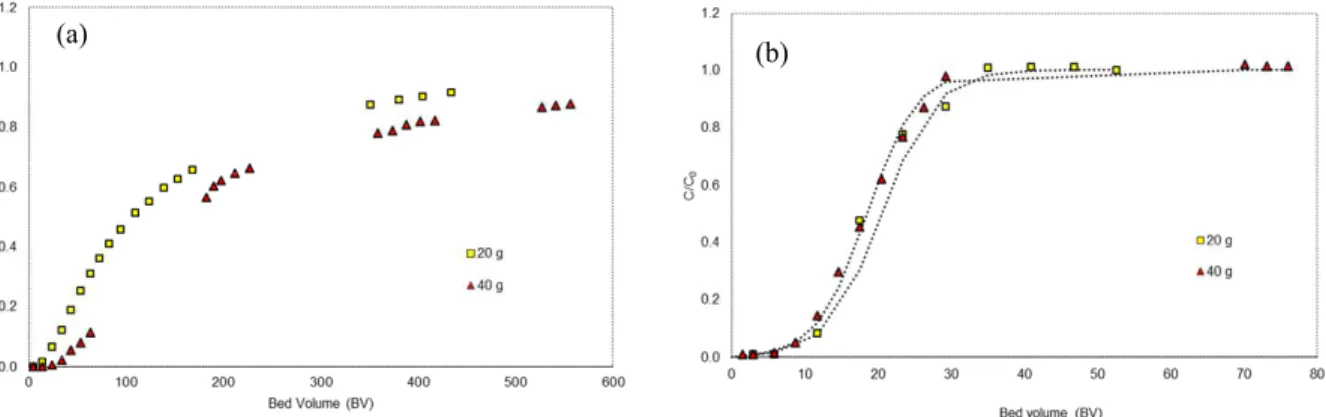
The effect of bed height on the sorption of man-ganese in the continuous fixed bed column is shown in Figure 1. Analyzing the curves obtained, the breakthrough curves for the laboratory solution did not show the typical “S” shape (see Figure 1(a)) as verified in runs using AMD effluents (see Figure 1(b)). In fact, the curves obtained in the runs with laboratory solutions are more inclined to the right. Such a behavior is an indication that the mass-trans-fer zone is nearly as long as the bed and that signifi-cant resistance is involved. As such, a longer period of time is necessary to reach the saturation point (Quek and Al-Duri, 2007), and less than one-half of the bed capacity is actually used (McCabe et al., 2005). The difference in the shape of the curves is due to the distinct flow rates used in the runs. The breakthrough curve is sharper with the increase in the adsorption rate, i.e., at lower flow rates and lower initial concentrations of feed solution.
The constants from the Thomas model (kT and q0)
and operating parameters BVb (breakthrough point
that refers to the maximum manganese concentration
in the effluent, limited by CONAMA at 1.0 mg L-1) and BVs (saturation point relative to the final
manga-nese concentration, which is equal to the initial man-ganese concentration) for the laboratory solution and AMD effluents are shown in Table 2. A better fit was obtained using the Thomas model in comparison to the Bohart-Adams model (R2 ≤ 0.87, equations are shown in Vieira et al., 2014), for instance. Results for the laboratory solution revealed that an increase in the bone char mass also increased the break-through point. By increasing the bone char mass from 20 g to 40 g, at a constant flow rate, the break-through time was extended from 50 min to 280 min, and the BVb was extended from 11.70 to 34.16 due
to the increase in the number of binding sites. In the case of AMD effluents, by increasing the bone char mass from 20 g to 40 g, at a constant flow rate, the breakthrough time was extended from 60 min to 120 min, but the BVb remained unchanged. In fact, the
same value of 5.85 was obtained for both bone char masses, which proved to be smaller than the BVb
values obtained for the laboratory solution. This can be attributed to the fact that, in the case of AMD effluents (pHi = 2.96), the initial pH is lower and
there are other species in the solution that may limit the removal of manganese. A precipitate formed on the surface of the loaded bone char can be seen in Figure 2, which most likely blocked the binding sites, in turn preventing the evolution of the removal process. In the case of AMD effluents, it is also inter-esting to note that the pH of the effluent leaving the column dropped quickly, thus reducing manganese adsorption.
(a) (a)
(b) (b)
Figure 1: Effect of bed height on the breakthrough of manganese removal with bone char in a continuous fixed bed column (417-833 µm): (a) Laboratory solution (Q = 7.5 mL min-1, C0 = 100 mg L-1, pHi = 5.76),
(b) AMD effluent (Q = 3.0 mL min-1, pHi = 2.96, continuous curves according to the Thomas model).
Adsorption of Manganese from Acid Mine Drainage Effluents Using Bone Char: Continuous Fixed Bed Column and Batch Desorption Studies 581
Table 2: Parameters of the Thomas model regarding the adsorption of manganese onto bone char (417-833 µm).
Bone char mass
(g)
Flow rate (mL min-1)
Initial pH
Final pH
BVb BVs q0
(mg g-1)
kTx104 (mg g-1 min-1)
R2
Laboratory solution
20 20 40
3.0 7.5 7.5
5.76 5.76 5.76
7.34 7.34 7.34
11.70 11.70 34.16
444.60 444.60 556.35
15.97 15.85 26.74
0.23 0.44 0.24
0.95 0.95 0.99
AMD effluent
20 20 40
3.0 3.0 3.0
2.96 5.50 2.96
4.45 5.55 4.45
5.85 17.55 5.85
35.09 70.19 35.09
2.85 6.03 2.60
3.00 1.32 1.58
0.97 0.97 0.99
(a)
(a) (b)(b)
Figure 2: Morphology of bone char by SEM analysis: (a) bone char as received and (b) bone char after contact with AMD effluent in the column.
Concerning the rate constant values from the Thomas model (kT) and the maximum loads (q0)
shown in Table 2, quite different values were ob-tained for kT for both solutions, which indicates that
significant variations in the resistance to the mass transfer of manganese into bone char within both systems could be observed. The q0 values proved to
be larger for the longer bed height in the laboratory solution due to the increase in the number of binding sites. For AMD effluents, the q0 values remained
approximately the same, since the manganese re-moval was limited by the precipitate formed on the bone char surface and the low pH value of the efflu-ent leaving the column and not by the binding sites. As can be seen by comparing Figure 1 and Table 2, the higher the value of the constant kT, the more
effective the mass transfer process, thus resulting in sharper “S” curves.
The effect of flow rate on the manganese removal in the continuous fixed bed column is shown in Figure 3. No significant change in the breakthrough point could be identified with the increase in the evaluated flow rate range. As expected, faster saturation of the bed was obtained with the increase of the flow rate from 3.0 mL min-1 to 7.5 mL min-1, at the same bed height. The BVb also remained at the same value of
11.70, since it is limited by the number of binding sites.
Figure 3: Effect of flow rate on the breakthrough of manganese removal with bone char in a continuous fixed bed column using the laboratory solution (C0 =
100 mg L-1, pHi = 5.76, mass = 20 g, 417-833 µm).
The effect of the initial pH of the AMD effluents was also evaluated, the results of which are shown in Figure 4. By increasing the initial pH from 2.96 to 5.50, under the same operating conditions, it is possi-ble to observe that the saturation point was quickly reached for pHi = 2.96. This is due to the fact that the
pH value of the effluent leaving the column dropped from approximately 8.0 to 2.96 in only a few min-utes. The saturation point occurred after 240 min for pHi = 2.96 and after 660 min for pHi = 5.50. It was
at low pH values. In fact, increasing the initial pH from 2.96 to 5.50, at a constant flow rate, the break-through time was extended from 360 min to 720 min, and the BVb was extended from 35.09 to 70.19.
Regarding the values from the Thomas model shown in Table 2, the value obtained for q0 was larger for
pHi = 5.50 than for pHi = 2.96, since the manganese
adsorption is favored by the progression of the pH value during the experiment at pHi = 5.50. Moreover,
the AMD effluent, at pHi = 2.96, contains other metal
ions in the solution that compete with manganese for binding sites. This can occur either through the com-petition of the other metal ions with manganese or through the formation of precipitates of these metal ions on the bone char surface, which can block the binding sites. As no prior study could be found in the literature using bone char as an adsorbent for the removal of manganese in fixed bed columns, no comparison of the results obtained in this study was possible. The maximum manganese loading calculated in continuous tests using bone char was 6.03 mg g-1 for AMD effluents and 26.74 mg g-1 for the laboratory solution. The value for the laboratory solution was larger than that obtained in the batch tests (20 mg g-1). However, in the case of AMD effluents, this result was not confirmed. This may well be explained by the progression of the pH value throughout the column when AMD effluents are fed. New solutions are constantly fed into the column, and the calcite present in the bone char is rapidly consumed. This action made the pH value of the effluent leaving the column drop from approximately 8.0 to 2.96 in only a few minutes. Another fact that can also prevent the manganese removal from fixed beds is the high concentration of calcium in the effluent resulting from its precipitation with Ca(OH)2.
Figure 4: Effect of initial pH on the breakthrough of manganese removal with bone char in a continuous fixed bed column using AMD effluents (Q = 3.0 mL min-1, mass = 20 g, 417-833 µm, continuous curves from the Thomas model).
The manganese removal mechanism is based on ion exchange with the calcium present in the hy-droxyapatite structure; therefore, high concentrations of calcium in the effluent may negatively affect the ion exchange of calcium with manganese.
Desorption Studies
The design of adsorption processes requires the full implementation of desorption studies. Once the adsorbent has been exhausted, the recovery of the loaded adsorbent may be advantageous from the economic point of view, as it can be reused in a closed circuit. In fact, the regeneration of spent ad-sorbent columns is a rather important process in wastewater treatment (Mohan and Chander, 2006).
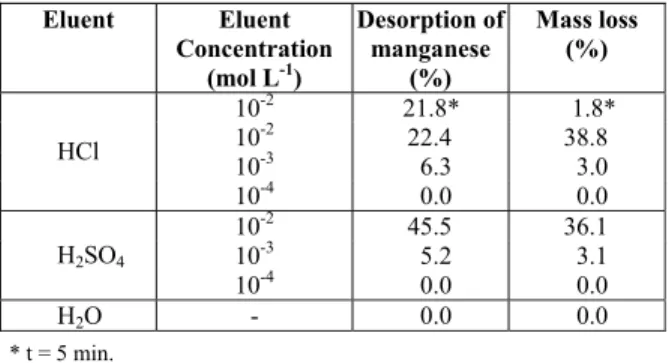
Our previous study revealed that manganese ad-sorption onto bone char occurs in the form of chemi-sorption (Sicupira et al., 2013). As chemisorption often results in more stable adsorbed species, desorp-tion is not commonly the expected outcome. Based on the results shown in Table 3, manganese desorp-tion from bone char appears uninteresting for the reuse of the material. Using HCl as an eluent, the highest desorption obtained was 22.4% with a mass loss of 38.8% during 15 minutes of agitation. Using the same conditions, but for 5 minutes of agitation, desorption was 21.8% with a mass loss of 1.8%. When using H2SO4 as an eluent, the best result was
obtained for 0.01M H2SO4, with 45.5% desorption
but with 36.1% mass loss after 15 minutes of agita-tion. By analyzing these results, it can be observed that manganese desorption from bone char is not a feasible option due to its low desorption levels as-sociated with a relatively high mass loss, which can also modify the characteristics of the bone char.
Table 3: Desorption of manganese from loaded bone char using various elution solutions (500 mg, 100 mL, 25 °C, 150 rpm, 417-833 µm).
Eluent Eluent Concentration
(mol L-1)
Desorption of manganese
(%)
Mass loss (%)
10-2 21.8* 1.8*
10-2 22.4 38.8
10-3 6.3 3.0
HCl
10-4 0.0 0.0
10-2 45.5 36.1
10-3 5.2 3.1
H2SO4
10-4 0.0 0.0
H2O - 0.0 0.0
* t = 5 min.
Adsorption of Manganese from Acid Mine Drainage Effluents Using Bone Char: Continuous Fixed Bed Column and Batch Desorption Studies 583
These authors observed that desorption with distilled water proved ineffective. However, in the case of desorption carried out with sulphuric acid solution (0.01 mol L-1), the levels of desorption reached 40%, which can be compared to the level of manganese desorption shown in Table 3 for the same eluent solution (45%). These authors failed to report the adsorbent mass loss, and desorption experiments with bone char loaded with Mn were not described.
CONCLUSIONS
In the present study, fixed bed tests were carried out to evaluate the feasibility of using bone char for manganese removal from AMD effluents in an at-tempt to reach the maximum concentration levels permitted by Brazilian law (CONAMA, 2005). Ex-periments using a laboratory solution containing manganese at typical concentrations were also per-formed for comparative analyses. The following main conclusions can be drawn based on the ob-tained results:
For the laboratory solution, an increase in the bone char mass increased the BVb, which was
ex-tended from 11.70 to 34.16. In the case of AMD effluents, when increasing the bone char mass, the BVb remained unchanged due to the other species in
solution and/or the precipitate formed on the surface, which may in fact limit the manganese removal.
Concerning the rate constant values from the Thomas model (kT), it can be concluded
that there are significant variations in resistance to the mass transfer of manganese to the bone char for laboratory solutions and AMD effluents. For the laboratory solution, the mass transfer zone was nearly as long as the bed. Therefore, a longer time period was necessary to reach the saturation point.
Regarding the influence of the flow rate, it could be observed that there was no significant change in the BVb. With the increase in the flow rate,
the bed saturated more quickly. The BVb also
re-mained at the same value of 11.70, as it is limited by the number of binding sites.
By increasing the initial pH of AMD effluents from 2.96 to 5.50, the BVb was extended from 35.09
to 70.19.
The maximum manganese loading calculated in continuous tests using bone char for AMD efflu-ents was 6.03 mg g-1, as compared to 26.74 mg g-1 for the laboratory solution.
Manganese desorption tests indicated that the reuse of bone char appears to be inapplicable. The highest desorption was obtained for 0.01M H2SO4,
with 45.5% desorption but with 36.1% mass loss after 15 minutes of agitation. Manganese desorption from bone char proved to be unfeasible due to low desorption levels associated with a relatively high mass loss, which may well modify the characteristics of the bone char.
The removal of manganese from AMD effluents using bone char as an adsorbent is technically feasi-ble, thus attending to Brazilian environmental laws, despite the apparent inapplicability of desorption for the investigated eluent solutions. It is interesting to note that bone char may avoid the need for pH cor-rection of the effluents after treatment, as is currently performed in treatments with lime. Furthermore, this method can also serve to remove fluoride ions and other metals from AMD effluents. Therefore, bone char does represent an interesting alternative material for the treatment of AMD effluents.
ACKNOWLEDGMENTS
The authors wish to acknowledge the financial support received from FAPEMIG (TEC-APQ-04026-10), CNPq (304788/2012-0), CAPES-PROEX, and INCT-Acqua: National Institute of Science and Technology of Mineral Resources, Water, and Bio-diversity (www.acqua-inct.org). The contributions from Bone Char do Brasil Ltda and INB (Indústrias Nucleares do Brasil), as well as the fruitful discus-sions with Prof. Sônia Denise Ferreira Rocha (DEMIN/UFMG), are also kindly acknowledged.
REFERENCES
Bamforth, S. M., Manning, D. A. C., Singleton, I., Younger, P. L. and Johnson, K. L., Manganese re-moval from mine waters - investigating the occur-rence and importance of manganese carbonates. Applied Geochemistry, 21, 1274-1287 (2006). Cavas, L., Karabaya, Z., Alyuruka, H., Dogan, H.
and Demir, G. K., Thomas and artificial neural network models for the fixed-bed adsorption of methylene blue by a beach waste Posidonia
oce-anica (L.) dead leaves. Chemical Engineering
Journal, 171, 557-562 (2011).
Chu, K. H., Fixed bed sorption: Setting the record straight on the Bohart-Adams and Thomas models. Journal of Hazardous Materials, 177, 1006-1012 (2010).
bem como estabelece as condições e padrões de lançamento de efluentes. Brazil (2005). Available in: <http://www.mma.gov.br/port/conama/index.cfm>. (Accessed: May 3, 2013). (In Portuguese).
Cussler, E. L., Diffusion: Mass Transfer in Fluid Systems. 3rd Ed. Cambridge Univ. Press, New York (2007).
Giraldo, L., Moreno-Piraján, J. C., Pb2+ adsorption from aqueous solutions on activated carbons ob-tained from lignocellulosic residues. Brazilian Journal of Chemical Engineering, 25(1), 143-151 (2008).
Guedes, T. S., Mansur, M. B. and Rocha, S. D. F., A perspective of bone char use in the treatment of industrial liquid effluents containing heavy metals. In: Proc. of the XXI Encontro Nacional de Trata-mento de Minérios e Metalurgia Extrativa, Ouro Preto, Brazil (2007).
Kumar, P. S., Ramakrishnan, K., Kirupha, S. D. and Sivanesan, S., Thermodynamic and kinetic studies of cadmium adsorption from aqueous solution onto rice husk. Brazilian Journal of Chemical Engi-neering, 27(2), 347-355 (2010).
Ladeira, A. C. Q. and Gonçalves, C. R., Influence of anionic species on uranium separation from acid mine water using strong base resins. Journal of Hazardous Materials, 148, 499-504 (2007). Martins, R. J. E., Vilar, V. J. P. and Boaventura, R. A.
R., Kinetic modeling of cadmium and lead re-moval by aquatic mosses. Brazilian Journal of Chemical Engineering, 31(1), 229-242 (2014). McCabe, W. L., Smith, J. C. and Harriott, P., Unit
operations of chemical engineering: Chemical Engineering Series. 7th Ed. McGraw-Hill’s Sci., New York (2005).
Mohan, D. and Chander, S., Removal and recovery of metal ions from acid mine drainage using lig-nite - A low cost sorbent. Journal of Hazardous Materials, B137, 1545-1553 (2006).
Quek, S. Y. and Al-Duri, B., Application of film-pore diffusion model for the adsorption of metal ions on coir in fixed bed column. Chemical Engineer-ing Process, 46, 477-485 (2007).
Robinson-Lora, M. A. and Brennan, R. A., Biosorp-tion of manganese onto chitin and associated pro-teins during the treatment of mine impacted wa-ter. Chemical Engineering Journal, 162, 565-572 (2010).
Sicupira, D. C., Silva, T. T., Leão, V. A. and Mansur, M. B., Batch removal of manganese from acid mine drainage using bone char. Brazilian Journal of Chemical Engineering, 31(1), 195-204 (2014). Unuabonah, E. I., Olu-Owolabi, B. I., Fasuyi, E. I.
and Adebowale, K. O., Modeling of fixed-bed column studies for the adsorption of cadmium onto novel polymer-clay composite adsorbent. Journal of Hazardous Materials, 179, 415-423 (2010).