ISSN 0104-6632 Printed in Brazil
www.abeq.org.br/bjche
Vol. 32, No. 02, pp. 317 - 324, April - June, 2015 dx.doi.org/10.1590/0104-6632.20150322s00003262
Brazilian Journal
of Chemical
Engineering
EFFECTS OF CULTIVATION MEDIA COMPONENTS
ON BIOSURFACTANT AND PIGMENT
PRODUCTION FROM
Pseudomonas aeruginosa
PAO1
Subhasish Das
1and Palashpriya Das
2*1School of Chemical and Biotechnology, SASTRA University,
Thirumalaisamudram, Thanjavur 613402, Tamilnadu, India. E-mail: [email protected]
2Institute of Microbiology, Chinese Academy of Sciences, Beijing, China.
E-mail: [email protected]
(Submitted: February 4, 2014 ; Revised: June 16, 2014 ; Accepted: June 18, 2014)
Abstract - Biosurfactant and pigment production by P. aeruginosa have been known to be associated with its selfish growth and colonization. However, according to recent studies these products can be exploited for human benefits. In the present work the effects of culture media components on yield of these two products from P. aeruginosa PAO1 have been studied with statistical screening design experiments. Biosurfactant yield was found to be increased by two times in a modified medium. This study will help in further modifying the media composition for cheaper media development, kinetic modelling and fermentation strategy development.
Keywords: Pseudomonas aeruginosa PAO1; Biosurfactant; Pigment; Culture medium; Screening design.
INTRODUCTION
P. aeruginosa, a Gram-negative opportunistic hu-man pathogen, produces biosurfactants which belong to rhamnolipids for colonization (Perfumo et al., 2006; Arutchelvi and Doble, 2010; Müller et al. 2010) and toxins, including pigment like blue-green pyocyanin, to kill other competitor microorganisms (Norman et al., 2004; Ozyurek et al., 2011). While biosurfactants are used in textile industries, leather processing, in bio-remediation, agriculture, and in the food and bever-age industry (Coelho et al., 2010), pyocyanin can be exploited against other pathogens to reduce crude oil degradation (Norman et al., 2004) and for quantify-ing ammonium ion concentration (Iida and Satoh, 2013). In this work complex media components for cultivation of P. aeruginosa PAO1 have been screened for identifying their specific roles to produce biosurfactant and pigment. Screening of components of complex cultivation media with statistical analysis
helps us to understand the effects of each component on biomass growth, product formation and underly-ing metabolic changes responsible for such variation (Das et al., 2009; Moussa et al., 2014). As carbon source is essential for growth and product formation, glycerol was used since it is available in excessive amount at a cheap price as a by-product from the biodiesel industry (Xu et al., 2012). This knowledge would further help us to minimize number of compo-nents in the media, leading to economization in large scale production, subsequent optimization and process modelling (Mukherjee et al., 2008).
MATERIALS AND METHODS
Isolation of Microorganism and Culture Conditions
Bertanni (LB) agar plates and LB medium was used for the preparation of the primary inoculum. 1% in-oculum (approximately 0.02 g) from LB was then transferred to peptone glycerol ammonium salts (PGAS) medium for biosurfactant production. The me-dium consisted of 0.02 M NH4Cl, 0.02 M KCl, 0.12 M
Tris-HCl (pH 7.2), 0.0016 M MgSO4, 1% glycerol
and 1% peptone. After inoculation the media were incubated for a week at 37 °C with an agitation speed of 200 rpm. An uninoculated medium was also incu-bated as a sterility control.
Studies on Growth and Biosurfactant Production
Fermentation broth samples were collected twice daily and checked for OD600nm and biosurfactant
con-centration. Biomass was estimated by the dry weight and also by the optical density of the fermentation broth at 600 nm measured with a UV-Visible spec-trophotometer (Eppendorf, Germany).
Biosurfactant Recovery and Pigment Estimation
Biosurfactant was isolated from the culture broth obtained after the completion of each fermentation cycle by the standard technique (Das et al., 2008). Briefly, the fermentation broth was acidified and kept at 4 ºC overnight for complete precipitation of the biosurfactant. The precipitate was then centri-fuged to get the crude biosurfactants as a pellet.
Pigment concentration was determined by multi-plying the optical density of the acidified culture su-pernatant at 520 nm with 17.072 (Raoof and Latif, 2010).
Statistical Screening of Media Compositions
For statistical screening of effective media com-ponents (A: NH4Cl, B: KCl, C: Tris-HCl with pH
7.2, D: MgSO4, E: Glycerol, F: Peptone) in P.
au-ruginosa PAO1 broth for biosurfactant and pigment production ‘screening design of mixture’ experi-ments were chosen since the medium was complex and the number of medium components (i.e., six) was too large for employing response surface methodology and too small for running the statistical optimization method involving Plackett-Burman design. More-over, screening experiments allows us to find effects of each component in media very precisely. Mere visualization of the results based on the experiments designed can help to make important decisions like which components have negative or no effects and can be removed from the medium and which compo-nent has a positive effect on increasing yield. The
concentrations of media components were 0.02 M NH4Cl, 0.02 M KCl, 0.12 M Tris-HCl (pH 7.2),
0.0016 M MgSO4, 1% glycerol and 1% peptone as
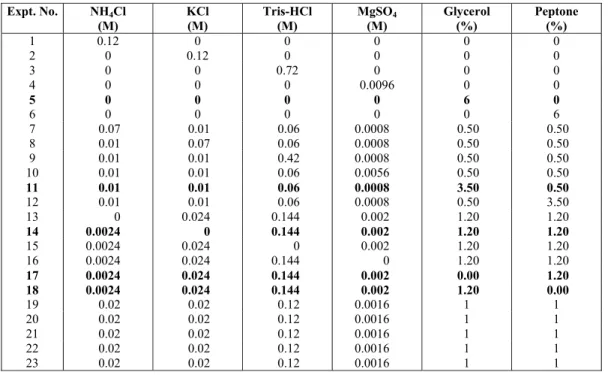
mentioned earlier and were coded as central points (+0.1667) of reference, whereas the lowest level (0 level) was set for zero concentrations of all compo-nents. A total of 23 experiments was performed, where there were six axial points (each experiment representing a medium composition having +1 level for one component and 0 level for the other five components), 12 (=2×6) points of vertices and five centroids (each components at +0.1667 level) for finding pure error in the whole set of experiments (Table 1).
Assay of Emulsification
The cell free supernatants obtained from cultures grown in different media combinations were checked for their ability to emulsify petrol and diesel. Equal volumes of aqueous biosurfactant solution (1 mg mL-1) and hydrocarbons were mixed and vortexed at high speed for 5 min. The resulting mixture was incubated at 25 °C for 24 h and then the emulsification index (EI) value was calculated using the formula:
Height of emulsion layer
EI 100
Height of the total mixture
⎛ ⎞
=⎜ ⎟×
⎝ ⎠ (1)
The emulsification of petrol and diesel by chemi-cal surfactants like SDS and Tween 20 was also ob-served as a positive control.
RESULTS AND DISCUSSION
The time course of biosurfactant production in batch cultivation of P. aeruginosa PAO1 in medium containing 0.02 M NH4Cl, 0.02 M KCl, 0.12 M
Tris-HCl (pH 7.2), 0.0016 M MgSO4, 1% glycerol and 1%
peptone was observed to follow a growth associated pattern, whereas pigment production followed a semi-growth associated profile (Figure 1). Biomass and biosurfactant were observed to reach maxima at about 6-7 h. Biosurfactant concentration in the media remained almost same, whereas pigment production continued beyond the growth phase (not shown in Figure 1).
reference). Without carbon source the microorganism could not even grow (Table 2). With only glycerol (6%) in the medium, biomass growth was observed to some extent and also biosurfactant (Expt. 2, Tables 1 and 2). Medium containing 6% peptone showed growth as well as product formation, but not at the highest level, indicating that peptone contains all necessary ingredients for synthesis of proteins in-volved in the synthesis of the two products—biosur-factant and pigment (Expt. 6, Table 1 and 2). This also proved that peptone in the absence of glycerol could work as carbon source. Since the yields of bio-mass and products were not the highest among all experiments, it can be inferred that peptone at this much higher concentration is not desired by the mi-croorganism and other media components also need
to be supplemented. The maximum amount of bio-mass was obtained with a medium containing KCl 0.024 M, Tris-HCl (pH 7.2) 0.144 M, MgSO4 0.00129
M, Glycerol 1.2%, Peptone 1.2%, but no ammonium chloride (Experiment No. 13 Tables 1 and 2), indi-cating that more alkalinity than normal that could be conferred by the presence of ammonium chloride in the medium is not good for initial multiplication of the bacterium.
The maximum amount of biosurfactant was ob-tained when all media components were of half con-centration compared to the original medium, except peptone, which was 3.5 times higher. A high amount of biosurfactant production was also reflected in high emulsification indices with respect to emulsification of petrol, diesel and hexadecane.
0.4 0.9 1.4 1.9 2.4 2.9 3.4
1 2 3 4 5 6 7
Time (day) B io m as s, B ios u rf a ct a n t, P igm en t con ce n tr a ti o n s
Biomass growth (g/L) Biosurfactant (g/L) Pigment (mg/L) Figure 1: Time course of Biomass, biosurfactant and pigment production in batch cultivation.
Table 1: Design of screening experiments showing real values for media components.
Expt. No. NH4Cl
(M) KCl (M) Tris-HCl (M) MgSO4 (M) Glycerol (%) Peptone (%)
1 0.12 0 0 0 0 0
2 0 0.12 0 0 0 0
3 0 0 0.72 0 0 0
4 0 0 0 0.0096 0 0
5 0 0 0 0 6 0
6 0 0 0 0 0 6
7 0.07 0.01 0.06 0.0008 0.50 0.50
8 0.01 0.07 0.06 0.0008 0.50 0.50
9 0.01 0.01 0.42 0.0008 0.50 0.50
10 0.01 0.01 0.06 0.0056 0.50 0.50
11 0.01 0.01 0.06 0.0008 3.50 0.50
12 0.01 0.01 0.06 0.0008 0.50 3.50
13 0 0.024 0.144 0.002 1.20 1.20
14 0.0024 0 0.144 0.002 1.20 1.20
15 0.0024 0.024 0 0.002 1.20 1.20
16 0.0024 0.024 0.144 0 1.20 1.20
17 0.0024 0.024 0.144 0.002 0.00 1.20
18 0.0024 0.024 0.144 0.002 1.20 0.00
19 0.02 0.02 0.12 0.0016 1 1
20 0.02 0.02 0.12 0.0016 1 1
21 0.02 0.02 0.12 0.0016 1 1
22 0.02 0.02 0.12 0.0016 1 1
Table 2: Results of 23 screening experiments showing biomass, biosurfactant, pigment yields.
Expt. No. Biomass (g/L)
O.D. (600 nm)
Biosurfactant concentration
(g/L)
Pigment concentration
(μg/ml)
Petrol emulsification
(E24)
Diesel emulsification
(E24)
Hexadecane emulsification
(E24)
1 0 0 0 0 0 0 0
2 0 0 0 0 0 0 0
3 0 0 0 0 0 0 0
4 0 0 0 0 0 0 0
5 0.18 0.08 0.1 0 0 0 0
6 2.25 0.98 0.7 6.62 0.5 0.54 0.54
7 3.36 1.46 1.1 7.84 0.5 0.52 0.55
8 3.63 1.58 0.45 2.71 0.5 0.47 0.47
9 0.87 0.38 0.5 2.78 0.31 0.33 0.41
10 3.31 1.44 0.35 4.51 0.47 0.47 0.47
11 2.25 0.98 0.5 0.72 0 0 0
12 1.33 0.58 2.4 7.49 0.6 0.5 0.52
13 3.73 1.62 0.55 11.35 0.6 0.52 0.47
14 3.08 1.34 0.7 17.25 0.5 0.52 0.47
15 2.12 0.92 0.7 9.49 0.47 0.5 0.52
16 2.67 1.16 0.25 1.88 0.25 0.4 0.35
17 1.52 0.66 0.65 0.92 0 0 0
18 1.24 0.54 0.8 0 0 0 0
19 2.53 1.1 0.85 25.69 0.6 0.3 0.42
20 2.94 1.28 1.35 15.36 0.5 0.52 0.47
21 3.27 1.42 0.88 21.34 0.5 0.48 0.45
22 2.85 1.24 1.2 18.25 0.54 0.5 0.45
23 2.53 1.1 0.98 22.53 0.6 0.5 0.5
Therefore, peptone had a pivotal role in produc-ing biosurfactant, whereas other components were also necessary, but at low concentration. This high amount of biosurfactant showed high emulsification of petrol, diesel and hexadecane (Expt. 12, Table 2). It was noteworthy that biosurfactant production in all experiments was not accompanied by proportional values of emulsification indices. In experiments 5, 11, 17, 18 (Tables 1 and 2) where the media were incomplete, the biosurfactant, although low, was syn-thesized. However, the biosurfactant thus formed could not emulsify petrol, diesel or hexadecane, indi-cating that the biosurfactant was different in com-position from that obtained from complete medium. Hence, neither too high, nor zero glycerol was de-sired by the bacterium for biosurfactant production. Without peptone the bacterium could also not pro-duce good quality biosurfactant with respect to emul-sification potential. The variation in emulemul-sification ability may be due to variation in production of different homologues, with different physicochemi-cal properties depending on media composition (Arutchelvi and Doble, 2010).
For the best yield of pigment the original medium seemed to be the best, although in the absence of potassium ion, pigment yield was high as well (Table 2 and 1, expt. 14). In the absence of peptone no pig-ment was produced, indicating some particular pep-tides or microelements or vitamins that could be present in peptone were essential for pigment
synthe-sis. As far as dependence of pigment production on a single medium component is concerned in this study, only peptone emerged as a potential supporter for product formation (Table 2 and 1, expt. 6). The opti-mum medium components for maxiopti-mum pigment production were not same as those for biosurfactant, because the two products were produced in different phases of growth.
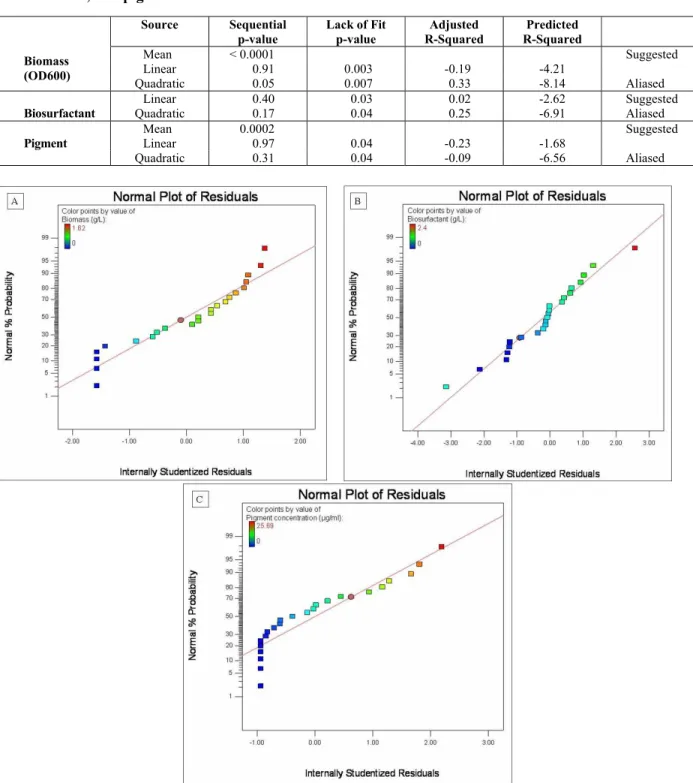
Table 3: Model selection for statistical screening of media components for production of biomass (OD600nm), biosurfactant, and pigment.
Source Sequential p-value
Lack of Fit p-value
Adjusted R-Squared
Predicted R-Squared
Mean < 0.0001 Suggested
Linear 0.91 0.003 -0.19 -4.21
Biomass (OD600)
Quadratic 0.05 0.007 0.33 -8.14 Aliased
Linear 0.40 0.03 0.02 -2.62 Suggested
Biosurfactant Quadratic 0.17 0.04 0.25 -6.91 Aliased
Mean 0.0002 Suggested
Linear 0.97 0.04 -0.23 -1.68
Pigment
Quadratic 0.31 0.04 -0.09 -6.56 Aliased
Figure 2: Normal probability plot of (A) biomass (g/L), (B) biosurfactant (g/L), and (C) pigment (µg/ml) data.
In an ideal case, the points denoting all the devia-tions would pass through a straight line; in other words, the distribution will be normal. In the present study, for all 3 responses, deviations from the ideal case were observed, although biosurfactant data seemed to be better than that of the other two
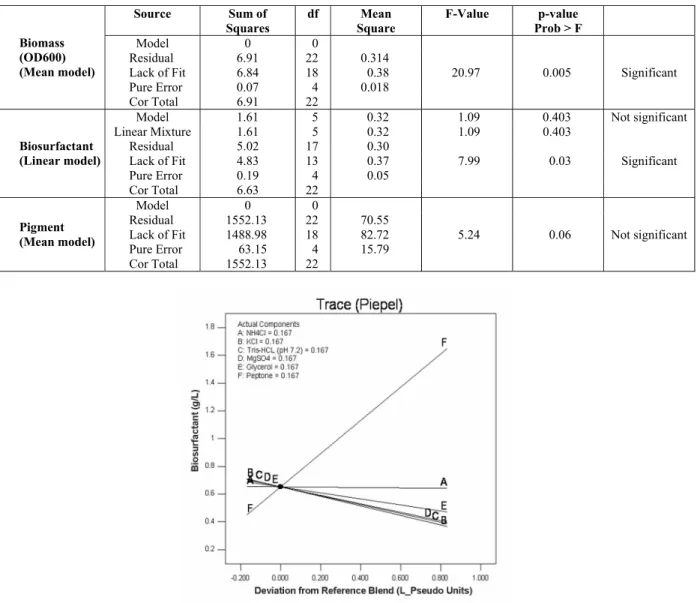
significant improvement was observed in model fit-ting of transformed data values. An analysis of vari-ance (ANOVA) of the mean, linear and mean models of biomass, biosurfactant, and pigment, respectively, is documented in Table 4. In the models for biomass and biosurfactant significant lack of fit was ob-served; hence, some insignificant parameters can be omitted from further experiment and subsequent analy-sis. Since a linear model was employed for biosur-factant, to understand which media-component af-fects biosurfactant production and which does not, a Trace (Piepel) plot was drawn (Figure 3). For biosur-factant production peptone had a huge positive effect while other components, except ammonium chloride,
had a slightly negative effect. Therefore, increasing the concentrations of salts (except NH4Cl) and glycerol
above the concentrations in the reference (i.e., origi-nal), the biosurfactant yield will decrease. NH4Cl had
no effect on biosurfactant yield as such. Hence, in the optimum medium the peptone concentration was more whereas other components had lower concentrations than that of the reference medium composition. For pigment the mean model did not have a significant lack of fit (Table 4) and hence the mean model could describe experimental outcomes well in 23 experi-ments. However, as the model was the mean value model, none of the media components could affect pigment formation in a greater way than one another.
Table 4: Analysis of variance (ANOVA) of mean, linear and mean models of biomass (OD600nm), biosurfac-tant, and pigment respectively.
Source Sum of
Squares
df Mean Square
F-Value p-value Prob > F
Model 0 0
Residual 6.91 22 0.314
Lack of Fit 6.84 18 0.38 20.97 0.005 Significant
Pure Error 0.07 4 0.018
Biomass (OD600) (Mean model)
Cor Total 6.91 22
Model 1.61 5 0.32 1.09 0.403 Not significant
Linear Mixture 1.61 5 0.32 1.09 0.403
Residual 5.02 17 0.30
Lack of Fit 4.83 13 0.37 7.99 0.03 Significant
Pure Error 0.19 4 0.05
Biosurfactant (Linear model)
Cor Total 6.63 22
Model 0 0
Residual 1552.13 22 70.55
Lack of Fit 1488.98 18 82.72 5.24 0.06 Not significant
Pure Error 63.15 4 15.79
Pigment (Mean model)
Cor Total 1552.13 22
As far as literature about biosurfactant production by P. aeruginosa is concerned, some recent reports would be relevant to mention. Kaya et al. (2014) re-ported that out of 26 Pseudomonas isolates from pe-troleum industry waste in Turkey, two P. auruginosa
strains 78 and 99 produced 0.287 and 0.286 g/L rham-nolipid, respectively, in nutrient broth. Patil et al. (2014) optimized complex media for cultivating P. aeruginosa F23 by a conventional method and could maximize rhamnolipid production up to 2.8 g/L. How-ever, literature on production and quantification of pyocyanin pigment production from Pseudomonas is rare. To the best of our knowledge, there is no report till date on pigment production from P. aeruginosa, either on a laboratory scale or commercial scale.
CONCLUSION
A modified medium with 3.5 times higher con-centration of peptone and half concon-centration of glyc-erol and salts compared to the original medium in-creased biosurfactant concentration by two-fold. Pep-tone had a very important role in biomass growth and biosurfactant production. Modification of the origi-nal medium composition did not increase pigment yield. This is the first report on optimization of me-dium composition for pigment production from P. aeruginosa PAO1.
REFERENCES
Arutchelvi, J., Doble, M., Characterization of glyco-lipid biosurfactant from Pseudomonas aerugi-nosa CPCL isolated from petroleum-contami-nated soil. Letters in Applied Microbiology, 51(1), 75-82 (2010).
Coelho, M. A. Z., Amaral, P. F. F., Belo, I., Yarrowia lipolytica: An Industrial Workhouse. Current Re-search, Technology and Education Topics in Ap-plied Microbiology and Microbial Biotechnology, A. Mendez-Vilas (Ed.) FORMATEX (2010). Das, P., Mukherjee, S., Sen, R., Improved
bioavail-ability and biodegradation of a model polyaro-matic hydrocarbon by a biosurfactant producing bacterium of marine origin. Chemosphere, 72, 1229-1234 (2008).
Das, P., Mukherjee, S., Sen, R., Substrate dependent production of extracellular biosurfactant by a ma-rine bacterium. Bioresource Technology, 100, 1015-1019 (2009).
Iglewski, B. H., Pseudomonas. In: Baron's Medical Microbiology. Baron, S. Ed., 4th (Ed.), University of Texas Medical Branch (1996).
Iida, Y., Satoh, I., New application of produced pig-ment from bacteria to detect of ammonia in com-bination with flow injection for ammonia analy-sis. ECS Transactions, 50(12), 385-392 (2013). Kaya, T., Aslim, B., Kariptas, E., Production of
bio-surfactant by Pseudomonas spp. isolated from industrial waste in Turkey. Turkish Journal of Bi-ology, 38, 307-317 (2014).
Moussa, T. A. A., Mohamed, M. S., Samak, N., Pro-duction and characterization of di-rhamnolipid produced by Pseudomonas aeruginosa TMN. Brazilian Journal of Chemical Engineering, 31(4), 867-880 (2014).
Mukherjee, S., Das, P., Sivapathasekaran, C., Sen, R., Enhanced production of biosurfactant by a marine bacterium on statistical screening of nutri-tional parameters. Biochemical Engineering Jour-nal, 42, 254-260 (2008).
Müller, M. M., Hörmann, B., Syldatk, C., Hausmann, R., Pseudomonas aeruginosa PAO1 as a model for rhamnolipid production in bioreactor systems. Applied Microbiology and Biotechnology, 87(1), 167-74 (2010).
Norman, R. S., Moeller, P., McDonald, T. J., Morris, P. J., Effect of pyocyanin on a crude-oil-degrad-ing microbial community. Applied and Environ-mental Microbiology, 70, 4004-4011 (2004). Ozyurek, S. B., Gur, S. D., Bilkay, I. S., Production
of pyocyanin pigment from Pseudomonas aerugi-nosa strains and investigation of the antimicro-bial effect of pyocyanin on other microorgan-isms. Current Opinion in Biotechnology, 22, S113 (2011).
Patil, S., Pendse A., Aruna, K., Studies on optimiza-tion of biosurfactant producoptimiza-tion by Pseudomonas aeruginosa F23 isolated from oil contaminated soil sample. International Journal of Current Bio-technology, 2(4), 20-30 (2014).
Perfumo, A., Banat, I. M., Canganella, F., Marchant, R., Rhamnolipid production by a novel thermo-philic hydrocarbon-degrading Pseudomonas aerugi-nosa AP02-1. Applied Microbial and Biotech-nology, 72,132-138 (2006).
Xu, J., Zhao, X., Wang, W., Du, W., Liu, D., Micro-bial conversion of biodiesel byproduct glycerol to triacylglycerols by oleaginous yeast