ISSN 0104-6632 Printed in Brazil
www.abeq.org.br/bjche
Vol. 32, No. 02, pp. 445 - 454, April - June, 2015 dx.doi.org/10.1590/0104-6632.20150322s00003318
Brazilian Journal
of Chemical
Engineering
DETERMINATION OF THE EFFECTIVE RADIAL
THERMAL DIFFUSIVITY FOR EVALUATING
ENHANCED HEAT TRANSFER IN TUBES UNDER
NON-NEWTONIAN LAMINAR FLOW
A. O. Morais and J. A. W. Gut
*Department of Chemical Engineering, Escola Politécnica, University of São Paulo, P.O. Box 61548, São Paulo, SP, CEP: 05424-970, São Paulo - SP, Brazil.
Phone: + (55) (11) 30912253 E-mail: [email protected]
(Submitted: February 24, 2014 ; Revised: August 15, 2104 ; Accepted: August 20, 2014)
Abstract - Enhanced heat transfer in tubes under laminar flow conditions can be found in coils or corrugated tubes or in the presence of high wall relative roughness, curves, pipe fittings or mechanical vibration. Modeling these cases can be complex because of the induced secondary flow. A modification of the Graetz problem for non-Newtonian power-law flow is proposed to take into account the augmented heat transfer by the introduction of an effective radial thermal diffusivity. The induced mixing was modeled as an increased radial heat transfer in a straight tube. Three experiments using a coiled tube and a tubular heat exchanger with high relative wall roughness are presented in order to show how this parameter can be obtained. Results were successfully correlated with Reynolds number. This approach can be useful for modeling laminar flow reactors (LFR) and tubular heat exchangers available in the chemical and food industries.
Keywords: Heat transfer; Laminar flow; Diffusivity; Laminar flow reactor; Graetz problem.
INTRODUCTION
Heat transfer to non-Newtonian viscous fluids un-der laminar flow in tubes is a recurrent problem in many chemical and food engineering applications, such as laminar flow reactors (LFR), tube sterilizers or tubular heat exchangers. Heat is transferred through the liquid by conduction in the radial direc-tion and by advecdirec-tion and conducdirec-tion in the axial direction. Due to the high consistency of the fluid, free convection is seldom significant (Skelland, 1967; Chhabra and Richardson, 2008).
The well known Graetz problem of laminar flow heat exchange in a straight tube has been extensively studied and various correlations for the Nusselt num-ber, either theoretical or empirical, are available in
the literature for Newtonian and non-Newtonian fluids (Lyche and Bird, 1956; Jones, 1971; Mahalingam et al., 1975; Richardson, 1979; Weigand and Gassner, 2007). In the case of coiled tubes or corrugated tubes under laminar flow, the development of secondary flows improves fluid mixing and, consequently, heat transfer. However, the mathematical modeling of these cases is more complex and studies often rely on empirical correlations (Barba et al., 2002; Vicente et al., 2004; Naphon, 2007; Pimenta and Campos, 2013; Pawar and Sunnapwar, 2013).
work was to adapt the Graetz problem to take into account the heat transfer augmentation in the form of an effective heat transfer diffusivity. In this case, a simpler model could be used to simulate heat transfer in real tubular systems. Three experiments are pre-sented to show how this effective diffusivity can be determined through this simple approach and what the extent of the heat transfer enhancement can be.
An analogous approach was taken by Dantas et al. (2014) to model mass dispersion in laminar flow tubular reactors. Dispersion inducing elements were assumed to increase the radial mass diffusivity in the reactor. By comparing experimental residence time distribution (RTD) data with the model prediction of tracer dispersion in the reactor, it was possible to determine the effective radial mass diffusivity and the mean residence time. With these parameters, the LFR model would provide a more reliable prediction of the RTD of the system, without the need of modeling complex flow distributions in the reactor.
MATHEMATICAL MODELING
The objective is to derive a dimensionless model for the problem of heat transfer to a fluid flowing in a tube under developed laminar flow. A tube with circular cross section, length L and internal radius R is considered. The temperature of the internal surface of the tube is assumed to be uniform (Tw). Firstly, the
Graetz problem is derived for non-Newtonian power-law flow in a straight smooth tube with radial diffu-sion of heat and then the effective radial thermal diffusivity is introduced as a parameter to take into account mechanisms that promote mixing and en-hance heat transfer in laminar flow, such as coiled or corrugated tubes.
The following equation represents the thermal en-ergy conservation for a homogenous liquid with a velocity field vG and a temperature gradient (Bird et al., 2002; Incropera et al., 2006):
(
)
(
)
(
)
(
)
0∂
ρ + ρ ⋅∇
∂
+∇⋅ −ρ α ∇ − =
G G G G P P P V C T
v C T
t
C T q
(1)
where ρ is the density, CP is the specific heat
ca-pacity at constant pressure, k is the thermal con-ductivity, T is the temperature, t is the time and qV is the uniform volumetric thermal energy generation. The terms in Eq. (1), from left to right, represent: 1) the accumulation of thermal energy, 2) the transport
of thermal energy due to advection, 3) the transport of thermal energy due to diffusion and 4) the genera-tion or consumpgenera-tion of thermal energy.
Considering steady-state conditions, uniform thermo-physical properties and negligible thermal energy generation (viscous dissipation), Eq. (1) can be expressed as:
2 0
⋅∇ − α∇ =G
G
v T T (2)
where α = k/(ρCP) is the thermal diffusivity of the
fluid.
Assuming incompressible inelastic flow with de-veloped velocity profile, the fluid velocity would have only one axial component, vz(r). Moreover, the
temperature field can be considered to be axisym-metric around the z axis, i.e., T = T(z,r). Regarding the axial conduction of heat, this transport mecha-nism can be neglected for most engineering applica-tions. In this case, Eq. (2) is reduced to (Chhabra and Richardson, 2008; Bird et al., 2002):
1
0
∂ − α ∂ ⎛ ∂ ⎞=
⎜ ⎟
∂ ∂ ⎝ ∂ ⎠
z
T T
v r
z r r r (3)
which is known as the Graetz problem for heat trans-fer in laminar flow.
In order to solve this differential equation, three boundary conditions are required; which are: 1) speci-fication of the tube inlet temperature (Tin), 2) the
symmetry condition in the center of the tube, and 3) specification of the tube wall temperature (Tw). These
conditions are summarized as:
( )
( )
00, 0 ,= ⎧ = ⎪∂ ⎪ = ⎨ ∂ ⎪ = ⎪⎩ in r w
T r T
T r
T z R T
(4)
The laminar velocity profile depends on the fluid viscosity. The rheological parameters of a power-law fluid are the consistency coefficient K and the flow behavior index n. Since average thermo-physical properties are considered, the temperature effects on the rheological parameters are not taken into ac-count. Consequently, the following power-law veloc-ity profile can be assumed as uniform along the tube (Chhabra and Richardson, 2008):
( )
1 3 1 1 1 + ⎡ ⎤ + ⎛ ⎞⎢ ⎛ ⎞ ⎥ = ⎜ ⎟⎢ −⎜ ⎟ ⎥ + ⎝ ⎠⎢ ⎝ ⎠ ⎥ ⎣ ⎦ n n z m n rv r v
where vm is the bulk velocity, which is related to the
tube pressure drop and the consistency coefficient. The Graetz problem for power-law laminar flow can be expressed in this dimensionless form:
1 2
3 1 1 1
1 0
1
+
⎛ ⎞
+ ∂θ ∂ ∂θ
⎛ ⎞⎜ − ⎟ −⎛ ⎞ ⎛ ⎞= ⎜ + ⎟⎜ ⎟∂ ⎜ ⎟ ∂ ⎜ ∂ ⎟ ⎝ ⎠⎝ ⎠ ⎝ ⎠ ⎝ ⎠ n n n L Y Y
n Z R Pe Y Y Y (6)
using the following dimensionless variables:
− θ = − w
in w
T T
T T , 0≤ θ ≤1 (7a)
= z
Z
L , 0≤ ≤Z 1 (7b)
= r
Y
R , 0≤ ≤Y 1 (7c)
and the parameter Pe:
= αm
L v
Pe (8)
which is the reactor Peclet number. This parameter represents the ratio between the axial transport of thermal energy by advection and the radial transport of thermal energy by diffusion (Fogler, 2006).
By introducing the modified Peclet number for radial diffusion of heat defined as:
2
⎛ ⎞
′ = ⎜ ⎟
α ⎝ ⎠m
L v R
Pe
L (9)
the problem can be expressed in the following form:
1
3 1 1 1
1 0
1
+
⎛ ⎞
+ ∂θ ∂ ∂θ
⎛ ⎞⎜ − ⎟ − ⎛ ⎞= ⎜ + ⎟⎜ ⎟∂ ′ ∂ ⎜ ∂ ⎟ ⎝ ⎠⎝ ⎠ ⎝ ⎠ n n n Y Y
n Z Pe Y Y Y (10)
( )
( )
00, 1
0
,1= 0
⎧θ = ⎪ ∂θ ⎪ = ⎨∂ ⎪ θ = ⎪⎩ Y Y Y Z (11)
This dimensionless problem has two parameters: the flow behavior index of the fluid (n) and the modi-fied Peclet number (Pe′). Alternatively, the modified Peclet number can be expressed as the Graetz num-ber (Dantas et al., 2014):
2
2 4
ρ μ ′
= = = =
μm P αm
D D Dv C L D Lv
Gz RePr Pe
L L k L L (12)
where Re is the Reynolds number, Pr is the Prandtl number, D = 2 R is the tube diameter and μ is the fluid viscosity. However, the Peclet form seems more suitable for diffusivity studies.
The average flow behavior index of the fluid (n) can be obtained from a rheological study correlating shear rate and shear stress for proper temperature and shear conditions. In the case of a Newtonian fluid, n = 1.0. The modified Peclet number for radial diffu-sion of heat (Pe′) can be calculated through Eq. (9) using an average value for the heat diffusivity of the fluid.
The solution of the model provides the tempera-ture distribution in the tube, θ(Z,Y). The mixing cup average temperature in the tube (Tm or θm) can be
evaluated numerically with:
( )
( )
2 1 2 0 22 3 1
1 , 1 + π = π ⎡ ⎤ + ⎛ ⎞⎢ ⎛ ⎞ ⎥ = ⎜ ⎟⎢ −⎜ ⎟ ⎥ + ⎝ ⎠⎢ ⎝ ⎠ ⎥ ⎣ ⎦
∫
∫
z m m n R nv T r dr
T z
v R
n r
T z r r dr
n R
R
(13a)
( )
1 1( )
0
3 1
2 1 ,
1
+
⎛ ⎞
+
⎛ ⎞ ⎜ ⎟
θ = ⎜ ⎟ ⎜ − ⎟θ
+ ⎝ ⎠ ⎝
∫
⎠ n n m nZ Y Z Y Y dY
n (13b)
The average Nusselt number based on the tube di-ameter can be calculated with:
( )
ln 1
′
= = − ⎡⎣θm ⎤⎦
h D
Nu Pe
k (14)
where h is the average convective coefficient. In order to obtain this dimensionless expression for Nu, the following definition of the convective coefficient was employed:
( )
2 1 ln 1 ⎡ ⎤ρ Δ π
= = = ⎢ ⎥
Δ lm π PΔ lm πm α ⎣θm ⎦
q Q C T k v R
h
A T D L T D L (15)
where q is the heat transfer rate, A is the heat transfer area, ΔT is the inlet/outlet change in Tm, ΔTlm is the
log-mean of the temperature difference between Tm
and Tw (LMTD) and Q is the volumetric flow rate
Heat Transfer Enhancement
As discussed in the introduction, the heat transfer to the fluid can be enhanced when using coiled or corrugated tubes. Mixing in laminar flow can also be induced by high relative wall roughness, mechanical vibration or the presence of fittings or curves. Since the mathematical modeling of these systems can be rather complex (Bergles and Joshi, 1983; Pimenta and Campos, 2013), the use of the straight tube model derived in this section with an “effective ra-dial thermal diffusivity” (αeff≥α) is suggested. The
augmentation of the heat transfer due to mixing in laminar flow could be modeled as a higher thermal diffusivity acting in the radial direction. The physical phenomena are different, but this approach could lead to a good approximation of the heat transfer enhancement using a simpler mathematical model. This would leave the model with one empirical pa-rameter to be determined through heat transfer ex-periments in the equipment. In this case, the theoreti-cal Pe′ should be replaced in the model by:
2
⎛ ⎞
′ = ⎜ ⎟
α ⎝ ⎠m
exp eff
L v R
Pe
L (16)
which is an experimental parameter and depends on the effective radial thermal diffusivity.
When the outlet temperature of the fluid is meas-ured (θm(Z=1)), the model in Eqs. (10) and (11) can
be solved to determine the corresponding modified Peclet number. Equation (16) would then provide the effective radial thermal diffusivity (αeff). Since αeff =
keff /(ρCP), the improvement in heat transfer could
also be expressed as an effective radial thermal con-ductivity (keff). Moreover, a heat transfer
enhance-ment factor can be defined as:
α ′
= = =
′ α
eff eff heat
exp
k Pe
F
k Pe (17)
This factor would be useful for the evaluation of corrugated or coiled tubes for improved heat transfer in laminar flow.
MATERIALS AND METHODS
In order to test and validate the proposed model, three heat transfer experiments (A, B1 and B2) were conducted and the enhancement factor in Eq. (17) was determined and analyzed. In Experiment A, a
stainless-steel coiled tube with 9.3 mm internal di-ameter, external 12.7 mm didi-ameter, 200 mL volume and 2.94 m calculated linear length was used. The diameter of the coil was 10.5 cm (eight turns). Ther-mocouples with exposed junctions (IOPE, Brazil) were placed in the inlet and outlet of the tube using union tees (John Guest, UK) and were connected to a cDAQ-9172 data acquisition system with three NI-9211 modules (National Instruments, USA) and a computer running a data-logger software. The outlet thermocouple was placed in a 90º bend to provide mixing to the fluid leaving the coil. Thermocouples were previously calibrated for the temperature range of 0 to 90 ºC.
The coil was connected to the hot water circulat-ing bath of a FT-43A laboratory plate pasteurizer (Armfield, UK). The equipment has a centrifugal pump, a rotameter and a heating element (1.5 kW). Tested volumetric flow rates were Q = 0.3, 0.4, 0.5, 0.6, 0.7, 0.8, 0.9 and 1.0 L/min of distilled water. The coil was immersed in an ice-water bath (27 L) with two propeller mixers and ice was added con-stantly in order to maintain the bath temperature constant and uniform. The temperature of the exter-nal surface of the tube (Text) was assessed with an
exposed junction thermocouple. The average tem-perature of the internal surface of the tube (Tw) was
calculated taking into account the thermal resistance of a cylindrical wall (Incropera et al., 2006):
ln
2
⎛ ⎞
⎜ ⎟
⎝ ⎠
= + π
ext
w ext
tube
R R
T T q
L k (18)
where Rext is the external radius of the tube and ktube
is the thermal conductivity of the metal.
The heat transfer rate across the tube wall (q) was calculated with:
(
)
= ρ P in− out
q Q C T T (19)
where Tin and Tout are the measured inlet and outlet
temperatures of the fluid. The experimental Nusselt number was calculated based on the definition in Eq. (14) with the fluid thermal diffusivity.
Once steady-state operation was verified, the tem-peratures were recorded for 30 s and average values were calculated. Two tests were performed for each flow rate, with inlet temperatures between 50 °C and 65 °C.
process-ing unit (laboratory scale). More details are pre-sented by Dantas et al. (2014). The inner tube has an internal diameter of 4.0 mm and an external diameter of 6.0 mm. The annular space has an internal diame-ter of 21.0 mm. Flow was provided by an eccentric screw pump model 3NE10A (Netzsch, Brazil) and tested flow rates were Q = 20, 30, 40 and 50 L/h. The fluids tested were a 80/20 (w/w) Glycerin/Water mixture in Experiment B1, which has Newtonian behavior, and a 1.0% (w/w) solution of carboxy-methylcellulose (CMC) in Experiment B2, which is a pseudoplastic fluid.
The exchanger of the heating section worked with pressurized hot water and steam injection in a closed loop circuit and a 32-16A centrifugal pump (KSB, Brazil). The cooling section, which was monitored in this study, was connected to a MAS-5-RI-220/C chiller (Mecalor, Brazil) with a cooling power of 5.8 kW and a flow rate between 5 and 6 m3/h. The flow rate was kept at its maximum to provide a uniform wall temperature around the internal tube (vm≈ 9 m/s
in the annulus). The temperature of the external sur-face of the tube was assumed to be equal to the aver-age temperature of the cooling water because of the high velocity in the annular space. The average tem-perature of the internal surface was calculated using Eqs. (18) and (19).
The heat exchanger of the cooling section con-sists of four straight tubes with a total effective length for heat transfer of 6.7 m. The tubes were connected by 180º bends with a diameter of 12.5 cm. The fluid inlet and outlet temperatures were obtained using thermocouples (IOPE, Brazil) and the same data acquisition equipment of Experiment A. Inlet and outlet temperatures of the cooling water were obtained using two thermo-resistances and a tem-perature display (H.Cidade, Brazil). Once steady-state operation was observed, the temperatures were measured for 30 s and average values were calcu-lated.
The dimensionless model presented in Eqs. (10) and (11) was solved using the finite difference method to discretize the variables. For n = 1.0, a first-order backward scheme with 150 equally spaced intervals was used for variable Z (axial) while a sec-ond order centered scheme with 50 intervals was used for variable Y (radial). For the simulations with n < 1.0 or log(Pe′) ≤ 0.0, the number of intervals had to be increased. Different numbers of intervals were tested in order to achieve reliable results with less computational time. The model was implemented in the software gPROMS 3.2 (Process Systems Enter-prise, UK). For each simulation, values of the pa-rameters n and Pe′ were specified.
For determining the experimental values of the modified Peclet number (Pe′exp), this parameter was
treated as a variable in the simulation and the meas-ured outlet temperature was specified as θm(Z=1) to
yield zero degrees of freedom. The enhancement factor was subsequently calculated using Eqs. (16) and (17). Results were correlated with the Reynolds number to analyze the behavior of the heat transfer enhancement. The Reynolds number for tube flow was evaluated with:
ρ =D vμm
Re (20)
For the power-law non-Newtonian flow, Re was calculated using the concept of generalized viscosity
μg instead of the fluid viscosity μ in Eq. (20). The
generalized viscosity is defined as:
(
)
1
1 1
1
−
− ⎛ ⎞ ⎛ υ⋅ + ⎞
μ = ⋅ξ ⎜⎜ ⎟ ⎜⎟ υ + ⋅ ⎟
⎝ ⎠
⎝ ⎠
n n
n m
g
eq
v n
K
D n (21)
where K is the consistency coefficient of the power-law model, Deq is the equivalent diameter of the duct
and ξ and υ are geometrical parameters of the duct (Deq = 2 R, ξ = 8 and υ = 3 for a circular tube)
(Delplace and Leuliet, 1995; Carezzato et al., 2007). Thermo-physical properties of water were evalu-ated using the correlations compiled by Gut and Pinto (2003). Density, heat capacity and thermal conductivity of pure glycerin were obtained from Yaws (2003) and the properties of the glycerin/water mixture were weighted based on the volume fraction (ρ and k) or on the mass fraction (CP). Viscosity of
the glycerin/water mixture was obtained from Cheng (2008). Properties of the CMC solution were deter-mined by this research group and are available else-where (Carezzato et al., 2007). All properties were evaluated at inlet and outlet conditions and the aver-age was used in the calculations.
RESULTS AND DISCUSSION Model Simulation Results
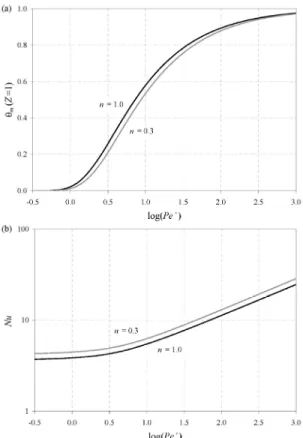
Lower values of Peclet are related to high thermal diffusivities and, thus, to a more efficient heat trans-fer. Figure 2(a) shows the effect of Pe′ on the outlet temperature of the tube. Pseudoplasticity is verified to slightly improve the heat exchange, which can be explained by the flatter velocity profile.
Figure 1: Simulation results for the average tem-perature (θm) as a function of the tube length (Z) and
modified Peclet number (Pe′) for n = 1.0 (black lines) and n = 0.3 (grey lines).
Figure 2: Simulation results showing the effect of the modified Peclet number (Pe′) on (a) the tube out-let temperature and (b) on the Nusselt number for n = 1.0 (black lines) and n = 0.3 (grey lines).
Figure 2(b) presents the effect of Pe′ on the Nusselt number and, for decreasing Pe′, the curve is observed to converge asymptotically to the constant Nusselt value of fully developed flow (velocity and thermal profiles). For n = 1.0, limiting Nusselt in Nu = 3.66 (Incropera et al., 2006). Low values of Pe′ can be associated with long tubes, in which the en-trance effect can be neglected.
Model Validation
Table 1 presents the range of the variables in the experiments. For Experiment A, the Reynolds number varied between 885 at 0.3 L/min to 3856 at 1.0 L/min, thus including the laminar and transition flow regimes. For all conditions, the experimental value of the modified Peclet number was obtained through model simulation with the specification of the outlet dimensionless temperature of the tube as described in the previous section. The enhancement factor was calculated through Eq. (17).
Table 1: Range of the variables in the experimental tests.
Experiment A: Coiled tube with
water
B1: Double pipe exchanger with glycerin/water
mixture
B2: Double pipe exchanger with
1.0% CMC solution
Tin (°C) 52 to 64 60 to 84 58 to 85
Tout (°C) 17 to 32 14 to 25 9.3 to 18
Tw (°C) 16 to 37 6.2 to 8.1 5.7 to 10
q (kW) 0.81 to 1.4 1.0 to 2.4 1.3 to 3.1 vm (m/s) 0.074 to 0.25 0.44 to 1.1 0.44 to 1.1
n (–) 1.0 1.0 0.43 to 0.47 Re (–) 885 to 3856 42 to 200 37 to 170 Pe′exp (–) 0.77 to 2.4 1.7 to 3.3 1.2 to 2.2
Fheat (–) 3.5 to 6.6 1.3 to 2.0 1.1 to 2.1 The results of Experiment A are presented in Figure 3 as a function of the Reynolds number. As expected, there was a significant improvement in the heat transfer because of the coil curves that induce secondary flows and mixture. This problem could be modeled as a straight tube under laminar flow with an effective thermal diffusivity up to six times higher than the actual thermal diffusivity of water. The in-crease in the flow rate caused an inin-crease in the en-hancement factor because of the larger degree of mixing. Because of the small data range and experi-mental error it was not possible to observe in Figure 3 the end of the laminar flow regime and the beginning of the transition flow regime.
rate. The low Reynolds numbers in Table 1 suggest laminar flow regime.
Figure 3: Heat transfer enhancement factor (Fheat) as
a function of the Reynolds number (Re) for Experi-ment A (water cooling in the coiled tube).
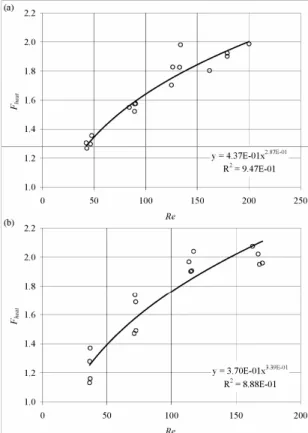
Figure 4 presents the enhancement factor ob-tained in these experiments as a function of the Reynolds number. Once again, an improved heat transfer was observed (Fheat > 1.0) and the
enhance-ment factor also increased with higher flow rates. The effective radial thermal diffusivity was up to two times higher than the fluid thermal diffusivity. This higher heat transfer efficiency in Experiments B1 and B2 can be attributed to the large relative rough-ness of the tube: 0.0018 in / 4.0 mm = 0.011 (Perry and Chilton, 1973). The wall turbulence induced by the tube roughness makes an important contribution to the heat transfer. Moreover, the presence of the 180° bends and the tip of thermocouples along the fluid path also contributed to the fluid mixing.
Dantas et al. (2014) determined the effective mass diffusivity in the same equipment and with the same fluids used in Experiments B1 and B2. RTD data for the isothermal flow of a 80/20 (w/w) glyc-erin/water mixture and 1.0% (w/w) solution of car-boxymethylcellulose (CMC) was obtained for flow rates between 10 and 50 L/h in one hairpin of the exchanger with 3.64 m length. Methylene blue dis-solved in the test fluid was used as tracer and its concentration was assessed by a spectrophotometer. Process modeling was used to simulate the flow dis-persion of the tracer in a LFR with radial mass diffu-sivity and power-law velocity profile. Comparison between experimental data and simulation results provided the effective mass diffusivity, also ex-pressed as a modified Peclet number. Results showed that the radial dispersion was higher than expected in
this equipment, as was verified in this work on ther-mal diffusion. This behavior was also attributed to the large relative roughness of the tube.
Figure 4: Heat transfer enhancement factor (Fheat) as
a function of the Reynolds number (Re) for Experi-ments (a) B1 (glycerin/water mixture) and (b) B2 (CMC solution) in the double pipe heat exchanger.
CONCLUSIONS
The enhanced heat transfer in tubes under laminar flow with induced mixing by the presence of coils, corrugated walls, curves, pipe fittings, high relative wall toughness or mechanical vibration was modeled as a straight tube problem with an effective radial thermal diffusivity. This variable was expressed as a modified Peclet number, a parameter to be deter-mined from heat transfer experiments.
For these experiments, the proposed model could predict the outlet temperature of the tube for a given effective radial thermal diffusivity or enhancement factor (adjusted correlations presented in Figures 3 and 4). However, it was not verified if this simplified model could predict the temperature distribution along the tube with confidence. If experimental data of the average temperature are available at more axial positions, the sum of squared errors on the pre-dicted temperature could be minimized in order to adjust Pe′exp.
The advantage of using the effective thermal dif-fusivity is that a laminar flow reactor that has mixing inducing elements can be modeled as a straight tube reactor without the need of describing a complex geometry or conditions. The work by Kechichian et al. (2012) can be used as an example, where the ther-mal processing equipment for liquid foods used in Experiments B1 and B2 was modeled and simulated as a non-isothermal laminar flow reactor to deter-mine the temperature and lethality distribution along the food product path. The model relies on the ther-mal and mass diffusivities in the food product and the experiments in this work can contribute with important parameters for the process model simula-tion and validasimula-tion. Preliminary data have already shown that the thermal effectiveness of the two heat exchangers is higher than expected because of the enhanced heat transfer to the food product (Dantas et al., 2012).
ACKNOWLEDGMENTS
The authors would like to acknowledge the finan-cial support from the São Paulo Research Foundation (FAPESP) under grant 2009/07934-3.
NOMENCLATURE
A heat transfer area (m2)
CP specific heat capacity at constant pressure
(J/kg K)
D internal diameter of tube (m)
Deq equivalent diameter of duct (m)
Fheat enhancement factor of the radial thermal
diffusivity (–)
Gz Graetz number (–)
h convective coefficient (W/K m2)
k thermal conductivity (W/K m)
keff effective radial thermal conductivity
(W/K m)
ktube thermal conductivity of the
tube (W/K m)
K consistency coefficient (Pa sn)
L tube length (m)
n flow behavior index (–)
Nu Nusselt number (–)
Nuexp experimental Nusselt number (–)
Pe Peclet number (–)
Pe′ modified Peclet number (–)
Pe′exp experimental modified Peclet number (–)
Pr Prandtl number (–)
q heat transfer rate (W)
V
q volumetric thermal energy generation (W/m3)
Q volumetric flow rate (m3/s)
r radial dimension (m)
R internal radius of tube (m)
Rext external radius of tube (m)
Re Reynolds number (–)
t time (S)
T temperature (K)
Text external surface temperature of the tube
(K)
Tin tube inlet temperature (K)
Tm mixing cup average temperature (K)
Tout tube outlet temperature (K)
Tw wall temperature, internal surface of the
tube (K) G
v velocity (m/s)
vm average/bulk velocity (m/s)
vz axial component of velocity (m/s)
Y dimensionless radius (–)
z axial dimension (m)
Z dimensionless length (–)
Greek Letters
α thermal diffusivity (m2/s)
αeff effective radial thermal diffusivity
(m2/s)
ΔT temperature change of the fluid (K)
ΔTlm log-mean temperature difference (K)
θ dimensionless temperature (–)
θm dimensionless mixing cup temperature
(–)
μ viscosity (Pa s)
ξ geometrical parameter of the duct (–)
ρ density (kg/m3)
υ geometrical parameter of the duct (–)
REFERENCES
Barba, A., Rainieri, S. and Spiga, M., Heat transfer enhancement in a corrugated tube. International Communications in Heat and Mass Transfer, 29 (3), p. 313-322 (2002).
Bergles, A. E. and Joshi, S. D., Augmentation Tech-niques for Low Reynolds Number in-Tube Flow. In: Kakaç, S., Shah, R. K. and Bergles, A. E. (Eds.), Low Reynolds Number Flow Heat Ex-changers. Hemisphere Pub. Co., Washington, p. 695-720 (1983).
Bird, R. B., Stewart, W. E. and Lightfoot, E. N., Transport Phenomena. 2nd Ed., John Wiley & Sons, New York, p. 290-332 (2002).
Carezzato A., Alcantara, M. R., Telis-Romero, J., Tadini, C. C. and Gut, J. A. W., Non-Newtonian heat transfer on a plate heat exchanger with generalized configurations. Chemical Engineering and Technology, 30(1) p. 21-26 (2007).
Cheng, N. S., Formula for the viscosity of a glycerol-water mixture. Industrial & Engineering Chemistry Research, 47(9) p. 3285-3288 (2008).
Chhabra, R. P. and Richardson, J. F., Non-Newtonian Flow and Applied Rheology: Engineering Applica-tions. 2nd Ed., Butterworth-Heinemann, p. 316-342 (2008).
Dantas, J. A. T. A., Ferrão, E. S. P. and Gut, J. A. W., Model validation of continuous thermal process-ing of a pseudoplastic food under non-ideal lami-nar conditions. EFFoST Annual Meeting Ab-stracts. Elsevier, Berlin, p. 4.41 (2011).
Dantas, J. A. T. A., Gut, J. A. W. and Pegoraro, P. R., Determination of the effective radial mass diffu-sivity in tubular reactors under non-Newtonian laminar flow using residence time distribution data. International Journal of Heat and Mass Trans-fer, 71, p. 18-25 (2014).
Delplace, F. and Leuliet, J. C., Generalized Reynolds number for the flow of power law fluids in cylindrical ducts of arbitrary cross-section. The Chemical Engineering Journal, 56(2) p. 33-37 (1995).
Fogler, H. S., Elements of Chemical Reaction Engi-neering. 4th Ed., Prentice Hall, Upper Saddle River, p. 945-1005 (2006).
Gut, J. A. W. and Pinto, J. M., Modeling of plate heat exchangers with generalized configurations. In-ternational Journal of Heat and Mass Transfer, 46(14), p. 2571-2585 (2003).
Incropera, F. P., DeWitt, D. P., Bergman, T. L. and Lavine, A. S., Fundamentals of Heat and Mass Transfer. 6th Ed., John Wiley & Sons, New York, p. 485-558 (2006).
Jones, A. S., Extensions to the solution of the Graetz problem. International Journal of Heat and Mass Transfer, 14(4), p. 619.623 (1971).
Kechichian, V., Crivellari, G. P., Gut J. A. W. and Tadini C. C., Modeling of continuous thermal processing of a non-Newtonian liquid food under diffusive laminar flow in a tubular system. Inter-national Journal of Heat and Mass Transfer, 55(21-22), p. 5783-5792 (2012).
Lyche, B. C. and Bird, R. B., Graetz-Nusselt problem for a power-law non-Newtonian fluid. Chemical Engineering Science, 6, p. 35-41 (1956).
Mahalingam, R., Tilton, L. O. and Coulson, J. M., Heat transfer in laminar flow of non-Newtonian fluids. Chemical Engineering Science, 30(8), p. 921-929 (1975).
Naphon, P., Laminar convective heat transfer and pressure drop in the corrugated channels. Interna-tional Communications in Heat and Mass Trans-fer, 34(1), p. 62-71 (2007).
Pawar, S. S. and Sunnapwar, V. K., Experimental studies on heat transfer to Newtonian and non-Newtonian fluids in helical coils with laminar and turbulent flow. Experimental Thermal and Fluid Science, 44, p. 792-804 (2013).
Perry, R. H. and Chilton, C. H., Chemical Engineers’ Handbook. 5th Ed., McGraw-Hill Kogakusha, Tokyo, p. 5.20-5.40 (1973).
Pimenta, T. A. and Campos, J. B. L. M., Heat transfer coefficients from Newtonian and non-Newtonian fluids flowing in laminar regime in a helical coil. International Journal of Heat and Mass Transfer, 58(1-2), p. 676-690 (2013).
Richardson, S. M., Extended Leveque solutions for flows of power law fluids in pipes and channels. International Journal of Heat and Mass Transfer, 22(10), p. 1417-1423 (1979).
Skelland, A. H. P., Non-Newtonian Flow and Heat Transfer. Wiley & Sons, New York, p. 358-433 (1967).
in Heat and Mass Transfer, 31(5), p. 651-662 (2004).
Weigand, B. and Gassner, G., The effect of wall conduction for the extended Graetz problem for laminar and turbulent channel flows. International
Journal of Heat and Mass Transfer, 50(5-6), p. 1097-1105 (2007).