Neuropsychology and Behavior Neurology Unit , Depart ment of Neurology, Facult y of M edical Sciences, St at e Universit y of Campinas (UNICAM P), Campinas SP, Brazil: 1Assist ant Prof essor of Psychology and Neuropsychology, Inst it ut e of Biosciences, Paulist a St at e Universit y (UNESP), Rio Claro S.P, Brazil; 2Associat ed Prof essor of Neurology, UNICAM P, Campinas SP, Brazil. This st udy w as support -ed by FAPESP, São Paulo, Brazil.
Received 11 M ay 2004, received in f inal f orm 3 August 2004. Accept ed 12 August 2004.
Dr. Florindo St ella - Inst it ut o de Biociências/Psicologia - Universidade Est adual Paulist a - CP 199 - 13506-900 Rio Claro SP - Brasil. E-mail: f st [email protected]
INTELLIGENCE FUNCTIONS DISORDERS IN PATIENTS
WITH COM PLEX PARTIAL EPILEPSY
Florindo St ella
1, Jayme Ant unes M aciel
2ABSTRACT - Object ive: To compare t he perf ormance of pat ient s w it h complex part ial epilepsy w it h t he nor-mal cont rols in t he subt est s of an inst rument used t o assess int elligence f unct ion. M et hod: Fif t y epilep-t ic paepilep-t ienepilep-t s, w hose ages ranged f rom 19 epilep-t o 49 years and 20 normal conepilep-t rols w iepilep-t houepilep-t any neuropsychiaepilep-t ric disorders. The Wechsler-Bellevue adult int elligence t est w as applied in groups, epilept ic pat ient s and con-t rol subjeccon-t s. This con-t escon-t is composed of several subcon-t escon-t s con-t hacon-t assess specif ic cognicon-t ive f unccon-t ions. A scon-t acon-t iscon-t ical analysis w as perf ormed using non-paramet ric t est s. Result s: All t he Wechsler-Bellevue subt est s revealed t hat t he int elligence f unct ions of t he pat ient s w ere signif icant ly inf erior t o t hat of t he cont rols (p<0.05). This perf ormance w as support ed by t he pat ient ’s complaint s in relat ion t o t heir cognit ive perf ormance. Conclusion: Pat ient s w it h complex part ial epilepsy present ed poorer result s in t he int elligence t est w hen compared w it h individuals w it hout neuropsychiat ric disorders.
KEY WORDS: epilepsy, cognit ive f unct ions, int elligence.
Dist úrbios das f unções da int eligência em pacient es com epilepsia parcial com plexa
RESUM O - Objet ivo: Comparar o desempenho de pacient es com epilepsia parcial complexa e de sujeit os-cont roles quant o ao desempenho nos subt est es de um inst rument o para avaliação das f unções da int eligên-cia. M ét odo: Foram est udados 50 pacient es epilépt icos em série consecut iva, com idade ent re 19 e 49 anos. Também foram avaliados 20 sujeitos-controles, sem enfermidades neuropsiquiátricas, para efeito compa-rat ivo. Foi aplicado t est e de int eligência para adult os de Wechsler-Bellevue em dois grupos, de pacient es e cont roles. Est e t est e é const it uído de vários subt est es que avaliam f unções cognit ivas específ icas. Os pro-cediment os de análise est at íst ica f oram ef et uados segundo t est es não-paramét ricos. Result ados: Em t odos os subt est es do Wechsler-Bellevue, os pacient es apresent aram desempenho das f unções da int eligên-cia signif icat ivament e inf erior ao dos cont roles (p<0,05), result ados corroborados pelas queixas dos mes-mos quant o às f unções cognit ivas. Conclusão: Pacient es com epilepsia parcial complexa apresent aram result ados signif icat ivament e inf eriores no t est e de int eligência quando comparados aos dos sujeit os sem epilepsia.
PALAVRAS-CHAVE: epilepsia, f unções cognit ivas, int eligência.
Complex part ial epilepsy is manif est ed by vario-us psychopat hological condit ions such as psycho-tic symptoms1, depressive disorders2, “
pseudo-seizu-res” t ype disorders, and ot hers1,3. Generally, t hese
psychopat hological alt erat ions ref lect a f unct ional disorder of t he limbic syst em2. Pat ient s w it h t his
t ype of epilepsy and acut e compromise of t he hip-pocampus also t end t o present cognit ive disorders, especially verbal memory disorders4, altered
perspec-tive activity and semantic memory for language con-t encon-t5. At t ent ion disorders have also been
associ-at ed w it h an epilept ic condit ion6, and during
child-hood, temporal lobe epilepsy, besides attention dis-orders, may also int erf ere in t he learning process7.
Ot her cognit ive processes such as organizat ion of logical t hinking as w ell as reasoning st ruct ure and expression may be aff ect ed in pat ient s w it h t empo-ral lobe epilepsy8.
Theref ore Aikia et al.9applied t he WAIS-R t est
(Wechsler Adult Int elligence Scale Revised) t o 56 adult pat ient s w it h complex part ial epilepsy and verif ied t hat 52% present ed alt ered cognit ive f unc-tions. Using the WAIS-R, Williamson et al.10also
capac-ity in patients with temporal lobe epilepsy. Obviously, several f act ors such as t he nat ure, severit y, chronici-ty and frequency of the seizures, involvement of bra-in structures, neurotoxicity of the antiepileptic drugs and t he pat ient ’s psychosocial dif f icult ies are res-ponsible f or det ermining alt erat ions in t he cognit i-ve f unct ion of epilept ic pat ient s8,11.
This research w as undert aken w it h t he purpose of studying the performance of the intelligence f unc t ions in pat ient s w it h complex part ial epilepsy and comparing t his perf ormance w it h t hat of individu-als w it hout t his clinical condit ion.
M ETHOD
Subject s – A st udy w as conduct ed on 50 consecut ive pat ient s, aged bet w een 19 and 49 years, w it h complex part ial epilepsy and under f ollow -up at t he Out pat ient ’s Epilepsy Unit , St at e Universit y of Campinas, UNICAM P. A cont rol group of 20 individuals w it hout epilepsy or any ot her neurological or psychiat ric disorder and w it h simi-lar socioeconomic condit ions, cult ural level, educat ion and in t he same age group as t he pat ient s w ere evalua-t ed f or comparaevalua-t ive purposes.
The research obeyed t he et hical st andards set by t he Service and t he individuals w ere volunt eers w ho part ici-pat ed af t er signing an inf ormed consent .
M et hodology
Criteria for inclusion and exclusion – Patients who par-t icipapar-t ed in par-t his spar-t udy had complex parpar-t ial epilepsy, used ant iepilept ic medicat ion regularly and t he serum levels w ere maint ained w it hin t he t herapeut ic range. Pat ient s had t o be f ree f rom any neuropsychiat ric disorders t hat may compromise t heir cognit ive f unct ions. Pat ient s w ho used ant iepilept ic medicat ion irregularly or ant iepilep-t ic serum dose levels iepilep-t haiepilep-t w ere noiepilep-t in conf ormiiepilep-t y w iiepilep-t h the recommended therapy and also those with psychopa-t hological symppsychopa-t oms such as depression, psychopsychopa-t ic disor-ders or any other symptom that may interfere in their cog-nit ive perf ormance w ere excluded. A det ailed clinical in-t erview and in-t he M onin-t gomery-Asberg depression rain-t e scale12, adapt ed f or t he Brazilian populat ion by Dract u
et al.13w ere applied t o ident if y t hese psychopat
hologi-cal sympt oms, especially depression. Theref ore, t he f inal sample consist ed of 50 pat ient s. The clinical int erview and t he above cit ed depression scale w as also applied t o t he cont rol subject s so t hat individuals w it h neuropsy-chiat ric disorders could be excluded. This result ed in a cont rol group w it h 20 individuals.
Clinical diagnosis – The clinical diagnosis of complex part ial epilepsy by t he t eam t hat regularly at t ends pa-t ienpa-t s apa-t pa-t he Epilepsy Ambulapa-t ory Unipa-t included pa-t ype of seizure, dat e of onset , seizure f requency, ant iepilept ic medication, serum dosage (whether within the therapeu-t ic range or notherapeu-t ) and electherapeu-t roencephalogram charactherapeu-t eris-t ics (inieris-t iaeris-t ing in eris-t he eris-t emporal region). Oeris-t her
procedu-res request ed w ere magnet ic procedu-resonance t o verif y t he pre-sence of st ruct ural lesions in t he mesial regions of t he t emporal lobe and t he int erict al brain SPECT t o check hypoperf usion in t hese regions.
Neuropsychological assessment – According to the cri-t eria adopcri-t ed in cri-t his scri-t udy, incri-t elligence is characcri-t erized by integrated cognitive processes that include the capaci-t y capaci-t o coherencapaci-t ly organize inf ormacapaci-t ion as w ell as under-stand and reach a logical inference when faced with chal-lenging sit uat ions, perceive and st ruct ure environmen-t al senvironmen-t imulus, perf orm logical-arienvironmen-t hmeenvironmen-t ic operaenvironmen-t ions, asso-ciat e ideas, execut e act ivit ies and cognit ively program behavior. This ment al process is verif ied by t he Wechsler-Bellevue adult intelligence test (adapted for the Brazilian population by Moraes, Andrade and Alves, s/d; apud Stel-la14and is t he neuropsychological inst rument used in t his
st udy. The Wechsler-Bellevue adult int elligence scale has t he same subt est s as t he revised t est (WAIS-R) and is also similar t o each ot her w it h regard t o int ernal st ruc-t ure and objecruc-t ives. The main diff erence beruc-t w een ruc-t hem is t he manner in w hich t he subt est s are execut ed by t he individual. The Wechsler-Bellevue is easier t o apply, qui-cker and less t iring t han t he WAIS - R. This inst rument is composed of several subtests that evaluate certain intel-ligence f unct ions: 1) St ory arrangement : t he capacit y t o logically int erpret st imuli, arrange visual images and ver-bal language in correct st ory sequence. 2) Comprehen-sion: t he capacit y t o logically int erpret cont ent , make in-f erences and resolve problem-sit uat ions. 3) Figure com-plet ion: abilit y t o perceive, elaborat e and coherent ly organize and const ruct logical t hinking. 4) Arit hmet ic reasoning: capacit y f or logical arit hmet ic reasoning and t he abilit y t o perf orm mat hemat ical operat ions. 5) Simi-larit ies: associat ing ideas, analyzing det ails, est ablishing relat ionships bet w een st imuli regarding similarit ies and differences. 6) Mosaic: executive functions such as concen-t raconcen-t ed aconcen-t concen-t enconcen-t ion, consconcen-t rucconcen-t ing cogniconcen-t ive ideas, visual-spa-t ial percepvisual-spa-t ion, spavisual-spa-t ial-logical reasoning and abilivisual-spa-t y visual-spa-t o self correct behavior w henever necessary. 7) Coding pat -t ern: execu-t ive f unc-t ions such as concen-t ra-t ed a-t -t en-t ion, cognit ive programming and visual-percept ual capacit y. All 50 pat ient s and t he 20 cont rol individuals underw ent t he same Neuropsychological Assessment bat t ery.
St at ist ical analysis – The st at ist ical assessment , w hich w as perf ormed by t he Research Commission, Facult y of M edical Sciences, UNICAM P, used t he non-paramet ric M ann - Whit ney and chi-square t est s w it h signif icance
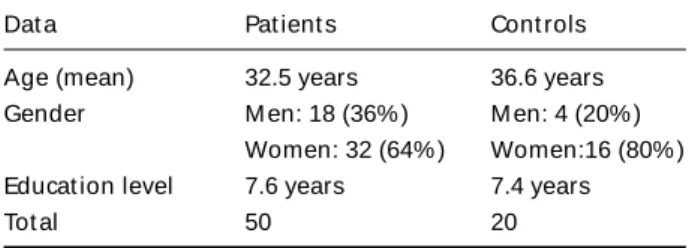
Table 1. Social and demographic dat a of pat ient s and cont rols.
Dat a Pat ient s Cont rols
Age (mean) 32.5 years 36.6 years Gender M en: 18 (36% ) M en: 4 (20% )
Women: 32 (64% ) Women:16 (80% ) Educat ion level 7.6 years 7.4 years
observed bet w een pat ient s and cont rols w hen t hese f act ors w ere compared (age: p=0.08; educa-t ion p=0.06; M ann-Whieduca-t ney nonparameeduca-t ric educa-t eseduca-t ). Table 1 displays t he social and demographic dat a.
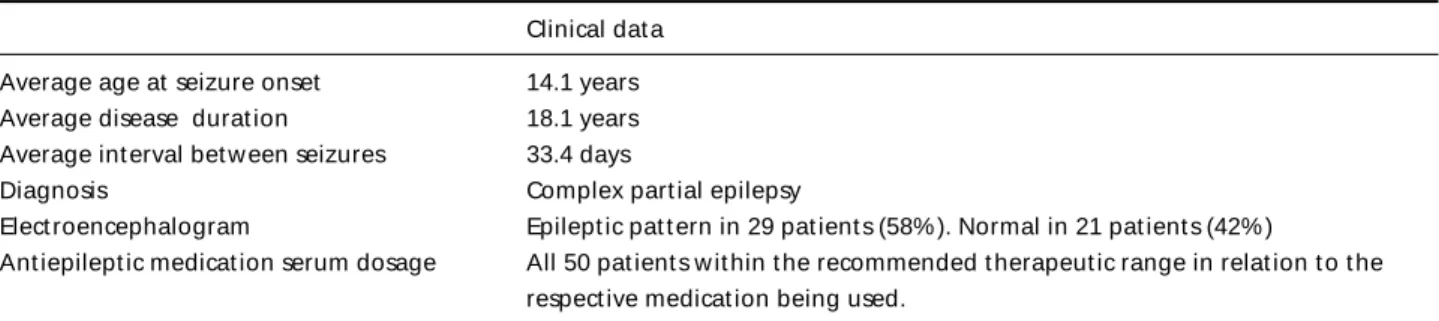
Clinical dat a and subsidiary exams – All t he pa-t ienpa-t s presenpa-t ed complex parpa-t ial epilepsy w ipa-t h ove-rall onset of seizure during adolescence, around t he age of 14.1 years. The chronic epilept ic condit ion w hen t his st udy w as being conduct ed revealed an average durat ion of 18.1 years w it h relat ively f re-quent interictal intervals of 33.4 days (mean) between one ictal episode and the other. Although all the pa-t ienpa-t s w ere clinically diagnosed as complex parpa-t ial epilepsy by t he t eam of neurologist s at t he Epilepsy Outpatients Unit, the encephalogram displayed t ra-ces t hat w ere compat ible w it h t his condit ion in 29 pat ient s (58% ), w hile in t he remaining 21 pat ient s, t he t races w ere considered w it hin t he limit s of nor-malit y. Table 2 displays t hese dat a.
Assessment of int elligence f unct ions (Figure) – The perf ormance of int elligence f unct ions presen-ted by the patients in all the Wechsler-Bellevue sub-t essub-t s w as inf erior sub-t o sub-t hasub-t of sub-t he consub-t rols and sub-t he diff erence bet w een t he groups w as st at ist ically sig-nif icant (p<0.05; nonparamet ric M ann-Whit ney t est ). Figure displays t hese dat a.
The dif f erence bet w een pat ient s and cont rols w as part icularly signif icant , more so w it h regard t o t he subt est s Coding, Comprehension, st ory ar-rangement and mosaic. Likew ise, t he pat ient s’ per-f ormance w as also poorer t han t he cont rols in t he subt est s f igure complet ion, arit hmet ic reasoning and similarit ies. Alt hough t his dif f erence w as st a-t isa-t ically signif icana-t , ia-t w as smaller a-t han in a-t he pre-vious subt est s. These dat a are present ed in Table 3.
Pat ient s, w ho present early complex part ial sei-zures and a longer epileptic condition, concomitan-t ly presenconcomitan-t cogniconcomitan-t ive concomitan-t ype of complainconcomitan-t s. The sconcomitan-t aconcomitan-t is-tical analysis confirmed a correlation between
chro-value at 5% (p=0.05) t o assess t he correlat ions of t he va-riables and cat egories.
RESULTS
Social and demographic dat a – Age and educa-t ional level w ere pareduca-t icularly relevaneduca-t f aceduca-t ors in educa-t he cont ext of t he neuropsychological assessment . In t his st udy, no signif icant st at ist ical dif f erence w as
Fig. Weschler-Bellevue subt est s compared in a group of 50 par-t ial complex epilepsy papar-t ienpar-t s and 20 normal conpar-t rols. Spar-t ; spar-t o-ries, C; comprehension, FC; f igure complet ion, AR; arit hmet ic reasoning, S; similarit ies, M ; mosaic, Cd; Coding.
Table 2. Clinical dat a of 50 epilept ic pat ient s.
Clinical dat a Average age at seizure onset 14.1 years Average disease durat ion 18.1 years Average int erval bet w een seizures 33.4 days
Diagnosis Complex part ial epilepsy
Elect roencephalogram Epilept ic pat t ern in 29 pat ient s (58% ). Normal in 21 pat ient s (42% )
Ant iepilept ic medicat ion serum dosage All 50 pat ient s w it hin t he recommended t herapeut ic range in relat ion t o t he respect ive medicat ion being used.
Table 3. The Wechsler-Bellevue scale: a comparison result s in cont rols and pat ient s w it h complex part ial epilepsy.
Subt est s Pat ient s Cont rols p
(N=50) (N=20)
St ories 13.7 18.7 0.0021*
Comprehension 3.1 5.7 0.0015*
Figure complet ion 4.2 5.7 0.0464*
Arit hmet ic reasoning 3.3 5.2 0.0338*
Similarit ies 2.8 5.0 0.0210*
M osaic 21.3 29.9 0.0075*
Coding 20.0 29.2 0.0001*
nic epilepsy and t he subt est s, but t his correlat ion w as not st at ist ically signif icant (p>0.05; M ann-Whi-t ney nonparameann-Whi-t ric ann-Whi-t esann-Whi-t ).
Comprehension w as t he subt est most af f ect ed by f requent seizures and t he correlat ion bet w een t hese t w o variables w as st at ist ically signif icant (p=0.0345; M ann-Whit ney nonparamet ric t est ). A correlat ion w as also observed bet w een f requen-cy of seizures and t he rest of t he subt est s, but w i-thout significance (p>0.05; Mann-Whitney nonpara-met ric t est ).
The mean age of t he pat ient s at seizure onset w as 14.1 years, w hich meant onset w as during ado-lescence and w hile t he st udy w as being conduct ed, t he durat ion of t his epilept ic condit ion in 13 pa-t ienpa-t s (26% ) w enpa-t up pa-t o 10 years and in pa-t he case of 37 pat ient s (74% ) t he durat ion w as great er. The subt est perf ormance of pat ient s w it h over 10 years of chronic seizure w as more aff ect ed t han in t he ca-se of pat ient s w it h a short er durat ion of t he epilep-tic condition, but the difference between these two groups of pat ient s w as not st at ist ically signif icant (p>0.05; chi-square t est ).
Wit h regard t o t he f requency of seizures, t he dat a reveals a dist inct ion bet w een t w o groups of pat ient s: one group of 35 pat ient s (70% ) w it h an int erict al int erval of up t o 30 days and t he ot her group of 15 pat ient s (30% ) w it h an int erict al int er-val of 31 days or more. The group of patients with a short er int erict al int erval (up t o 30 days) present ed great er compromise in t he subt est s t han t hose w i-t h a larger ini-t erval (31 days or more). How ever, i-t he difference between both groups was not statistical-ly signif icant (p>0.05; chi-square t est ).
DISCUSSION
Our result s are in accordance w it h t hose obt ai-ned by other investigations in which neuropsycholo-gical assessments, particularly the WAIS-R, were per-formed in adult patients with temporal lobe epilep-sy. These invest igat ions, in general, aimed at over-all alt erat ions of cognit ive f unct ions10,15-17. Ot her
aut hors have highlight ed disorders t hat are specif i-cally related to semantic memory and associated with hippocampus disrupt ion9,18-20.
The perf ormance of t he pat ient s in our st udy w as signif icant ly poorer t han t hat of t he cont rols in relation to the Wechsler-Bellevue intelligence test. A signif icant dif f erence w as observed bet w een both groups, but in the case of the subtests compre-hension, st ories, mosaic and coding, t he dif f eren-ce w as more aceren-cent uat ed. The mosaic and coding
subtests evaluate executive functions. Mental orga-nizat ion and t he expression of t hese f unct ions in-volve several psychic processes such as cognitive pro-gramming of sequent ially const ruct ed logical ac-t ions, concenac-t raac-t ed aac-t ac-t enac-t ion capaciac-t y and visu-al–spat ial percept ion. The subt est comprehension, in t urn, evaluat es t he inf erence of several ment al processes such as t he capacit y t o underst and con-t encon-t con-t hacon-t demands ref ined logical incon-t erprecon-t acon-t ion due t o it s complexit y. It also invest igat es t he skill f or seeking solut ions t o overcome challenges such as problem-sit uat ions. The subt est st ory arrange-ment allow s t he inf erence of several arrange-ment al mech-anisms such as t he capacit y f or logical int erpret a-t ion of complex sia-t uaa-t ions and a-t he capacia-t y of a-t he individual to coherently organize cognitive content. It also assesses t he st ruct ure of t hought s verbally expressed.
In the other subtests-figure completion, arithme-tic reasoning and similarities, the logical performance present ed by t he pat ient s w as signif icant ly inf erior t o t hat of t he cont rols, but t he diff erence bet w een t he t w o groups w as less accent uat ed t han in t he previous subt est s. It should be highlight ed t hat t he subt est f igure complet ion invest igat es t he abilit y of t he individual t o coherent ly organize t he dat a obt ained t hrough t his t ype of percept ion.
The subt est arit hmet ic reasoning evaluat es t he individual’s capacit y t o elaborat e operat ions t hat process calculat ion and t he qualit y of mat hemat i-cal-logical t hinking. The subt est similarit ies inf er t he individual’s capacit y t o est ablish a relat ionship bet w een ideas, analyze det ails of a cert ain pheno-menon and globally correlat e all t hese det ails. It al-so assesses similar and dissimilar relat ionships of t his phenomenon.
A comparison bet w een int erict al int ervals and subt est perf ormance revealed t hat pat ient s w it h int ervals of less t han 30 days demonst rat ed cogni-t ive perf ormance inf erior cogni-t o cogni-t hacogni-t of pacogni-t iencogni-t s w icogni-t h larger int ervals, even t hough t he dif f erence bet -w een bot h groups -w as not st at ist ically signif icant . How ever, pat ient s w it h int erict al int ervals of less t han 30 days present ed relevant subject ive cognit i-ve complaint s and more f requent ly t han pat ient s w it h longer int ervals.
icul-t ies, especially in paicul-t ienicul-t s w iicul-t h more icul-t han 10 years of disease durat ion. Alt hough our st udy did not re-veal a st at ist ically signif icant correlat ion bet w een disease durat ion and cognit ive compromise, ot her st udies have suggest ed t hat chronic complex par-tial epilepsy may cause cognitive disorders, especial-ly in t he case of short t erm memory21.
The mean age of seizure onset in our st udy w as 14.1 years, w hich dif f ered f rom ot her st udies t hat verified seizure onset before the age of five22,23. Early
onset seizures t hat ext end f or a long t ime reveal more accent uat ed compromise of brain f unct ion and an increased risk of aggravat ion of t he cogni-t ive f unccogni-t ions24.
It is import ant t o underscore t he f act t hat cogni-t ive accogni-t ivicogni-t y cogni-t ends cogni-t o suff er incogni-t erf erence f rom vari-ous f act ors t hat cannot alw ays be cont rolled and interfere in the patient’s cognitive performance. So-me of t hese f act ors are out st anding such as neuro-pat hological compromise sub-adjacent t o seizures, t ype of seizure, age at onset , f requency of seizures, elect roencephalographic pat t ern8,11. Ant iepilept ic
drugs, especially t he older ones like phenobarbi-tal, may also have a harmful effect on overall cogni-t ive f unccogni-t ioning, compromising several f unccogni-t ions such as concentrated attention, alertness, recent me-mory, visual-spat ial meme-mory, capacit y f or problem resolut ion and rout ine act ivit y8,11,25. Alt hough t hese
subst ances harm cognit ive f unct ions, epilept ic sei-zure control, particularly with the more recent drugs and a monot herapeut ic regimen, cont ribut es t o-w ards t he preservat ion of cognit ive qualit y26,27.
Be-sides t his, several st udies have demonst rat ed t hat uncont rolled epilepsy present s great er risk of cog-nit ive compromise t han medicat ion-cont rolled sei-zures, especially t he more recent medicat ions10,20,28.
Finally, patients with complex partial epilepsy pre-sent signif icant compromise of int elligence f unc-tions according to the Wechsler-Bellevue Intelligen-ce Test w hen compared w it h individuals w it hout t his clinical condit ion. Poorer perf ormance by t hese pat ient s is probably due t o t he int erf erence of va-rious f act ors t hat simult aneously inf luence cognit i-ve perf ormance such as t ype of seizure, onset age, seizure f requency, elect roencephalographic pat -tern, presence of structural alterations in the mesial region of the temporal lobe, antiepileptic drugs etc. Furt her research on t he int erf erence of t hese f ac-t ors in ac-t he organizaac-t ion of inac-t elligence f uncac-t ions would enhance information regarding the relation-ship bet w een epilepsy and cognit ion.
REFERENCES
1. Kristensen O, Alving J. Pseudoseizures: risk factors and prognosis. Acta Neurol Scand 1992;85:177-180.
2. Perini GI, Tosin C, Carraro C, et al. Interictal mood and personality disor-ders in temporal lobe epilepsy and juvenile myoclonic epilepsy. J Neurol Neurosurg Psychiatry 1996;61:601-605.
3. Oana Y. Epileptic seizures and pseudoseizures from the viewpoint of the hierarchy of consciousness. Epilepsia 1998;39(Suppl 5):S21-S25. 4. Hermann BP, Wyler AR, Richey ET, Rea JM. Memory function and
verbal learning ability in patients with complex partial seizures of tem-poral lobe origin. Epilepsia 1987;28,547-554.
5. Engel J. Introduction to temporal lobe epilepsy. Epilep Res 1996;26:141-150.
6. Stella F., Maciel JA. Attentional disorders in patients with complex partial epilepsy. Arq Neuropsiquiatr 2003;61:355-358.
7. Croona C, Kihlgren M, Lundberg S, Eeg-Olofsson O, Eeg-Olofsson KE. Neuropsychological findings in children with benign childhood epilep-sy with centrotemporal spiles. Dev Med Child Neurol 1999;41:813-818. 8. Binnie CD, Channon S, Marston D. Learning disabilities in epilepsy:
neurophysiological aspects. Epilepsia 1990;31(Suppl 4):S2-S8. 9. Aikia M, Kalviainen R, Riekkinen P. Verbal learning and memory in
new-ly diagnosed partial epilepsy. Epilep Res 1995;22:157-164.
10. Williamson PD, French JA, Thadani M, et al. Characteristics of medi-cal temporal lobe epilepsy: II. Interictal and ictal smedi-calp electroencep-halography, neuropsychological testing, neuroimaging, surgical results, and pathology. Ann Neurol 1993;34:781-787.
11. Motamedi G, Meador K Epilepsy and cognition. Epilep Behav 2003;4(Suppl 2):S25-S38.
12. Montgomery AS, Asberg MNew depression scale designed to be sensiti-ve to change. Br J Psychiatry 1979;134:382-389.
13. Dractu L, Ribeiro LC, Calil HM. Escalas de avliação da depressão e sua utilidade clínica: Hamilton, Montgomery-Asberg e visual-análoga do humor. Rev Assoc Bras Psiquiatria 1985;7:59-65.
14. Moraes R. Teste de inteligência de adultos de Wechsler-Bellevue. CEL-PA - Centro de Psicologia Aplicada. In Stella F. Distúrbios cognitivos na epilepsia. Tese de Doutorado. Universidade Estadual de Campinas. Campinas, 1998;102-109.
15. Verma NP, Twitty GR, Fuerst DR. Event-related potentials in complex partial seizures. Brain Topogr 1993;6:35-41.
16. Selwa LM, Berent S, Giordani B, Henry TR, Buchtel HA, Ross DA. Se-rial cognitive testing in temporal loge epilepsy: longitudinal changes with medical and surgical therapies. Epilepsia 1994;35:743-749. 17. Jokeit H, Ebner A. Long term effects of refractory temporal lobe
epilep-sy on cognitive abilities: a cross sectional study. J Neurol Neurosurg Psychiatry 1999;67:44-50.
18. Kilpatrick C, Murrie V, Cook M, Andrewes D, Desmond P, Hopper J. Degree of left hippocampal atrophy correlates with severity of neuropsy-chological deficits. Seizure 1997;6:213-218.
19. Baxendale SA. The role of the hippocampus in recognition memory. Neuropsychologia 1997;35:591-598.
20. Hermann BP, Seidenberg M, Schoenfeld J, Davies K. Neuropsychological characteristics of the syndrome of mesial temporal lobe epilepsy. Arch Neurol 1997;54:369-376.
21. Mataro-Serrat M, Junque-Plaja C. Memory and epilepsy. Rev Neurol (Barc) 1997;25:1241-1245.
22. O’Lery DS, Lovell MR, Sackellares JC, et al. Effects of age of onset of partial and generalized seizures on neuropsychological performance in childern. J Nerv Mental Dis 1983;17:624-629.
23. Rodin EA, Schmaltz S, Twitty G. Intellectual function in patients with childhood epilepsy. Dev Med Child Neurol 1986;28:25-33.
24. Aldenkamp AP. Effect of seizures and epileptiform discharges on cogni-tive function. Epilepsia 1997;38(Suppl 1):S52-S55.
25. Sabers A, Moller A, Dam M, Smed A, et al. Cognitive function and anti-convulsivant therapy: effect of monotherapy in epilepsy. Acta Neurol Scand 1995;92:19-27.
26. Powell AL, Yudd A, Zee P, Mandelbaum DE. Attention deficit hperac-tivity disorder associated with orbitofrontal epilepsy in a father and a son. Neurpsych Neuropsychol Behav Neurol 1997;10:151-154. 27. Helmstaedter C, Kurthen M, Lux S, Reuber M, Elger CE. Chronic
epile-psy and cognition: a longitudinal study in temporal lobe epileepile-psy. Ann Neurol 2003;54:425-432.