w w w . r b h h . o r g
Revista
Brasileira
de
Hematologia
e
Hemoterapia
Brazilian
Journal
of
Hematology
and
Hemotherapy
Original
article
Could
CD64
expression
be
used
as
a
predictor
of
positive
culture
results
in
children
with
febrile
neutropenia?
Gustavo
Göhringer
de
Almeida
Barbosa
a,∗,
Mariela
Granero
Farias
a,
Helena
Cocolichio
Ludwig
b,
Isabel
Stensmann
c,
Matheus
Vanzin
Fernandes
c,
Mariana
Bohns
Michalowski
c,d,
Liane
Esteves
Daudt
aaUniversidadeFederaldoRioGrandedoSul(UFRGS),PortoAlegre,RS,Brazil
bPontifíciaUniversidadeCatólicadeRioGrandedoSul(PUCRS),PortoAlegre,RS,Brazil cUniversidadeFederaldeCiênciasdaSaúdedePortoAlegre(UFSCPA),PortoAlegre,RS,Brazil
dHospitaldaCrianc¸adeSantoAntonio,SantaCasadeMisericórdiadePortoAlegre,PortoAlegre,RS,Brazil
a
r
t
i
c
l
e
i
n
f
o
Articlehistory:
Received23June2015 Accepted21August2015 Availableonline9October2015
Keywords:
Sepsis
Febrileneutropenia AntigensCD64 Flowcytometry Creactiveprotein
a
b
s
t
r
a
c
t
Background:Earlyrecognitionofinfectiousprocessesinneutropenicpatientsishamperedby thefactthattheseprocessesmayhavedissimilarandnon-specificclinicalpresentations. CD64isaneutrophilsurfacemarkerthatisnotexpressedinnon-sensitizedneutrophils. Whentheneutrophilisexposedtotumornecrosisfactor-alphaitisactivatedandis mea-suredviatheCD64index.
Methods:ThispaperevaluatedtherelationshipbetweentheindexvalueofCD64onthe firstdayoffebrileneutropeniaandapositivebloodculture.Thecorrelationswithwhite bloodcount,C-reactiveproteinanderythrocytesedimentationratewerealsoevaluated. Thiscase–control,prospective,diagnosticstudyincluded64episodesofneutropenia.Case group(n=14)comprisedpositivebloodcultures,andthecontrolgroup(n=50),negativeblood cultures.
Results:ThemedianratesofCD64were2.1(±3.9)inthecasegroupand1.76(±5.02)in thecontrolgroup.TherewasnocorrelationbetweenthevalueoftheCD64indexandblood cultures.TheCD64indexwasalsonotcorrelatedwithC-reactiveproteinpositivity. Further-more,theCD64indexwasnotabletopredictbloodculturepositivity.Thesensitivitywas 64.3%,thespecificitywas42%,thepositivepredictivevaluewas23.7%andthenegative pre-dictivevaluewas80%.ForC-reactiveprotein,thesensitivity,specificity,positivepredictive value,andnegativepredictivevaluewere71.4%,32%,22.7%,and80%,respectively.
Conclusion: TheCD64indexisnotsuitableforpredictingthepositivityofbloodculturesin thisspecificpopulationofpatientswithfebrileneutropenia.
©2015Associac¸ãoBrasileiradeHematologia,HemoterapiaeTerapiaCelular.Published byElsevierEditoraLtda.Allrightsreserved.
∗ Correspondingauthorat:Av.AltosdoSantaRita,441,PortoAlegre,RS,Brazil.
E-mailaddress:[email protected](G.G.d.A.Barbosa).
http://dx.doi.org/10.1016/j.bjhh.2015.08.011
Introduction
Thetreatmentofchildhoodcancerisoneofthemajor suc-cessstories of healthcareatthe end of the 20thcentury.1
Nevertheless,oneinevery25childrenwithcancerdiesfrom thecomplicationsoftreatment,correspondingtooneinevery sixdeaths.2,3Infectionfrequentlymanifestsasfeverand
neu-tropenia,whichisknownas‘febrileneutropenia’.4
Somestudieshaveshownthattheincidenceofsepticshock amongchildren with febrile neutropenia and positive cul-turesisapproximately19%andthatculturesarepositivein 83% ofthe patients requiring intensive care.5–7 Early
diag-nosisofinfection allowsthe immediateonset ofantibiotic treatment,withconsequentimprovementofsurvivalinthis patientpopulation.8
Accordingtoavailableevidence,thewhitecellcountisa poortestfordistinguishingtheinfectiontypeinpatientswith neutropenia.Nevertheless,somestudieshavereportedthat anabsoluteneutrophilcountlessthan0.1×109/Lisan
inde-pendentpredictorofsepsisinsevereneutropenicpatients.9
C-reactiveprotein(CRP)andprocalcitoninareproducedas apartoftheinflammatoryresponse.Bothproteinsarewidely usedintheclinicalpracticeinthediagnosisandmanagement ofpatientswith sepsis.BecauseCRP levelsincrease inthe acutephaseofinflammation,this proteiniswidelyusedto detectactiveinfectious-inflammatoryprocesses,particularly inthepediatricsetting.10
TheresultsofCRPtestingarecontroversial,andthe sensi-tivityandspecificityoftheassayarelimited.11–13Detectionof
thisproteinseemstobemoreusefulattheonsetof inflam-mation,particularlywithinthefirst24h,asitssensitivityis higheratthis stagecompared tothatin thelate stagesof sepsis.14
CD64isamembraneglycoproteinthatmediates endocy-tosis,phagocytosis,antibody-dependentcellularcytotoxicity, cytokinerelease,and superoxideproduction.Itisnormally expressedonthesurfacesofmonocytesandmacrophages.15
Innon-stimulatedneutrophils,surfaceCD64isexpressed invery low amounts. However,its expression increases in infectionsand/orsepsisasaresultofneutrophilstimulation byinflammatorycytokines.16,17TheincreaseinCD64
expres-sion isproportional tothe cytokine stimulus and remains stableforapproximately24h.7
Arecent study reportedthat the antigensexpressedon leukocyte surfaces might be used as markers of sepsis in patientsadmittedtoadultandneonatalintensivecareunits (ICUs),astheirsensitivityandspecificityaresatisfactory.18–20
Technologicaladvancesinflowcytometryhaveallowedthe rapidandprecisequantificationofCD64expressionwitha minimalamountofblood(i.e.,approximately0.5mL).
In adults, one study showed that a CD64 index value <1.19waspredictiveofnegativebloodcultures,whileaCD64 indexvalue>1.9waspredictiveofpositivecultureswith94.6% sensitivityand88.7%specificityandpositiveandnegative pre-dictivevaluesof89.8%and94%,respectively.20
Thestudyofearlymarkersofsepsis,suchasCD64is rel-evant because it allowsthe earliest possibleestablishment oftreatmentandanadjustmentofthedurationofantibiotic treatment.21
CD64expressionhasbeenlittleinvestigatedinneutropenic patients.Theauthorswerenotabletolocateanyreferencein theliteratureastotheuseofCD64asamarkerinpatientswith neutropenia,certainlynotasconcernschildrenwithfebrile neutropenia.
The aim of this study was to establish whether CD64 expressioninneutrophils,whichisasensitive,rapidand easy-to-measure index, might be useful inchildrenwith febrile neutropenia. In addition, this study analyzed the patients’ hematologicalprofilestoinvestigatethebehaviorofCRPlevels relativetothebloodcultureresults.
Methods
Aprospective,diagnostic,case–controlstudywasperformed ofunder18-year-oldchildrenadmittedtothePediatric Hema-tology Services of the Hospitalde Clínicas dePorto Alegre (HCPA)andHospitaldaCrianc¸aSantoAntônio(HCSA)from May2011toJune2014.
Seventy-one episodes of febrile neutropenia in patients undergoingchemotherapywereselectedindependentlyfrom the type of underlying oncological–hematological diseases that required antibiotic treatment during the study period with63episodesbeingeligibleforinclusioninthisstudy.All thepatientsand/ortheirguardianssignedinformedconsent formsandthestudywasapprovedbytheinstitutions’Ethics Committee(#100559).
Suspectedinfection wasdefinedasoneepisodeoffever >38.3◦Cortwoepisodesoffeverof38.0◦Cwithin24hin neu-tropenicpatientssubjectedtoempiricalantibiotictreatment for sepsis.The groupof casesincluded patientswith con-firmeddiagnosisofsepsis,whichwasdefinedaspositiveblood cultureresults.
The group of patients without sepsis included children withsuspectedinfectionbut negativebloodcultureresults. Singleepisodesoffebrileneutropeniawereconsidered;thus, the samepatientmayhavebeenincludedmorethanonce. Two bloodsamplesforcultures(one fromaperipheralvein and one from a catheter) were obtained at arrival in the Emergency Room or during hospitalization at the time of the diagnosis of febrile neutropenia. In addition to CD64 expressionandbloodcultures,thewhitecellcount, erythro-cyte sedimentation rate (ESR) and CRP were assessed.The under18-year-oldpatientswereincludedinthisstudyifthey had neutropenia (absolute neutrophil count <0.5×10⁹/L or
0.5–1.0×10⁹/Lthatdecreasedto<0.5×109/Lduringanepisode
offeverinpatientsundergoingchemotherapy)associatedwith one episode of fever >38.3◦C or two episodes of fever of 38.0◦C within24h. Patients undergoingchemotherapy and withfeverbut withabsoluteneutrophilcounts>1.0×10⁹/L,
thosewithbloodculturespositiveforfungi,andthose who refusedtoparticipateinthestudywerenotincluded.The sam-pleswerealsocomparedregardingoutcome.Apooroutcome wasdefinedasdeathoradmissionintotheICUbecauseof sepsis.
ofquantitative flow cytometry using a FACSCalibur device (BectonDickinson,NY,USA)andaLeuko64kit(Trillium Diag-nostics,LLC,ME,USA).
Descriptivedata,suchasageand gender,were summa-rizedasmeansandsimplefrequencies.Areceiveroperating characteristic(ROC)curvewasusedtoanalyzethepotential capacityoftheCD64indextopredictpositivebloodculture results. Correlation of the CD64 index with the white cell count, ERS and CRP and outcome was assessed using the Mann–Whitneytest.Alltheanalyseswereperformedusing theStatisticalPackagefortheSocialSciences(SPSS)version 22.0(IBMCorp.,Armonk,NY).Thesignificancelevelwassetat ap-value<0.05.
Thesamplesizewascalculated basedondata available in the literature.20 In order to detect a two-fold increase
in CD64 levels, a 90% power and a significance level of 0.05wereconsidered.Thecut-offlevelsofCD64indexwere 1.19 in the negative culture group and 2.38 in the posi-tive culturegroup. Thus, 40 episodes of neutropenia were required(32negativeculturesandeightpositivecultures).The WindowsversionofthePEPIsuiteofprogramsfor epidemiol-ogists,WINPEPI(version3.2.2)wasusedtodeterminesample size.22
SamplepreparationandCD64quantification
Theneutrophil populationwasanalyzedinaFACSCalibur®
flow cytometer (BD Biosciences, San Jose, CA, USA) using a Leuko64TM kit (Trillium Diagnostics, Brewer, ME, USA),
whichperformsquantitativeimmunotypingbyflow cytom-etry based on an antigen–antibody (Ag–Ab) reaction with fluorescent beads. The kit consists of three monoclonal antibodies,twospecifictoCD64(bothconjugated with flu-orescein isothiocyanate– FITC)and onespecific forCD163 (cloneMac2-158,conjugatedwithphycoerythrin–PE),a con-centratedlysingreagent,andfluorescentsuspensionbeads, which are used to calibrate and standardize the device for CD64 and CD163 expression in human blood leuko-cytes.
The samples were prepared following the kit manu-facturer’s instructions. To improve the test quality and concentratethecells,leukocyteconcentration(Buffycoat)was performed.23
Thesampleswerepreparedasfollows:50Lofblood(after
beingsubmittedtoleukocyteconcentration–Buffycoat)was incubatedatroomtemperatureinthe darkfor15minwith 50LofreagentA(themixtureofthemonoclonalanti-CD64
FITCantibodiesandthemonoclonalanti-CD163PEantibody). Next,1.0mLofTrilliumLysesolutionwasadded,followedby incubationatroomtemperatureinadarkchamberfor15min. Then,5.0Lofreagent C(Leuko64® beads)wasadded,and
100,000 events were acquired within24h via flow cytome-try.
Lymphocyteswere usedasthe internalnegativecontrol (CD64<1.0) and monocytes as the internalpositive control (CD64>1.0). The sample results (polymorphonuclear neu-trophils– CD64PMNs) were consideredreliable onlywhen thevaluescorrespondingtotheinternalpositiveandnegative controlswerewithintheexpectedranges.
Results
Seventy-one episodes of neutropenia were analyzed. Four wereexcludedbecausethebloodculturestestedpositivefor fungiandthreebecausetheywerenotanalyzedwithinthe establishedtimelimit.Therefore,64eventsmettheinclusion criteriaandwereeligibleforthisstudy.
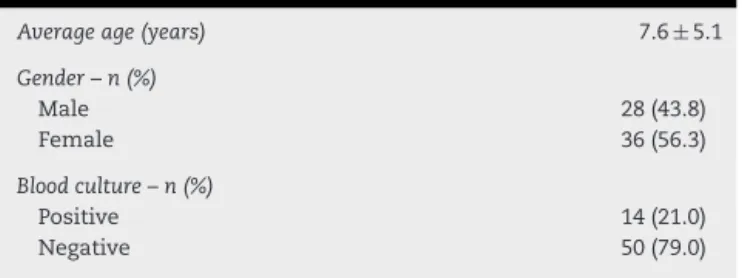
The average age of the participants was 7.6 years old (standarddeviation:5.1years).Thedistributionofthesample pergenderwasbalanced:28episodes(43.8%)occurredinboys and36(56.3%)ingirls(Table1).Thirteenofthe64analyzed episodescorrespondedtochildrenwithtwoormoreepisodes ofneutropenia;theywereconsideredasseparateeventsand wereincludedassuchintheanalysis.Amongthe64included events,14episodeshadpositivebloodcultureresults,and50 hadnegativeresults.
ThemedianCD64indexvalueinthepositiveculturegroup was2.71(interquartilerange:1.87)andthemedianCD64index value inthe negative culturegroup was 1.76 (interquartile range:2.9).
Regarding the underlying neoplastic diseases of the patientswithneutropenia,45episodescorrespondedto chil-drenwithhematologicalneoplasmsand19tochildrenwith solidtumors.Inthegroupwithhematologicaldiseases,nine episodeswereassociatedwithpositivebloodculturesand36 withnegativeculturesandinthe groupwithsolidtumors, thebloodcultureswerepositiveinfivepatientsandnegative in14patients. Themeanneutrophilcountwas1.73×109/L
(±1.80×10⁹/L) and the mean total leukocyte count was 2.46×10⁹/L(±5.79×109/L).
Regardingthebloodcultures,coagulase-negative Staphylo-coccuswasisolatedinthreeepisodes(allpatientshadclinical signs ofinfection),Escherichia coliintwo,Pseudomonas aeru-ginosaintwo,Klebsiellapneumoniaeintwo,Enterobactercloacae
in one, Haemophilus sp. in one, Streptococcus dysgalactiae in one,StreptococcushominisinoneandRalstoniamannitolilyticain one.
AnalysisoftheROCcurve revealed thattheCD64index crossedthenegativeandthepositivefieldsatleastonce, indi-catingthatthecurvewasnotabletopredictthebloodculture results[areaunderthecurve(AUC):0.491].Thisalsohappened withtheCRP(AUC:0.529),leukocytecount(AUC:0.535)and neutrophilcount(AUC:0.548).
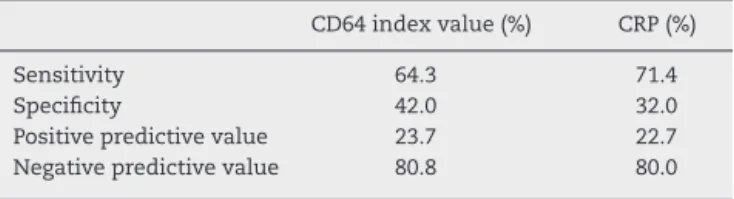
TheCD64indexwascategorizedaseitherpositive(>1.19) ornegative(<1.19).20Thefollowingarethetestefficacy
meas-ures: sensitivity 64.3%, specificity 42%, positive predictive value23.7%andnegativepredictivevalue80%(Table2).
Table1–Distributionofthepopulationbyage,gender andbloodcultureresults.
Averageage(years) 7.6±5.1
Gender–n(%)
Male 28(43.8)
Female 36(56.3)
Bloodculture–n(%)
Positive 14(21.0)
Table2–CD64indexvaluesandC-reactiveprotein(CRP) efficacymeasures.
CD64indexvalue(%) CRP(%)
Sensitivity 64.3 71.4
Specificity 42.0 32.0
Positivepredictivevalue 23.7 22.7 Negativepredictivevalue 80.8 80.0
Basedonthelaboratoryreferencevalues,CRPwas catego-rizedaspositive(>4mg/L)ornegative(<4mg/L).Thefollowing are thetest efficacy measures:sensitivity71.4%,specificity 32%,positivepredictivevalue22.7%andnegativepredictive value80%(Table2).
Thesignificance(p-value)ofthetwo-tailedtestassessing thecorrelationbetweenCD64expressionandblood culture results,categorized CRP,ESR,and outcome were 0.20,0.53, 0.15,and0.49,respectively.These resultsindicatealackof correlationbetweenCD64expressionandthevariables.The resultofthetwo-tailedtesttoassessthecorrelationbetween outcomeandcategorizedCRPwas0.06.Regardingthe corre-lationbetweenbloodcultureresultsand CRP,astatistically significantdifferencewasnotfoundbetweenthegroups.
Discussion
Febrileneutropeniaisariskfactorforsepticshock;itisusually associatedwithfewpatentclinicalmanifestationsatitsonset. Thus,alleffortstoidentifypositiveblood cultureresultsas earlyaspossibleareofextremeimportance.Uponexposureto pathogens,neutrophilsareactivated;theidentificationofthis statebyopticalmicroscopyoccursonlyatlaterstagesthrough thevisualizationoftoxicgranulation.
Analysisofsurfacemarkerexpressionbymeans offlow cytometryallowsearlierdetectionofthestateofneutrophil activation.24Inrecentyears,theneutrophilsurfacereceptor
CD64hasbeenthefocusofseveralstudiesonbiomarkers. Inonestudythatassessedasmallnumberofadultswith severe sepsis, the sensitivityof increased CD64index val-ueswassimilartothatofprocalcitonin,butlessspecific.25A
recentlypublishedprospectivestudy assessedCD64 expres-sioninaneonatalICU;thestudyincluded700patientsand performedmorethan1000assessmentsofsepsis.Theresults indicatedlowprevalenceofsepsis(5%),andmostcaseswereof latesepsis.IncreasedCD64expressioninneonatesexhibited 75%sensitivityand77%specificity.26
Inanotherstudy,theROCAUCdemonstratedthecapacity oftheCD64indextopredictpositivecultureresultswith91.7% sensitivityand88.9%specificity.27
Inthepresentstudy,theusefulnessofCD64expressionwas assessedasapredictorofpositivebloodcultureresults.This studyalsoassessedthe associationoftheCD64indexwith positivebloodcultureresults,CRPandESR.
ThemedianCD64indexvaluesweresimilarinbothgroups. Itwas notpossibleto detectany relationship betweenthe CD64indexvalueandpositivebloodcultureresultsorwith positiveCRPresults.
TheefficacymeasuresoftheCD64index(64.3%sensitivity and42%specificity)werelower thanthosedescribedinthe
literature.26Theseresultsdisagreewiththedatareportedin
theliterature20forpatientswithoutneutropenia.
TherearenodataintheliteratureastoCD64expressionin neutropenicpopulations.TheCD64indexwasnotadequate toassessinfectioninthepopulationwithfebrileneutropenia analyzedinthepresentstudy.
Inthisstudy,norelationshipbetweentheCD64indexvalue andpositivebloodcultureresultswasdetected.Moreover,the CD64index didnotexhibit acorrelation withpositiveCRP results.Therefore,thisstudydoesnotsupportdatapublished forpatientswithoutneutropenia;theCD64indexwasnotable topredictpositivebloodcultureresultsinthisspecific popu-lationofpatientswithfebrileneutropenia.
TheCRPvaluesdidnotexhibitanystatisticallysignificant differencesbetweenthegroupswithorwithoutpositiveblood culture results.This finding indicates thatthe elevationof CRPaloneisnotindicativeofpositivebloodcultureresultsin patientswithneutropenia.Thisresultagreeswithpreviously publisheddata.11
However,theresultofthetwo-tailedtesttoassessthe cor-relationbetweenpooroutcomeandcategorizedCRPwas0.06. Althoughnot statisticallysignificant,thisvalueindicates a strongtrendtowardsignificance.
Thus,furtherstudiesareneededtoestablishwhetherthere isarelationshipbetweenpositiveCPRandapooroutcome andtheefficacyofCD64expressiontopredictpositiveblood cultureresultsinpatientswithfebrileneutropenia. Further-more,itisimportanttoassesstheusefulnessofCD64asatest capableofidentifyingahigh-riskgroupamongpatientswith febrileneutropenia,inordertoachieveanearlydiagnosisand tomanagethesepatients.
Conflicts
of
interest
Theauthorsdeclarenoconflictsofinterest.
r
e
f
e
r
e
n
c
e
s
1.MoscucciO,HerringR,BerridgeV.Networkinghealth researchinBritain:thepost-warchildhoodleukaemiatrials. 20CenturyBrHist.2009;20(1):23–52.
2.FreyconF,Trombert-PaviotB,CasagrandaL,BertrandY, PlantazD,Marec-BérardP.Trendsintreatment-relateddeaths (TRDs)inchildhoodcancerandleukemiaovertime:a follow-upofpatientsincludedinthechildhoodcancer registryoftheRhône-AlpesregioninFrance(ARCERRA). PediatrBloodCancer.2008;50(6):1213–20.
3.HargraveDR,HannII,RichardsSM,HillFG,LilleymanJS, KinseyS,etal.Progressivereductionintreatment-related deathsinMedicalResearchCouncilchildhoodlymphoblastic leukaemiatrialsfrom1980to1997(UKALLVIII,XandXI).BrJ Haematol.2001;112(2):293–9.
4.HannI,ViscoliC,PaesmansM,GayaH,GlauserM.A comparisonofoutcomefromfebrileneutropenicepisodesin childrencomparedwithadults:resultsfromfourEORTC studies.InternationalAntimicrobialTherapyCooperative Group(IATCG)oftheEuropeanOrganizationforResearchand TreatmentofCancer(EORTC).BrJHaematol.1997;99(3):580–8.
6. ScheinemannK,EthierMC,DupuisLL,RichardsonSE,DoyleJ, AllenU,etal.Utilityofperipheralbloodculturesin
bacteremicpediatriccancerpatientswithacentralline. SupportCareCancer.2010;18(8):913–9.
7. HoffmeyerF,WitteK,SchmidtRE.Thehigh-affinityFc gammaRIonPMN:regulationofexpressionandsignal transduction.Immunology.1997;92(4):544–52.
8. PhillipsB,SelwoodK,LaneSM,SkinnerR,GibsonF,Chisholm JC.Variationinpoliciesforthemanagementoffebrile neutropeniainUnitedKingdomChildren’sCancerStudy Groupcentres.ArchDisChild.2007;92(6):495–8.
9. HakimH,FlynnPM,SrivastavaDK,KnappKM,LiC,OkumaJ, etal.Riskpredictioninpediatriccancerpatientswithfever andneutropenia.PediatrInfectDisJ.2010;29(1):53–9.
10.JayeDL,WaitesKB.ClinicalapplicationsofC-reactiveprotein inpediatrics.PediatrInfectDisJ.1997;16(8):735–46,quiz746–7.
11.KassamA,ChanAK,DzolganovskiB,ConstantinJ,Ramphal R,GrantR,etal.NoassociationbetweenproteinClevelsand bacteremiainchildrenwithfebrileneutropenia.JPediatr HematolOncol.2009;31(9):647–50.
12.AvabrathaKS,RauAT,VenkataravanammaP,RauA. SignificanceofC-reactiveproteinduringfebrileneutropenia inpediatricmalignancies.IndianPediatr.2009;46(9):797–9.
13.SpasovaMI,Grudeva-PopovaJG,KostyanevSS,GenevED, StoyanovaAA,KirinaVI,etal.Riskindexscoreforbacteremia infebrileneutropenicepisodesinchildrenwith
malignancies.JBUON.2009;14(3):411–8.
14.HoferN,ZachariasE,MüllerW,ReschB.Anupdateontheuse ofC-reactiveproteininearly-onsetneonatalsepsis:current insightsandnewtasks.Neonatology.2012;102(1):25–36.
15.DavisBH.Improveddiagnosticapproachestoinfection/sepsis detection.ExpertRevMolDiagn.2005;5(2):193–207.
16.QuayleJA,WatsonF,BucknallRC,EdwardsSW.Neutrophils fromthesynovialfluidofpatientswithrheumatoidarthritis expressthehighaffinityimmunoglobulinGreceptor,Fc gammaRI(CD64):roleofimmunecomplexesandcytokines ininductionofreceptorexpression.Immunology.
1997;91(2):266–73.
17.HallettMB,LloydsD.Neutrophilpriming:thecellularsignals thatsay‘amber’butnot‘green’.ImmunolToday.
1995;16(6):264–8.
18.ZeitounAA,GadSS,AttiaFM,AbuMaziadAS,BellEF. EvaluationofneutrophilicCD64,interleukin10and procalcitoninasdiagnosticmarkersofearly-andlate-onset neonatalsepsis.ScandJInfectDis.2010;42(4):299–305.
19.Groselj-GrencM,IhanA,Pavcnik-ArnolM,KopitarAN, Gmeiner-StoparT,DergancM.NeutrophilandmonocyteCD64 indexes,lipopolysaccharide-bindingprotein,procalcitonin andC-reactiveproteininsepsisofcriticallyillneonatesand children.IntensiveCareMed.2009;35(11):1950–8.
20.IcardiM,EricksonY,KilbornS,StewartB,GriefB,Scharnweber G.CD64indexprovidessimpleandpredictivetestingfor detectionandmonitoringofsepsisandbacterialinfectionin hospitalpatients.JClinMicrobiol.2009;47(12):3914–9.
21.SchüttrumpfS,BinderL,HagemannT,BerkovicD,TrümperL, BinderC.Procalcitonin:ausefuldiscriminatorbetween febrileconditionsofdifferentorigininhemato-oncological patients?AnnHematol.2003;82(2):98–103.
22.AbramsonJ.WINPEPI(PEPI-for-Windows).Availableat:
http://www.brixtonhealth.com/pepi4windows.html
23.SantosAP,BandeiraMB,SiqueiraL.Comparac¸ãoentre diversosmétodosdecontagemdiferencialdeleucócitosem pacientesleucopênicos.RevBrasHematolHemoter. 2009;31(3):203–5.
24.LivaditiO,KotanidouA,PsarraA,DimopoulouI,Sotiropoulou C,AugustatouK,etal.NeutrophilCD64expressionand serumIL-8:sensitiveearlymarkersofseverityandoutcome insepsis.Cytokine.2006;36(5–6):283–90.
25.CardelliP,FerraironiM,AmodeoR,TabaccoF,DeBlasiRA, NicolettiM,etal.EvaluationofneutrophilCD64expression andprocalcitoninasusefulmarkersinearlydiagnosisof sepsis.IntJImmunopatholPharmacol.2008;21(1):43–9.
26.StreimishI,BizzarroM,NorthrupV,WangC,RennaS,Koval N,etal.NeutrophilCD64asadiagnosticmarkerinneonatal sepsis.PediatrInfectDisJ.2012;31(7):777–81.