Measurement of DIS Cross Section at HERA
Sasha Glazov1, for the H1 Collaboration
1 Deutsches Electronen Synchrotron (DESY), Notkestrasse 85, Hamburg, Germany 22607
Received on 25 December, 2006, 2006; revised version received on 18 March, 2007
This paper presents recent measurements of the inclusive DIS cross section performed by the H1 and ZEUS collaborations at the HERA collider. We discuss relations of the HERA results with the upcoming experiments at the LHC. Importance of the planed measurement of the longitudinal proton structure functionFLis commented.
Keywords: Deep inelastic scattering
I. INTRODUCTION
Deep Inelastic Scattering (DIS) has played an important role in the understanding of the proton structure. The first results obtained at the SLAC electron beam in the 60s lead to the development of the parton model which later evolved into the modern description of the strong interactions via QCD. Further experimental data based on muon and neutrino beams allowed to extend the measurements to larger negative four momentum transfersQ2and smaller Bjorken-xand also to un-fold different quark flavor contributions to proton structure.
An important milestone for the proton structure measure-ments was the start of operation of the HERA collider lo-cated at DESY, Hamburg. HERA collides 920 GeV protons off 27.5 GeV electrons leading to a large center of mass en-ergy of the collisions√S≈320 GeV. This large energy leads to a wide coverage inQ2andx, thus allowing detailed tests of the QCD evolution and of the QCD validity for the high parton density regime which was discovered at lowxat HERA.
While the parton dynamics and properties of the strong in-teractions are fascinating topics by themselves, the knowledge of the proton structure has an important auxiliary value for the studies of the physics beyond the standard model based on the future pp collider. In particular, measurement of the Higgs boson production at LHC, for light Higgs boson masses, is determined by the proton structure forx∼0.01.
For lowx, the gluon density at HERA is measured using scaling violation for theF2structure function. Alternatively,
the gluon density can be determined using the longitudinal structure functionFL. FLallows for not only improved
preci-sion of the gluon density but also provides an important cross check of the standard QCD picture for lowx dynamics. A measurement ofFL requires operation of the HERA collider
at sufficiently different proton beam energies. A HERA run at a reduced proton beam energy dedicated forFLmeasurement
is planned in 2007, for the last three months of the HERA operation.
II. STRUCTURE FUNCTIONS, PDFS, AND THE LHC
The unpolarized Neutral Current (NC) double differential DIS cross section can be expressed in terms of three structure
functions: d2σNC
e∓p
dxdQ2 = 2πα2Y
+ xQ4
µ
F2−
y2 Y+
FL±
Y− Y+
xF3

(1)
whereα=1/137 is the fine structure constant andy is the inelasticity calculated asy=Q2/S xandY±=1±(1−y)2.
The main source of information on the proton structure comes from theF2structure function. In the parton modelF2
is proportional to a singlet quark density,F2=x∑e2q(q+q¯).
This relation holds to all orders in QCD for the so-called DIS scheme. TheF2structure function has a leading contribution
to the DIS cross section across the kinematic plane and thus can be most easily experimentally accessed. The other struc-ture functions usually do not complicate an extraction ofF2
from the DIS cross section; fory<0.35 the contribution of FL is negligible compared to the experimental uncertainties
whilexF3becomes significant only at higherQ2.
The structure functionxF3arises fromγZinterference. At
leading order QCDxF3is proportional to a non-singlet quark
density,xF3=x∑2eqaq(q−q¯), hereaqare the axial couplings
of the quarks to theZ0 boson. The structure functionxF3is
significantly more difficult to measure experimentally thanF2.
It can be accessed by measuring charge asymmetry of the DIS cross section for charged lepton beams at highQ2or by using neutrino beams.
The structure functionFL vanishes in leading order QCD
for spin 1/2 quarks. This property, known also as Callan-Gross relation, played an important role for establishing the nature of the partons. In Next-to-Leading Order (NLO) QCD FLacquires non zero value; for lowx,FLis mostly determined
by the gluon densityg(x). MeasuringFLis a challenging
ex-perimental task. The structure function has a significant con-tribution to the cross section only at high inelasticityy, which corresponds to low scattered electron energy and thus is prone to large background. At high y, for a fixed center of mass energy, the measured DIS cross section can not be unambigu-ously decomposed into itsF2andFL contributions. The
de-composition can be achieved by comparing the cross section measured using different center of mass energies.
The proton parton distribution functions (PDF) are deter-mined in QCD fits to the cross section data. To separate dif-ferent quark flavors, Charged Current (CC) DIS cross section data and data on lepton scattering off the deuteron are used along with NC data for the proton.
x
Q
2 / GeV
2
Atlas and CMS
Atlas and CMS rapidity plateau D0 Central+Fwd. Jets CDF/D0 Central Jets H1
ZEUS NMC BCDMS E665 SLAC
10-1 1 10 102 103 104 105 106 107 108
10-7 10-6 10-5 10-4 10-3 10-2 10-1 1
FIG. 1: Kinematic coverage of the DIS and collider pp-pp¯ exper-iments. For ppand p−p¯colliders, the Bjorkenx1 andx2 of the interacting quarks are related to the massMof the Drell-Yan pair and its rapidityyasx1,2=M/
√
Sexp(±y)whereSis the center of mass energy squared for the experiment.
processes such as Drell-Yan pair production. The QCD Q2 evolution, now known to Next-to-Next-to-Leading Or-der (NNLO) [1], allows to calculate the parton densities for a given x for higher values ofQ2. Therefore, PDFs
deter-mined in DIS experiments can be used for precise predictions of the production cross sections at ppcolliders, for example the LHC. Fig. 1 shows the kinematic coverage of the fixed target DIS experiments and HERA compared to pp¯ and pp colliders, the Tevatron and LHC. While the LHC extends the range greatly towards lowxfor low Drell-Yan pair masses, for theW andZ bosons production (M∼100 GeV) and for the central rapidity range of the detectors (|y|<2.5) the Bjorken-xrange (0.0005−0.05) is fully covered by HERA. Further-more, HERA covers completely thexrange for a light Higgs boson (Mh∼128 GeV), which in the Standard Model is
pre-dominantly produced viaggfusion with the top quark in the loop. Measuring the ratio of the Higgs to Z production rate experimentally and using the HERA based predictions for the Zand Higgs rates, it is possible to place strict limits on certain scenarios of non-standard Higgs production.
III. SUMMARY OF RESULTS FROM THE HERA-I
PERIOD
Most of the information on the proton structure function at low xcomes so far from the data collected at HERA in 1992-2000 running period (HERA-I). Most of the structure function analyses for this data sample have been finalized, for example Fig. 2 shows a summary of theF2structure function
10-3 10-2 10-1 1 10 102 103 104 105 106
1 10 102 103 104 105
Q2 / GeV2
F2
⋅
2
i
x = 0.65, i = 0 x = 0.40, i = 1 x = 0.25, i = 2 x = 0.18, i = 3 x = 0.13, i = 4 x = 0.080, i = 5 x = 0.050, i = 6 x = 0.032, i = 7 x = 0.020, i = 8 x = 0.013, i = 9 x = 0.0080, i = 10 x = 0.0050, i = 11 x = 0.0032, i = 12 x = 0.0020, i = 13 x = 0.0013, i = 14 x = 0.00080, i = 15 x = 0.00050, i = 16 x = 0.00032, i = 17 x = 0.00020, i = 18 x = 0.00013, i = 19 x = 0.000080, i = 20
x = 0.000050, i = 21 H1 e+p
ZEUS e+p
BCDMS
NMC
H1 PDF 2000
extrapolation
H1 Collaboration
FIG. 2: Structure functionF2as a function ofQ2based on HERA-I measurements of H1 [2, 3] and ZEUS [4] collaboration compared to results from fixed target experiments BCDMS [5] and NMC [6].
measurements by the H1 [2, 3] and ZEUS [4] collaborations at HERA and also by fixed target experiments BCDMS [5] and NMC [6].
The precision achieved for the F2 data in 0.0005−0.05
Bjorken-xrange is about 2−3% which leads to about 5% PDF uncertainty on theW,Zproduction cross section at LHC1. To improve this precision, further analysis of lowQ2<100 GeV2 HERA-I data is in progress by the H1 collaboration. In addi-tion, a better understanding of the systematic uncertainties is possible if H1 and ZEUS data are compared and combined in a common dataset in a model independent way. A proce-dure for this combination has been developed recently [7], the combination is now under study by the two collaborations.
IV. NEW RESULTS FROM HERA-II
During the shutdown in 2001−2002, HERA underwent an extensive upgrade aimed to increase the luminosity and also
1Two quarks are needed forW,Zproduction in a Drell-Yan process
e
P
-1 -0.5 0 0.5 1
(pb)
CC
σ
0 20 40 60 80 100 120
p Scattering
±
Charged Current e
X
ν →
p
-e
X
ν →
p
+
e
2
> 400 GeV
2
Q y < 0.9 SM (H1 PDF 2000)
H1 Data 2005 (prel.) H1 Data 98-99 ZEUS Data 04-05(prel.) ZEUS Data 98-99
H1 Data ZEUS Data
e
P
-1 -0.5 0 0.5 1
(pb)
CC
σ
0 20 40 60 80 100 120
FIG. 3: Charged Current cross section as a function of the lepton beam longitudinal polarization.
provide longitudinal polarization for the electron beam us-ing spin rotators. Since 2003 HERA resumed the operation and experiments started to collect new data (HERA-II period). Significant increase in the luminosity will eventually allow to improve the precision of the structure functions for high Q2>1000 GeV2, corresponding data analyses have started but detailed studies of the systematic uncertainties will take more time before the data become ready for the publications. For now, the first new results are based on new features of the data, such as polarization and a significant increase ofe− sample.
Figure 3 shows the first results on the total CC cross sec-tion polarizasec-tion dependence which are published or released as preliminary by the H1 and ZEUS collaborations. The ab-sence in the SM of the right-handed CC interactions requires vanishinge−p ande+p cross sections for the right and left handed polarized leptons, respectively. One can see that H1 and ZEUS data are consistent with each other and confirm the expectations of the SM. This measurement provides the first direct determination of the polarization dependence of the CC cross section inepscattering.
In summer 2006 new results on the NC polarization depen-dence have become available. Neglecting the pureZexchange term, for highQ2the structure functionF2attains a correction
from theγZinterference:
∆F2=κ(−ve∓Pae)F2γZ, (2)
where κ= 1
4 sin2θWcos2θW
Q2 Q2+M2
Z
, ve,ae are vector and axial
electron couplings toZ,Pis the longitudinal beam polariza-tion, θW is the Weinberg angle and MZ is the Z mass. At
leading order
F2γZ=x
∑
2eqvq(q+q¯), (3)HERA
-1 -0.8 -0.6 -0.4 -0.2 0 0.2 0.4 0.6 0.8 1
103 104 Q2 (GeV2)
A
H1 (prel.)
A+
A
-H1 2000 PDF
-1 -0.8 -0.6 -0.4 -0.2 0 0.2 0.4 0.6 0.8 1
103 104 Q2 (GeV2)
A
ZEUS (prel.)
A+
A
-ZEUS-JETS PDF
-1 -0.8 -0.6 -0.4 -0.2 0 0.2 0.4 0.6 0.8 1
103 104
Q2 (GeV2)
A
H1+ZEUS Combined (prel.)
A+
A
-H1 2000 PDF ZEUS-JETS PDF
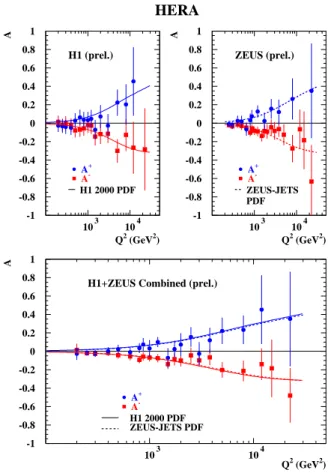
FIG. 4: Polarization dependence of the NC cross section as a function ofQ2, measured by H1 and ZEUS collaborations.
wherevqis theZvector quark coupling. The measured
polar-ization asymmetry, defined as
A±= 2
PR−PL
σ±(PR)−σ±(PL) σ±(PR) +σ±(PL)≈ ∓
κae
F2γZ F2
, (4)
allows to study directly the NC cross section parity violation. One can see in Fig. 4 that the data do indeed prefer SM pre-diction with non-vanishing polarization dependence which is more clearly visible for the combined H1 and ZEUS measure-ment.
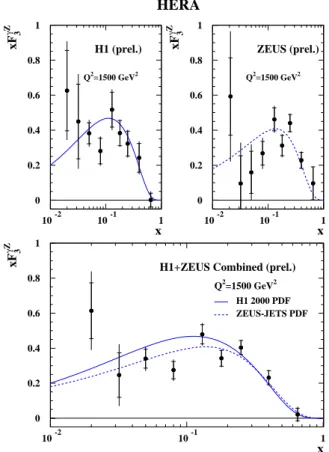
For the most of the HERA-I period, HERA was operat-ing with positrons due to limitations of the electron beam life time. Only a small fraction of the luminosity was collected with the negatively charged electron beam. For HERA-II, the problem of the low electron beam life time has been solved. From the end of 2004 to summer of 2006 HERA operated with electron beams, allowing a large increase of thee−p luminos-ity and thus a more precise measurement of thexF3structure
function. This measurement for the H1, ZEUS collaborations and for the combination of the two is represented in Fig. 5.
ThexF3structure function measures the valence quark
expec-HERA
0 0.2 0.4 0.6 0.8 1
10-2 10-1 1
x
xF
3
γ
Z
Q2=1500 GeV2
H1 (prel.)
0 0.2 0.4 0.6 0.8 1
10-2 10-1 1
x
xF
3
γ
Z
Q2=1500 GeV2
ZEUS (prel.)
0 0.2 0.4 0.6 0.8 1
10-2 10-1 1
x
xF
3
γ
Z
Q2=1500 GeV2 H1+ZEUS Combined (prel.)
H1 2000 PDF ZEUS-JETS PDF
FIG. 5:xF3γZstructure function as measured by H1 and ZEUS col-laborations.
tation. More precise and lowerxdata are needed for a better check, these data will become available after more detailed study of the systematic uncertainties in a lowerQ2range. A non-vanishing asymmetry inq−q¯at lowxwould have impor-tant implications forW+/W−production at LHC.
V. LOW ENERGY RUN TO MEASUREFL
The decomposition of the singlet and gluon density at lowx plays an important role for predicting the Higgs toW,Zbosons production cross section ratio at the LHC.W andZ produc-tion are singlet dominated processes, for them the dominant diagrams are similar to theF2structure function. On the
con-trary, Higgs production is dominated by gluon-gluon fusion. The QCD evolution of the singlet and gluon densities is closely coupled together, yet the densities depend on the initial input values which are not so easy to disentangle experimen-tally. In particular, gluon density determined by the MRST collaboration [9] at lowQ2and lowxdiffers drastically from
the CTEQ [8] and Alekhin [10] determinations. For the pre-dictions of the light Higgs production cross section, this leads to a spread of the central values between the three groups on the order of 5−7%, larger than the uncertainty associated with each individual prediction.
At low xadditional effects may become important which
are not included in the standard QCD evolution. These effects may arise from large 1/xcorrections, requiring additional re-summation, or from a large gluon density leading to non-linear interaction effects. An excellent quality of the conven-tional QCD fits to theF2structure function may not exclude
the presence of these additional contributions. Many smallx modifications may be “hidden” in the input parton densities at the starting scale. Since the smallxmodifications can be dif-ferent for difdif-ferent processes, the parton densities determined from the fits toF2may be valid for F2-like (singlet)
observ-able only. The non-universality of the parton densities would have a big impact on the light Higgs production cross section predictions.
The best way to obtain a more reliable decomposition of the gluon and singlet densities at lowQ2and lowxas well as to verify the universality of the parton density functions is to measure the other independent structure function, the longi-tudinal structure functionFL. For the conventional QCD,
re-cently NNNLO corrections have become available [12], mak-ing FL one of the cleanest observables from the theoretical
point of view. TheFL structure function acquires a non zero
value only at NLO, it is more sensitive to the gluon compared toF2. In this senseFLis closer to the Higgs production
com-pared toF2which is closer toW,Zproduction at LHC.
The DIS cross section is sensitive to theFLstructure
func-tion only for high inelasticity values,y>0.5, see Eq. 1. For this kinematic region, bothF2andFL structure function
con-tribute significantly to the DIS cross section, thus an addi-tional constraint is required in order to separate the individual contributions.
-0.2 0 0.2 0.4 0.6 0.8 1 1.2 1.4 1.6
100 200 300 400 500 600 700 800
Q2 / GeV2
FL
0.002 0.004 0.008 x
H1 Collaboration
e+p H1 99-00 e−p H1 98-99
y=0.75
H1 PDF 2000 H1 Low y fit
F L=F
2 (H1 PDF 2000)
FIG. 6: Structure FunctionFLdetermined in a model dependent way by the H1 collaboration based one−p(open circles) ande+p(closed circles) data collected during HERA-I running period [3]
deter-mination, theF2structure function was determined for lower
Q2selecting data aty<0.35, and than evolved using the stan-dard QCD evolution to higher Q2and thus higher yvalues.
Fixing theF2contribution to the conventional QCD prediction
allowed the H1 collaboration to extract theFLstructure
func-tion. This model dependent determination works better for higherQ2values, since in this case a larger evolution range is available for the determination ofF2. Fig. 6 shows thisFL
de-termination forQ2>100 GeV2kinematic range. Good agree-ment between the determination and the QCD prediction pro-vides an important consistency check in thexrange important for the LHC measurements. Higher statistics HERA-II data should allow to improve the precision of this measurement.
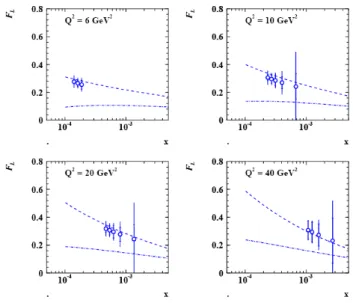
FIG. 7: Open circles: simulation of the FL structure function measurement based on proposed lowEp =460 GeV energy run. The dashed (dashed-dotted) lines represent predictions based on CTEQ [8] (MRST [9]) parton density functions.
A model independent separation of theF2andFLstructure
functions is possible by measuring the DIS cross section at the samex,Q2values but differenty. This can be achieved by lowering the center of mass energy for the experiment. For the maximal cancellation of the experimental uncertainties it is desirable to lower the proton beam energy, in this case the kinematics of the scattered electron is largely unmodified.
Lowering of the proton beam energy leads to a reduction of the luminosity as∼1/Ep2. To increase sensitivity toFL, a
mea-surement at lowest possible beam energy is desired. A com-promise between luminosity loss and the sensitivity is reached at about half the nominal proton beam energy,Ep=460 GeV.
Taking into account that currently both H1 and ZEUS experi-ments collect about 20 pb−1of data per month each, an about 3 month long low energy run is needed to obtain 10 pb−1of
low energy data per experiment. This low energy run is fore-seen to be performed in April-June 2007, at the end of the HERA operation.
A possible outcome of this low energy run is illustrated in Fig. 7 which shows a simulation of theFL structure function
measurement. One can see that the precision of these data should be sufficient to distinguish between predictions based on MRST and CTEQ parton distribution functions, thus this measurement should allow to reduce uncertainties in the gluon density.
VI. SUMMARY AND OUTLOOK
HERA continues to provide a large amount of inclusive DIS data interesting for deeper understanding of the QCD and the Standard Model electroweak physics. The parton density functions determined based on these measurements will play an important role for the LHC.
HERA-II upgrades enriched the physics outcome of the ex-periments. Higher luminosity will eventually lead to a more precise determination of the proton structure functions also in the highQ2kinematic domain. The longitudinal polarization of the electron beam allows to study the polarization depen-dence of the charged current cross section, provides additional sensitivity to the vector quark couplings. A largee−sample improves the determination of thexF3structure function.
The HERA-II operation is scheduled to be stopped at the end of June-2007. Before that, a dedicated special low proton energy run is foreseen in order to measure the longitudinal structure functionFL. This measurement will allow a
decom-pose the contributions of theFLandF2structure functions to
the DIS cross section at lowQ2, it will provide an important cross check of the conventional QCD at lowxand will allow to improve the knowledge of the gluon density.
[1] S. Moch, J.A.M. Vermaseren, and A. Vogt, Phys. Lett. B606, 123 (2005).
[2] C. Adolffet al., Eur. Phys. J. C21, 33 (2001). [3] C. Adolffet al., Eur. Phys. J. C30, 1 (2003). [4] S. Chekanovet al., Phys. Rev. D67, 012007 (2003). [5] A.C. Benvenutiet al., Phys. Lett. B223, 485 (1989). [6] M. Arneodoet al., Nucl. Phys. B483, 3 (1997).
[7] A. Glazov,DIS05, XIII International Workshop on Deep Inelas-tic Scattering, Madison, Wisconsin, 2005.
[8] J. Pumplinet al., JHEP0207, 12 (2002). [9] A. D. Martinet al., Eur. Phys. J. C28, 455 (2003) [10] S. I. Alekhin, Phys. Rev. D68, 0149002 (2003).
[11] A. De Roeck and H. Jung (eds.), HERA-LHC Workshop, CERN-DESY (2005).
![FIG. 2: Structure function F 2 as a function of Q 2 based on HERA-I measurements of H1 [2, 3] and ZEUS [4] collaboration compared to results from fixed target experiments BCDMS [5] and NMC [6].](https://thumb-eu.123doks.com/thumbv2/123dok_br/18982725.457642/2.892.94.433.75.411/structure-function-function-measurements-collaboration-compared-results-experiments.webp)