Revista Brasileira de
Engenharia Agrícola e Ambiental
Campina Grande, PB, UAEA/UFCG – http://www.agriambi.com.br
v.21, n.6, p.379-385, 2017
Nitrogen efficiency in oat yield through the biopolymer hydrogel
DOI: http://dx.doi.org/10.1590/1807-1929/agriambi.v21n6p379-385
Osmar B. Scremin
1, José A. G. da Silva
2, Ângela T. W. de Mamann
1,
Rubia D. Mantai
1, Ana P. Brezolin
1& Anderson Marolli
1A B S T R A C T
The retainers of water in the soil can favor nitrogen (N) use efficiency in oat yield. The aim of the study was to determine if the conditions of use of the biopolymer hydrogel increase the fertilizer-N use efficiency in oat yield in succession systems of high and low residual-N release. In each succession system (soybean/oat, corn/oat), two experiments were conducted in 2014 and 2015, one to quantify biomass yield and the other to estimate grain yield and lodging. The design was randomized blocks with four replicates in a 4 x 4 factorial scheme for hydrogel doses (0, 30, 60 and 120 kg ha-1), added in the furrow with the seed, and N fertilizer doses (0, 30, 60 and 120 kg ha-1) applied in the fourth-expanded-leaf stage. The use of hydrogel increases N use efficiency in oat yield, especially under the conditions of 30 to 60 kg ha-1 of biopolymer; however, this effect is dependent on the succession system and on weather conditions.
Eficiência do nitrogênio na produtividade
da aveia pelo biopolímero hidrogel
R E S U M O
Os hidroretentores de água no solo podem favorecer a eficiência de uso do nitrogênio na produtividade da aveia. O objetivo do estudo foi determinar se as condições de uso do biopolímero hidrogel aumentam a eficiência de aproveitamento do N-fertilizante na produtividade da aveia em sistemas de sucessão de alta e reduzida liberação de residual-N. Em cada sistema de sucessão (soja/aveia; milho/aveia), dois experimentos foram conduzidos em 2014 e 2015, um para quantificar a taxa de produtividade de biomassa e outro na estimativa da produtividade de grãos e o acamamento. O delineamento foi de blocos casualizados com quatro repetições em fatorial 4 x 4, para doses de hidrogel (0, 30, 60 e 120 kg ha-1), adicionado no sulco junto à semente e doses de N-fertilizante (0, 30, 60 e 120 kg ha-1), aplicado no estádio de 4ª folha expandida. O uso de hidrogel aumentou a eficiência de aproveitamento do nitrogênio na produtividade da aveia, principalmente nas condições de 30 e 60 kg ha-1 do biopolímero; porém, este efeito é dependente do sistema de sucessão e condições meteorológicas.
Key words:
Avena sativa L.
biodegradable C/N ratio lodging biomass
Palavras-chave:
Avena sativa L.
biodegradável razão C/N acamamento biomassa
1 Universidade Regional do Noroeste do Estado do Rio Grande do Sul/Departamento de Ciências Exatas e Engenharias. Ijuí, RS. E-mail: [email protected]
(Corresponding author); [email protected]; [email protected]; [email protected]; [email protected]
2 Universidade Regional do Noroeste do Estado do Rio Grande do Sul/Departamento de Estudos Agrários. Ijuí, RS. E-mail: [email protected]
Introduction
Oat is an extremely nutritious cereal increasingly used in the food industry, especially in the form of flakes (Alves & Kist, 2010; Mantai et al., 2016). Rio Grande do Sul is the state with largest cultivation area, 196.8 thousand hectares, and mean yield of 2 t ha-1 (CONAB, 2016). The use of fertilizer-N is
essential to maximizing the yield and quality of grains required by the industry (Mantai et al., 2015). Although the use of fertilizer-N increases oat biomass and grain yield in favorable years, high doses may lead to lodging, compromising grain production and quality (Arenhardt et al., 2015). In unfavorable years, yield losses can occur through leaching or volatilization of the nutrient, increasing costs and generating environmental pollution (Flores et al., 2013; Krüger et al., 2014). Arenhardt et al. (2015) comment that the adequate volume and distribution of rainfall with lower temperatures represent conditions of favorable years for oat cultivation.
The maximum use efficiency of the nutrient by the plant is determined by the maintenance of soil moisture, with expressive effects on the increase of yield (Borges et al., 2014; Silva et al., 2015). In this context, the use of water retainers can favor the maintenance of moisture in the soil, because it contributes to retaining water and gradually releasing it to the plants (Oliveira et al., 2004; Moghadam et al., 2011), which can improve the fertilizer-N use, potentiating the yield and reducing risks of losses of the nutrient. Hydrogels are biodegradable, three-dimensional polymer networks that retain water in their structure, forming a gel capable of hydrating and releasing water for a long period (Sartore et al., 2013; Guilherme et al., 2015).
This study aimed to determine if the conditions of use of the polymer hydrogel increase the fertilizer-N use efficiency in oat yield in succession systems of high and reduced residual-N release.
Material and Methods
The experiments were carried out under field conditions in 2014 and 2015, in the municipality of Augusto Pestana-RS, Brazil (28° 26’ 30’’ S; 54° 00’ 58’’ W). The soil of the experimental area was classified as typic dystroferric Red Latosol and the climate of the region, according to Köppen’s classification, is Cfa (humid subtropical), with rainfalls well distributed along the year and the mean temperature of the hottest month above 22 ºC. Ten days before sowing, soil analysis was performed to determine the following chemical characteristics (Tedesco et al., 1995): i) corn/oat system (pH = 6.5; P = 34.4 mg dm-3; K =
262 mg dm-3; OM = 2.9%; Al = 0 cmol c dm
-3; Ca = 6.6 cmol c dm
-3
and Mg = 3.4 cmolc dm-3) and; ii) soybean/oat system (pH =
6.2; P = 33.9 mg dm-3; K = 200 mg dm-3; OM = 3.0%; Al = 0 cmol c
dm-3; Ca = 6.5 cmol c dm
-3 and Mg = 2.5 cmol c dm
-3). Regardless
of agricultural year, sowing was performed in the third week of June, according to the recommendation of cultivation for the species, in residual cover of high and reduced C/N ratio, corn/ oat and soybean/oat system, respectively. The sowing process used a seeder-fertilizer in the composition of the plot with five
5-m-long rows spaced by 0.18 m, forming an experimental unit of 4.5 m2. The population density was 400 viable seeds m-2.
During the study, the fungicide Tebuconazole was applied at the dose of 0.75 L ha-1. Weeds were controlled with the herbicide
metsulfuron-methyl at the dose of 4 g ha-1 and manual weedings,
always when necessary. In the experiments, 45 and 30 kg ha-1
of P2O5 and K2O were applied at sowing, based on the contents of P and K in the soil for the expected grain yield of 3 t ha-1,
respectively, and 10 kg ha-1 of N as basal application, except in
the control experimental unit, with absence of N. Therefore, basal fertilization consisted in the N-P-K formulation of 10-20-20. The rest of the N was applied as top-dressing in the fourth-expanded-leaf stage. The different doses of granular hydrogel of the biopolymer were applied together with the oat seeds, being in the soil at the same depth and cultivation row, approximately 3 cm deep.
In each cultivation condition of high and reduced residual-N release (corn/oat and soybean/oat systems), two experiments were conducted, one to quantify biomass yield (BY, kg ha-1) through the cuts performed every 30 days until
physiological maturity and the other to estimate grain yield (GY, kg ha-1) and lodging (LD, %). Hence, the four experiments
were set in a randomized block design with four replicates, in a 4 x 4 factorial scheme corresponding to four hydrogel doses (0, 30, 60 and 120 kg ha-1) and four fertilizer-N doses (source:
urea) (0, 30, 60 and 120 kg ha-1), using the white oat cultivar
‘URS-Corona’.
Lodging was visually estimated and expressed in percentage, in the stage close to grain harvest, following the methodology proposed by Moes & Stobbe (1991). Grain yield was obtained by the cut of three central rows of each plot in the harvest maturity stage, with grain moisture around 22%. Plants were threshed with stationary threshing machine and sent to the laboratory for the correction of grain moisture to 13% and weighing, to estimate grain yield (GY, kg ha-1). In the
experiments intended for quantifying biomass yield (BY kg ha-1) along the development of the plants, the vegetal material
was harvested close to the soil, through the collection of one linear meter of the three central rows of each plot, in the periods of 30, 60, 90 and 120 days after emergence, totaling four cuts. The samples of fresh biomass were dried in an oven at temperature of 65 ºC.
After meeting the assumptions of homogeneity and normality through the Bartlet tests, analysis of variance was used to detect the main effects and the effects of interaction. Linear equations (BY = b0 ± b1x) were used to estimate the biomass yield of oat and the Scott-Knott method was used to compare the mean values of grain yield and lodging. Quadratic equations (Y = b0 ± b1x ± b2x2) were used to estimate
the fertilizer-N dose ideal for maximum grain yield (Nideal = -b1/2b2), with simulation of lodging, under the conditions of the use of hydrogel in the cultivation systems. The computer program Genes was used for these determinations.
Results and Discussion
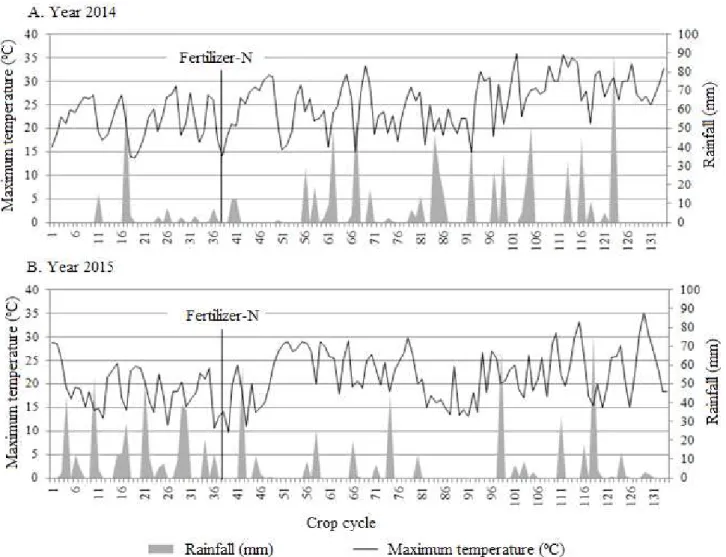
average of the last 20 years (900 mm), but with different distribution. In 2014, a large volume of rainfall occurred from half of the cycle to the maturation (Figure 1A), a condition that led to periods of lower insolation in the phase of elongation and grain filling. In 2015, the largest volume of rainfall occurred from emergence to 43 days of development, with subsequent regular rainfalls of lower volumes (Figure 1B). Rainfall periods along the cycle reduce the light use efficiency in the photosynthesis and, in the stage of filling and maturation, interfere with grain yield and quality (Arenhardt et al., 2015). These conditions led to the higher grain yield obtained in 2015. In the analysis of the source of variation year, N dose and hydrogel dose, the main effects and interaction effects were significant. In Table 1, in the soybean/oat system in 2014, the use of 30 kg ha-1 of hydrogel caused greater biomass yield
per day and grain yield at the highest dose of fertilizer-N. The highest mean of grain yield (2775 kg ha-1), regardless of
the N use condition, was also obtained with 30 kg ha-1 of the
biopolymer. In 2015 (Table 1), the higher biomass yield per day and grain yield was also obtained with 30 kg ha-1 of hydrogel
at the highest fertilizer-N dose (120 kg ha-1). The highest
mean of grain yield, regardless of the N dose, was obtained with the doses of 30 and 60 kg ha-1 of hydrogel and 3416
and 3518 kg ha-1, respectively. Although higher biomass and
grain yields occurred in 2015 favored by the meteorological conditions (Figure 1), reflexes on the increase of plant lodging
were intensified, especially at higher doses of fertilizer-N, a condition that compromises harvest and decrease grain quality. It should be pointed out that the condition of high residual-N release, as in the soybean/oat system along with the interaction with the fertilizer, tends to lead to greater plant lodging.
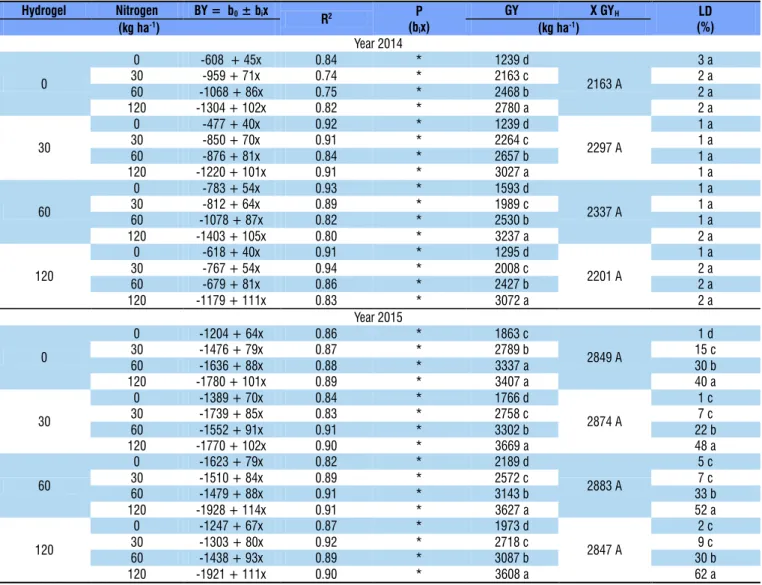
In Table 2, in the corn/oat system, the biomass yield per day and grain yield were incremented by the increase in the dose of fertilizer-N, regardless of the hydrogel dose and agricultural year. There were reduced values of lodging in this succession system, especially in 2014, in which the increase of fertilizer-N did not lead to alteration. In 2014, grain yield was not altered using hydrogel. On the other hand, in the absence of hydrogel with the highest dose of fertilizer-N, grain yield was equal to 2780 kg ha-1, but the use of the biopolymer with 60 kg ha-1 at
the highest dose of fertilizer-N incremented grain yield to 3237 kg ha-1 (Table 2). In 2015, regardless of the dose of fertilizer-N,
the use of hydrogel did not alter grain yield; however, high doses of fertilizer-N increased the biomass and grain yields, along with the lodging percentage, a fact also observed in the year 2014. It should be highlighted that, in the condition of reduced release of residual-N, in corn/oat system, there is a strong contribution to the reduction of plant lodging, which, in this perspective, qualifies this succession system.
High levels of N fertilization, despite maximizing production, can favor plant lodging, in addition to other environmental damages and increase in the production costs (Ma et al., 2010;
Arenhardt et al., 2015). In rye, the use of hydrogel led to a significant increment in the biomass production at different levels of fertilization under water restriction (Nissen & Tapia, 1996). In canola, the use of the biopolymer increases the water storage capacity of the soil, favoring the vegetative period and oil quality in the grains (Moghadam et al., 2011).
To determine if the biopolymer hydrogel increases the fertilizer-N use efficiency, Tables 3 and 4 show the estimates of the optimal dose of the nutrient for maximum grain yield and expected lodging using the biopolymer. In Table 3, for the soybean/oat system in 2014, the maximum N use efficiency for grain yield was obtained with 75 kg ha-1 in
the absence of hydrogel, with expected yield of 2993 kg ha-1
and lodging of 36%. For the use of hydrogel with 30 and 60 kg ha-1, there were reductions in the N use to 73 and 71
kg ha-1, respectively, generating expected yields of 3180 and
3017 kg ha-1, respectively. At these doses of the biopolymer,
the obtained values of lodging were similar to those of the standard dose. At the highest dose of hydrogel, there was a reduction in N use efficiency (84 kg ha-1), indicating greater
use of the nutrient with lower grain yield and high lodging. This fact indicates that the excess of hydrogel may substantially increase soil moisture, leading to greater vegetative growth and, consequently, plant lodging, interfering with the yield.
In 2015, in the soybean/oat system (Table 3), the maximum N use efficiency for grain yield without using hydrogel was obtained with 87 kg ha-1, with expected yield of 3968 kg ha-1
and lodging of 74%. The hydrogel dose of 60 kg ha-1 led to
reduction in the use of fertilizer-N to 80 kg ha-1, with expected
grain yield of 4084 kg ha-1 and lodging percentage similar to
those of the other biopolymer doses.
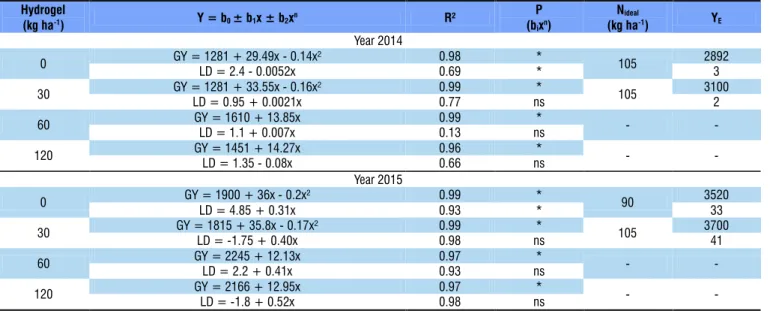
In Table 4, for the corn/oat system in 2014, the maximum N use efficiency for grain yield was obtained with 105 kg ha-1
in the absence of hydrogel. This dose promoted expected grain yield of 2892 kg ha-1 with lodging of 3%. In the use of 30
kg ha-1 of hydrogel, the optimal dose of fertilizer-N was also
obtained with 105 kg ha-1. Although there was no reduction of
fertilizer-N, there was an increment in grain yield to 3100 kg ha-1. The hydrogel doses of 60 and 120 kg ha-1 caused a linear
response in the fertilizer-N use efficiency for grain yield. In 2015, the maximum N use efficiency for grain yield without using hydrogel was obtained with 90 kg ha-1, and expected grain
yield of 3520 kg ha-1 and lodging of 33%. The hydrogel dose of
30 kg ha-1 promoted increment in the use of the optimal dose
of fertilizer-N, to 105 kg ha-1, with increment in the expected
grain yield to 3700 kg ha-1. The hydrogel doses caused linearity
in the N use for grain production, i.e., for being linear, the functions do not generate stability, as the quadratic functions
Table 1. Biomass yield per day, grain yield and lodging of oat plants under doses of hydrogel and nitrogen in the soybean/oat system
Hydrogel Nitrogen BY = b0± bix
R2 P
(bix)
GY X GYH LD
(%)
(kg ha-1) (kg ha-1)
Year 2014
0
0 -585 + 48x 0.91 * 1999 b
2565 B
4 c
30 -1279 + 85x 0.86 * 2748 a 8 c
60 -1433 + 104x 0.91 * 2874 a 43 b
120 -1560 + 116x 0.88 * 2640 a 52 a
30
0 -766 + 55x 0.91 * 2172 b
2775 A
8 c
30 -1308 + 81x 0.90 * 2893 a 9 c
60 -1213 + 98x 0.91 * 2970 a 37 b
120 -1977 + 134x 0.91 * 3065 a 53 a
60
0 -851 + 58x 0.91 * 2036 d
2596 B
3 d
30 -1299 + 85x 0.90 * 2783 b 23 c
60 -1234 + 98x 0.93 * 2948 a 43 b
120 -1712 + 118x 0.89 * 2615 c 57 a
120
0 -1175 + 69x 0.89 * 2000 c
2519 B
4 d
30 -1391 + 95x 0.89 * 2485 b 33 c
60 -1394 + 114x 0.92 * 2786 a 57 b
120 -1578 + 120x 0.93 * 2807 a 79 a
Year 2015
0
0 -1605 + 79x 0.82 * 2442 c
3330 B
10 c
30 -1826 + 96x 0.84 * 3321 b 40 b
60 -1832 + 108x 0.90 * 3810 a 76 a
120 -2204 + 126x 0.91 * 3745 a 83 a
30
0 -1879 + 89x 0.81 * 2482 c
3416 A
4 d
30 -1812 + 102x 0.88 * 3319 b 35 c
60 -2143 + 122x 0.88 * 3996 a 72 b
120 - 2019 + 130x 0.91 * 3868 a 93 a
60
0 -1600 + 80x 0.85 * 2847 d
3518 A
9 d
30 -1451 + 87x 0.91 * 3493 c 33 c
60 -1899 + 109x 0.90 * 4057 a 72 b
120 -1840 + 117x 0.91 * 3677 b 88 a
120
0 -1457 + 74x 0.85 * 2141 c
3207 B
7 c
30 -1427 + 92x 0.93 * 3452 b 40 b
60 -1702 + 109x 0.91 * 3644 a 78 a
120 -2206 + 125x 0.90 * 3591 a 86 a
BY - Biomass yield; LD - Lodging; GY - Grain yield; XGYH - Mean of grain yield in the conditions of use of hydrogel; R2 - Coefficient of determination; P (b
ix) - Probability of the line slope parameter; *Significant at 0.05 probability level by t-test
Table 2. Biomass yield per day, grain yield and lodging of oat plants under doses of hydrogel and nitrogen in the corn/ oat system
Hydrogel Nitrogen BY = b0± bix
R2 P
(bix)
GY X GYH LD
(%)
(kg ha-1) (kg ha-1)
Year 2014
0
0 -608 + 45x 0.84 * 1239 d
2163 A
3 a
30 -959 + 71x 0.74 * 2163 c 2 a
60 -1068 + 86x 0.75 * 2468 b 2 a
120 -1304 + 102x 0.82 * 2780 a 2 a
30
0 -477 + 40x 0.92 * 1239 d
2297 A
1 a
30 -850 + 70x 0.91 * 2264 c 1 a
60 -876 + 81x 0.84 * 2657 b 1 a
120 -1220 + 101x 0.91 * 3027 a 1 a
60
0 -783 + 54x 0.93 * 1593 d
2337 A
1 a
30 -812 + 64x 0.89 * 1989 c 1 a
60 -1078 + 87x 0.82 * 2530 b 1 a
120 -1403 + 105x 0.80 * 3237 a 2 a
120
0 -618 + 40x 0.91 * 1295 d
2201 A
1 a
30 -767 + 54x 0.94 * 2008 c 2 a
60 -679 + 81x 0.86 * 2427 b 2 a
120 -1179 + 111x 0.83 * 3072 a 2 a
Year 2015
0
0 -1204 + 64x 0.86 * 1863 c
2849 A
1 d
30 -1476 + 79x 0.87 * 2789 b 15 c
60 -1636 + 88x 0.88 * 3337 a 30 b
120 -1780 + 101x 0.89 * 3407 a 40 a
30
0 -1389 + 70x 0.84 * 1766 d
2874 A
1 c
30 -1739 + 85x 0.83 * 2758 c 7 c
60 -1552 + 91x 0.91 * 3302 b 22 b
120 -1770 + 102x 0.90 * 3669 a 48 a
60
0 -1623 + 79x 0.82 * 2189 d
2883 A
5 c
30 -1510 + 84x 0.89 * 2572 c 7 c
60 -1479 + 88x 0.91 * 3143 b 33 b
120 -1928 + 114x 0.91 * 3627 a 52 a
120
0 -1247 + 67x 0.87 * 1973 d
2847 A
2 c
30 -1303 + 80x 0.92 * 2718 c 9 c
60 -1438 + 93x 0.89 * 3087 b 30 b
120 -1921 + 111x 0.90 * 3608 a 62 a
BY - Biomass yield; LD - Lodging; GY - Grain yield; XGYH - Mean of grain yield in the conditions of use of hydrogel; R2 - Coefficient of determination; P (b
ix) - Probability of the line slope parameter; *Significant at 0.05 probability level by t-test
Means followed by the same lowercase letters in each hydrogel dose compare nitrogen doses and uppercase letters compare hydrogel doses constituting statistically homogeneous group by the Scott-Knott model at 0.05 probability level
Table 3. Equation of the estimate of the nitrogen dose ideal for grain yield with expected lodging using hydrogel in the soybean/oat system
Hydrogel
(kg ha-1) Y = b0± b1x ± b2xn R²
P (bixn)
Nideal
(kg ha-1) YE
Year 2014
0 GY = 2036 + 25.51x - 0.17x² 0.96 * 75 2993
LD = 3.95 + 0.43x 0.84 * 36
30 GY = 2224 + 21.5x – 0.15x² 0.94 * 73 3180
LD = 5.35 + 0.41x 0.89 * 35
60 GY = 2066 + 26.88x - 0.19x² 0.98 * 71 3017
LD = 8.4 + 0.44x 0.93 * 40
120 GY= 1999 + 21.9x - 0.13x² 0.97 * 84 2859
LD = 11.6 + 0.61x 0.93 * 63
Year 2015
0 GY= 2445 + 34.9x - 0.2x² 0.99 * 87 3968
LD = 20.45 + 0.61x 0.83 * 74
30 GY= 2454 + 37.71x - 0.22x² 0.99 * 86 4070
LD = 11.95 + 0.74x 0.92 * 76
60 GY= 2813 + 31.88x - 0.2x² 0.98 * 80 4084
LD = 15.4 + 0.67x 0.91 * 69
120 GY= 2220 + 41.57x - 0.25x² 0.94 * 83 3949
LD = 18.5 + 0.65x 0.83 * 72
GY - Grain yield (kg ha-1); LD - Lodging percentage (%); R² - Coefficient of determination; P(b ix
do, in the increment of N doses. This fact was similar in both cultivation years.
The N use efficiency was obtained through equations as a function of the N doses in each condition of the biopolymer. Therefore, the results of Tables 3 and 4 indicate that, in the soybean/oat system, the highest yields with the lowest use of fertilizer-N were obtained at hydrogel doses of 30 and 60 kg ha-1.
On the other hand, in the corn/oat system, the highest efficiency was observed with 30 kg ha-1 of the biopolymer, leading to the
highest estimate of yield using the optimal dose. The product hydrogel costs R$ 18.00 kg-1; thus, a dose of 30 kg ha-1 of the
biopolymer leads to a cost of R$ 540.00 ha-1. Although the cost
may seem high considering the reduced use of the technology in large scale, the biopolymer has a water retaining action in the soil of 3 to 4 years; therefore, the cost is diluted along the cultivation seasons. However, there are no studies on the use of hydrogel in cereals considering the actual conditions of cultivation, especially searching for the link with N use efficiency. Therefore, we highlight the innovative character of this study, for using the biopolymer aiming at higher N use efficiency in oat grain yield.
Studies conducted by Marques et al. (2012), with sugarcane, indicated that the hydrogel dose of 53 kg ha-1 increased the stalk
mass yield, a value between the biopolymer doses that led to higher N use efficiency for oat yield in the present study. In the production of seedlings, Mews et al. (2015) observed that the use of the biopolymer increased the use of N fertilization, with ideal doses between 2 and 4 g kg-1 of substrate. In bell pepper,
the increment of hydrogel doses led to greater development of the seedlings, linearly increasing the number of leaves and shoots of the plants (Marques & Bastos, 2010).
Conclusions
The use of hydrogel increases N use efficiency in oat yield, especially in the conditions of 30 and 60 kg ha-1 of the
biopolymer; however, this effect is dependent on the succession system and on weather conditions.
Acknowledgments
To the Coordination for the Improvement of Higher Education Personnel (CAPES), the Rio Grande do Sul Research Support Foundation (FAPERGS) and the Regional University of Northwestern Rio Grande do Sul (UNIJUÍ), for the financial support and grant of Scientific Initiation, Technological and Research Productivity.
Literature Cited
Alves, A. C.; Kist, V. Composição da espigueta de aveia branca (Avena
sativa L.). Revista Brasileira de Agrociência, v.16, p.29-33, 2010. Arenhardt, E. G.; Silva, J. A. G. da; Gewehr, E.; Oliveira, A. C. de; Binelo, M. O.; Valdiero, A. C.; Gzergorczick, M. E.; Lima, A. R. C. de. The nitrogen supply in wheat cultivation dependent on weather conditions and succession system in southern Brazil. African Journal of Agricultural Research, v.10, p.4322-4330, 2015. https://doi.org/10.5897/AJAR2015.10038
Borges, T. K. de. S.; Montenegro, A. A. de A.; Santos, T. E. M. dos; Silva, D. D. de; Silva Junior, V. de P. e. Influência de práticas conservacionistas
na umidade do solo e no cultivo do milho (Zea mays L.) em semiárido
nordestino. Revista Brasileira de Ciência do Solo, v.38, p.1862-1873, 2014. https://doi.org/10.1590/S0100-06832014000600021
CONAB - Companhia Nacional de Abastecimento. Acompanhamento da safra brasileira de grãos. Safra 2016/17- Segundo levantamento. Brasília: CONAB, 2016. 156p.
Flores, R. A.; Urquiaga, S.; Alves, B. J. R.; Collier, L. S.; Zanetti, J. B.; Prado, R. de. M. Nitrogênio e idade de corte na qualidade da biomassa de capim-elefante para fins agroenergéticos cultivado em Latossolo. Semina: Ciências Agrárias, v.34, p.127-136, 2013. https://doi.org/10.5433/1679-0359.2013v34n1p127
Guilherme, M. R.; Aouada, F. A.; Fajardo, A. R.; Martins, A. F.; Paulino, A. T.; Davi, M. F.; Rubira, A. F.; Muniz, E. C. Superabsorbent hydrogels based on polysaccharides for application in agriculture as soil conditioner and nutrient carrier: A review. European Polymer Journal, v.72, p.365-385, 2015. https://doi.org/10.1016/j. eurpolymj.2015.04.017
Table 4. Equation of the estimate of the nitrogen dose ideal for grain yield with expected lodging using hydrogel in the corn/oat system
Hydrogel
(kg ha-1) Y = b0± b1x ± b2xn R²
P (bixn)
Nideal
(kg ha-1) YE Year 2014
0 GY = 1281 + 29.49x - 0.14x² 0.98 * 105 2892
LD = 2.4 - 0.0052x 0.69 * 3
30 GY = 1281 + 33.55x - 0.16x² 0.99 * 105 3100
LD = 0.95 + 0.0021x 0.77 ns 2
60 GY = 1610 + 13.85x 0.99 * -
-LD = 1.1 + 0.007x 0.13 ns
120 GY = 1451 + 14.27x 0.96 * -
-LD = 1.35 - 0.08x 0.66 ns
Year 2015
0 GY = 1900 + 36x - 0.2x² 0.99 * 90 3520
LD = 4.85 + 0.31x 0.93 * 33
30 GY = 1815 + 35.8x - 0.17x² 0.99 * 105 3700
LD = -1.75 + 0.40x 0.98 ns 41
60 GY = 2245 + 12.13x 0.97 * -
-LD = 2.2 + 0.41x 0.93 ns
120 GY = 2166 + 12.95x 0.97 * -
-LD = -1.8 + 0.52x 0.98 ns
GY - Grain yield (kg ha-1); LD - Lodging percentage (%); R² - Coefficient of determination; P(b ix
Krüger, C. A. M. B.; Silva, J. A. G. da; Medeiros, S. L. P.; Dalmago, G. A.; Silva, A. J. da; Arenhardt, E. G.; Gewehr, E. Relações de variáveis ambientais e subperíodos na produtividade e teor de óleo em canola. Ciência Rural, v.44, p.1664-1670, 2014. https:// doi.org/10.1590/0103-8478cr20121331
Ma, B. L.; Wu, T. Y.; Tremblay, N.; Deen, W.; Mclaughlin, N. B.; Morrison, M. J.; Stewart, G. On-farm assessment of the amount and timing of nitrogen fertilizer on ammonia volatilization. Agronomy Journal, v.102, p.134-144, 2010. https://doi. org/10.2134/agronj2009.0021
Mantai, R. D.; Silva, J. A. G. da; Arenhardt, E. G.; Sausen, A. T. Z. R.; Binello, M. O.; Bianchi, V.; Silva, D. R. da; Bandeira, L. M. The dynamics of relation oat panicle with grain yield by nitrogen. American Journal of Plant Sciences, v.7, p.17-27, 2016. https://doi.org/10.4236/ajps.2016.71003
Mantai, R. D.; Silva, J. A. G. da; Sausen, A. T. Z. R.; Costa, J. S.; Fernandes, S. B.; Ubessi, C. A Eficiência na produção de biomassa e grãos de aveia pelo uso do nitrogênio. Revista Brasileira de Engenharia Agrícola e Ambiental, v.19, p.343-349, 2015. https:// doi.org/10.1590/1807-1929/agriambi.v19n4p343-349
Marques, P. A. A.; Bastos, R. O. Uso de diferentes doses de hidrogel para produção de mudas de pimentão. Revista Brasileira de Tecnologia Aplicada nas Ciências Agrárias, v.3, p.53-64, 2011. Marques, T. A.; Santos, A. T. dos; Marques, P. A. A. Polímero hidrogel
e profundidade de plantio na produção de cana-de-açúcar. Irriga, v.18, p.126, 2012. https://doi.org/10.15809/irriga.2013v18n1p126 Mews, C. L.; Sousa, J. R. L. de; Azevedo, G. T. de O. S.; Souza, A. M.
Efeito do hidrogel e uréia na produção de mudas de Handroanthus
ochraceus (Cham.) mattos. Floresta e Ambiente, v.22, p.107-116, 2015. https://doi.org/10.1590/2179-8087.080814
Moes, J.; Stobbe, E. H. Barley treated with ethephon: I. Yield components and net grain yield. Agronomy Journal, v.83, p.86-90, 1991. https://doi.org/10.2134/agronj1991.00021962008300 010021x
Moghadam, H. R. T.; Zahedi, H.; Ghooshchi, F. Oil quality of canola cultivars in response to water stress and super absorbent polymer application. Pesquisa Agropecuária Tropical, v.41, p.579-586, 2011.
Nissen, J.; Tapia, J. Efecto de la aplicación de una poliacrilamida
sobre la nutrición de ballica (Lolium multiflorum) en un suelo
volcánico. Agro Sur, v.24, p.206-212, 1996.
Oliveira, R. A. de; Rezende, L. S.; Martinez, M. A.; Miranda, G. V. Influência de um polímero hidroabsorvente sobre a retenção de água no solo. Revista Brasileira de Engenharia Agrícola e Ambiental, v.8, p.160-163, 2004. https://doi.org/10.1590/S1415-43662004000100023
Sartore, L.; Vox, G.; Schettini, E. Preparation and performance of novel biodegradable polymeric materials based on hydrolyzed proteins for agricultural application. Journal of Polymers and the Environment, v.21, p.718-725, 2013. https://doi.org/10.1007/ s10924-013-0574-2
Silva, J. A. G. da; Wohlenberg, M. D.; Arenhardt, E. G.; Oliveira, A. C. de; Mazurkievicz, G.; Müller, M.; Arenhardt, L. G.; Binelo, M. O.; Arnold, G.; Pretto, R. Adaptability and stability of yield and industrial grain quality with and without fungicide in brazilian oat cultivars. American Journal of Plant Sciences, v.6, p.1560, 2015. https://doi.org/10.4236/ajps.2015.69155