A
R
T
I
G
O
T
É
C
N
I
C
O
C
I
E
N
T
Í
F
I
C
O
The Polymerization of Furfuryl Alcohol with
p-toluenesulfonic Acid:
Photocross-Linkeable Feature of the Polymer
Martha Principe, Ricardo Martínez, Pedro Ortiz and Jacques Rieumont IMRE, Faculdad Química, Universidad de La Habana
Abstract: Poly(furfuryl alcohol) with different amounts of oxymethylenic bridges was synthesized using trifluoroacetic and p-toluenesulfonic acid. All polymers displayed a tendency to retain acids. The isolated products containing traces of acid became insoluble in a few hours; while neutral material maintains their solubility for at least one month. Polymers stored in solution were stable according to their 1H NMR
spectra. Polymers cross-linked after being exposed to UV radiation. The product of the reaction of polymer with maleic anhydride is useful for preparing negative photoresists.
Keywords: Furfuryl alcohol, polymerization, cross-link, photoresist.
Introduction.
Furfuryl alcohol (FA) polymerizes by Brönsted and Lewis acid yielding colored polymers with rather complex structures[1]. The study of the
po-lymerization of FA with trifluoroacetic acid, con-ducted in methylene dichloride, shows that the number of chains with ether bonds depends on the ratio of the initial concentrations of the mono-mer to the acid and oxymethylenic bridges can be reduced to zero[2,3]. However, changes in
experi-mental conditions do not avoid the formation of branched sequences and the buildup of color, which indicates that both phenomena are inherent to the mechanism of polymerization.
The easy cross-linking of resins from FA by acids and heat have found applications in a wide variety of technologies such as metal-casting cores and molds; corrosion-resistant materials; polymer concretes and others[4].
Color has been considered one of the disad-vantages of these resins. Small amounts of very strong chromophores are present along the chains; their concentrations are too low to be detected by spectroscopy. Recently, the mechanism of the ori-gin of color was explained with the help of model systems[5]. Polyunsaturated sequences are produced
O =
=
O
C H
O C
H C
H
= =
O O C
H
by successive hydride-ion/proton abstractions from methylene groups.
This work is aimed at taking advantage of the presence of polyunsaturated sequences in the res-ins from FA through photocross-linking by UV light and the reported tendency of the polymer to be-come insoluble in presence of air[2]. Hence, we also
studied the influence of the neutralization of the polymerizing solution on polymer solubility as well as the aging of the polymer solution whether containing traces of acid or not.
Materials and Experimental Procedures.
Materials: The purification of furfuryl alcohol (FA, from Merck) has been reported elsewhere[2].
Methylene dichloride (DCM, from BDH), trifluoroacetic acid (TFA, from Carlo Erba), tet-rahydrofuran (THF), p-toluenesulphonic acid (PTS) and other reagents (all from BDH) were used in the procedures without further purification.
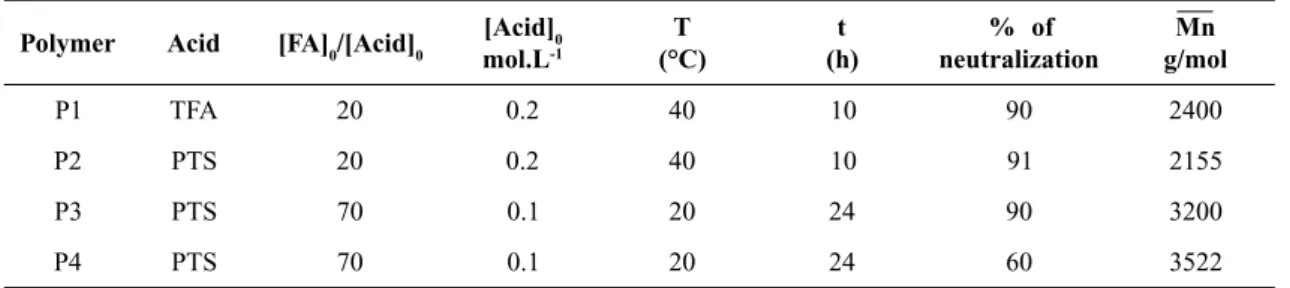
Techniques: Polymerization was carried out in a three-neck flask, under reflux and stirring (Table 1). Solid
PTS was added slowly into the FA solution to insure homogeneity of the polymerizing solution. Acid solu-tion was dripped into the monomer solusolu-tion when TFA was used as the initiator. The neutralization of the poly-merizing solution with a concentrated basic solution may easily lead to emulsification. The use of a 1 M NaOH solution requires two washes of 10 minutes each but at the end of the reaction an emulsion may appear. In order to avoid this problem an excess of 0.1 M NaOH solu-tion was used.
The neutralization of the reaction mixture was also followed by titration. An excess of a base so-lution (KOH or Na2CO3) 0.1M was added to the
sample and stirred for 10 minutes. Afterwards, the aqueous layer was removed and titrated with 0.1 M HCl solution. This process was repeated until the polymer solution became neutralized.
Polymers were isolated by precipitation in petro-leum ether and dried by using a high vacuum line.
Diels-Alders adduct. PolyFA and maleic an-hydride (10:1 g/g) were dissolved in THF and heated at 40oC for 3 hours. The product was
iso-lated by precipitation in petroleum ether.
Acrylic copolymer from methyl methacrylate, butyl methacrylate and methacrylic acid (molar composition 42:49:9) was supplied by R. Lago[6].
Photoresists were prepared by dissolving the adduct and the acrylic copolymer (10:1 g/g) in chlo-roform. Films were formed over Cu plate or flat sili-con by immersion or spin coating, respectively, followed by evaporation of the solvent at 50oC. The
resists were exposed to the UV light from a Hg lamp (200 W). The negative patterns were developed by treating the resists with a mixture of toluene, trichlo-roethylene and chloroform (1:2:7).
Measurements: NMR spectra were recorded
using a Bruker AMX-600 spectrometer equipped with an ASPECT 300 computer, a the frequencies of 600 Mhz (1H) and 150 Mhz (13C). The polymers were
dissolved in CDCl3 and the temperature were
regu-lated to 300K. The nature of each carbon atom was
determined by using the distortionless enhancement by polarization transfer technique (DEPT). with proton pulses at 135° and 90° respectively.
Number-average molecular weights, were deter-mined by vapor-pressure osmometry using a Knauer equipment.
Results and Discussion
Polymer solubility and neutralization of the polymerizing solution.
Table 1 shows representative and reproducible re-sults from the experiments carried out in this work. According to Gonzalez et al.[2] polymer chains that
are produced by polymerization with [FA]0/[TFA]0 =
20 should have few oxymethylenic bridges. That was confirmed with Polymer P1, which was synthesized as a reference. However, with PTS the polymer (P2) is free of ether bridges and a relation [FA]0/[PTS]0 >
20 is required to obtain this sequence (P3 and P4). PTS is insoluble in DCM but with the addition of FA the system becomes homogeneous. The polymer-ization with PTS is faster than with TFA and reticula-tion is reached in experiments of series P2 with [FA]/ [acid] = 20. Approximately, 34-40 % of the polymer is insoluble.
Different behavior in the solubility of the isolated polymer depending on the percentage of neutralization of the polymerizing solution and the presence of air is observed. Polymers arising from a poorly neutralized solution became insoluble approximately two hours after being isolated and dried; while, polymers obtained after a good neutralization (higher than 90 %) kept their solubility for at least one month. However, the exclusion of air by drying the polyFA in a high vacuum line avoid the reticulation of both kinds of samples. These results indicate that the polymer becomes in-soluble by oxidation but this process is accelerated by acids. r e m y l o
P Acid [FA]0/[Acid]0 [Acid]0
L . l o m -1
T ) C ° ( t ) h ( f o % n o i t a z i l a r t u e n n M l o m / g 1
P TFA 20 0.2 40 10 90 2400
2
P PTS 20 0.2 40 10 91 2155
3
P PTS 70 0.1 20 24 90 3200
4
P PTS 70 0.1 20 24 60 3522
PolyFA has the capacity to retain acids. Figure 1 shows that the neutralization of the polymerizing solu-tion is slow and that not all of the acid is free. After the first base addition only about 50% of the acid is titrated. The first extraction with basic solutions (represented with triangles and squares) was somewhat more efficient than with water (represented with circles). However, the neutralization curves over 70% tended to be identical. This phenomenon is analogous to what was observed in the polymerization of 2-propenylfuran where around 30% of the initial amount of the acid was retained by the polymer probably in the form of esters[7] and in the
po-lymerization of 2-vinylfuran where the consumption of acid is higher (≈ 70%) due to the additional and more important formation of conjugated ions[8]. Both the
pres-ence of esters[3] and conjugated ions[5] in the
polymer-ization of FA were reported and are in accordance with acid consumption.
Aging of the polymer solution
Both good and poorly neutralized solutions of polyFA were examined with the help of NMR spec-troscopy.
Polymer structures were determined by 1H and 13C NMR. The assignment of signals can be found
elsewhere[2,9-11]. Scheme 1 shows the three main
struc-tures that occur depending on the reaction conditions as well as some significant signals (£ values in ppm) of their 1H and 13C NMR spectra:
0 50 100 150 200 250
0 20 40 60 80 100
t(min)
Neutralization (%)
Figure 1. Time dependence of neutralization of P1 (Table 1) £ KOH
0.1M was used for neutralization; Polymer sample was extracted with water, neutralized with an excess of KOH 0.1M and titrated with HCl 0.1M; Q Na2CO3 0.05M was used for neutralization
O CH2OCH2
O
CH2 O
O
O CH2
O O CH
CH2
O CH2 O
3.90 4.50
27.96 62.93
broad signal: 40.35
1 2
3
Scheme 1
O CH2 CH2
O H3
H4
H5 O
H'4 H'3
CH2
H3
H4 H5
7 6 5 4 3 2 1 0
H’4+ H’3
δ(ppm)
Figure 2.1H NMR spectrum (600MHz) of polyfurfuryl alcohol without ether bridges
No signals are observed around δ = 4.50 ppm in the 1H NMR spectrum (600 MHz) of P1 (Figure 2)
indicating the absence of CH2-O-CH2 bridges in the
polymer. Figure 3 exhibits the 13C NMR (150 MHz)
with the assignment of the signals supported by a determination applying DEPT technique. The signals at δ = 29.29 and 38.83 ppm suggests that the branched sequence 3 accompanies the main sequence 1 of polyFA.
The 1H and 13C NMR spectra of the polymers
prepared with [FA]/[PTS] = 70 exhibit intense sig-nals at δ = 4.50 and 62.93, respectively, which confirm the presence of significant CH2-O-CH2 bridges in the polymer.
The 1H NMR spectra of the polymers reported
in Table 1 were recorded for a month. Some se-lected proton intensity ratios were chosen as the criterion for structural changes, namely:
- (I ΣH(3 + 4) - 2 I H5)/ I ΣH(3 + 4) = A is the fraction of the alkylated furan ring that is representative of sequence 3 (scheme 1)
- I CH2/ I H5 = Xn if only linear sequence 1 was present.
- I ΣHFuran/I CH2 = MB. This relation is proportional to the amount of methylene bridges in the polymer while
- I ΣHFuran/I CH2-O-CH2 = EB is proportional to the number of ether bridges.
Figure 4 shows almost no change in these ra-tios for a polymer of series P2. The same behavior was observed in the other polymers. Spectra were virtually unchanged and the average of the refer-ence ratios measured during one month are shown in Table 2.
However, when some FA remained in a poorly neutralized sample the spectra differed over time due to additional, but slow polymerization.
140 100 60 20
O CH2 O CH2 O
4
5 3
5' 4' 3'
5’ 5
4
3 4’ + 3’
CH2
δ(ppm)
Figure 3.13C NMR spectrum (150 MHz) of polyfurfuryl alcohol without ether bridges
s o i t a r y t i s n e t n
I Samples
1
P P2 P3 P4
0 0 1 x
A 76 80 82 70
B
M 1.5 1.8 1.7 1.8
B
E 3.9 — 2.5 2.6
Xn 6.4 6.4 7.4 4.2
0 5 10 15 20 25
0 1 2 3 4 5 6 7 8 9 10
t (days)
Ratio
of
proton
intensities
Figure 4. Time dependence of some ratios of proton intensities of
1H NMR spectra of polyfurfuryl alcohol (P
2, Table 1):R I CH2/ I H5; ¡ I ΣHFuran/I CH2; (I ΣH(3 + 4) - 2 I H5)/ I ΣH(3 + 4)
Table 2. Mean values of some selected ratios of proton intensities from
1H NMR spectra of polyFA samples measured during one month
FA is hardly eliminated when the initial concentra-tion of acid is low in relaconcentra-tion to the monomer concen-tration and the reaction is stopped at low conversion of polymerization as in experiments of series P3. The pres-ence of FA is observed in the 1H NMR spectrum of
this sample (Fig 5a). Difurfuryl ether (DFE) is also produced[2] with the experimental conditions of P3,
but the 1H NMR spectra of FA and DFE are
indistin-guishable and it is possible that the signals attributed to FA are actually due to a mixture of both substances. The solution of P3 was washed twice with 1M NaOH and water, and a second 1H NMR was
re-corded (Fig 5b). This resulted in the elimination of most of the FA.
Photocross-linking.
Gandini[12] has remarked that labile hydrogen
at-oms on carbon atat-oms are the most likely candidates that initiate photodegradation or other degradation pro-cesses. The tertiary hydrogen atom of poly(2-vinylfuran), for example, can be abstracted leading to a macroradical. The coupling of these radicals in-duces crosslinking.
PolyFA cross-links when exposed to the UV ra-diation of a Hg lamp. The mechanism probably in-volves the formation of macroradicals analogous to those obtained from poly(2-vinylfuran):
O C
O H
CH2
O
O C
O CH2
O hν
- H
The major reaction pathways opened to the macroradicals should be:
• the attack on some olefin or dihydrofuran carbon atom of the polyunsaturated se-quences
O C
O C
H H
O
H4 H3
H5
CH2 OH
O H5
H3
H4
CH2
O H4' H3'
n
7,40 7,00 6,60 6,20 5,80
δ(ppm) a
b
7,32 (H )5
6,28 (H + H )4 3
6,25 (H )4
6,03 (H )3
5,95 (H’ + H’ )4 3
Figure 5.1H NMR spectrum of polyfurfuryl alcohol P3 (Table 1). (a) Spectrum of the original sample; (b) Spectrum of the sample after a
• the addition to monosubstituted furan rings
bonyl signal at 1700 cm-1 with respect to the signal at
1010 cm-1 (ring breathing[14]) and II) the occurrence
of two signals at 1727 and 1767 cm-1, separated by
40 cm-1, which are characteristic of the carboxylic
anhydrides[15]. Both feature point out the formation
of the Diels-Alder adduct. MAN moiety contributes to the relative increase of the carbonyl signals by car-boxylic anhydrides groups and by the carcar-boxylic acid yielded from the hydrolysis of some anhydride groups. The Mn of the adducted polyFA increases mark-edly when compared to the original polymer (from 3500 to 8200 g/mol).
Films of the adducted polyFa over glass have good performance as photoprinting material[16] and films
over silicon produces periodic interference patterns using ultraviolet laser[17].
Films formation were improved by adding an acrylic copolymer composed of methyl methacry-late, butyl methacrylate and methacrylic acid (mo-lar composition 42:49:9).
The modified resin was successfully tested as pho-toresist by making circuits on copper-coated boards. High quality images were developed on the copper surface. The photoresist was also tested on flat Si to
O
CH
R
O+
R
R
H
CH
+
CH
R
1R
1O
.
...
.
.
The second pathway is probably more important. The polyunsaturated sequences are formed from the beginning of the reaction but their concentrations are very low. However, the proportion of monosubsti-tuted furan ring is above 20% due to branching. It is well known that the addition of radicals to furan rings occurs predominantly at C2 or C5, with a kinetic
pref-erence for the unsubstituted position[13].
PolyFA displayed properties of a negative photore-sist. Two problems were observed when coating the Cu surface: the poor adherence of the polymer and some difficulties in the formation of films.
Adhesion was improved by introducing carbonyl group through chemical modification with maleic an-hydride (MAN).
Figure 6 shows the comparison of the spec-trum of polyFA (a) and the specspec-trum of the product from the reaction of polyFA with MAN (b). The pres-ence of furan rings in both spectra is proved by the bands at 1600, 1150, 1020, 780 and 600 cm-1,
whereas aliphatic segments give rise to the bands at 1420 and 1350 cm-1 [2,14].
Two important feature are observed in spectrum b: I) an increment of the relative intensity of the
car-a
b
100
90
80
70
60
50
40
30
20
10
0
T
ransmittance
22 20 18 16 14 12 10 8 6 4
ν10 (cm )-2 -1
make circuits. Good images were developed again and measurements concerning resolution will be per-formed.
The addition of 3,3’-diethyloxotiocianine io-dide or the substitution of the acrylic copolymer by a polyalkenylfuran or a polyvinylphenylene also produces resists with good performance.
Conclusion.
PolyFA displays a tendency to retain the acids employed as catalysts hindering neutralization. Poorly neutralized polymers cross-link in solid state and exposed to air but not in solution.
The UV light initiates the reticulation of polyFA. The process is slow because the quantity of polyconjugated sequences in the polymer is relatively low. The presence of some acid accom-panying the polymer film also induces reticula-tion. The combination of the two factors allows the development of images in lithographic pro-cesses.
References
1. Gandini, A. - Adv. Polymer Sci. 25, 47 (1977)
2. Gonzalez, R.; Martinez, R.; Ortiz, P. - Makromol. Chem. 193, 1 (1992)
3. Gonzalez, R.; Martinez, R.; Ortiz, P. - Makromol. Chem., Rapid Commun. 13, 517 (1992)
4. Gandini, A. - in “Encyclopedia of Polymer Science and Engineering”, ed. H.F. Mark, Bikales, N.M.;
Overberger C.G.; Menges, G., Willey, New York, Vol. 7, p. 454 (1986).
5. Choura, M.; Belgacem, N.M.; Gandini, A. - Macro-molecules, 29, 3839 (1996).
6. Lago, R.; Ortiz, P. J.; Martínez, R. - Acta Polym. 42, 403 (1991)
7. Gandini, A.; Martínez, R. - Rev. Cienc. Quím. 16: 275 (1985)
8. Martinez, R.; Alvarez, R.; Gandini, A. - Acta Polym. 40, 613 (1989)
9. Maciel, G. E.; Chuang, I. S.; Meyers, G. E.;
-Macromolecules 17, 1087 (1984).
10. Fawcett A. H; Dadamba W. - Makromol. Chem. 183, 2799 (1982).
11. Principe M.; Ortiz P.; Martínez R. - Polym. Int., 48, 637 (1999).
12. Gandini A.; Belgacem, N.M. - Progress in Polymer Science (1996)
13. Gandini A.; Rieumont, J. - Tetrahedron Lett. 25, 2101 (1976).
14. Katritsky, A. R. - “Physical Methods in Heterocyclic Chemistry”, vol. 2, Academic Press Inc., New York (1956).
15. Marquarat, F. - J. Chem. Soc. B, 1242 (1966).
16. Sthel, M; Rieumont, J.; Martinez, R. - Polymer Testing 18(1), 47 (1999).
17. Sthel, M; Rieumont, J.; Martinez, R.. - Appl. Polymer Sci., 71, 1749(1999).