Article
J. Braz. Chem. Soc., Vol. 22, No. 1, 111-119, 2011. Printed in Brazil - ©2011 Sociedade Brasileira de Química
0103 - 5053 $6.00+0.00
A
*e-mail: [email protected]
Degradation of Food Dyes by Zero-Valent Metals Exposed to Ultrasonic Irradiation in Water
Medium: Optimization and Electrospray Ionization Mass Spectrometry Monitoring
Sérgio P. Pavanelli, Glayson Leonardo Bispo, Clésia Cristina Nascentes and Rodinei Augusti*
Universidade Federal de Minas Gerais, Instituto de Ciências Exatas, Departamento de Química, 31270-901 Belo Horizonte-MG, Brazil
A degradação redutiva de quatro corantes típicos (Azul Brilhante, Amaranto, Amarelo Crepúsculo e Vermelho 40), largamente empregados pela indústria alimentícia, por metais de valência zero (Fe e Sn), sob irradiação ultrassônica (US) em meio aquoso ácido (pH 3,0), foi estudada. As reações foram monitoradas por ESI(-)-MS (espectrometria de massas com ionização electrospray no modo negativo), além de espectrofotometria UV-Vis e carbono orgânico total (TOC). A inluência de parâmetros preponderantes (tempo de exposição à radiação ultrassônica e massa do metal) nas taxas de degradação foi seguramente estabelecida por meio da construção de planejamentos fatoriais e superfícies de resposta. Deste modo, observou-se que, sob as condições experimentais otimizadas, ferro metálico (Fe) degradou eicientemente todos os corantes (com taxas de degradação superiores a 90% após 30 min de reação), enquanto que estanho metálico (Sn) apresentou um desempenho notavelmente inferior. As baixas taxas de mineralização obtidas foram consequência, provavelmente, do caráter essencialmente redutivo de tais processos. Baseado nos resultados do monitoramento por ESI(-)MS, uma rota de degradação plausível para o corante Azul Brilhante em meio aquoso, pelo sistema Fe/US, foi proposta e envolve, como etapas iniciais, a hidrogenação da ligação dupla exocíclica carbono−carbono, seguida pela inserção de hidreto no
grupamento imino da molécula.
The reductive degradation of four prototype dyes largely employed by the food industry (Brilliant Blue, Amaranth, Sunset Yellow and Red 40), by zero-valent metals (Fe and Sn) under ultrasonic irradiation in acidic aqueous solution (pH 3.0), was studied. The reactions were monitored by direct infusion ESI(-)-MS (electrospray ionization mass spectrometry in the negative ion mode) as well as by UV-Vis and total organic carbon (TOC). The inluence of major parameters (time of exposure to ultrasonic irradiation and mass of metal) on the degradation rates was irmly established by means of factorial design and surface response approaches. Hence, it was noticed that, under the optimized experimental conditions, metallic iron (Fe) was able to eficiently degrade all the dyes (with rates higher than 90% after 30 min reaction time), whereas metallic tin (Sn) exhibited a noticeably lower performance. Low mineralization rates were achieved probably due to the essentially reductive character of such process. Based on the results from the ESI(-)-MS monitoring, a plausible degradation route for the Brilliant Blue dye in aqueous medium by the Fe/US system was proposed. Hence, this route involves, as initial pathways, the hydrogenation of the exocyclic carbon-carbon double bond of the dye followed by the insertion of hydride at its imino moiety.
Keywords: electrospray ionization mass spectrometry, monitoring, food dyes, zero-valent metals
Introduction
Color is by far the most important sensorial property of foods. In this way, dyes have been widely used to accentuate their original colors, or to provide different ones.
While being controversial, this practice has been usually
accomplished to meet consumer expectations.1 However,
The estimate world production of dyes and pigments is between 750 to 800 thousand tons per year, of which 26 thousand tons are annually consumed in Brazil.4 About
20% of the world production is lost and dispersed into the environment.2 In Brazil, the current legislation from
the National Health Surveillance Agency (ANVISA, www.anvisa.gov.br) allows the use of only eleven artiicial food dyes: Amaranth (CI 16185), Erythrosine (CI 45430), Red 40 (CI 16035), New Coccine (CI 16255), Sunset Yellow (CI 15985), Tartrazine (CI 19140), Indigo Carmine (CI 73015), Brilliant Blue (CI 42090), Carmoisine (CI 14720), Fast Green (CI 42053) and Patent Blue V (CI 42051).3
Although these synthetic dyes are tolerated, their use can cause some adverse effects. For instance, some studies have shown that dyes can cause simple hives, asthma and immune responses, and even cancer in laboratory animals.5 Yamazaki
and coworkers,6 for example, demonstrated that some red
dyes present a potential risk to the human health since they can interfere on the blood clotting process.
Reductive degradation processes are predominantly based on reactions with zero-valent metals in acidic media. These processes can be used to initiate remediation of complex anthropogenic chemicals, such as nitro and chlorinated aromatic compounds.7-11 Dyes are another
category of complex chemicals that are labile to reduction, as already shown for several dyes.12-18 Several metals (such
as Zn, Sn, Pt) can be used as reduction agents, but iron has received the foremost emphasis due to its high eficiency in addition to its low cost and toxicity.19-29
Mass spectrometry (MS) has been used for a long time for the measurement of isotopes and to determine the structure of organic molecules. Currently the major advances in mass spectrometry have occurred in the ionization sources. Electrospray ionization (ESI) is a soft ionization technique that allows the attainment of ionic species in the gas phase, including the ones derived from polar, non-volatile and thermolabile compounds.30 Recent examples have shown
that ESI-MS, in conjunction with ESI-MS/MS, can be successfully applied to monitor a number of processes, including the environmentally-relevant ones, furnishing novel and signiicant information about them.31-41
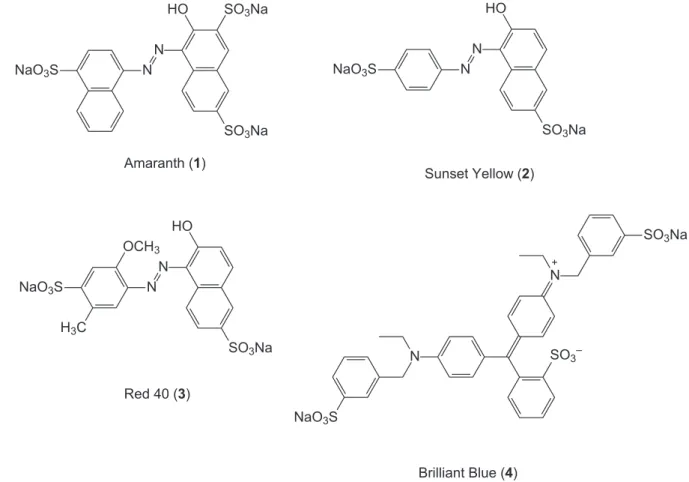
In this work, ESI(-)-MS (electrospray ionization mass spectrometry in the negative ion mode), in conjunction with ultraviolet-visible spectrophotometry (UV-Vis) and total organic carbon (TOC) techniques, were employed to monitor the reductive degradation of four prototype food dyes: Amaranth (1), Sunset Yellow (2), Red 40 (3) and Brilliant Blue (4) (Figure 1). The reactions were
conducted in an acidic aqueous medium by using zero-valent metals (Fe and Sn) and the systems exposed to ultrasonic irradiation (US).
Experimental
Chemicals
Standards of four selected food dyes (Amaranth, Sunset Yellow, Red 40 and Brilliant Blue), as their sodium salts (Figure 1), were furnished by food industries located at the São Paulo State (Brazil). The metals (powdered iron and tin) were purchased from Synth (Diadema, SP, Brazil). H2SO4 was purchased from Merck (Darmstadt, Germany). Ultrapure water, from a Millipore Milli-Q system (Milford, MA, USA), was employed to prepare all the solutions. All the reagents were used with no previous pre-treatment.
Degradation procedure
In a typical run, a given mass (which ranged from 20 to 100 mg) of a (powdered) metal (Fe or Sn) was added to an aqueous solution of the dye (25.0 mL, 2.0 × 10⁻⁵ mol L-1)
and the pH adjusted to 3.0 by dropping H2SO4 1:1. The system was then exposed to an ultrasonic irradiation (US) at a frequency of 40 kHz (Unique, model USC-1400A, Indaiatuba, SP, Brazil), for periods ranging from 0 up to 60 min. Aliquots were collected at assorted times and then iltered by using a Millipore ilter (Milford, MA, USA, 0.45 µm) to eliminate solid particles, and kept protected from light in a refrigerator prior to the ESI-MS, UV-Vis and TOC analyses.
Factorial design
Factorial designs (22 with a central point with a total
of 7 assays) were built to determine the conditions that led to an optimal degradation rate for each dye.42 The
inluence of two variables, i.e., the exposure time to the ultrasonic irradiation (tUS) and the mass of metal (iron: mFe; tin: mSn), as well as their interactions, was thus established. The experiments were carried out in a random order. A conidence interval of 95% was used to determine the most signiicant effects. The calculations, Pareto charts, and surface responses were achieved by using the Statgraphics software.
Analytical methods
UV-Vis analyses were conducted on a spectrophotometer (HITACHI, model U-2010, Tokyo, Japan). Scans were
performed from 689 to 190 nm, with 0.5 nm intervals. The spectra were then exported to be processed by the Origin 8.0
software. The consumption of each dye by the reductive processes was monitored by measuring the
absorbance at the maximum absorption wavelength (λ
max).
Total organic carbon (TOC) analyses were conducted on a TOC analyzer (Shimadzu, model TOC-VCPH, Kyoto, Japan). Previously to the insertion into the injection system, 15.0 mL of each sample were diluted with 10.0 mL of Milli-Q water. The TOC measurements were obtained by the indirect method that corresponds to the difference between the total carbon (TC) and inorganic carbon (IC) values.
ESI-MS analyses were conducted on a MS instrument (model LCQ Fleet, ThermoScientiic, San Jose, CA) with an ion trap analyzer, operating in the negative ion mode. The collected aliquots were diluted with methanol (Merck, Germany) in a 1:1 ratio and directly infused into the ESI source by a 500 µL micro syringe (Hamilton, Reno, NV). Flow rates ranged from 10 to 30 µL min-1. Mass spectra
were obtained as an average of 50 scans at intervals of 0.2 s. Spray and capillary voltages, capillary temperature, sheath gas (N2) low rate, and other parameters were adjusted according to each sample aiming at obtaining a maximum response. The m/z range used varied according to the dye investigated. For the ESI-MS/MS, the precursor ions were irst mass-selected within the ion trap, with an isolation width of 1 m/z unit, and fragmented via collision-induced dissociation (CID) with the target gas (helium). The relative collision energy was adjusted to yield product ions in a measurable abundance.
Results and Discussion
Factorial designs and optimization
Aiming at optimizing the performance of the zero-valent metal (Fe or Sn)/US systems, factorial designs (22 with a central point) were built for all the studied dyes.
The variables investigated were the exposure time to ultrasonic irradiation (tUS) and the mass of metal (iron: mFe; tin: mSn). Hence, the results related to the reductive degradation of the Brilliant Blue dye by the Fe/US system are shown in Table 1.
Based on these data, the Pareto chart of effects and the surface response (degradation rate as a function of tUS and mFe) were built, as displayed in Figure 2.
interaction between both variables is not relevant at all. The positive effect observed for both variables (tUS and mFe), as displayed in Figure 2a, refers to a direct relationship between the response (degradation rate) and the variables
(tUS and mFe). Hence, the increase in the mass of iron (from 20 to 100 mg) and in the exposure time (from 10 to 30 min) causes an enhancement in the degradation rate. As expected, ultrasonic irradiation (US) is of fundamental importance as it continuously activates the metal surface thus allowing the reaction to take place with no disruption. Moreover, a quadratic model to adjust the degradation rate (response) as a function of the variables (tUS and mFe) seems to be adequate since the curvature, as estimated by the Pareto chart (Figure 2a), is undoubtedly signiicant. On the other hand, the conditions employed at the central point (Table 1) shown to be convenient as high degradation rates (average value of 90.68%) were achieved with acceptable values for mFe (60 mg) and tUS (20 min). Finally, the response surface (Figure 2b) shows a clear trend that corroborates the Pareto chart remarks: higher values of both variables (mFe and tUS) are accompanied by a concomitant and steady enhancement in the degradation rate.
Table 2 shows the results obtained for the analogous reductive degradation of the dye Brilliant Blue promoted by the Sn/US system. These results thus revealed that the use of Sn as a reduction agent promoted the attainment of much lower degradation rates in comparison to Fe. For instance, for the assays with the variables at their superior values (mmetal = 100 mg; tUS = 30 min), degradation rates of 92.81% (Table 1) and 38.04% (Table 2) were achieved for the Fe/US and Sn/US systems, respectively.
Aiming to compare the eficiency of the Fe/US and Sn/ US systems, another set of experiments was conducted with the other dyes investigated (Amaranth, Sunset Yellow and Red 40). The results (factorial designs not shown) again indicated that for these dyes much higher degradation rates were obtained when the Fe/US system was applied. Therefore, due to its superior efficiency, the Fe/US
Table 1. Factorial design (22 with central point) showing the degradation rates for the dye Brilliant Blue in an aqueous solution (pH 3.0; 25.0 mL; 2.0 × 10⁻⁵ mol L-1) achieved by the Fe/US system. The inferior (–), superior (+), and central point (0) levels of each variable (mFe: mass of powdered iron; tUS: exposure time to the ultrasonic irradiation) are indicated
Variables Degradation Rate
(%) mFe (mg) tUS (min)
20 (–) 10 (–) 47.15
100 (+) 10 (–) 75.62
20 (–) 30 (+) 83.54
100 (+) 30 (+) 92.81
60 (0) 20 (0) 86.96
60 (0) 20 (0) 93.22
60 (0) 20 (0) 91.87
Figure 2. The reductive degradation of the dye Brilliant Blue in an aqueous solution (pH 3.0) achieved by the Fe/US system: (a) Pareto chart of effects; and (b) the surface response showing the degradation rate as a function of tUS and mFe.
Table 2. Factorial design (22 with central point) showing the degradation rates of the Brilliant Blue dye in an aqueous solution (pH 3.0; 25.0 mL; 2.0 × 10⁻⁵ mol L-1) achieved by the Sn/US system. The inferior (–), superior (+), and central point (0) levels of each variable (mSn: mass of powdered tin; tUS: exposure time to the ultrasonic irradiation) are indicated
Variables Degradation Rate
(%) mSn (mg) tUS (min)
20 (–) 10 (–) 18.48
100 (+) 10 (–) 18.48
20 (–) 30 (+) 14.70
100 (+) 30 (+) 38.04
60 (0) 20 (0) 20.65
60 (0) 20 (0) 19.46
system was selected to be employed in all the subsequent experiments described in this paper.
In this way, Table 3 shows the degradation and mineralization rates obtained for all the evaluated dyes by applying the following conditions: 60 mg of iron and 30 min of exposure to the ultrasonic irradiation. A longer
exposure time (30 min) in relation to that employed at the central point (20 min, Table 1) was used in an attempt to enhance (even if in a small proportion) the degradation rates for all the dyes.
Under such optimized conditions, quite high (close to 100%) degradation rates were obtained for all the dyes, thus demonstrating the high eficiency of the Fe/US system. As expected, there were no high mineralization (i.e., the conversion of the dyes into CO2, H2O, and other small molecules) rates as oxidation is not involved in this essentially reductive process.
UV-Vis monitoring
Figure 3 shows the UV-Vis spectra of the aqueous solutions of the four dyes, before and after the application of the Fe/US reductive process. The UV-Vis spectra show a clear decrease in the absorbance at the λ
max (wavelength
at the maximum absorption) for each dye: λ
max (Brilliant
Figure 3. UV-Vis spectra of aqueous solutions (pH 3.0) of the following dyes: (a) Brilliant Blue; (b) Amaranth; (c) Sunset Yellow; (d) Red 40. The spectra were acquired from aliquots collected after 0 and 30 min of treatment with the Fe/US system. Conditions: [dye] = 2.0 × 10⁻⁵ mol L-1; m
Fe = 60 mg.
Table 3. Degradation and mineralization rates for the prototype food dyes (Brilliant Blue, Amaranth, Sunset Yellow, and Red 40) in aqueous solution (pH = 3.0; 25.0 mL) produced by the Fe/US reductive process. The following conditions were employed: [dye] = 2.0 × 10⁻⁵ mol L-1; mFe = 60 mg; tUS = 30 min. The experiments were conducted in duplicate
Dye Degradation Rate
(%) ± SDa
Mineralization Rate (%) ± SDa
Brilliant Blue 93.90 ± 0.71 6.56 ± 0.51
Amaranth 91.63 ± 0.56 7.70% ± 0.43
Sunset Yellow 99.53 ± 0.01 28.28 ± 0.89
Red 40 99.86 ± 0.03 7.80 ± 0.13
Blue) = 629 nm; λ
max (Amaranth) = 523 nm; λmax (Sunset
Yellow) = 480 nm and λ
max (Red 40) 502 nm. Most
important, note that there was no the emergence of new absorption bands after 30 min reaction time, thus indicating that by-products (possibly formed under these conditions as revealed by the lower mineralization rates achieved, Table 3) do not absorb at such wavelength range.
ESI(-)-MS monitoring
ESI(-)-MS was also applied to monitor the degradation of the four prototype food dyes in aqueous medium by the Fe/US reductive process. The ESI(-)-MS of the aqueous (pH 3.0) methanolic (1:1) solutions of the Amaranth (1), Sunset Yellow (2) and Red 40 (3) dyes are shown in Figure 4. In these mass spectra the desodiated form of each dye is by far the predominant signal, i.e., [1 – 3Na + 2H]−
of m/z 537 (Amaranth, Figure 4a), [2 – 2Na + H]−
of m/z 407 (Sunset Yellow, Figure 4b) and [3 – 2Na + H]−
of m/z 451 (Red 40, Figure 4c). In Figure 4b, note the presence of another anion of m/z 111 ascribed to be CH3SO4−
, probably arising from an interaction between CH3OH (used to dilute the aliquots previously to their insertion into the mass spectrometer ion source; see Experimental section) and H2SO4 (applied to adjust the pH of the reaction media). The ESI(-)-MS of the aliquots (not shown), collected after exposing the dyes solutions to the Fe/US system for assorted times, revealed the steady decrease in the intensity of the [1 – 3Na + 2H]−
, [2 – 2Na + H] −
and [3 – 2Na + H]−
anions, whereas new signals, that could emerge as a result of the formation of degradation products in the reaction media, were not detected at all. Therefore, these results, while clearly indicating the ongoing dyes consumption, did not allow the detection and characterization of any by-product resulting from the reduction of such dyes by the Fe/US system.
The ESI(-)-MS of an aqueous (pH 3.0) methanolic (1:1) solution of the Brilliant Blue (4) dye revealed the predominant presence of [4 – 2Na + H] −
(m/z 747), whose structure is shown in Figure 5a. Other anions, i.e., [4 – 2Na]2−
of m/z 373 and [4 – Na] −
of m/z 769, also appear in this mass spectrum but with lower intensities. The mass-selection and fragmentation via CID (collision-induced dissociation) of the [4 – 2Na + H] −
anion (m/z 747) generated the product ions of m/z 667 and m/z 587 via a characteristic release of one or two molecules of SO3, respectively (MS/MS not shown).
After 30 min of exposure to the Fe/US system, an aliquot was withdrawn, diluted with methanol (in a 1:1 proportion) and directly injected into the mass spectrometer ion source. The resulting ESI(-)-MS, displayed in Figure 5b, exhibits
a number of remarkable changes in comparison to the ESI(-)-MS of the initial solution (Figure 5a). These changes encompass the decrease in the relative intensity of the [4 – 2Na + H] −
anion (m/z 747) as well as the emergence of novel anions (Scheme 1) m/z 749 [5] −
, m/z 375 [6]2−
, m/z 361 [7]2−
and m/z 347 [8]2−
, which are certainly derived from
degradation products formed under these conditions. Based on these results, chemical structures for such products and, as a consequence, a plausible route for the reductive degradation of the dye Brilliant Blue in aqueous solution, could thus be proposed, as displayed in Scheme 1.
Hence, anion [5] −
(m/z 749) is suggested to be formed via the insertion of two hydrogen atoms (hydrogenation) at the exocyclic carbon−carbon double bond of [4 – 2Na + H]−
(m/z 747). This pathway, which necessarily involves a H+→ H• reduction, probably takes place at the iron
surface. This proposed mechanism also explains the need of an acidic medium to improve the system eficiency. In sequence, the formation of [6]2−
(m/z 375) is proposed to occur via the insertion of hydride (H−
), generated via the reduction of H+ probably at the iron surface, into the imino
moiety of [5] −
. Note that such hydride insertion causes the attainment of the double-charged anion [6]2−
, obviously with a smaller m/z (375) than its precursor, the single-charged anion [5] −
(m/z 749). The reduction of these sites
destroys the chromophore groups present in the chemical structure of [4 – 2Na + H] −
, and these assumptions are consistent with the quick solution discoloration observed (Figure 3a). The ESI(-)-MS also shows the presence of the anions [7]2−
(m/z 361) and [8]2−
(m/z 347). Their formation was proposed to occur via the loss of one or two molecules of ethylene (CH2=CH2) from the precursor anion [6]2−
, respectively, probably induced by the ultrasonic irradiation.
Conclusions
The system consisted of metallic iron (Fe) and ultrasonic irradiation (US) shown to be quite eficient (although yielding low mineralization rates) in degrading four prototype dyes (Brilliant Blue, Amaranth, Sunset Yellow and Red 40), largely employed by the food industry, in an acidic aqueous medium. Conversely, metallic tin (Sn) was found to be much less eficient. We also made use of the appealing features of ESI-MS to monitor the reductive degradation of such dyes by the Fe/US in aqueous medium (pH 3.0). Whereas for Amaranth, Sunset Yellow and Red 40 no degradation products could be detected, for Brilliant Blue a number of primary products were promptly revealed. Hence, a plausible and inedited degradation route for this dye could be proposed. Finally, it can be envisaged that such a methodology is potentially applicable to reveal mechanistic details of other relevant environmental processes.
Acknowledgments
The authors thank the Brazilian agencies CAPES, CNPq and FAPEMIG (EDT PRONEX 479/07) for the inancial support. The authors are also indebted to Prof. Rochel M. Lago (Universidade Federal de Minas Gerais, Brazil) as he kindly permitted us to perform the TOC measurements in his laboratory.
References
1. Delwiche, J.; Food Qual. Prefer.2004, 15, 137.
2. Azbar, N.; Yonar, T.; Kestioglu, K.; Chemosphere2004, 55, 35. 3. Guaratini, C. C. I.; Zanoni, M. V. B.; Quim. Nova2000, 23, 71. 4. Kunz, A.; Peralta-Zamora, P.; de Moraes, S. G.; Duran, N.;
Quim. Nova2002, 25, 78.
5. Ring, J.; Brockow, K.; Behrendt, H.; J. Chromatogr., B2001,
756, 3.
6. Yamazaki, H.; Akieda, S.; Tanaka, Y.; Yokoi, T.; Yamaguchi, T.;
Jpn. J. Toxicol. Environ. Health1997, 43, P6.
7. Hung, H. M.; Hoffmann, M. R.; Environ. Sci. Technol.1998,
32, 3011.
Figure 5. ESI(-)-MS of aqueous (pH 3.0) methanolic (1:1) solutions of the Brilliant Blue (4) dye after treatment with the Fe/US system for: (a) 0 min; (b) 30 min. Conditions: [Brilliant Blue] = 2.0 × 10⁻⁵ mol L-1; m
8. Hung, H. M.; Ling, F. H.; Hoffmann, M. R.; Environ. Sci. Technol.2000, 34, 1758.
9. Cavalotti, L. F. R.; Peralta-Zamora, P.; Rodrigues, M. B.; de Paiva, T. C. B.; Quim. Nova2009, 32, 1504.
10. de Arruda, T. L.; Jardim, W. F.; Quim. Nova2007, 30, 1628. 11. Raja, P.; Bozzi, A.; Jardim, W. F.; Mascolo, G.; Renganathan,
R.; Kiwi, J.; Appl. Catal., B2005, 59, 249.
12. Cao, J. S.; Wei, L. P.; Huang, Q. G.; Wang, L. S.; Han, S. K.;
Chemosphere1999, 38, 565.
13. Deng, N.; Luo, F.; Wu, F.; Xiao, M.; Wu, X.; Water Res.2000,
34, 2408.
14. Liu, H. N.; Li, G. T.; Qu, J. H.; Li, H. J.; J. Hazard. Mater.2007,
144, 180.
15. Mu, Y.; Yu, H. Q.; Zhang, S. J.; Zheng, J. C.; J. Chem. Technol. Biotechnol.2004, 79, 1429.
16. Nam, S.; Tratnyek, P. G.; Water Res.2000, 34, 1837. 17. Zhang, H.; Duan, L. J.; Zhang, Y.; Wu, F.; Dyes Pigm.2005,
65, 39.
18. de Souza, C. R. L.; Peralta-Zamora, P.; Quim. Nova2005, 28, 226.
19. Dai, Y. Z.; Li, F. F.; Ge, F.; Zhu, F.; Wu, L. Y.; Yang, X. Z.;
J. Hazard. Mater.2006, 137, 1424.
20. Eykholt, G. R.; Davenport, D. T. ; Environ. Sci. Technol.1998,
32, 1482.
21. Ghauch, A.; Chemosphere2001, 43, 1109.
22. Monson, S. J.; Ma, L.; Cassada, D. A.; Spalding, R. F.; Anal. Chim. Acta1998, 373, 153.
23. Pereira, W. S.; Freire, R. S.; Quim. Nova2005, 28, 130. 24. Sayles, G. D.; You, G. R.; Wang, M. X.; Kupferle, M. J.; Environ.
Sci. Technol.1997, 31, 3448.
25. Singh, J.; Comfort, S. D.; Shea, P. J.; J. Environ. Qual.1998,
27, 1240.
26. Singh, J.; Shea, P. J.; Hundal, L. S.; Comfort, S. D.; Zhang, T. C.; Hage, D. S.; Weed Sci.1998, 46, 381.
27. Pereira, W. S.; Freire, R. S.; J. Braz. Chem. Soc.2006, 17, 832. 28. Moura, F. C. C.; Araujo, M. H.; Costa, R. C. C.; Fabris, J. D.;
Ardisson, J. D.; Macedo, W. A. A.; Lago, R. M.; Chemosphere
2005, 60, 1118.
29. Moura, F. C. C.; Oliveira, G. C.; Araujo, M. H.; Ardisson, J. D.; Macedo, W. A. A.; Lago, R. M.; Appl. Catal., A2006, 307, 195.
30. Manisali, I.; Chen, D. D. Y.; Schneider, B. B.; Trend Anal. Chem.
2006, 25, 243.
31. Dalmazio, I.; Almeida, M. O.; Augusti, R.; Alves, T. M. A.;
J. Am. Soc. Mass Spectrom.2007, 18, 679.
32. Dalmázio, I.; de Urzedo, A. P. F. M.; Alves, T. M. A.; Catharino, R. R.; Eberlin, M. N.; Nascentes, C. C.; Augusti, R.; J. Mass Spectrom.2007, 42, 1273.
33. de Urzedo, A. P. F. M.; Diniz, M. E. R.; Nascentes, C. C.; Catharino, R. R.; Eberlin, M. N.; Augusti, R.; J. Mass Spectrom.
2007, 42, 1319.
34. de Urzedo, A. P. F. M.; Nascentes, C. C.; Diniz, M. E. R.; Catharino, R. R.; Eberlin, M. N.; Augusti, R.; Rapid Commun. Mass Spectrom.2007, 21, 1893.
35. Florencio, M. H.; Pires, E.; Castro, A. L.; Nunes, M. R.; Borges, C.; Costa, F. M.; Chemosphere2004, 55, 345.
36. Madeira, P.; Nunes, M. R.; Borges, C.; Costa, F. M. A.; Florencio, M. H.; Rapid Commun. Mass Spectrom.2005, 19, 2015.
37. Meyer, S.; Koch, R.; Metzger, J. O.; Angew. Chem. Int. Ed.
2003, 42, 4700.
38. Sabino, A. A.; Machado, A. H. L.; Correia, C. R. D.; Eberlin, M. N.; Angew. Chem. Int. Ed.2004, 43, 4389.
39. Santos, L. S.; Dalmazio, I.; Eberlin, M. N.; Claeys, M.; Augusti, R.; Rapid Commun. Mass Spectrom.2006, 20, 2104. 40. Santos, L. S.; Knaack, L.; Metzger, J. O.; Int. J. Mass Spectrom.
2005, 246, 84.
41. Lopes, R. P.; de Urzedo, A. P. F. M.; Nascentes, C. C.; Augusti, R.; Rapid Commun. Mass Spectrom.2008, 22, 3472. 42. de Urzedo, A. P. F. M.; Nascentes, C. C.; Augusti, R.; J. Braz.
Chem. Soc.2009, 20, 51.
Submitted: March 9, 2010