Article
J. Braz. Chem. Soc., Vol. 22, No. 1, 30-37, 2011. Printed in Brazil - ©2011 Sociedade Brasileira de Química 0103 - 5053 $6.00+0.00
A
*e-mail: [email protected]
Highly Selective and Sensitive Membrane Salicylate Electrode Based on Complex of
(1,8-Diamino-3,6-dioxaoctane) Nickel(II)
M. Mazloum-Ardakani,*,a P. Pourhakkak,b M. Salavati-Niasari,c M. A. Karimid and
M. H. Mashhadizadehe
aDepartment of Chemitry, Faculty of Science, Yazd Univesity, Yazd, Iran
bDepartment of Chemistry, Payam Noor University, Ardakan Center, Ardakan, Iran
cDepartment of Inorganic Chemistry, Faculty of Chemistry, University of Kashan, Kashan, Iran
dDepartment of Chemistry, Payam Noor University, Sirjan Center, Sirjan, Iran
eDepartment of Chemitry, Faculty of Science, Tarbiat Moalem Univesity, Tehran, Iran
Foi estudada a resposta potenciométrica do eletrodo de salicilato com o complexo (1,8-diamino-3,6-dioxaoctano) de níquel (II). O complexo 1,8-diamino-3,6-dioxaoctano de níquel (II) [Ni(DADOO)] foi suportado em uma membrana contendo policloreto de vinila (PVC), um plastiicante e um aditivo. A inluência de diversas variáveis foi investigada e a resposta e a seletividade potenciométrica do eletrodo foram otimizadas. O eletrodo de membrana resultante incorpora 29% de PVC, 63% dioctilftalato (DOP) como plastiicante, 2% de cloreto de metiltrioctilamônio (MTOAC) como aditivo catiônico e 6% do ionóforo carregador (m/m).
Demonstrou uma resposta de Nernstiana de −59,5 ± 1,0 mV por década para o intervalo de
concentração do salicilato entre 7,0 × 10⁻⁷- 1,0 × 10⁻¹ mol de L−1. O eletrodo exibiu um rápido tempo
de resposta (≤ 20 s) com limite de deteção (LOD) de 5,0 ×10⁻⁷ mol L−1 podendo ser empregado
para faixa de pH entre 6,0 e 9,5. Foi aplicado com sucesso à determinação do íon salicilato em amostras reais.
The potentiometric response of salicylate electrode based oncomplex of
(1,8-diamino-3,6-dioxaoctane) nickel(II) was studied. The complex of 1,8-diamino-3,6-dioxaoctane nickel(II) [Ni(DADOO)] was used as carrier into plasticized polyvinyl chloride (PVC) membrane. The inluence of several variables was investigated in order to optimize the potentiometric response and selectivity of the electrode. The resulting membrane electrode incorporating 29% PVC, 63% dioctylphthalate (DOP) as plasticizer, 2% methyltrioctylammonium chloride (MTOAC) as cationic additive and 6% carrier (all m/m) demonstrated a Nernstian response of −59.5 ± 1.0 mV decade-1
over the concentration range of 7.0 × 10⁻⁷- 1.0 × 10⁻¹ mol L−1 salicylate. The electrode exhibited a fast
response time (≤ 20 s) with detection limit of 5.0 ×10⁻⁷ mol L−1, and can be used over a wide pH
range of 6.0-9.5. It was successfully applied to the determination of salicylate ion in real samples.
Keywords:salicylate ion-selective electrode, PVC membrane, potentiometry, salicylate analysis, Ni-complex
Introduction
In the modern health care setting clinicians are increasingly dependent upon the reliable and rapid measurement of chemical variables for accurate diagnostic
and therapeutic decisions.1 There is a perceived and
increasing demand for simple‚ inexpensive and rapid
analytical tests for detection of trace amounts of biologically and chemically important compounds. Potentiometric detection based on ion-selective electrodes (ISEs) as a simple method offers great advantages such as speed, and ease of preparation and procedure, relatively fast response reasonable selectivity, wide linear dynamic range and low cost. These characteristics have inevitably led to sensors for several ionic species and the list of available electrodes has
wide spread use specially for the direct determination of ionic species in whole and diluted blood, serum, urine,
tissue, and intercellular samples.3
Salicylate derivatives are commonly used as effective antimicrobial, antipyretic and analgesic agents. Aspirin, in particular, probably remains one of the most widely
used drugs of any kind. Salicylate ion (Sal−) is the main
hydrolyzed product of tablet aspirin or an aspirin-like substances, with are commonly used as effective analgesics. One should realize, however, that salicylates can be quite toxic if taken in large doses. Level in plasma higher than 2.2 mmol L−1 of salicylates are regarded as being toxic
for patients.4 Therefore, inding simple methods for the
determination of salicylate is still of considerable interest. The conventional analytical method for the detection of salicylate is based on the Trinder reaction, in which the simple salicylate reacts with ferric ions to form a colored complex in an acidic solution. This method always lacks adequate selectivity for the formation of other similar
complexes.5 Several methods such as high performance
liquid chromatography,6,7 luorometric,8 phosphorimetric,9
luminescent,10 and biomimetic11 methods have recently
been reported for its determination. Compared to the above mentioned methods, the ion-selective electrode is relatively simple in preparation, not requiring any sophisticated instrumentation and thus attracting remarkable attention for many years.12-17
This paper describes the use of the complex of 1,8-diamino-3,6-dioxaoctane nickel(II) percholorate [Ni(DADOO)] as an electroactive material for preparing salicylate-sensitive electrode. The potentiometric response properties, reproducibility and selectivity of electrodes were evaluated by the response potentials and selectivity coeficients. The salicylate-ion selective electrode exhibited signiicantly high sensitivity, stability, and selectivity for salicylate ion over many common ions. It was successfully used for determining salicylate ion in real samples.
Experimental
Reagents
PVC of high relative molecular weight, methyl-trioctylammonium chloride (MTOAC), dibutylphthalate (DBP), sodium teraphenylborate (NaTPB), dioctylphthalate (DOP), were obtained from Merck (Darmstadt, Germany). The ionophore was prepared as follows. A stock solution of 1.0 × 10⁻¹ mol L−1 Sal− was prepared by dissolving
1.6010 g of sodium salicylate in 100 mL of doubly distilled water. Working solutions were prepared by successive dilutions with doubly distilled water. All working
solutions were buffered at pH 7.0. All anion solutions were prepared in doubly distilled water and solutions of different concentrations were made by serial dilution of
1.0 × 10⁻¹ mol L−1 stock solutions. Doubly-distilled water
was used throughout all experiments. In order to prepare the pharmaceutical samples, tablets of different samples of aspirin were inely powdered. A precisely weighted
portion of each sample was reluxed with ca. 50 mL of
5.0 × 10⁻¹ mol L−1 NaOH for 1 h. After being iltered,
the solution was diluted to 250 mL in a volumetric lask and used for the determination of salicylate content by potentiometric and specrophotometric methods.
Synthesis of 1,8-diamino-3,6-dioxaoctane nickel(II) percholorate [Ni(DADOO)]
[ N i ( 1 , 8 - d i a m i n o - 3 , 6 - d i o x a o c t a n e ) ] ( C l O4)2 [Ni(DADOO)] complex (Figure1) was obtained by the reaction of 1,8-diamino-3,6-dioxaoctane with Ni(ClO4)2•6H
2O in methanol and recrystallized from water.
For the preparation of [(Ni(C20H24N2O4)](ClO4)2 complex, to a solution of (1,8-diamino-3,6-dioxaoctane) nickel(II) percholorate (5 mmol) in MeOH (100 mL), a solution of 2-hydroxy benzaldehyde (10 mmol) in MeOH (50 mL) was
added and the resulting mixture was stirred for ca. 24 h at
relux. The brown solid product was iltered off, washed
with MeOH and dried over fused CaCl2 in desiccators. The
product was crystallized from hot MeOH. Anal. calc. for [C20H24Cl2N2NiO12]: C, 39.12; H, 3.94; N, 4.56; Ni, 9.56.
Found: C, 39.02; H, 3.84; N, 4.63; Ni, 9.41%; yield: ca.
58%; ν
C=N 1610 cm
–1; d↔d 492 nm (in MeOH solution);
μB−0.009 B.M; Λ
M 250 (Ω
–1cm–1M–1).
Electrode preparation
A mixture of PVC, plasticizer and the membrane additive with a total mass of 100 mg was dissolved in about 10 mL of
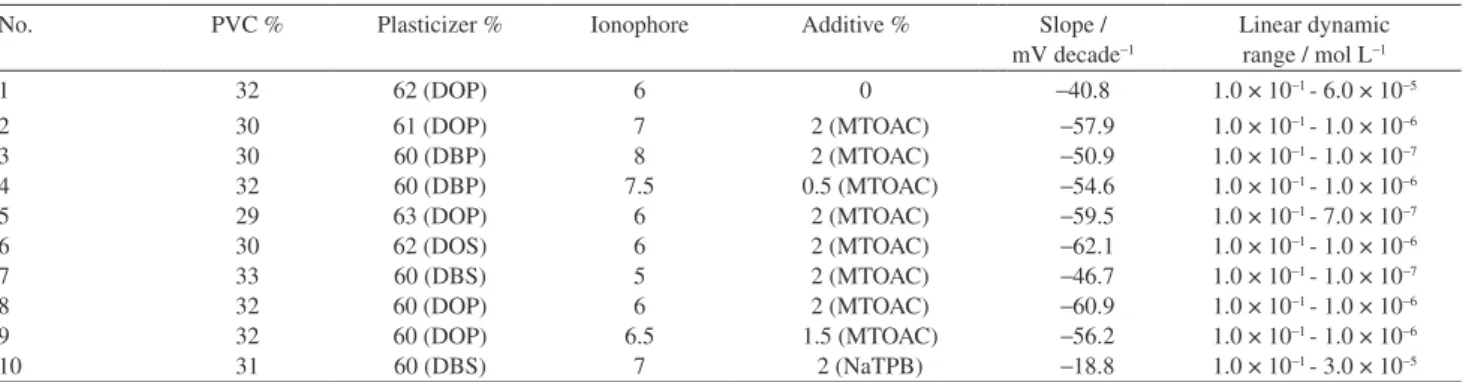
THF. To this mixture, the ionophore [Ni(DADOO)] complex was added and the solution was mixed well. Membrane compositions are listed in Table 1. The optimum composition of the membrane was 29.0 wt.% PVC, 63.0 wt.% DOP, 6.0 wt.% ionophore, 2.0 wt.% MTOAC as cationic additive. The resulting mixture was poured into a small lat bottom dish of 2 cm diameter, covered with a ilter paper and the solvent was allowed to evaporate at room temperature. A pyrex tube (5 mm i.d.) was dipped into the mixture for about 10 s so that a nontransparent membrane was formed. Then, the tube was then pulled out from the mixture and kept at room temperature for 24 h. The tube was then illed with the internal solution 1.0 × 10⁻¹ mol L−1 Sal−.
The irst conditioning time was approximately 24 h and then 20-30 min for successive uses. A silver/silver chloride electrode was used as an internal reference electrode.
Apparatus
The potential measurements were carried out at
25 ± 1 °C using a digital pHmeter (mV), Zag Chimi, Iran,
by setting up the following assembly:
Ag | AgCl | internal solution (KCl 3.0 mol L−1, Sal−
1.0 × 10⁻¹ mol L−1) | PVC membrane | test solution || SCE
A saturated calomel electrode (SCE, Azar electrode, Iran) with a fiber junction was used as the external reference electrode. Activities were calculated according
to the Debye-Hückel procedure.18 For construction of
the calibration curve, concentration instead of activity was used. The pH of the sample solution was monitored simultaneously with a conventional glass pH electrode (Metrohm, Swittzerland). The performance of the electrode was investigated by measuring its potential in salicylate solutions prepared in the concentration range 1.0 × 10⁻⁸ - 1.0 × 10⁻¹ mol L−1 by serial dilution at constant
pH. All solutions were freshly prepared by dilution from the stock standard solution, 1.0 × 10⁻¹ mol L−1, with
doubly-distilled water. The solutions were stirred and potential readings recorded when they became stable. The data
were plotted as observed potential vs. the logarithm of the
Sal− concentration at constant pH (pH = 7.0).
Determination of selectivity coeficient
The selectivity factor, Kpot is a measure of the preference
of the ion-selective electrode for the interfering ion
A relative to the primary ion Sal−to be measured. A
selectivity factor below 1 indicates that the preference is
for the primary ion Sal−. Selectivities of solvent polymeric
membrane ion-selective electrodes are quantitatively related to equilibria at the interface between the sample and the electrode membrane. Selectivity coeficients are determined experimentally using the separate solution method (SSM) and fixed interference method (FIM). In the separate solution method, potential values obtained for measuring (primary) ion and the interfering ion, both determined in pure single electrolyte solutions, are compared using the Nicolsky-Eisenmann equation. In ixed interference method, the potential of a cell comprising an ion-selective electrode and a reference electrode is measured with solutions of constant level of interference ion, a A, and
varying activity of primary ion aSal. The potential values
obtained are plotted vs. the concentration of the primary ion.
The intersection of the extrapolation of the linear portions
of this curve will indicate the value aA which is to be used
to calculate Kpot. Potentiometric selectivity coeficients for
several anions relative to salicylate ion were determined by
the ixed interferences method (FIM).19,20
Results and Discussion
The [Ni(DADOO)] complex as a carrier was found to be highly responsive to salicylate with respect to several other ions. Therefore, we studied in detail the performance of the plasticized PVC membrane containing this ionophore for salicylate in aqueous solutions. Preliminary experiments
Table 1. Optimized membrane compositions and their potentiometric response properties in salicylate-selective electrode; values in table are mass ratio percent
No. PVC % Plasticizer % Ionophore Additive % Slope /
mV decade−1
Linear dynamic range / mol L−1
1 32 62 (DOP) 6 0 −40.8 1.0 × 10⁻¹ - 6.0 × 10⁻⁵
2 3 4 5 6 7 8 9 10
30 30 32 29 30 33 32 32 31
61 (DOP) 60 (DBP) 60 (DBP) 63 (DOP) 62 (DOS) 60 (DBS) 60 (DOP) 60 (DOP) 60 (DBS)
7 8 7.5
6 6 5 6 6.5
7
2 (MTOAC) 2 (MTOAC) 0.5 (MTOAC)
2 (MTOAC) 2 (MTOAC) 2 (MTOAC) 2 (MTOAC) 1.5 (MTOAC)
2 (NaTPB)
−57.9 −50.9 −54.6 −59.5 −62.1 −46.7 −60.9 −56.2 −18.8
were carried out to obtain an optimum membrane composition. The optimized membrane was used to test the performance of the membrane characteristics.
The inluence of membrane composition
In a preliminary experiment, membranes with and without carrier were constructed. The membrane with no carrier displayed insigniicant selectivity toward salicylate and its response was not reliable. However, in the presence of the proposed carrier, the optimized membrane demonstrated Nernstian response and remarkable selectivity for salicylate over several common inorganic and organic anions. The
preferential response toward Sal− is believed to be associated
with the coordination of salicylate with the central metal ion of the carrier.
Besides the critical role of the nature of the ion-carrier in preparing membrane-selective sensors, some other important features of the PVC membrane such as the amount of the ionophore, the nature of the solvent mediator (plasticizer), the plasticizer/PVC ratio, and especially the nature of additives used are known to signiicantly inluence the sensitivity and selectivity of ion selective electrodes.21-23
Thus, several membrane compositions were investigated by varying the ratio of PVC, plasticizer, and the membrane active material, [Ni(DADOO)] complex (Table 1). The potentiometric response of the membrane was greatly improved in the presence of lipophilic cationic additive, MTOAC. Generally, better response characteristics were observed with an ionophore/MTOAC weight ratio of about 3.5, which corresponds to a mol ratio of about 3.4. It is known that lipophilic salts not only reduce the membrane resistance, but also enhance the response behavior and
selectivity, and reduce interferences from sample anions.24,25
The presence of lipophilic ionic sites is beneicial for both neutral carrier and charged carrier-based ion-selective
electrodes.26,27 Neutral carrier based cation-selective
electrodes require lipophilic ionic sites with a charge sign opposite to that of the primary ion for obtaining Nernstian
responses.28,29 However, for the charged carrier based
ion-selective electrodes, the charged sign of the ionic sites that gives the highest potentiometric selectivities depends on the charge of the ionophore, charge of the primary and interfering ions as well as on the stoichiometry of
their complexes with the ionphore.30 Therefore, from the
different effect that the charge of the added ionic sites has on neutral and charged carrier based ion-selective electrodes, the carrier mechanism may be evaluated by investigating
membranes that contain ionic sites of opposing charges.31,32
As it is obvious from Table 1, among four different plasticizers used, DOP was a more effective solvent
mediator in preparing the salicylate selective electrode. It should be noted that the nature of the plasticizer inluences both the dielectric constant of the membrane and the mobility of the ionophore and its complex. Initially, plasticizers were applied to the polymer matrix in order to decrease its viscosity and provide mobility of the membrane constituents within the membrane phase. In relation to the role of plasticizer in a PVC membrane, it should be noted that a plasticizer acts as a membrane solvent, affecting membrane selectivity through both extraction of ions into organic phase and inluencing their complexation with the ionophore.
The critical response characteristics of the proposed electrode were investigated according to IUPAC
recommendations.29,30 The membrane with a composition
of 6% ionophore, 63% DOP, 29% PVC, 2% MTOAC generated a stable potential response in solutions containing Sal− after conditioning for 24 h in a 1.0 × 10⁻¹ mol L−1
Sal− solution.
Lipophilic ionic additive is a salt of non-exchangeable lipophilic anion/cation and an exchangeable counter ion. Ionic sites provide electroneutrality of the membrane with neutral ionic carriers so that no signiicant amount of counter ions can be co-extracted into the membrane together with primary ion. Therefore, the membrane is permeable only for ions of the same charge sign as primary ion (Donnan exclusion) and demonstrates theoretical Nernstian response. Moreover, lipophilic ionic sites reduce electrical resistance of the membrane, which is especially important for micro-dimensional electrodes.
Response characteristics of the electrodes
The potential response of the optimized
salicylate-selective electrode to varying concentrations of Sal− ions
was examined. All the emf values were corrected for liquid junction potential using the Henderson equation. The average slope of the calibration plot resulted
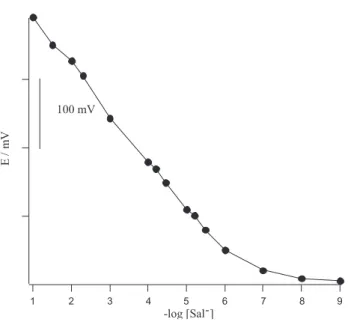
−59.5 ± 1.0 mV decade-1. The calibration plot is shown
in Figure 2; it indicates a linear range from 7.0 × 10⁻⁷ to
1.0 × 10⁻¹ mol L−1. The practical limit of detection, deined
as the concentration of salicylate ion obtained from the intersection of two extrapolated segments of the calibration
graph, was about 5.0 × 10⁻⁷ mol L−1. The optimum
equilibration times for salicylate-selective electrode in the
presence of 1.0 × 10⁻¹ mol L−1 sodiun salicylate was 24 h,
after which the electrode would generate stable potentials
in contact with Sal−solutions.
were ± 0.4, ± 0.8 and ± 1.0 mV, respectively. The signal
stability was good, i.e., 3 mV h−1.33 The long-term stability
of the electrode was studied by periodically re-calibrating in standard solutions and calculating the response slope over the range of 1.0 × 10⁻⁸ - 1.0 × 10⁻¹ mol L−1.
The effect of the pH of the test solution on the
response of the membrane electrode was examined at Sal−
concentration 1.0 × 10⁻² mol L−1. The pH was adjusted with
dilute hydrochloric acid and sodium hydroxide as required. As illustrated in Figure 3 the potentials remain constant within a pH range of approximately 6.0-9.5. Variation of the potential at pH < 6.0 could be related to protonation of [Ni(DADOO)] in the membrane phase, which results
in a loss of its ability to interact with Sal− ions. At higher
pH > 9.5, the potential drop (negative slope) may be because of interference of the hydroxide ions. In high pH media,
hydroxide ion will compete with salicylate ion for the cation site in the membrane.
The response time, deined as the time elapsed from the dipping of the electrode in the solution until the equilibrium potential was reached, varied from 10 to 15 s depending on the analyte concentration. The response time was faster
when the concentration was higher. The actual potential vs.
time traces is shown in Figure 4. The sensing behavior of the membrane electrode did not depend on whether the potentials were recorded from low to high concentrations or vice versa.
The inluence of the concentration of internal solution on the potential response of the salicylate-selective electrode was studied and the results showed the concentration of the internal solution does not cause any signiicant difference in the potential response of the electrodes, except for an expected change in the intercept of the resulting Nernstian plots (Figure 5).
The electrode was tested over a period of two months to investigate stability. During this period the electrode
was used daily and was stored in 1.0 × 10⁻¹ mol L−1 Sal−
solution when not in use. Before any measurements, the
electrode was conditioned in 1.0 × 10⁻¹ mol L−1 NaSal for
approximately 20-30 min. The slopes of the electrode
response were reproducible to within ± 5 mV/decade over
a period of two months. Storage of the electrode in solution for extended periods, however, especially in stirred solution, resulted in a slight gradual decrease in the slope, as is usual for many plasticized PVC membranes, probably as a result of leaching of the ionophore from the membrane. The characteristic properties of the optimized membrane are summarized in Table 2.
Potentiometry selectivity coeficient
The selectivity of the proposed salicylate ion selective
electrode over other anions (A−) was important. Their
Figure 4. Response time of the membrane electrode for salicylate with changes of concentration from 1.0 × 10⁻⁷ mol L−1 to 1.0 × 10⁻¹ mol L−1.
Figure 2. Potentiometric response of the salicylate-selective electrode to salicylate using optimized membrane electrode.
potential responses were investigated in the presence of a wide variety of interfering foreign anions using the mixed
solution method (MSM).34,20 Potentiometric selectivity
coeficients (Kpot
Sal,A–) describing the preference of the
membrane for an interfering ion A− relative to Sal− were
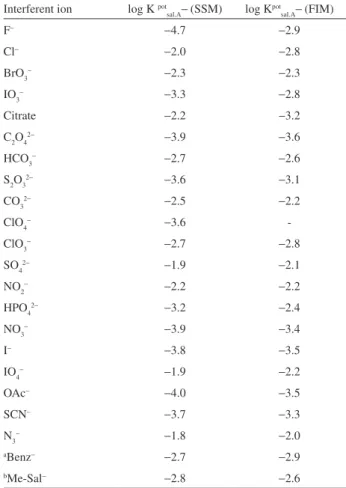
determined by the fixed interference method (FIM) and separate solution method (SSM). The selectivity coefficient for various anions was evaluated by the mixed solution method with a fixed concentration of interference (1.0 × 10⁻¹ mol L−1) and varying amounts
of Sal− concentrations. Table 3 lists the potentiometric
selectivity coeficient data of the sensor for several anions
relative to Sal−. The selectivity coeficients clearly indicate
that the electrode is selective to salicylate over a number of other inorganic and organic anions. As it is evident from the data in Table 3 the electrode based on [Ni(DADOO)]
has relatively high selectivity toward Sal− relative to several
common anions. This is most probably due to the weak interaction between these anions and the ionophore. It is interesting to note that the observed selectivity pattern for the Sal−-ISE signiicantly differs from the so-called
Hofmeister selectivity sequence. According to the tabulated data in Table 3, the interfering effect of the ions is in the following order:
N3−> SO 4
2−> IO 4
−= NO
2
−= CO
3
2− > BrO 3
−> HPO 4
2−>
HCO3−= m-Sal > Cl−= IO 3
−= ClO
3
−> F−= Benz− > S 2O3
2−>
SCN−> NO 3
− > I−= OAc− > ClO 4
−= C 2O4
2−.
The electrode demonstrates a signiicant deviation in
selectivity from the Hofmeister series,35,36 large lipophilic
anions > ClO4− > SCN− > I− > NO 3
− > Br− > N 3
− > NO 2
− >
Cl− > OAc− > SO 4
2−, A theoretical treatment of liquid
anion-exchanger membranes has shown that this kind of behavior is typical of dissociated anion-exchangers in which the complexation between the cationic sites and the counter ions in the membrane phase is negligible. The selectivity
Figure 5. The influence of internal solution concentration on the potential response of the optimized Sal−-ISE: () 1.0 × 10⁻¹ mol L−1, () 1.0 × 10⁻² mol L−1, () 1.0 × 10⁻³ mol L−1.
Table 2. Characteristics of optimized Sal-ISE
Linear range / mol L−1 7.0 × 10⁻⁷ - 1.0 × 10⁻¹
Slope / mV decade−1 −59.5
pH range 6.0-9.5
precision at concentrations of 1.0 × 10⁻¹, 1.0 × 10⁻², and 1.0 × 10⁻³ Sal− standard deviations
were of ± 0.4 and ± 0.8 and ±1.0 mV
Detection limit / mol L−1 5.0 × 10⁻⁷
Lifetime / month > 2
Response time / s 10-15
Table 3. Selectivity coeficients determined by use of the separate solution method (SSM) and ixed interference method (FIM) for the salicylate-selective electrode
Interferent ion log K pot
sal.A− (SSM) log K pot
sal.A− (FIM)
F− −
4.7 −2.9
Cl− −2.0 −2.8
BrO3− −2.3 −2.3
IO3− −
3.3 −2.8
Citrate −2.2 −3.2
C2O42− −
3.9 −3.6
HCO3− −2.7 −2.6
S2O32− −3.6 −3.1
CO32− −
2.5 −2.2
ClO4− −3.6
-ClO3
− −
2.7 −2.8
SO42− −
1.9 −2.1
NO2− −2.2 −2.2
HPO42− −
3.2 −2.4
NO3− −3.9 −3.4
I− −3.8 −3.5
IO4− −
1.9 −2.2
OAc− −4.0 −3.5
SCN− −
3.7 −3.3
N3− −1.8 −2.0
aBenz− −2.7 −2.9
bMe-Sal− −
2.8 −2.6
is completely described by the distribution coeficients of the various anions between the sample solution and
the membrane phase.37 The reason that the selectivity
coeficients of the proposed salicylate electrode do not comply with the Hofmeister series can be due to speciic interaction of the anions with the metal center in the carrier
used in this study, i.e. chemical recognition of the anions,
and especially of salicylate, by the complex. From the data given in Table 3; it is immediately obvious that the
Sal−-ISE is highly selective with respect to other inorganic
and organic anions. This is most probably due to the weak interaction between other anions and the ionophore.
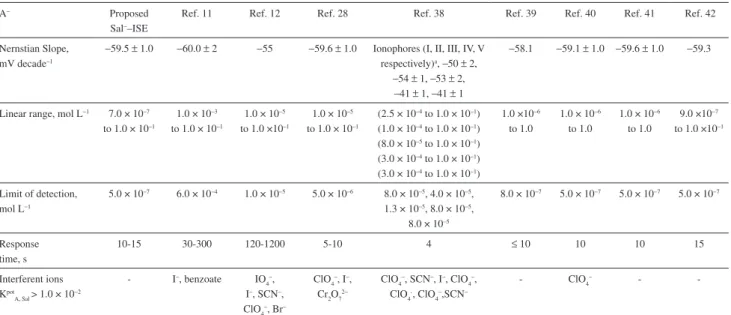
Table 4 lists the linear range, detection limit, slope, response time and selectivity coeficients of some of other selective electrodes against proposed salicylate-selective electrode for comparative purposes.11,12, 28, 38-42 As
can be seen from the Table 4, the selectivity coeficients obtained for the proposed electrode are superior to some reported for other Sal−-selective electrodes listed in Table 4.
Linear range, Nernstian slope and limit of detection
characteristics of the proposed Sal−-selective electrode is
comparable with other Sal-selective electrode.
Analytical applications
The proposed membrane electrodes were found to work well under laboratory conditions. It can be seen that the amount of salicylate ion can be accurately determined from the electrode. The salicylate-selective electrode has also been applied to the determined of salicylate in drugs (aspirin
tablets). It is known that the salicylate and its derivatives are extensively used as analgesics in many pharmaceutical preparations. The salicylate content of the inal solution was determined by the proposed electrode using the standard addition method and also by spectrophotometric method as
a reference method.43 The comparison of the results obtained
from ten measurements and the certiied value shows that the
present electrode can be used in determination of Sal- in real
samples. The results are given in Table 5.
Conclusions
New salicylate-selective membrane electrode has been prepared using the complex of [Ni(DADOO)]. This electrode has shown to have good operating characteristics (Nernstian response, reasonable detection limit, relatively high selectivity, wide dynamic range and fast response). These characteristics and the typical applications presented in this paper make the electrode suitable for measuring the acetylsalicylic acid content in pharmaceutical samples without a signiicant interaction from concomitant anionic species. The results show that there was a coordination interaction between salicylate and
Table 4. Comparison of the potentiometric parameters of the proposed Sal−
-selective electrode with other Sal−
-selective electrodes
A− Proposed
Sal−–ISE
Ref. 11 Ref. 12 Ref. 28 Ref. 38 Ref. 39 Ref. 40 Ref. 41 Ref. 42 Nernstian Slope,
mV decade−1
−59.5 ± 1.0 −60.0 ± 2 −55 −59.6 ± 1.0 Ionophores (I, II, III, IV, V respectively)a, −50 ± 2,
−54 ± 1, −53 ± 2, −41 ± 1, −41 ± 1
−58.1 −59.1 ± 1.0 −59.6 ± 1.0 −59.3
Linear range, mol L−1 7.0 × 10⁻⁷
to 1.0 × 10⁻¹
1.0 × 10⁻³
to 1.0 × 10⁻¹
1.0 × 10⁻⁵
to 1.0 ×10⁻¹
1.0 × 10⁻⁵
to 1.0 × 10⁻¹
(2.5 × 10⁻⁴ to 1.0 × 10⁻¹)
(1.0 × 10⁻⁴ to 1.0 × 10⁻¹)
(8.0 × 10⁻⁵ to 1.0 × 10⁻¹)
(3.0 × 10⁻⁴ to 1.0 × 10⁻¹)
(3.0 × 10⁻⁴ to 1.0 × 10⁻¹)
1.0 ×10⁻⁶
to 1.0
1.0 × 10⁻⁶
to 1.0
1.0 × 10⁻⁶
to 1.0
9.0 ×10⁻⁷
to 1.0 ×10⁻¹
Limit of detection, mol L−1
5.0 × 10⁻⁷ 6.0 × 10⁻⁴ 1.0 × 10⁻⁵ 5.0 × 10⁻⁶ 8.0 × 10⁻⁵, 4.0 × 10⁻⁵,
1.3 × 10⁻⁵, 8.0 × 10⁻⁵,
8.0 × 10⁻⁵
8.0 × 10⁻⁷ 5.0 × 10⁻⁷ 5.0 × 10⁻⁷ 5.0 × 10⁻⁷
Response time, s
10-15 30-300 120-1200 5-10 4 ≤ 10 10 10 15
Interferent ions Kpot
A, Sal > 1.0 × 10 −2
- I−
, benzoate IO4 −
, I−
, SCN−
, ClO4
−
, Br−
ClO4 −
, I−
, Cr2O7
2−
ClO4 −
, SCN−
, I−
, ClO4 −
, ClO4
-, ClO 4 −
,SCN−
- ClO4
−
-
-a Ionophore I, II, III, IV and V are: aluminum tetrakis-tert-butylphthalocyanine chloride (PćAlCl), PćCu, PćSnCl
2, PćLuOAc, PćDyOAc respectively. Tetrakis-tert
-butylphthalocyanine is describe as Pć.
Table 5. Determination of salicylate in different Aspirintablets samples
(n = 10)
Aspirin samples (mg / tablet )
Spectrophotometric method (mg / tablet)
ISE (mg / tablet) 100
325
95.21 ± 0.63
311.0 ± 2.8
the proposed carrier, which played an important role in the response characteristics and selectivity of the electrodes.
Acknowledgments
The authors express their appreciation to the Payam Noor University Research Councils (Ardakan Center) and the IUT Research Council and Excellence in Sensors for inancial support of this research.
References
1. Singer, R.; Anal. Chem.1987,59, 113.
2. Bühlmann, P.; Pretsh, E.; Bakker, E.; Chem. Rev.1998,98,
1593.
3. Meyerhoff, M. E.; Trends Anal. Chem.1993,12, 257. 4. MacMahon, G. P.; Kelly, M. T.; Anal. Chem. 1998, 70, 409. 5. Trinder, P.; Biochem. J. 1954, 57, 301.
6. Moore, T. J.; Joseph, M. J.; Allen, B. W.; Coury, L. A.; Anal. Chem. 1995, 67, 1869.
7. MacMahon, G. P.; O’Connor, S. J.; Fitzgerald, D. J.; Roy, S. L.; Kelly, M. T.; J.Chromatogr., B:Anal. Technol. Biomed. Life Sci. 1998, 48, 469.
8. Navalon, A.; Blanc, R.; Olmo, M. D.; Vilchez, J. L.; Talanta
1999, 48, 469.
9. Lloyed, J .B. F.; Analyst1978, 103, 775. 10. Arnaud, N.; Georges, J.; Analyst1999, 124, 1075.
11. Hutchins, R. S.; Bansal, P.; Molina, P.; Alajarin, M.; Vidal, A.; Bachas, L. G.; Anal.Chem.1997, 69, 1273.
12. Chaniotakis, N. A.; Park, S. B.; Meyerhoff, M. E.; Anal. Chem.
1989, 61, 566.
13. Creager, S. E.; Lawrence, K. D.; Tibbets, C. R.; J. Chem. Educ.
1995, 72, 274.
14. Hisamoto, H.; Siswanta, D.; Niashara, H.; Suzuki, K.; Anal. Chim. Acta1995, 304, 171.
15. Katso, T.; Mori, Y.; Talanta1996, 43, 755.
16. Rover Jr., L.; Garcia, C. A. B.; Oliveira Neto, G.; Kubota, L. T.; Galembeck, F.; Anal.Chim. Acta1998, 366, 103.
17. Radecki, J.; Stenka, I.; Dolusic, E.; Dehaen, W.; Electrochim. Acta2006, 51, 2282.
18. Kamata, S.; Bhal, A.; Fakunaga, Y.; Marata, A.; Anal. Chem.
1998,60, 2464.
19. Bakker, E.; Pretsch, E.; Bühlmann, P.; Anal. Chem.2000, 72, 1127.
20. Umezawa, Y.; Umezawa, K.; Sato, H.; Pure Appl. Chem.1995,
67, 507.
21. Shamsipur, M.; Khayatian, G.; Tangestaninejad, S.;
Electroanalysis1999,18, 1340.
22. Rouhollahi, A.; Shamsipur, M.; Anal. Chem.1999, 71, 1350. 23. Farhadi, K. H.; Maleki, R.; Shamsipur, M.; Electroanalysis
2002, 14, 760.
24. Mazloum-Ardakani, M.; Sheikhmohseni, M. A.; Salavati-Niasari, M.; Can. J. Anal. Sci. Spectrosc. 2008, 53, 163. 25. Huser, M.; Gehrlg, P. M.; Morf, W. E.; Simon, W.; Lindner, C.;
Jeney, J.; Toth, K.; Pungor, E.; Anal. Chem.1991,63, 1380. 26. Schaller, U.; Bakker, E.; Spichiger, U. E.; Pretsch, E.; Anal.
Chem.1994,66, 391.
27. Bakker, E.; Malinowska, E.; Schiller, R. D.; Meyerhoff, M. E.;
Talanta1994, 41, 881.
28. Mazloum-Ardakani, M.; Pourhakak, P.; Salavati-Niasari, M.;
J. Braz. Chem. Soc. 2007, 18, 782.
29. Yajima, S.; Tohda, K.; Bühlmann, P.; Umezawa, Y.; Anal. Chem.
1997,69, 1919.
30. Amemiya, S.; Bülhlmann, P.; Pretsch, E.; Rusterholz, B.; Umezawa, Y.; Anal. Chem.2000,72, 1618.
31. Bakker, E.; Bühlmann, P.; Pretsch, E.; Chem. Rev.1997,97, 3083.
32. Schaller, U.; Bakker, E.; Pretsch, E.; Anal. Chem. 1995,67, 3123.
33. Buck, R. P.; Lindner, E.; Pure Appl. Chem. 1994,66, 2527. 34. Srinivasan, K.; Rechnitz, G. A.; Anal. Chem.1969,41, 1203. 35. Badr, I. H. A.; Meyerhoff, M. E.; Hassan, S. S. M.; Anal. Chem.
1995,67, 2613.
36. Morf, W. E.; The Principles of lon-Selective Electrodes and of Membrane Transport, Akademiai Kiaddo, Budapest, Elsevier: Amsterdarn, 1981.
37. Ammann, D.; Ion-Selective Electrodes, Springer Verlag: Berlin, 1986.
38. Leyzerovich, N. N.; Shvedene, N. V.; Bilkova, Y. N.; Tomilova, L. G.; Pletnev, I. V.; Electroanalysis 2001, 3, 246.
39. Mazloum-Ardakani, M.; Mashhadizadeh, M. H.; Karimi, M. A.; Iranpoor, F.; Azimi, M. S.; Salavati-Niasari, M.; Can. J. Anal. Sci. Spectrosc. 2006, 51, 323
40. Mazloum-Ardakani, M.; Jamshidpoor, M.; Naeimi, H.; Heidarnezhad, A.; Bull. Korean Chem. Soc.2006, 27, 1127. 41. Mazloum-Ardakani, M.; Jalayer, M. S.; Safari, J.; Sadeghi, Z.;
Zare, H. R.; Anal. Biochem.2005, 341, 259.
42. En-Ping Luo.; Ya-Qing Chai; Ruo Yuan.; Jian-Yuan Dai.; Lan Xu.; Desalination 2009, 249,615.
43. British Pharmacopoeia; University Press: Cambridge, vol. II, 1993.
Submitted: May 9, 2010
![Figure 1. Structural representation of the compound of 1,8-diamino-3,6- 1,8-diamino-3,6-dioxaoctane nickel(II) [Ni(DADOO)] used as ionophore in the PVC-membrane Sal − -selective electrode](https://thumb-eu.123doks.com/thumbv2/123dok_br/18995733.462130/2.892.550.747.752.956/structural-representation-compound-dioxaoctane-ionophore-membrane-selective-electrode.webp)