
Introduction
Recently, the design and synthesis of supramolecules that provide new shapes, sizes and chemical environments as well as the search-es for new functional materials caussearch-es an incsearch-es- inces-sant interest in supramolecular chemistry [1-10]. This is not only due to their complicated structur-al diversity, but structur-also they are fundamentstructur-al steps to discover and fabricate various fundamental supramolecular devices or technologically useful materials [11-15]. In the synthesis of supramole-cular inorganic architectures by design, the assembly of molecular units in predefined arrangements is a key goal[16-18]. Directional intermolecular interactions are the primary tools in achieving this goal and hydrogen bonding is currently the best among them[19-20]. The use of noncovalent interactions (such as the hydrogen bonds and aromatic π–πstacking interactions) to arrange molecular building blocks has evolved into one of the most useful and flexible strategies
for the crystal engineering design of extended constitutes that have versatile functions [21-25]. H3dcp (Scheme 1) is a suitable candidate for assembling supramolecular structure due to its two interesting structural features. At first, it has multiple coordination sites that allow structures of higher dimensions involving both the nitrogen atoms of the pyrazole ring and all of the carboxy-late oxygens. These multifunctional coordination sites are highly accessible to metal ions; H3pdc can coordinate as a mono-, bi-, or tetradentate ligand and can act to link together to the metal centers through a number of bridging modes. A variety of its coordination compounds containing transition, lanthanide and alkalineearth metals have been syn-thesized and reported in the literature [26-30]. Second, it can act both as an excellent hydrogen donor and hydrogen acceptor in hydrogen bond-ing, which interactions are fundamental in supramolecular chemistry. Furthermore, there are strong π-πstacking interactions between pyrazole rings, which can consolidate the framework. All
www.scielo.br/eq www.ecletica.iq.unesp.br
Volume 33, número 2, 2008
Self-assembly of supermolecular species directed by hydrogen
bonding and aromatic
π
–
π
stacking interactions
X.H. Li1, A. F. Jalbout2*and W.D. Xiang1
1College of Chemistry and Materials Engineering, Wenzhou University, Wenzhou, Zhejiang 325027, P.R.China
2Instituto de Quimica, Universidad Nacional Autonoma de Mexico, Mexico D.F.
Abstract: A new Cu(II) trimers, [Cu3(dcp)2(H2O)8]. 4DMF, with the ligand 3,5-pyrazoledicarboxylic acid monohydrate (H3dcp) has been prepared by solvent method. Its solid-state structure has been char-acterized by elemental analysis, thermal analysis (TGA and DSC), and single crystal X-ray diffraction. X-ray crystallographic studies reveal that this complex has extended 1-D,2-D and 3-D supramolecular architectures directed by weak interactions (hydrogen bond and aromatic π-π stacking interaction) leading to a sandwich solid-state structure.
the factors above strongly stimulate our interest, in this paper, we report a new Cu(II) trimers, [Cu3(dcp)2(H2O)8]. 4DMF. Interestingly, the com-plex exhibits a sandwich structure, which is con-structed by intense intermolecular hydrogen bond and aromatic π-πinteraction.
Scheme 1.
Experimental
Materials and instrumentation
All reagents were commercially obtained and used without any further purification. Elemental analyses (C, H and N) were carried out on a Carlo-Erba 1112 Elemental Analyzer. Crystal structure was obtained on a Bruker Smart-1000 CCD diffractometer. Thermogra-vimetric (TGA) and calorimetric analyses were performed on a SDT Q600 V5.0 Build 63
simul-taneous thermobalance and a differential scan-ning calorimeter (DSC), respectively, at 20°C min-1 to a maximum temperature of 825°C in dynamic dinitrogen atmosphere of approximate-ly 150 cm3min-1.
Synthesis of the title compound
Copper(II) sulfate pentahydrate (0.25g, 1 mmol) was dissovled in water (10 mL), then, a DMF solution (10 mL) of 2,2’-bipyridine (0.16g, 1mmol), and 3,5-pyrazoledicarboxylic acid (0.16 g, 1 mmol) was added dropwise with stir-ring at 298 K temperature. Then the reaction mixture was filtered and the filtrate stood for about two weeks until the blue single crystals were obtained. The prism shaped crystals suit-able for X-ray diffraction were collected by fil-tration, washed with water and ethanol and dried in air. Yield 40%. Anal. Calcd for C22H46N8 O20 Cu3(%) C, 28.29; H, 4.93; N, 12.00. Found: C, 28.36; H, 5.02; N, 11.88.
X-ray crystallography
All measurements were made on a Bruker Smart-1000 CCD diffractometer with graphite monochromated Mo-Kαradiation (λ= 0.071073 nm) using ω-scan technique. Determination of the Laue class, orientation matrix, and cell dimensions were performed according to the established procedures. Lorentz polarization and absorption corrections were applied. Absorption
corrections were applied by fitting a pseudoel-lipsoid to the ω-scan data of selected strong reflections over a wide range of 2θangles. Most of the non-hydrogen atoms in the crystal struc-ture were located with the direct methods, and subsequent Fourier syntheses were used to derive the remaining non-hydrogen atoms. All of non-hydrogen atoms were refined anisotropical-ly, and all of the hydrogen atoms were held sta-tionary and included in the final stage of full-matrix least-squares refinement based on F2 using the SHELXS-97 and SHELXL-97 pro-grams package[31-32]. The crystal data are given in Table 1. The select bond lengths and bond angles are given in Table 2. The hydrogen bonding data is given in table 3.
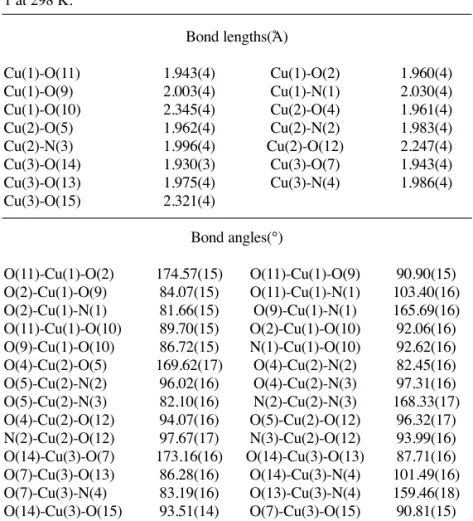
Table 2. Selected bond lengths (Å) and bond angles (°) for the title complex 1 at 298 K.
Bond lengths(Å)
Cu(1)-O(11) 1.943(4) Cu(1)-O(2) 1.960(4) Cu(1)-O(9) 2.003(4) Cu(1)-N(1) 2.030(4) Cu(1)-O(10) 2.345(4) Cu(2)-O(4) 1.961(4) Cu(2)-O(5) 1.962(4) Cu(2)-N(2) 1.983(4) Cu(2)-N(3) 1.996(4) Cu(2)-O(12) 2.247(4) Cu(3)-O(14) 1.930(3) Cu(3)-O(7) 1.943(4) Cu(3)-O(13) 1.975(4) Cu(3)-N(4) 1.986(4) Cu(3)-O(15) 2.321(4)
Bond angles(°)
O(11)-Cu(1)-O(2) 174.57(15) O(11)-Cu(1)-O(9) 90.90(15) O(2)-Cu(1)-O(9) 84.07(15) O(11)-Cu(1)-N(1) 103.40(16) O(2)-Cu(1)-N(1) 81.66(15) O(9)-Cu(1)-N(1) 165.69(16) O(11)-Cu(1)-O(10) 89.70(15) O(2)-Cu(1)-O(10) 92.06(16) O(9)-Cu(1)-O(10) 86.72(15) N(1)-Cu(1)-O(10) 92.62(16) O(4)-Cu(2)-O(5) 169.62(17) O(4)-Cu(2)-N(2) 82.45(16) O(5)-Cu(2)-N(2) 96.02(16) O(4)-Cu(2)-N(3) 97.31(16) O(5)-Cu(2)-N(3) 82.10(16) N(2)-Cu(2)-N(3) 168.33(17) O(4)-Cu(2)-O(12) 94.07(16) O(5)-Cu(2)-O(12) 96.32(17) N(2)-Cu(2)-O(12) 97.67(17) N(3)-Cu(2)-O(12) 93.99(16) O(14)-Cu(3)-O(7) 173.16(16) O(14)-Cu(3)-O(13) 87.71(16) O(7)-Cu(3)-O(13) 86.28(16) O(14)-Cu(3)-N(4) 101.49(16) O(7)-Cu(3)-N(4) 83.19(16) O(13)-Cu(3)-N(4) 159.46(18) O(14)-Cu(3)-O(15) 93.51(14) O(7)-Cu(3)-O(15) 90.81(15)
a Symmetry transformations used to generate equivalent atoms: B -x+1/2,
y+1/2, -z+1/2; C x, y+1, z.
Results and discussion Crystal structures
Figure 1. ORTEP drawing with labeling scheme for [Cu3(pdc)2(H2O)8]. 4DMF (1), DMF molecules are omitted for clarity.
center [33], this complex doesn’t have an inver-sion center. Here, dcp3- coordinates as a tetra-dentate ligand.
As shown in figure 1, Cu (1) atom is six-coordinated and has a distorted octahedron geom-etry. A pyrazole nitrogen N (1) and a carboxylate oxygen O (2) from one carboxylate group of a pdc 3-trianion occupy two coordination sites on Cu
(1). Four further positions are occupied by oxy-gens from four H2O molecules. The angles sub-tended the Cu(1) range from 89.70(15).° to 92.62(16).° The distortion from octahedral geom-etry of the Cu(1) site is a result of ligand con-straints and the Jahn-Teller effect. the latter is responsible for the elongated axial bonds.
In the case of the central pentacoordinate copper in the trimeric unit, the geometry of Cu(2) atom is a transmutative square-pyramidal which is defined by Cu(2), O(4), O(5), N(2), N(3) and O(12). Two pyrazole nitrogen atoms [Cu(2)-N(3), 1.996(4) Å; Cu(2)-N(2) 1.983(4) Å], and Two carboxylate oxygen atoms [Cu(2)-O(5), 1.962(4) Å; Cu(2)-O(4) 1.961(4) Å], from pdc 3-ligands form the distorted equatorial plane
Table 3. Hydrogen bonds for [Cu3(pdc)2(H2O)8]. 4DMF (Å and °).
D-H...A d(D-H) d(H...A) d(D...A) <(DHA) O(20)-H(20D)...O(3)#1 0.73(10) 2.08(10) 2.809(6) 169(11) O(20)-H(20E)...O(17)#2 0.72(10) 2.05(10) 2.719(5) 156(11) O(15)-H(15)...O(6)#3 0.82 2.13 2.874(4) 149.4 O(15)-H(15D)...O(19)#4 0.82 1.90 2.714(8) 172.1 O(14)-H(14)...O(4) 0.82 1.79 2.604(3) 171.9 O(14)-H(14D)...O(2)#2 0.82 1.95 2.746(3) 165.1 O(13)-H(13)...O(2)#2 0.82 2.61 3.267(4) 138.3 O(13)-H(13)...O(1)#2 0.82 1.94 2.691(4) 150.7 O(13)-H(13D)...O(20)#3 0.82 1.92 2.736(4) 174.1 O(12)-H(12)...O(18)#5 0.83 1.88 2.690(9) 166.2 O(12)-H(12D)...O(1)#6 0.82 1.93 2.748(4) 171.6 O(11)-H(11)...O(7)#7 0.82 1.93 2.750(4) 173.3 O(11)-H(11D)...O(5) 0.82 1.81 2.623(3) 171.9 O(10)-H(10)...O(16)#2 0.83 1.97 2.756(7) 158.4 O(10)-H(10A)...O(6)#8 0.82 2.01 2.808(4) 165.8 O(9)-H(9)...O(15)#1 0.82 2.46 2.853(4) 110.5 O(9)-H(9A)...O(7)#7 0.82 2.54 3.272(5) 148.8 O(9)-H(9A)...O(8)#7 0.82 1.97 2.728(5) 153.6
Symmetry transformations used to generate equivalent atoms: #1=x,-y+3/2,z+1/2, #2=x,-y+3/2,z-1/2, #3 =x,-y+1/2,z-1/2, #4 x+1,-y+1/2,z-1/2, #5= -x+1,y-1/2,-z+1/2, #6=x,y-1,z, #7=x,-y+1/2,z+1/2, #8=x,y+1,z
around Cu(2) with a chelating angle O(5)-Cu(2)-N(3) of only 82.10(16)°C. The remaining axial coordination sites are occupied by an oxygen from a H2O molecule [Cu(2)-O(12), 2.247(4) Å].
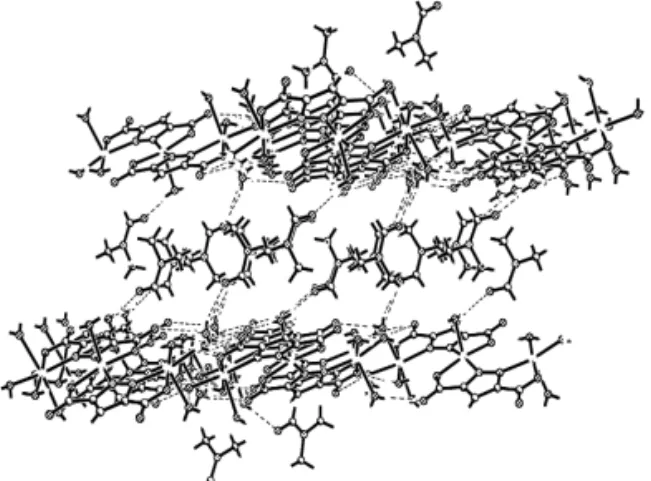
As shown in Figure 2, strong intermole-cular hydrogen bond exists between the trimers, resulting in an one-dimensional supramolecular ribbon, which is strengthened by π-π stacking interaction. Further hydrogen-bonding among the ribbons leads to a two-dimensional H-bonded sheet (Fig.3). A sandwich structure has been formed in the whole three-dimensional stacking (see Fig.4). The DMF guest in the title compound
disposed between the mutually parallel planes of two planes of Fig. 3 and is coordinated to each of them by intermolecular hydrogen bonds and other interactions.
The structure of the complex is shown in an undulated one-dimension ribbon constructed by hydrogen bonds and π...π stacking interactions, Fig. 2. Undoubtedly, the hydrogen bonding plays important roles in the stabilization of the title com-plex. Two neighboring HMA+ cations are held together by N–H…N hydrogen bond, meanwhile, there are strong π...πstacking interactions between two HMA+cations from adjacent layers to yield molecular ribbon. HMA+cations in adjacent unit cell related by an inverse centre are connected by pairs to form undulate ribbons via R2
2(8) ring motifs, each composed of two pairs of N–H…N hydrogen bonds [ N(7)…N(10) #6 2.994(6)Å, N(2)…N(6) #7 3.048(7)Å]. The R2
2 (8) hydrogen-bonded motifs involving N–H…N hydrogen bonds has been found in the crystal structures of many MA complexes [27,29, 37-39].
As we can see from Fig. 3, the ribbons are held together in a three-dimensional microporous arrangement by the intense intermolecular (N–H…O and O–H…O) hydrogen bonds. Between the protonated aromatic/amino nitrogen atoms of MA and the sulfate oxygenatoms, the ribbons of HMA+cations and SO
42-anions are interconnected alternatively, giving rise to a 14-membered hydro-gen bonded R3
3(14) ring motifs[ N(3)…N(11) 3.093(7) Å, N(1)…O(2) 2.849(6) Å, N(8)…O(3) 2.989(6) Å] to generate corrugated layers. Interestingly, the O(2) and O(3) atoms of SO4 2-bridge two amino hydrogen atoms from two differ-ent HMA+cations respectively, while O(1) and O(4) atoms connect two triazine nitrogen atoms from two different HMA+cations and two oxygen atoms from two water molecules [O(1)…O(6) 2.815(7) Å, O(2) #1…O(6) 2.904(7) Å]. The adjacent ribbons are also hydrogen-bonded through water molecules to the amino groups [N(2)…O(6) #8 3.025(7) Å, N3…O(6) #4 2.941(7) Å]. Such ribbons extend into a layer structure. These layers are stacking into a 3-D microporous network (Fig. 3) by (N–H…O, N–H…N, O–H…O) hydrogen bonds. Meanwhile, there are strong π...πstacking interactions between the HMA+cations from adjacent layers, which are found to consolidate the undulated ribbons.
Figure 2. Stereoview of the 1-D linear structure of 1 constructed by hydrogen bonds and π-π stacking interactions.
Figure 3. Stereoview of the 2-D sheet structure of 1 constructed by hydrogen bonds.
Thermal analysis
DMF molecules linked to the trimmer by weak hydrogen bonds. This action is weaker than the coordination action of water molecules and pdc3-trianions obviously. Compare to tetradentate pdc3-l trianions, water molecules only coordinate copper(II) ion by one oxygen atom. So, the decom-posed order is DMF, water and pdc3-ligand.
The thermal behavior of the title coordi-nation compound has been deduced from the TG analysis in nitrogen atmosphere. A crystalline sample was heated at a constant rate of 10°C/min from 40 to 800°C. The sample lost weight imme-diately. Just as what we have been supposed: the weight loss at 50-200 °C is considered as the loss of four DMF guests in each formula unit 31.0% (calcd 31.3%). And the sheet (see Fig.2) is left. The weight loss at 200-250°C is considered as the loss of eight ligand water molecules, 15.0% (calcd 15.4%). This means the complex has been disassembled. At 250-650°C, there is a obvious-ly exothermic progress. It is ascribed to decom-position of the organic acid ligands.
Figure 5. TGA=% mass loss, DSC=∆T (µV) curves at 20°C min-1 in dynamic dinitrogen atmosphere at
150 cm3min-1[Cu
3(pdc)2(H2O)8]. 4DMF.
The thermal decomposition behavior of the title supramolecular complex has been fol-lowed up to 800 ºC by the thermogravimetric (TGA) and differential scanning calorimeter (DSC) analysis. The TGA curve shows that the complex is stable up to 500 ºC, above which its structure begins to collapse. The TGA and DSC curves exhibit a continuous weigh loss,
indicating a multi-step decomposition of the complex.
The TGA curve shows that the weight loss of 9.54% in the temperature range 50-310 ºC can be attributed to the removal of two water molecules (Cacld 9.3%). The violently exothermic peak between 310-400 ºC is attributed to the degradation of the sulfate dianion with the weight loss of 24.24% which is in good agreement with the result obtained from X-ray diffraction (24.85% for one sulfate dianion). The weight loss of 35.11% in the temperature range 400-500 ºC is in agreement with the weight loss calculated for the loss of melamine molecules (Calcd 32.64%). The weight drops off sharply between 500 and 610 ºC attributed to framework decomposition. The decomposition process of the complex ends at around 650 ºC.
The DSC curve display three endothermic peaks at 135, 355 and 490 ºC due to the elimination of water molecule, sulfate dianion, MA, respec-tively, and a exothermic peak at 610 ºC which is ascribed to decomposition of melamine cations. The TGA and DSC curves reveal the intensity of interactions in the complex (Water molecules < sulfate dianion <MA). According to the DSC curve, Water molecules and sulfate dianion link to MA only with hydrogen bonds. When the complex is heated, water molecule is vaporized first, then is sulfate dianion. This phenomena indicates that the hydrogen bonding interaction of water molecules is much weaker than sulfate dianion. The MA cation disconnect last at 500 ºC due to the intense hydrogen bonding and aromatic π-πstacking inter-action between MA cations.
Conclusions
A trimer complex of [Cu3(pdc)2(H2O)8]. 4DMF is prepared by solution method. Its struc-ture is a zero-dimensional lattice. The weak inter-actions (hydrogen bonding and aromatic π-π stacking interaction) between each unit result in a sandwich supramolecule .
com-plexes. There are three kinds of hydrogen bonds (N-H…O, N–H…N, O-H…O) which sustain the microporous structure. The hydrogen-bonding patterns include the commonly observed R2
2(8) ring motifs and the less commonly observed R3
3(14) ring motifs. The results demonstrate that the main driving forces in the formation of the final 3D structures are intermolecular hydrogen bonding and π-πstacking interactions. The ther-mal analysis supports the results of this supramolecular structure and reveals the intensi-ty of interactions in the complex.
Acknowledgement
We acknowledge financial support by the S & T project of Zhejiang Province (No. 2007C31035), the S & T project of Wenzhou (No. G20060097 and G20060090), and the Nation Natural Science Foundation of China (grant No. 50772075 and 50472018).
Supporting Information Available
CCDC-628830 contains the supplemen-tary crystallographic data for this paper. These data can be obtained free of charge at www.ccdc.cam.ac.uk/conts/ retrieving.html [or from the Cambridge Crystallographic Data Center, 12, Union Road, Cambridge CB2 1EZ, UK; fax: (internat.) +44-1223/336-033; E-mail: [email protected]].
Received 26 February 2008 Accepted 28 April 2008
References
[1] T.K. Maji, K. Uemura, H.-C. Chang, R. Matsuda, S. Kitagawa, Angew. Chem. Int. Ed. 43 (2004) 3269.
[2] F.A. Cotton, C. Lin, C.A. Murillo, Acc. Chem. Res. 34 (2001) 759.
[3] A. Morsali, A.R. Mahjoub, Polyhedron 23 (2004) 2427. [4] S. Kawata, S. Kitagawa, H. Kumagai, C. Kudo, H. Kamesaki, T. Ishiyama, R. Suzuki, M. Kondo, M. Katada, Inorg. Chem. 35 (1996) 4445.
[5] O.M. Yaghi, C.E. Davis, G. Li, H. Li, J. Am. Chem. Soc. 119 (1997) 2861.
[6] D. Dobrzyjska, T. Lis, L.B. Jerzykiewicz, Inorg. Chem. Commun. 8 (2005) 1090.
[7] J.P. GarcÌa-Ter·n, O. Castillo, A. Laque, U. Garcia-Couceivo, P. Rom·n, F. Lloret, Inorg. Chem. 43 (2004) 5761. [8] A.M. Chippindale, M.R. Grimshaw, A.V. Powell, A.R. Cowley, Inorg. Chem. 44 (2005) 4121.
[9] S.J. Loeb, Chem. Commun. (2005) 1511.
[10] T.K. Maji, G. Mostafa, H.-C. Chang, S. Kitagawa, Chem. Commun. (2005) 2439.
[11] O.M. Yaghi, H. Li, J. Am. Chem. Soc. 118 (1996) 295. [12] Q. Wei, M. Nieuwenhuyzen, F. Meunier, C. Hardacre, S.L. James, J. Chem. Soc. Dalton Trans. (2004) 1807. [13] A.R. Millward, O.M. Yaghi, J. Am. Chem. Soc. 127 (2005) 17998.
[14] B.J. Holliday, C.A. Mirkin, Angew. Chem. Int. Ed. 40 (2001) 2022.
[15] P.J. Hagraman, D. Hagrman, J. Zubieta, Angew. Chem. Int. Ed. 38 (1999) 2638.
[16] G. R. Desiraju, Angew Chem. Int. Ed. Engl. 34 (1995) 2311. [17] G. R. Desiraju, Chem. Commun. (1997)1475.
[18] D. Braga, F. Grepioni, G. R. Desiraju, Chem. Rev. 98 (1998) 1375.
[19] D. Braga, F. Grepioni, Acc. Chem. Res. 33 (2000) 601. [20] M. J. Zaworotko, Nature (London), 386 (1997) 220. [21] S.-I. Noro, H. Miyasaka, S. Kitagawa, T. Wada, T. Okubo, M. Yamashita, T. Mitani, Inorg. Chem. 44 (2005) 133. [22] P. Diaz, J. Benet-Buchholz, R. Vilar, A.J.P. White, Inorg. Chem. 45 (2006) 1617.
[23] F.S. Delgado, J. Sanchiz, C. Ruiz-PÈrez, F. Lloret, M. Julve, Inorg. Chem. 42 (2003) 5938.
[24] H.W. Roesky, M. Andruh, Coord. Chem. Rev. 236 (2003) 91. [25] E. Colacio, F. Lloret, R. Kivekäs, J. Ruiz, J. Suärez-Varela, M.R. Sunberg, Chem. Commun. (2002) 592. [26] Pan. L, Ching. N, Huang. X, Li. J. Chem. Eur. J. 7 (2001) 4431- 4437.
[27] Wenkin. M, Devillers. M, Tinant. B, Declercq. J. Inorg. Chim. Acta 258 (1997) 113-118.
[28] Sanna. D, Micera. G, Buglyo. P, Kiss. T, Gajda. T, Surdy.P. Inorg. Chim. Acta 268 (1998) 297-305.
[29] Sakagami. N, Nakahanada. M, Ino. K, Hioki. A, Kaizaki. S. Inorg. Chem. 35 (1996) 683-688.
[30] Nakahanada. M, Ino. K, Kaizaki. S. J. Chem. Soc., Dalton Trans. (1993) 3681-3684.
![Figure 1 . ORTEP drawing with labeling scheme for [Cu 3 (pdc) 2 (H 2 O) 8 ]. 4DMF (1), DMF molecules are omitted for clarity.](https://thumb-eu.123doks.com/thumbv2/123dok_br/18977314.455749/4.892.195.664.105.464/figure-ortep-drawing-labeling-scheme-molecules-omitted-clarity.webp)
![Figure 5. TGA=% mass loss, DSC= ∆ T (µV) curves at 20°C min -1 in dynamic dinitrogen atmosphere at 150 cm 3 min -1 [Cu 3 (pdc) 2 (H 2 O) 8 ]](https://thumb-eu.123doks.com/thumbv2/123dok_br/18977314.455749/6.892.98.409.564.777/figure-tga-mass-loss-curves-dynamic-dinitrogen-atmosphere.webp)
