SEAWEED DIVERSITY IN THE NORTH ATLANTIC OCEAN
IAN TITTLEY
TITTLEY, I. 2002. Seaweed diversity in the North Atlantic Ocean. Arquipélago. Life and Marine Sciences 19A: 13-25.
Seaweed species-richness in the arctic and temperate North Atlantic Ocean (north of 39º N) is reviewed. Comparisons with other oceanic areas show, for example, the Indian Ocean to be richer in species but the northern North Atlantic Ocean to have a greater diversity of brown algal genera. Comparisons between North Atlantic regional floras show the north-east Atlantic to be richer in species than the north-west, and a gradient of species richness to occur from south to north along both coasts. The area comprising Ireland, southern England, Atlantic France and Spain may be considered a “hot-spot” of species richness. The mid-Atlantic Azores archipelago has been recently shown to be richer in species than sites on the American coast and in northern Europe. The conservation of seaweed biodiversity is briefly considered.
Ian Tittley (e-mail: [email protected]), Department of Botany, The Natural History Museum, Cromwell Road, London SW7 5BD, UK.
INTRODUCTION
Marine algae (seaweeds) comprise relatively small groups of marine organisms mostly occupying only a narrow inshore strip of our oceans but which make important contributions to local biodiversity, ecosystem functioning, and also to man’s well-being through their economic uses. Notwithstanding some preliminary assessments (EDDY et al. 1992; JOHN 1994), seaweed biodiversity still remains a neglected topic (NORTON et al. 1996).
A checklist and distributional index to the benthic marine algae (seaweeds) of the North Atlantic Ocean (SOUTH & TITTLEY 1986) presented a comprehensive collation of taxonomic and distributional information following earlier collations of BØRGESEN & JÓNSSON (1905) and SCHMIDT (1931). The systematic part of the checklist indicated inter alia amphi-atlantic taxa requiring reappraisal. The geographical data provided a basis for an overview of algal biogeography (SOUTH 1987) and for area by area comparison of species richness and a re-evaluation of phyco-geographical provinces in the North Atlantic (TITTLEY et al. 1990). Contemporaneously, algal data were being collated for parts of the Atlantic
Ocean to the south; these facilitate floristic comparison between the warm and cold north Atlantic regions. A revised inventory for tropical atlantic America (WYNNE 1986, 1998) presented taxonomic information for the region from Virginia to Uruguay. A checklist for tropical and subtropical Atlantic Africa and adjacent islands (since completed as a series: LAWSON & PRICE 1969; PRICE et al. 1978, 1986, 1988, 1992; JOHN et al. 1979, 1994; LAWSON et al. 1995; WOELKERLING et al. 1998) provided a critical assessment of the flora from Western Sahara and the Canary and Salvage Islands to Namibia. Other recent algal checklists for Atlantic locations include HAROUN et al. (2002) for the Canary Islands and NETO et al. (2001) for Madeira. A detailed inventory for the Indian Ocean (SILVA et al. 1996) has provided a basis for comparison of floras between oceans. Such endeavours have been considerably supported by taxonomic and floristic studies (e.g. AFONSO-CARILLO & SANSÓN 1999; BIRD & MCLACHLAN 1992; COPPEJANS 1995, 1998; LAWSON & JOHN 1987; MAGGS & HOMMERSAND 1993; SCHNEIDER & SEARLES 1991; SEARS 1998). Aspects of the evolutionary history of the North Atlantic Ocean and its seaweed flora are considered in GARBARY &SOUTH (1990).
Patterns and anomalies in marine diversity have been addressed in several studies. BOLTON (1994), using selected examples of floras including some from the Atlantic Ocean, confirmed earlier assertions for the absence of a peak of species numbers in tropical latitudes. CLARKE &CRAME (1997) concluded that study of shallow water soft bottom infauna communities has yet to provide evidence of a latitudinal cline in alpha diversity. SOUTH (1987) identified nine distribution patterns of algal species in the North Atlantic. TITTLEY & NETO (1995) reassessed diversity and biogeographical affinities of the mid-Atlantic Azores marine flora; the latter contrasted with other northern and southern Atlantic island floras (e.g. Faroes, Ascension) where species diversity was lower. Changes in the seaweed flora and its diversity in another part of the North Atlantic, the North Sea, is considered in SCOTT &TITTLEY (1998).
This paper reviews seaweed biodiversity in the North Atlantic Ocean (defined as coastal areas to the north of latitude 39º N, the northern boundary of Carolina and the Straits of Gibraltar, to the Arctic). Species richness in the North Atlantic is compared with four other oceanic areas and between regional floras of the North Atlantic. The paper concludes with observations on the conservation of marine floristic diversity. THE CURRENT STATUS OF THE FLORA A checklist and distributional index for the North Atlantic (SOUTH & TITTLEY 1986) listed 1116 species from 33 regional floras (Table 1). A revision of the checklist (NIELSEN & TITTLEY
unpub.) contains 1200 species reflecting inter alia improved floristic knowledge for poorly known areas. An example is the mid-Atlantic Azores archipelago for which 186 species were listed in SOUTH &TITTLEY (1986); a decade of study has increased the total to 360 species (NETO 1994; TITTLEY et al. 1998; PARENTE & NETO 2000; TITTLEY et al. 2001). Even at better-known locations nomenclatural and taxonomic information continues to change and new algal records continue to be accumulated (e.g. BARTSCH & KUHLENKAMP (2000) for Helgoland, GUIRY (1997) for the British Isles, and STEGENGA
et al. (1997) for the Netherlands). TITTLEY & FARNHAM (2001) have increased the Shetlands flora to 281 species, NIELSEN & GUNNARSSON (2001) have increased the Faroes flora to 264 species, and GUNNARSON &JÓNSSON (2002) have added 21 new species records to the Iceland flora (now 234). Data for the less-worked arctic areas remain incomplete; also generally less studied are subtidal areas.
The North Atlantic species total represents approximately 10% of currently recognised marine algal (seaweed) species in the world (cf. NORTON et al. 1996). Similar proportions (9-10%, Table 1) are known for the green and red algae, but a larger proportion of the world’s brown algal species occurs in the North Atlantic (21-22%).
Table 1
The arctic and temperate North Atlantic Marine Flora (SOUTH &TITTLEY 1986).
Genera Species World Total % of World Total* Chlorophyceae** 67 253 2700 9.4 Phaeophyceae** 127 324 1500 21.6 Rhodophyeae** 193 539 6000 9.0
* See NORTON et al. (1996) which may include some freshwater species.
** Class-level nomenclature follows SILVA et al. (1996). COMPARISON WITH OTHER OCEANIC FLORAS
Table 2 compares the species total for the North Atlantic with those of four other oceanic regions. The tropical east Atlantic is the least species-rich area and the Indian Ocean the most species rich with over twice as many as the North Atlantic (such comparisons have to be viewed with caution since the areas differ in extent, latitudinal range, and other factors). Table 3 compares totals of genera and species for these areas. In the green algae greatest generic and species diversity occurs in the Indian Ocean with almost twice the number of species recorded compared with the North Atlantic. Although the Indian Ocean brown algal flora contains many more species than other areas, generic diversity is not as great as in the North Atlantic; the 127 genera reported from the North Atlantic form the largest proportion of
genera in the compared floras. Brown algal species in the Indian Ocean comprise 18% of the overall flora compared with 31% in the North Atlantic. In the red algae lowest generic diversity occurs in the North Atlantic while maximum diversity is in the Indian Ocean where the 390 genera comprise 71% of the genera in the overall seaweed flora. The Indian Ocean red algal flora contains over three times as many species as that of the North Atlantic.
Table 2
Species totals for selected oceanic/regional floras. Species Arctic-temperate North Atlantic Ocean (NIELSEN &TITTLEY unpub.)
1200
Tropical-subtropical American Atlantic Ocean (WYNNE 1998)
1232
Tropical-subtropical African Atlantic Ocean (JOHN &LAWSON 1997)
911
Indian Ocean (SILVA et al. 1996) 2587 Japanese Pacific Ocean (YOSHIDA et al. 2000)
1389
Unique and shared elements at all taxonomic levels are present in the five floras; Table 4 compares totals of genera and species shared between the North Atlantic and tropical-subtropical West Atlantic and Indian Ocean floras. The North Atlantic shares slightly more green algal genera with the Indian Ocean than with the tropical-subtropical America, and a similar number of brown algal genera with both areas; a larger number of red algal genera are shared with the Indian Ocean. Slightly more brown algal species are shared with tropical America than with the Indian Ocean while the converse applies to the red algae.
COMPARISON OF SEAWEED FLORAS WITHIN THE NORTH ATLANTIC OCEAN Of the 1200 species recorded from the arctic and temperate North Atlantic Ocean, the majority are restricted to the east Atlantic (720 species, 60% of the flora). A smaller proportion (420 species, 35%) is common to both European and American coasts, and 60 species (5%) occur only on the American coast. A small but significant
proportion of the north Atlantic algal flora (currently 360 species, 30%) occurs in the isolated mid-Atlantic Azores archipelago (latitude 39º N).
Table 3
Comparison of genus and species totals. Genera Species
Chlorophyceae
Arctic-temperate North Atlantic Ocean
(SOUTH & TITTLEY 1986)
67
(17%) (22%) 253 Tropical-subtropical
American Atlantic Ocean (WYNNE 1998)
75
(19%) (24%) 301 Tropical-subtropical African
Atlantic Ocean (JOHN & LAWSON 1997) 40 (14%) 153 (17%) Indian Ocean (SILVA et al 1996) 77 (13%) (18%) 474 Japanese Pacific Ocean
(YOSHIDA et al. 2000) 67 (15%) (17%) 230 Phaeophyceae Arctic-temperate North Atlantic Ocean 127 (32%) 324 (31%) Tropical-subtropical
American Atlantic Ocean
72 (19%) 169 (14%) Tropical-subtropical African Atlantic ocean (16%) 45 (15%) 138 Indian Ocean (16%) 96 (18%) 447 Japanese Pacific Ocean (24%) 107 (22%) 306
Rhodophyceae Arctic-temperate North Atlantic Ocean 193 (51%) 539 (47%) Tropical-subtropical
American Atlantic Ocean (62%) 226 (62%) 764 Tropical-subtropical African
Atlantic Ocean (70%) 201 (69%) 620 Indian Ocean (71%) 390 (64%) 1667 Japanese Pacific Ocean (61%) 271 (61%) 853
Figures in parentheses indicate proportion of overall local seaweed flora.
The species richer north east Atlantic contrasts with tropical areas where the east Atlantic is less rich in species than the west (JOHN & LAWSON
1997). However, it should be noted that the Canary Islands (latitude 28º-29º N) have a species-rich (currently 628) algal flora (AFONSO -CARILLO &SANSÓN 1999; HAROUN et al. 2002). Other islands just to the south of 39º N currently have species totals close to that of the Azores. Bermuda (latitude 32º N but tropical with coral reef, 3000km SW of the Azores) has 377 species (TAYLOR & BERNATOWICZ 1969, an under-estimate) but shares only 56 species (15% of the total flora of the Azores). The Madeiran Archipelago (latitude 30º-33º N, 1000km SE of the Azores) has 359 species (NETO et al. 2001) and shares 161 with the Azores (45% of the Azores flora).
Table 4
Genera and species shared.
Genera shared Species shared
Arctic-temperate North Atlantic* and Tropical-subtropical west Atlantic floras**
Chlorophyceae 39 78
Phaeophyceae 55 75
Rhodophyceae 115 146
Arctic-temperate North Atlantic* and Indian Ocean Floras***
Chlorophyceae 43 84
Phaeophyceae 57 60
Rhodophyceae 167 156
* Modified SOUTH & TITTLEY (1986) and additional records; ** comparison based on taxonomy and nomenclature of WYNNE (1998); *** comparison based on taxonomy and nomenclature of SILVA et al. (1996).
Changes in species richness occur from south to north along both east and west coasts in the North Atlantic (also shown by NORTON et al. (1996, Fig. 2) for the British Isles). Fig. 1 shows a south to north (Azores to the British Isles) increase in seaweed species (all groups) richness in the east Atlantic. This is followed by a decrease to the western Baltic Sea (an area of reduced salinity) and also the Shetlands and Faroes. France is the most species rich area in the North Atlantic, followed by England, northern Spain, and Ireland. Together these create an area (“hot-spot”) of species richness in the North Atlantic. The Maritime Provinces region of Canada is the most species rich area in the north
western Atlantic with more than in the Shetlands and Faroes, but fewer than in the mid-Atlantic Azores and the Low Countries of Europe (381 species) where suitable hard substrata for macroalgal colonisation are sparse. The Iceland and North Norway floras are similar in content as well as total; other sites in the arctic region (e.g. Jan Mayen, Bear Island, and Spitzbergen) have species-poor floras. The short, non-rocky, coastlines of Delaware and Maryland have depauperate seaweed floras and, as with the low seaweed species diversity recorded in Virginia and North Carolina to the south, this may relate to the fact that these coasts consist of estuaries and lagoons (RAY et al. 1997).
Fig. 1. Seaweed species richness with latitude (mean latitude of stations in SOUTH & TITTLEY 1986).
Comparison of species richness of green algae (Fig. 2) shows the north-east Atlantic flora (with the exception of France) to be only a little richer in species than the north-west Atlantic; a south to north increase in species richness is followed by a decrease. Arctic floras in the west are a little richer in species than those to the east. TITTLEY & NETO (1995) compared the green algal floras of the North Atlantic using an ordination method and showed that the Azores flora was different due to species not present elsewhere. Figures 3 and 4 plot species richness against latitude for brown and red algae respectively; both show the species richer east Atlantic and similar trends to those described previously. The flora of the Azores is poorer in brown algal species compared
with most temperate areas in Europe to the north but richer in red algae (see below). Unlike the green algae, ordination of the brown and red algal floras of the Azores (TITTLEY & NETO 1995) positioned them in a south to north series along the coast of the eastern North Atlantic Ocean.
Fig. 4. Red algae species richness with latitude (mean latitude of stations in SOUTH & TITTLEY 1986).
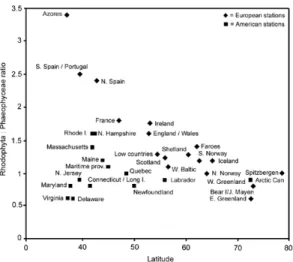
The proportion of red to brown algae in the local floras of the North Atlantic when plotted against latitude differs on the two sides of the ocean (Fig. 5). In the north-east Atlantic the greatest proportion of red algal species occurs in the Azores with 3.4 red algal species recorded for every brown algal species; this complements the high ratios in the Salvage Island (6.5 to 1) and Canary Island (4.5 to 1) floras noted by JOHN & LAWSON (1997). Ratios decrease from the south to north with a steep drop from the Azores to the Low Countries and Scotland where the ratio is 1.25 red to brown algae; the curve in the graph flattens from the Low Countries to the Arctic where ratios are closer to 1 to 1. In the north-west Atlantic low ratios of 0.6 - 0.9 to 1 occur in the south with more brown algae than red algae in the floras from Virginia to Connecticut; higher ratios occur in the floras of Rhode Island, Massachusetts and New Hampshire. The ratio then decreases from New Hampshire to Newfoundland where at 0.8 to 1 there are more brown algal species in the flora; a similar trend in relative importance of brown algae is to be found also on the eastern side throughout the Arctic region. SOUTH (1987) also noted proportional differences in the distribution of benthic marine algae.
Fig. 2. Green algae species richness with latitude (mean latitude of stations in SOUTH & TITTLEY 1986).
Fig. 3. Brown algae species richness with latitude (mean latitude of stations in SOUTH & TITTLEY 1986).
RARITY
As stated, very few species of seaweed tolerate the full, wide, range of environmental conditions in the North Atlantic Ocean. A frequency distribution of red, brown and green species in the North Atlantic using the 33 stations of SOUTH & TITTLEY (1986) as possible sites of occupation shows that almost 22% of species have been recorded from a single site, and a further 11% are known from two sites only. Thus one-third of all algal species could be deemed rarities. However, the comparison is skewed by many factors including differences in sizes of areas compared. Many of the rarities are under-recorded species, often microscopic forms identified by specialists and missed by generalists, or taxonomically difficult groups also requiring specialist attention. Examples of rarities include Gelidiocolax christinae J.Feldmann et G.Feldmann (a parasitic species known only from North Spain), Platysiphon verticillata Wilce (known only from East Greenland) and Buffhamia speciosa a small epiphyte on Dictyosiphon foeniculaceus (Hudson) Greville (known only from southern England) not recorded since the late nineteenth century. Further study may reveal such species to be more widespread.
Fig. 5. Ratio ofred algae to brown algae with latitude (mean latitude of stations in SOUTH & TITTLEY 1986). SHARED ELEMENTS IN THE NORTH ATLANTIC SEAWEED FLORA
Each of the 33 regional floras of SOUTH & TITTLEY (1986) shares species in common but few species are common to all areas. An example, totals of the brown algal species shared in England and Wales with 31 other regional floras (excluding the eastern Baltic as it is a low salinity environment; for details of the algae of this area see NIELSEN et al. 1995) is shown in Table 5. The brown algal flora of England and Wales comprises 183 (57%) of the 321 species listed for the North Atlantic Ocean and shares most species in common with neighbouring France, Scotland, Ireland, South Norway and the Low Countries. Forty-two percent is shared with the Maritime Provinces of Canada, more than with the Faroes. Only two species (Mesogloia neglecta Batters and Buffhamia speciosa Batters) appear endemic to England. The ordinations of the brown and red algal floras of the North Atlantic Ocean (TITTLEY & NETO 1995) form a series that suggests an overlap in floras with more shared species between neighbouring floras than between those geographically further apart. Ordination of green algal floras as a tight cluster (with the exception of the Azores) indicated a large proportion species in common.
Rarities also include a few elements of the North Atlantic flora that are restricted to southern, warmer, waters but which are widespread in tropical -subtropical areas of the Atlantic Ocean; examples are listed in Table 6A, many of which are from the Azores. Fewer rarities are restricted in occurrence to the Arctic North Atlantic; examples are Phaeosiphoniella cryophila Hooper, Henry & Kuhlenkamp and Platysiphon verticillata.
Other more widespread species are globally restricted (endemic) to the North Atlantic. Examples of brown algae (Fucales and Laminariales) and their distribution are given in Table 6B. Himanthalia elongata forms a monospecific familiy (Himanthaliaceae) restricted to the northeast Atlantic. All are functionally important species and key characterising elements of sea-shore or subtidal communities or biotopes. Delesseria sanguinea
Table 5
Shared components of Phaeophyceae floras; England & Wales (stn. 10) and regional floras in the North Atlantic Ocean (from SOUTH & TITTLEY 1986).
Stn Total spp.
% of North Atlantic
flora
% local flora shared with England &
Wales
No. of shared species
% of England & Wales flora
shared
0 Azores 72 23 69 50 27
1 S. Spain & Portugal 99 31 80 80 44
2 N.Spain 114 36 86 98 53 3 France 194 60 75 149 81 4 Low Countries 126 39 90 114 62 5 W.Baltic 134 42 82 109 60 6 E.Baltic * - - - - - 7 S.Norway 141 44 85 120 65
8 N.Norway & Russia 97 30 75 74 40
9 Ireland 144 45 84 120 65
10 England & Wales 183 57 - - -
11 Scotland 135 42 94 128 70
12 Shetland 93 29 97 90 49
13 Faroes 83 26 87 75 41
14 Jan Mayen & Bear I. 20 6 50 10 5
15 Spitzbergen 39 12 72 28 15 16 Iceland 86 27 71 61 33 17 E.Greenland 63 20 57 36 20 18 W.Greenland 68 21 48 33 19 19 Arctic E. Canada 52 16 63 33 19 20 Labrador 58 18 64 37 20 21 Newfoundland 90 28 71 64 35 22 Quebec 73 23 74 54 30 23 Maritime Provinces 103 32 75 77 42 24 Maine 64 20 81 52 28 25 New Hampshire 63 20 79 50 27 26 Massachusetts 75 23 63 52 28 27 Rhode I. 47 15 79 37 20
28 New York & Long I. 100 31 38 38 21
29 New Jersey 59 18 34 20 11
30 Delaware 40 12 35 14 8
31 Maryland 21 6 19 4 2
32 Virginia 83 26 33 27 15
* Stn 6. E. Baltic omitted - brackish environment
(Hudson) Lamouroux is an example of a red alga restricted in distribution to the northeast Atlantic Ocean (France to Iceland and Norway). The order Tilopteridales (Haplospora globosa Kjellman, Phaeosiphoniella cryophila and Tilopteris mertensii (Turner in Kützing) was considered to be endemic to the North Atlantic (LÜNING 1990), but there is new evidence to suggest the order occurs in the North Pacific Ocean (Kuhlenkamp pers. comm.). Nonetheless, P. cryophila is
currently known only from Newfoundland. Some other species restricted to the North Atlantic but with wider distributions on European and American coasts are listed in Table 6C.
Species considered to be endemic to the geographically isolated Azores archipelago have proven to be more widespread (e.g. Codium elisabethae O.C. Schmidt, recorded recently in the Madeiran archipelago). Otherwise they are members of taxonomically unresolved groups
(e.g. Cladophora michaelensis O.C. Schmidt, C. theotonii O.C. Schmidt, C. weizenbauri O.C. Schmidt, Lithophyllum azorum Lemoine in O.C. Schmidt, L. bipartitum Lemoine, Polysiphonia azorica O.C. Schmidt, P. hochstetteriana O.C.
Schmidt). AFONSO-CARILLO & SANSÓN (1999) noted that the total of species endemic to the Canary Islands is small and stands at 17 (2.6% of the local flora).
Table 6
Examples of rare species in the North Atlantic. A. Southern (warm water) species
Cladophoropsis membranacea (C. Agardh) Børgesen Azores
Codium elisabethae O.C. Schmidt Azores, Madeira
Cottoniella filamentosa (Howe) Børgesen Azores, S.Spain/Portugal
Dictyota bartayresii Lamouroux Azores
Halymenia floresii (Clemente) C.Agardh S.Spain/Portugal Hydroclathrus clathratus (Bory) Howe Azores, S. Spain/Portugal
Liagora divaricata Tseng Azores
Taenioma nanum (Kützing) Papenfuss Azores, S.Spain/Portugal
B. Species globally restricted to the northeast Atlantic
Bifurcaria bifurcata Ross Morocco to S. England and Ireland Fucus ceranoides Linnaeus Portugal to N. Norway, Russia and Iceland Halidrys siliquosa (Linnaeus) Lyngbye S. Spain to N. Norway, Russia and Iceland Himanthalia elongata (Linnaeus) S.F. Gray S. Spain to N. Norway and Iceland Laminaria hyperborea (Gunnerus) Foslie S. Spain to N. Norway and Iceland Laminaria ochroleuca Bachelot de la Pylaie Azores, Morocco to S. England Pelvetia canaliculata (Linnaeus) Decaisne & Thuret S. Spain to N. Norway and Russia Saccorhiza polyschides (Lightfoot) Batters Morocco and the Mediterranean Sea to Norway
C. Species globally restricted to the east and west coasts of the North Atlantic
Ascophyllum nodosum (Linnaeus) Le Jolis N. Spain to Russia, Iceland, W. Greenland, Labrador to Delaware
Chondrus crispus Stackhouse Portugal to N. Norway, Iceland, Newfoundland to Delaware
Fucus serratus Linnaeus N. Spain to Russia, Iceland, Gulf of St Lawrence Fucus vesiculosus Linnaeus Morocco to Russia, Iceland, E. and W. Greenland,,
Arctic Canada to Virginia
Laminaria digitata (Hudson) Lamouroux N. Spain to Russia, Spitzbergen, Iceland, E. and W. Greenland, Arctic Canada to Connecticut
Laminaria solidungula J. Agardh Arctic, Newfoundland
Membranoptera alata (Hudson) Stackhouse France to N. Norway, Iceland, W. Greenland, Labrador to Connecticut
Phyllophora pseudoceranoides (S.G. Gmelin)
Newroth & A.R.A. Taylor (Black Sea), France to central Norway, Iceland, Newfoundland to Delaware Saccorhiza dermatodea (Bachelot de la
Pylaie) J. Agardh
N. Norway to Russia, Spitzbergen, Iceland, E. and W. Greenland, Newfoundland to Massachusetts
NON NATIVE SPECIES
Two percent of the British seaweed flora comprises recent immigrants (FARNHAM 1994,
1998); introductions to the North Atlantic generally are of the same order of magnitude (32 species). Some, such as Sargassum muticum (Yendo) Fensholt, Codium fragile (Suhr) Hariot,
have been aggressive invaders; S. muticum, originally from Japan, has spread to Norway in the north and Portugal in the south. The kelp, Undaria pinnatifida (Harvey) Suringar, also from Japan, is now established on European Atlantic shores from France to the Netherlands. Even isolated locations have introduced algal species; ARDRÉ et al. (1974) and TITTLEY et al. (1998) reported the widespread occurrence in the Azores of the small, creeping, red alga Symphyocladia marchantioides (Harvey) Falkenberg (originally from New Zealand). ATHANASIADIS & TITTLEY (1994) suggested that Antithamnion diminuatum Wollaston, A. pectinatum (Montagne) Brauner and Scageliopsis patens Wollaston recently discovered in the Azores may also be introduced species. Within the North Atlantic, Fucus serratus Linnaeus has probably been introduced to North American from European waters, and Mastocarpus stellatus (Stackhouse) Guiry to Helgoland (BARTSCH & KUHLENKAMP 2000). Although the impact of non-native species in the marine environment is not as great as on the land, there is increasing concern about the effects of introduced species to European waters on local ecosystems, and a call for legislation to limit this (BOUDOURESQUE et al. 1994). By contrast,
Laminaria ochroleuca De la Pylaie is a recent migrant to England through natural range extension.
CONSERVATION OF MARINE FLORISTIC BIODIVERSITY
Maintenance of marine floristic biodiversity is the aim of most conservation management programmes irrespective of species richness; some areas (e.g. the arctic North Atlantic) are intrinsically low in species diversity but nonetheless of conservation value. Strategies for achieving conservation of biodiversity in the sea have been proposed by NORSE &GERBER (1993) for global issues, HISCOCK (1997) for the North-east Atlantic, and JOHN (1994) for algae.
As mentioned, northern Spain, France, Ireland and England represent areas of high species diversity for seaweeds and these needs to be taken into account when developing policies and programmes for the conservation and sustainable management of marine resources.
Although anthropogenic disturbance is significant in these areas, the marine inshore environment (and associated plant diversity) still remains much less altered than the terrestrial environment. Examples of changes in the marine flora of one area of the North Atlantic, the North Sea, are presented in SCOTT &TITTLEY (1998); both a loss of local marine floristic diversity and long-term persistence of species and communities are described. A feature of the marine environment in the North Sea and other areas is the ability of algal communities to survive short and long-term environmental perturbation, and the ephemerality of many algal populations.
Conservation success in the marine environment is achieved through the protection of habitats, and thereby species and communities or biotopes (cf. BRODIE 1998). For species in the UK (ANON. 1995) attention has been focused on those whose numbers or range have declined significantly in recent years, endemic species, and those under a high degree of international threat, and/or are covered by conventions, directives or legislation. Since only 156 species of British seaweeds have been mapped (NORTON 1985) in a single time-frame, it is difficult to assess comprehensively change in distribution range with time and thus threat and decline cannot be addressed in any detail. From the distribution data in SOUTH &TITTLEY (1986) and LÜNING (1990), the international importance (cf. ANON. 1995) of some key seaweed species has been estimated for the UK (Table 7).
Table 7
Importance of selected UK algal species
Estimate of world population in UK
Himanthalia elongata 25% Pelvetia canaliculata 20% Halidrys siliquosa 20% Laminaria hyperborea 20% Membranoptera alata 20% Phyllophora pseudoceranoides 20% Chondrus crispus 17% Delesseria sanguinea 17% Saccorhiza polyschides 17% Fucus ceranoides 17% Bifurcaria bifurcata 14% Fucus serratus 13%
For habitat conservation in the UK, priority lies with those for which it has international obligations, or is at risk owing to a high rate of decline, or is rare, functionally critical, or important for key species. Although it is recognised (ANON. 1995) that the quality of the marine environment around the UK is affected by human activities, there are no seaweeds listed as threatened or declining and thus requiring immediate action. There is no evidence of extinction from the UK marine flora although several species recorded in the nineteenth century have not been recorded since then.
The EC Habitats Directive promotes the conservation of habitats and species within the European Union (ANON. 1992). The designation of “Special Areas of Conservation” is one of the main measures by which the directive will be implemented; these will form a network of European protected sites called “NATURA 2000” which will be regularly monitored. This measure will contribute to the protection of algal diversity in the north eastern Atlantic Ocean.
CONCLUSIONS
This review of seaweed diversity in the North Atlantic using species richness is inevitably superficial, and almost immediately outdated by new floristic and taxonomic information. It represents only part of the story, for implicit in biological diversity is the degree of taxonomic diversity (improved taxonomic knowledge is therefore a continuing requirement). Organisms which differ widely from each other may be considered to contribute more to overall diversity than those which are similar (GROOMBRIDGE 1992; NORTON et al. 1996) and unique taxa, especially at higher levels, may merit greater attention for conservation purposes. Thus in the North Atlantic for example, the brown alga Himanthalia elongata (a monospecific family of limited global distribution), a species not statutorily protected in the UK, could be rated higher for conservation purposes than the red alga Anotrichium barbatum (C.Agardh) Nägeli, a listed species for which an action plan has been prepared in the UK. A. barbatum is a member of a genus common in the warmer waters of the
Atlantic and a family (Ceramiaceae) globally widespread. The restricted occurrences of for example Codium elisabethae (Azores and Madeira) and Phaeosiphoniella cryophila (Newfoundland) suggest other species that would merit action plans for conservation.
Although the North Atlantic Ocean is well studied in comparison to other oceans, much remains to be done. Large areas remain poorly surveyed, especially those in the Arctic. Floristic study is often uneven and may be strongly influenced by personal taxonomic interest. There are many critical groups at all taxonomic levels (e.g. Corallinales, Cystoseiraceae, Ceramium, Cladophora) that require further taxonomic study. Nonetheless, from the pool of information on the diversity of the seaweeds of the North Atlantic Ocean, it can be concluded that: (i) The North Atlantic is less rich in genera and species than the tropical west Atlantic, the Indian Ocean and the Japanese Pacific area. (ii) Brown algae form a larger proportion of the flora at genus and species level than the other compared floras, particularly at northern (arctic) latitudes. (iii) Species richness is greater in the east Atlantic than the west. (iv) Species richness is greater in southern parts of the east Atlantic. (v) A latitudinal cline (decrease) in diversity occurs from south to north and is more noticeable in the east Atlantic. (vi) The mid Atlantic Azores archipelago is not species-poor. Latitudinal changes in sea-temperature, cold- and warm-water currents, day-length, suitable substrate, biological interactions, as well as evolutionary history, are significant in determining the present patterns of algal diversity in the North Atlantic Ocean.
TITTLEY et al. (1990) noted that the difficulties in undertaking ecological-biogeographical analyses, which apply also to analysis of species diversity, relate to problems of sampling and that of achieving comparable sampling effort. LAWSON’S (1988) suggestion of analysing the flora of unit lengths of coastline represents a solution but data are currently not available in this format. When the UK seaweed atlas is completed, comparison of mapping grid squares will enable recognition of key areas for conservation of maximum biodiversity. Unfortunately such schemes are largely incomplete for the North Atlantic despite
intensive field-work, extensive data in museum collections and much published literature, thus holding back objective assessment of diversity.
BOUDOURESQUE, C.F., F. BRIAND & C. NOLAN 1994. Introduced species in European coastal waters.
European Union, Luxembourg. v + 111 pp.
The “Convention on Biological diversity” signed in 1992 drew attention to the need for sustainable development and conservation. Species inventories provide an important tool to enable policy-makers and others to frame programmes for the conservation of biodiversity based upon the best taxonomic and biogeographical information (cf. ANON. 1995; EDDY et al. 1992). Continued improvement to such alpha data resources in the North Atlantic Ocean is of high priority for the better understanding and sustainable management of seaweed biodiversity.
BØRGESEN, F. & H. JÓNSSON 1905. The distribution of the marine algae of the Arctic Sea and of the northernmost part of the Atlantic. Appendix, Pp. I-XXVII. in WARMING, E. (Ed.). Botany of the
Faeröes based upon Danish Investigations. Parts 1,
2 and 3: Gyldendanske, Copenhagen, Christiana and London. 1070 + XXVIII pp.
BRODIE, J. 1998. Seaweed biodiversity in the North Sea: species conservation. Pp. 149-157 in SCOTT, G.W. & I. TITTLEY (Eds). Changes in the marine flora of the North Sea. Centre for
Environmental Research into Coastal Issues, Scarborough. 168 pp.
CLARKE, A. & A. J. CRAME 1997. Diversity, latitude and time: Patterns in the shallow sea. Pp. 122-147 in: ORMOND, R.F., J.D. GAGE & M.V. ANGEL (Eds). Marine Biodiversity. Patterns and
Processes. Cambridge University Press,
Cambridge. xxii+449 pp.
ACKNOWLEDGEMENT
I gratefully thank to Dr David John (NHM) and
anonymous reviewers for their helpful comments. COPPEJANSNord de la France et de la Belgique. Scripta , E. 1995. Flore algologique des côtes du
Botanica Belgica 9: 1-454.
COPPEJANS, E. 1998. Flora van de Noord-Franse en Belgische Zeewieren. Scripta Botanica Belgica 17: 1-462.
REFERENCES
EDDY, A., D.J. GALLOWAY, D.M. JOHN & I. TITTLEY 1992. Chapter 7. Lower plant diversity. Pp.55-63 in: GROOMBRIDGE B. (Ed.). Global Biodiversity Status of the Earth’s living resources. World
Conservation Monitoring Centre, London. xvii+[2]+585 pp.
AFONSO-CARILLO, J. & M. SANSÓN 1999. Algas, hongos, y fanerógamas marinas de las Islas Canarias Clave analítica. Universidad de la
Laguna, La Laguna. 254 pp.
ANON. 1992 Council Directive 92/43/EEC of 21 May 1992 on the conservation of natural habitats and wild fauna and flora. Official Journal of the
European Communities 35: 7-49.
FARNHAM, W.F. 1994. Introduction of marine benthic algae into Atlantic European waters. Pp. 32-37 in: BOUDOURESQUE, C.F., F. BRIAND & C. NOLAN (Eds). Introduced species in European coastal
waters. European Union, Luxembourg. v+111 pp.
ANON. 1995. Biodiversity: the UK Steering Group
Report Volume 2: Action Plans. HMSO, London.
[ii]+324 pp.
FARNHAM, W.F. 1998. Introduced species in the English Channel and North Sea. Pp. 99-117 in: SCOTT, G.W. & I. TITTLEY (Eds). Changes in the
marine flora of the North Sea. Centre for
Environmental Research into Coastal Issues, Scarborough. 168 pp.
ARDRÉ, F., C.F. BOUDOURESQUE & J. CABIOCH 1974
Symphyocladia marchantioides (Harv.) Falkenberg
(Rhodomélacées, Ceramiales) aux Açores. Bulletin
de la Societé Phycologique de France 19: 178-182.
ATHANASIADIS, A. & I. TITTLEY 1994. Antithamnioid algae (Rhodophyta, Ceramiaceae) newly recorded
from the Azores. Phycologia 33: 77-80. GARBARY, D.J. & G.R. SOUTH 1990. Evolutionary biogeography of the marine algae of the North Atlantic. NATO ASI Series Series G Ecological
Sciences Vol 22. Springer Verlag, Berlin. vii+429
pp. BARTSCH, I. & R. KUHLENKAMP 2001. The marine
macroalgae of Helgoland (North Sea): an annotated list of records between 1845 and 1999. Helgoland
Marine Research 54: 160-189.
GROOMBRIDGE, B. 1992. Global Biodiversity Status of the Earth’s living resources. Chapman & Hall,
London. xvii+[2]+585 pp. BIRD, C. & J.L. MCLACHLAN 1992. Seaweed flora of
the maritimes 1: Rhodophyta – the red algae.
Biopress Ltd., Bristol. v+177 pp.
GUIRY, M.D. 1997. Benthic red, brown and green algae. Pp. 341-367 in: HOWSON, C.M. & B.E. BOLTON, J.J. 1994. Global seaweed diversity: patterns
PICTON (Eds). The species directory of the marine fauna and flora of the British Isles and surrounding seas. Ulster Museum and The Marine Conservation
Society, Belfast and Ross-on-Wye. vi + 508 pp. GUNNARSON, K. & S. JÓNSSON 2002. Benthic marine
algae of Iceland: revised checklist. Cryptogamie,
Algologie 23: 131-158.
HAROUN, R.J., M.C. GIL-RODRÍGUEZ, J. DÍAZ DE CASTRO & W.T. PRUD’HOMME VAN REINE 2002. A checklist of the marine plants from the Canary Islands. Botanica Marina 45: 139-169.
HISCOCK, K. 1997. Conserving biodiversity in North-east Atlantic marine ecosystems. Pp. 415-427 in: ORMOND, R.G., J.D. GAGE & M.V. ANGEL (Eds). Marine biodiversity. Patterns and Processes.
Cambridge University Press, Cambridge. xxii + 449 pp.
JOHN, D.M. 1994. Biodiversity and conservation: An algal perspective. The Phycologist 38: 3-15.
JOHN, D.M. & G.W. LAWSON 1997. Seaweed biodiversity in West Africa: a criterion for designating marine protected areas. Pp. 111-123 in EVANS, S.M., C.J. VANDERPUYE & A.K. ARMAHN (Eds). The coastal zone of West Africa: Problems
and Management. Penshaw Press, Sunderland. xv +
246 pp.
JOHN, D.M., J.H. PRICE, C. MAGGS & G.W. LAWSON 1979. Seaweeds of the western coast of tropical Africa and adjacent islands: a critical reassessment. III. Rhodophyta (Bangiophyceae). Bulletin of the
British Museum (Natural History), Botany 7:
69-82.
JOHN, D.M., J.H. PRICE, W.F. PRUD’HOMME VAN REINE & W.J. WOELKERLING 1994. Seaweeds of the western coast of tropical Africa and adjacent islands: a critical assessment. IV. Rhodophyta (Florideae) 4. Genera L-O. Bulletin of the Natural
History Museum, London, Botany 24: 49-90.
LAWSON, G.W. 1988. Seaweed distribution patterns as revealed by ordination with reference to the Atlantic and southern oceans. Helgoländer
Meeresuntersuchung 42: 187-189.
LAWSON, G.W. & D.M. JOHN 1987. The marine algae of the coastal environment of tropical West Africa (Second edition). Beihefte zur Nova Hedwigia 93: vi + 1-415.
LAWSON, G.W. & J.H. PRICE 1969. Seaweeds of the western coast of tropical Africa and adjacent islands: a critical assessment. I. Chlorophyta and Xanthophyta. Botanical Journal of the Linnean
Society 62: 279-346.
LAWSON, G.W., W.J. WOELKERLING, J.H. PRICE, W.F. PRUD’HOMME VAN REINE & D.M. JOHN 1995. Seaweeds of the western coast of tropical Africa and adjacent islands: a critical assessment. IV.
Rhodophyta (Florideae) 5. Genera P. Bulletin of the
Natural History Museum London, Botany 25:
199-122.
LÜNING, K. 1990. Seaweeds their environment, biogeography and ecophysiology. Wiley
Interscience, New York. xiii + 527 pp.
MAGGS, C.M. & M.H. HOMMERSAND 1993. Seaweeds of the British Isles Volume 1 Rhodophyta part 3A Ceramiales. HMSO, London. xv + 444 pp.
NETO, A.I. 1994. Checklist of the benthic marine algae of the Azores. Arquipélago Life and Marine Sciences 12A: 15-24.
NETO, A.I., D.C. CRAVO & R.J. HAROUN 2001. Checklist of the benthic marine plants of the Madeiran Archipelago. Botanica Marina 44: 391-414.
NIELSEN R. & K. GUNNARSSON 2001. Seaweeds of the Faroe Islands An annotated checklist.
Fródskaparret 49: 45-108.
NIELSEN R., A. KRISTIANSEN, L. MATHIESEN & H. MATHIESEN 1995. Distributional index of the benthic macroalgae of the Baltic Sea area. Acta
Botanica Fennica 155: 1-51.
NORSE, E.A. & L.R. GERBER 1993. A global strategy for conserving biodiversity in the sea. Diversity 9(3): 40-43.
NORTON, T.A., 1985. Provisional atlas of the marine algae of Britain and Ireland. NERC, Huntingdon.
viii + [159] pp.
NORTON, T.A., M. MELKONIAN & R.A. ANDERSON 1996. Algal biodiversity. Phycologia 35: 308-326. PARENTE, M.I. & A.I. NETO 2000. New records of
benthic marine red algae (Ceramiales: Rhodophyta) from the Azores. Arquipélago Life and Marine Sciences. Supplement 2(Part A): 53-61.
PRICE, J.H., D.M. JOHN & G.W. LAWSON 1978. Seaweeds of the western coast of tropical Africa and adjacent islands: a critical assessment. II. Phaeophyta. Bulletin of the British Museum
(Natural History), Botany 6: 87-182.
PRICE, J.H., D.M. JOHN & G.W. LAWSON 1986. Seaweeds of the western coast of tropical Africa and adjacent islands: a critical assessment IV. Rhodophyta (Florideae) 1. Genera A-F. Bulletin of
the British Museum (Natural History), Botany 15:
1-122.
PRICE, J.H., D.M. JOHN & G.W. LAWSON 1988. Seaweeds of the western coast of tropical Africa and adjacent islands: a critical assessment. IV. Rhodophyta (Florideae) 2. Genera G. Bulletin of
the British Museum (Natural History), Botany 18:
195-273.
PRICE, J.H., D.M. JOHN & G.W. LAWSON 1992. Seaweeds of the western coast of tropical Africa and adjacent islands: a critical assessment. IV.
Rhodophyta (Florideae) 3. Genera H-K. Bulletin of
the British Museum (Natural History), Botany 22:
123-146.
RAY, G.C., B.P. HAYDEN, M.G. MCCORMICK-RAY & T.M. SMITH 1997. Land-seascape diversity of the USA east-coast coastal zone with particular reference to estuaries. Pp. 337-37 in: ORMOND, R.F. J.D. GAGE & M.V. ANGEL (Eds). Marine Biodiversity. Patterns and Processes. Cambridge
University Press, Cambridge. xii+449 pp.
SCHMIDT, O.C. 1931. Die marine Vegetation der Azoren in ihren Grundzügen dargestellt.
Bibliotheca Botanica 24: ix+1-116.
SCHNEIDER, C.W. & R.B. SEARLES 1991. Seaweeds of the southeastern United States Cape Hatteras to Cape Canaveral. Duke University Press, Durham
and London. xiv + 553 pp.
SCOTT, G.W. & I. TITTLEY 1998. Changes in the
marine flora of the North Sea. Centre for
Environmental Research into Coastal Issues, Scarborough. 168 pp.
SEARS, J.R. 1998. NEAS keys to benthic marine algae of the northeastern coast of North America from Long Island Sound to the Strait of Belle Isle.
Northeast Algal Society, Dartmouth. xvii + 161 pp. SILVA, P.C., P.W. BASSON & R.L. MOE 1996.
Catalogue of the benthic marine algae of the Indian Ocean. University of California Publications in
Botany 79: xiv+1-1259.
SOUTH, G.R. 1987. Biogeography of the benthic marine algae of the North Atlantic Ocean - an overview.
Helgoländer Meeresuntersuchung 41: 273-282.
SOUTH, G.R. & I. TITTLEY 1986. A checklist and distributional index to the benthic marine algae of the North Atlantic Ocean. Huntsman Marine
Laboratory and British Museum (Natural History), St. Andrews and London. pp. 76.
STEGENGA, H., I. MOL., W.F. PRUD’HOMME VAN REINE & G.M. LOKHORST 1997. Checklist of the marine algae of the Netherlands. Gorteria Supplement 4: 1-57.
TAYLOR W.R. & A.J. BERNATOWICZ 1969. Distribution
of marine algae about Bermuda. Bermuda
Biological Station for Research, St George’s West. 42 pp.
TITTLEY, I. & W.F. FARNHAM 2001. The Shetland Isles: long-term observations on the subtidal marine flora. Arquipélago Life and Marine Sciences. Supplement 2 (Part B): 1-17.
TITTLEY, I. & A.I. NETO 1995. The marine algal flora of the Azores and its biogeographical affinities.
Boletim do Museu Municipal do Funchal.
Suplemento 4: 747-766.
TITTLEY, I., A.I. NETO & W.F. FARNHAM 1998. Marine algae of the island of Flores, Azores: ecology and floristics. Boletim do Museu Municipal
do Funchal. Suplemento 5: 463-479.
TITTLEY, I., A.I. NETO, W.F. FARNHAM & M.I. PARENTE 2001. Additions to the marine algal (seaweed) flora of the Azores. Botanica Marina 44: 215-220.
TITTLEY, I., G.L.J. PATERSON, P.J.D. LAMBSHEAD & G.R. SOUTH 1990. Algal provinces in the North Atlantic - do they exist? Pp. 291-322 in: GARBARY, D.J. & G.R. SOUTH (Eds). Evolutionary
biogeography of the marine algae of the North Atlantic. NATO ASI Series G Ecological Series 22:
Springer Verlag, Berlin. viii+429 pp.
WOELKERLING, W.J., G.W. LAWSON, J.H. PRICE, D.M. JOHN & W.F. PRUD’HOMME VAN REINE 1998. Seaweeds of the western coast of tropical Africa and adjacent islands: a critical assessment. IV.Rhodophyta (Florideae) 6. Genera [Q] R-Z, and an update of current names for non-geniculate Corallinales. Bulletin of the Natural History
Museum, London 28: 115-150.
WYNNE, M.J. 1986. A checklist of benthic marine algae of the tropical and subtropical western Atlantic.
Canadian Journal of Botany 64: 2239-2281.
WYNNE, M.J. 1998. A checklist of benthic marine algae of the tropical and subtropical western Atlantic: first revision. Beiheft zur Nova Hedwigia 116: 1-155.
YOSHIDA, T., K. YOSHINAGA & Y. NAKAJIMA 2000. Check list of marine algae of Japan (revised in 2000). Japanese Journal of Phycology 48: 113-166.