0103 - 5053 $6.00+0.00
A
r
ti
c
le
*e-mail: [email protected], [email protected]
Investigation of the Solid State Reaction of LaMnO
3with Fe
oand its effect on the
Catalytic Reactions with H
2O
2Flávia C. C. Moura,a Maria H. Araujo,a José D. Ardisson,b Waldemar A. A. Macedo,b
Adriana S. Albuquerque*,b and Rochel M. Lago*,a
a
Departamento de Química, ICEx, Universidade Federal de Minas Gerais, 31270-901 Belo Horizonte-MG, Brazil
b
Laboratório de Física Aplicada, Centro de Desenvolvimento de Tecnologia Nuclear, CDTN-CNEN, 31270-901 Belo Horizonte-MG, Brazil
Neste trabalho, reações entre a perovskita LaMnO3,15 e Feo foram promovidas pelo tratamento
térmico da mistura Feo/LaMnO
3,15 a 200, 400 e 600 oC. Análises por espectroscopia Mössbauer,
difração de raios X (DRX), redução em temperatura programada (TPR) e desorção em temperatura programada (O2-TPD) sugerem que a 400 oC e a 600 oC a perovskita transfere
oxigênios para o Feo, produzindo uma perovskita deficiente em oxigênio, LaMnO
3-δ, e formando
óxidos de ferro altamente dispersos, principalmente Fe3O4 e FeO. Os parâmetros de rede e os tamanhos de cristalitos obtidos por DRX mostram que o LaMnO3 sofre uma forte distorção da rede cristalina após a reação, mas sem o colapso da estrutura perovskita. Estudos de reatividade sugerem um efeito especial de interface na mistura Feo/LaMnO
3 em duas reações com H2O2,
i.e. a decomposição para produzir O2 e a oxidação da molécula modelo, o corante azul de metileno. Com o tratamento da mistura Feo/LaMnO
3,15 a temperaturas mais altas, observa-se
uma diminuição da atividade de decomposição do H2O2, porém um aumento na atividade de oxidação do corante. Estes resultados são discutidos em termos de uma diminuição da concentração das espécies Mn3+
sup e Mn4+sup, ativas para a decomposição do H2O2, com a formação
de espécies Mn2+
sup e Fe2+sup, ativas para a reação de Fenton.
In this work, the reaction of the perovskite LaMnO3.15 with Feo has been promoted by thermal
treatment of the mixture Feo/LaMnO
3.15 at 200, 400 and 600 oC. Mössbauer spectroscopy, X-ray
diffraction (XRD), temperature programmed reduction (TPR) and temperature programmed desorption (O2-TPD) analyses suggested that at 400 and 600 oC oxygen from perovskite is transferred
to Feo to produce an oxygen deficient perovskite, LaMnO
3-δ,and highly dispersed iron oxides,
mainly Fe3O4 and FeO. XRD lattice parameters and crystallite size showed that LaMnO3 suffers a strong lattice distortion after reaction but no collapse of the perovskite structure. Reactivity studies pointed to a special interface effect of Feo/LaMO
3 towards two reactions with H2O2, the
decomposition to O2 and the oxidation of the model molecule, the methylene blue dye. As the treatment temperature of the Feo/LaMnO
3.15 increased, the activity for H2O2 decomposition
decreased, whereas the activity for the dye oxidation increased. These results are discussed in terms of a decrease in the concentration of Mn4+
surf and Mn3+surf species, active for the H2O2
decomposition, with the formation of Mn2+
surf and Fe2+surf species, active for the Fenton reaction.
Keywords: perovskites, iron oxides, Fenton, Mössbauer spectroscopy
Introduction
Metallic iron and iron oxides have been extensively investigated in several environmental applications, such as the reductive treatment of organic and inorganic groundwater contaminants, e.g. reactive permeable
barriers,1,2 and the advanced oxidation Fenton process.3-5
We have recently reported two ways to increase the activity of Feo and iron oxides in these applications, i.e.
(i) the combination of the oxide with metallic iron4,5 and (ii) the introduction of Mn in the iron oxide structure.3,6 The combination of Fe3O4 with Feo strongly increases the
activity for the Fenton chemistry and also for the electron transfer reactions of Feo.4,5 This increase in activity was
discussed in terms of a thermodynamically favorable electron transfer from Feo to Fe
3O4 to generate Fe2+surf
species active for the reactions. Also, the presence of Mn in the oxide structure, e.g. Fe3-xMnxO4, produces a remarkable increase in the activity for the Fenton reaction.3,6 The high reactivity was explained by a redox
cycle where Mn2+
surf species were oxidized by H2O2 to
generate radicals and subsequently regenerated by reduction of Mn3+
surf by Fe2+bulk.
In this work, we investigate for the first time the use of the perovskite LaMnO3 and the mixture Feo/LaMnO
3
as catalysts in the Fenton reaction. The perovskites LaMnO3 and its derivatives La1-xAxMn1-yMyO3 (where A can be a lanthanide, actinide, alkaline or earth alkaline metal and M a transition metal such as Co, Fe and Ni) show interesting properties for the reactions with H2O2, such as the possibility of Mn in different oxidation states, Mn2+, Mn3+, Mn4+, and a flexible oxygen stoichiometry
(δ), allowing a control of their redox behavior.7 Hereon,
we describe in detail the interface reaction of LaMnO3 with Feo and its effect on the reactions with H
2O2, i.e., the
decomposition to O2 and the oxidation of the organic probe molecule, the methylene blue dye.
Experimental
The perovskite LaMnO3 was prepared by co-precipitation of a solution (85 mL) of Mn3+
aq 0.05 mol L-1
(Mn(NO3)3, Synth) and La3+
aq 0.05 mol L-1 (La(NO3)3,
Synth) with NaOH (180 mL of 2 mol L-1) at room
temperature. The solid obtained was extensively washed, dried at 80 oC for 5 h and treated at 800 oC in air for 4 h.
The mixtures Feo/LaMnO
3 used iron metal α-Feo (Sicalab).
The Feo/LaMnO
3 mixtures were prepared with a
metal:oxide weight ratio of 1:1 by simple manual grinding for 60 s using an agate mortar. The thermal treatment was carried out in a quartz tube under argon (99.995%) flow (50 mL min-1) heated from room
temperature to 200, 400 or 600 oC at 10 oC min-1 and
kept at the final temperature for 2 h. The mixtures were then quenched to room temperature under argon atmosphere by removing the quartz tube from the oven and using compressed air to cool down the external tube wall.
The transmission 57Fe Mössbauer spectroscopy analysis
was carried out on a CMTE spectrometer model MA250 with a 57Co/Rh source at room temperature using α-Feo as
reference. Assuming that all phases possess the same recoil-free fraction, the analysis of the experimental data was carried out by a least-squares computer minimization routine, using a sum of Lorentzian spectral components characterizing different iron phases.8 The spectra were fitted
using the NORMOS DO BRANT program.9 The powder
X-ray diffraction (XRD) data were obtained on a Rigaku model Geigerflex diffractometer using Cu Kα radiation, scanning from 2 to 75° at a scan rate of 4° min-1. The values
of the lattice parameters were obtained by a least-squares refinement using the method of Holland & Redfern.10,11 The
TPR (temperature programmed reduction) analysis was performed in a CHEM BET 3000 TPR using H2 (8% in N2) with a heating rate of 10 oC min-1. The H
2 consumption was
obtained after calibration of the TPR system using standard CuO. The TPD (temperature programmed desorption) was carried out using a HP quadrupole mass spectrometer to measure the O2 desorbed during the heating (10 oC min-1)
under vacuum (10-6 torr). The hydrogen peroxide (Synth)
decomposition was carried out with 11 mL of a H2O2 solution (0.9 mol L-1) and 60 mg of the alloyed mixture,
measuring the formation of gaseous O2 in a volumetric glass system. For the oxidation of methylene blue (3.5 mL at 0.05 g L-1), 0.1 mL of H
2O2 30% and 30 mg of the Feo/
LaMnO3 mixtures were added to the aqueous solutions (prepared with Millipore MilliQ water) under stirring. All reactions were carried out using magnetic stirring in a recirculating temperature controlled bath kept at 25 ± 1 oC.
The oxidation of methylene blue was monitored via UV/ Vis (Varian Cary 50 Conc). The hydrogen peroxide was added only after the adsorption equilibrium took place. The solution spectroscopic absorbance usually decreased only between 3 to 6%. After the reactions, the aqueous phases were analyzed for Fe and Mn by atomic absorption (Carl Zeiss Jena AAS).
Results and Discussion
Characterization of the LaMnO
3 by TPR and TPD: oxygen
availability for reaction
In order to investigate the oxygen availability and reactivity for the transference to Feo, the prepared LaMnO
3
assigned to the reduction of Mn4+ and also to the reduction
of some Mn3+ with loss of oxygen, according to the
process:12
LaMnO3+δ + nH2→ LaMnO3-x + nH2O (1)
The high temperature TPR peak centered at 760 oC is
related to the reduction of all Mn3+ to Mn2+, leading to the
collapse of the perovskite structure to produce mainly La2O3 and MnO:12
2LaMnO3-x + nH2→ La2O3 + 2MnO + nH2O (2)
From the total hydrogen consumption, the oxygen stoichiometry obtained for the perovskite in this work was ca. LaMnO3.15, which agrees with different values reported in the literature.13
The O2-TPD experiment (Figure 1b) shows that oxygen is released from the perovskite structure at temperatures higher than 500 oC, as a broad O
2 desorption peak centered
at 650 oC can be observed. This O
2, named β-oxygen,14 is
related to the desorption of non-stoichiometric oxygen and the reduction of Mn4+ to Mn3+. A shoulder near
800-900 oC is also observed, which has been assigned in the
literature to the reduction of Mn3+ to Mn2+.14
Based on the TPR and TPD results, three temperatures were selected for the treatment of the mixtures Feo/
LaMnO3: 200 oC, where the perovskite begins to be
reduced; 400 oC, where non-stoichiometric and some
stoichiometric oxygen reacts without destroying the perovskite structure and 600 oC, where the perovskite
structure can be strongly affected by H2. Also, the thermal treatment of the Feo/LaMnO
3 mixtures was carried out
under argon flow to avoid non-interface reactions, for example the oxidation of Feo by O
2 released by desorption,
as seen in the TPD experiment.
Interface reactions in the system Feo/LaMnO 3
In order to produce a superficial interaction between the particles of Feo and the perovskite LaMnO
3 but to avoid
an extensive reaction, a very mild mechanical alloying by simple manual grinding for 60 s was used. Alloying for longer time or with higher energy can promote a significant reaction of iron metal with different oxides.15
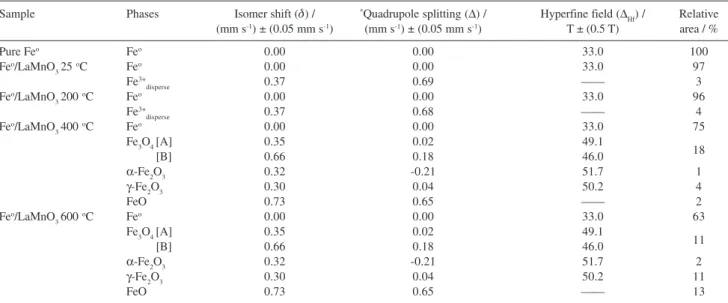
Mössbauer spectra of the Fe°/LaMnO3 mixtures after grinding (25 oC) and after thermal treatment at 200-600 oC
are shown in Figure 2.The Mössbauer hyperfine parameters obtained from the spectra can be seen in Table 1.
Figure 2. Transmission room temperature Mössbauer spectra of the Feo/ LaMnO3 mixtures treated at 25, 200, 400 and 600 oC under argon atmo-sphere.
The commercial iron metal used in this work showed only a sextet with quadrupolar splitting of 33 T relative to Feo. The Feo/LaMnO
3 mixture after a simple manual
grinding for 60s (25 oC) showed, besides the Feo signal
(97%), also a low intensity signal (3%) relative to Fe3+
disperse, with δ 0.37 and ∆ 0.69 mm s-1. As pure Feo
ground by the same procedure did not show this signal for Fe3+
disperse, this result suggests that the simple grinding
of Feo with LaMnO
3 for 60 s led to some oxidation of the
iron metal surface. Upon treatment at 200 oC no significant
change was observed. On the other hand, at 400 and 600 oC
the relative intensity of Feo signal strongly decreased and
new signals related to the Fe3O4, FeO, γ-Fe2O3/α-Fe2O3 phases appeared. Experiments with pure iron at 600 oC
under argon flow did not show any significant reaction, ruling out any oxidation by impurities such as O2 or H2O in the Ar gas.
The phase compositions for the different treatment temperatures can be better visualized in Figure 3. It can be observed that at 400 oC the Feo is converted mainly to
Fe3O4 (18%). As the reaction was carried out under argon atmosphere, the oxygen to oxidize Feo should come from
the perovskite according to the process:5
LaMnO3.15 + 3 Feo→ LaMnO
3-x + Fe3O4 (3)
At 600 oC, the relative Feo signal intensity further
decreases, indicating its consumption in the reaction. As the Fe3O4 relative signal intensity decreases, the signals for FeO and Fe2O3 (as γ-Fe2O3 and α-Fe2O3) showed a significant increase. To explain the formation of these iron oxides, one can consider several processes taking place
at 600 oC: (i) The oxidation of the Fe
3O4 by LaMnO3
according to the process:
LaMnO3.15 + Fe3O4 → LaMnO3-x + γ-Fe2O3 (4)
It should also be considered that Fe3O4 can be oxidized by air even at room temperature to produce large quantities of maghemite.5 Therefore, a significant part of the Fe
2O3
observed might have been formed after thermal treatment when the sample was exposed to air; (ii) The trans-formation of the maghemite γ-Fe2O3 spinel cubic structure to the hematite α-Fe2O3 hexagonal structure, which is known to take place at temperatures near 520 oC.16 (iii)
The reaction of Fe3O4 and Fe2O3 with Feo to produce FeO,
occurring at temperatures near 600 oC.17
Table 1. Mössbauer hyperfine parameters for the Fe°/LaMnO3 mixtures treated at 25, 200, 400 and 600 °C under argon atmosphere
Sample Phases Isomer shift (δ) / *Quadrupole splitting (∆) / Hyperfine field (∆
Hf) / Relative (mm s-1) ± (0.05 mm s-1) (mm s-1) ± (0.05 mm s-1) T ± (0.5 T) area / %
Pure Feo Feo 0.00 0.00 33.0 100
Feo/LaMnO
3 25 oC Feo 0.00 0.00 33.0 97
Fe3+
disperse 0.37 0.69 —— 3
Feo/LaMnO
3 200 oC Feo 0.00 0.00 33.0 96
Fe3+
disperse 0.37 0.68 —— 4
Feo/LaMnO
3 400 oC Feo 0.00 0.00 33.0 75
Fe3O4 [A] 0.35 0.02 49.1
18
[B] 0.66 0.18 46.0
α-Fe2O3 0.32 -0.21 51.7 1
γ-Fe2O3 0.30 0.04 50.2 4
FeO 0.73 0.65 —— 2
Feo/LaMnO
3 600 oC Feo 0.00 0.00 33.0 63
Fe3O4 [A] 0.35 0.02 49.1
11
[B] 0.66 0.18 46.0
α-Fe2O3 0.32 -0.21 51.7 2
γ-Fe2O3 0.30 0.04 50.2 11
FeO 0.73 0.65 —— 13
*relative to α-Fe
Another process which could take place is the complete reduction of the LaMnO3, leading to the collapse of the perovskite structure. To investigate this possibility, the thermally treated Feo/LaMnO
3 mixtures were also studied
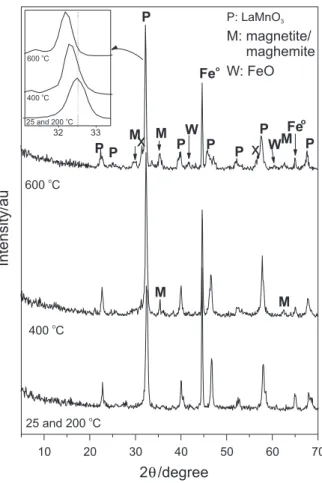
by powder X-ray diffraction (XRD). In Figure 4, typical peaks for the LaMnO3 orthorhombic structure can be observed.18
When the mixture Feo/LaMnO
3 was thermally treated
at 200 oC under argon, no significant change was detected.
On the other hand, at 400 and 600 oC several changes were
observed: (i) the relative intensity of the Feo diffraction peaks progressively decreases. The ratio IXRD(LaMnO3)/ IXRD(Feo) (I
XRD Feo at 2θca. 45o and IXRD LaMnO3 at 2θca.
32o) changes from 0.86 to 0.85, 1.54 and 1.67 for the
mixtures treated at 25, 200, 400 and 600 oC, respectively.
These results clearly indicate the consumption of the Feo
upon thermal treatment; (ii) The perovskite diffraction peaks shift to lower angles (Figure 4, detail), suggesting that the lattice parameters are changing after thermal treatment. The lattice parameters obtained for the sample at 25 and 200 oC
are similar to the observed in the literature for the pure LaMnO3 (a = 7.796 Å, b = 5.540 Å and c = 5.508 Å),19 indicating that at these conditions no significant change in
the perovskite structure takes place. On the other hand, after treatment at 400 and 600 oC, the XRD data suggest
that the perovskite unit cell volume increased to 245.1Å3
(a = 7.689 Å, b = 5.540 Å and c = 5.753 Å), likely due to the loss of oxygen from the structure; (iii) Estimation of the crystallite size using the Scherrer equation suggests that the perovskite crystals increase from 170 to 240 and 310 Å as the Feo/LaMnO
3 mixture is treated at 200, 400 and 600 oC respectively; (iv) Although the Mössbauer spectrum
clearly shows the formation of Fe3O4 at 400 oC, XRD only
shows a small and broad peak related to Fe3O4, suggesting a highly dispersed phase. On the other hand, at 600 oC better
crystallized Fe3O4 and FeO were observed, with particle sizes of 103 and 135 Å estimated by the Scherrer equation; (v) No peaks for La2O3 (at 27.2 and 31.6o, file 22-0369) or MnO (40.5, 34.9 and 58.7o, file 07-0230) could be detected,
suggesting that the collapse of the perovskite structure does not take place significantly or it is producing highly dispersed/amorphous La2O3 and MnO phases; (vi) It was also observed that the thermal treatment at 600 oC does not
affect the surface area measured by the BET N2 adsorption method, which was ca. 2 m2 g-1 for the Feo/LaMnO3 mixture before and after thermal treatment.
Mössbauer and XRD data suggest that the perovskite LaMnO3.15 can transfer oxygen to Feo by an interface reaction
producing new iron oxide phases. Based on these results, a very simple and idealized scheme to explain the surface reaction between LaMnO3+δ and Feo can be proposed:
After thermal treatment, the particles shown in Figure 5 can be separated by breaking the interface and exposing both surfaces, the reduced LaMnO3 and the oxidized Feo,
which have an important effect on the catalytic properties of the materials.
Effect of thermal treatment on the properties of Fe°/ LaMnO3 towards H2O2 reactions
The Feo/LaMnO
3 mixtures treated at different
temperatures were studied to promote two reactions: (i) the decomposition of H2O2 to O2 and (ii) the oxidation of methylene blue with H2O2.
Figure 4. X-ray powder diffractograms of the Feo/LaMnO
3 mixtures af-ter thermal treatment under argon at 200, 400 and 600 oC.
The hydrogen peroxide decomposition (equation 5) is a versatile probe reaction to investigate the activity of perovskite catalysts, as (i) the experimental set-up is simple, (ii) it has been well investigated for different perovskites,19-22 (iii) Mn-containing perovskites are
especially active for this reaction,23-25 and (iv) the activity
is very sensitive to changes in the transition metal oxidation state and oxygen vacancies on the surface.
H2O2 → H2O + 0.5 O2 (5)
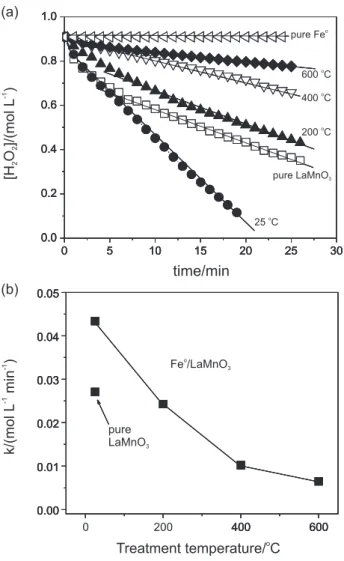
The results obtained for the peroxide decomposition in the presence of the different Feo/LaMnO
3 mixtures can
be seen in Figure 6. The linear behavior of the decomposition plots (Figure 6a) suggests a pseudo zero order dependence on the H2O2 concentration under the reaction conditions employed (Vdecomp= - kdecomp.[H2O2]o).
The pseudo-zero order reaction rate constants calculated from the slope of the decomposition plots are shown in Figure 6b.
It can be observed that the pure LaMnO3 perovskite is highly active for H2O2 decomposition. This high activity has been reported in the literature for different Mn perovskites and was assigned to the presence of high oxidation state species, e.g. Mn4+.23,25 It has also been reported that oxygen vacancies on the perovskite surface21
can play an important role for the H2O2 decomposition. Figure 6 shows that, although Feo is completely inactive
for the peroxide decomposition, its simple mixture with LaMnO3 caused a significant increase on the activity. Mössbauer spectroscopy and XRD analyses of the mixture did not show any bulky significant change in Feo and
LaMnO3. Therefore, this increase in reactivity suggests that a surface reaction should have taken place by the simple contact of the Feo and the perovskite phases, likely
by a superficial oxygen transfer from the perovskite to Feo. This oxygen transfer should generate two different
species: (i) oxygen vacancies on the perovskite surface and (ii) Fe oxidized species on the Feo surface. Both species can catalyze H2O2 decomposition. Previous work has also shown that a simple mixture of Feo with Fe
3O4 or
Fe2O3 produced an increase on the activity for H2O2 decomposition.4,5 Therefore, the iron oxides formed might
have an important contribution to increase the reaction rate.
On the other hand, after thermal treatment at 200, 400 and 600 oC, a progressive decrease in the decomposition
activity is observed. Although the reasons for this decrease are not clear, one can envisage that at higher temperatures the oxygen transfer from the perovskite should significantly reduce the concentration of Mn4+
surf and also
Mn3+
surf species on the perovskite to produce Mn2+, leading
to a decrease on the H2O2 decomposition activity. The effect of the thermal treatment on the activity of the Fe°/LaMnO3 mixtures for the oxidation of organic compounds in aqueous medium with H2O2 was also investigated. In this study, methylene blue (MB) was used as a probe molecule, as it shows several interesting features: (i) it is highly soluble in water, (ii) its oxidation can be simply monitored by spectrophotometric measurements and (iii) it simulates the behavior of textile dyes, which are an important class of industrial contaminant.
The oxidation of methylene blue was monitored by the discoloration rate, which is related to the first oxidation steps to produce non-colored intermediates
Dye + H2O2 → non-colored intermediates (6)
These discoloration measurements give important information on the rate of formation of reactive oxidation
Figure 6. (a) Hydrogen peroxide decomposition for the pure LaMnO3,
pure Feo and Fe°/LaMnO
species. Some processes that could interfere on the reaction monitoring by discoloration, such as adsorption and reduction of the dye by Feo, are minimized by the use
of MB, as (i) it is a cationic molecule which decreases its adsorption on the LaMnO3 perovskite and on the iron oxides due to their high PZC (point zero charge) 26 and
(ii) MB is not easily reduced by pure iron metal.27 The discoloration plots obtained for pure LaMnO3, pure Feo and the Feo/LaMnO
3 mixtures treated at 25, 200,
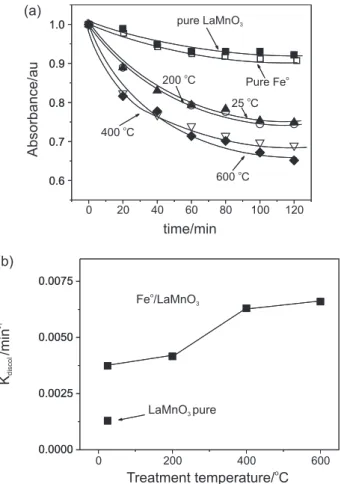
400 and 600 oC are shown in Figure 7. A kinetic treatment
using a ln At/Ao (where At = absorbance at the time t and Ao=absorbance at time zero) versus time produced fairly straight lines, suggesting that the kinetics of the discoloration process under the reaction conditions employed can be approximated to a first order dependence on the dye concentration Vdiscol=kdiscol.[dye]~1.
It can be observed that pure LaMnO3 shows some activity, producing a discoloration of ca. 10% after 120 min. Pure Feo also showed a similar discoloration activity. However,
this discoloration is mainly due to the reduction of methylene blue by Feo, as suggested by blank experiments without H
2O2.
It is interesting to observe that the simple mixture of LaMnO3
with Feo produced a remarkable increase on the activity for
the discoloration. Upon thermal treatment at 200 oC, no
significant difference was observed. On the other hand, after treatment at 400 and 600 oC, a further increase on the
discoloration activity was observed. Atomic absorption analyses for Fe and Mn ions in all solutions after reaction did not show any significant metal content, suggesting the presence of a heterogeneously catalyzed process.
A simple proposal to understand these results is to consider the reaction between the perovskite and Feo to
produce Mn2+
surf and Fe2+surf species, according to the process:
Mn3+
surf/Mn4+surf(LaMnO3) + Feo→
Mn2+
surf(LaMnO3) + Fe2+ surf(Feo) (7)
It is well known that Fe2+
surf species are active for the
Fenton reaction.4 Previous work in our group4,5 suggested
that the effect of grinding Fe3O4 with Feo is the reduction
of Fe3O4 to form higher concentrations of Fe2+
surf species
active for the Fenton chemistry. Also, several works in the literature showed that Mn2+ species, soluble or in solid
matrix, are active to promote the Fenton reaction.28-30
Therefore, the oxygen transfer from LaMnO3 to Feo has
two important effects for the H2O2 reactions, i.e. it decreases the activity for the undesired peroxide decomposition and it produces M2+ species active for the
Fenton chemistry.
Conclusions
The perovskite LaMnO3.15 can transfer oxygen to Feo
by an interface reaction producing a partially reduced perovskite LaMnO3-δ and highly dispersed iron oxides, mainly Fe3O4, on the Feo surface. As the mixtures Feo/
LaMnO3 are treated at 200, 400 and 600 oC, the reactivity
towards H2O2 decomposition decreases, whereas the activity for the oxidation of methylene blue increases. These results can be discussed in terms of a decrease on the concentration of Mn4+
surf and Mn3+surf (active for H2O2
decomposition) with an increase on the Mn2+
surf and Fe2+surf
species, active for the Fenton reaction.
Ackowledgments
The authors are grateful to CNPq, FAPEMIG and CAPES for financial support.
References
1. Khan, F. I.; Husain, T.; Hejazi, R.; J.Environ. Manage.2004,
71, 95.
Figure 7. (a) Discoloration activity and (b) first order reaction rates for the oxidation of methylene blue with pure LaMnO3, pure Feo andFe°/ LaMnO3 mixtures treated at 25-600 °C (dye 3.5 mL at 0.05 g L-1,H
2. Szecsody, J. E.; Fruchter, J. S.; Williams, M. D.; Vermeul, V. R.; Sklarew, D.; Environ. Sci. Technol. 2004, 38, 4656.
3. Costa, R. C. C.; Lelis, F.; Oliveira, L. C. A.; Fabris, J. D.; Ardisson, J. D.; Rios, R. R. A.; Silva, C. N.; Lago, R. M.; Catal.
Commun. 2003, 4, 525.
4. Moura, F. C. C.; Araújo, M. H.; Costa, R. C. C.; Macedo, W. A. A.; Fabris, J. D.; Ardisson, J. D.; Lago, R. M.; Chemosphere
2005, 60, 1118.
5. Moura, F. C. C.; Araújo, M. H.; Oliveira, G. C.; Macedo, W. A. A.; Ardisson, J. D.; Lago, R. M.; Chem. Lett. 2005, 34, 1172.
6. Costa, R. C. C.; Ardisson, J. D.; Fabris, J. D.; Macedo, W. A. A.; Lago, R. M.; J. Hazard. Mater.2005, B129, 171.
7. Pena, M. A.; Fierro, J. L. G.; Chem. Rev. 2001, 101, 1981.
8. Longworth, G. In Mössbauer Spectroscopy Applied to
Inorganic Chemistry, Long, G. J., ed., Plenum Press: New York,
1984, vol. 1, p. 43.
9. Teillet, J.; Varret, F.; MOSFIT program, University du Maine,
France (unpublished).
10. Pawley, A. R.; Redfern, S. A. T.; Holland, T. J. B.; Am. Mineral.
1996, 81, 335.
11. Holland, T. J. B.; Redfern, S. A. T.;Mineral. Mag. 1997, 61,
65.
12. Lee, Y. N.; Lago, R. M.; Fierro, J. L. G.; Cortes, V.; Sapina, F.; Martinez, E.; Appl. Catal. A 2001, 207, 17.
13. Noginova, N.; Bah, R.; Bitok, D.; Atsarkin, V. A.; Demidov, V. V.; Gudenko, S. V.; J. Phys.: Condens. Matter 2005, 17, 1259.
14. Teraoka, Y.; Yoshimatsu, M.; Yamazoe, N.; Seiyama, T.; Chem. Lett. 1984, 893.
15. Ding, J.; Miao, W. F.; Pirault, E.; Street, R.; McCormick, P. G.;
J. Alloys Compd.1998, 267, 1999.
16. Oliveira, L. C. A.; Fabris, J. D.; Rios, R. R. A.; Mussel, W. N.; Lago, R. M.; Appl. Catal. A2004, 259, 253.
17. Andreozzi, R.; Caprio, V.; Insola, A.; Marotta, R.; Catal. Today
1999, 53, 51.
18. Shu, Q.; Zhang, J.; Liu, J.; J. Alloy. Compd. 2005, 390, 240.
19. Ariafard, A.; Aghabozorg, H. R.; Salehirad, F.; Catal. Commun.
2003, 4, 561.
20. Falcon, H.; Carbonio, R. E.; Fierro, J. L. G.; J. Catal.2001,
203, 264.
21. Alonso, J. A.; Martinez-Lopez, M. J. ; Falcon, H.; Carbonio, R. E.; Phys. Chem. Chem. Phys.1999, 1, 3025.
22. Goeta, A. E.; Goya, G. F.; Mercader, R. C.; Punte, G.; Falcon, H.; Carbonio, R.; Hyperfine Interact. 1994, 90, 371.
23. Teraoka,Y.; Kakebayashi, H.; Moriguchi, I.; Kagawa, S.; Denki
Kagaku1996, 64, 1189.
24. Lee, Y. N.; Lago, R. M.; Fierro, J. L. G.; J. Appl. Catal. A 2001,
215, 245.
25. Yang, H. G.; Zhang, T.; Tian, H. J.; Tang, J. W.; Xu, D. Z.; Yang, W. S.; Lin, L. W.; React. Kinet. Catal. Lett. 2001, 73,
311.
26. Rosenholm, J. B.; Kosmulski, M.; Maczka, E.; Jartych, E.; Adv.
Colloid Interface Sci. 2003, 103, 57.
27. Ma, L. M.; Ding, Z. G.; Gao, T. Y.; Zhou, R. F.; Liu, W. Y. J.;
Chemosphere2004, 55, 1207.
28. Watts, R. J.; Sarasa, J.; Loge, F. J.; Teel, A. L.; J. Environ. Eng.
2005, 131, 158.
29. Xu, X. R.; Li, H. B.; Wang, W. H.; Gu J. D.; Chemosphere
2004, 57, 595.
30. Tucker, M. D.; Barton, L. L.; Thomson, B. M.; Wagener, B. M.; Aragon, A.; Waste Manage. 1999, 19, 477.