The Next
e
+
e
−
Linear Collider
Arthur K. A. Maciel
Physics Department, Northern Illinois University, DeKalb, IL 60115 USA
Received on 12 November, 2003
Following the recent realization by the worldwide high energy physics community for the need of a next gene-ratione+e−collisions machine, we review the main reasons for such a proposal, and the current status of that
endeavor. General aspects of the physics program, the collider itself, and its detectors are covered.
1
Introduction
The field of High Energy Physics (HEP) has experienced several leaps in the understanding of the subatomic world during the past three to four decades. In the late 1960’s deep inelastic (e−
Ncollision) experiments revealed the existence of nucleon substructure, and the 1970’s solidified the new (and current) concept of elementarity, with quarks and lep-tons organized in three generations. The existence of some entries was first speculated, then observed in the ensuing de-cades. Flavordynamics, neutral currents and the electroweak (EW) unification as a gauge theory were juxtaposed with the quantum chromodynamics of the strong interactions, to yi-eld this spectacularly successful model of the fundamental interactions known as the Standard Model (SM). Since the pivotal observation of the EW gauge bosons (by the UA1 and UA2 collaborations at CERN) in 1983, the experimental activity in the HEP frontier may be broadly summarized as a persistent and ever more accurate confirmation of the predic-tions of the SM, eventually achieving part-per-mil precision in some key measurements such as parity violating asymme-tries performed at thee+e−
colliders at CERN and SLAC. A particularly noteworthy event was the discovery of the top quark (by the CDF and DØ collaborations at Fermilab) in 1995, thus completing the cadre of expected matter parti-cles (fermions) in the SM. Equally rewarding has been the ever increasing cross fertilization among the fields of HEP and Cosmology, whose rapport has evolved in the past few decades from intimate tosymbiotic, with the emergence of one fundamental field of research often calledastroparticle
physics.
Despite the recent progress, there is however compelling evidence that the SM model cannot be the ultimate theory of the fundamental interactions. Among its foremost pro-blems is the fact that the (mass giving) non-gauge sector of the fundamental interactions is incomplete and unexplained. A postulated scalarHiggsboson has not yet been observed, nor is its mass predicted by the theory. Equally disturbing is the mere concept of a fundamental scalar boson in the SM framework, since its mass will undergo quantum correcti-ons that are quadratically divergent, and will require can-cellation mechanisms that are hard to justify (the “hierarchy problem”).
HEP now faces a new set of fundamental questions, led
by the need to understand the origin of electroweak symme-try breaking (EWSB) with its associated mechanism that en-dows masses to the elementary particles. A creative stream of tentative answers has been steadily flowing, and a distinct trait that seems common to all proposals is that some kind of new physics phenomenology must exist at an energy scale that does not exceed one (or a few) TeV. This new physics is of course expected to hold the SM as some form of low energy limit, but beyond that it should also address EWSB and the origin of mass, explain flavor and flavor generations, hopefully bring added hints (or fully explain) grand unifi-cation, and perhaps reveal the unseen elements of the uni-verse (e.g. dark matter). Candidate theories may be broadly classified as weakly coupled (e.g. Supersymmetry), strongly coupled (e.g. Technicolor), as well as various models with additional space dimensions, some dedicated to accomoda-ting fundamental gravity.
It is extraordinary that the answers to most of the cur-rent fundamental questions in HEP seem to live in the few TeV range, and that we are about to experimentally reach this energy scale. The main motivation behind this article is a discussion of how best to prepare for this new era of HEP challenges. We review the proposal that a newe+e−
Li-near Collider [1], with the characteristics and parameters to be discussed below, is a key element in the set of tools that need to be in place for this new chapter in HEP exploration.
2
Hadron and Lepton Colliders
The question we are trying to answer is; what is the best set of tools for efficiently mapping out the new physics expected at the TeV scale? The Large Hadron Collider (LHC) — a 14 TeV C.M. proton-proton collider — is under construction at CERN and on schedule to start operations in 2007[2]. One unmistakable lesson that we have learned from recent past experience is that of thecomplementarity between hadron and lepton colliding machines. A pattern has emerged that most discoveries were made at hadron machines, followed by precision studies at lepton machines, and a clear example is again the observation of the EW gauge bosons in theSppS
TABLE I. LHC production rates atL= 1033
cm−2s−1for a few
benchmark processes. Note that 1Snowmass year ∼ 107 secs
(physics running).
process evts/yr. total collected at other machines by 2007
W → e ν 108 107
(Tevatron) ,104
(LEP)
Z→ e e 107
105
(Tevatron) ,107
(LEP)
tt 107
104
(Tevatron)
bb 1012
109
(Belle/BaBar)
H(mH = 130GeV) 105 (?)
˜
gg˜(m= 1T eV) 104
(?)
Hadron colliders reach the highest accessible beam ener-gies and therefore can be thought of as the natural pushers of the energy frontier, the powerful probes that first access a new energy range, thediscovery machines. This is the role expected of the LHC[3] whose dynamic reach is such that it should discover or exclude any form of an EWSB Higgs-like sector, and should reveal or exclude Supersymmetry (SUSY) in most of its parameter space. To exemplify that reach, we list in table 2 the production rates of the LHC in its “low” luminosity regime for a few benchmark processes. Note for instance the top quark pair production at a rate of one per second.
Parton-parton collisions in hadron machines imply a wide band of C.M. energies and a wide range of physics processes and final states. Some of the drawbacks are (i) very large backgrounds due to the strong interactions, and (ii) largely unknown initial state quantum numbers and C.M. energy and momentum. In sharp contrast,e+e−
collisions have well defined initial “parton” four- momenta and quan-tum numbers (JP = 1−
). They naturally bypass the uncer-tainties introduced by parton density functions (PDF’s) in hadron colliders, and avoid difficulties associated with the perturbative breakdown of the strong interactions under cer-tain conditions. Another consequence of structureless parti-cles in the initial collision is a precise access to the missing energy due to unobserved final state particles. This is a ma-jor asset ofe+e−
colliders, where the systematic causes of beam energy smearing (initial state radiation and beamstrah-lung) are measurable and well understood.
Lepton colliders (and the case here is made for e+e− collisions) are therefore the naturalprecision machines, with a much simpler collision environment than that of hadron machines. Most processes ine+e−
collisions have simple two-body kinematics, and their cross sections are largely comparable. Exotic processes share a large fraction of the totale+e−
annihilation cross section, and final states of in-terest are relatively free of backgrounds. If cross sections are shared democratically among final states, they are howe-ver comparably much smaller than those of hadron colliders, and luminosity becomes a vital commodity. For a simple comparison, the top quark pair production rate ine+e−
col-lisions at 500 GeV C.M. andL = 1034cm−2s−1 is about one per minute.
3
The Next Lepton Collider
As a complement to the LHC, the international HEP com-munity is considering the construction of a new e+e− collider[4, 5, 6]. Given the fact that electron beam energy loss in a circular accelerating ring scales as the 4th power of the beam energy, the proposed collider energies, well above the Z boson mass, necessarily imply alinear collider. In fact, LEP represents the practical engineering limit for cir-cular ringe+e−
collisions. The proposed setup for this next
e+e−
machine consists of two identical linear accelerators shooting head-on against one another, with a total site length of about 30km[7, 8, 9].
A worldwide proposal for a nexte+e−
linear collider has been gathering momentum since the mid-90’s, and is now being carried out under the leadership of three main or-ganizing bodies located in Europe[10], Japan[11] and the USA[12]. Given the common interests of these organi-zations, and the practical certainty that only one collider will eventually exist, an international linear collider steering committee (ILCSR) has been convened by the ICFA (the International Committee for Future Accelerators) with the charge of facilitating the convergence of all three projects into one optimized e+e−
collider for the worldwide HEP community.
Very broadly, the proposed ILCSR convergence plan can be divided in three stages. (1) In the next few months the three interested regions (Europe, Japan and the USA) must come up with a technical proposal for their preferred choice of machine technology and parameters. (2) At the Novem-ber 2003 meeting in Paris, the ILCSR shall appoint an in-ternational technical panel that must extract from the exis-ting proposals a machine design that embodies the best of all proposed technologies and parameters. The timeline for this is the end of 2004. (3) The project then becomes one for the whole planet, an international collaboration sometimes referred to as the global linear collider (GLC).
Among the existing projects the current degree of con-vergence is remarkable, and some vital aspects of the pro-posals are already common ground: the next e+e−
linear collider should (i) start operations at 500 GeV C.M., with energy extendable to about 1.2 TeV (ii) have enough flexibi-lity to run at different C.M. energies, including theZ-pole, and perform precision C.M. energy scans for production th-reshold studies (iii) supply beams for two interaction halls (iv) start operations at an instantaneous luminosity around L = 2×1034cm−2s−1, with an initial collection capacity of 200f b−1/yr of data. Note that while the energy upgrade with respect to the SLC (the existing linear collider) is of a factor of 10, the upgrade in luminosity covers four orders of magnitude! A technical review committee convened by the ICFA has recently completed a thorough review[13] of the status of the existing LC studies, and has concluded that the necessary technology already exists to support the construc-tion of ane+e−
linear collider with the desired parameters of energy, luminosity etc.
(ii) room temperature (Cu) cavities favoring beam energy upgradability. The former tolerates longer bunch intervals and higher beam spot sizes, while the latter necessitates shorter bunch intervals and beams that are twice as narrow. Proposed beam spots are ∼5 to 10 nm, about the size of a virus! Bunch spacing in the european superconducting (TESLA[8]) proposal is 5 Hz while that of the warm coun-terparts in the USA (NLC[7]) and Japan (JLC[9]) is about 120 Hz.
4
The Case for an
e
+e
−Collider
The linear collider (LC) is expected to provide critical pre-cision measurements to complement LHC findings, such as quantum number assignments and theory model discrimi-nation. Given the observation of a scalar boson, the LC is a powerful tool in determining whether it is a Higgs or so-mething else, with direct tests of whether it generates masses for (i) the gauge bosons, (ii) fermions, and (iii) itself. In the absence of a Higgs boson, it is also a precision tool in the scanning of resonances or other strong interaction effects in longitudinalW Wscattering, as is expected in non-Higgs (or composite Higgs) EWSB models. In the case of observation of some new physics by the LHC, it is easy to come up with scenarios in which the LC could be extremely useful in de-termining whether it is aSUSY manifestation, under which specific model, and proceeding towards investigations of a SUSYbreaking mechanism [14].
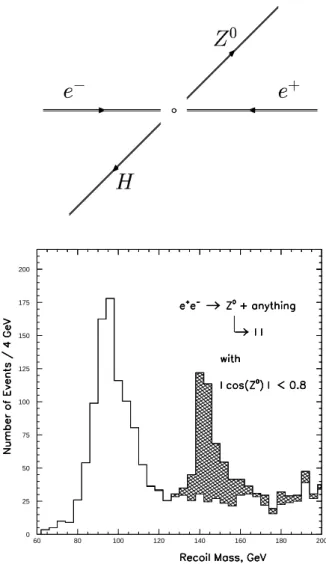
Beyond LHC complementarity, the LC has a rich pro-gram of its own, spanning QCD details such as fragmen-tation, precision flavor physics such as single top produc-tion and top polarizaproduc-tion, and continued precision EW phy-sics. A detailed review of the LC physics capabilities can be found in [14]. Here we highlight one particular and cri-tical measurement that is unavailable to a hadron collider. Given a Higgs boson, the LC will have direct access to the fullZZH coupling (as well as the Higgs mass), indepen-dently of the Higgs decay modes, even if some modes exist that are invisible (such asH →χ˜0
1χ˜01). Fig. 1 shows the re-sulting Higgs signal, after a simulation of thee+e−
→ZH
process, detected as the missing mass that recoils against the (mono-energetic) Z [15]. This measurement directly ex-tracts the fullgZZHcoupling constant, responsible forboth
thee+e−
→ZHcross section and for endowing theZwith its mass. One could therefore determine whether this cou-pling is responsible for the fullZmass, or possibly the exis-tence of more Higgses otherwise. Given the high rates for associatedZHproduction, enough data for such a measure-ment could be collected in less than six months.
5
Collision Modes
One important property of e+e−
machines is that beams can be polarized. Electron beam polarizations of about 80% have already been achieved at SLAC, and the polarization of positron beams, while not yet efficiently achieved, is under intensive study. A high degree of beam polarization (no-minally 80% (e−
) and 60%(e+)) is a key item in the LC
project, and is instrumental in the separation of overlapping signals, in the selective suppression of backgrounds, in the measurement of parity violating couplings and many other applications. As an example, considerW-pair production (e+e−
→ W+W−
). This is the largest single process con-tribution to thee+e−
annihilation cross section, and a po-tentially significant background in many studies. Because of maximal parity violation in the W couplings (left cur-rents only), this cross section is extremely sensitive to beam polarization, as demonstrated in Fig. 2. The fact that the total rate for this process can be reduced by about a factor of 30 simply with R-polarization of the electron beam, ma-kes beam polarization an idealdialfor reducing (or deter-mining) background levels. Besides,σ(e+e−
→W+W−
)
is very sensitive to the SM relations betweenW W γ and
W W Zcouplings, making comparative measurements with different beam polarizations a powerful test-bench for trili-near gauge coupling anomalies. Other examples of uses for beam polarization will be given.
✂✁ ☎✄
✆
✝✟✞
✠
0 25 50 75 100 125 150 175 200
60 80 100 120 140 160 180 200
Figure 1. Dilepton(Z) recoil mass in the simulation of e+e−→
ZH(Z → ℓ+ℓ−and H →anything) for a Higgs mass of 140
10
-210
-11
10
10
20
20
40
60
80
100 120 140 160 180
e−U e+U
e−R:80 e+U
e−R:80 e+L:60
e+e−→ W+W− dσ/dcosθ[pb]
θ
Figure 2. The effect of beam polarization on σ(e+e− →
W+
W−). U denotes unpolarized beam, then adding 80%
e−(Right) and 60%e+(Left). θis the scattering angle.
Another important aspect of e+e−
colliders is that ne-arly monochromaticγbeams can be achieved by shinning a high intensity laser beam against the primarye−
beam. Compton backscattering of the laser light will provide the secondaryγ beam. Electron polarization to a high degree (and opposite to the laser beam helicity) is a necessity here, in order to reducee+e−
conversions near the collision point and thus enhance monochromaticity in the resultingγbeam. This is a technologically simple (and relatively inexpensive) extension to the collider hardware, and therefore an efficient method of achievinge−
γandγγ(besidese+e− ande−
e− ) collision modes.
There are many physics applications for thee−
e− mode, despite the drawbacks (with respect toe+e−
) of increased C.M. energy smearing due to initial state radiation (ISR) and beamstrahlung. One specific measurement of interest is that of s-electron (˜e) production in aSUSYscenario [16]. The t-channel exchange of a neutralino (χ˜0
1) between the two initial electrons is the best reaction for high precision mea-surements ofe˜(L& R)masses and need very little integrated luminosity since lepton number conservation acts as a natu-ral˜eselection mechanism.
✁ ✂
Figure 3. Leading SM Higgs production mechanism in theγγ col-lision mode.
The γγ collision mode is above all an extremely clean Higgs factory, with very low backgrounds and ideal for col-lecting rare Higgs decays (e.g.for low mass couplings). The main production mechanism in the SM (Fig. 3) is through the top Yukawa coupling. This entails a high sensitivity to
other massive particle states (such as s-top) that may inter-fere with the top loop. The determination of theH → γγ
partial width needs a lot less integrated luminosity if per-formed in theγγ collision mode. The same luminosity that achieves aδΓ/Γ∼20% in thee+e−
mode, delivers an un-certainty δΓ/Γ ∼1% in theγγ mode. The possibility of linearly polarizedγbeams gives access to an interesting CP test. The asymmetry
A= σ(γLγL)−σ(γRγR)
σ(γLγL) +σ(γRγR)
(1)
will vanish for either a pure scalar or pure pseudo-scalar Higgs. The observation of a non-zero A will necessarily mean that the Higgs is a mixture of CP eigenstates (a CP violation quite similar to that in theKKsystem).
6
A Program for Higgs Studies
The main production diagrams for SM Higgs bosons in
e+e−
annihilations are shown in Fig. 4, and their respec-tive cross sections for various values of the Higgs mass at two C.M. energies are in Fig. 5. For an example of event ra-tes, supposeEcm=500GeV,Mh=120GeV and 100f b−1 of
integrated luminosity (∼1 yr); this yields∼6000 higgstrah-lung (ZH) and 8000W W fusion events. To illustrate the difference between gauge couplings and Yukawa couplings, we note that the largest of the latter (top-Higgs) is such that
σ(e+e−
→ ttH)barely makes it into the lower left corner of Fig. 5 forEcm= 1 TeV.
e– e+
Z0
Z0 h0
W – W+
e+ e–
e+ e–
ν ν
Z0 Z0
e+ e–
h0 h0
Figure 4. Leading SM Higgs production mechanism in thee+ e−
collision mode.
The initial Higgs program of course will consist of spec-troscopy and quantum number determinations, followed by
Γtot and individual coupling tests to determine its mass-giving nature. The LC expects to measure couplings and
Γtot to better than 5%. A second neutral Higgs-like parti-cle with JP C = 0−+ would be a strong pointer to SUSY. Another curiosity would be the access to the charm quark mass via the Higgs-charm coupling measurement, therefore bypassing the difficulties associated with charm bound sta-tes.
The determination of the Higgs spin and parity quantum numbers throughZH associated production ise.g. descri-bed in [17, 14]. This is a rather accurate measurement, uni-que to lepton colliders, where the angular distributions of the producedZ andH, and those of their decay products, are used in conjunction with a scanning of the cross section behavior near the production threshold to unambiguously determine JP(Higgs). But we choose to highlight here a
more difficult and elaborate measurement, one that is likely to be possible only at the nexte+e−
collider; that of the light Higgs self-coupling[18].
✁
✂✄ ✂☎
✁
✁
✁
✁
✁
✁
✆
Figure 6. Double “Higgs-strahlung” diagrams ine+
e−→ZHH
Direct and independent measurements of the Higgs mass (Mh2 = 4λv2) and of the Higgs self-coupling (ghhh =
6λv/√2) provide two-way access to the Higgs potential constantλ(as in[V =λ(Φ2−v2/2)2]) and therefore repre-sents a powerful constraint on the SM validity, or a pointer to new physics. The Higgs self-coupling can be extracted from double “Higgs-strahlung” events (e+e−
→ ZHH),
with contributing diagrams shown in Fig. 6. Considering a light Higgs (e.g.below theW Wthreshold), their most favo-red decays are tobbpairs. This makesH2Z→(bb)2(ℓ+ℓ−
)
the easiest final state signature, but it has a branching ratio of only 8%. Given the smallness (σ(e+e−
→H2Z)≈0.2f b)
of the signal cross section, a wider access to more final sta-tes (as well as integrated luminosity) becomes a vital asset. It is found[18] that the inclusion of generic two-jetZdecays is a necessity in this measurement. The analysis now deals with a difficult six-jet final state (H2Z → (bb)2(qq)), but benefits from an added branching fraction of 60%.
Main backgrounds to the six-jetZHH final states are due to triple boson production(σ(e+e−
→W W Z)≈28f b
andσ(e+e−
→ ZZZ) ≈ 1.5f b) and must be rejected th-rough reconstructed di-jet masses. This puts an extremely high strain on precision calorimetry, and is commonly ci-ted as one of the performance benchmarks for the propo-sals of calorimeters for the next e+e−
linear collider. We will return to this point when we consider detectors. The use of beam polarization to detect gauge boson contami-nation levels plays a vital role here. Detailed simulation studies[18] indicate that a measurement ofλto an accuracy of∆λ/λ≈20−30% can be achieved after the collection of 1000f b−1of data.
7
A Program for Supersymmetry
Perhaps second to the observation and understanding of the Higgs sector comes the need to explain the origin of its exis-tence (i.e.EWSB). It is well known that the SM Higgs boson is unstable (the hierarchy problem) to quantum corrections in its mass which diverge quadratically. SUSY tames these corrections into only logarithmic divergences, a huge solu-tion to a huge problem. At the same time,SUSYprovides a (radiative) mechanism for EWSB — the Higgs field natu-rally condenses into vacuum if the top quark is massive (it needs150 < mtop < 200 GeV) just as observed. Being
a weakly coupled theory,SUSYremains compatible with all precision EW measurement results (the MSSM value for
sin2θw matches experimental observation to better than 2
ppm) and with a light Higgs boson. SUSYpredicts the cor-rect unification relation among the SM-like gauge coupling constants g3g2g1, and holds the neutralino(χ˜01) as a natural candidate for cosmologicaldark matter. While all this re-presents a remarkable achievement, it comes at the expense of introducing a parameter space that is so vast as to house various forms of sub-models and scenarios. Nevertheless, among all proposals for (beyond SM) TeV scale theories, we believe thatSUSYis (arguably) the one most strongly mo-tivated.
It is of course expected that, if SUSY exists, the LHC should find it relatively soon [3]. Given that, some of the main goals for aSUSYprogram at the linear collider would be; (i) to determine the underlying SUSY model (a severe reduction of parameter space) through a survey of masses, couplings, quantum numbers and other parameters. (ii) to understand the spontaneousSUSY breaking mechanism and deduce its scale. (iii) to dedicate special focus todark matter
candidates. If the neutralino, then use beam polarization to resolve its higgsino/wino/bino contents. (iv) mixing angles and heavy sleptons versustanβ, flavor physics (generation patterns), search for FCNC, CP phases etc.
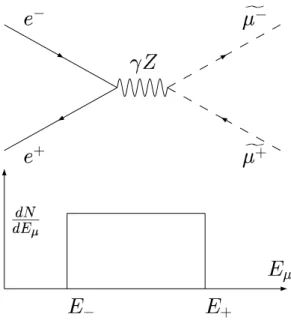
The simplest (yet very informative)SUSYprocess at the linear collider is that of s-muon pair production (e+e−
→
˜
µ+µ˜−
) with a single leading diagram as shown in Fig. 7. Typically the s-muon will decay (µ˜→µ+ ˜χ0
1) into a muon and a neutralino which escapes undetected. The final state consists of aµ+µ−
pair plus missing energy (E/). This largeE/ component leaves onlyW-pair production as a background candidate, which can be understood, measured and removed by means of different beam polarizations. The scalar muon decays isotropically and the boost in the lab frame gives the final muon a flat energy distribution with endpointsE± as shown in Fig. 7, and algebraically given by
E±=
√ s
4 (1±β)(1−
m2 ˜
N0 m2
˜
µ
) ; β= (1−4m 2 ˜
µ
s )
✂✁
☎✄
✆
✝
✁
✆
✝
✄
✞✠✟
✡☞☛
✡☞✌✎✍
✏
✁
✏
✄
✏✒✑
Figure 7.e+e−annihilation into a s-muon pair.
Theµ˜andχ˜0
1masses can be accurately extracted [19] from the observed muon spectrum endpoints (E±). This proce-dure is simpler for the lighterµ˜Rpair production, and
sligh-tly more involved for the heavierµ˜Lvariety (see ref.[19]).
FurtherSUSYchecks can be performed over the same events. Thee+e−annihilation cross section to a massive scalar pair takes the form
dσ d(cosθ)∼
α2
s β
3 sin2θ
|fp|2 (3)
whereβ3is the expected p-wave threshold behavior,sin2θ is the p-wave angular distribution for the decay products and
fpholds theγZinterference effects due to initial state
pola-rization.
Improvements on s-particle masses may be achieved th-rough production cross section scans near threshold (cons-trainsβ), and the shape of the onset, as well as the angular distribution of the final muons, can be used to confirm µ˜
quantum numbers. Furthermore, given that – theγcouples toQ=I3+Y with strengthe – theZcouples to(I3−s2
wQ)with strengthe/(swcw)
the factor|fp|2 in equation 3 will vary according to initial
and final state helicities as indicated (relative normalization) in the following table [20];
|
f
p
|
2
µ˜+
Lµ˜
−
L
(I3
= 1/2Y = 1/2)
˜
µ+Rµ˜
−
R
(I3
= 0Y = 1)
e−
Le
+
R→ 1.0 0.21
e−
Re
+
L → 0.21 0.85
With different options of beam polarization one may (yet again use s-muon pair production to) check whetherSUSYis preserving the SM gauge relations as it should.
Instead of pursuing with furtherSUSYanalysis examples (for reviews see [4, 5, 14]) we conclude this section with
some comments on the complementarity betweenSUSY me-asurements in the LHC and the LC [21].
LHC reactions are QCD dominated, and typical SUSY events will have lengthy decay cascades of squarks (Fig. 8) or gluinos. Under such crowded environment the problem becomes the discrimination of many different decay chan-nels that originate from many possible parent states, and SUSYbecomes an important background toSUSY, thus enhan-cing the model dependence of event interpretations. A further difficulty is the LSP (χ˜0
1) at the end of every decay chain. A hadron collider has no access to the 4-vector “mis-sing energy”, and therefore no direct access to mass recons-truction, but only to mass relations. One of the main analysis tools for the extraction of mass relations is the identification of kinematic end-points for combinations of visible parti-cles that belong to a same decay chain. For example, in the neutralino decay (see Fig. 8)χ˜0
2 →ℓ˜+ℓ −
→ χ˜0
1ℓ+ℓ −
, the
ℓ+ℓ−
mass distribution has an end-point with a sharp edge atMℓℓ=
r
(M2 ˜
χ0 2
−M2 ˜
ℓ)(M
2 ˜
ℓ−M
2 ˜
χ0 2
)
M2 ˜
ℓ
as is shown in Fig. 9.
✁ ✂☎✄✆
✝✟✞
✂☎✄✠
✁
✝✟✡ ✝✟✞
Figure 8. Example decay chain of a s-quark.
0 100 200 300 400
0 50 100 150
205.7 / 197
P1 2209.
P2 108.7
P3 1.291
Mll (GeV)
Events/0.5 GeV/100 fb
-1
Figure 9. Dilepton kinematic edge inχ˜0
2decay (Atlas TDR).
Such end-point analyses introduce strong s-particle mass inter-dependences and correlations. SUSY studies at the LHC[3] often have the LSP (χ˜0
1) mass as the largest source of systematic errors. These, in some cases,may go down
by one order of magnitudeif the LC-measuredχ˜0
The strength of the LCSUSYprogram is that the events are simple and allow for no or minimal model dependence. Special features are the direct access to non-colored states, generally believed to be lighter than color, (pair production of neutralinos, charginos or sleptons) and access to mixing angles through beam polarization.
8
Detector Challenges
The main motivation behind the linear collider project is the potential for high precision measurements, and this requi-res unprecedented performance standards from its detectors. The typical cross section “democracy” among the various processes of interest in thee+e−
annihilation environment, associated with the high luminosities that are being plan-ned, imply that we may expect abundant statistics even for new or exotic physics. Detection systematics must neces-sarily match the statistical accuracy. One important item in detector development that does not represent a challenge to the LC is that of radiation hardness. Technology has already been developed that survives the many times hotter LHC en-vironment.
Among some of the physics oriented performance go-als for LC detectors are; (i) momentum resolution capable of reconstructing the recoiling dilepton (Z) mass in Higgs-strahlung events (see Fig. 1) with resolution better than beam energy spread (this due mostly to initial state radia-tion and beamstrahlung) (ii) two-jet mass resoluradia-tion capable of clearly separating theqqdecays of theW andZ bosons (the benchmark for calorimetry) (iii) hermeticity and cove-rage to very forward angles to precisely determine the mis-sing momentum (iv) exceptional flavor tagging ability (with displaced vertices) to separateb,cand light quark jets (e.g.
in the discrimination of Higgs couplings). Also desirable is the control over jet profiles for quark and gluon jet discrimi-nation and enhancedτidentification.
A current and interesting debate concerning the tracking detectors is largely centered around two different technolo-gies that may surround the inner high-resolution Silicon ba-sed vertex detectors. While large volume gas-filled tracking detectors are being proposed by the European [23] and Ja-panese [24] developers, the USA counterpart [25] suggests a smaller Silicon based tracking chamber. The ultimate goal of course is maximal resolution with minimal material den-sity (to minimize multiple scattering). The gas detectors (such as time proportional chambers) naturally have lower densities, but the Silicon chamber studies are reaching com-parable material density due to an absolute minimum of sup-porting structures (carbon fibers), with the added bonus of a significant cost reduction in the smaller calorimeters that will surround a more compact tracking volume.
While the steady stream of detector capability improve-ments is truly remarkable (see [26] and recent workshops reachable from LC web pages [10, 11, 12]), we do think that the giant step in detection techniques is occurring in calori-metry, where a rather new concept is being developed and tested, that of the imaging calorimeter, to be used in con-junction with the technique ofparticle flowreconstruction. We explain both next.
Consider 500 GeV C.M. collisions of typee+e−
→
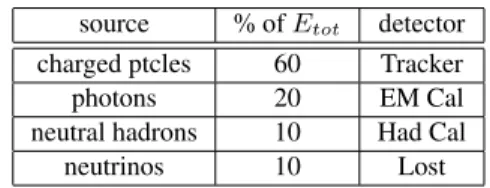
ha-drons. Table II shows the expected breakdown in percentual energy of the various final state components. Charged parti-cles and photons carry about 90% of the detectable energy, the rest being due to neutral hadrons. The goal of the par-ticle flow reconstruction method is to (i) use the hadronic calorimeter (HC) only for the neutral hadron component of the final state (ii) use the eletromagnetic calorimeter (EC) only for photons (iii) charged hadron and lepton momenta are to be extracted from the tracker with much better reso-lution than that available through calorimetry. Here the ca-lorimeters act solely as particle identification devices. For this reason, the ability to image the various track paths and interactions through the calorimeter becomes more impor-tant than collective jet energy resolution. Charged tracks in the tracking chamber are used as seeds for calorimeter parti-cle flow reconstruction. Electrons will be identified by their track matching EC showers, and charged hadrons by their matched HC showers. All showers associated with charged tracks are removed from calorimetry, the remainder being photons (EC) and neutral hadrons (HC). To minimize scat-tering material between the tracking chamber and the calo-rimeters and also to make use of the magnetic bending of charged tracks in the calorimeters, these are now placed in-side the magnetic coil. This is a significant change from previous standards, and also a cost reduction in the (very ex-pensive) calorimeters due to their consequent reduction in size.
TABLE II. Breakdown of final state component energies in e+
e−→qqevents at 500GeV CM.
source % ofEtot detector
charged ptcles 60 Tracker
photons 20 EM Cal
neutral hadrons 10 Had Cal
neutrinos 10 Lost
The goal of imaging calorimetry places enormous cons-traints and challenges in calorimeter building and usage. The imaging ability requires a much finer segmentation than that of present calorimeters. As an example we compare the calorimeter in the DØ experiment (Tevatron) with5×104 readout channels, to the expected∼ 5 ×10⁷ channels in the LC calorimeters. Problems associated with the routing of millions of detection signals are agravated by their being inside a magnetic field of 4-5 Tesla. Such conditions have led hadron calorimeter proponents to consider digital signal extraction from each small detection cell (e.g. two-bits, for below/above a set threshold). This reduction in information content may be the only way to render signal extraction and treatment manageable.
in the LC system. Various different options of HC techno-logy are still under consideration. An informative study of calorimetry for the LC is that of reference [29], where the discrimination ofW andZ di-jet masses mentioned above in connection with six-jet events and the Higgs self-coupling (see Figs. 6 and 10) is addressed in detail. This is a calori-metry performance target that is vital for the success of the LC program.
Figure 10. A six-jet event in the TESLA detector. Calorimeter thicknesses are about 20cm (EC) and 1 meter (HC).
9
Comments and Conclusion
While this brief review does not cover important phenome-nology such as that associated with EWSB through new strong forces, or additional gauge bosons from extended gauge groups, we would like to add a comment on the so-mewhat intriguing idea that extra space dimensions may play a role in the TeV scale physics. A particular class of models [30] holds that our observable 4-dimensional world is a membrane in a space of more dimensions. The con-sequent dilution of gravity in this multi-dimensional world allows for fundamental quantum gravity to become a strong interaction well below the Planck scale, possibly even at the few TeV scale. If this is the case, effects of gravitational ra-diation become relevant for experiments at the LHC and the LC. Current searches for Graviton interference (virtual G-exchange effects), or direct (on shell ) Graviton radiation at LEP and the Tevatron [31, 32] do place lower limits on the gravity scale at about 1 TeV. When repeated at the next gene-ration of colliders (the LHC and the LC), these limits can be pushed further into the 10 GeV region. If the hypothesis of extra dimensions is true, the evidence will most likely come from collider experiments. Here again the LHC⊕LC com-plementarity may play a vital role, with brute force (higher C.M. energy) monojet searches at the LHC leading to a de-tailed access to the missing energy sources at the LC.
In conclusion, the present lore of HEP contains
signifi-cant experimental evidence and enticing theoretical reaso-ning that important new physics exists at the TeV scale, and we are about to reach it. First, the LHC (circa 2008) is ex-pected to reveal this new physics and indicate the critical items for detailed exploration. A few years later the next
e+e−
linear collider may join in the exploration program. Initially, a sub-TeV LC is planned for precision Higgs boson physics and EWSB scenario discrimination. Subsequent up-grades to higher energy may prove essential to understand in detail the nature of the new physics. The needed technology for thee+e−
collider now exists — and beam polarization is a necessary ingredient in its program — but the project is very ambitious and alas, very costly (an estimated US$6B total). Such enterprise can only go ahead under truly global consensus and worldwide collaboration, and will probably represent another major advance in the sociology and inner organization of HEP. While we can only guess what new physics will show up, it is our belief that a sound program for this new age of exploration is taking shape. Indeed, these are extraordinary times in HEP...
Acknowledgments
We would like to thank the organizers of the XXIV ENFPC for the oportunity of this talk, and at the same time of course the very many people whose research work made the talk possible. Thanks also to M.Peskin for his linear collider resource web page [33] as well as past talks and lectures. This work is funded by the National Science Foun-dation (NSF) under grant PHY-0243692, and we gratefully acknowledge the hospitality and support received from the Sociedade Brasileira de F´ısica.
References
[1] “The Whitepaper”, J.Baggeret.al.hep-ex/0007022
[2] Seee.g.L.Maiani’s talk at the Lepton-Photon 2003 confe-rence, http://conferences.fnal.gov/lp2003/
[3] For a summary of LHC physics by the Atlas and CMS colla-borations see hep-ph/0110021
[4] H.Murayama, M.Peskin, hep-ph/9606003
[5] E.Accomandoet.al., hep-ph/9705442
[6] http://blueox.uoregon.edu/∼lc/wwstudy/
[7] http://www-project.slac.stanford.edu/lc/nlc.html
[8] http://tesla.desy.de/ , and
http://tesla.desy.de/new pages/TDR CD/start.html
[9] http://lcdev.kek.jp/RMdraft/ , also http://acfahep.kek.jp/acfareport/
[10] http://www.desy.de/conferences/ecfa-lc-study.html
[11] http://acfahep.kek.jp/
[12] http://blueox.uoregon.edu/∼lc/alcpg/
[13] http://www.slac.stanford.edu/xorg/
. ilc-trc/2002/2002/report/03rep.htm
[14] http://www.slac.stanford.edu/grp/th/LCBook/
[16] J.Feng and M.Peskin, hep-ph/0105100.
[17] D.J.Milleret.al., hep-ph/0102023
[18] C.Castanieret.al.hep-ex/0101028
[19] H.Martyn, A.Blair, hep-ph/9910416
[20] M.Peskin, lectures at Fermilab (March 2002)
[21] The LHC/LC interface study group, http://www.ippp.dur.ac.uk/∼georg/lhclc/
[22] Reference [21], report in preparation.
[23] http://tesla.desy.de/new pages/TDR CD/
. PartIV/detect.html
[24] http://acfahep.kek.jp/subg/cdc/
[25] http://scipp.ucsc.edu/LCTrack/
[26] http://blueox.uoregon.edu/ lc/randd.html
[27] F.Badaudet.al., note LC-DET/2001-58 on the DESY LC no-tes server, http://www-flc.desy.de/lcnono-tes/
[28] seee.g.the hadron calorimetry research program at Northern Illinois University, http://nicadd.niu.edu/
[29] J.Brient and H.Videau, hep-ex/0202004
[30] N.Arkani-Hamedet.al., hep-ph/9803315
[31] A recent summary talk is by S.Mele at EPS2003 http://eps2003.physik.rwth-aachen.de/data/talks/
. parallel/09StringTheory/09mele.pdf
[32] Current DØ analyses and limits can be seen at http://www-d0.fnal.gov/Run2Physics/np/
. results/LP2003/led diem/