
QCD at High Parton Density
V. P. Gonc¸alves
Instituto de F´ısica e Matem´atica, Universidade Federal de Pelotas
Caixa Postal 354, CEP 96010-090, Pelotas, RS, Brazil
Received on 11 December, 2003
The high parton density regime of Quantum Chromodynamics (QCD) is briefly discussed. Some phenome-nological aspects of saturation are described, mainly focusing on possible signatures of the non-linear QCD dynamics in electron-proton/nucleus collisions. Implications of these effects in central and ultraperipheral heavy-ion collisions are also presented.
1
Introduction
The high parton density regime in deep inelastic electron-proton (nucleus) scattering is characterized by small values of the Bjorken variable x = Q2/s, where Q2 is the mo-mentum transfer and√sis the center of mass energy, and represents the challenge of studying the interface between the perturbative and nonperturbative QCD, with the pecu-liar feature that this transition is taken in a kinematical re-gion where the strong coupling constantαs is small. By
the domain of perturbative QCD we mean the region where the parton picture has been developed and the separation between the short and long distance contributions (the col-linear factorization) is made possible by the use of the operator product expansion (OPE). The Dokshitzer-Gribov-Lipatov-Altarelli-Parisi (DGLAP) equations [1] are the evo-lution equations in this kinematical region. In the limit of small values ofx(<10−2)one expects to see new features
inside the nucleon: the density of gluons and quarks become very high and an associated new dynamical effect is expec-ted to stop the further growth of the structure functions. In particular, for a fixed hard scale Q2 ≫ Λ2
QCD, the OPE
eventually breaks down at sufficiently smallx[2]. Ultima-tely, the physics in the region of high parton densities will be described by nonperturbative methods, which is still waiting for a satisfactory solution in QCD. However, the transition from the moderatexregion towards the smallxlimit may possibly be accessible in perturbation theory, and, hence, al-lows us to test the ideas about the onset of nonperturbative dynamics.
The expectation of the transition for the high density regime can be understood considering the physical picture of the deep inelastic scattering. In the infinite momen-tum frame (IMF) the virtual photon with virtualityQ2
me-asures the number density of charged partons having lon-gitudinal momentum fractionxand transverse spatial size ∆x⊥≤1/Q. WhenQ2is large,αs(Q2)is small, so that the
struck quark can be treated perturbatively. Also, whenQ2
is large the struck quark is small, so that one can picture the struck quark as being isolated, far away from similar quarks,
in the proton. Thus, so long as the parton distributions are not large, the partons in a proton are dilute. However, if the parton distributions get large enough, which happens when
xis very small, partons in the proton must begin to overlap. If there is a sufficient amount of parton overlap then a given parton will not act as a free quantum over its lifetime but will interact strongly with the other partons in the proton, even thoughαsmay still be in the perturbative regime. In other
words, while for large momentum transfer k⊥, the linear
evolution equations (DGLAP/BFKL) predicts that the me-chanismg→ggpopulates the transverse space with a large number of small size gluons per unit of rapidity (the trans-verse size of a gluon with momentumk⊥ is proportional to
1/k⊥), for small k⊥ the produced gluons overlap and
fu-sion processes,gg→g, are equally important. Considering the latter process, the rise of the gluon distribution below a typical scale is reduced, restoring the unitarity. That typi-cal stypi-cale is energy dependent and is typi-called saturation stypi-cale
Qs. The saturation momentum sets the critical transverse
size for the unitarization of the cross sections. Therefore, at sufficient small values ofx, one enters in the regime of high density QCD, where partons from neighboring ladders overlap spatially and new dynamical effects associated with the unitarity corrections are expected to stop further growth of the parton densities.
Other important aspect which must be considered for the description of the QCD at high energies is that the usual col-linear factorization approach for the calculations of the ob-servables has to be replaced by a corresponding high energy (k⊥-dependent) factorization in this regime. In the collinear
dependent. The conventional gluon distribution g(x, µ2),
which drives the behavior of the observables at high ener-gies, corresponds to the density of gluons in the proton ha-ving a longitudinal momentum fractionxat the factorization scaleµ. This distribution satisfies the DGLAP evolution in
µ2 and does not contain information about the transverse
momentak⊥of the gluon. On the other hand, in the large
energy (small-x) limit, we have that the characteristic scale
µ of the hard subprocess of parton scattering is much less than√s, but greater than theΛQCD parameter. In this
li-mit, the effects of the finite transverse momenta of the inco-ming partons become important, and the factorization must be generalized, implying that the cross sections are nowk⊥
-factorized into an off-shell partonic cross section and ak⊥
-unintegrated parton density functionF(x, k⊥),
characteri-zing thek⊥-factorization approach [4]. The functionF is obtained as a solution of the evolution equation associated to the dynamics that governs the QCD at high energies.
The understanding and analytic description of the QCD at high energies has become an increasingly active subject of research, both from experimental and theoretical points of view. Theoretically, we expect that the growth of parton distributions should saturate, possibly forming a color glass condensate (CGC) [5], which is characterized by a bulk mo-mentum scaleQs. If the saturation scale is larger than the
QCD scale ΛQCD, then this regime can be studied using
weak coupling methods. The magnitude ofQsis
associa-ted to the behavior of the gluon distribution at high energies, and some estimates has been obtained. In general, the pre-dictions areQs ∼1GeV at HERA/RHIC andQs∼2−3
GeV at LHC [6, 7, 8]. In particular, it has been observed that theep deep inelastic scattering (DIS) data at lowxcan be successfully described with the help of the saturation mo-del [6], which incorporates the main characteristics of the high density QCD approaches [9, 10, 5]. On the other hand, deep inelastic scattering on nuclei gives us a new possibi-lity to reach high-density QCD phase without requiring ex-tremely low values of x. The nucleus in this process ser-ves as an amplifier for nonlinear phenomena expected in QCD at small x. In order to understand this expectation and estimate the kinematic region where the high densities effects should be present, we can analyze the behavior of the functionκ(x, Q2)≡ 3π2
αs
2Q2
xgA(x,Q 2
)
πR2
A , which represents the probability of gluon-gluon interaction inside the parton cascade, and also is denoted the packing factor of partons in a parton cascade [11, 10]. Considering that the condition
κ= 1specifies the critical line, which separates between the linear (low parton density) regimeκ≪1and the high den-sity regimeκ≫1, we can define the saturation momentum scaleQsgiven by
Q2s(x;A) =
3π2αs
2
xgA(x, Q2s(x;A))
πR2
A
, (1)
below which the gluon density reaches its maximum value (saturates). At any value ofxthere is a value ofQ2=Q2
s(x)
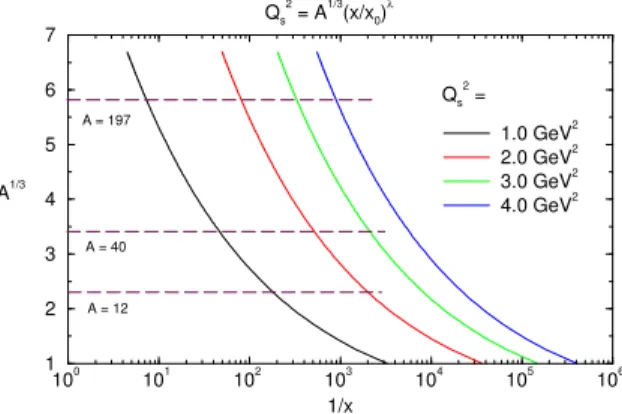
in which the gluonic density reaches a sufficiently high value that the number of partons stops to rise. This scale depends on the energy of the process [xg∝x−λ(λ≈0.3)] and on
the atomic number of the colliding nuclei [RA ∝ A
1 3 →
Q2
s ∝A
1
3], with the saturation scale for nuclear targets lar-ger than for nucleon ones [Fig. 1]. This result motivates more extensive studies of nuclear collisions and, in parti-cular, of electron-nucleus collisions at high energies, where the number of other medium effects is reduced in compari-son withAAcollisions.
In that follows we present a brief review of some sig-natures of the high parton density regime (For other recent reviews see Refs. [12, 13, 14]). In the next section, we dis-cuss the high density effects in the deep inelastic scattering process and the property of geometric scaling predicted the-oretically and observed in the HERA data. Moreover, some signatures of these effects in electron-nuclei collisions are proposed. In Section 3 the possibility of using ultraperiphe-ral heavy ion collisions as a photonuclear collider is analy-zed and some predictions for the saturation effects in the he-avy quark production are presented. In Section 4 we discuss the saturation effects in nuclear collisions. In particular, we present some estimates for these effects in the signatures of the quark-gluon plasma. Finally, in Section 5 we summarize our main conclusions.
100 101 102 103 104 105 106
1/x 1
2 3 4 5 6 7
A1/3
Qs2 = A1/3(x/x0)λ
1.0 GeV2 2.0 GeV2 3.0 GeV2 4.0 GeV2 Qs2 =
A = 197
A = 40
A = 12
Figure 1. Saturation scale for different values ofAandx.
2
Seeking Saturation in
ep/eA
Pro-cesses
We start from the space-time picture of the epprocesses [15]. The deep inelastic scatteringep→e+Xis characteri-zed by a large electron energy lossν(in the target rest frame) and an invariant momentum transferq2≡ −Q2between the
incoming and outgoing electron such thatx =Q2/2m
Nν
is fixed. In terms of Fock states we then view theep scatte-ring as follows: the electron emits a photon (|e >→ |eγ >) withEγ = ν andp2t γ ≈ Q2, after the photon splits into
a qq (|eγ >→ |eqq >) and typically travels a distance
lc ≈ 1/mNx, referred as the coherence length, before
in-teracting in the nucleon. For smallx(larges, where √s
is theγ∗pcenter-of-mass energy), the photon converts to a
long before the interaction with the target. Theqqpair sub-sequently interacts with the target. In the smallxregion, wherex ≪ 1
2mR, theqqpair crosses the target with fixed
transverse distancer⊥ between the quarks. Following
Gri-bov [16], we may write a double dispersion relation for the forwardγ∗pelastic amplitudeA, related to the total cross
section by the optical theorem (ImA=sσγ∗p
(s, Q2)), and
obtain for fixeds σγ∗p(s, Q2) =X
q
Z dM2 M2+Q2
dM′2
M′2+Q2ρ(s, M 2, M′2)
×1sImAqq+p(s, M2, M′2), (2)
whereM andM′are the invariant masses of the incoming
and outgoingqqpair. If we assume that the forwardqq+p
scattering does not change the momentum of the quarks then
Aqq+pis proportional toδ(M2−M′2), and (2) becomes
σγ∗p(s, Q2) =X
q
Z dM2
(M2+Q2)2ρ(s, M 2)σ
qq+p(s, M2), (3)
where the spectral function ρ(s, M2) is the density of qq
states, which may be expressed in terms of theγ∗→qq
ma-trix element [17]. Using thatM2= (k2
⊥+m2q)/[z(1−z)],
wherek⊥andzare the transverse and longitudinal momen-tum components of the quark with mass mq, we can
ex-press the integral over the massM of theqq in terms of a two-dimensional integral overz andk⊥. Instead ofk⊥, it
is useful to work with the transverse coordinater⊥ (impact
parameter representation), which is the variable Fourier con-jugate tok⊥, resulting [15],
σγL,T∗p(x, Q2) =Z dz d2r
⊥|ΨL,T(z, r⊥, Q2)|2σdip(x, r⊥),
whereσdip=σqq+pandx≃Q2/Wγp2 (s=Wγp2) is
equi-valent to the Bjorken variable. In general, the photon wave functionsΨL,T are determined from light cone perturbation
theory [15].
The dipole hadron cross sectionσdipcontains all
infor-mation about the target and the strong interaction physics. At leading order,σqq = CCFA(3αs(
4
r2
⊥)/4)π
2r2
⊥xg(x,
4
r2
⊥),
wherexg(x, 4
r2
⊥)is the nucleon gluon distribution. In the
linear regime, where the high densities effects can be dis-regarded, the smallxbehavior of the gluon distribution is given by the solutions of the DGLAP [1] and/or BFKL [18] evolution equations. The common feature of these equati-ons is the steep increase ofxgas xdecreases. This steep increase cannot persist down to arbitrarily low values ofx
since it violates a fundamental principle of quantum theory, i.e. the unitarity. The large values of the gluon distribution in this regime (large occupation number of the soft gluon modes) suggests the use of semi-classical methods, which allow to describe the small-xgluons inside a fast moving nucleus by a classical color field [19]. This color field is dri-ven by a classical Yang-Mills equation whose source term is provided by faster partons. When the energy further incre-ases, the structure of the classical field equations does not
change, but only the correlations of the color source. This change can be computed in perturbation theory, and expres-sed as a functional renormalization group equation for the weight function, in which the ’fast’ partons are integrated out in steps of rapidity and in the background of the classi-cal field generated at the previous step [5]. This approach enables one to calculate cross sections in a high gluon den-sity environment. Recently, this approach has been applied foreA[20, 21],pA[21, 22, 23] andAAprocesses [24]. Ba-sically, we have that the corrections associated to the high parton density when estimated in the color glass condensate formalism [5], implies thatσdipcan be written as
σdip(x, r⊥) = 2
Z
d2b⊥ [1−S (x,r⊥,b⊥)] , (4)
whereSis theS-matrix element which encodes all the in-formation about the hadronic scattering, and thus about the non-linear and quantum effects in the hadron wave function.
2.1
Geometric Scaling
The function S can be obtained by solving an appropri-ate evolution equation in the rapidityy ≡ ln(1/x)[9, 5]. The main properties of S are: (a) for the interaction of a small dipole (r⊥ ≪ 1/Qs), S(r⊥) ≈ 1, which
characte-rizes that this system is weakly interacting; (b) for a large dipole (r⊥≫1/Qs), the system is strongly absorbed which
impliesS(r⊥)≪1. This property is associated to the large
density of saturated gluons in the hadron wave function. The phenomenological saturation model proposed in Ref. [6] en-codes the main properties of the saturation approaches. In this model
σdip(x, r⊥)
σ0
= 1−S (x,r⊥) ; S = exp
·
−Q
2 s(x) r2⊥
4
¸
, (5)
withσdip/σ0the scattering amplitude, averaged over all
im-pact parametersb⊥, andQ2s ≃Λ2eλln(x0/x). The
parame-ters of the model were constrained from the HERA smallx
data, coming out typical values of order 1-2 GeV2 for the momentum scale. We have that whenQ2s(x)r2⊥ ≪ 1, the
model reduces to color transparency, whereas as one appro-aches the regionQ2
s(x)r⊥2 ≈1, the exponential takes care
of resumming many gluon exchanges, in a Glauber-inspired way. Intuitively, this is what happens when the proton starts to look dark. The saturation model depends upon the va-riables xandr⊥ only through the dimensionless quantity
Qsr⊥. Consequently, the saturation model predicts the
ge-ometric scaling of the total cross section. As demonstrated in Ref. [25], the HERA data on the proton structure function
F2are consistent with scaling atx≤ 0.01andQ2 ≤ 400
GeV2. Similar behavior has been observed in exclusive [26]
1 10 100 1000 τ
10−4 10−3 10−2 10−1
σtot c [GeV −2 ]
H1 (96) ZEUS (97) ZEUS (00) H1 (02) SAT−MOD SYMMETRIC SAT−MOD
Figure 2. Experimental data on inclusive charm production plotted versus the scaling variableτ=Q2/Q2
s[28].
Recently, we have demonstrated [28] that the inclusive charm production also exhibits geometric scaling in a large region of photon virtualities, as verified in Fig. 2. In the HERA kinematic domain the saturation momentumQ2
s(x)
stays below the hard scaleµ2
c = 4m2c, implying that charm
production probes mostly the color transparency regime and saturation corrections are not very important. The curves are our predictions for the geometric scaling considering two different saturation models, which relies on quite simple as-sumptions about the dipole-proton interaction. The presence of the geometric scaling in a kinematical region above the saturation scale agrees with recent studies. In particular, in Ref. [29] the authors have demonstrated that the geometric scaling predicted at low momentaQ2≤Q2s(x)is preserved
by the BFKL evolution (at both fixed and running coupling constant) up to relatively large virtualities, within the kine-matical window1 ≤ lnτ ≪ ln(Q2
s/Λ2QCD). On the other
hand, in Ref. [30], the impact of the QCD DGLAP evo-lution on the geometric scaling has been studied. In this case, the DGLAP evolution equation is solved imposing as initial conditions along the critical line Q2 = Q2
s(x)
sa-tisfying scaling, showing that it is approximately preserved at very small x. The residual scaling violation is factored out, although the determination of a window for the scaling aboveQsis not provided. It is important to emphasize that
our results for the nuclear heavy quark photoproduction in-dicate that the geometric scaling should also be present in the nuclear case [31].
2.2
The nuclear structure function
In recent years several experiments have been dedicated to high precision measurements of deep inelastic lepton scatte-ring (DIS) off nuclei. Experiments at CERN and Fermilab focus especially on the region of small values ofx. The data [32], taken over a wide kinematic range, have shown that the proton and neutron structure functions are modified by a nu-clear environment. The modifications depends on the parton momentum fraction: for momentum fractionsx <0.1and 0.3< x <0.7, a depletion is observed in the nuclear struc-ture functions. The lowx(shadowing region) and the larger
x(EMC region) are bridged by an enhancement known as antishadowing for0.1< x <0.3. We refer to the entire
10−5
10−4
10−3 10−2
10−1
100
x
0 0.2 0.4 0.6 0.8 1 1.2 1.4
RG
AG (A=40) EKS EKS (A=208) AG
LHC RHIC
Q2=15 GeV2
Figure 3. Comparison between the ratioRGwith and without the
high density effects for A=40 (Ca) and A=208 (Pb). The RHIC and LHC kinematic regions are also shown [39].
phenomena as the nuclear shadowing effect. The theoretical understanding ofFA
2 in the full kinematic region has
pro-gressed in recent years, with several models which describe the data quite successfully [33]. On the other hand, the satu-ration effects should also modify the behavior of the nuclear structure function FA
2 (x, Q2)[34, 35] and its logarithmic
slope [8] at smallx.
One approach to estimate the high density effects in nuclear processes is the Glauber multiple scattering theory [36], which was derived in QCD [37]. In this framework the nuclear collision is analyzed as a succession of independent collisions of the probe with individual nucleons within the nucleus, which implies that [10]
S = exp
·
−Q
2
s(x,A)s(b⊥)
4 r
2
⊥
¸
, (6)
whereQ2
s(x, A)is given by Eq. (1) ands(b⊥) is the
nu-clear profile function. In Ref. [35] we have estimated the high density effects in the nuclear structure function and proposed a procedure to obtain a parameterization for the parton distributions which includes the high density and nu-clear shadowing effects. In order to illustrate our results, in Fig. 3 we compare our predictions for thex- dependence of the ratioRG = xgA(x, Q2)/xgN(x, Q2)for Q2 = 15
the smallxlimit. This behavior is preserved by the DGLAP evolution, since these equations reduce to the DLA limit at low x in the nucleon and nuclear case, keeping the ratio constant. When the high density effects are considered in the dynamics, a large modification of the gluon distribution is predicted, which is amplified in nuclear processes since the nuclear medium amplifies the effects associated to the high parton density. Therefore, the high density approaches predict larger effects in the nuclear gluon distribution than the nucleon one, independent of the initial parton distribu-tions used. This expectation is present in the behavior of
RA
G(AG), which turn to be much smaller thenRAG(EKS)
in lowxregion. The implications of this behavior in the he-avy quark production inpAcollisions has been studied in Ref. [39].
2.3
The
F
A2
slope
Other important observable which can be useful to constrain the boundary region between the linear and nonlinear dyna-mics is the nuclear structure function slope. As the behavior of this quantity is strongly dependent of the gluon distribu-tion, we expect distinct behaviors atQ2> Q2
sandQ2< Q2s
with the transition point dependent of the values ofxand
A. In Ref. [8] we have estimated the behavior of theFA
2
-slope in the kinematic regions which could be explored in
eAcolliders at HERA and RHIC, as well as for some typi-cal values of the number of nucleonsA. Following [6], we have considered that the Bjorken variablexand the photon virtualityQ2 are related by the expressionx = Q2/W2,
whereW is theγ∗N c.m. energy, and calculate thexand
Q2dependences forW andAfixed. The Fig. 4 shows the
logarithmicQ2slope ofFA
2 plotted for some typical values
ofW2andA = 197as a function ofQ2. The main aspect
in the plot is the presence of a distinct maximum for each slope, dependent of the energy. A similar behavior is ve-rified for different number of nucleons. We can see that at fixedA, if we increase the value of the energy, the maximum value of the slope occur at larger values ofQ2(and smaller
values of x) as obtained for the proton structure function slope [6]. The remarkable properties of the collisions with nuclei targets are the large values ofQ2for the turnover of FA
2 slope and the large shift of the turnover at large values
ofQ2 with the growth of the energy. These behaviors can
be understood intuitively. The turnover is associated with the regime in which the partons in the nucleus form a dense system with mutual interactions and recombinations, with a transition between the linear and nonlinear regime at the sa-turation scale [Eq. (1)]. As the partonic density growth at larger values of the number of nucleonsAand smaller va-lues ofxwe have that, at fixedA, the saturation scaleQ2
s
will increase at small values ofx, since this is directly pro-portional to the gluon distribution. Moreover, at fixed energy
W, the same density atA= 12,32,197will be obtained at larger values ofxandQ2. These properties of the high
den-sity effects are verified in the FA
2 slope. The main result
of our analysis was that the saturation should occur already at rather small distances (largeQ2
s) well below where soft
dynamics is supposed to set in, justifying the use of pertur-bative QCD to approach a highly dense system.
10−1
100
101
102
103
Q2
0 10 20 30 40 50 60 70 80
dF
2
A/dlogQ
2
W = 50 W = 75 W = 115
A = 197
Figure 4. The logarithmicQ2
slope ofFA
2 as function of the
vari-ableQ2
at different values ofW[8].
2.4
The asymptotic regime
The description of the nucleon (nuclear)F2 and its slope
is simplified in the asymptotic regime of very high parton densities. In this case, under the assumption that the in-teraction is black, we can estimate the total cross section (3) using the following approximations: ρ(s, M2) ∝ M2
and σqq+p(s, M2) = πR2. Consequently, we can get
σγ∗p
(s, M2)∝R2 ln[(M2
max+Q2)/(Mmin2 +Q2)]. Using
thatM2
min≈4m2πwhereasMmax2 ∝s, results that
F2(x, Q2) = Q2
4παemσ γ∗p
∝Q2R2 ln1
x , (7)
which is the black disc limit for theF2structure function.
This bound, derived from a geometrical analysis, represents the maximum value allowed for the cross sections at high energies (high densities). In Ref. [40] we have analyzed some distinct high energy approaches and demonstrated that this prediction is a common limit. In particular, from the re-sults for the structure function in the asymptotic regime we have verified that this regime is characterized by the identity
dF2(x, Q2)
dln Q2 =F2(x, Q
2), (8)
which is an important signature of the asymptotic regime of high density QCD. This regime should be reached for the case of an interaction with nuclei at smaller parton densities than in a nucleon, sinceQ2
s(x;A) = A
1 3 ×Q2
s(x), where
Q2
s(x)is the nucleon saturation scale.
3
Saturation in Ultraperipheral
He-avy Ion Collisions
in the current and/or scheduled accelerators which allow us to constrain the QCD dynamics. Recently, we have analyzed the possibility of using ultraperipheral heavy ion collisions as a photonuclear collider (For a review see Ref. [41]). In particular, we have studied theJ/Ψproduction [42] and the heavy quark production [43] assuming distinct approaches for the QCD evolution. In this section we present a brief re-view of the approach and indicate the original references for more details.
In heavy ion collisions the large number of photons co-ming from one of the colliding nuclei will allow to study photoproduction, with energiesWγN reaching to 950 GeV
for the LHC. The photonuclear cross sections are given by the convolution between the photon flux from one of the nuclei and the cross section for the scattering photon-nuclei, with the photon fluxdNdω(ω)given by the Weizsacker-Williams method [44, 41]. The final expression for the pro-duction of heavy quarks in ultraperipheral heavy ion collisi-ons is given by,
σAA→QQX ³pSNN
´
=
∞
Z
ωmin
dωdN(ω) dω
×σγA→QQX³W2
γA= 2ω
p
SNN
´
(9) whereωmin=MQQ2 /4γLmpand√SNNis the c.m.s energy
of the nucleus-nucleus system. The Lorentz factor for LHC is γL = 2930, giving the maximum c.m.s. γN energy
WγA ≈ 950 GeV. The typical values of x which will
be probed in ultraperipheral heavy ion collisions, are gi-ven by x = (MQQ/2p)e−y, whereM
QQ is the invariant
mass of the photon-gluon system and y the center of mo-mentum rapidity. For Pb + Pb collisions at LHC energies the nucleon momentum is equal to p = 2750GeV; hence
x= (MQQ/5500 GeV)e−y. Therefore, the region of small
mass and large rapidities probes directly the high energy (smallx) behavior of the QCD dynamics present in theγ A
cross section. This demonstrates that ultraperipheral heavy ion collisions at LHC represents a very good tool to cons-train the high energy regime of the QCD dynamics, as alre-ady verified for two-photon processes [45].
0 2 4 6 8 10 12
Y
0 100 200 300
d
σ
/dY [mb]
SAT−MOD SEMIHARD I SEMIHARD II CGC EKS98
CHARM PbPb LHC
Figure 5. Rapidity distribution for charm production in ultrape-ripheral heavy ion collisions [43].
In Ref. [43] we have estimated the heavy quark pro-duction assuming distinct approaches for the QCD evolu-tion. First, we have considered the usual collinear approach, where the production cross section is driven by the colli-near gluon distribution on the nuclei. This one contains a lot of information about nuclear shadowing, EMC, and anti-shadowing effects. Second, thek⊥-factorization formalism
was introduced, where the relevant quantity is now the nu-clear unintegrated gluon distribution. For this purpose, we have analyzed two simple parameterizations for it which are consistent with data description on inclusive and diffractive DIS. Finally, we have taken into account the color glass con-densate formalism, where the scattering process is viewed as the interaction of the probe particles with the strong nu-clear color field treated in a classical approximation. The main quantity is the correlator of two Wilson lines, which is related to the dipole cross section and at lowest order has no energy dependence. In [43] we have proposed a simple phenomenological parameterization which introdu-ces higher orders corrections to the classical approximation and allow us to produce more realistic estimates for the cross section.
In Fig. 5 is shown the rapidity distribution for the dis-tinct high energy approaches considered. The collinear re-sult is denoted by the long-dashed curves, where we have employed the EKS98 parameterization for the collinear nu-clear gluon function. The solid and dotted lines label the semihard (k⊥-factorization) results, where one has used that
the unintegrated gluon distribution is related to the usual par-ton distributions by
Fnuc(x, k2⊥;A) =
∂ xGA(x, k2⊥)
∂lnk2
⊥
, (10)
where xGA(x, Q2) = Rg ×xGN(x, Q2) is the nuclear
gluon distribution, withRg taken from the EKS
paramete-rization [38]. Two possibilities for the nucleon gluon distri-bution were considered: (I) GRV94(LO) - solid line - and (II) GRV98(LO) - dotted line. The saturation model results are denoted by the dot-dashed line. In this case we have used the model proposed in Ref. [46], which provides an extension of theepsaturation model for nuclear processes through Glauber-Gribov formalism. The color glass con-densate prediction is denoted by the dashed line. We have that the predictions for the collinear approach and the se-mihard formalism are similar for both charm and bottom production and give somewhat larger values than the satu-ration and CGC results. One possible interpretation for the similarity between the predictions of the semihard approach and the collinear one is that the expected enhancement in the
k⊥-factorization formalism, associated to the resummation
of the(αs ln
√
s mQ)
nin the coefficient function [4], is not
assumes scattering on a black area filled by partons coming from many nucleons. It is important to emphasize that the current experimental data for the nuclear structure function can only be described if the first choice is implemented [46]. Our results shown that an experimental analysis of this pro-cess can be useful to constrain the QCD dynamics at high energies.
4
Saturation in Hea
vy-Ion Collisions
As we expect that the saturation effects should be manifest in nuclear collisions, the recent results for heavy ion collisi-ons at RHIC have motivated some phenomenological analy-sis which assume the presence of these effects. In particular, the approach from Ref. [47], which assume saturation of the nuclear wavefunction, describes the experimental data for the multiplicity distributions of produced particles very well. However, the current situation is not unambiguous, since other approaches which do not assume saturation also describe the same set of data. It is important to emphasize that the presence of these effects should modify the beha-vior of the signatures of the quark-gluon plasma. One of the proposed signatures of the QCD phase transition is the pression of quarkonium production [48]. The idea of sup-pression ofccmesonsJ/ψ,ψ,, etc., is based on the notion
thatccare produced mainly via primary hard collisions of energetic gluons during the preequilibrium stage up to shor-tly after the plasma formation (before the initial tempera-ture drops below the production threshold), and the mesons formed from these pairs may subsequently experience de-confinement when traversing the region of the plasma. In a QGP, the suppression occurs due to the shielding of the
ccbinding potential by color screening, leading to the brea-kup of the resonance. Thecc(J/ψ, ψ′, ...) andbb(Υ,Υ′, ...)
resonances have smaller radii than light-quark hadrons and therefore higher temperatures are needed to dissociate these quarkonium states.
The probability of a thermalized QGP production and the resulting strength of its signatures strongly depends on the initial conditions associated to the distributions of par-tons in the nuclear wave functions. As discussed above, at very high energies, the growth of parton distributions should saturate. Some years ago, Mueller has proposed ideali-zed initial conditions for a saturated nuclear wave function and shown that the evolution of single particle distributi-ons could be described by a nonlinear Landau equation [49]. One of the main conclusions of that study was that the equi-libration time and the initial temperature of the plasma have a strong functional dependence on the initial gluon satura-tion scaleQs. As a direct consequence, the possible
signa-tures of this saturated gluon plasma should beQs-dependent
if the saturation scenario is valid for RHIC and LHC. We denote saturated gluon plasma, the plasma formed from the collision of two nuclei with saturated nuclear wave functi-ons. In Ref. [50] we have analyzed the quarkonium sup-pression as a probe of a saturated gluon plasma. In particu-lar, we have estimated the quarkonium suppression and its dependence in the saturation scale at LHC energies. Below we present a brief review of the main results of that analyses.
Lets start from a brief review of the quarkonium sup-pression in heavy-ion collisions. The heavy quark pair le-ading to the quarkonia are produced in such collisions on a very short time-scale∼ 1/2mQ, wheremQ is the mass
of the heavy quark. The pair develops into the physical resonance over a formation time τf . For a confined
sur-rounding, the bound states ofccandbbinteracting via two forces: a linear confining potential and a color-Coulomb in-teraction. In the plasma phase, the linear potential is absent due to the high temperature leading to deconfinement and the color charge is Debye screened by a cloud of surroun-ding quark-antiquarks pairs which weaken the binsurroun-ding force between theQQpair, thus reducing the color charge seen by the other (anti)quark. Basically, above the critical tempera-tureTc, we have
V(r) =−αr +σr⇒V(r) =−αr exp(−µDr)
where α and σ (the string tension) are phenomenologi-cal parameters and µD is the Debye mass. For values
of the screening mass above a certain critical value µdiss i
(i = J/ψ, ψ′, χ
c,Υ,Υ′, χb), the screening become strong
enough for binding to be impossible and the resonance no longer forms in the plasma. As a result, theQandQdrift away from each other, after leaving the interacting system to form a charm and bottom mesons, which subsequently decays into leptons to be detected. Therefore, a procedure to determine if quarkonium suppression is expected is the analysis of the screening mass. Basically, if we known the evolution of the screening mass during the collision process we can estimate what quarkonia will be effectively suppres-sed. At screening mass values greater thanµdiss
i for values
of time above (or equal) to the formation time of the bound state (τF), the bound state does not be formed. Therefore,
we can analyze the quarkonium suppression considering the dynamical evolution of the screening mass. In Ref. [50] we have obtained an expression for the screening mass in terms of the saturation scale, which is
µ2= (cαsNc
π )
2
3 Q
2
s
(Qst)2/3
. (11)
We have concentrated our analysis in theΥsuppression at LHC energies, since at current energies, the situation ofJ/ψ
0 0.5 1 1.5 2 2.5 3 3.5 4 Qs (GeV)
0 0.5 1 1.5 2 2.5 3 3.5 4
µ
(GeV)
t = 0.2 fm t = 0.8 fm
Υ
αs = 0.3
Figure 6. The dependence of the screening mass in the saturation scale for two instants in the saturated plasma evolution. The long dashed curve characterize the dissociation screening mass for the mesonΥ[50].
In Fig. 6 we present the dependence of the dynamical screening mass in the saturation scale for a typical value of the coupling constant. We verify that the dissociation of the
Υmust occur only if the saturated gluon plasma is characte-rized by large values of the momentum saturation scale. In other words, the presence ofΥsuppression indicates that if a saturation scenario is valid, the initial nuclear wave function are characterized for a bulk momentum scaleQs≥1.5GeV.
Therefore, the Υsuppression may be an indirect probe of the nuclear wave functions, and consequently, from the Co-lor Glass Condensate, allowing to constrain the initial gluon saturation scale.
Other possible approach to estimate the high density ef-fects in nuclearJ/Ψproduction was recently considered in Ref. [51]. There we have assumed that the collinear factori-zation approach is still valid for LHC energies and included the high density effects as estimated in the parameterization proposed in Ref. [35]. In particular, we have considered that theJ/Ψproduction can be described by the color evapora-tion model (CEM) [52]. Consequently,
σAB→J/ψX =K
X
a,b
Z
dq2
µˆσ
ab→cc¯(Q2)
Q2

Z
dxFφa/A(xa)φb/B(xb)
xaxb
xa+xb
Fc¯c→J/ψ(q2), (12)
whereP
a,b runs over all parton flavors,Q2 = q2+ 4m2c,
φa/A(xa)is the distribution function of partonain hadron
A,xF = xa−xb andxaxb = Q2/s ≡ τ. TheK-factor
takes into account the next-to-leading order corrections to the cross section. Moreover, the factorFc¯c→J/ψ(q2)
descri-bes the transition probability for thec¯cstate of the relative square momentumq2to evolve into a physicalJ/ψmeson.
The final state interactions of the produced cc pairs were estimated using the model proposed in Ref. [53], which im-plies
Fcc¯→J/ψ(¯q2) =Fcc¯→J/ψ(q2+ε2L), (13)
whereLis the effective length of the nuclear medium in the
ABcollisions andǫ2is the energy gained by the produced
ccpair per unit length. The above behavior implies that for a
large enoughL, such that forq¯2>4m
D2−4m2c, the
transi-tion probability essentially vanishes due to the existence of the open charm threshold. In Fig. 7 we show our result for the medium length dependence of theJ/Ψcross section and LHC energy using the distinct parameterizations as input in our calculations. We have assumedǫ2 = 0.250GeV2/fm,
which has been constrained using the NA50 data. It is im-portant to emphasize that our model describes very well this set of data. We can see by the comparison between the EKS and AG curve, which includes high density effects, that for LHC energies these effects present in the initial state can-not be disregarded. Moreover, the inclusion of these effects implies an additionalJ/Ψsuppression. Therefore, for LHC energies, we predict that these effects strongly reduces the
J/Ψ production rate. This effect is associated to the do-minance of the small-xbehavior of the nuclear parton dis-tributions at high energies. These results demonstrate that the high density effects will significantly contribute in the nuclearJ/Ψproduction, which implies that a careful disen-tangling of initial and final state effects is required before the clear identification of a new state of matter.
0 2 4 6 8 10
L (fm)
0 2000 4000 6000 8000 10000 12000
Bµµ
σJ/Ψ
/AB (nb/nucleon)
GRV 94 EKS 98 (ε2
= 0.250 GeV2
/fm) AG
LHC s1/2 = 5.5 TeV
Figure 7. TotalJ/Ψcross sections with the branching ratios to
µ+
µ− in AAcollisions, as a function of the effective nuclear lenghtL(A, B)[51].
5
Summary
The perturbative QCD has furnished a remarkably succes-sful framework to interpret a wide range of high energy lepton-lepton, lepton-hadron and hadron-hadron processes. Through global analysis of these processes, detailed infor-mation on the parton structure of hadrons, especially the nu-cleon, has been obtained. The existing global analysis have been performed using the standard DGLAP evolution equa-tions. However, in the smallxregion the DGLAP evolution equations are expected to breakdown, since new dynamical effects associated to the high parton density must occur in this kinematical region.
theoretical effort has been devoted towards the understan-ding of the growth of the total scattering cross sections with energy. These studies are mainly motivated by the violation of the unitarity (or Froissart) bound by the solutions of the linear perturbative DGLAP and BFKL evolution equations. Since these evolution equations predict that the cross sec-tion rises obeying a power law of the energy, violating the Froissart bound, unitarity corrections are expected to stop its further growth.
In this paper we have presented a brief review of the ba-sic concepts present in the high density approaches and dis-cussed some aspects of the rapidly developing field of QCD at high parton density in ep, eA andAA collisions. The successful description of all inclusive and diffractive deep inelastic data at the collider HERA, as well as some recent results from RHIC, by saturation models suggests that these effects might become important in the energy regime probed by current colliders. In particular, the remarkable property of geometric scaling verified in the data indicate that the ex-periments are in a kinematical region which probe QCD in the non-linear regime of high parton density. Moreover, we have verified that deeply inelastic scattering of electrons off nuclei at high energies can determine whether parton distri-butions saturate. The analysis of the nuclear structure func-tion slope at eA HERA and/or RHIC energies will allow to establish the presence of a high density system and the behavior of the saturation scale. These results show that the transition between the linear and nonlinear regimes ineA
processes at high energies will occur in a perturbative re-gime, justifying perturbative QCD approaches. Our recent studies shown that an alternative foreAcolliders is the study of saturation effects in ultraperipheral heavy ion collisions. Furthermore, our results demonstrate that the high density effects are very important mainly at the LHC kinematic re-gion, where strong modifications in the Drell- Yan and quar-konium production are expected. As the small xbehavior of the parton densities strongly determines the initial con-ditions of the minijet system in nucleus-nucleus collisions, we have that the high density effects cannot be disregarded in the calculations of the observables and signatures of a Quark-Gluon Plasma.
Acknowledgments
It is a pleasure to acknowledge fruitful discussions and collaborations with my friends A. Ayala Filho, C. A. Ber-tulani, M. A. Betemps, M. B. Gay Ducati, M. V. T. Ma-chado, L. F. Mackedanz, C. B. Mariotto and W. Sauter. This work was partially financed by the Brazilian funding agen-cies CNPq and FAPERGS.
References
[1] V.N. Gribov and L.N. Lipatov, Sov. J. Nucl. Phys.15, 438 (1972); G. Altarelli and G. Parisi, Nucl. Phys. B126, 298 (1977); Yu.L. Dokshitzer, Sov. Phys. JETP46, 641 (1977).
[2] A. H. Mueller. Phys. Lett. B396, 251 (1997).
[3] J.C. Collins, D.E. Soper, G. Sterman, Factorization of hard processes in QCD. In: MUELLER, A. H. (Ed.)
Perturba-tive quantum chromodynamics. Singapore: World Scienti-fic, 1989.
[4] S. Catani, M. Ciafaloni, F. Hautmann, Nucl. Phys. B366, 135 (1991); J. Collins, R. Ellis, Nucl. Phys. B360, 3 (1991); L. Gribov, E. Levin, and M. Ryskin, Phys. Rep.100, 1 (1983); E.M. Levin, M.G. Ryskin, Y.M. Shabelski, and A.G. Shu-vaev, Sov. J. Nucl. Phys.53, 657 (1991).
[5] E. Iancu, A. Leonidov, L. McLerran, Nucl. Phys. A692, 583 (2001); E. Ferreiro, E. Iancu, A. Leonidov, and L. McLerran, Nucl. Phys. A703, 489 (2002);J. Jalilian-Marian, A. Kovner, L. McLerran, and H. Weigert, Phys. Rev. D55, 5414 (1997); J. Jalilian-Marian, A. Kovner, and H. Weigert, Phys. Rev. D 59, 014014 (1999),ibid.59, 014015 (1999),ibid.59034007 (1999); A. Kovner, J. Guilherme Milhano, and H. Weigert, Phys. Rev. D62, 114005 (2000); H. Weigert, Nucl. Phys. A703, 823 (2002).
[6] K. Golec-Biernat and M. W¨usthoff, Phys. Rev. D59, 014017 (1999),ibid.D60114023 (1999).
[7] M. Gyulassy, L. McLerran, Phys. Rev. C56, 2219 (1997).
[8] V. P. Gonc¸alves, Phys. Lett. B495, 303 (2000); M. B. Gay Ducati and V. P. Goncalves, Phys. Lett. B466, 375 (1999).
[9] Ia. Balitsky, Nucl. Phys. B463, 99 (1996); Yu. Kovchegov, Phys. Rev. D60, 034008 (1999).
[10] A. L. Ayala, M. B. Gay Ducati, and E. M. Levin, Nucl. Phys. B493, 305 (1997).
[11] L. V. Gribov, E. M. Levin, and M. G. Ryskin, Phys. Rept. 100, 1 (1983).
[12] M. B. Gay Ducati, Braz. J. Phys.31, 115 (2001).
[13] E. Iancu, A. Leonidov, and L. McLerran, arXiv:hep-ph/0202270.
[14] E. Iancu and R. Venugopalan, arXiv:hep-ph/0303204.
[15] V. Barone and E. Predazzi,High-Energy Particle Diffraction, Springer-Verlag, Berlin Heidelberg, (2002).
[16] V. N. Gribov. Sov. Phys. JETP29, 483 (1969).
[17] A. Rostovtsev, M. G. Ryskin, and R. Engel. Phys. Rev. D59, 014021 (1999).
[18] L. N. Lipatov, Sov. J. Nucl. Phys.23, 338 (1976); E. A. Ku-raev, L. N. Lipatov, and V. S. Fadin, JETP45, 1999 (1977); I. I. Balitskii, L. N. Lipatov, Sov. J. Nucl. Phys.28, 822 (1978).
[19] L. McLerran and R. Venugopalan, Phys. Rev. D 49, 2233 (1994),ibid.49, 3352 (1994),ibid.50, 2225 (1994).
[20] L. McLerran and R. Venugopalan, Phys. Rev. D59, 094002 (1999); R. Venugopalan, Acta Phys. Polon. B 30, 3731 (1999).
[21] F. Gelis and J. Jalilian-Marian, Phys. Rev. D 66, 014021 (2002); Phys. Rev. D66, 094014 (2002); Phys. Rev. D 67, 074019 (2003).
[22] A. Dumitru and L. McLerran, Nucl. Phys. A700, 492 (2002).
[23] A. Dumitru and J. Jalilian-Marian, Phys. Lett. B 547, 15 (2002); Phys. Rev. Lett.89, 022301 (2002).
[25] A. M. Sta´sto, K. Golec-Biernat and J. Kwieci´nski, Phys. Rev. Lett.86, 596 (2001).
[26] S. Munier, S. Wallon, Eur. Phys. J. C30, 359 (2003).
[27] A. Freund, K. Rummukainen, H. Weigert, and A. Schafer, Phys. Rev. Lett.90, 222002 (2003).
[28] V. P. Goncalves and M. V. T. Machado, Phys. Rev. Lett.91, 202002 (2003)
[29] E. Iancu, K. Itakura, and L. McLerran, Nucl. Phys A708, 327 (2002).
[30] J. Kwiecinski and A. M. Stasto, Phys. Rev. D 66, 014013 (2002).
[31] V. P. Goncalves and M. V. Machado, Eur. Phys. J. C30, 387 (2003).
[32] M. Arneodoet al.. Nucl. Phys. B483, 3 (1997); Nucl. Phys. B441, 12 (1995); M. R. Adamset al.. Z. Phys. C67, 403 (1995).
[33] See,e.g., M. Arneodo. Phys. Rep.240, 301 (1994); G. Piller and W. Weise. Phys. Rep.330, 1 (2000).
[34] M. B. Gay Ducati, V. P. Gonc¸alves, Phys. Rev. C60, 058201 (1999)
[35] A. L. Ayala Filho and V. P. Gonc¸alves, Eur. Phys. J. C20, 343 (2001).
[36] R. J. Glauber, Phys. Rev. 100, 242 (1955); R. C. Arnold, Phys. Rev. 153, 1523 (1967); T. T. Chou and C. N. Yang, Phys. Rev.170, 1591 (1968).
[37] A. H. Mueller. Nucl. Phys. B335, 115 (1990).
[38] K. J. Eskola, V. J. Kolhinen and C. A. Salgado, Eur. Phys. J. C9, 61 (1999).
[39] A. L. Ayala Filho and V. P. Gonc¸alves, Phys. Lett. B534, 76 (2002).
[40] M. B. Gay Ducati and V. P. Goncalves, Phys. Lett. B502, 92 (2001)
[41] G. Baur, K. Hencken, D. Trautmann, S. Sadovsky, and Y. Kharlov, Phys. Rept.364, 359 (2002).
[42] V. P. Gonc¸alves and C. A. Bertulani, Phys. Rev. C65, 054905 (2002).
[43] V. P. Gonc¸alves and M. V. Machado, Eur. Phys. J. C31, 371 (2003).
[44] C. A. Bertulani and G. Baur, Phys. Rept.163, 299 (1988).
[45] V. P. Gonc¸alves and M. V. Machado, Eur. Phys. J. C28, 71 (2003); Eur. Phys. J. C29, 37 (2003); Eur. Phys. J. C29, 271 (2003).
[46] N. Armesto, Eur. Phys. J. C26, 35 (2002).
[47] D. Kharzeev and M. Nardi, Phys. Lett. B507, 121 (2001); D. Kharzeev and E. Levin, Phys. Lett. B 523, 79 (2001); D. Kharzeev, E. Levin, and L. McLerran, Phys. Lett. B561, 93 (2003).
[48] T. Matsui, H. Satz, Phys. Lett. B178, 416 (1986).
[49] A. H. Mueller, Nuc. Phys. B572, 227 (2000); Phys. Lett. B 475, 220 (2000).
[50] V. P. Goncalves, Phys. Lett. B518, 79 (2001).
[51] M. B. Gay Ducati, V. P. Goncalves, and L. F. Mackedanz, Eur. Phys. J. C (in press); arXiv:hep-ph/0306129.
[52] J. F. Amundsonet al., Phys. Lett. B372, 127 (1996); M. B. Gay Ducati, C. B. Mariotto, Phys. Lett. B464, 286 (1999); M.B. Gay Ducati, G. Ingelman, and C.B. Mariotto, Eur. Phys. J. C23, 527 (2002); M. B. Gay Ducati, V. P. Gonc¸alves, and C. B. Mariotto, Phys. Rev. D65, 037503 (2002).
![Figure 2. Experimental data on inclusive charm production plotted versus the scaling variable τ = Q 2 /Q 2 s [28].](https://thumb-eu.123doks.com/thumbv2/123dok_br/18980378.456805/4.892.500.805.85.294/figure-experimental-inclusive-production-plotted-versus-scaling-variable.webp)
![Figure 4. The logarithmic Q 2 slope of F 2 A as function of the vari- vari-able Q 2 at different values of W [8].](https://thumb-eu.123doks.com/thumbv2/123dok_br/18980378.456805/5.892.553.800.89.296/figure-logarithmic-slope-function-vari-vari-different-values.webp)
![Figure 5. Rapidity distribution for charm production in ultrape- ultrape-ripheral heavy ion collisions [43].](https://thumb-eu.123doks.com/thumbv2/123dok_br/18980378.456805/6.892.102.426.855.1056/figure-rapidity-distribution-production-ultrape-ultrape-ripheral-collisions.webp)
![Figure 7. Total J/Ψ cross sections with the branching ratios to µ + µ − in AA collisions, as a function of the effective nuclear lenght L(A, B) [51].](https://thumb-eu.123doks.com/thumbv2/123dok_br/18980378.456805/8.892.522.795.476.682/figure-total-sections-branching-collisions-function-effective-nuclear.webp)
