Dental and skeletal effects of combined headgear used
alone or in association with rapid maxillary expansion
Milton Meri Benitez Farret1, Eduardo Martinelli de Lima2, Marcel M. Farret3, Laura Lutz de Araújo4
Objective: The aim of this study was to assess the effects of combined headgear used alone or in association with rapid maxillary expansion, as the first step for Class II malocclusion treatment. Methods: The sample comprised 61 patients divided into three groups: Group 1, combined headgear (CH); Group 2, CH + rapid maxillary expansion (CH + RME); and Group 3, control (CG). In Group 1, patients were treated with combined headgear until Class I molar relationship was achieved. In Group 2, the protocol for headgear was the same; however, patients were previously subject to rapid maxillary expansion. Results: Results showed distal displacement of maxillary molars for both experimental groups (p < 0.001), with distal tipping only in Group 1 (CH) (p < 0.001). There was restriction of forward maxillary growth in Group 2 (CH + RME) (p < 0.05) and clockwise rotation of the maxilla in Group 1 (CH) (p < 0.05). Conclusion: Based on the results, it is possible to suggest that treatment with both protocols was efficient; however, results were more sig-nificant for Group 2 (CH + RME) with less side effects.
Keywords: Cephalometry. Extraoral traction appliance. Angle Class II malocclusion.
How to cite this article: Farret MMB, Lima EM, Farret MM, Araújo LL. Dental and skeletal effects of combined headgear used alone or in association with rapid maxillary expansion. Dental Press J Orthod. 2015 Sept-Oct;20(5):43-9. DOI: http://dx.doi.org/10.1590/2177-6709.20.5.043-049.oar
Submitted: 30 September, 2014 - Revised and accepted: March 14, 2015
» The authors report no commercial, proprietary or financial interest in the products or companies described in this article.
Contact address: Milton Meri Benitez Farret Rua Floriano Peixoto 1000/113, Santa Maria, RS, Brazil E-mail: [email protected]
1 Professor of Orthodontics, Undergraduate Program, Universidade Federal de
Santa Maria, Santa Maria, Rio Grande do Sul, Brazil.
2 Adjunct professor of Orthodontics, Pontifícia Universidade Católica do Rio
Grande do Sul (PUC/RS), Porto Alegre, Rio Grande do Sul, Brazil.
3 PhD in Orthodontics, Pontifícia Universidade Católica do Rio Grande do Sul
(PUCRS), Porto Alegre, Rio Grande do Sul, Brazil.
4 MSc in Orthodontics, Pontifícia Universidade Católica do Rio Grande do Sul
(PUC/RS), Porto Alegre, Rio Grande do Sul, Brazil. DOI: http://dx.doi.org/10.1590/2177-6709.20.5.043-049.oar
Objetivos: a finalidade do presente estudo foi verificar os efeitos do aparelho extrabucal de tração combinada, associado ou não à expansão rápida da maxila, como primeiro passo do tratamento da má oclusão de Classe II. Métodos: a amostra consis-tiu de 61 indivíduos divididos em três grupos: Grupo 1 = extrabucal de tração combinada (TC); Grupo 2 = tração combinada + expansão rápida da maxila (TC +ERM); Grupo 3 = controle (GC). No Grupo 1 os indivíduos foram tratados com extrabucal de tração combinada até a relação molar ficar em Classe I. No Grupo 2, o protocolo foi o mesmo, entretanto, os indivíduos receberam, previamente, expansão maxilar rápida. Resultados: os resultados mostraram deslocamento distal dos molares superiores em ambos os grupos experimentais (p < 0,001), com inclinação distal somente no Grupo 1 (TC) (p < 0,001). Houve restrição de crescimento anterior da maxila no Grupo 2 (TC + ERM) (p < 0,5) e rotação horária da maxila no Grupo 1 (TC) (p < 0,5). Conclusão: baseado nos resultados, é possível concluir que o tratamento com ambos os protocolos foi eficiente; entretanto, os resultados foram mais significativos para o Grupo 2 (TC + ERM), e com menos efeitos colaterais.
INTRODUCTION
Class II malocclusion can result from multiple combi-nations of dental and/or skeletal relationships established between the maxilla and mandible.1 Headgear followed by
the use of full ixed orthodontic appliance can be consid-ered the gold standard treatment for children and adoles-cents with skeletal Class II malocclusion.2 Extraoral forces
hold maxillary forward displacement while the mandible grows forward naturally. Since the 1950s, orthodontists have used headgears successfully and produced favorable dental and orthopedic efects proved by cephalometric analysis.3 There is scientiic evidence that headgear can
re-duce facial convexity and improve the sagittal relationship between upper and lower dental arches.4-7
The morphological characteristics of Class II mal-occlusions usually include transverse maxillary dei-ciency.8,9,10 In those cases, patients should undergo rapid
maxillary expansion.9,10,11 According to Haas10 and Lima
Filho et al,9 there is marked upper arch constriction in the
region between canines in individuals with Class II, Di-vision 1 malocclusion. Maxillary constriction should be corrected by rapid maxillary expansion, followed by the use of headgear whenever necessary. Headgear appliances provide diferent force systems according to the direction of traction.12 Cervical headgear is generally indicated for
patients with hypodivergent facial types, while high-pull headgear is more commonly used in hyperdivergent fac-es.13-16 Nevertheless, combined headgear has been used in
a wide variety of cranial-facial architetures.17
From the clinical orthodontist’s standpoint, the ques-tion is whether the beneits of rapid maxillary expan-sion before combined traction headgear is used are really worth it when treating Class II malocclusion. Therefore, the aim of this study was to assess maxillary dental and skeletal efects caused by combined headgear used alone or in association with rapid maxillary expansion in ado-lescents with Class II, Division 1 malocclusion.
MATERIAL AND METHODS
The experimental sample comprised 41 individuals (18 boys and 23 girls) with Class II, Division 1 malocclusion, aged between 9 and 13 years old and treated by combined headgear (CH) as the irst step of orthodontic treatment. A total of 20 individuals (8 boys and 12 girls) with Class I malocclusion were assessed during the development of dentition and served as controls.
Research subjects were selected from the records of 400 individuals available in the iles of the Clinic of Orthodontics, School of Dentistry, Pontifícia Universi-dade Católica do Rio Grande do Sul, Brazil. All treated and control individuals had good general and oral health conditions, were in the pubertal growth period, and had less than 3 mm of crowding in the lower arch. The research was approved by the university Institutional Review Board (10/05127).
Initial records (T1) included patient’s medical and dental history, dental casts, and Lateral cephalograms. Dental casts determined the diagnosis of Class II mal-occlusion associated or not with transverse maxillary deiciency. In Class II, irst molars should at least pres-ent a cusp-to-cusp relationship. Transverse maxillary deiciency was determined when the distance between maxillary molars was 4 mm less than the distance be-tween mandibular molars, as described previously.16
Based on anteroposterior and transversal irst molar rela-tionship, subjects were allocated into Group 1 (Class II, normal transverse maxilla) or Group 2 (Class II, trans-verse maxillary deiciency). Group 3 comprised control individuals with Class I molar relationship and normal transverse maxilla.
Subjects in Group 1 (n = 20, 8 boys and 12 girls) had Class II malocclusion with normal transverse maxilla and were treated with combined head-gear (CH), 12 to 14 hours per day, during six months. The headgear outer bow was parallel to the inner bow and had hooks in the region of first molars. The in-ner bow was expanded 2 mm before being inserted into the molar tubes. Forces of 300 g/f were applied in both parietal and cervical direction on each side. The equation Vr = √ Vc2 + V
p2, in which Vr is the
Figure 1 - Anatomical tracing and cephalometric measurements. Dental measurements: molar inclination (1), molar height (2) and anteroposterior molar (3). Maxillary measurements: SNA (4), SN.Sn (5), SN.PP(6), Ptm-Sn (7), Co-Ptm-Sn (8) and N-Ptm-Sn (9).
combined headgear, following the same protocol ap-plied for Group 1 (CH). In Group 3, control subjects (n = 20, 8 boys and 12 girls) had Class I malocclusion with normal transverse maxilla. During the 6-month period of the study, they underwent space supervi-sion procedures only, including space maintenance or wearing of deciduous teeth.
At baseline, cephalometric measurements showed that all groups were representative of slightly hy-perdivergent individuals. Mandibular plane angle (SN.GoGn) was 36.9 ± 3.9o in Group 1 (CH),
36.4 ± 6.3o in Group 2 (RME+CH) and 36.9 ± 4.1o
in Group 3 (control). On the other hand, ANB angle highlighted a Class II skeletal pattern in the treat-ed groups (CH = 5 ± 1.9o, RME+CH = 5.9 ± 1.8o)
and a Class I skeletal pattern in the control group (3.7 ± 2.2o).
Follow-up records (T2) of experimental groups (Group 1 [CH], Group 2 [RME+CH]) included lateral cephalograms taken when Class I molar relationship was achieved, on average, six months ater headgear therapy onset. The follow-up records of Group 3 (con-trol) were taken six months later, on average; similar to the experimental groups when Class I molar relation-ship was achieved. Cephalograms were manually taken in random order. Aterwards, the cephalometric land-marks were digitized with the aid of Dentofacial Plan-ner Plus (DFP 2.0) sotware by an operator blind to subject and group. Cephalometric measurements were selected to assess dental and skeletal efects of treatment on the maxilla (Fig 1). Statistical analysis was performed by Student’s t-test for comparison between T1 and T2 in each group. One-way analysis of variance (ANOVA) and Tukey’s multiple comparison tests were applied to compare diferences (T2−T1) between groups.
RESULTS
Molars
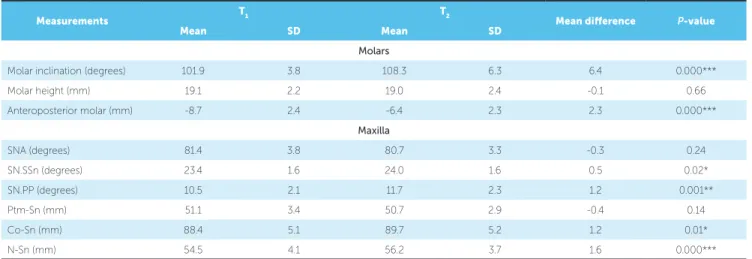
Distal movement of maxillary molars occurred in both experimental groups during the study period (p < 0.001), but distal tipping occurred only in
Group 1 (CH) (p < 0.001) (Tables 1 and 2). However,
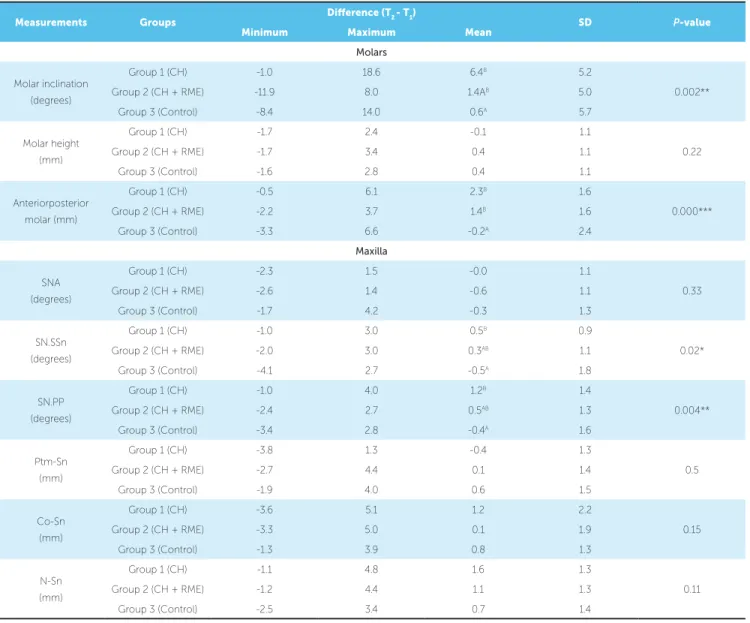
the amount of distal tipping of maxillary molars did not difer whether the headgear was used alone or in asso-ciation with maxillary expansion (p > 0.05) (Table 4).
There was no extrusion of maxillary molars in either one of the experimental groups (p > 0.05).
Maxilla
Clockwise rotation of the maxilla occurred be-tween T1 and T2 only in Group 1 (CH) (p < 0.05)
(Table 1). Nevertheless, the values of maxillary clock-wise rotation did not difer whether the headgear was used alone or in association with maxillary expansion (p > 0.05) (Table 4). There was restriction of forward
maxillary growth between T1 and T2 only in Group 2 (CH + RME) (p < 0.05) (Table 2). However, the
varia-tion occurring in Group 2 did not difer from that found in Groups 1 and 3 (p > 0.05) (Table 4).
Class I molar relationship was achieved in 6.5 ± 1 months in Group 1 and 5.5 ± 1.1 months in Group 2.
DISCUSSION
The combined headgear is well indicated to treat pa-tients with Class II malocclusion and mesodivergent or hyperdivergent facial patterns.12,14,15 On the other hand,
3 8
7 1
6 9
4
5
Table 1 - Means, standard deviation, mean difference and Student’s t-test comparing initial (T1) and control (T2) values in Group 1 (CH) (n = 20).
Table 2 - Means, standard deviation, mean difference and Student’s t-test comparing initial (T1) and control (T2) values in Group 2 (CH + RME) (n = 21).
Table 3 - Means, standard deviation, mean difference and Student’s t-test comparing initial (T1) and control (T2) values in Group 3 (C) (n = 20). * p < 0.05; ** p < 0.01; *** p < 0.001.
* p < 0.05; ** p < 0.01; *** p < 0.001.
* p < 0.05; ** p < 0.01; *** p < 0.001.
Measurements T1 T2 Mean diference P-value
Mean SD Mean SD
Molars
Molar inclination (degrees) 101.9 3.8 108.3 6.3 6.4 0.000***
Molar height (mm) 19.1 2.2 19.0 2.4 -0.1 0.66
Anteroposterior molar (mm) -8.7 2.4 -6.4 2.3 2.3 0.000***
Maxilla
SNA (degrees) 81.4 3.8 80.7 3.3 -0.3 0.24
SN.SSn (degrees) 23.4 1.6 24.0 1.6 0.5 0.02*
SN.PP (degrees) 10.5 2.1 11.7 2.3 1.2 0.001**
Ptm-Sn (mm) 51.1 3.4 50.7 2.9 -0.4 0.14
Co-Sn (mm) 88.4 5.1 89.7 5.2 1.2 0.01*
N-Sn (mm) 54.5 4.1 56.2 3.7 1.6 0.000***
Measurements T1 T2 Mean diference P-value
Mean SD Mean SD
Molars
Molar inclination (degrees) 102.8 3.2 104.3 4.4 1.4 0.18
Molar height (mm) 21.0 2.3 21.5 2.2 0.4 0.07
Anteroposterior molar (mm) -8.0 3.1 -6.5 2.9 1.4 0.001**
Maxilla
SNA (degrees) 81.3 3.5 80.7 -0.6 0.02*
SN.SSn (degrees) 23.5 2.2 23.8 2.3 0.3 0.15
SN.PP (degrees) 9.7 2.8 10.3 2.8 0.5 0.06
Ptm-Sn (mm) 52.1 3.6 52.1 3.3 0.0 0.77
Co-Sn (mm) 89.7 4.6 89.8 4.7 0.1 0.75
N-Sn (mm) 54.0 2.5 55.2 2.8 1.1 0.001**
Measurements T1 T2 Mean diference P-value
Mean SD Mean SD
Molars
Molar inclination (degrees) 102.2 3.6 102.8 5.9 0.6 0.62
Molar height (mm) 20.7 2.1 21.1 2.6 0.4 0.14
Anteroposterior molar (mm) -8.4 2.8 -8.7 3.5 -0.2 0.60
Maxilla
SNA (degrees) 80.0 3.5 79.9 2.9 -0.3 0.91
SN.SSn (degrees) 23.8 2.6 23.2 2.4 -0.5 0.18
SN.PP (degrees) 9.6 3.0 9.1 3.0 -0.4 0.25
Ptm-Sn (mm) 50.3 2.1 51.0 2.8 0.6 0.06
Co-Sn (mm) 86.4 4.0 87.2 4.1 0.8 0.01*
Table 4 - Minimum and maximum differences, means, standard deviation and one-way analysis of variance supplemented by Tuke’s multiple comparisons test comparing groups at two intervals.
Measurements Groups Diference (T2 - T1) SD P-value
Minimum Maximum Mean
Molars
Molar inclination (degrees)
Group 1 (CH) -1.0 18.6 6.4B 5.2
0.002**
Group 2 (CH + RME) -11.9 8.0 1.4AB 5.0
Group 3 (Control) -8.4 14.0 0.6A 5.7
Molar height (mm)
Group 1 (CH) -1.7 2.4 -0.1 1.1
0.22
Group 2 (CH + RME) -1.7 3.4 0.4 1.1
Group 3 (Control) -1.6 2.8 0.4 1.1
Anteriorposterior molar (mm)
Group 1 (CH) -0.5 6.1 2.3B 1.6
0.000***
Group 2 (CH + RME) -2.2 3.7 1.4B 1.6
Group 3 (Control) -3.3 6.6 -0.2A 2.4
Maxilla
SNA (degrees)
Group 1 (CH) -2.3 1.5 -0.0 1.1
0.33
Group 2 (CH + RME) -2.6 1.4 -0.6 1.1
Group 3 (Control) -1.7 4.2 -0.3 1.3
SN.SSn (degrees)
Group 1 (CH) -1.0 3.0 0.5B 0.9
0.02*
Group 2 (CH + RME) -2.0 3.0 0.3AB 1.1
Group 3 (Control) -4.1 2.7 -0.5A 1.8
SN.PP (degrees)
Group 1 (CH) -1.0 4.0 1.2B 1.4
0.004**
Group 2 (CH + RME) -2.4 2.7 0.5AB 1.3
Group 3 (Control) -3.4 2.8 -0.4A 1.6
Ptm-Sn (mm)
Group 1 (CH) -3.8 1.3 -0.4 1.3
0.5
Group 2 (CH + RME) -2.7 4.4 0.1 1.4
Group 3 (Control) -1.9 4.0 0.6 1.5
Co-Sn (mm)
Group 1 (CH) -3.6 5.1 1.2 2.2
0.15
Group 2 (CH + RME) -3.3 5.0 0.1 1.9
Group 3 (Control) -1.3 3.9 0.8 1.3
N-Sn (mm)
Group 1 (CH) -1.1 4.8 1.6 1.3
0.11
Group 2 (CH + RME) -1.2 4.4 1.1 1.3
Group 3 (Control) -2.5 3.4 0.7 1.4
* p < 0.05; ** p < 0.01; *** p < 0.001. Means followed by the same letter do not differ.
cervical headgear is more suitable in cases of hypodiver-gent or mesodiverhypodiver-gent facial patterns in which extru-sion of maxillary molars would not hinder facial esthet-ics.14,18,20 Molar extrusion can cause clockwise rotation
of the mandible and increase anterior facial height.17
High-pull headgear is usually recommended for cases of marked hyperdivergent facial pattern associated or not with anterior open bite.15,20,22
Transverse maxillary deiciency is oten associ-ated with Class II malocclusion, especially Class II, Division 1.9,11,16 Upper arch constriction in the region
of canines may lead to mandibular retrognathism, which impairs natural anteroposterior growth of the
mandible.9,11 Should transverse maxillary deiciency be
diagnosed, rapid maxillary expansion should be carried out to maximize the beneits of orthodontic treatment for Class II patients.8,10
Follow-up records were taken when maxillary and mandibular irst molars achieved Class I relationship. Despite the importance of assessment presented herein, further studies should include the inal results of treat-ment. Cephalometric measurements were selected based on their potential to analyze the behavior of dental and skeletal maxillary structures.
The design of the appliance followed standards adopted in a previous study,16 with the outer bow parallel
to the inner bow and ending in the region of irst perma-nent molars. The design of the headgear is strongly asso-ciated with its efects on maxillary molars. In combined headgears, longer and/or downward angled outer bows produce resultant forces that maximize vertical upward vectors, avoiding molar extrusion, but increasing distal tipping.11 On the other hand, cervical headgears with
shorter outer bows would maximize the horizontal vec-tors, producing a resultant force in distal direction, which can reduce the tendency towards molar inclination, but still prevent extrusion.16 Although outer bows angled
upward can eliminate molar inclination, this design may lead to undesirable extrusion of molars usually associated with clockwise rotation of the mandible, which jeopar-dizes Class II malocclusion treatment.12,16,22
Distal movement of maxillary molars was found occur in both Class II malocclusion treatment ap-proaches. It was clear that combined headgear was ef-fective in producing distal dental movement whether associated or not with maxillary expansion. Distal tip-ping of maxillary molars was found only in Group 1, which included individuals treated by headgear alone. In the present study, mean maxillary molars distal tip-ping was of 6.4 degrees in Group 1 (CH), very close to the value of 6.9 degrees found by Üçem and Yüksel.22
In Group 2 (CH+RME), molar distal tipping decreased to 1.4 degrees. Despite no statistical signiicant difer-ences being found between groups, it seems that maxil-lary expansion was useful in preventing molar inclina-tion. The connection of maxillary molars with the ex-pander’s acrylic plate and premolars would increase an-chorage against distal tipping.16 There was no extrusion
of maxillary molars either if the headgear was used alone or in association with the maxillary expander. Üçem and Yüksel have already showed that combined head-gear avoided extrusion of maxillary molars.22 This is a
positive result, since molar extrusion would be an unde-sirable efect in the treatment of Class II malocclusion.
Restriction of forward maxillary growth is one of the objectives of the headgear used to treat Class II mal-occlusions.5,6,16 In the present study, there was a
reduc-tion in the SNA angle between T1 and T2 only in Group 2 (CH + RME). However, comparison between groups did not show signiicant diferences. Likewise, Üçem and Yüksel did not report efects over the SNA angle when combined headgear was used alone.22 One can
consider that the greater restriction in forward maxillary growth observed in subjects treated by rapid maxillary expansion is related to the distribution of forces over the maxilla provided by the connection of maxillary molars and premolars to the expander’s acrylic plate and due to marked mobility caused by sutures separation.10
Clockwise rotation of the maxilla was observed be-tween T1 and T2 in Group 1 (CH), but without signii-cant diference from that found in Group 2 (CH+RME). The clockwise rotation of the maxilla is related to the di-rection of forces applied over maxillary molars. As molars are located in the posterior region of the arch, they can rotate the palatal plane and tilt the occlusal plane.14 This
efect is undesirable, especially in patients with excessive exposure of gingival tissues and deep bite.14 According
to O’Reilly et al,17 clockwise rotation of the maxilla also
happens in Class II patients treated with cervical head-gear; and according to Üçem and Yüksel,22 clockwise
rotation may also be observed in patients treated with combined headgear. Therefore, it seems that only high-pull headgears would prevent or at least reduce maxillary clockwise rotation, based on a system of forces in which the resultant force passes through or above the center of resistance of the maxilla.14
Treatment efect can be considered equivalent to changes in the treated group minus changes in the con-trol group. Comparison of mean diferences (T2 - T1) between groups, as disclosed in Table 4, depict the main results of our study.
There was distal movement of maxillary molars in both treated groups when compared to the control group. On the other hand, distal tipping of molars was found only in Group 1 (CH). This inding is in agreement with those reported by Üçem and Yüksel.22 Clockwise
Based on these results, we consider that combined headgear, used alone or in association with rapid max-illary expansion, is an efective strategy as the irst step of Class II malocclusion treatment. Additionally, rapid maxillary expansion seems to reduce initial treatment time, probably due to anterior accommodation of the mandible and favorable environment to anteriorpos-terior mandibular growth ater expansion.8,9,11
Fur-thermore, deciduous molars and premolars are distally tipped together by their connection with the Haas expander, which reduces time and prevents a second phase of treatment. The clinical indings provided by this study allow the authors to recommend maxil-lary expansion before headgear appliance used to treat
Class II associated with transverse maxillary deicien-cy. Further investigation, including inal records (T3), should be carried out to provide better information about this treatment strategy.
CONCLUSION
Combination headgear used as the irst step of Class II malocclusion treatment results in the following:
» Distal movement of maxillary molars whether the headgear is used alone or in association with RME.
» Distal tipping of maxillary molars when the head-gear is used alone: Group 1 (CH).
» Clockwise rotation of the maxilla when used alone: Group 1 (CH).
1. Johnston LE, Answers in search of questioners. Am J Orthod Dentofacial Orthop. 2002;121(6):552-3.
2. Garbui IU, Nouer PR, Nouer DF, Magnani MB, Pereira Neto JS. Cephalometric assessment of vertical control in the treatment of class II malocclusion with a combined maxillary splint. Braz Oral Res. 2010;24(1):34-9.
3. Baumrind S, Molthen R, West EE, Miller DM. Distal displacement of the maxilla and the upper irst molar. Am J Orthod. 1979;75(6):630-40.
4. Gandini MRS, Gandini LG Jr, Martins JCR, Del Santo M Jr. Efects of cervical headgear and edgewise appliances on growing patients. Am J Orthod Dentofacial Orthop. 2001;119(5):531-8.
5. Jacob HB, Buschang PH, Santos-Pinto A. Class II malocclusion treatment using high-pull headgear with a splint: a systematic review. Dental Press J Orthod. 2013;18(2):21.e1-e7.
6. Ramos DS, Lima EM. A longitudinal evaluation of the skeletal proile of treated and untreated skeletal Class II individuals. Angle Orthod. 2005;75(1):47-53. 7. Tollaro I, Baccetti T, Franchi L, Tanasescu CD. Role of posterior transverse interarch discrepancy in Class II, Division 1 malocclusion during the mixed dentition phase. Am J Orthod Dentofacial Orthop. 1996;110(4):417-22. 8. Lima Filho RM, Lima AC, Ruellas ACO. Spontaneous correction of Class II
malocclusion after rapid palatal expansion. Angle Orthod. 2003;73(6):745-52. 9. Haas AJ. Palatal expansion: just the beginning of dentofacial orthopedics. Am J
Orthod. 1970;57(3):219-55.
10. Lima Filho RM, Ruellas ACO. Long-term maxillary changes in patients with skeletal Class II malocclusion treated with slow and rapid palatal expansion. Am J Orthod Dentofacial Orthop. 2008;134(3):383-8.
11. Armstrong MM. Controlling the magnitude, direction, and duration of extraoral force. Am J Orthod. 1971;59(3):217-43.
12. Freeman CS, McNamara JA Jr, Baccetti T, Franchi L, Graf TW. Treatment efects of the bionator and high-pull facebow combination followed by ixed appliances in patients with increased vertical dimensions. Am J Orthod Dentofacial Orthop. 2007;131(2):184-95.
REFERENCES
13. Gautam P, Valiathan A, Adhikari R. Craniofacial displacement in response to varying headgear forces evaluated biomechanically with inite element analysis. Am J Orthod Dentofacial Orthop. 2009;135(4):507-15.
14. Gkantidis N, Halazonetis DJ, Alexandropoulos E, Haralabakis NB. Treatment strategies for patients with hyperdivergent Class II Division 1 malocclusion: is vertical dimension afected? Am J Orthod Dentofacial Orthop. 2011;140(3):346-55.
15. O’Reilly MT, Nanda SK, Close J. Cervical and oblique headgear: a comparison of treatment efects. Am J Orthod Dentofacial Orthop. 1993;103(6):504-9. 16. Tortop T, Yuksel S. Treatment and posttreatment changes with combined
headgear therapy. Angle Orthod. 2007;77(5):857-63.
17. Farret MM, Lima EMS, Araujo VP, Rizzatto SMD, Menezes LM, Grossi ML. Molar changes with cervical headgear alone or in combination with rapid maxillary expansion. Angle Orthod. 2008;78(5):847-51.
18. Casaccia GR, Gomes JC, Squef LR, Penedo ND, Elias CN, Gouvêa JP, et al. Analysis of initial movement of maxillary molars submitted to extraoral forces: a 3D study. Dental Press J Orthod. 2010;15(5):37.e1-e8.
19. Tamburus VS, Neto JSP, Siqueira VCV, Tamburus WL. Treatment efects on Class II division 1 high angle patients treated according to the Bioprogressive therapy (cervical headgear and lower utility arch), with emphasis on vertical control. Dental Press J Orthod. 2011;16(3):70-8.
20. Ibitayo AO, Pangrazio-Kulbersh V, Berger J, Bayirli B. Dentoskeletal efects of functional appliances vs bimaxillary surgery in hyperdivergent Class II patients. Angle Orthod. 2011;81(2):304-11.
21. Marsan G. Efects of activator and high-pull headgear combination therapy: skeletal, dentoalveolar, and soft tissue proile changes. Eur J Orthod. 2007;29(2):140-8.