Influence of occlusal plane inclination and
mandibular deviation on esthetics
Cristiane Cherobini Dalla Corte1, Bruno Lopes da Silveira2, Mariana Marquezan3
Objective: The aim of this study was to assess the degree of perception of occlusal plane inclination and mandibular deviation in facial esthetics, assessed by laypeople, dentists and orthodontists. Methods: A woman with 5.88° of incli-nation and 5.54 mm of mandibular deviation was selected and, based on her original photograph, four new images were created correcting the deviations and creating more symmetric faces and smiles. Examiners assessed the images by means of a questionnaire. Their opinions were compared by qualitative and quantitative analyses. Results: A to-tal of 45 laypeople, 27 dentists and 31 orthodontists filled out the questionnaires. All groups were able to perceive the asymmetry; however, orthodontists were more sensitive, identifying asymmetries as from 4.32° of occlusal plane inclina-tion and 4.155 mm of mandibular deviainclina-tion (p < 0.05). The other categories of evaluators identified asymmetries and assigned significantly lower grades, starting from 5.88° of occlusal plane inclination and 5.54 mm of mandibular deviation (p < 0.05). Conclusion: Occlusal plane inclination and mandibular deviation were perceived by all groups, but ortho-dontists presented higher perception of deviations.
Keywords:Smiling. Face. Esthetics. Facial asymmetry. Photography.
How to cite this article: Dalla Corte CC, Silveira BL, Marquezan M. Influence of occlusal plane inclination and mandibular deviation on esthetics. Dental Press J Orthod. 2015 Sept-Oct;20(5):50-7.
DOI: http://dx.doi.org/10.1590/2177-6709.20.5.050-057.oar
» The authors report no commercial, proprietary or financial interest in the prod-ucts or companies described in this article.
» Patients displayed in this article previously approved the use of their facial and intraoral photographs.
Contact address: Mariana Marquezan
Rua Dr Alberto Pasqualini, 70/809, Santa Maria/RS - Brazil - CEP 97015-010 E-mail: [email protected]
1 Specialist in Orthodontics, Centro Universitário Franciscano (UNIFRA),
Santa Maria, Rio Grande do Sul, Brazil.
2 Professor, Universidade Federal de Santa Maria (UFSM), Department of
Restorative Dentistry, Santa Maria, Rio Grande do Sul, Brazil. 3 Postdoc resident, Universidade Federal do Rio de Janeiro (UFRJ),
Department of Pediatric Dentistry and Orthodontics, Rio de Janeiro, Rio de Janeiro, Brazil.
Dentist, Universidade Federal de Santa Maria (UFSM), Department of Restorative Dentistry, Santa Maria, Rio Grande do Sul, Brazil..
Submitted: October 12, 2014 - Revised and accepted: May 09, 2015
DOI: http://dx.doi.org/10.1590/2177-6709.20.5.050-057.oar
Objetivo: o objetivo do presente estudo foi avaliar o grau de percepção, de leigos, dentistas e ortodontistas, quanto à influência das inclinações do plano oclusal e dos desvios mandibulares na estética facial. Métodos: uma mulher com 5,88o
de desvio do plano oclusal e 5,54mm de desvio mandibular foi selecionada. A partir de sua fotografia original, quatro novas imagens foram criadas, corrigindo os desvios e criando rostos e sorrisos mais simétricos. Os examinadores avaliaram as imagens por meio de um questionário, sendo realizadas análises qualitativas e quantitativas. Resultados: 45 leigos, 27 dentistas e 31 ortodontistas preencheram os questionários. Todos os grupos foram capazes de perceber a assimetria, no entanto, os orto-dontistas foram mais sensíveis, sendo capazes de perceber a assimetria de 4,32o de inclinação do plano oclusal e 4,155mm
de desvio mandibular (p > 0,05). Os demais avaliadores perceberam a assimetria apenas a partir de 5,88o de desvio do
pla-no oclusal e 5,54mm de desvio mandibular (p > 0,05). Conclusão: inclinações do plano oclusal e desvios mandibulares foram percebidos por todos os grupos, mas os ortodontistas apresentaram maior sensibilidade aos desvios.
INTRODUCTION
Perfect facial symmetry is a theoretical concept. There is no perfectly symmetrical human face, even the most beautiful face exhibits some degree of asym-metry.1,2 Asymmetry in craniofacial areas can be recog-nized as diferences in size or relationship between the two sides of the face. This may be the result of discrep-ancies either in shape of individual bones, or a malposi-tion of one or more bones in the craniofacial complex.3 From the point of view of esthetics, it is challenging to establish the threshold level of mild facial asymmetry. It is diicult to ind a cutof point that distinguishes a pleasing asymmetrical face, an acceptable asymmetrical face and an asymmetrical face that requires intervention. Despite the subjectivity of beauty, it becomes necessary to acknowledge and study facial esthetics, bearing in mind the concept of normality which serves as a guide during orthodontic treatment planning.4
Craniomandibular structural asymmetry can be congenital or hereditary, or can be acquired as a result of trauma or infection. During growth, quantitative and qualitative alterations of functional loads applied to the bones might modify their developmental pattern and lead to asymmetry.5 Facial asymmetry may be present in the upper, middle and lower thirds of the face. The majority of asymmetries are usually concentrated in the lower third of the face due to being involved in the mas-ticatory structures6,7,8 and subject to masticatory and oc-clusal problems.9
Many patients with facial asymmetry present oc-clusal plane inclination caused by unilaterally extruded maxillary molars or asymmetrical mandibular vertical development.10 Because the occlusal plane is an impor-tant element in the position and adaptation of the man-dible,11 inclination is usually associated with mandibular deviation and vice-versa.12,13 The degree of inclination of the maxilla is proportional to the degree of mandibu-lar deviation in both hard and sot tissues.13 The preva-lence of inclination is about 41%, but many cases are not perceptible due to being of minor severity.14
Facial asymmetries in sot tissues inluence patient’s expectations regarding orthodontic treatment.8 In order to prevent disagreements between patient’s and ortho-dontist’s treatment objectives, the normal range of facial asymmetry needs to be determined in a given popula-tion.1 Therefore, the aim of this research was to assess the inluence of occlusal plane inclination and consequent
mandibular deviation on esthetics in the opinion of lay-people, dentists and orthodontists.
METHODS
This study was characterized as an observational, de-scriptive, transverse study with quantitative and qualitative analysis of data. It was submitted to and approved by the Hu-man Research Ethics Committee of Centro Universitário Franciscano (UNIFRA) (CAAE: 11097113.5.0000.5306, #265.831, issued on 21st of May, 2013). A model with an esthetically pleasant face, but with severe occlusal plane inclination (5.88°) and mandibular deviation (5.54 mm), both of which led her to seek orthodontic treatment, was selected for the study.
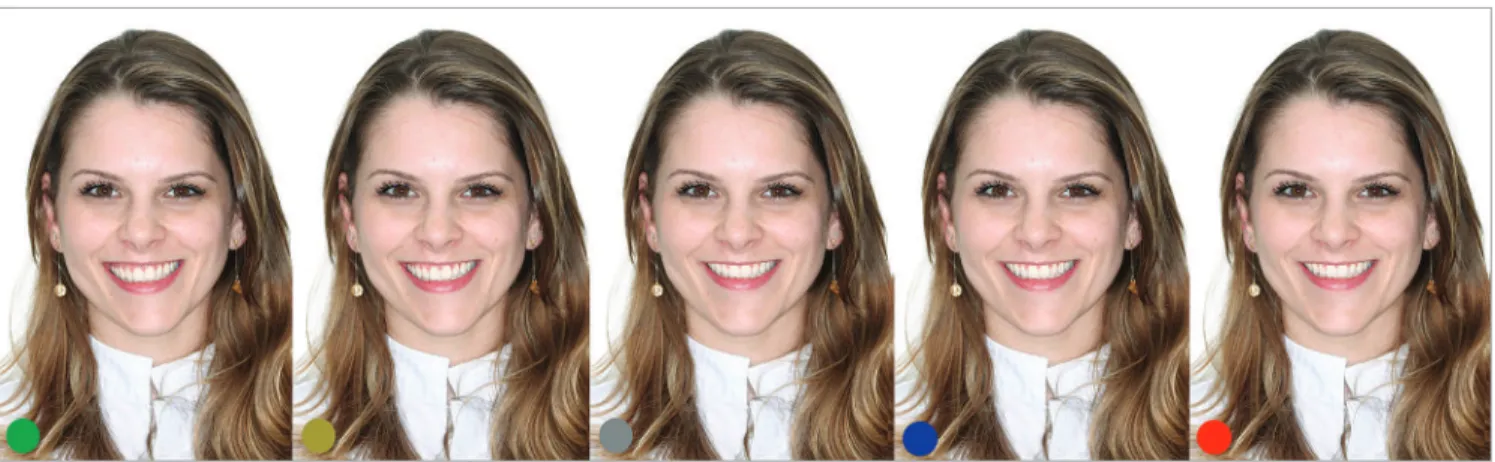
Based on patient’s original photograph, a profes-sional designer created four smiles by means of Adobe Photoshop CS5 (Adobe Systems, San Jose, California) sotware. Firstly, the pupillary plane was traced and po-sitioned parallel to the ground. A new line was traced starting from the center of the let pupil up to the tip of the maxillary let canine cusp.23 The distance between these points was transferred to the right side, and, thus, it was possible to trace the ideal occlusal plane. The dif-ference between the angle formed by the patient’s real inclination and the digital manipulation at an angle equal to zero resulted in 5.88°. The four manipulated smiles had occlusal plane inclination progressively cor-rected by 1.47° in each photo, until the smile became symmetrical. As the occlusal plane was being altered, mandibular deviation was also manipulated until it was completely corrected (1.385 mm for each photograph, totaling 5.54 mm), rendering the face more symmetri-cal and making the facial midline match with the center of the mentum (Fig 1). It is emphasized that the model agreed with the use of her image in the research by sign-ing a term of authorization for image use.
Figure 1 - Original smile (green label), with 5.88° of inclination and 5.54 mm of mandibular deviation, and their corrections (1.47° and 1.385 mm in each photo).
scores from 0 to 10 (zero to ten) to each image. In the questionnaire, the evaluators were also asked whether they perceived anything that called their attention in each one of the photographs, so as to justify the score attributed to them.
A total of 150 questionnaires were distributed in Dental Schools and Dental Clinics of Santa Maria (Rio Grande do Sul, Brazil). These are the places where den-tists and orthodonden-tists work, and laypeople can also be found (employees, patients’ relatives and friends).
Quantitative data were tabulated in SPSS Statistics version 20 for statistical analysis. The scores attributed to each smile in the categories of evaluators were com-pared by ANOVA/Tukey tests.
RESULTS
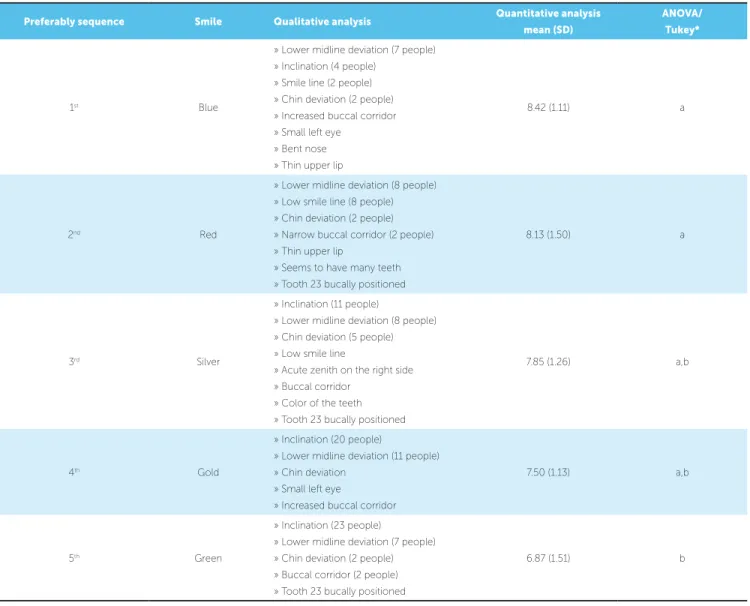
Of the 150 questionnaires, 103 were returned duly illed out: 45 by laypeople, 27 by dentists and 31 by or-thodontists. All groups were able to perceive asymmetry; however, orthodontists were more sensitive, identifying asymmetries as from 4.32° of inclination and 4.155 mm of mandibular deviation (p ≤ 0.05). The other categories of evaluators identiied asymmetries and assigned signii-cantly lower grades, starting from 5.88° of inclination and 5.54 mm of mandibular deviation (p ≤ 0.05). All three groups of evaluators considered the original photograph (green) as the least attractive one, followed by gold and silver photographs. Laypeople and orthodontists con-sidered the most symmetrical face and smile (red pho-tograph) to be the most attractive. Dentists, on the other hand, preferred the blue photograph. The results of the qualitative and quantitative analyses (means, standard
deviation and results of ANOVA/Tukey tests) as regards the esthetic preference of laypeople are shown in Table 1, whereas the preference of dentists is shown in Table 2 and orthodontists’ preference is shown in Table 3.
DISCUSSION
Although no face is perfectly symmetrical, a face is only considered asymmetrical when there is perceptible disharmony between homologous parts. It is known that a certain degree of asymmetry is beautiful, but the border line between normal asymmetry and asym-metry that requires treatment is subjective15 and varies among professionals and laypeople.16 In order to assess the threshold of esthetic tolerance for occlusal plane inclination and mandibular lateral deviation, the pho-tographs of a model with an asymmetrical face were gradually edited until these parameters became sym-metrical. In the qualitative analysis, it was perceived that the largest number of evaluators detected the asym-metry of the smile (inclination) rather than that of the face itself (mandibular shit). In the three categories, a lower number of evaluators reported deviation of the mandible or chin. According to a previous study, fron-tal photographs of the face allow facial symmetry, and numerous other factors such as eyes, size and shape of the face, to be assessed. These aspects can divert atten-tion from potential skeletal-facial changes.17
Table 1 - Perception of laypeople.
* ANOVA showed statistical difference among groups (p = 0.016). Different letters indicate statistical difference for post hoc Tukey. Preferably sequence Smile Qualitative analysis Quantitative analysis
mean (SD)
ANOVA/
Tukey*
1st Red
» White teeth (3 people) » Perfect teeth, aligned (3 people) » Thin upper lip (3 people)
» Gingival exposure (2 people) » Harmony (2 people)
» Deviated chin » Narrow mouth
» Narrow smile » Aligned chin
» Diferent earrings » Happiness
8.68 (1.39) a
2nd Blue
» Good gingival exposure (5 people)
» White teeth (4 people) » Bent smile (3 people)
» Beautiful teeth, perfect (3 people) » Problem in the height of the teeth
» The right side of the patient is higher » Thin upper lip
» Problems in the teeth, gingiva and lip » Great alignment
» The smile expresses pleasure, happiness, sympathy
8.60 (1.13) a
3rd Silver
» Asymmetry (6 people)
» Yellow teeth (2 people) » Lighten teeth (2)
» Perfect teeth (2) » Deviated chin
» Diference in posterior teeth
» Thin upper lip » Beautiful smile
» Mouth and face in harmony » Happiness, sympathy
8.31 (1.25) a,b
4th Gold
» Asymmetric smile (13 people) » White teeth (3 people)
» Symmetric teeth (3 people) » Happy person (2 people)
» Beautiful smile (2 people) » Asymmetric face
» Deviated chin
» One side of the mouth is more open
» Aligned teeth
» Happiness, sympathy in the look and smile
8.04 (1.52) a,b
5th Green
» Asymmetric smile (20 people)
» One side of the mouth is more open » Bent upper lip
» Deviated chin
» Posterior teeth are diferent
» Lighten teeth, perfect » Smile revels teeth well
» Happiness, sympathy
Table 2 - Perception of dentists.
* ANOVA showed statistical difference among groups (p = 0.000). Different letters indicate statistical difference for post hoc Tukey. Preferably sequence Smile Qualitative analysis Quantitative analysis
mean (SD)
ANOVA/
Tukey*
1st Blue
» Lower midline deviation (7 people)
» Inclination (4 people) » Smile line (2 people)
» Chin deviation (2 people) » Increased buccal corridor
» Small left eye » Bent nose
» Thin upper lip
8.42 (1.11) a
2nd Red
» Lower midline deviation (8 people)
» Low smile line (8 people) » Chin deviation (2 people)
» Narrow buccal corridor (2 people) » Thin upper lip
» Seems to have many teeth » Tooth 23 bucally positioned
8.13 (1.50) a
3rd Silver
» Inclination (11 people)
» Lower midline deviation (8 people) » Chin deviation (5 people)
» Low smile line
» Acute zenith on the right side
» Buccal corridor » Color of the teeth
» Tooth 23 bucally positioned
7.85 (1.26) a,b
4th Gold
» Inclination (20 people)
» Lower midline deviation (11 people)
» Chin deviation » Small left eye
» Increased buccal corridor
7.50 (1.13) a,b
5th Green
» Inclination (23 people)
» Lower midline deviation (7 people)
» Chin deviation (2 people) » Buccal corridor (2 people)
» Tooth 23 bucally positioned
6.87 (1.51) b
score in the three categories, followed by photographs with gold (4.32° and 4.155 mm of deviation) and silver (2.88° and 2.77 mm of deviation) labels. The photographs with blue and red labels received the highest scores, being red (symmetrical) preferred by laypeople and orthodontists. Nevertheless, the photograph with a blue label was pre-ferred by dentists who probably did not identify the small degree of inclination (1.47°) and small mandible deviation (1.385 mm) and perceived the more harmonious smile line (Table 2). It has been shown that a smile with the up-per lip resting on the gingival margin of maxillary incisors (as found in the blue photograph) is considered the most esthetic for a female subject.18
Orthodontists were more sensitive to perceiving in-clination and chin deviation. When verifying the scores
Table 3 - Perception of orthodontists.
* ANOVA showed statistical difference among groups (p = 0.000). Different letters indicate statistical difference for post hoc Tukey. Preferably sequence Smile Qualitative analysis Quantitative analysis
mean (SD)
ANOVA/ Tukey*
1st Red
» Lower midline deviation (15 people) » Chin deviation (6 people)
» Little gingival exposure (4 people) » Artiicial smile (3 people)
» Larger buccal corridor on left side » Greater exposure of left teeth
» Decreased vertical dimension
8.48 (1.37) a
2nd Blue
» Lower midline deviation (17 people) » Mandibular asymmetry (8 people)
» Inclination (3 people) » Thin upper lip (2 people)
» Nose (2 people)
» Little exposure of lower incisors
» Mild crowding of tooth #21 » Low smile line
8.15 (0.74) a,b
3rd Silver
» Inclination (15 people)
» Mandibular asymmetry (11 people) » Lower midline deviation (11 people)
» Upper lip (3 people) » Buccal corridor
» Nose
7.58 (1.10) a,b
4th Gold
» Inclination (22 people)
» Mandibular asymmetry (10 people)
» Lower midline deviation (9 people) » Buccal corridor
» Little exposure of lower incisors » Nose
7.25 (1.05) b
5th Green
» Inclination (24 people)
» Mandibular asymmetry (11 people) » Lower midline deviation (8 people)
» Buccal corridor (2 people)
» Upper central incisor inclined to the left
» Nose
to 4 mm when analyzing a woman’s photographs (rest position). When examining a man’s photographs, or-thodontists perceived shits greater than or equal to 4 mm, but laypeople did not perceive any changes (up to 6 mm). On the other hand, in a classiication proposed by Kim et al,13 used to assess facial asymmetry in diag-nosis for orthognathic surgeries, mandibular and occlu-sal plane deviations greater than 2 mm were considered as asymmetries.
Although some laypeople perceived inclination and mandibular deviation, these deviations were mentioned by a larger number of orthodontists. While dentists and orthodontists analyzed the smile more carefully, detail-ing problems such as buccal corridor and midline devia-tion, the attention of laypeople did not focus so much on the oral region, as they reported details of the face other than the teeth, such as earrings and eyes, in addi-tion to subjective characteristics such as sympathy and happiness. According to Jackson et al,21 orthodontists have a clear advantage in assessing facial symmetry when compared with laypeople, and an advantage over gen-eral clinical dentists in the most diicult cases.
The more symmetrical the smile, the more details, such as color and anatomy of teeth, were perceived and described by the interviewees; however, with increasing
inclination and mandibular deviation, the negative in-luence of these features was perceived and described by the three groups of evaluators.
Although laypeople perceived the asymmetries, the mean scores attributed to the photograph with green label (the most asymmetric one) was still high (7.75). This fact makes one wonder if this amount of asymme-try is clinically signiicant for patients as far as esthetics is concerned.
Some limitations were detected and need to be addressed by future studies, such as the number of questionnaires. Sample size should be increased to re-duce the possibility of type II error (failure to reject a false null hypothesis; in other words, failure to detect difference between photographs). It would also be in-teresting to use different models, varying the sex, eth-nicity, color of the hair, skin, and eyes. It would also be interesting to register more detailed data about the evaluators, such as the time elapsed since their gradu-ation (experience time).
CONCLUSION
1. Alqattan M, Djordjevic J, Zhurov AI, Richmond S. Comparison between landmark and surface-based three-dimensional analyses of facial asymmetry in adults. Eur J Orthod. 2015;37(1):1-12.
2. Primozic J, Perinetti G, Zhurov A, Richmond S, Ovsenik M. Assessment of facial asymmetry in growing subjects with a three-dimensional laser scanning system. Orthod Craniofac Res. 2012;15(4):237-44.
3. Bishara SE, Burkey PS, Kharouf JG. Dental and facial asymmetries: a review. Angle Orthod. 1994;64(2):89-98.
4. Peron APLM, Morosini IC, Correia KR, Moresca R, Petrelli E. Photometric study of divine proportion and its correlation with facial attractiveness. Dental Press J Orthod. 2012;17(2):8-11.
5. Schmid W, Mongini F. [Factors in craniomandibular asymmetry: diagnostic principles and therapy]. Mondo Ortod. 1990;15(1):91-104.
6. Vig PS, Hewitt AB. Asymmetry of the human facial skeleton. Angle Orthod. 1975;45(2):125-9.
7. Shah SM, Joshi MR. An assessment of asymmetry in the normal craniofacial complex. Angle Orthod. 1978;48(2):141-8.
8. Masuoka N, Momoi Y, Ariji Y, Nawa H, Muramatsu A, Goto S, et al. Can cephalometric indices and subjective evaluation be consistent for facial asymmetry? Angle Orthod. 2005;75(4):651-5.
9. Lundstrom A. Some asymmetries of the dental arches, jaws, and skull, and their etiological signiicance. Am J Orthod. 1961;47(2):81-106.
10. Jeon YJ, Kim YH, Son WS, Hans MG. Correction of a canted occlusal plane with miniscrews in a patient with facial asymmetry. Am J Orthod Dentofacial Orthop. 2006;130(2):244-52.
11. Ishizaki K, Suzuki K, Mito T, Tanaka EM, Sato S. Morphologic, functional, and occlusal characterization of mandibular lateral displacement malocclusion. Am J Orthod Dentofacial Orthop. 2010;137(4):454.e1-e9; discussion 54-5. 12. Hashimoto T, Fukunaga T, Kuroda S, Sakai Y, Yamashiro T,
Takano-Yamamoto T. Mandibular deviation and canted maxillary occlusal plane treated with miniscrews and intraoral vertical ramus osteotomy: functional and morphologic changes. Am J Orthod Dentofacial Orthop. 2009;136(6):868-77.
REFERENCES
13. Kim JY, Jung HD, Jung YS, Hwang CJ, Park HS. A simple classiication of facial asymmetry by TML system. J Craniomaxillofac Surg. 2014;42(4):313-20.
14. Severt TR, Proit WR. The prevalence of facial asymmetry in the dentofacial deformities population at the University of North Carolina. Int J Adult Orthodon Orthognath Surg. 1997;12(3):171-6.
15. Lee MS, Chung DH, Lee JW, Cha KS. Assessing soft-tissue characteristics of facial asymmetry with photographs. Am J Orthod Dentofacial Orthop. 2010;138(1):23-31.
16. Edler R, Wertheim D, Greenhill D. Clinical and computerized assessment of mandibular asymmetry. Eur J Orthod. 2001;23(5):485-94.
17. Morihisa O, Maltagliati LA. Avaliação comparativa entre agradabilidade facial e análise subjetiva do Padrão Facial. Rev Dental Press Ortod Ortop Facial. 2009;14(6):46.e1-e9.
18. Dutra MB, Ritter DE, Borgatto A, Derech CD, Rocha R. Inluence of gingival exposure on the smile esthetics. Dental Press J Orthod. 2011;16(5):111-8. 19. Padwa BL, Kaiser MO, Kaban LB. Occlusal cant in the frontal plane as a
relection of facial asymmetry. J Oral Maxillofac Surg. 1997;55(8):811-6; discussion 17.
20. Silva NCF, Aquino ERB, Mello KCFR, Mattos JNR. Orthodontists’ and laypersons’ perception of mandibular asymmetries. Dental Press J Orthod. 2011;16(4):38.e1-e8.