Rev Odontol UNESP. 2013 Sept-Oct; 42(5): 350-356 © 2013 - ISSN 1807-2577 ORIGINAL ARTICLE
Dental auxiliaries versus community health
workers: similarities and contrasts
Proissionais auxiliares da odontologia versus agente comunitário de saúde: similaridades e contrastes
Simone de Melo COSTA
a, Flávia Ferreira ARAÚJO
aaUNIMONTES – Universidade Estadual de Montes Claros, Montes Claros, MG, Brasil
Resumo
Introdução: Os profissionais auxiliares da odontologia e os agentes comunitários de saúde (ACS’s) são profissionais que representam importante segmento na Estratégia Saúde da Família e possuem funções diversificadas.
Objetivo: Analisar as atribuições dos auxiliares de cirurgiões-dentistas e dos agentes comunitários de saúde, tanto no aspecto da utilização de seus serviços como na formação, identificando as similaridades e contrastes entre os profissionais da saúde da família, Brasil. Metodologia: Estudo quantitativo e censitário conduzido no âmbito do Programa de Educação pelo Trabalho em Saúde- PET-Saúde, 2010-2012. O instrumento de coleta de dados foi um questionário semiestruturado. A análise considerou o nível de significância p<0,05. Resultado: Participaram 29 profissionais auxiliares da odontologia e 241 ACS’s. As funções relacionadas ao contexto comunitário, como conhecer as condições de saúde do território, identificar situação de risco das famílias, visita domiciliar estiveram mais associadas ao ACS’s (p<0,05). Em contraste, atividades no ambiente clínico como auxiliar profissional de nível superior e realizar procedimentos clínicos são ações predominantemente dos técnicos/auxiliares da odontologia (p<0,05). As categorias profissionais apresentaram similaridades na prática de vigilância à saúde, reflexão do trabalho em equipe e educação e mobilidade comunitária (p>0,05). Conclusão: Similaridades e contrastes foram identificados entre as ações dos profissionais. A categoria auxiliar em odontologia, apesar de funções específicas no ambiente clínico, ao integrar-se à equipe saúde da família reorienta a prática profissional assumindo ações no âmbito coletivo e familiar.
Descritores: Pessoal técnico de saúde; auxiliares de odontologia; agentes comunitários de saúde; saúde da
família; prática profissional.
Abstract
Introduction: The dental auxiliaries and the community health workers (CHWs) are practitioners that represent an important part in the Family Health Policy in Brazil and have several tasks. Objective: To analyze the attributes of the dental auxiliaries and of the CHWs, regarding the application of their services and their education/training, to identify the similarities and contrasts between these health care practitioners. Methodology: Quantitative and census method data collection performed on the context of the Education Program for Health Workers - PET-Saúde, 2010-2012. The data collection method was a semi-structured questionnaire. The analysis has a level of significance of p<0.05. Result: In this paper, 29 dental auxiliaries and 241 CHWs have participated in the surveys. The assignments that take place on the community context, such as home visits were more associated to the CHWs (p<0.05). On the other hand, the activities that happen on a clinical environment, such as providing assistance to graduated health professionals and performing clinical procedures, are more commonly performed by the dental assistant (p<0.05). Both categories presented similarities performing preventive health care, teamwork analysis, informative initiatives and community mobilization routines (p>0.05). Conclusion: Similarities and contrasts were identified between these health care workers. The dental auxiliaries, despite being mostly issued to specific assignments on a clinical environment, are able to shift their praxis by taking actions on a family and community context once integrated to a family health team.
Descriptors: Allied health personnel; dental auxiliaries; community health workers; family health;
INTRODUCTION
he Family Health Strategy (Estratégia Saúde da Família - ESF) presents itself as a proposal to restructure the Primary Health Care (PHC) in Brazil, by following the directives of the Brazilian Uniied Health System (Sistema Único de Saúde - SUS). he ESF aims to provide continuous and integral health assistance to the community surrounding the Basic Health Care Unit, according to the needs of the population1. he ESF team is multi-professional
and must act as such. It consists of physicians, nurses, nursing assistants, community health workers (CHWs) and, since the year 2000, it also rallies dentists, dental technicians and oral health assistants2,3. he dentistry workers develop preventive
actions regarding oral diseases and health promotion routines4.
he performance of these professionals has been a success factor for the operation of the health care teams5.
Even though comparative studies between the roles of the ESF workers are important, they have been overlooked by researchers. he comparison of the roles of the CHWs with those of other health workers may be useful, given the community health worker (CHW) were molded by the family health care policies in Brazil. A recent study6, performed with the same subjects of the present
paper, has identiied the roles of the CHW on a family health care environment. In the present paper, their tasks are compared to those of the dental auxiliaries.
he hypothesis of this study is that many of the tasks of the CHW were also undertaken by dental auxiliaries, despite their role being consolidated in a clinical setting and under the supervision of graduated health professionals. It is believed that a new set of skills had to be attained by the dental professionals in order to act in a family health care setting.
herefore, discussing the work assignments in the ESF is timely and necessary, as it may contribute to the development of strategies that address the challenges regarding the qualiications of the PHC. his study examined the tasks of dental auxiliaries and community health agents, both in the usage of their services as in their training, identifying similarities and contrasts between these family health workers.
METHODOLOGY
Quantitative, observational and cross-sectional study made under the Education Program for Health Workers – PET-Saúde of the Universidade Estadual de Montes Claros, 2010-2011 Notice. he proposal had census directed and was developed with CHWs and dental auxiliaries (dental assistants- DAs and dental hygienist- DHs) associated to the ESF in the urban area of Montes Claros city, located in the state of Minas Gerais, Brazil. he aforementioned city is considered a regional urban center of the northern portion of the state, with an estimated population of 361,971,000 inhabitants.
he instrument for data collection was a semi-structured, self-report questionnaire illed by 270 family health workers (241 CHWs and 29 dental auxiliaries). he questionnaire was designed to meet the objectives of the study and derived
from bibliographic research on the subject. A pilot study was performed with only 10 participants to test and adapt the data collection instrument. hese subjects were not included in the main study. he actual data collection occurred between the months of August and October of the year 2010.
Statistical analysis was performed using SPSS computer program, version 18.0 (SPSS Inc., Chicago, USA). he descriptive analysis involved the calculation of measures of central tendency of separatrices and of proportions. To make comparisons between the work categories, Pearson’s chi-squared test was used and Fisher Test and Student’s T-Test were placed as alternatives. he level of signiicance considered was p<0.05 with a 95% conidence interval.
he study was approved by the Health Secretary of Montes Claros and by the Ethics Committee in Research (Protocol #1966/2010), in accordance with the Helsinki Declaration and the Resolution of 196/96 of the National Health Council. All the data obtained is conidential.
RESULT
A total of 270 health workers were part of the present study, while 29 of those were dental auxiliaries (10.7%). he female gender has been dominant on both categories, being absolute on the dental assistant group (100%), with a statistical diference (p<0.05). he dental auxiliaries presented higher age average, set at 40.08 years old (± 9.920) (p<0.001). hey also present longer average experience on the public sector, set at 6.42 years (±5.72) (p=0.054) (Table 1).
Regarding professional certiication, the dental auxiliaries reported having taken more courses related to their occupation (93.1%) than the CHWs (p=0.005). Most of the dental auxiliaries believe they are ready to work on SUS (96.6%), with no statistical diference between these health workers groups (p>0.05) (Table 2).
With regard to actions relating to the context of family health workers, the dental auxiliaries (82.8%) have reported being aware of the health condition of the population in their work area, though presenting a lower percentage than that of the CHWs category (p<0.001).
Regarding providing information to the family health care team on the situation of the families served, the dental auxiliaries showed lower percentage of positive response in comparison to the CHWs (p<0.001). he referral of people to graduated medical professionals is also done at a lower rate by the dental auxiliaries (82.1%) (p=0.083). Most of the dental auxiliaries (89.7%) reported allocating some of their time for personal analysis related to their teamwork skills, with no statistical diference between the categories analyzed (p>0.05) (Table 3).
auxiliaries also provide a signiicant portion (58.6%) (p<0.001). Dental auxiliaries refer families to health care services (93.1%), however, such task was associated with the CHWs (p<0.05). he performance of educational and health awareness activities was detected in both health work categories (p>0.05). he promotion
of education and community mobilization was observed in lower prevalence in the dental auxiliaries category (p<0.05) (Table 4).
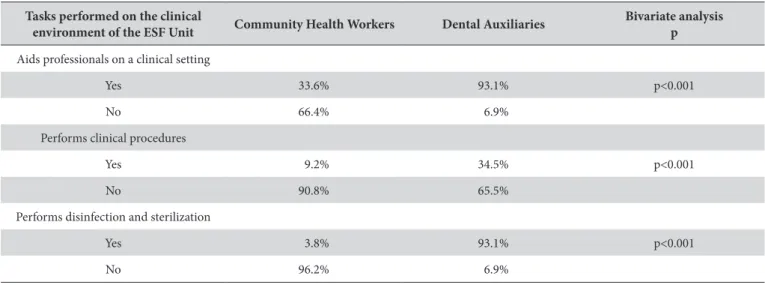
he tasks performed on a clinical setting in the ESF environment were evaluated by the health worker categories. Dental auxiliaries aid graduated health professionals (93.1%),
Table 2. Professional Certiication. 2010
Professional certiication and
SUS Community Health Workers Dental Auxiliaries
Bivariate analysis p
Certiication on their occupation
Yes 68.0% 93.1% p=0.005
No 32.0% 6.9%
Course taken related to their occupation
Yes 97.9% 93.1% p=0.124
No 2.1% 6.9%
Ready for SUS
Yes 94.6% 96.6% p=0.652
No 5.4% 3.4%
Table 3. Distribution of tasks of the health care workers performed under a Family Health Care setting. 2010
Family health care setting Community Health Workers Dental Auxiliaries Bivariate analysis p
Awareness of the ESF health conditions
Yes 97.5% 82.8% p<0.001
No 2.5% 17.2%
Reports health condition of the families to the team
Yes 99.2% 79.3% p<0.001
No 0.8% 20.7%
Referrals people to medical graduated professionals
Yes 92.1% 82.1% p=0.083
No 7.9% 17.9%
Self-analysis of teamwork along ESF
Yes 82.4% 89.7% p=0.321
No 17.6% 10.3%
Table 1. Social and Demographic proile of the study subjects. 2010
Subjects of the present study Community Health Workers Dental Auxiliaries Bivariate analysis p
Gender
Female 79.3% 100.0% p=0.008
Male 20.7% 0.0%
Average age
(standard deviation) 31.92 (±7.787)
40.08
(± 9,920) p<0.001
Average time working on the public sector (standard deviation)
5.08 (±3.179)
6.42
perform clinical procedures on patients (34.5%) and perform disinfection and sterilization routines (93.1%). On the other hand, most of the CHWs do not practice such tasks (p<0.001) (Table 5).
DISCUSSION
he present study was performed with a greater number of CHWs. his is due to the fact that the CHW is part of the family health team, as dictated by the ESF. Each team may have up to 12 CHWs7.
he majority of the participating health workers were female, and 100% of the dental auxiliaries were women. Such fact is in accord to other studies focused on dental auxiliaries8-10.
he dental auxiliaries have displayed higher average age. his can be partially explained by the fact that CHW is a recent occupation in Brazil. Despite existing since 1991 through the Programa de Agentes Comunitários de Saúde (PACS), this occupation was efectively regulated only in 2002, by law nº 10.50711-13. Regarding the dental auxiliaries, their occupation
exists since the 70’s14, though it has only been regulated on
December 2008 by law nº 11.88915.
he average time working for the public sector was also higher for the dental auxiliaries (p=0.05) what can be explained by the longer existence of such occupation. Most subjects claimed being certiicated on their ield of work, and the dental auxiliaries reported taking more courses.
To become a CHW, the Brazilian Ministry of Health (Ministério da Saúde - MS) requires basic education, as it is deined by the law nº 10.507 which regulates the occupation16. A
speciic CHW certiication course is available since 2004, though it is not mandatory, which may explain why some CHWs report not having taken any courses17,18. On the other hand, DAs or DHs
must fully take a theoretical/practical course to be certiied to work.
In the present paper, both categories claimed being part of in in-service training, as well as taking time self-analyze their teamwork performance on the ESF environment.
he training includes preparation to work following guidelines that organize work and integrate the family health team members19. It is important that these workers undergo
continuous training, as established by the guidelines of SUS. A properly prepared health worker can better fulill their tasks in order to meet the needs brought about by the dynamism of problems20. Besides allowing for professional development,
this continuous training is an important mechanism in the development of the concept of a team formed by workers in touch with the population – this trait is fundamental for the operation of the ESF21.
Regulation nº 1886/GM, created by the Ministry of Health requires the CHWs to receive in-service training, in a gradual and continuous manner, under the responsibility of their Instructor-Supervisor, considering the priorities identiied on the area of Table 4. Group tasks performed by Family Health Care workers. 2010
Group tasks performed by family
health care workers Community Health Workers Dental Auxiliaries
Bivariate analysis p
Home visiting
Yes 99.6% 89.7% p<0.001
No 0.4% 10.3%
Family record
Yes 99.2% 17.9% p<0.001
No 0.8% 82.1%
Identiication of families under health risk
Yes 99.2% 58.6% p<0.001
No 0.8% 41.4%
Family instructing
Yes 99.6% 93.1% p=0.002
No 0.4% 6.9%
Health awareness tasks performed
Yes 86.3% 96.6% p=1.115
No 13.7% 3.4%
Community education and mobilization
Yes 71.8% 55.2% p=0.064
work21. Regarding the DAs and DHs, the in-service training
is important, given the ESF presents new challenges to these workers since they are no longer restricted to a clinical setting.
On the subject of taking time to self-analyze their work, the Ministry of Health has published policies aimed at the preparation and development for SUS. his document establishes that from the analyses of the teamwork, taking into account the knowledge and experience of the workers, it is possible to identify and crat strategies that tackle issues that emerge on a daily basis at health work22. he ongoing training composes fundamental strategies to
the transformations of work, given it allows for critical analysis, experiences exchange and resolution of problems aimed at improving the work setting23,24. his ongoing education identiied
on the ESF environment may have, at least partially, contributed to the common feeling of readiness for the tasks required at SUS, this conidence has been noted on a large portion of both worker categories.
he awareness of the health conditions of the population living in the area of work as reporting the situation of the families under the care of the ESF to the team were tasks performed by the majority of the members from both groups, though being more commonly performed by the CHWs (p<0.001). As for the referral of people to clinical attention, this task was performed by both groups, with no relevant diferences present (p>0.05).
he community health agent is the link between the health services user and the health care team, since the planning of the health care work is derived from what is reported to the CHWs by the population. he CHW acts as a social medium that translates the actual needs of the community to the health team and ensures that the group identity of the people under its responsibility are in harmony with the health activities performed by the health public service25. In this fashion, the CHW acknowledges the health
situation of the community and is able to identify the families that require greater care by the ESF. Additionally, the CHW scouts problems of the area of work that are relevant to the health personnel and may require some kind of intervention, such as open sewage, places teeming with infections and contagious diseases, among others26.
On the present paper, most of the subjects perform home visitations, though on a smaller scale by the dental auxiliaries. his task is an important instrument of intervention utilized by the health times, since it allows for bonding with the family under care and favors the understanding on the dynamics of said family27. In this manner, and by understanding the family
relations as a relevant aspect to the physical condition of the people28, the home visitation allows the professionals to plan their
actions, by taking into consideration the lifestyle and the available resources of the families27.
In Brazil, the Ministry of Health has recognized home visitation as the main instrument of the CHWs12. hrough it, the
CHW identiies families that requires special care, performs tasks towards the integration of the health team and the population under its care and perform educational health initiatives. he health team must know the actuality of the families to optimize their work. hus, the team must gather information that point to the main health needs of the population, performing a large scale diagnosis on the entire community, necessary for crating a plan of action29. herefore, the CHWs may increase the access
to health care and allow for the adequate usage of health care resources, triage, detection and treatment of basic emergencies and contribution to an ongoing health assessment thanks to the local diagnosis of the community30.
According to regulation nº 648 from March 2006, among the roles of the CHW is the sign up of all the people in its area of work, the identiication of family risk and the tutoring regarding how to use the available health care services. In this research, such tasks were more associated to the CHW category, though they were also detected among the tasks of the dental auxiliaries4.
he sign up of the families, performed during the home visitation by the CHW, provides a real understanding of the living conditions of the families that live in the area where the family health care team acts. When performing this task, the CHW raises the main health issues of the families. his contributes to a directed attention to the actual demands of the families regarding its common problems29.
Table 5. Tasks performed on a clinical environment. 2010
Tasks performed on the clinical
environment of the ESF Unit Community Health Workers Dental Auxiliaries
Bivariate analysis p
Aids professionals on a clinical setting
Yes 33.6% 93.1% p<0.001
No 66.4% 6.9%
Performs clinical procedures
Yes 9.2% 34.5% p<0.001
No 90.8% 65.5%
Performs disinfection and sterilization
Yes 3.8% 93.1% p<0.001
he development of health awareness routines, health education and community mobility performances were detected on both categories, with no statistical diference. his result suggests that once integrated to the family health care team end up integrated to the community as well. And thus acquire new proiciencies and abilities, such as require the solution for community problems that afect the family health environment.
All these performances must be part of the daily routine of the family health care teams and are duties of every single team member7. hereby, the population may be taught to
detect challenges and provide tools to face them through the empowering of the people.
On regard to the activities on a clinical environment, this task was associated to the dental auxiliaries, as was the performance of clinical procedures and disinfection and sterilization of clinical instruments. An expected result, given this category is certiied to provide health assistance. However, some CHWs (33.6%) were deviated from their original attributions by performing on clinical environment.
he present study has its limitations. Since it is based on collecting data through a questionnaire, there is a possibility of information/recall bias that may compromise the accuracy of the information provided by the research subjects.
CONCLUSION
As for the characterization of workers, dental auxiliaries are all female, have higher average age, more years of working for
the public sector and most presented certiication in their ield of work.
Regarding the tasks performed on the ESF, despite the similarities in important tasks such as health conditions awareness and teamwork analysis, the categories presented contrasts in the family and clinical contexts. he dental assistant was associated to restricted tasks on the clinical environment, unlike the CHW, who is issued a greater amount of tasks on the family environment.
On the subject of diferences, in none of the tasks there was lack of participation of the categories, however, the results of the collective performances towards education and community mobility for the dental auxiliaries demonstrated the need of greater participation from this category, since nearly half of these workers do not take part on these tasks. On the other hand, it also seems that it is necessary to evaluate the reasons for the lack of CHW involvement in tasks performed on a clinical environment, since the lack of certiication in their ield of work may have a negative impact on the quality of the health care provided.
he efective attendance of the dental auxiliaries on health conditions awareness, teamwork analysis, education and community mobility tasks demonstrate that, despite having speciic roles on clinical environment, once integrated to the family health care team, these workers undergo a shit in their practice, working alongside the community and the families. Identifying the in-service training may have contributed to the perception of readiness to perform on the SUS and to the acquisition of proiciency and abilities needed for family health care.
REFERENCES
1. Oliveira EM, Spiri WC. Programa Saúde da Família: a experiência de equipe multiproissional. Rev Saúde Pública. 2006;40(4):727-33. http://dx.doi.org/10.1590/S0034-89102006000500025
2. Santos KT, Saliba NA, Moimaz SAS, Arcieri RM, Carvalho ML. Agente comunitário de saúde: peril adequado a realidade do Programa Saúde da Família. Ciênc Saúde Colet. 2011;16(Suppl 1):1023-8. PMid:21503451. http://dx.doi.org/10.1590/S1413-81232011000700035 3. Pereira CRS, Roncalli AG, Cangussu MCT, Noro LRA, Patrício AAR, Lima KC. Impacto da Estratégia Saúde da Família sobre indicadores
de saúde bucal: análise em municípios do Nordeste brasileiro com mais de 100 mil habitantes. Cad Saúde Pública. 2012;28(3):449-62. http://dx.doi.org/10.1590/S0102-311X2012000300005
4. Brasil. Portaria nº 648 de 28 de março de 2006. Aprova a Política Nacional de Atenção Básica, estabelecendo a revisão de diretrizes e normas para a organização da Atenção Básica para o Programa Saúde da Família (PSF) e o Programa Agentes Comunitários de Saúde (PACS). Diário Oicial da União 2006; 29 mar.
5. Ferreira MEV, Schimith MD, Caceres NC. Necessidades de capacitação e aperfeiçoamento dos proissionais de equipes de saúde da família da 4ª Coordenadoria Regional de Saúde do Estado do Rio Grande do Sul. Ciênc Saúde Colet. 2010;15(5):2611-20. http://dx.doi. org/10.1590/S1413-81232010000500035
6. Costa SM, Araújo FF, Martins LV, Nobre LLR, Araújo FM, Rodrigues CAQ. Agente Comunitário de Saúde: elemento nuclear das ações em saúde. Ciênc Saúde Colet. 2012 [citado em 2013 Maio 12]. Disponível em: http://www.cienciaesaudecoletiva.com.br/artigos/artigo_int. php?id_artigo=11508
7. Brasil. Ministério da Saúde. Secretaria de Atenção à Saúde. Departamento de Atenção Básica. Política Nacional de Atenção Básica. Brasília: Ministério da Saúde; 2012.
8. Paranhos LR, Tomasso S, Ricci ID, Siqueira DF, Scanavini MA. Atribuições e implicações legais dos proissionais auxiliares da odontologia: visão do próprio auxiliar. RGO – Rev Gaúcha Odontol. 2009;57(1):77-85.
9. Queluz DP. Peril dos proissionais auxiliares da odontologia e suas implicações no mercado de trabalho. Rev Odonto Ciência. 2005;20(49):270-80.
11. Brasil. Lei no 10.507, de 10 de julho de 2002. Cria a proissão de agente comunitário de saúde e dá outras providências. Brasília: Ministério da Saúde; 2002.
12. Brasil. Ministério da Saúde. Secretaria Executiva. Programa Agentes Comunitários de Saúde (PACS). Brasília: Ministério da Saúde; 2001. 13. De Barros DF, Barbieri AR, Ivo ML, Da Silva MG. O contexto da formação dos agentes comunitários de saúde no Brasil. Texto & Contexto
Enferm. 2010;19(1):78-84. http://dx.doi.org/10.1590/S0104-07072010000100009
14. Brasil. Lei nº 11889 de 24 de dezembro de 2008. Regulamenta o exercício das proissões de Técnico em Saúde Bucal - TSB e de Auxiliar em Saúde Bucal – ASB [citado em 2013 Maio 12]. Disponível em: http://www.planalto.gov.br/ccivil_03/_Ato2007
15. Girardi SN, Fernandes Júnior H, Carvalho CL. A regulamentação das proissões de saúde no Brasil. Espaç Saúde (Online). Disponível em: http://www.ccs.uel.br/espacoparasaude/v2n1/RPSB.htm
16. Oliveira AR, Chaves AEP, Nogueira JA, Sá LD, Collet N. Satisfação e limitação no cotidiano de trabalho do agente comunitário de saúde. Rev Eletr Enferm. 2010;12(1):28-36.
17. Fonseca AF, Staufer AB, organizadores. O processo histórico do trabalho em saúde. Rio de Janeiro: EPSJV/Fiocruz; 2007.
18. Brasil. Ministério da Saúde. Ministério da Educação. Referencial curricular para curso técnico de agente comunitário de saúde: área proissional saúde/ Ministério da Saúde, Ministério da Educação. Brasília: Ministério da Saúde; 2004.
19. Pedrosa JIS, Teles JBM. Consenso e diferenças em equipes do Programa Saúde da Família. Rev Saúde Pública. 2001;35(3):303-11. http:// dx.doi.org/10.1590/S0034-89102001000300014
20. Camelo SHH, Angerami ELS. Formação de recursos humanos para a estratégia de saúde da família. Ciênc Cuid Saúde. 2008;7(1):45-52. 21. Brasil. Ministério da Saúde. Normas e diretrizes do programa de agentes comunitários de saúde, PACS, Portaria nº 1886/GM. Anexo 1.
Brasília: Ministério da Saúde; 1997.
22. Brasil. Secretaria de Gestão do Trabalho e da Educação na Saúde. Departamento de Gestão da Educação na Saúde. Políticas de Formação e Desenvolvimento para o SUS: Caminhos para a educação permanente em saúde. Brasília: Ministério da Saúde; 2003.
23. Ceccim RB. Educação Permanente em Saúde: descentralização e disseminação de capacidade pedagógica na saúde. Ciênc Saúde Colet. 2005;10(4):975-86. http://dx.doi.org/10.1590/S1413-81232005000400020
24. Lopes SRS, Piovesan ETA, Melo LO, Pereira MF. Potencialidades da educação permanente para a transformação das práticas de saúde. Comun Ciênc Saúde. 2007;18(2):147-55.
25. Filgueiras AS, Silva ALA. Agente Comunitário de Saúde: um novo ator no cenário da saúde do Brasil. Physis. 2011;21(3):899-916. http:// dx.doi.org/10.1590/S0103-73312011000300008
26. Nascimento EPL, Correa CRS. O agente comunitário de saúde: formação, inserção e práticas. Cad Saúde Pública. 2008;24(6):1304-13. http://dx.doi.org/10.1590/S0102-311X2008000600011
27. Albuquerque ABB, Bosi MLM. Visita domiciliar no âmbito da Estratégia Saúde da Família: percepções de usuários no Município de Fortaleza, Ceará, Brasil. Cad Saúde Pública. 2009;25(5):1103-12. http://dx.doi.org/10.1590/S0102-311X2009000500017
28. Sakata KN, Almeida MCP, Alvarenga AM, Craco PF, Pereira MJB. Concepções da equipe de saúde da família sobre as visitas domiciliares. Rev Bras Enferm. 2007;60(6):659-64. http://dx.doi.org/10.1590/S0034-71672007000600008
29. Brasil. Ministério da Saúde. Secretaria de Atenção à Saúde. Departamento de Atenção Básica. O trabalho do Agente Comunitário de Saúde. Brasília: Ministério da Saúde; 2009.
30. Harris MJ, Haines A. he potential contribution of community health workers to improving health outcomes in UK primary care. J R Soc Med. 2012;105(8):330-5. http://dx.doi.org/10.1258/jrsm.2012.120047
CONFLICTS OF INTERESTS
he authors declare no conlicts of interest.
CORRESPONDING AUTHOR
Simone de Melo Costa
UNIMONTES – Universidade Estadual de Montes Claros, Rua Dr. Valmor de Paula, 27, Vila Regina, 38400-198 Montes Claros, MG, Brasil
e-mail: [email protected]