ABSTRACT: The experimental results of speciic heat capacity of 2 plastic bonded explosives formulations based on 1,3,5-trinitroperhydro-1,3,5-triazine, using differential scanning calorimetry thermal analysis, and the theoretical ones calculated with the speciic heat capacity and mass fraction of individual compounds are compared for a temperature range between 340 and 410 K. Apart the iller, the plastic bonded explosives composition includes the binder based on hydroxyl-terminated polybutadiene, the plasticizer bis (2-ethylhexyl) sebacate and the curing agent isophorone diisocyanate. The experimental and theoretical results showed a better approach when no curing agent is added. Without curing agent, the speciic heat capacity of plastic bonded explosives increases linearly with temperature. When plastic bonded explosive is cured, the speciic heat capacity is nearly constant until 380 K and decreases linearly for higher temperature values. These results suggest that phase change requires adjusting parameters to different heating rates in order to describe adequately the experimental data. KEYWORDS: Heat capacity, DSC, RDX, HTPB, DOS, IPDI.
Research on the Speciic Heat Capacity of
PBX Formulations Based on RDX
Flávio Rodrigues Chaves1, José Carlos Góis2
INTRODUCTION
Energetic materials (EM) must be safe during handling, transport or storage; thereby it is important to know their behaviour under potential thermal scenarios, like cookof. In order to predict the thermal behaviour of EM the speciic heat capacity is a fundamental property that allows assessing the energy storage progress by the efect of temperature increasing. Not only this property but also others, such as the activation energy, pre-exponential factor, kinetic model, heat of reaction and thermal conductivity, are used in thermal simulation of EM and must be obtained free from errors caused by incorrect setting or sample efects, allowing to perform eicient kinetics computations (Vyazovkin et al. 2014; Zhang et al. 2014). Many methods can be used for thermal analysis, such as diferential scanning calorimetry (DSC), thermogravimetry (TG), dilatometry (DIL) or thermomechanical analysis (TMA) (Hemminger and Cammenga 1989; Cuimei et al. 1991; Fiala and Šesták 2000; Höhne et al. 2003; Ehrenstein et al. 2004; Magoń et al. 2015). hermoanalytical curves analysis requires careful interpretation and should be compared with literature data but these are not available for all materials or used conditions, despite the signiicant amount of information available on materials science (Schindler et al. 2015).
In this study it was used a well-established method (Speyer 1993) based on DSC technique to measure the speciic heat capacity of 2 plastic bonded explosives (PBX) formulations based on 1,3,5-trinitroperhydro-1,3,5-triazine (RDX) and their individual compounds. This experimental technique (DIN 51007:1994) has the advantage of using a baseline, which allows a better accuracy and enables speciic heat capacity values with less scatter at high temperatures.
1.Instituto Politécnico de Tomar – Unidade Departamental de Engenharia – Curso de Engenharia Mecânica – Tomar/Santarém – Potugal. 2.Universidade de Coimbra – Faculdade de Ciências e Tecnologia – Departamento de Engenharia Mecânica – Coimbra – Portugal.
Author for correspondence: Flávio Rodrigues Chaves | Instituto Politécnico de Tomar – Unidade Departamental de Engenharia – Curso de Engenharia Mecânica | Quinta do Contador – Estrada da Serra | 2330-313 – Tomar/Santarém – Portugal | Email: [email protected]
he main objectives of this study are to compare these results of speciic heat capacity for a temperature range from 340 to 410 K with those obtained by other authors for RDX and similar PBX at room temperature (Rogers 1975; Tarver et al. 1978; Dobratz 1981; Jones and Parker 2004; Xue et al. 2010) as well as to evaluate the diference between the speciic heat capacity value of a PBX based on RDX and the results obtained by calculation based on the mass fraction of individual compounds igures.
MATERIALS AND METHODS
he individual compounds were selected in order to be representative of potentially useable species in PBX. The main charge was RDX, also named 1,3,5-trinitro-1,3,5-triazacyclohexane, the binder was hydroxyl-terminated polybutadiene (HTPB), the plasticiser was bis (2-ethylhexyl) sebacate (DOS) and the curing agent was isophorone diisocyanate (IPDI). Two compositions were studied:
• PBX RH8515 — RDX and HTPB, with a weight ratio
of 85/15, respectively.
• PBX RHDI8515 — RDX, HTPB, DOS and IPDI, with
a weight ratio of 85/10.46/3.49/1.05, respectively. he measurements were carried out using a simultaneous TGA/DTA (Rheometric Scientiic STA 1500) thermal analyser. he test conditions were: sample masses in the range of 20 – 30 mg; temperature range of 298 – 420 K; linear heating rates of 2.5 and 10 K·min–1and inert atmosphere. he samples were carefully
loaded into alumina crucibles, and a dry nitrogen purge low of 50 mL·min–1at 0.1 MPa (absolute pressure) was used in all
the measurements. he speciic heat capacity calculation was based on the diference between the DSC heat low signals of the sample and a reference standard material (Sapphire). Both curves were corrected by a zero line or baseline correction experiment, whereby 2 empty crucibles were placed in the furnace and the system signal drit was measured under identical experimental conditions. he procedure was carried out following the 3 steps for standard speciic heat capacity according to the German standard DIN 51007:1994.
he speciic heat capacity is then calculated by Eq. 1 (Speyer 1993):
where: DTsample/reference – zero is the temperature diference between the sample (or reference material) and the empty crucible during the operating range; m is the mass of the sample or reference.
A minimum of 3 runs were carried out for each sample and the relative diference between replicates in the range of 340 – 410 K was lower than 2.0%. his diference is due to the unavoidable sample heterogeneity and potential slight adsorption of water coming from the air captured in the vessel during sample preparation.
RESULTS AND DISCUSSION
he accuracy of experimental results may be inluenced by material factors, such as weight, sample geometry and thermal difusivity (Vyazovkin et al. 2014). he most fundamental factor is the baseline stability, which will depend largely on the apparatus employed. In order to obtain precise measurements, a very good baseline stability should be guaranteed and needs to be checked at regular intervals. With the same objective it is fundamental to reduce the unfavourable factors that may include: (a) variation of sample preparation including mixing, storage or curing conditions; (b) change the positioning of crucibles in relation to the heat lux sensor; (c) poor cleaning of the crucible for each new sample; (d) change the positioning and thickness of the sample on the crucible. Samples with very low or high mass are not suitable. Although the sample mass increase allows improving the measurement accuracy it also causes efects on temperature gradients and self-heating of the explosive, which in turn may lead to deviations in performance and equipment damage. Since the measurements were performed at temperatures below the beginning corresponding to the variation of mass loss, there was no risk of damage to the equipment and the sample mass was between 20 and 30 mg.
Figure 1 shows the speciic heat capacity results of individual compounds used for the PBX studied. Within the temperature range of 340 – 410 K, the specific heat capacity of RDX is almost constant. In the same temperature range, the speciic heat capacity of IPDI decreases slightly, while the HTPB and DOS decrease signiicantly. Table 1 shows, for the temperature range of 340 – 410 K, the speciic heat capacity and standard deviation obtained with RDX and IPDI and the representative equations obtained to describe the speciic heat capacity of HTPB and DOS as a function of temperature. he square correlation coeicient (R2) for both equations is higher than 0.995.
m
sampleΔT
reference-zerom
referenceΔT
sample-zeroEM Cp [kJ·kg–1·K–1] Temperature range (K)
PBX RH8515 0.5914 + 2 × 10− 3× T
R
²
= 1 343 – 407PBX RHDI8515
1.112 ± 0.007 3.0094 − 5.1 × 10⁻³× T
R
²
= 0.9957343 – 379 380 – 393
Table 3. Speciic heat capacity of PBX based on RDX within
a temperature range. he speciic heat capacity of RDX available in literature data
for 298 K (Table 2) is between 1.005 and 1.226 kJ·kg–1·K–1. Our
measurement compared with these results shows a diference of 6.8% with the highest value and of 12.5% with the lowest one. hese diferences are signiicant when compared with the relative standard deviation (RSD), which can be relevant in thermal simulation studies.
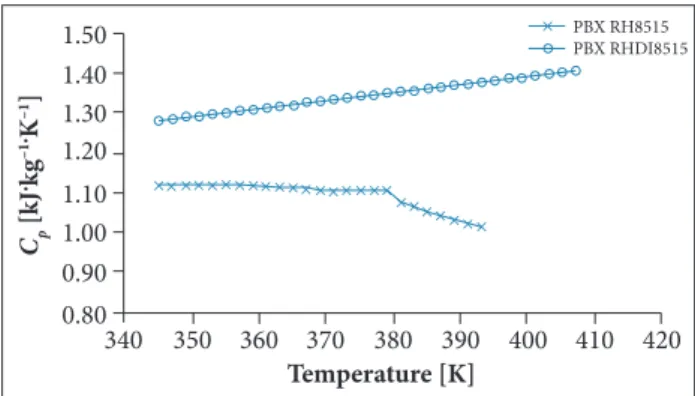
Figure 2 shows the results of speciic heat capacity within the temperature range of 340 – 410 K for a PBX RH8515 just with binder and a PBX RHDI8515 fully cured, both based on RDX. When the HTPB binder is added to RDX, the speciic heat capacity is increased and shows a linear dependence with the temperature. When the plasticiser and curing agent are added, the speciic heat capacity of PBX has no linear dependence with temperature being
close to the speciic heat capacity of RDX main charge. Speciic heat capacity of PBX RHDI8515 is almost constant until 380 K, decreasing ater that due to the phase transition based on the crosslink (cure) of DOS and IPDI compounds with HTPB and RDX, showing lower values than RDX (Fig. 2).
The average value and the polynomial fit functions representative of speciic heat capacity of PBX dependence with temperature, based on least squares method, are shown in Table 3. The specific heat capacity of PBX RH8515 is well-described by a linear it with R2= 1. he speciic heat
capacity of PBX RHDI8515 within the temperature range of 343 – 379 K is 3.1% lower than that of RDX. As the speciic heat capacity is an indirect measurement of the molecular mobility, the crosslinking efect of the curing agent is the main responsible for the decrease in speciic heat capacity of PBX when compared with the RDX alone (Vyazovkin et al. 2014).
For the same temperature range, despite the gap between the results, a similar behaviour of speciic heat capacity with the temperature is observed for PBX RH8515 and the other 2 PBX (PBXN 109 and PBX 9407) both based on RDX (with 64 and 95 wt%) cited in the literature (Table 4).
Taking into account the mass fraction of the individual compounds of the PBX,the theoretical specific heat capacity
EM Cp[kJ·kg–1·K–1]
RDX 1.148 ± 0.010*
HTPB −1.9408E−05 × T
2 + 0.0121 × T + 0.0116
R
²
= 0.9960DOS −0.0043 × T + 3.9973 R
²
= 0.9987 IPDI 1.726 ± 0.032**×××××××××××××××××××××××××××××××××××××××××××××××× × HTPB DOS IPDI RDX 330 0.6 1.0 1.4 1.8 2.2
340 350 370 380 390 410 420 430
Temperature [K] Cp [kJ.kg –1.K –1] 360 400 2.6 3.0 × × × × × × × × × × × × × × × × × × × × × × × × × 340 0.80 0.90 1.00 1.10 1.20 1.30
350 360 370 380 390 400 410 420
Temperature [K] Cp [kJ.kg –1.K –1] 1.40
1.50 × PBX RH8515
PBX RHDI8515
Figure 1. Speciic heat capacity of RDX, HTPB, DOS and
IPDI as a function of temperature.
Figure 2. Speciic heat capacity of PBX RH8515 and PBX RHDI8515 within the temperature range of 340 – 410 K.
Table 1. Speciic heat capacity of RDX, HTPB, DOS and IPDI in the temperature range of 340 – 420 K.
*Temperature range of 340 – 410 K; **Temperature range of 340 – 400 K.
Table 2. Speciic heat capacity of RDX available in literature for 298 K.
Reference Speciic heat capacity [kJ·kg–1·K–1]
Table 4. Speciic heat capacity of PBX based on RDX used for comparison.
*Cured PBX.
PBX RH8515 Experimental Theoretical
RD (%)
PBX RHDI8515* Experimental Theoretical
RD (%) T (K) Cp [kJ·kg–1·K–1] T (K) Cp[kJ·kg–1·K–1]
298.15 1.1877 1.2599 6.1 298.15 1.1120 1.2868 15.7 340 1.2714 1.2581 −1.0 340 1.1120 1.2793 15.0 345 1.2814 1.2572 −1.9 345 1.1120 1.2779 14.9 350 1.2914 1.2562 −2.7 350 1.1120 1.2764 14.8 355 1.3014 1.2550 −3.6 355 1.1120 1.2748 14.6 360 1.3114 1.2536 −4.4 360 1.1120 1.2732 14.5 365 1.3214 1.2522 −5.2 365 1.1120 1.2714 14.3 370 1.3314 1.2505 −6.1 370 1.1120 1.2695 14.2 375 1.3414 1.2488 −6.9 375 1.1120 1.2675 14.0 380 1.3514 1.2469 −7.7 380 1.1120 1.2654 13.8 385 1.3614 1.2448 −8.6 385 1.0459 1.2632 20.8 390 1.3714 1.2426 −9.4 390 1.0204 1.2609 23.6 395 1.3814 1.2402 −10.2 395 0.9949 1.2586 26.5 400 1.3914 1.2377 −11.0 400 0.9694 1.2561 29.6
Table 5. Comparison of experimental and theoretical values of speciic heat capacity of two PBX (cured and not cured) based
on RDX as a function of the temperature.
Reference Material Temperature range (K)
Speciic heat capacity [kJ·kg–1·K–1]
McClelland et al. (2001) PBXN 109 - 1.086 + 3.223 × 10⁻³× T
Cooper (1996) PBX 9407 310 – 440 1.009 + 3.223 × 10⁻³× T
of the PBX was estimated and it was established a correlation with the experimental result. Table 5 compares the specific heat capacity result obtained by theoretical calculation with the experimental one and the relative deviation (RD) in relation to the experimental results. Without curing agent, the theoretical results of specific heat capacity of PBX are lower than the experimental ones. When the curing agent is added, the theoretical results of PBX are always higher than the experimental ones and show a significant relative deviation.
he accuracy of the speciic heat capacity is relevant on cookof simulation, since a variation of 20% causes considerable diferences in the results of time and temperature of runaway (Góis et al. 2004). hus, within the temperature range studied, the speciic heat capacity measurement with this DSC method was more reliable, providing a suitable reference data for thermal simulation.
CONCLUSIONS
REFERENCES
Cooper PW (1996) Explosive engineering. Weinheim: Wiley-VCH.
Cuimei Y, Ziru L, Gangle W, Chengyan W (1991) Determination of heat capacity of explosives and related materials by DSC. Proceedings of the 17th International Pyrotechnics Seminar; Beijing, China.
Dobratz B (1981) LLNL Explosives handbook – properties of chemical explosives and explosives simulants. Livermore: Lawrence Livermore Laboratory.
Ehrenstein G, Riedel G, Trawiel, P (2004) Thermal analysis of plastics: theory and practice. New York: Hanser Gardner Publications.
Fiala J, Šesták J (2000) Databases in materials science. Contemporary state and future. J Therm Anal Calorim 60(3):1101-1110. doi: 10.1023/A:1010100917679
Góis JC, Chaves F, Simões P, Pedroso L, Plaksin I, Mendes R, Ribeiro J, Portugal A, Campos J (2004) Cookoff test models and results. In: Branco PC, Schubert H, Campos J, editors. Defense industries: science and technology related to security: impact of conventional munitions on environment and population. Dordrecht: Springer Netherlands. p. 65-81.
Hemminger W, Cammenga H (1989) Methoden der thermischen analyse. Heidelberg: Springer.
Höhne G, Hemminger W, Flammersheim H (2003) Differential scanning calorimetry. Berlin: Springer-Verlag.
Jones DA, Parker RP (2004) Simulation of cookoff results in a small scale test. Melbourne: Explosives Ordnance Division, Aeronautical and Maritime Research Laboratory, DSTO.
Magoń A, Wurm A, Schick C, Pangloli P, Zivanovic S, Skotnicki M, Pyda M (2014) Heat capacity and transition behavior of sucrose by standard, fast scanning and temperature-modulated calorimetry. Thermochim Acta 589:183-196. doi: 10.1016/j.tca.2014.05.029
McClelland MA, Tran TD, Cunningham BJ, Weese RK, Maienschein JL (2001) Cookoff response of PBXN-109: Material characterization and ALED3D thermal predictions. Proceedings of the 50th Joint Army-Navy-NASA-Air Force (JANNAF) Propulsion Meeting; Salt Lake City, USA.
Rogers RN (1975) Thermochemistry of explosives. Thermochim Acta 11:131-139.
Schindler A, Strasser C, Schmölzer S, Bodek M, Seniuta R, Wang X (2015) Database-supported thermal analysis involving automatic evaluation, identiication and classiication of measurement curves. Journal of Thermal Analysis and Calorimetry 123(3):2405-2414. doi: 10.1007/s10973-015-5026-x
Speyer RF (1993) Thermal analysis of materials. New York, Basel: Marcel Dekker, Inc.
Tarver C, McGuire RR, Lee EL, Wrenn EW, Brein KR (1978) The thermal decomposition of explosives with full containment in one-dimensional geometries. Proceedings of the 17th Symposium (International) on Combustion; Pittsburgh, USA.
Vyazovkin S, Chrissais K, Di Lorenzo ML, Koga N, Pijolat M, Roduit B, Sbirrazzuoli N, Suñol JJ (2014) ICTAC Kinetics Committee recommendations for collecting experimental thermal analysis data for kinetic computations. Thermochim Acta 590:1-23. doi: 10.1016/ j.tca.2014.05.036
Xue L, Zhao F, Xing X, Xu S, Pei Q, Gao Y, Hu R (2010) Evaluation of thermal hazard of composite modiied double-base propellant by microcalorimetery method. Chem Res Chinese Universities 26(4):626-629.
Zhang Y, Wu H, Xu K, Zhao F (2014) Nonisothermal decomposition kinetics, speciic heat capacity, and adiabatic time-to-explosion of Zn(NH3)2(FOX-7)2. J Therm Anal Calorim 116(2):817-823. doi: 10.1007/s10973-013-3589-y
are higher than the relative standard deviation of experimental data, thus it is not recommended to use the speciic heat capacity based on theoretical calculation to perform thermal simulation.
Methods used to measure specific heat capacity from the DSC curves are accurate and faster than those using