33
Universidade de São Paulo Faculdade de Saúde Pública
VO LU M E 33
N Ú M ERO 4
AGO STO 1999
© Copyright Faculdade de Saúde Pública da USP. Proibida a reprodução mesmo que parcial sem a devida autorização do Editor Científico. Proibida a utilização de matérias para fins comerciais. All rights reserved.
Revista de Saúde Pública
Journal of Public Health
p.329-33
A theoretical model of the evolution of
virulence in sexually transmitted H IV/ AID S
Modelo teórico da evolucão da virulência do HIV/
AIDS transmitido sexualmente
FAB Coutinho, E M assad, RX M enezes and M N Burattini
Departamento de Patologia. Laboratórios de Investigação Médica 01. Faculdade de Medicina da Universidade de São Paulo. São Paulo, SP-Brasil
Correspondence to: The publication of this article was supported by FAPESP (Process n. 98/13915-5). Marcelo N. Burattini Submitted on 10.10.1998. Reviewed on 13.1.1999.
Av. Dr. Arnaldo, 455 Approved on 13.4.1999. 01246-903 São Paulo - Brasil
E-mail: [email protected]
A theoretical model of the evolution of
virulence in sexually transmitted H IV/ AID S
Modelo teórico da evolucão da virulência do
HIV/AIDS transmitido sexualmente
FAB Coutinho, E M assad, RX M enezes and M N Burattini
Departamento de Patologia. Laboratórios de Investigação Médica 01. Faculdade de Medicina da Universidade de São Paulo. São Paulo, SP-Brasil
Keywords Abstract
Acquired Inmunodeficiency
Syndrome. Introduction
Virulence. Models, statistical. The evolution of virulence in host-parasite relationships has been the subject of several publications. In the case of HIV virulence, some authors suggest that the evolution of HIV virulence correlates with the rate of acquisition of new sexual partners. In contrast some other authors argue that the level of HIV virulence is independent of the sexual activity of the host population.
Methods
Provide a mathematical model for the study of the potential influence of human sexual behaviour on the evolution of virulence of HIV is provided.
Results
The results indicated that, when the probability of acquisition of infection is a function both of the sexual activity and of the virulence level of HIV strains, the evolution of HIV virulence correlates positively with the rate of acquisition of new sexual partners.
Conclusion
It is concluded that in the case of a host population with a low (high) rate of exchange of sexual partners the evolution of HIV virulence is such that the less (more) virulent strain prevails.
D escritores Resumo
Síndrome de Imunodeficiência
Adquirida. Introdução
Virulência. Modelos estatísticos. A evolução da virulência na relação hospedeiro-parasita tem sido objeto de várias publicações. No caso do HIV, alguns autores sugerem que a evolução da virulência do HIV correlaciona-se com a taxa de aquisição de novos parceiros sexuais. Por outro lado, outros autores argumentam que o nível de virulência do HIV é independente da atividade sexual da população hospedeira.
Métodos
Evolution of H IV virulence Coutinho FBA et al.
330 Rev. Saúde Pública, 33 (4), 1999
www.fsp.usp.br/ rsp
IN TRO D U CTIO N
A recent paper by Lipstch and Nowak10 investi-gates the evolution of virulence in sexually transmit-ted HIV/AIDS. Assuming a population with a con-stant supply of new susceptibles they conclude that, in the long run, new partner acquisition rates should have no effect on the evolution of pathogen virulence. We summarise their arguments below.
They consider the competition of two different strains of virus. Strain 1, called more virulent is more pathogenic to its hosts and more transmissible during the course of a single partnership. Strain 2 , called less virulent for its ability to remain longer in the host without producing AIDS, is therefore less pathogenic to its host but is also assumed to be less transmissible. The rate of new partner infection is assumed to be independent of the total population density or size.
Let X be the number of susceptibles in the popu-lation, Y1 and Y2 represent the number of hosts in-fected, respectively, with strain 1 and strain 2. N = X + Y1 + Y2 is the total population minus the individuals with AIDS which are assumed to be too ill. The spread of the two strains can be modelled by the fol-lowing system of differential equations:
dX (t)
dt = f ( N ) – (λ1+ λ2+ µ) X(t) dY1(t )
dt = λ1X(t )−(ν1+ µ)Y1(t ) (1) dY2(t)
dt = λ2X(t)−(ν2+ µ)Y2(t)
The force of infection λi (i = 1,2) is assumed to be
λi=
cβiYi(t)
N (2)
where c is the rate of new partner acquisition, βi (i =
1, 2) is the probability that a host with strain i will infect a single susceptible partner and νi is the rate
individuals infected with each strain develop full-blown AIDS (in the present paper this parameter is called virulence).
As shown by Brenmerman and Thieme2 one of the pathogen strains will drive the other to extinc-tion. The winning strain will be the one with the great-est reproductive number R0. For strain i, we have
R0i =
cβi vi+ µ
(3)
Equation 3 shows that changing the rate of new partner acquisition c scales R0i equally for all strains. Thus, the main conclusion of Lipstch and Nowak10 that, in the long run, partner acquisition should have no effect on the evolution of virulence.
This conclusion depends crucially on βi being in-dependent of c and ν. This assumption is, however, contradicted by a number of studies on HIV trans-mission. In section 2, we summarise the biological studies that show that in fact β, for sexually trans-mitted HIV, should be a function of both c and ν. In section 3 we propose a simple form for this depen-dence and we examine how R0 depends on c and ν to conclude that low rates of acquisition of new part-ners favours a less virulent strain.
Epidemiological evidence for the dependence of β on c and ν.
It is an already well established fact that the like-lihood of sexually related HIV transmission is influ-enced, among other things, by the presence of coadjuvant factors, in particular other sexually trans-mitted diseases (STDs), including chlamydia, gon-orrhea, herpes and syphilis. The later, in turn, have incidence rates which are directly dependent on the level of sexual activity. In fact, it has been reported by a number of authors4,13,17 that STD’s can increase the risk of HIV transmission by a factor of up to nine
Resultados
Os resultados indicam que, quando a probabilidade de aquisição da infecção pelo HIV é uma função tanto da atividade sexual da população humana quanto da virulência das cepas de HIV, a evolução da virulência do HIV correlaciona-se positivamente com a taxa de aquisição de novos parceiros correlaciona-sexuais.
Conclusão
times. In addition, the relationship between HIV and other STDs has been suggested as a possible expla-nation for the higher prevalence of heterosexually transmitted HIV observed in Africa as compared to the rates observed in western countries1.
Furthermore, the number of new sexual partners has been directly associated with the risk of HIV in-fection in a number of studies3,8,16. For instance, in the study by Burcham et al.3 it has been shown that the relative risk for HIV infection increases by a factor of 1.02 per new sexual partner. It is, therefore, valid to assume the level of sexual activity as a determining factor of the likelihood of HIV transmission.
As for the influence of the viral load on the natu-ral course and transmissibility of HIV infection, sev-eral direct and indirect evidences, mainly related to maternal-fetal transmission, point to a positive rela-tionship between the level of viremia and the speed of disease progression and/or the transmission like-lihood15,18,19.
In what follows we consider likelihood of transmis-sion as dependent both on the rate of partner exchange and on the level of virulence of HIV, as defined above.
A simple model for the dependence of β on c and ν.
It is reasonable to assume a function for β that is a logistic-like curve for both c and ν. This function should assume a zero value when either c or ν were zero, and should
β(c,ν)= κ1ck2 1−exp− κ3 ν 2
ck2
(4) saturates when c and ν increase to a finite value. A simple function satisfying the above requirements could be:
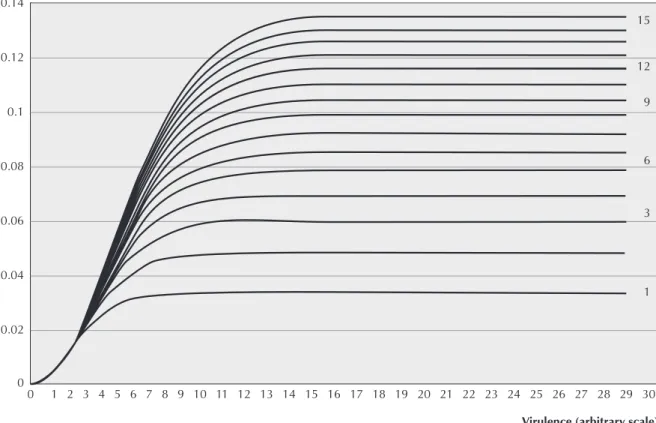
where κi are positive constants. Figure 1 shows the shape of the function β(c, ν), for κ1 = 0.0333, κ2 = 0.5 and κ3 = 0.1. The values for the parameters κi were arbitrarily chosen to make the function β(c, ν) reproduce accepted epidemiological data.
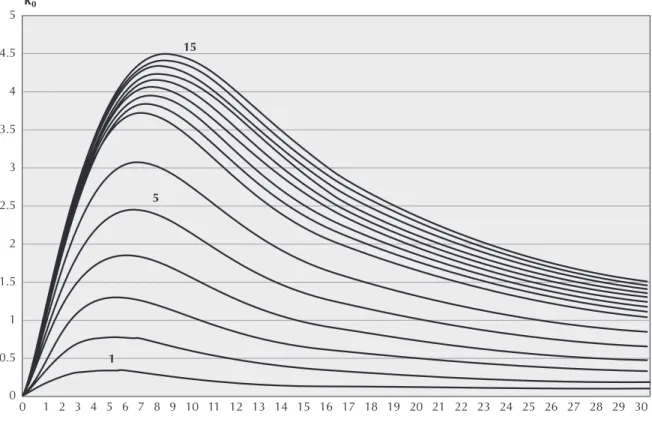
The basic reproductive ratio, R0, is calculated according to equation 3 replacing β with β(c,ν) given by equation 4. Figure 2 shows its shape as a function of ν for several values of c.
It should be noted that R0 is maximised by cer-tain values of ν (νmax) and its peaks increase with c
Evolution of H IV virulence Coutinho FBA et al.
332 Rev. Saúde Pública, 33 (4), 1999
www.fsp.usp.br/ rsp
Figure 2 - The basic reproductive number (R0) for several values of c . The abscissa represents the virulence of HIV in on an
arbitrary scale.
and always shift to the right, indicating that, for the assumed β, in the sub-population with a lower level of sexual activity, HIV evolves towards a less viru-lent state. In figure 3 is shown νmax as a function of c. These results are in agreement with the findings of Ewald5 and Massad et al.11,12
D ISCU SSIO N
The evolution of virulence in host-parasite rela-tionships has been the subject of several publications in the past two decades (see the review by Levin9 for details). The paradigm of commensalism as a final end in the evolution of host-parasite interactions has been challenged by some theoretical14 and experi-mental works6,7. In the case of HIV virulence, some authors have been addressing the subject with basi-cally two opposite points of view with regard to the importance of sexual activity level. In a seminal pa-per, Ewald5 concludes that the fraction of the host population with the lowest level of sexual activity ends up infected with a less virulent HIV strain, in the sense that it causes disease (AIDS) after a longer
period of time. Attempts to provide a mathematical treatment of Ewald’s arguments is provided in Massad et al.12, indicating that the rate of acquisition of new sexual partners may influence the evolution of HIV virulence.
On the other hand, as mentioned above, Lipsitch and Nowak10 argue against this, demonstrating that when of βi is independent of c and ν, the level of
virulence at equilibrium is independent of sexual activity. In this paper we show that when βi is
con-sidered as a function of c and ν it turns out that the evolution of HIV virulence correlates with the rate of acquisition of new sexual partners in the sense that the greater this rate is, the greater the virulence of the HIV strain selected.
This debate is of extreme importance from the point of view of the epidemiology of HIV/AIDS. For such an infection, for which the only effective control measure is education with changing habits and atti-tudes towards sex, any conclusion regarding the role of sexual activity on the evolution of virulence can constitute an argument for or against such a measure.
REFEREN CES
11. Massad E. Transmission rates and the evolution of pathoge-nicity. Evolution 1987; 41:1127-30.
12. Massad E, Burattini MN, Menezes RX, Coutinho FAB. Modelling the role of sexual activity on the
evolution of HIV virulence. Math Model Sci Comput 1995; 26:810-5.
13. Mastro TD, Satten GA, Nopkerso T, Sanguekharomyo S, Longini Jr IM. Probability of female to male transmission of HIV-1 in Thayland. Lancet 1994; 343:204.
14. May RM, Anderson RM. Parasite hosts coevolution. In: Futuyama DJ, Slatikin, M, editors. Coevolution. Sunderland (MA): Sinauer Associates; 1983. p. 186-206.
15. Mellors JW, Rinaldo Jr CR, Gupta P, White RM, Todd JA, Kingsley LA. Prognosis in HIV-1 infection predicted by the quantity of virus in plasma. Science 1996; 272:1167-70.
16. Pape JW, Stanback ME, Pamphile M, Bonsy M, Deschamps MM, Verdier RI et al. Prevalence of HIV infection and high risk activities in Haiti. JAIDS 1990; 3:995-1001.
17. Plummer FA, Simonsen JN, Cameron DW et al. Cofactors in male-female sexual transmission of human immunodeficiency virus type 1. J Infec Dis 1991; 163:233.
18. Simmonds P. Variation in HIV virus load of individuals at different stages in infection: possible relationship with risk of transmission. AIDS 1990; 4(Suppl. 1):S77-S83.
19. Weiser B, Nachman S, Tropper P, Viscosi KH, Grimson, R, Baxter G et al. Quantitation of human immunodeficiency virus type 1 during pregnancy: relationship of viral titer and mother to child transmission and stability of viral load. Proc
Natl Acad Sci USA 1994; 91:8037-41.
1. Berkley SF, Widy-Wirski R, Okware SI, Downing R, Linnand MJ , White KE, Sempala S. Risk factors associated with HIV infection in Uganda. J Infect Dis 1989; 160:22-30.
2. Bremermann HJ, Thieme HR. A competitive exclusion principle for pathogen virulence. J Math Biol 1989; 27:179-90.
3. Burcham JL, Tindall B, Marmor M, Cooper DA, Berry G, Penny R. Incidence and risk factors for human immunodefi-ciency virus seroconversion in a cohort of Sidney homosexual men. Med J Aust 1989; 150:634-9.
4. Cameron DW, Simonsen JN, D’Costa LJ, Ronald AR, Maitha GM. Gakinya MN et al. Female to male transmission of human immunodeficiency virus type 1: risk factors for seroconversion in men. Lancet 1989; 2(8660):403-7.
5. Ewald PW. Evolution of infectious disease. Oxford: Oxford University Press; 1994.
6. Fenner F, Marshall ID. A comparison of the virulence for European rabbits Oryctolagus cuniculus of strains of myxoma virus recovered in the fields of Australia, Europe and America.
J Hyg 1957; 55:149-91.
7. Fenner F, Ratcliff FN. Myxomatosis. Cambridge (UK): Cambridge University Press; 1965.
8. Latif AS, Katzenstein DA, Bassett MT, Houston S, Emmanuel JC, Marowa E. Genital ulcers and transmission of HIV among couples in Zimbabwe. AIDS 1989; 3:519-23.
9. Levin BR. The evolution and maintanance of virulence in micro parasites. Emerg Infect Dis 1996; 2:93-102.