Self-Determination Theory: An Analysis of Student Motivation in an
Accounting Degree Program*
Edvalda Araújo Leal
Ph.D., Department of Accounting Sciences, Federal University of Uberlândia E-mail: [email protected]
Gilberto José Miranda
Ph.D., Department of Accounting Sciences, Federal University of Uberlândia E-mail: [email protected]
Carlos Roberto Souza Carmo
Master, Department of Accounting Sciences, Federal University of Uberlândia E-mail: [email protected]
Received on 1.16.2012- Accepted on 3.22.2012- 3rd. version accepted on 9.19.2012
ABSTRACT
The Self-Determination Theory has been widely discussed in the field of motivation in school learning and, according to some researchers, this theory can be summarized as a continuum of self-determination that indicates six types of motivation, which vary qualitatively according to the internalization of external rules of behavior. In this sense, the present study aimed to evaluate the motivation of Accounting Science students in a public university in light of the Self-Determination Theory. The research sample consisted of 259 students enrolled in all academic terms of the Accounting degree program of a public higher education institution in Brazil. The survey results were analyzed using exploratory factor analysis, which identified seven factors that explain 61.09% of the total data variability. The results of the present study are somewhat consistent with those found in previous studies, and the motivation for learning was quite diverse among the students studied. However, some students were concerned with deepening their level of expertise or achieving adequate foundations for their future role. Others were concerned only with getting their diploma or were present in classes simply to meet attendance requirements. These findings show the relevance of studies on the teaching of Accounting because the field has epistemological peculiarities that must be considered while teaching and learning. It is important to emphasize the importance of understanding and evaluating students' motivational levels because this will facilitate planning while encouraging and exploring motivation in academic settings.
Keywords:Self-Determination. Motivation. Students. Teaching. Accounting.
1 InTRoDuCTIon
Motivation in the school context has been highlighted in several studies in recent years. In most cases, the goal has been to find ways to influence students to increase their involvement in learning activities (Guimarães, Bzuneck, & Sanches, 2002).
Students' motivation is considered a galvanizing energy in the teaching and learning process that per-meates all levels of education, both in relation to the amount of time students spend studying as well as their academic performance and achievements, and contributes importantly to the achievement of imme-diate satisfaction in their lives - wellbeing versus ma-laise (Lens, Matos, & Vansteenkiste, 2008). For these authors, motivation is "a psychological process in whi-ch personality traits (e.g., motives, reasons, skills, in-terests, expectations, and future perspectives) interact with perceived environmental characteristics" (Lens, Matos, & Vansteenkiste, 2008, p. 17); this indicates that student motivation can be affected by changes within the students themselves, in their learning environment, or in school culture.
In this sense, the Self-Determination Theory (SDT) has been widely discussed in the field of motivation in scho-ol learning, and many studies have shown that motivation can affect students' learning and performance and, conver-sely, that learning can affect motivation (Wechsler, 2006, Pfromm, 1987, Schunk, 1991, Mitchell, Jr., 1992).
The principles of the SDT state that individuals' mo-tivations differ, being determined and driven by contexts that support psychological needs that manifest themselves in different ways, making students' motivation for lear-ning "a complex, multi-determined phenomenon, which can only be inferred by observing behavior, either in real performance situations or by self-reporting" (Guimarães & Bzuneck, 2008, p.111).
Based on the SDT, Guimarães and Bzuneck (2008) presented a study on the psychometric properties of a Brazilian version of the Academic Motivation Scale (AMS), which was conducted with a group of university students in the northern region of the state of Paraná. The authors used factor analysis to evaluate the data and inferred that the seven factors identified showed good internal consistency, with the exception of the evalua-tion of extrinsic motivaevalua-tion by identified regulaevalua-tion. The correlations between the studied variables supported the proposition of a self-determination continuum for the
behavior regulation types.
In this context, the question guiding the present study is the following: what are the types and levels of academic motivation affecting Accounting Sciences stu-dents in light of the SDT? In other words, the purpose of the study is to evaluate the motivation of Accounting Science students from a Brazilian public university in li-ght of the SDT, using Guimarães and Bzuneck's (2008) study as a basis.
A quantitative approach was adopted in the research: a survey was conducted by distributing a questionnaire to Accounting Science students (259 participants). A factor analysis was performed along with principal components extraction, internal consistency analysis, and descriptive statistics.
The main difference between this study and that of Guimarães and Bzuneck's (2008) lies in the sample studied because the present study investigated univer-sity students enrolled in an Accounting Sciences pro-gram rather than students enrolled in several progra-ms. The importance of the proposed research lies in its empirical scientific contribution because it seeks to identify, in light of the SDT, the factors that might promote or jeopardize the motivation of Accounting Science students.
Little research has been conducted in Brazil regarding academic motivation in higher education, representing a gap with regard to knowing and understanding the styles of behavior regulation in Brazilian university students (Guimarães & Bzuneck, 2008). This gap is particularly noticeable in the accounting context because the field has epistemological peculiarities that must be conside-red during the teaching and learning process (Njoku, Heijden, & Inanga, 2010; Pierre, Wilson, Ravenscroft, & Rebele, 2009; Kachelmeier, 2002; Bell, Frecka, & Solo-mon, 1993); notably, these include understanding and evaluating students' motivational levels because only then is planning to explore and encourage motivation in the classroom possible.
The study is divided into five sections, the first of whi-ch is this introduction. The second section discusses the SDT, its fundamentals, proposed scales, and previous stu-dies. The research method is presented in the third section. The calculated results are presented in the fourth section, and concluding remarks are presented in the fifth and final section.
2 THE SELF-DETERMInATIon THEoRY (SDT)
According to Gagné and Deci (2005, p. 331), Porter and Lawler (1968) proposed a model of work motivation ba-sed on the motivation theory of Vroom (1964) that opera-tes on two dimensions: intrinsic motivation and extrinsic motivation. According to this theory, intrinsic motivation involves people performing an activity because they find it
In other words, the SDT "makes an important distinc-tion between two different motivadistinc-tional issues: why versus what for. What is the purpose of your activity and why do you want to accomplish this goal?; what are the reasons that lead the effort to achieve this goal?" (Lens, Matos, & Vans-teenkiste, 2008, p. 19, emphasis added).
School learning has also been studied through the con-cepts of intrinsic and extrinsic motivation. Researchers state that an intrinsically motivated student "is one whose involvement and maintenance in the activity happens as a result of the task itself because it is interesting and creates satisfaction; students with this type of motivation work on activities because they consider them pleasant" (Siqueira & Wechsler, 2006, p. 22). The extrinsically motivated student "is one who performs a task or activity because they are interested in social or external rewards; a student with this type of motivation is more interested in the opinion of the other person, [...] external recognition, praise or just avoi-ding punishment" (Siqueira & Wechsler, 2006, p. 22).
According to Siqueira and Wechsler (2006, p. 22), re-searchers' interest in the motivational aspects of learning is a recent development, whereas older theories positioned motivation as an important precondition. However, today's studies show a reciprocal relationship, i.e., "motivation can have an effect on learning and performance at the same time that learning can affect motivation" (Siqueira and We-chsler, 2006, p. 22).
According to Penna (2001), motivation is the study object of Psychology, and the various theories are de-rived from four main movements: behavioral, cogniti-ve, psychoanalytic, and humanistic. The SDT builds on the principle of evaluating different manifestations of motivation that may be involved in the teaching and learning process.
It has also been argued by researchers that motivation (intrinsic or extrinsic) varies in relation to culture (Trum-bull & Rothstein-Fisch, 2011; Kaplan, Karabenick, & De Groot, 2009; Brockelman, 2009; Rothstein-Fisch & Trum-bull, 2008; Otsuka & Smith, 2005; Henderlong & Lepper, 2002). For Trumbull and Rothstein-Fisch (2011), the very notion of self-determination is limited by culture becau-se some cultures are more oriented to the "I" than to the "other". Moreover, what counts as an extrinsic motivator and the way in which it is used is also culturally variable (Rothstein-Fisch & Trumbull, 2008).
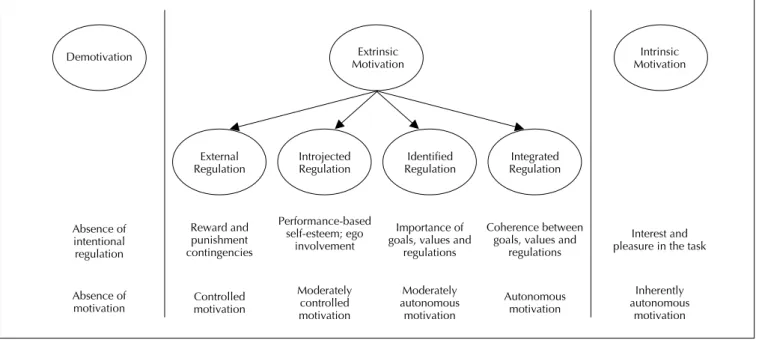
As research has evolved on this topic (Lens, Matos, & Vansteenkiste, 2008; Vansteenkiste, Lens, & Deci, 2006; Siqueira & Wechsler, 2006; Gagné & Deci, 2005), diffe-rent degrees of motivation have been mapped, in addi-tion to the cultural aspects. Gagné and Deci (2005) have presented a self-determination continuum (Figure 1), in which six types of motivation are differentiated that vary qualitatively according to the internalization of external behavioral regulation.
Figure 1 The Self-Determination continuum
Source: Adapted from Gagné and Deci (2005, p. 336).
According to this approach, the analysis of the mo-tivation of an individual can be classified into three groups: demotivation, extrinsic motivation, and intrin-sic motivation. Demotivation, as the name implies, is characterized by a lack of motivation, i.e., the person has no intention to engage in proactive behavior, and "in such a situation, there is devaluation of activity and a lack of perceived personal control." (Guimarães & Bzu-neck, 2008, p. 103).
The second group, extrinsic motivation, is divided into four types of behavioral regulation: a) External regulation; this is the least autonomous form of mo-tivation because, in this case, the person acts to ob-tain rewards or avoid punishments. For example, "a student can be (even highly) motivated to study on a Friday evening because that way his/her mother might let him/her go to a party on Saturday night (extrinsic motivation and external regulation)" (Lens, Matos, & Extrinsic
Motivation
Intrinsic Motivation Demotivation
External Regulation
Introjected Regulation
Identified Regulation
Integrated Regulation
Absence of intentional regulation
Absence of motivation
Reward and punishment contingencies
Performance-based self-esteem; ego
involvement
Importance of goals, values and
regulations
Interest and pleasure in the task
Inherently autonomous
motivation Autonomous
motivation Moderately
autonomous motivation Moderately
controlled motivation Controlled
motivation
Coherence between goals, values and
Vansteenkiste, 2008, p. 19). b) Introjected regulation; the person manages external consequences according to the result of internal pressures such as guilt and an-xiety. For instance, "a student can give his/her best in school because his/her parents require it and he/she does not want to disobey them and because otherwise he/she would feel guilty. Thus, he/she studies to avoid feeling guilty" (Lens, Matos, & Vansteenkiste, 2008, p. 19). c) Identified regulation; this form is more auto-nomous than the previous types because, in this case, some internalization already exists, even if the reason for doing something is of external origin. For example, "A student can do his/her best in school because he/ she wants to go to college and become an architect. He/ She perceives himself/herself as a future architect. This student’s motivation is instrumental and hence extrin-sic, but identifies itself with the reason to study" (Lens, Matos, & Vansteenkiste, 2008, p. 19). d) Integrated regulation; here, the behavior, goals and values of the person are coherent. This is the most autonomous form of extrinsic motivation, although the focus remains "on personal benefits arising from carrying out the activi-ty" (Guimarães & Bzuneck, 2008, p. 103).
Finally, in relation to intrinsic motivation, the person has interest and enjoyment in performing the task, and the activity is perceived as an end in itself.
Guimarães and Bzuneck (2008) note that several studies have found associations between the types of motivation and positive learning results with the use of deep information processing strategies and psycho-logical wellbeing (Grolnick & Ryan, 1989; Miserandino, 1996; Ryan & Deci, 2000). In the same line of thought, Osborne and Jones (2011) propose a theoretical model that directly links the structure of self-motivation to academic results. Furthermore, the authors suggest stra-tegies to increase student motivation (increasing student autonomy, demonstrating the usefulness of academic knowledge, supporting student success, initiating and supporting students' interests, and fostering a sense of belonging to the group) and, consequently, their acade-mic results.
To evaluate academic motivation, some studies have set out to develop and validate questionnaires or scales, as follows: Yamauchi (1980) developed a scale to mea-sure motives related to academic performance, invol-ving a sample of 299 university students; Harter (1981) constructed an instrument to assess children's
intrin-sic versus extrinsic orientation in school learning and
mastery in the classroom (based on a sample of 2,925 subjects); Palenzuela (1987) attempted to develop a Spanish questionnaire to evaluate intrinsic motivation and self-determination; and Shah (1988) developed a motivation scale for performance based on four fac-tors of need; namely, motivation to perform, to achieve academic success, toward vocational performance and social performance, and skills.
Following this pattern, Vallerand, Blais, Briere, and Pelletier (1989) developed and validated (in French) the
psychometric properties of an instrument termed the
Echelle de Motivation en Education [Academic Motivation
Scale] (EME), the objective of which was to measure mo-tivation in education. This study was conducted with 746 university students. The results confirmed the existence of seven subscales that measured three types of internal motivation: (a) to know, (b) to experience sensations, and (c) to accomplish, in addition to three other types of mo-tivation: (a) external; (b) introjected, and (c) identified regulation.
Other studies on the construction or adaptation of instruments to evaluate motivation for learning were conducted by Deci and Ryan (1985), Vallerand et al. (1992), Amabile, Hill, Hennessey, and Tighe (1994), Guimarães, Bzuneck, and Sanches (2002), Reeve and Sickenius (1994), and Guimarães, Bzuneck, and Boru-chovitch (2003). The results of these studies show that it is possible to evaluate learning motivation in a valid, accurate, and reliable way.
It is noteworthy that Vallerand et al. (1992) propo-sed to validate the scale for measuring learning moti-vation (EME) constructed by Vallerand et al. (1989). The results revealed that the EME showed satisfactory levels of internal consistency and temporal stability. The instrument showed robust psychometric proper-ties, reinforcing the construct’s validity (Vallerand et al., 1992).
The French scale Echelle de Motivation en Education (EME), which was developed and validated by Vallerand et al. (1989), was translated into a Portuguese version, which was renamed the ‘Escala de Motivação Acadêmi-ca’ (Academic Motivation Scale - AMS), although few studies have been conducted in Brazil on academic mo-tivation in higher education (Sobral, 2003; Guimarães & Bzuneck, 2008; Souza, 2008; Falcão & Rosa, 2008; Engel-mann, 2010).
Initially, this scale was applied by Sobral (2003), who evaluated student motivation in a medical degree program based on the SDT’s precepts. The Portuguese version ap-plied by Sobral (2003) listed 28 items divided into seven subscales of four items each, evaluating the three types of intrinsic motivation (to know, to accomplish, and to expe-rience sensations) and the three types of extrinsic motiva-tion (External, Introjecmotiva-tion, and Identificamotiva-tion) as well as Demotivation.
Guimarães and Bzuneck (2008) conducted a survey of the psychometric properties of a Brazilian version of the AMS with a group of university students. According to the authors, the seven factors identified showed good internal consistency, with the exception of the evalua-tion of extrinsic motivaevalua-tion by identified regulaevalua-tion. The correlations between variables supported the proposi-tion of a self-determinaproposi-tion continuum for the different types of behavior regulation. This study provided sup-port for the construction of the instrument used in the present study.
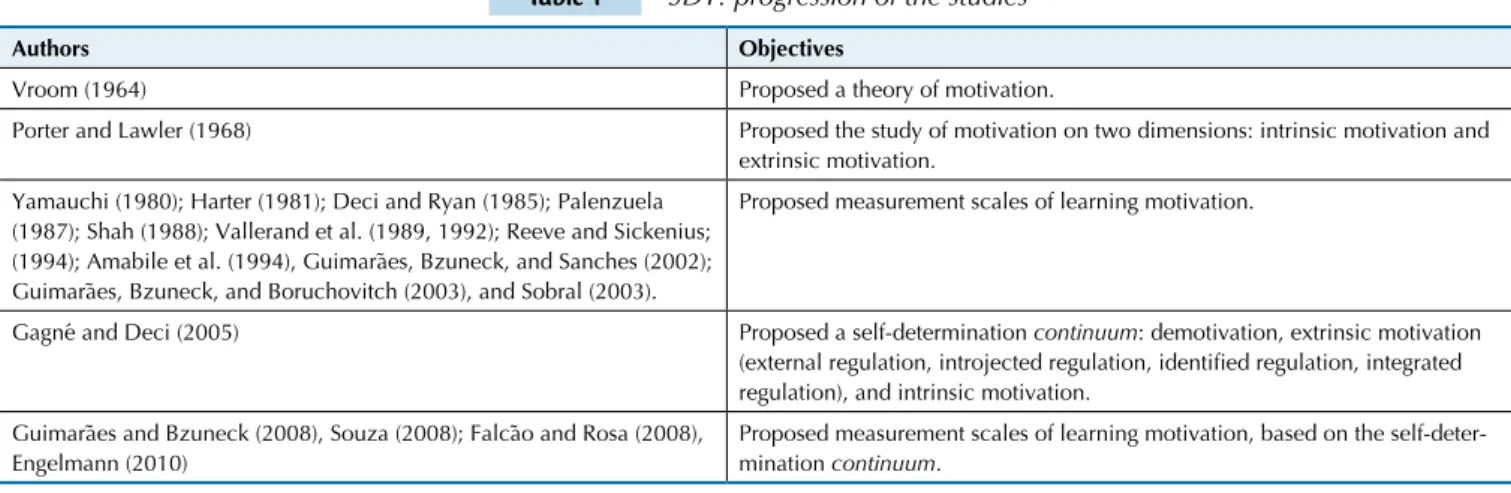
Table 1 SDT: progression of the studies
Authors Objectives
Vroom (1964) Proposed a theory of motivation.
Porter and Lawler (1968) Proposed the study of motivation on two dimensions: intrinsic motivation and extrinsic motivation.
Yamauchi (1980); Harter (1981); Deci and Ryan (1985); Palenzuela (1987); Shah (1988); Vallerand et al. (1989, 1992); Reeve and Sickenius; (1994); Amabile et al. (1994), Guimarães, Bzuneck, and Sanches (2002); Guimarães, Bzuneck, and Boruchovitch (2003), and Sobral (2003).
Proposed measurement scales of learning motivation.
Gagné and Deci (2005) Proposed a self-determination continuum: demotivation, extrinsic motivation
(external regulation, introjected regulation, identiied regulation, integrated
regulation), and intrinsic motivation. Guimarães and Bzuneck (2008), Souza (2008); Falcão and Rosa (2008),
Engelmann (2010)
Proposed measurement scales of learning motivation, based on the self-deter-mination continuum.
students at a public university in northern Paraná, could influence the students' perceptions about the activities re-quired in their program; the study also assessed the type of motivation adopted by the students in the present. At the end of the work, the author observed a prevalence of autonomous (intrinsic) motivation among the students in the research sample.
In a study conducted with the students of an Arts program at a public university in northern Paraná, using the AMS, Engelmann (2010) sought to identify the type of motivation, perception of basic skill needs for lear-ning, learning strategies used, perception of academic performance, and students' intention to remain in the program. In light of the SDT and after analyzing the data collected, the researcher noted that it was possible to ob-serve a predominance of the most autonomous type of motivation among the 192 students in the four grades of the program. Regarding the perception of basic needs that are relevant to learning, Engelmann (2010) noted that three of these needs (a sense of belonging, compe-tence, and autonomy) are directly related to the intrinsic motivation of students. The researcher also noted that students positively used adaptive learning strategies that are related to managing resources and deep learning. Re-garding the perception of performance, it was found that the best performance meets the personal expectations of success and security regarding the achievement of the established goals.
With regard to the relationship between the variables studied by Engelmann (2010), the students' perceptions about the basic needs for learning in the social context of the program revealed that these needs were predictors of the intrinsic motivation detected. Regarding demo-tivation, the perceived satisfaction of those needs had a negative predictive effect. The variation of the use of deep learning strategies was related to extrinsic motiva-tion variables through introjected regulamotiva-tion and intrin-sic motivation.
Specifically, in the field of Applied Social Sciences, Falcão and Rosa (2008) applied the AMS to 267 univer-sity students from public and private institutions in the state of Rio de Janeiro to identify and compare the cha-racteristics of students' motivating factors on the mana-gement programs of public and private institutions.
Ac-cording to the authors, extrinsic motivation was scored the highest, which suggested that freshman students of university programs are extrinsically oriented towards pursuing goals due to the characteristics of the educa-tional system itself. The survey also showed that because most private university students are already active in the labor market, they perceive the act of attending univer-sity as a higher motivating factor, unlike students in pu-blic institutions. The authors emphasized that the per-ceptions of this last category of students is more related to the beginning of their professional life.
Falcão and Rosa's (2008) study analyzing the moti-vational characteristics of freshmen and non-freshmen students found that students in public universities exhi-bit a pattern of increasing motivation as they progress through the programs. In private institutions, the oppo-site occurs because most of these students enter univer-sity with greater motivation, and this motivation decre-ases over time.
Falcão and Rosa (2008) and Boruchovitch (2008) also found differences with respect to gender. Female students showed a higher level of intrinsic motivation than male students. The researchers noted that this fin-ding may be related to increasing female participation in the labor market. However, when they attempted to analyze levels of extrinsic motivation, the male students showed higher levels of motivation. To explain the lat-ter finding, Falcão and Rosa (2008) assume that social variables have an effect, i.e., they believe that men, still living in a society that exhibits traces of patriarchy, are more motivated to fulfill tasks and the pursuit of ma-terial rewards for their livelihood and that of their fa-mily.
Oliveira, Theóphilo, Batista, and Soares (2010) con-ducted a survey with students regarding an Accounting Sciences program to identify their motivation level based on the SDT. They used the AMS for this purpose, and the results were analyzed using descriptive statistics that in-dicated high levels of student motivation (both in earlier and later academic terms). However, the authors point to lower levels of student motivation during later terms of the program (non-freshmen).
3 METHoDS
The instrument used in the present study was the Brazilian version of the AMS proposed by Guimarães and Bzuneck (2008). This instrument includes 29 ite-ms, with each point of the self-determination continuum being evaluated by a set of items that encompasses three types of intrinsic motivation (to know, to accomplish, and to experience sensations), three types of extrinsic motivation (External, Introjection, and Identification), and Demotivation. An initial question: "Why do I come to university?", was presented to the participants, and this was followed by 29 statements, each of which was answered using a Likert seven-point scale (1 not true at all to 7 totally true).
3.1 Data Collection and Participants.
A pretest of the survey instrument was initially applied to a group of five students, and after adjustments, data col-lection began. The process began by scheduling a date and time with the professors of each class researched (1st to 10th
academic terms) of the Accounting Sciences program of a Brazilian public university.
Permission was sought from the professor to give the questionnaire to the participating students to complete in the classroom, and, before answering, the students signed an informed consent form. Students were informed about the study objectives and assured about the confidentiali-ty of the information provided and their freedom not to answer the questionnaire, if they so wished.
The study sample consisted of 259 students enrol-led in all academic terms (1st to 10th) of the Accounting
Sciences program of a public higher education institu-tion in Brazil.
According to Fávero, Belfiore, Silva, and Chan (2009, p. 237), a sample must generally have "at least 5 times more observations than the number of variables that make up the database." In the present study, 259 Ac-counting Sciences students in a Brazilian Public Institu-tion participated, representing almost 9 times the num-ber of variables in the database (29). The profile of the respondents was 153 (59.1%) females and 106 (40.9%) males, distributed among the following age groups: 38 (14.7%) up to 19 years of age, 182 (70.3%) from 20 to 25 years of age, and 39 (15.1%) aged 26 years or older. Of the students, 136 (52.5%) had some work experience in the field of accounting.
3.2 Data Analysis.
Initially, the statistical test known as exploratory factor analysis was conducted to simplify the data set obtained with the application of the instrument. The test evaluates how much each factor is associated with each variable, as well as analyzing to what degree the set of factors found explains the variability of results obtained in the sample by summing the variances of the original variables (Fávero et al., 2009).
After organizing the items based on the results of the factor analysis, descriptive statistical analysis was used to assess the means and standard deviations. The Pearson's correlation coefficient was then calculated to ascertain the linear association between the studied variables.
4 PRESEnTATIon AnD AnALYSIS oF RESuLTS
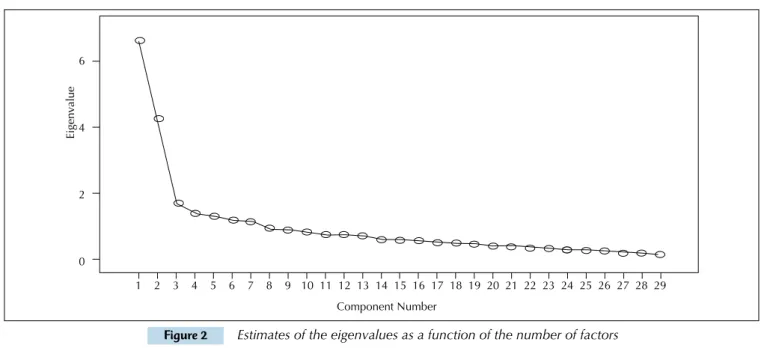
Factor analysis was performed using the 29 items re-sulting from the study of Guimarães and Bzuneck (2008). First, the Scree graph (Figure 2) is shown, which indicates the eigenvalues and the principal components representing,
on each slope, the rotation point for each factor found. This graph also informally displays the variance explained by the principal components in order from the highest to the lowest (Hair, Black, Babin, Anderson, & Tatham, 2005).
Figure 2 Estimates of the eigenvalues as a function of the number of factors
Source: Study data.
Component Number
Eigenvalue
6
4
2
0
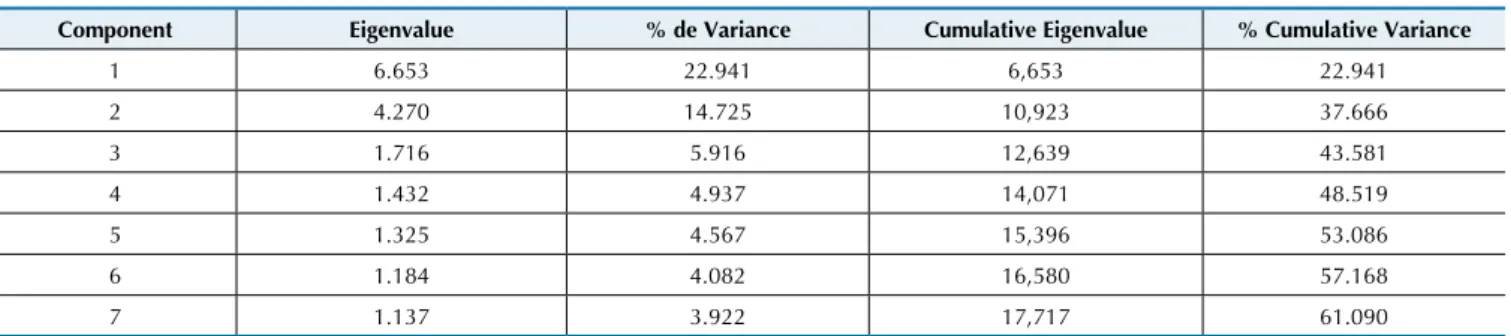
In this study, the principal components analysis indica-ted seven factors that explain 61.09% of the total variability of the data. As observed, the eigenvalues decline
approxi-mately linearly after the seventh principal component. Ta-ble 2 presents the defined components.
Table 2 Summary of the percentage of explained variance of the eigenvalues based on the principal components analysis
Component Eigenvalue % de Variance Cumulative Eigenvalue % Cumulative Variance
1 6.653 22.941 6,653 22.941
2 4.270 14.725 10,923 37.666
3 1.716 5.916 12,639 43.581
4 1.432 4.937 14,071 48.519
5 1.325 4.567 15,396 53.086
6 1.184 4.082 16,580 57.168
7 1.137 3.922 17,717 61.090
Source: Study data.
Table 2 shows that the 29 variables (questions) could be reduced to seven factors that explain 61.09% of the variation in the original data. Factor composition was based on the
se-lection of questions with loadings greater than 0.38. For Kli-ne (1994), factor loadings of greater than 0.30 are acceptable because they explain at least 9% of the total variance.
Table 3 Factor analysis (Varimax Rotation)
Items Factors
F1 Integ. / Intr.
F2 Demot.
F3 Introj.
F4 Extern.
F5 Identif.
F6 Extern.
F7 Extern.
Q4-For the pleasure I obtain by engaging in interesting discussions with professors 0.545 Q12-Because education is a privilege 0.572 Q17-Because the university is a pleasure for me 0.735 Q18-Because access to knowledge takes place at the university 0.568 Q21-Because I love coming to the university 0.690 Q24-I come to the university because attendance is necessary for learning 0.542 Q26-Because studying broadens one’s horizons 0.778 Q27-I come to the university because that is what I chose for myself 0.686
Q1-Honestly, I do not know why I come to the university 0.632 Q7-I really feel that I am wasting my time at the university 0.718 Q9-I had good reasons for coming to the university, but I now have doubts about
continuing
0.566
Q13-I do not see why I must come to the university 0.782 Q16-I do not know or understand what I'm doing at the university 0.782 Q19-I do not see what difference it makes coming to the university 0.830 Q5-I come to the university to prove to myself that I am able to complete the
program
0.656
Q8-I come because that is what is expected of me 0.543 Q10-To prove to myself that I am an intelligent person 0.815 Q20-Because I want to prove to myself that I can be successful in my studies 0.665 Q3-I come to the university so that I will not fail 0.736 Q11-I come to the university because attendance is mandatory 0.699
Q14-I come to the university to obtain a diploma 0.440
Q25-If attendance was not mandatory, few students would attend classes 0.583 Q22-Because I think attendance is required for students to take the program
seriously
0.751
Q23-I want to avoid people seeing me as someone who has lunked out 0.496 Q6-I come to the university so I don't have to stay at home 0.705 Q29- Seeing my friends is the main reason why I come to the university 0.788 Q2-I come to the university because I think attendance should be mandatory 0.620 Q15-I come to the university because being successful makes me feel important 0.387 Q28-I come to the university because as long as I am studying, I do not have to work 0.708
Items Factors
F1 Integ. / Intr.
F2 Demot.
F3 Introj.
F4 Extern.
F5 Identif.
F6 Extern.
F7 Extern.
Eigenvalues 6.653 4.270 1.716 1.432 1.325 1.184 1.137
% Explained variance 22.941 14.725 5.916 4.937 4.567 4.082 3.922
% Cumulative Variance 22.941 37.666 43.581 48.519 53.086 57.168 61.090
Cronbach's alpha 0.846 0.835 0.711 0.731 0.523 0.434 0.366
Source: Study data. continued
The results demonstrate the existence of seven fac-tors, corroborating the results of Guimarães and Bzuneck (2008), although the factor composition presented some differences that should be explained in detail.
Note, initially, that Factor 1 combined items relating to "extrinsic motivation by integrated regulation" (Q12, Q18, Q26, and Q27), items related to "intrinsic motiva-tion" (Q4, Q17, and Q21), and one item related to "ex-trinsic motivation by identified regulation." The mean scores attributed to this factor reached 4.72 points on a scale of 1-7, as shown in Table 4. Therefore, it can be inferred that the students in the study sample mostly presented themselves as intrinsically motivated or ex-trinsically motivated in the most autonomous manner possible, i.e., in addition to being motivated to perform academic activities from the perspective of the personal benefits that may accrue from such activities, these stu-dents also showed interest and enjoyment in performing the tasks, thereby corroborating the studies of Guima-rães and Bzuneck (2008), Falcão and Rosa (2008), and Boruchovitch (2008).
However, in the study of Guimarães and Bzuneck (2008), the types "intrinsic motivation" and "extrinsic mo-tivation by integrated regulation" also had the highest me-ans, at 4.44 and 5.43, respectively. Similarly, in Falcão and Rosa (2008), the means of these two factors were as follows: "intrinsic motivation" - 5.74 and "extrinsic motivation by integrated regulation" - 5.66. This suggests that Accounting Sciences students classified as Factor 1 in the present study displayed motivation with lower levels of autonomy than previously surveyed students (including those enrolled in management programs). This may be one cause of the allocation of questions related to intrinsic motivation along with questions related to "extrinsic motivation by integra-ted regulation".
Factor 2, regarding "demotivation", presents the same items (Q1, Q7, Q9, Q13, Q16, and Q19) listed in Guimarães and Bzuneck (2008), demonstrating that these items effec-tively identify students’ lack of motivation. Factor 2 has the lowest mean (1.51 points on a scale of 1 to 7, as shown in Table 4) among the seven factors resulting from the study, i.e., few students identify themselves with the "demotiva-tion" category. This finding is consistent with the results found by Guimarães and Bzuneck (2008), in which "demo-tivation" also earned the lowest mean among the evaluated factors (1.50), and those of Falcão and Rosa (2008), whose research identified a mean score of the factor related to "de-motivation" of 1.56.
Factor 3 grouped four items that refer to the "extrinsic motivation by introjected regulation" type (Q5, Q8, Q10, and Q20). In Guimarães and Bzuneck (2008), two other variables were present (Q15 and Q23) in addition to these. Factor 3 had a mean of 3.08, as shown in Table 4. Students with this type of motivation usually manage the result of internal pressures, as in the example provided by Lens, Ma-tos, and Vansteenkiste (2008, p. 19), in which the "[...] stu-dent can give his/her best in school because his/her parents require it and he/she does not want to disobey them becau-se otherwibecau-se he/she would feel guilty. Thus, he/she studies so he/she will not feel guilty".
The "extrinsic motivation by external regulation" type is split across two factors: Factors 4 and 6. Factor 4 com-prised items Q3, Q11, Q14, and Q25, i.e., in addition to the items originally designed for this evaluation, an "ex-trinsic motivation by identified regulation" evaluation item was also incorporated (Q25). As observed, all items of this factor frequently allude to class attendance as a re-ason to come to the university. Guimarães and Bzuneck (2008) termed this factor "external regulation by atten-dance". Factor 4 had the second highest mean (3.75, Table 4). In other words, Factor 4 was the second factor in terms of the number of students. In the study conducted by Gui-marães and Bzuneck (2008), this factor was ranked fifth, with a mean of 2.97, indicating that attendance constitu-tes a strong (extrinsic) reason why Accounting Sciences students attend university. Accordingly, the findings of Prates, Joly, Dias, and Almeida (2011, p. 104) show that "the more competent the university student is, the less he/ she is motivated by social rewards or just by school atten-dance and the less demotivated he/she feels."
Factor 6, also related to "extrinsic motivation by exter-nal regulation", incorporated only two items (Q6 and Q29). Guimarães and Bzuneck (2008) defined this factor as "ex-ternal regulation by social interaction". Factor 6 had the second lowest mean (2.05). The same was found in Guima-rães and Bzuneck (2008), where the mean was 2.03, (Table 4), indicating that few students come to the university due to that type of motivation.
intro-jected regulation". The mean score achieved by Factor 5 was 2.47 (Table 4).
Finally, Factor 7 grouped together items Q2, Q15, and Q28, each of which relates to a different motivation type. Q2 refers to "extrinsic motivation by identified regula-tion", Q15 refers to "extrinsic motivation by introjected regulation", and Q28 refers to "extrinsic motivation by ex-ternal regulation". This combination of items in Factor 7 does not allow us to establish a clear characterization of the factor. The mean score achieved by Factor 7 was 2.63 (Table 4).
To evaluate the reliability of the factors, the Cronbach's
Alpha internal consistency coefficient was applied. The
in-dices of the first four factors found (Table 3) are considered acceptable when evaluated using Cronbach's alpha. Howe-ver, Factors 5, 6, and 7 had low internal consistency due to the limited number of items grouped around these factors, thus preventing further analysis.
Once the composition of each subscale had been determined according to the results of the factor analy-sis, the mean performance, minimum score, maximum score, and standard deviation of the participants were calculated for the seven evaluation subscales, as shown in Table 4.
Table 4 Performance analysis in evaluating motivation types
Factors Minimum Maximum Mean Standard deviation
F1 Integrated / Intrinsic 1.00 7.00 4.72 1.86
F2 Demotivated 1.00 7.00 1.51 1.20
F3 Introjected 1.00 7.00 3.08 1.93
F4 External 1.00 7.00 3.75 2.05
F5 Identiied 1.00 7.00 2.47 1.78
F6 External 1.00 7.00 2.05 1.52
F7 Identiied / Introjected / External 1.00 6.67 2.63 1.48
Source: Study data.
It can be noted therefore that the Accounting Scien-ces students studied have a self-determined motivation profile because Factor 1 had the largest mean ("intrin-sic motivation" and "extrin("intrin-sic motivation by integrated regulation"), although the means obtained were lower than those determined in previous studies (Guimarães & Bzuneck, 2008; Falcão & Rosa, 2008). The second hi-ghest mean was obtained by "extrinsic motivation by external regulation", reinforcing evidence that Accoun-ting Sciences students have less autonomous extrinsic motivations than students in other programs.
Figure 3 shows a comparison between the motiva-tion means of freshmen (first year) and senior students
(final year). Note that at the start of the program, stu-dents had higher autonomous motivation levels (intrin-sic, integrated, and identified) and that the situation is reversed over time, i.e., non-autonomous motivation types (introjected, external, and demotivated) are hi-gher in the final years of the program. According to Guimarães and Bzuneck (2008), the importance of achieving goals supports conducting school activities in integrated regulation. In this context, the concern of Accounting Sciences students is directed toward obtai-ning a diploma and the possibilities provided thereby, namely, a job, better pay, high quality of life, and pres-tige, among others.
Figure 3 Motivation of freshmen versus senior students
Source: Study data.
F1 Integ./Intr.
(autonomous)
F5 Identif.
(moder. autonomous)
F3 Introj.
(moder. controlled)
F4 External
(controlled)
F7 External
(controlled)
F6 External
(controlled)
F2 Demotiv.
(absence) 4.95
4.43
2.67 2.48
3.05
3.19 3.19
4.07
2.41 2.78
1.66 2.11
1.40 1.67
1 Year
st
5 Year
The results showed that "extrinsic motivation by exnal regulation" is higher for students in later academic ter-ms than for freshman students, i.e., students in later terter-ms perform an activity because they feel pressured by some-thing or someone to do it. These results were not consistent with those obtained by Oliveira et al. (2010), in which the percentages found for this type of motivation were higher for students of earlier terms.
Cunha and Pinto (2009) argue that university expan-sion implies the arrival of increasingly heterogeneous stu-dents in terms of cognitive styles, prior schooling, motiva-tions, and expectations; it also implies a diversification of ages and an increasing presence of working students who are studying part-time at the university, generally at night. Likewise, Miranda (2011) listed possible causes for a decre-ase in the number of students graduating from Accounting Sciences programs. These include the fact that people who left school early (mostly workers) are beginning to enroll in
higher education; thus, it is possible that they would need longer to complete the program. Students also drop out, which is the most likely cause for the decrease and also the most disturbing. All of these factors can affect Accounting Sciences students’ motivation in general, as well as in the institution researched.
Other factors may also affect the motivation of university students. Currently, the reasons for the expansion of higher education in Brazil and the forms of access to it are diverse. For example, there are quotas for vacancies due to affirmati-ve action policies aimed at improving access for historically marginalized population segments. Black and indigenous people are included in these segments, for whom vacancy quotas in public education institutions are reserved, provi-ded they meet the criteria of low income and a compatible educational trajectory (Instituto Nacional de Estudos e Pes-quisas Educacionais AnísioTeixeira [Anísio Teixeira Natio-nal Institute for EducatioNatio-nal Studies and Research], 2006).
5 FInAL ConSIDERATIonS
Given the significance of motivation as a way of influen-cing students to increase their involvement in learning acti-vities, the present study aimed to evaluate the motivation of Accounting Sciences students from a Brazilian public uni-versity in light of the SDT, based on Guimarães and Bzu-neck (2008), which surveyed the psychometric properties of the AMS.
The results of the present study were analyzed using exploratory factor analysis, which yielded seven factors from the 29 variables studied; these factors explained 61.09% of the total variability of the data. Items for the evaluation of extrinsic motivation by integrated regu-lation and items related to intrinsic motivation were grouped around a single factor (Factor 1), and this fac-tor showed strong internal consistency (alpha, 0.84). We note that despite the autonomous style of behavior regu-lation in integrated reguregu-lation, the focus remains on the personal benefits arising from performing the activity (Guimarães & Bzuneck, 2008). This means that the ex-pectations of Accounting Sciences students when ente-ring university are predominantly linked to professional benefits, and the program is simply a means to achieve a desired end.
A rich diversity of learning motivations can be ob-served among the studied students. Comparisons be-tween the different variables comprising the present study revealed, on the one hand, students who were an-xious to deepen their level of knowledge or achieve an adequate basis for the performance of their future roles and, on the other hand, students who were concerned only with getting a diploma or who were interested in attending classes simply to meet attendance require-ments.
The level of motivational autonomy decreases over the course of the program. One of the possible causes for this may be linked to the didactic and pedagogical qualifica-tions of the professors, as emphasized by Lagioia, Santiago,
Gomes, and Ribeiro Filho (2007). These authors support the hypothesis that the main reasons that lead Accounting Sciences students to modify their expectations of the gram are the didactic deficiency of the professors and pro-gram limitations.
In this sense, it was found that environmental fac-tors affect the intrinsic motivation of individuals becau-se behavior is driven by contexts that provide support for psychological needs, demanding autonomy, compe-tence, and connectedness of relationship that can vary according to the level and type of motivation (Sobral, 2003).
The findings of the present study can therefore provi-de a substantial contribution to the teaching of accoun-ting in that they highlight the importance of the teacher understanding motivational processes and their rele-vance in the classroom. In the university environment, students’ behavior can be regulated by several factors, such as social influences, internal pressures, attendance, or even being compelled to attend classes in search of interaction.
Knowing the motivations of students means that tea-chers and institutions can act to stimulate the students and maintain motivation levels throughout the program, according to the results found in the present study. This is especially true when there are clues that the didactic and pedagogical skills of teachers may be related to student motivation. An important action, therefore, would be to invest in teacher training, as mentioned in previous studies on Accounting education (Miranda, Casa Nova, & Cornac-chione, 2012; Miranda, 2011; Njoku, Heijden, & Inanga, 2010; Pierre et al., 2009).
university environment of increasingly heterogeneous students across different generations who are increa-singly connected to new technologies. These factors call for the implementation of new education strategies that motivate and engage Accounting Sciences students in the learning process.
New and more extensive research is thus needed. It is suggested, accordingly, that this study be replicated in other contexts, especially in the Accounting Scien-ce programs of private higher education institutions to compare results and thus establish trends on
Accoun-ting students' motivation, thereby contribuAccoun-ting to edu-cational debate. Furthermore, it is suggested that the causes of these students’ declining motivation as the program progresses be explored together with the mo-tivational effects of using different teaching modalities. Finally, as suggested by Boruchovitch (2008), there is a need for studies using qualitative methodologies, such as the observation of student behavior, to better un-derstand the phenomenon of motivation, given that previous studies have primarily used quantitative ap-proaches.
Amabile, T. M., Hill, K.G., Hennessey, B.A., & Tighe, E.M. (1994, May). he work preference inventory assessing intrinsic and extrinsic motivational orientations. Journal of Personality and Social Psychology,
Mason, 66 (5), 950-967.
Bell, T., Frecka, T., & Solomon, I. (1993, December). he relation between research productivity and teaching efectiveness: empirical evidence of accounting educators. Accounting Horizons, 7 (4).
Boruchovitch, E. (2008, janeiro/abril). A motivação para aprender de estudantes em curso de formação de professores. Educação, Porto Alegre, 31 (1), 30-38.
Brockelman, K. F. (2009, May/June). he interrelationship of self-determination, mental illness, and grades among university students.
Journal of College Student Development, 50 (3).
Cunha, M. I., & Pinto, M. M. (2009, setembro/dezembro). Qualidade e educação superior no Brasil e o desaio da inclusão social na perspectiva epistemológica e ética. Revista Brasileira de Estudos
Pedagógicos, Brasília, 90 (226), 571-591.
Deci, E. L., & Ryan, R. M. (1985). Intrinsic motivation and
self-determination in human behavior. New York: Plenum.
Engelmann, E. (2010). A motivação de alunos dos cursos de artes de
uma universidade pública do norte do Paraná. Dissertação de
mestrado, Universidade Estadual de Londrina, Centro de Educação, Comunicação e Artes, Programa de Pós-Graduação em Educação, Londrina, PR, Brasil.
Falcão, D. F., & Rosa, V. V. da. (2008). Um estudo sobre a motivação dos universitários do curso de administração: uma contribuição para gestão acadêmica no âmbito público e privado. Anais do Encontro da
Anpad, Rio de Janeiro, RJ, Brasil, 32.
Fávero, L. P., Beliore, P. P., Silva, F. L. da, & Chan, B. L. (2009). Análise
de dados: modelagem multivariada para tomada de decisões. Rio de
Janeiro: Elsevier.
Gagné, M., & Deci, E. L. (2005, January). Self-determination theory and work motivation. Journal of Organizational Behavior, Malden, 26, 331-362.
Grolnick, W. S., & Ryan, R. M. (1989, January). Parent styles associated with children’s self regulation and competence in school. Journal of
Educational Psychology, New York, 81, 143-154.
Guimarães, S. E. R., & Bzuneck, J. A. (2008, março). Propriedades psicométricas de um instrumento para avaliação da motivação de universitários. Ciências & Cognição, Ilha do Fundão, 13 (1), 101-113. Guimarães, S. E. R., Bzuneck, J. A., & Boruchovitch, E. (2003, janeiro/
abril). Estilos motivacionais de professores: propriedades
psicométricas de um instrumento de avaliação (problems in schools).
Psicologia: Teoria e Pesquisa, Brasília, 19 (1), 17-24.
Guimarães, S. E. R., Bzuneck, A. J., & Sanches, S. F. (2002). Psicologia educacional nos cursos de licenciatura: a motivação dos estudantes.
Psicologia Escolar e Educacional, Campinas, 6 (1), 11-19.
Hair Jr, J. F., Black, W. C., Babin, B. J., Anderson, R. E., & Tatham, R. L. (2005). Análise multivariada de dados. Porto Alegre: Bookman. Harter, S. (1981, May). A new self-report scale of intrinsic versus extrinsic
orientation in the classroom: motivational and informational components. Developmental Psychology, Washington, 17 (3), 300-312. Henderlong, J., & Lepper, M. R. (2002). he efects of praise on children’s
intrinsic motiva-tion: a review and synthesis. Psychological Bulletin, 128 (5), 774-795.
Instituto Nacional de Estudos e Pesquisas Educacionais Anísio Teixeira. INEP. (2006). Sinopse estatística da educação superior: graduação. Recuperado em 19 setembro, 2008, de http://www.inep.gov.br/ superior/censosuperior/sinopse/.
Kachelmeier, S. J. (2002). In defense of accounting education. he CPA
Journal, 72 (10), 34.
Kaplan, A., Karabenick, S., & De Groot, E. (2009). Introduction: culture, self, and motivation: the contribution of Martin L. Maehr to the ields of achievement motivation and educational psychology. In: Kaplan, A., Karabenick, S., & De Groot, E. (Eds.). Culture, self, and motivation:
essays in honor of Martin L. Maehr. Charlotte, NC: Information Age
Publishing.
Kline, P. (1994). An easy guide to factor analysis. New York: Routledge. Lagioia, U. C. T., Santiago, H. L. F., Gomes, R. B., & Ribeiro Filho
(2007, julho/dezembro). Uma investigação sobre as expectativas dos estudantes e o seu grau de satisfação em relação ao curso de Ciências Contábeis. Revista Contemporânea de Contabilidade (RCC), Florianópolis, 1 (8), 121-138.
Lens, W., Matos, L., & Vansteenkiste, M. (2008, janeiro/abril). Professores como fontes de motivação dos alunos: o quê e o porquê da aprendizagem do aluno. Educação, Porto Alegre, 31 (1), 17-10. Miranda, G. J. (2011). Relações entre as qualiicações do professor e o
desempenho discente nos cursos de graduação em Contabilidade no
Brasil. Tese de doutorado, Programa de Pós-Graduação em Ciências
Contábeis, Departamento de Contabilidade e Atuária, FEA/USP, São Paulo, SP, Brasil.
Miranda, G. J., Casa Nova, S., & Cornacchione, E. (2012, maio/agosto). Os saberes dos professores referência no ensino de Contabilidade. Revista
de Contabilidade & Finanças, 23 (59), 142-153.
Miserandino, M. (1996). Children who do well in school: Individual diferences in perceived competence and autonomy in above average children. Journal of Educational Psychology, Washington, 88 (2), 203-214.
Mitchell Jr, J. V. (1992). Interrelationships and predictive eicacy for indices of intrinsic and extrinsic, and self-assessed motivation for learning. Journal of Research and Development in Education, Germantown, 25 (3), 149-155.
Njoku, J. C., Heijden, Van Der B. I. J. M., & Inanga, E. L. (2010). Fusion of expertise among accounting faculty: towards an expertise model for academia in accounting. Critical Perspectives on Accounting, (21), 51-62.
Oliveira, P. A., heóphilo, C. R., Batista, I. V. C., & Soares (2010). Motivação sob a perspectiva da Teoria da Autodeterminação: um estudo da motivação de alunos do curso de Ciências Contábeis da Universidade Estadual de Montes Claros. Anais do Congresso USP de
Controladoria e Contabilidade, Universidade de São Paulo, São Paulo,
SP, Brasil, 10.
Osborne, W. J., & Jones, B. D. (2011). Identiication with academics and motivation to achieve in school: how the structure of the self inluences academic outcomes. Educational Psychology Review, (23), 131-158.
Otsuka, S., & Smith, I. D. (2005). Educational applications of the expectancy-value model of achievement motivation in the diverse cultural contexts of the west and the east. Change: Transformations in
Education, 8 (1), 91-109.
Palenzuela, D. L. (1987). Teoria y evaluacion de la motivacion intrinseca y la autodeterminacion: hallazgos preliminares. Psychological
Assessment, Washington, 3 (2), 233-263.
Penna, A. G. (2001). Introdução a motivação e a emoção. Rio de Janeiro: Imago. Pfromm, S. N. (1987). Psicologia da aprendizagem e do ensino. São Paulo: EPU. Pierre, K. St., Wilson, R. M. S., Ravenscrot, S. P., & Rebele, J. E. (2009,
May). he role of accounting education research in our discipline - an editorial. Issues in Accounting Education, Sarasota, 24 (2), 112-130.
Porter, L. W., & Lawler, E. E. (1968). Managerial attitudes and
performance. Homewood: Irwin-Dorsey.
Prates, E. A. R., Joly, C., Dias, A. S., & Almeida, L. S. (2011).
Competências de estudo e motivação para a universidade. Anais do
Congresso Iberoamericano de Avaliação/Evaluación Psicológica, XV
Conferência Internacional Avaliação Psicológica, Lisboa, Portugal, 8. Reeve, J., & Sickenius, B. (1994, September). Development and validation of a brief measure of three psychological needs underlying intrinsic motivation: the AFS scales. Educational & psychological Measurement, Washington, 54 (2), 506-516.
Rothstein-Fisch, C., & Trumbull, E. (2008). Managing diverse classrooms:
how to build on students’ cultural strengths. Alexandria, VA: ASCD.
Ryan, R. M., & Deci, E. (2000, January). Selfdetermination theory and the facilitation of intrinsic motivation, social development, and well-being. American Psychologist, Washington, 55 (1), 68-78.
Schunk, D. H. (1991). Self-eicacy and academic motivation. Educational
Psychologist, Greensboro, 3-4 (26), 207-231.
Shah, B. (1988, January). Development of achievement motivation scale.
Indian Journal of Psychometry and Education, 19 (1), 35-40.
Siqueira, L. G. G., & Wechsler, S. M. (2006, junho). Motivação para a aprendizagem escolar: possibilidades de medida. Avaliação
Psicológica, Porto Alegre, 5 (1), 21-3.
Sobral, D. T. (2003, janeiro/abril). Motivação do aprendiz de medicina: uso da escala de motivação acadêmica. Psicologia: Teoria e Pesquisa, Brasília, 19 (1), 25-31.
Souza, I. C. de. (2008). A perspectiva de tempo futuro e a motivação de
estudantes de pedagogia. Dissertação de mestrado, Universidade
Estadual de Londrina, Centro de Educação, Comunicação e Artes, Programa de Pós-Graduação em Educação, Londrina, PR, Brasil. Trumbull, E., & Rothstein-Fisch, C. (2011). he intersection of culture
and achievement motivation. he School Community Journal, 21 (2). Vallerand, R. J., Blais, M. R., Briere, N. M., & Pelletier. (1989).
Construction and validation of the echelle de motivation en Education (EME). Canadian Journal of Behavioral Sciences, Montreal,
3 (21), 323-349.
Vallerand, R. J., Pelletier, L. G., Blais, M. R.; Briere, N. M.; Senecal, C., & Vallieres, E. F. (1992, Winter). he academic motivation scale: a measure of intrinsic, extrinsic, and amotivation in education. Educational and
Psychological Measurement, Durham, 52 (4), 1003-1017.
Vansteenkiste, M., Lens, W., & Deci, E. L. (2006, January/April). Intrinsic versus extrinsic goal contents in Self-Determination heory: another look at the quality of academic motivation. Educational Psychologist, Greensboro, 41 (1), 19-31.
Vroom, V. H. (1964). Work and motivation. New York: Wiley. Wechsler, S. M. (2006). Manual estilos de pensar e criar. São Paulo:
LAMP/PUC.
Yamauchi, H. (1980, December). An analysis of scales to measure achievement-related motives. Japanese Journal of Educational