International Experiences with Accrual Budgeting in the Public Sector*
Bento Rodrigo Pereira Monteiro Legislative Analyst, House of Representatives E-mail: [email protected]
Ricardo Corrêa Gomes
First Associate Professor, Department of Business Administration, School of Economics, Business Administration and Accounting Sciences - FACE, University of Brasilia E-mail: [email protected]
Received on 8.27.2012 - Accepted on 10.16.2012 - 3rd version accepted on 5.23.2013
ABSTRACT
With the adoption of accrual accounting as the basis for accounting records applied to accounting in the public sector of many countries, governments have to decide between keeping a cash basis for the preparation of budget documents and broadening the spectrum of chan-ge to include the field of public budchan-get chan-generation. This subject has been studied particularly by national governments and international organizations to verify the appropriateness of the paths taken by these countries. This article aims to initiate an important discussion for Brazil regarding the future passing of laws on public finances and paves the way for additional studies that expound on the discussion on accrual budgeting. International studies conducted on accrual budgeting together with government documents of the countries that have adopted the practice have been used as data sources. Based on the compilation of these documents from the Internet, content analysis was conducted, making it possible to identify differences between existing regimes and to identify advantages and disadvantages of accrual budgeting. Notably, differences were identified in terms of recorded amounts related to non-financial expenditure (e.g., depreciation) and recognition of liabilities during their generation rather than at the time of their payment. It is important to compare countries that use cash-based budgeting after the adoption of the accrual basis of accounting with countries that have adopted accrual budgeting and accounting to ascertain to what extent the same regime should be used for accounting and budgeting.
Keywords: Public budgeting. Accrual basis. Fiscal policy.
1 INTRODUCTION
In recent years, the accrual basis of accounting has been adopted for the preparation of financial state-ments by different levels of government in many coun-tries in an attempt to improve the information contai-ned in these statements. Until the adoption of accrual accounting, accounting events disclosed in financial statements were conducted by cash-basis accounting. This change has allowed the users of this information to assess accountability for all resources controlled by the entity as well as the distribution of those resour-ces, to evaluate performance, the financial position and cash flows of the entity and to make decisions about providing resources for the entity or conducting joint business ventures (International Federation of Accoun-tants - IFAC, 2011).
Until the early 1990s, when the first countries began to adopt the accrual basis of accounting, the application of the accrual regime to the public sector was limited to units, bodies, agencies and companies operating in economic activity exploration sectors often competing with private companies.
The International Federation of Accountants (IFAC) through the issuance of the International Public Sector Accounting Standards - IPSAS declared the use of the accrual basis as a good accounting practice for the public sector. Accordingly, IPSAS 1 - Presentation of Financial Statements expressly directs in its second paragraph that international standards should be adopted in an envi-ronment that uses the accrual basis of accounting: "This standard shall be applied to all general purpose financial statements prepared and presented under the accrual basis of accounting in accordance with IPSASs." (IFAC, 2010, p. 32). Following this initiative, the accrual basis of accounting began to be adopted by other governments in a project of convergence with international standards (Torres, 2004; Martí, 2004).
In parallel, the International Monetary Fund (IMF) adopted the accrual basis for preparing Government Finance Statistics (GFS) in 2001. Information from fi-nance statistics allows those who use this information to analyze various factors such as the size of the public sector, the contribution of the public sector to aggregate demand, investments and savings, the impact of fiscal policy on the use of resources, effectiveness of expen-diture on poverty reduction and sustainability of fiscal policies among others (International Monetary Fund - IMF, 2001).
In 2001, other IMF documents such as the System of National Accounts - SNA, 1993, the Balance of Payments Manual and the Monetary and Financial Statistics Manual already required the use of the accrual basis for the gene-ration of their financial statements. The alignment of the Government Finance Statistics Manual (GFSM) with the other manuals was desirable to facilitate the flow of data between different systems.
Thus, the GFSM suggested that "many countries will need to revise their underlying accounting sys-tems to reflect the accrual basis of recording" (IMF, 2001, p. vii). This recommendation stems from the change in regime that was underway in some coun-tries, which was perceived as a future trend and an in-dicator that a greater amount of information could be generated if these countries adopted the accrual basis of accounting; this potential underscored the impor-tance of modifying the accrual basis adopted in the manual (Efford, 1996).
Nevertheless, the GFSM concedes the possibility of ad-justing the data from cash accounting systems if there are no major differences. Nevertheless, the IMF suggests the generation of accounting reports based on cash and accrual accounting (IMF, 2007).
Accrual budgeting is a recent development for most of the countries in which it has been implemented. Therefore, academic discussion on accrual budgeting remains incipient. Scholars from the countries that have recently adopted accrual budgeting have focused their work on case studies relating to the results gene-rated by the change (Guthrie, 1998; Warren & Barnes, 2003; Carlin, 2003, 2005, Van Der Hoek, 2005; Scheers, Sterck, & Bouckaert, 2005; Marti, 2006; Wynne, 2008; Robinson, 2009).
When extending a literature search to professional studies, many public bodies and international organiza-tions were identified that have studied accrual budgeting intent on assessing the usefulness of accrual budgeting within their particular budgetary systems (Government Accountability Office - GAO, 2000 2007; Athukorala & Reid, 2003; Algemene Rekenkamer, 2003) as well as to establish a theoretical framework regarding the efficacy of changing to accrual budgeting (Christie, 2009; Fede-ral Finance Administration, 2008).
In Brazil, although the accrual basis of accounting has been explored academically (Pigatto, Holanda, Moreira, & Carvalho, 2010; Borges, Mario, Cardoso & Aquino, 2010), the theme of accrual budgeting has not merited similar attention. Our literature search has identified a study performed by Rezende, Cunha, and Bevilacqua (2010), which briefly addresses the use of accrual bud-geting and highlights the necessity to deepen this dis-cussion.
(Manual de Contabilidade Aplicada ao Setor Público - MCASP) according to national and international stan-dardization and a reinterpretation of Law 4,320/1964 to allow the accrual basis to be adopted as the basis of accounting records.
Despite the adoption of the accrual basis of accoun-ting, IPSAS does not assume that the accrual basis will be used in budgeting. Specifically, IPSAS 24 Presentation of Budget Information in Financial Statements provided the option to use either the cash or accrual basis for budge-ting. The ongoing process of convergence to international standards does not necessarily mean that the accrual basis must be adopted for the budget.
These changes are leading to discussions in the Brazi-lian public sector regarding the topic of public budgeting on an accrual basis. The discussion of the subject in the First International Information Seminar on Public Sector Costs (I Seminário Internacional Informação de Custos no Setor Público)1 and the Second International Seminar on
Public Sector Accounting (II Seminário Internacional de Contabilidade Pública)2 is indicative of the relevance of this
issue for public accountants.
Considering the imminent update of Brazil's public fi-nance legislation and based on the revision of Senate Bill 229/2009, the present study aims to create a knowledge base
that will initiate research on the topic of accrual budgeting. Experiences with public budgeting using the accru-al basis in the internationaccru-al arena remain subjected to adjustments in the continuous improvement of certain processes and the quality of information. Experience from the implementation of the accrual basis in Swit-zerland, the UK and Australia evaluated in several stu-dies presented in this article will be the starting point for our analysis. Therefore, the present study aims to ve-rify differences related to public management, financial results and cultural aspects associated with the change to accrual-based budgeting. This study will define the main differences between cash-based and accrual-based budgeting and accounting and will identify the changes required in the budgetary process to establish the accru-al basis for the accru-allocation of the budgetary revenue and expenditure. To fulfill its purpose, this article analyzes international experiences based on the data presented in a literature search. Content analysis was conducted to establish the changes made in those countries. Content analysis was chosen because it allows one to draw in-ferences from the text under study (Bauer, 2008). The analysis of revenue and expenditures according to diffe-rent criteria guided our comparison.
1 Conducted by the National Treasury on 03 to 04 December 2009, in the Auditorium of the School of Finance Administration in Brasilia. 2 Conducted by the CFC on 20 to September 22, 2010 in Belo Horizonte.
2 DEVELOPMENT
One way in which budgets can be classified is accor-ding to the accounting process used for the allocation of resources. By dividing budgets in this way, some bud-gets record government expenditure at the time when payment is made (cash basis) and some budgets record expenditure at the time the event occurs (accrual basis). Other budgeting methods consider the time associated with the legal obligation to incur an expense related to a project, which is a variation of the cash basis regime (obligation basis) (GAO, 2000). In addition, the budgets from many countries have mixed formulas of the above models, and the implementation of accrual budgeting in some countries has been limited to certain agencies or certain programs (GAO, 2007).
In cash budgeting, revenue and expenditure are recor-ded when cash is adrecor-ded to or taken from the financial co-ffers. In this scenario, the date of the event generating the transaction is irrelevant. Allocating resources according to the cash basis means that a budgetary authorization of expenditure effectively corresponds to an outflow of re-sources of equal value. When considering that the elapsed time between the generating event and the financial tran-saction is relatively small for the vast majority of govern-ment transactions, the distortion of financial information does not generally involve a considerable amount of mo-ney (Blöndall, 2003b, 2004).
In the obligation regime (used in the United States), budgetary expenditure is considered to occur at the point
of creation of the legal contract for execution of this ex-penditure. Thus, for long-term projects with expenditure spread over several financial years, expenditure is consi-dered as if it took place to its total value at the beginning of the project because the legal relationship was establi-shed at this time (GAO, 2000).
In accrual budgeting, establishment of expenditure ceilings and forecasting of revenue are performed accor-ding to the accrual basis of accounting. Accoraccor-ding to Lü-der and Jones (2003, p. 35), "the term 'accrual budgeting' means, in practice, the extent to which the accrual ac-counting records and measures are used in the budgeting process." In Brazil, this concept is included in Article 9 of Resolution 750/93 of the CFC, which was amended by Resolution 1,282/2010, and states: "The Principle of Accrual determines that the effects of transactions and other events are recognized in the period to which they relate, regardless of receipt of payment."
The standardization performed by the national body of accounting professionals in Brazil, the CFC, resulted in the issuance of ten resolutions dealing with public sector accounting in Brazil in late 2008. Thus, began the drafting process of the NBCASP.
and expenditure in the public sector, as this concern is addressed by federal regulation.
The enforcement regime of the Brazilian budget is enshrined in Article 35 of Law 4,320/1964: "Art 35. Be-long to the financial year: I - revenue collected in that financial year; II - expenditure legally made in that fi-nancial year". Thus, Brazil currently uses a modified cash basis of accounting, in which in addition to re-lating expenditure to the time when the financial as-set left the public coffers, the legislation also considers expenditure made at the time that the compromise to make the payment was committed. The definition of commitment is present in the same law: "The expen-diture commitment is the act emanated from the com-petent authority establishing the State's obligation to make the outstanding payment, dependent or not on implementation of the condition." In the case of reve-nue, the entry of the asset in the single account of the National Treasury occurs only at the gathering stage subsequent to collection, so that the recognition of fi-nancial gain actually occurs before the inflow of finan-cial resources.
Thus, although the perspective given to accrual in the public sector is that "the principle of accrual applies in full to the public sector", according to the text of Annex II of Resolution 750/1993 of the CFC amended by Resolution 1,367/2011, full implementation occurs only in relation to equity items. Thus, the budgetary subsystem, which accor-ding to Resolution 1,129/2008 "records, processes and hi-ghlights the acts and facts relating to budgetary planning and execution", follows the regime defined in Law 4,320/1964.
The values reported by accrual budgeting are not necessarily identical to those revealed by accrual ac-counting because in the former case they are recorded ex ante, whereas in accrual accounting, this recording is made ex-post. Nevertheless, the term accrual budge-ting is generally used to refer to budget records based on Financial Accounting Standards (Robinson, 2009). The ex-ante nature of the budget means that certain operations that are recorded in accounting and that in-fluence the generation of accounting results are not re-corded in the budget such as the revaluation of assets. However, this does not mean that it is not necessary to pay attention to these values at the time of budget pre-paration. In the specific case of reevaluations, the as-sumed asset value affects the appropriation to be made for depreciation in the budget. Furthermore, in cases where agencies are "saving" money in the acquisition of assets, the undervaluation of an acquired asset can mean that the funds earmarked for this purpose are not sufficient to maintain and/or replace them (GAO, 2007.) The fact that depreciation is an uncontrollable expense raises concerns about the inclusion of depre-ciation in the budget (Robinson, 2002b). In this sense, a study conducted by the U.S. Government Accounta-bility Office - GAO (1995), the Court of Auditors of the United States found that the inclusion of depreciation in the budget reduces control and increases the
uncer-tainty of budget estimates.
One of the main goals that motivated the introduc-tion of the accrual basis in the public budget was to make the public budget more transparent and to impro-ve the efficiency of public spending and accountability. Transparency is achieved because by considering the expenses incurred at the time of the money-generating event with the time during which the financial asset is disbursed being insignificant, one can obtain the real cost of government action allowing one to compare the cost of the activity if undertaken by the government and the cost of outsourcing the activity. Therefore, ac-crual budgeting acts as a decision tool for managers and as a way to measure results (Schick, 1996; Likierman, 2000; Salinas, 2002; Blöndall, 2003a; Barton, 2005; Van Der Hoek, 2005; Marti Lopez, 2008; Robinson, 2009; Jagalla, Becker, & Weber, 2011). Conversion to accrual budgeting means that the budget is transformed from an aspect of public expenditure authorization and fi-nancial control to a tool for planning and management (Sterck, Scheers, & Bouckaert, 2004).
However, a study conducted by Carlin (2005) in the state of Victoria, Australia showed that the evaluation of the total cost of departments using the accrual basis tends to show a higher cost for the public sector making it impossible to compare services provided by the public sector with services provided by the private sector.
Nevertheless, the adoption of the accrual basis for budgeting does not have the power to allow the asses-sment of different government bodies, and other ac-tions are necessary to accomplish this goal (Robinson, 2002a). One way to assess different government bodies is the use of budgeting based on products (output get). However, Carlin (2003) argues that output bud-get distorts operating and economic results of the go-vernment. Perhaps it was for this reason that in New Zealand, the disclosure of information on government costs had no impact on decision-making (Warren & Barnes, 2003).
Furthermore, proper cost management by the units responsible for incurring the expense is hampered by the requirement to meet a budget. The evaluation of managers using the results obtained in the generation of public services becomes impossible in the context of budgetary controls, which do not allow the flexibili-ty required for the manager to achieve the lowest cost (Schick, 2007).
the recognition of the expense at the time the stock is consumed leaving the expense to be recorded upon pay-ment to the supplier, which occurs when using the pure cash basis. Regarding other types of assets that are not intended for consumption, these assets must be depre-ciated over their useful life, meaning that the resources spent on their purchase become a form of expense that is divided across the period of existence of the asset (Blön-dall, 2003a; Robinson, 2009).
Certain rights that public servants acquire over time should also be recognized according to the fulfillment of the conditions necessary for that acquisition. The follo-wing may be cited as examples in Brazil: the right to paid vacation leave, the thirteenth salary and bonus leave, whi-ch still exists in certain spheres of government. Similarly, interest on a loan is recognized in accordance with the passage of time. This is particularly important for loans on which the interest is paid only at the end of the period as well as for loans associated with a grace period (Blön-dall, 2003a; Robinson, 2009).
Considering the case of capital assets and their tre-atment in public budgets on an accrual basis, the Aus-tralian National Commission of Audit indicated that "accrual budgets would eliminate distortions in the cash-based budget deficit or surplus caused by asset sa-les" (Australian National Commission of Audit, 1996). This proposal is founded based on the fact that the re-venue from the sale of assets could not be used to redu-ce the budget deficit, which is not true when the cash basis is implemented.
However, the identification of public assets and their evaluation is problematic. There is no consensus regar-ding the accounting of common goods. International standardization on the subject conducted by IPSAS 17 - Property, Plant and Equipment (Tangible Fixed Assets) stipulates the requirement for accounting of infrastruc-ture assets (streets, squares and roads, for example), while decreeing accounting of so-called heritage assets to be op-tional, among which are public monuments and national parks (IFAC, 2010).
Regarding the assessment of the value of most of the-se asthe-sets, where there are cathe-ses of asthe-sets being built more than a century ago, complexity arises from the lack of information regarding the construction cost of the asset. Furthermore there are no markets for trading public as-sets, thus their evaluation at market price is also unfeasi-ble. These factors could mean that even under the accrual basis, the selling of undervalued assets can take place to reduce the budget deficit with the profit generated by this transaction (Robinson, 1998). The GFSM suggests the va-lue of the insurance premium on the asset in question as a solution to the lack of common means of asset evaluation (IMF, 2001).
Despite these difficulties, New Zealand includes both categories of goods as assets (GAO, 2007). The UK has solved the issue by determining a nominal va-lue for non-operating assets that were already owned while evaluating new acquisitions at their purchase
pri-ce (Diamond, 2006).
The use of the accrual regime leads to an impro-vement in the way that resources are allocated for the maintenance of government assets. When using the cash basis, projects related to capital expenditure were only considered if there was a budget surplus. With deprecia-tion, public assets will always occupy part of the budget (Christie, 2009).
Another relevant difference between the cash and accrual basis is the timing of revenue recognition. In accrual budgeting, the generating event of the revenue is considered. The birth of the right to receive money from the State regardless of the payment of such by the taxpayer represents the birth of revenue on an accrual basis. Using this approach, there is also the need to as-sume that a portion of taxpayers will not make such a payment creating a provision in the value relating to this portion (Blöndall, 2004).
Expenditure recorded under the accrual period that has a non-monetary nature such as depreciation and the right to Social Security benefits may be included in the budget in two different ways: the cash-in-hand model and the no-cash-in-hand model (Blöndall, 2004).
In the cash-in-hand model, administrative units re-ceive financial resources to meet their expenditure ne-eds where disbursement occurs during the financial year as well as for expenses not involving cash. In this model, the control of the acquisition of assets becomes less transparent, as the administrative unit could use the resources received for purposes other than replacing the depreciated asset (Blöndall, 2004).
In the no-cash-in-hand model, financial resources are only allocated for the payment of expenses in a certain pe-riod. Expenses that do not correspond to disbursements receive budgetary resources but not financial resources. This model has the advantage of ensuring parliamentary control over the acquisition of capital assets reducing the autonomy of units in the use of financial resources related to expenses recorded according to the generating event, al-though financial resources are not paid during the period (Blöndall, 2004).
over the budget, and Australian politicians still have di-fficulty understanding accrual budgeting even ten ye-ars after the implementation of accrual budgeting. The very posture of the legislature changes when the object of reform is focused on the budget with many parlia-mentarians showing aversion to changes in the budge-tary process. In Germany, for example, parliamenbudge-tary opposition suspended the budget modernization plan (Lüder & Jones, 2003; Blöndall, 2003a, 2003b, 2004; Scheers, Sterck, & Bouckaert, 2005; Schick, 2007; Robb & Newberry, 2007; Blöndall, Bergvall, Hawkesworth, & Deighton-Smith, 2008; Robinson, 2009; Jones & Lüder, 2011; Adhikari & Mellemvik, 2011).
The cash regime portrays public expenditure in a straightforward manner, as the budgeted amounts are those that actually leave the public coffers. Furthermo-re, the implementation of the accrual basis requires es-timates to be made, which are more easily manipulated and more difficult to understand, which brings about concerns regarding the generation and use of informa-tion. Most likely for this reason, studies indicate that the decision-making process of government continues to use cash-based information even after the accrual ba-sis is applied (Diamond, 2006; Schick, 2007; GAO, 2007; Groot & Budding, 2008; Barton 2011).
The use of tools to assess costs and the production of accurate financial and budgetary information are key for the optimal allocation of public funds, and so that mana-gers can be held accountable for the results (OECD, 2009). However, the reluctance of some governments in using the accrual method for budget preparation indicates that the factors discussed above have prevented the adoption of accrual budgeting as a logical step to be taken after the adoption of the accrual method for public accounting in those countries.
The basis chosen for the appropriation of budgetary revenue and expenditure is that used primarily for the ge-neration of reports and documents used by public servants and political agents (Athukorala & Reid, 2003).
Therefore, it is important to confirm that the use of the same regime for the preparation of the budget and the ge-neration of financial statistics is advantageous for both sys-tems by allowing information generated by one system to be directly used as the basis of analysis for the other (Keu-ning & Van Tongeren, 2004).
The same purpose can be observed when the accounting basis used is accrual in nature because one of the goals of the financial statements generated by accrual accounting is the evaluation of conformity of the entity in relation to accrual budgeting (International Federation of Accountants - IFAC, 2000). The use of different systems for budgeting and ac-counting, although individually useful as management tools, diminishes their relevance regarding budgetary policy and the development of public policies (Paulsson, 2006).
As a result, the accrual regime, which was initially for the preparation of financial statements, began to be used as the basis for budget allocation of public expenditure (Schi-ck, 2007).
The adoption of accrual as the basis of accounting re-cords without the use of the accrual basis for the appro-priation of budgetary revenue and expenditure can prevent financial statements from being useful as tools for deci-sion-making essentially rendering the financial statements useful only for bureaucratic reasons (Anessi-Pessina & Steccolini, 2007).
A study conducted by the Netherlands Court of Audit (Algemene Rekenkamer, 2003), in which the ex-perience of the Swedish central government was dis-cussed (the Swedish government maintained cash bud-geting after the introduction of accrual accounting), concluded that use of the two different systems was inadvisable because of compatibility problems with the information from the accounting and budgetary docu-ments. A similar study conducted on local Italian go-vernments (Anessi-Pessina, Nasi & Steccolini, 2008) found that the reliability of the financial statements prepared under the accrual regime was being undermi-ned at least partially by the use of traditional budgetary accounting, which is a solution that is being adopted in Brazil.
These problems using different regimes occur because the goals of the accrual and cash regimes can be conflicting (Diamond, 2006). Chan (2001) adds that harmony between budgeting and accounting standards is an essential factor for the credibility of the information generated by the ac-counting statements.
However, the purpose for which the information is used in each system, the greater resistance found against budge-tary regime change and the use of mixed modified regimes can be considered as the reason why many governments still operate with different regimes for accounting and bud-geting (Paulsson, 2007).
In this sense, it is interesting that Australia, whi-ch adopted both budgeting and accounting on an ac-crual basis, continues to make decisions based mostly on cash flow information when referring to budgetary policies (Blöndall et al., 2008.) In a study conducted by Connolly and Hyndman (2006), the use of accrual information in Northern Ireland, a country that uses accrual budgeting and accounting, was also found to be limited because managers did not understand this information. The adoption of the accrual basis in Nor-thern Ireland has therefore failed to generate the ex-pected benefits.
The difficulty encountered by developing countries in increasing the collection of public revenue as well as in their greater susceptibility to international crises are undoubtedly related to the problems those coun-tries face in implementing these reforms (IMF, 2003). Moreover, Schick (1998) considers that institutional differences between developed countries and develo-ping countries can make the adoption of good public management practices unviable.
In addition to the level of resource allocation, accrual budgeting may be used to meet the goal of macroecono-mic stabilization, where the accrual basis can be used to calculate budgetary results for political financial purposes and for the establishment of ceilings relating to govern-ment debt (Diamond, 2006).
The two functions performed by fiscal policy that should be guaranteed by any budgetary system are fis-cal sustainability and fisfis-cal stabilization (Robinson, 2009). The influence of the budgetary process on fi-nancial results can be found when identifying coun-tries that, despite going through periods of economic growth and commitment to fiscal discipline, have not obtained favorable results with regard to finances (Blöndall, 2003a).
An argument has been made that the measurement of government financial results using the cash basis may be incomplete rendering government financial re-sults subject to manipulation. This can occur because payment may be anticipated or postponed when the ex-pense associated with the consumption of assets is not considered, thus generating a different result (Schick, 2007). A study performed by the U.S. General Accoun-tability Office - GAO (2007) identified six areas as ge-nerators of the biggest differences in determining the results between the two different regimes: benefits for public servants, benefits for military personnel, com-pensation for veterans, capital assets, insurance and environmental contingencies.
Thus, budgeting on a cash basis can bypass the ge-neration of contingencies that will be paid in the futu-re. An accrual budget therefore can be advantageous in making governments act with greater caution with respect to making commitments with a low impact on the current budget but could have additional impact on future fiscal years (Schick, 2007). Thus, the best method for measuring the potential cost of long-term commitments is the accrual budget because it allows the calculation of the likely cost of cash flows in pre-sent values and anticipates measures to ensure that financial sustainability is not compromised (Meyers, 2009; Salinas, 2002).
In considering that changing the point at which revenues and expenses are recognized interferes with the evaluation of fiscal policy, Marti (2006) identified that the larger deficit generated by the accrual budget and the possibility of evaluating the long-term impact mean that better policies for the treatment of fiscal ag-gregates can be adopted.
In addition, the accrual budget also enables the identification of budgetary effects on long-term sustai-nability as well as intergenerational effects in showing the relationship between total government revenue and costs for a certain period forming a more actuarially solid budget (Ball, Dale, Eggers, & Sacco, 2000; Barton, 2009).
The use of the accrual regime therefore increases the ease with which to represent the maintenance of the net equity of the public entity (Robinson, 1998). Accordingly, whereas a balanced cash budget is one in which cash inputs outweigh outputs, all costs incurred in a given period of time are considered when using the accrual basis of ac-counting (Robinson, 2002c).
Another important factor to consider is that although governments may seek to generate positive budgetary ou-tcomes when adopting the accrual basis, cash deficits may be generated (Buti, Martins, & Turrini, 2007). Therefore, fiscal policy will only be considered appropriate for go-vernments that use the accrual basis when there is also a control on the amount of financial resources received and expended (Robinson, 2009).
When using accrual budgeting practices, mere con-trol of the total expenditure is insufficient to maintain fiscal debt. This occurs because expenditure on capital goods is no longer included in the budget, as expendi-tures on capital goods will only be recognized through the depreciation of the asset that is built or acquired (Robinson, 2009).
Countries that have implemented accrual budgeting have accounted for capital expenditures in two ways. In some countries, control of capital expenditure has been achieved through a budget ceiling for the capital expenditure of the body. This model is followed in the UK and in New Zealand and is more transparent, as the ceilings are explicit in the budget document. Howe-ver, Australia chose not to include ceilings for capital expenditures in the budget. In Australia, expenditures with one-year depreciation help determine the amount to be spent on capital expenditures. This value is accu-mulated by the body, and thus external authorization was not necessary to incur the expense when the body had depreciated to a sufficient extent for making ca-pital expenditure (Jones, 2003; Robinson, 2009). Thus, in the words of Robinson (2002b), the receipt of funds by the body is effectively accomplished by expenditure rather than disbursement. However, in the latter case, the agencies could use the accumulated funds for other purchases showing that in this model, parliament can easily lose control over the acquisition of capital assets (GAO, 2007).
received the funds relating to accumulated deprecia-tion means that such a method makes even less sense (Blöndall et al., 2008). Based on this premise, a recom-mendation was made to the government suggesting that a new model should be developed for the 2009/2010 budget (Murray, 2008). Thus, control of capital expen-ditures based on the total resources required for a given financial year on the budget was subsequently establi-shed for the 2010/2011 fiscal year (Australia, 2008). Furthermore, cash budgeting was reintroduced for the generation of governmental financial statistics in addi-tion to the accrual budgeting from the 2008/2009 bud-get (Barton, 2009).
In contrast to what Rezende et al. (2010) sugges-ted previously, this change was not the end of accrual budgeting in Australia. In fact, "cash transactions are specifically identified because cash management is considered an integral function of accrual budgeting" (Australia, 2010, p. 9-31). Thus, the change was con-centrated on the model used for authorization of ca-pital expenditure, which was no longer based on the accumulation of depreciation balances throughout the budgets of the agency and on the recentralization of financial resource management effectively abandoning the cash-in-hand model.
Of the countries that have adopted the accrual regime, there is no standardization on the regime used for the cal-culation of financial results. Indicators of fiscal aggregates in New Zealand and Canada are based on the accrual me-thod, whereas Australia and the UK use a cash basis for calculating government outcomes. However, all countries without exception use information generated on a cash basis at some point (GAO, 2007).
Robinson (2009) notes that governments that use the accrual regime should also generate fiscal aggregates ba-sed on the accrual method. The author adds that the use of accrual-based aggregates is advantageous because pu-blic equity debt is a better indicator for the management of fiscal sustainability than cash debt. However, the use of fiscal aggregates on a cash or accrual basis can be perfor-med regardless of the regime adopted for accounting or budgeting (Schick, 2009).
The analysis of studies conducted on international ex-periences with accrual budgeting highlights some diffi-culties that the model may encounter if adopted in Brazil. First, there would be a change in the bodies that currently concentrate budgetary resources given the change in the focus of consideration of budgetary expenditure. As ow-ners of a considerable amount of assets, the expenditures of the Armed Forces, for example, would be increased by virtue of the inclusion of depreciation. The need for statutory modification is clear because Law 4,320/1964 determines which regime should be used for budgeting. Furthermore, a cultural change is needed for a culture that is completely focused on the generation of cash-ba-sed information, and this change must be accompanied by training of the public servants that work with this in-formation. Finally, as observed in the Australian exam-ple, the complexity of the budgetary process will increase, and Parliament's understanding of the budgetary process would therefore decrease. This obstacle cannot be unde-restimated because the complexity of accrual budgeting was one of the main reasons why Sweden and Germany did not adopt accrual budgeting.
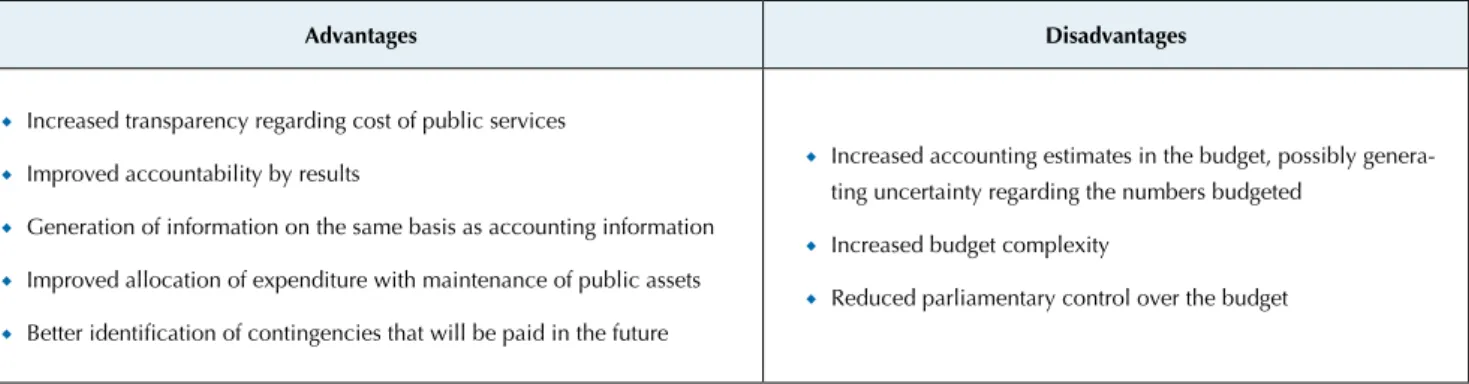
The following table shows the main advantages and di-sadvantages of accrual budgeting ascertained in this study:
Advantages Disadvantages
Increased transparency regarding cost of public services ◆
Improved accountability by results ◆
Generation of information on the same basis as accounting information ◆
Improved allocation of expenditure with maintenance of public assets ◆
Better identiication of contingencies that will be paid in the future
◆
Increased accounting estimates in the budget, possibly genera-◆
ting uncertainty regarding the numbers budgeted
Increased budget complexity ◆
Reduced parliamentary control over the budget ◆
Figure 1 Advantages and disadvantages of using accrual budgeting in the public sector
3 CONCLUSIONS
The accrual basis for budgeting revenue and expen-diture is a process that began approximately twenty years ago, yet accrual budgeting remains a foreign topic in Brazil despite the fact that the accrual approach has been used in accounting events applied to the public sector and cost information used by the federal government.
The main purpose of this study was to understand the importance of accrual budgeting at a period when Brazil has adopted the accrual basis for accounting. As Brazil is
in the process of changing the laws for public finances, a regime of accrual budgeting should not be implemented without first being explored and discussed in academia.
that have already adopted the accrual regime justify the need to discuss the budget-making options acade-mically from the Brazilian perspective. Therefore, this article opens the discussion of accrual budgeting in Brazil by analyzing previous studies and highlighting possible future developments on the subject.
This article has fulfilled its objective of developing a theoretical starting point for the study of the public budget on an accrual basis in Brazil bringing together the main aspects of this budget allocation model by using studies conducted on the subject around the world.
Future discussions and studies should explore the advantages and disadvantages of accrual budgeting in greater depth, which will require more studies on the
experiences of other countries that have adopted accrual budgeting. Future studies should compare countries that have kept cash budgeting after the adoption of the accru-al basis of accounting with countries that have adopted the accrual basis of budgeting and accounting to deter-mine to what extent the same regime should be used for accounting and budgeting.
In addition, studies should be conducted to consider the peculiarities of the Brazilian budget model, the politi-cal institutions and the characteristics of the Brazilian bu-reaucracy focusing not only on international experiences. Such an approach is necessary to avoid the adoption of the accrual model without considering the peculiarities of the Brazilian public administration.
Adhikari, P., & Mellemvik, F. (2011). he rise and fall of accruals: a case of nepalese central government. Journal of Accounting in Emerging Economies, 1 (2), 123-143.
Algemene Rekenkamer. (2003). Accrual budgeting and accounting in central government - budgets and accounts in balance. Haia. Allen, R. (2009). he challenge of reforming budgetary institutions in
developing countries. IMF Working Paper, WP/09/96.
Anessi-Pessina, E., & Steccolini, I. (2007). Efects of budgetary and accruals accounting coexistence: evidence from Italian local governments. Financial Accountability & Management, 23 (2), 113-131.
Anessi-Pessina, E., Nasi, G., & Steccolini, I. (2008). Accounting reforms: determinants of local governments’ choices. Financial Accountability & Management, 24 (3), 321-342.
Athukorala, S. A., & Reid, B. (2003). Accrual budgeting and accounting in government and its relevance for developing member countries. Manila: Asian Development Bank.
Australia. (2008). Operation Sunlight – enhancing budget transparency. Recuperado de http://www.inance.gov.au/inancial-framework/ inancial-management-policy-guidance/operation-sunlight/docs/ operation-sunlight-enhancing-budget-transparency.pdf. Australia. (2010). Budget Paper, 1, 2010-2011. Budget strategy and
outlook. Recuperado de http://www.budget.gov.au/2010-11/content/ bp1/download/bp1.pdf.
Bale, M., & Dale, T. (1998). Public sector reform in New Zealand and its relevance to developing countries. he World Bank Observer, 13 (1), 103-121.
Ball, I., Dale, T., Eggers, W. D., & Sacco, J. (2000). Reforming inancial management in the public sector: lessons Canada can learn from New Zealand. Frontier Centre for Public Policy, Policy Series, 6.
Barton, A. (2005). Professional accounting standards and the public sector – a mismatch. Abacus, 41 (2), 138-158.
Barton, A. (2009). he use and abuse of accounting in the public sector inancial management reform program in Australia. Abacus, 45 (2), 221-248.
Barton, A. (2011). Why governments should use the government inance statistics accounting system. Abacus, 47 (4), 411-445.
Bauer, M. W. (2008). Análise de conteúdo clássica. In W. Martin Bauer, & G. Gaskell. Pesquisa qualitativa com texto, imagem e som. (pp. 189-217). Petrópolis: Vozes.
Blöndall, J. R. (2003a). Budget reform in OECD member countries: common trends. Journal on Budgeting, Paris, OECD, 2 (4), 7-26. Blöndall, J. R. (2003b). Accrual accounting and budgeting: key issues and
recent developments. Journal on Budgeting, Paris, OECD, 3 (1), 43-59. Blöndall, J. R. (2004). Issues in accrual budgeting. Journal on Budgeting,
Paris, OECD, 4 (1), 103-120.
Blöndall, J. R., Bergvall, D., Hawkesworth, I., & Deighton-Smith, R. (2008). Budgeting in Australia. Journal on Budgeting, Paris, OECD, 8 (2), 1-64.
Borges, T. B., Mario, P. do C., Cardoso, R. L., & Aquino, A. C. B. de. (2010). Desmistiicação do regime contábil de competência. Revista de Administração Pública, Rio de Janeiro, 44 (4), 877-901.
Buti, M., Martins, J. N., & Turrini, A. (2007). From deicits to debt and back: political incentives under numerical iscal rules. CESifo Economic Studies, 53 (1), 115-152.
Carlin, T. M. (2003). Accrual output based budgeting systems in Australia
- a great leap backwards. Australian Accounting Review, 13 (2), 41-47. Carlin, T. M. (2005). Debating the impact of accrual accounting
and reporting in the public sector. Financial Accountability & Management, 21 (3), 309-336.
Chan, J. L. (2001, Fall). he implications of GASB statement n. 34 for public budgeting. Public Budgeting & Finance, 21 (3), 79-87. Christie, T. (2009). Accrual budgeting by canadian federal, provincial and
territorial governments. Toronto: he Canadian Institute of Chartered Accountants.
Connolly, C., & Hyndman, N. (2006). he actual implementation of accruals accounting - caveats from a case within the UK public sector. Accounting, Auditing & Accountability Journal, 19 (2), 272-290. Conselho Federal de Contabilidade. CFC. (1993). Resolução 750/93.
Recuperado de www.cfc.org.br/sisweb/sre/docs/RES_750.doc. Conselho Federal de Contabilidade. CFC. (2010). Resolução 1282/2010.
Recuperado de www.cfc.org.br/sisweb/sre/docs/RES_1282.doc. Conselho Federal de Contabilidade. CFC. (2011). Resolução 1367/2011.
Recuperado de www.cfc.org.br/sisweb/sre/docs/RES_1367.doc. Diamond, J. (2006). Budget system reform in emerging economies: the
challenges and the reform agenda. Washington, D.C.: International Monetary Fund.
Eford, D. (1996). he case for accrual recording in the IMF’s government inance statistics system. IMF Working Paper, WP/96/73.
Federal Finance Administration. (2008). he new accounting model of the swiss confederation. Journal on Budgeting, Paris, OECD, 8 (1), 1-38. Government Accountability Oice. GAO, U.S. (1995). Budget issues -
the role of depreciation in budgeting for certain federal investments. Washington.
Government Accountability Oice. GAO, U.S. (2000). Accrual budgeting - experiences of other nations and implications for the United States. Washington.
Government Accountability Oice. GAO, U.S. (2007). Budget issues - accrual budgeting useful in certain areas but does not provide suicient information for reporting on our nation’s longer-term iscal challenge. Washington.
Groot, T., & Budding, T. (2008). New public management’s current issues and future prospects. Financial Accountability & Management, 24 (1), 1-13. Guthrie, J. (1998). Application of accrual accounting in the australian
public sector - rhetoric or reality. Financial Accountability & Management, 14 (1), 1-19.
Hepworth, N. (2003, January). Preconditions for successful
implementation of accrual accounting in central government. Public Money & Managemtent, 23 (1), 37-44.
International Federation of Accountants. IFAC. (2000). Government inancial reporting : accounting issues and practices. Recuperado em 23 setembro, 2011, de http://www.ifac.org/publications-resources/study-11-Government-Financial-Reporting-Accounting-Issues-and-Practices. International Federation of Accountants. IFAC. (2010). 2010 IFAC Handbook
of international public sector accounting pronouncements. Recuperado em 18 outubro, 2010, de http://web.ifac.org/publications/%20international-public-sector-accounting-standards-board.
International Federation of Accountants. IFAC. (2011). Transition to the
accrual basis of accounting: guidance for public sector entities. (3rd.
ed.). Recuperado em 22 setembro, 2011, de http://www.ifac.org/
guidance-governments-and-governm.
International Monetary Fund. IMF. (2001). Government inance statistics manual. Washington DC: International Monetary Fund.
International Monetary Fund. IMF. (2003). Public debt in emerging markets: is it too high? World Economic Outlook. Washington DC: International Monetary Fund.
International Monetary Fund. IMF. (2007). Manual on iscal transparency. Washington DC: International Monetary Fund.
Jagalla, T., Becker, S. D., & Weber J. (2011). A taxonomy of the perceived beneits of accrual accounting and budgeting: evidence from german states. Financial Accountability & Management, 27 (2), 134-165. Jones, R. United Kingdom. (2003). In K. Lüder, & J. Rowan. Reforming
governmental accounting and budgeting in Europe. Frankfurt am Main: Fachverlag Moderne Wirtschat, 941-1018.
Jones, R., & Lüder, K. (2011). he federal government of Germany's circumspection concerning accrual budgeting and accounting. Public Money & Management, 31 (4), 265-270.
Keuning, S., & Van Tongeren, D. (2004). he relationship between government accounts and national accounts, with special reference to the Netherlands. Review of Income and Wealth, 50 (2), 167-179. Lei 432/1964. (1964). Recuperado de http://www.planalto.gov.br/ccivil_03/
leis/l4320compilado.htm.
Likierman, A. (2000). Changes to managerial decision-taking in U.K. central government. Management Accounting Research, 11 (2), 253-261. Lüder, K., & Jones, R. (2003). he difusion of accrual accounting and
budgeting in european governments – a cross-country analysis. In K. Lüder, & R. Jones. Reforming governmental accounting and budgeting in Europe. (pp. 13-58). Frankfurt am Main: Fachverlag Moderne Wirtschat. Martí, C. (2004). Hacia el presupuesto por devengo en las
administraciones publicas. Auditoría Pública, 34, 87-94.
Marti, C. (2006). Accrual budgeting: accounting treatment of key public sector items and implications for iscal policy. Public Budgeting and Financing, 26 (2), 45-65.
Martí Lopez, C. (2008). Aspectos clave en la presupuestación por devengo: las cargas de capital. Presupuesto y gasto público, 51, 243-254. Meyers, R. T. (2009). he “Ball of Confusion” in federal budgeting: a
shadow agenda for deliberative reform of the budget process. Public Administration Review, 69 (2), 211-223.
Murray, A. (2008). Review of Operation Sunlight: overhauling budgetary transparency. Australia. Recuperado de http://www.inance.gov. au/inancial-framework/inancial-management-policy-guidance/ operation-sunlight/docs/budget-transparency-report.pdf. Organisation for Economic Co-operation and Development. OECD.
(2009). Evolutions in budgetary practice: Allen Schick and the OECD Senior Budget Oicials. Paris.
Paulsson, G. (2006). Accrual accounting in the public sector: experiences from the central government in Sweden. Financial Accountability & Management, 22 (1), 47-62.
Paulsson, G. (2007). Accrual accounting and cash budgeting - the prospects for running a dual system. Sweden: Department of Business Administration, School of Economics and Management, Lund University.
Pigatto, J. A. M., Holanda, V. B. de, Moreira, C. R., & Carvalho, F. A.
(2010). A importância da contabilidade de competência para a informação de custos governamental. Revista de Administração Pública, Rio de Janeiro, 44 (4), 821-837.
Rezende, F., Cunha, A., & Bevilacqua, R. (2010). Informações de custos e qualidade do gasto público: lições da experiência internacional. Revista de Administração Pública, Rio de Janeiro, 44 (4), 959-992. Robb, A, & Newberry, S. (2007). Globalization: governmental accounting
and International Financial Reporting Standards. Socio-Economic Review, 5 (4), 725-754.
Robinson, M. (1998). Measuring compliance with the Golden Rule. Fiscal Studies, 19 (4), 447-462.
Robinson, M. (2002a, Winter). Output-purchase funding and budgeting systems in the public sector. Public Budgeting and Financing, 22 (4), 17-33. Robinson, M. (2002b, Spring). Financial control in australian government
budgeting. Public Budgeting and Financing, 22 (1), 80-93.
Robinson, M. (2002c). National and state iscal rules in Australia: an outline
and critical analysis. Rome: Proceedings of the 3rd Banca d’Italia
Workshop on Fiscal Policy, Perugia, Banca d’Italia, January 2001. Robinson, M. (2009). Accrual budgeting and iscal policy. Journal on
Budgeting, Paris, OECD, 2009 (1), 1-29.
Salinas, F. J. (2002). Accrual budgeting and iscal consolidation in the EMU. Contemporary Economic Policy, 20 (2), 193-206.
Scheers, B., Sterck, M., & Bouckaert, G. (2005). Lessons from Australian and British reforms in results oriented inancial management. Journal on Budgeting, Paris, OECD, 5 (2), 133-162.
Schick, A. (1996). he spirit of reform: managing the New Zealand state sector in a time of change. New Zealand: Report Prepared for the State Services Commission and he Treasury.
Schick, A. (1998). Why most developing countries should not try New Zealand's Reforms. he World Bank Research Observer, 13 (1), 123-131. Schick, A. (2007). Performance budgeting and accrual budgeting: decision
rules or analytic tools? Journal on Budgeting, Paris, OECD, 7 (2), 109-138.
Schick, A. (2009). Budgeting for iscal space. Journal on Budgeting, Paris, OECD, 2009 (2), 1-18.
Sterck, M., Scheers, B., & Bouckaert, G. (2004). Réformes budgétaires dans le secteur public: tendances et déis. Revue Internationale de Politique Comparée, 11 (2), 241-269.
Torres, L. (2004). Accounting and accountability: recent developments in government inancial information systems. Public Administration and Development, 24 (5), 447-456.
Van der Hoek, M. P. (2005). From cash to accrual budgeting and accounting in the public sector: the Dutch experience. Public Budgeting & Finance, 25 (1), 33-45.
Warren, K, & Barnes, C. (2003). he impact of GAAP on iscal decision making: a review of twelve years’ experience with accrual and output-based budgets in New Zealand. Journal on Budgeting, Paris, OECD, 3 (4), 7-40.