90 Brazilian Journal of Physics, vol. 36, no. 1, March, 2006
Glycymeris Longior Shells, an Alternative
γ
Radiation Reference Detector
Carlos Fainstein
Centro At´omico Bariloche, CNEA and Instituto Balseiro, UNC Av. E. Bustillo 9500, Bariloche, CP8400RN, Argentina
Received on 9 September, 2005; accepted on 31 October, 2005
Gamma irradiation of biogenic calcium carbonate, from fossil shells of species Glycymeris Longior, results in the formation of CO2−centers, as measured by electron paramagnetic resonance spectroscopy. The spectral line intensity increases linearly with increasing dose, without distortion, up to 50Gy. Fitting of the data yields the equation,
Dose[Gy]=-0.8(0.6)+0.0258(0.0004)×[dχ”/dH]pp/mg.
Over a year control measurements show no significative change in the data.
Keywords: Gamma irradiation; EPR
I. INTRODUCTION
The majority of invertebrate skeletal tissues are composed of the most stable crystalline polymorphs of CaCO3, calcite, and/or aragonite. A survey of the known biogenic minerals shows that approximately 80% are crystalline and 20% are amorphous(1).
After gamma irradiation, fossil shells were reported to show electron paramagnetic resonance (EPR) spectral lines, that were attributed to different paramagnetic centers(2,3), all
re-lated to the CO23−molecule ion(4).
For the CO2−center, the accepted g-values are those given by S.A.Marshall et al. (3), with the z-axis along the C-O bond, the x-axis in the [111] direction and the y-axis perpen-dicular to both. Those g-values are gx=2.00161, gy=1.99727,
and gz=2.00320; with g=2.00232 for the free electron value.
Those data were obtained from optical grade single crystals, at 77K, when spectral lines are 30mG wide. Below 77K the linewidths remain constant, but broaden for temperatures above 77K, and the spectral lines overlap. The total angular variation of the spectra is about 8G.
In this work we report EPR data obtained from fossil sea shells of the family Glycymerididae, species Glycymerys Longior (GL), gamma irradiated by a137Cs55 (Eγ=661keV) source. The irradiation rate was 0.24Gy/min, and the esti-mated error in the values of Dose is less than 4%.
We discuss the use of biogenic material obtained from GL fossil shells as a possible gamma irradiation detector and ref-erence data storage, up to 50Gy Dose.
II. SAMPLES
A large number of fossil shells of GL were collected at the Atlantic sea shore, more precisely at Golfo San Matias, Argentina (40 ˚ 44’S, 64 ˚ 57’W), selecting those that were whole and slightly polished by weather exposure. Three of those shells (about 25g total weight) were washed with a mild detergent, air dried and then pulverized with mortar
and pestle. The powder thus obtained was passed through a 0.15mm×0.15mm sieve, and quantities of a few grams stored in polystyrene vials for further irradiation and storage. The EPR spectra of both the non-irradiated and irradiated samples, for each of the three shells, were found equal, and well within the spectrometer precision limit. Accordingly, we neglected EPR differences between the shells.
The XRD spectra of the material, see Fig. 1, show spectral lines that are assigned to the Aragonite and Calcite phases of Calcium Carbonate. Some XRD spectral lines remain uniden-tified, such as those located at 2θ= 18.18 ˚ , 34.19 ˚ , 43.04 ˚ and 50.32 ˚ .
FIG. 1: XRD spectra of fossil shells, species Glycymeris Longior. Scattered points show data for Aragonite (open circles) and Calcite.
III. EPR OF NON IRRADIATED SAMPLES
Carlos Fainstein 91
FIG. 2: EPR spectra of non-irradiated Glycymeris Longior fossil shells.
IV. EPR OFγ-IRRADIATED SAMPLES
Figure 3 shows the EPR spectral lines of irradiated samples of GL shells, as recorded, for dose 0Gy, 4.8Gy and 48Gy. The spectral lines enclosed in circles are Mn2+reference signals, from a single crystal of MgO.
FIG. 3: EPR spectral lines of irradiated fossil shells of Glycymeris Longior.
Samples were irradiated in the dose range as required for blood irradiation protocols, in 5Gy steps, up to 50Gy. Known amounts of sample (about 100mg each) were lightly packed into 3mm diameter pure quartz tubes, and then sealed. In or-der to compare quantitatively the EPR spectrum for the differ-ent irradiation doses, the following corrections were made,
1. Normalization of the spectra to a common value of spec-trometer frequency,
2. Normalization to a common value for the spectrometer signal gain, using as a reference, the III and IV Mn2+EPR spectral lines from a MgO crystal, fixed to the sample holder,
FIG. 4: a) Normalized EPR spectral lines from fossil shells of Gly-cymeris Longior, for Dose in the range 4.8Gy to 48.0Gy.
FIG.4: b) EPR peak-to-peak amplitude for Glycymeris Longior shells as a function ofγirradiation dose. The EPR amplitude from
unirradiated shells has been subtracted.
and
3. The EPR spectrum for the non irradiated sample was subtracted from all EPR spectra of the irradiated samples.
The final result after applying these corrections is shown in Fig. 4a, were it should be noted that the spectral line-shape remains unchanged, and that its amplitude, [dχ”/dH]pp/mg,
increases with increasing Dose. The spectral line-shape can be simulated with the parameters: gx=2.0017, gy=1.9975 and
gz=2.0033; [with line-widths∆Hx=0.325mT,∆Hy=0.400mT,
and∆Hz=0.375mT]. These values agree with those given by
Marshall et al. (3) for the CO−2 center, in an optical grade CO3Ca single crystal.
92 Brazilian Journal of Physics, vol. 36, no. 1, March, 2006
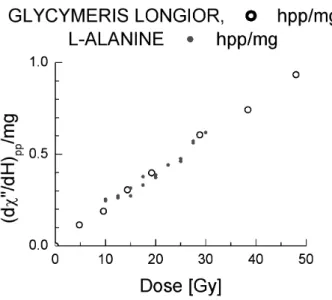
FIG. 5: EPR peak-to-peak amplitude as function ofγ-dose for both Glycymeris Longior (open circles) and L-Alanine samples.
Finally, in Fig. 5 we compare data from both the amino acid L-Alanine(5)and the biogenic mineral from GL, in the blood
irradiation range, from 15Gy to 50Gy(6,7)..
V. CONCLUDING REMARKS
Fossil shells from species Glycymeris Longior are exten-sively found at the atlantic shore, from Baia do Esp´ırito Santo, Brasil (20 ˚ 17’S, 40 ˚ 15’W) to Golfo San Mat´ıas, Ar-gentina (40 ˚ 44’S, 64 ˚ 57’W); the material of those shells is mostly polymorph calcium carbonate. A stable paramag-netic center is created on this biogenic mineral byγ-irradiation (up to 50Gy), which is identified by EPR spectroscopy as a CO2− radical. The number of those radicals increases lin-early with γ-dose, much at the same rate as it does for the aminoacid L-Alanine. For γ-dose larger than 50Gy the re-sponse {[(dχ”/dH)pp/mg]/Dose} is reduced, suggesting the
onset of saturation
We conclude that the availability of this biogenic mineral, the stability of the radiation induced paramagnetic defect, and the response of the EPR line intensity versusγ-dose, favours the use of this solid as an EPR radiation detector in the blood irradiation range.
[1] H. A. Lowenstam and S. Weiner, On Biomineralization, Oxford University Press, New York, 1989.
[2] Ikeya, M. New applications of electron spin resonance: dating,
dosimetry and microscopy. Singapore, World Scientific 1993.
ISBN 9810211996.
[3] H. Peishua, L. Renyou, and J. Sizhao, P. Zicheng, and N. W. Rutter Appl. Radiat. Inst. 40, No. 10-12, 1119 (1989). (Int. J. Radiat. Appl Instrumen. Parr A)
[4] S. A. Marshall, A. R. Reinberg, R. A. Serway, and J. A. Hodges.
Mol. Phys. 8, 225 (1964).
[5] “Practice for use of the alanine-EPR dosimetry system”. ISO/ASTM FDIS 51607:2001(E).
[6] “Practice for blood irradiation dosimetry”. ISO/ASTM FDIS 51939:2001(E).