Gamma Radiation Effects on Polydimethylsilane Stationary Phases
for Use in Packed-Column Gas Chromatographic Analyses
M.B. Adaime*, M.J.T.F. dos Santos, I. Facchin, K.E. Collins,
and C.H. Collins
Instituto de Química , Universidade Estadual de Campinas, C.P. 6154,
13.083-970 Campinas - SP, Brazil
Este trabalho estudou os efeitos da radiação gama como indutora da imobilização de fases estacionárias líquidas de polidimetilsilicones usadas para separações cromatográficas em colunas recheadas. Testes de extração em solventes mostram que doses moderadas de radiação gama (80-140 kGy) produzem imobilização (90%) da maioria dos polidimetilsilicones testados em suportes do tipo Chromosorb, apesar do efeito da massa molecular ser importante. A estabilidade térmica também aumenta significativamente, possibilitando o uso de altas temperaturas sem perdas por volatilização. Espectros no infravermelho confirmam a presença de fase estacionária no suporte após testes de estabilidade térmica e após lavagem exaustiva com solventes em coluna croma-tográfica. O comportamento cromatográfico das fases imobilizadas é igual ou melhor do que o das fases não-irradiadas, exceto no caso de altas doses (300 kGy) de radiação gama. As colunas preparadas com polimetilsilicones imobilizados por radiação gama podem ser usadas com sucesso em análises onde a contaminação da coluna por compostos de alto ponto de ebulição exigem frequente recuperação da mesma.
Gamma radiation induced immobilization of several polydimethylsilane liquid stationary phases for use in packed-column gas chromatographic separations has been studied. Extraction tests show that moderate doses of gamma radiation (80-140 kGy) are sufficient to produce significant (90%) immobilization of most polydimethylsilanes onto Chromosorb supports, although a molecular mass effect is seen. Thermal stability also increases significantly with radiation dose, suggesting higher temperature use with smaller volatility losses. Infrared spectra confirm the continued presence of the stationary phase on the support after thermal stability tests and after exhaustive in-column washing. The column chromatographic behavior of the immobilized phases is equal to or better than that of the unirradiated phases, except for higher doses (300 kGy) of gamma-radiation. Columns prepared from gamma-immobilized polydimethylsilane have been used successfully in analyses where column contamination from high boiling materials requires frequent column recuperation.
Keywords: gas chromatography, packed columns, immobilized phases, gamma radiation
Introduction
Liquid polymeric stationary phases used in gas chroma-tography often present limitations due to volatility or ther-mal stability, which impose upper temperature limits on their use. One way to alleviate this problem is through chemical bonding of the liquid stationary phase to the support1, as is done for most HPLC stationary phases. Another way to improve stationary phase stability is by crosslinking reactions which increase the polymer molecu-lar mass. These immobilization processes, which involve bonding between the chains with possible bonding to the
support2, are usually initiated by free radicals produced by heat3,4, chemical initiators such as peroxides5,6, azo com-pounds7,8 or ozone9, low temperature plasmas10, or by ionizing radiation from accelerated electrons11 or from gamma irradiation12-17.
These free radical initiated immobilization methods have been very successful in producing modern high tem-perature capillary columns. However, very little informa-tion exists about immobilizainforma-tion of supported liquid stationary phases for use in packed-column gas chromatog-raphy18. This investigation was undertaken to investigate the properties of several polydimethylsilanes on Chro-Article
mosorb supports after immobilization by different doses of gamma irradiation.
Experimental
Materials
The polydimethylsilane liquid phases were dissolved in chloroform for preparing different loadings on Chromosorb W (80-100 mesh) or Chromosorb W-HP (80-100 mesh). Portions of the prepared packings were placed in glass ampoules and sealed under air for irradiation in an indus-trial irradiation facility operated by IBRAS-CBO (Campi-nas, Brazil). All solvents and most of the test compounds were p. a. and used without further treatment. When neces-sary, reagents were purified by conventional methods19.
Equipment
Two different gas chromatographic systems were used: a Varian 1700 and an Instrumentos Científicos CG 500, both equipped with flame ionization detectors. Packed stainless steel columns were positioned to permit on-col-umn injection.
Infrared spectra were taken on a Perkin-Elmer 399B spectrophotometer while thermogravimetric analyses were carried out on a DuPont model 1090B thermal analyzer with a model 951‘thermogravimetric analyzer.
Testing procedures
Solvent extraction of the packings was carried out in a modified Soxhlet apparatus20 with three solvents (metha-nol, hexane and chloroform), each for six hours.
A number of compounds with different polarities were used to evaluate the efficiency of each stationary phase, as determined by the retention factor (k), platenumber (N), resolution (Rs) and asymmetry factor (As) at 10% of peak height. The chromatographic conditions for each separa-tion, isothermal or with temperature programming, were determined by optimizing resolution of each mixture on an unirradiated column. The mobile phase (N2) retention time was determined by injecting a mixture of propane and butane (cooking gas) at three different temperatures (60, 110 and 160 °C).
For the thermal stability tests, the column was heated in the chromatograph oven, without the detector connection, for one hour each at successively higher temperature, meas-uring the efficiency (plate number) of a standard compound (2-butanone) at 60 °C after each step.
The columns were also subjected to successive rinsings at 200 °C15, injecting one column volume each of acetone, 1:1 acetone-dichloromethane, 4:1 dichloromethane-pen-tane, 1:1 dichloromethane-pentane and pendichloromethane-pen-tane, with the detector disconnected. Following this, the efficiencies of the columns were determined (n-decane and benzyl alco-hol) at 110 °C.
Results and Discussion
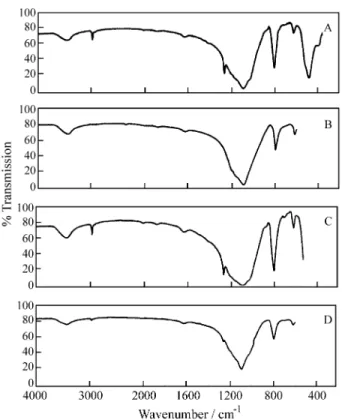
Solvent extraction removes all of the polydimethylsi-lane liquid stationary phase (SP) from unirradiated pack-ings. Extraction removes a small amount of the SP from the irradiated packings, quantities which appear directly re-lated to the irradiation dose received (Table 1). Immobi-lization by radiation was less effective with SP-2100 and DC-200, although even with these packings some immobi-lization occurred, as shown by the continued presence of the 2960 cm-1 band in the infrared spectra (Figs. 1 and 2) after extraction of the irradiated samples. Extraction of unirradiated packings removes the liquid SP and this band disappears.
Low irradiation doses are sufficient to immobilize sig-nificant quantities of SE-30, with no dependence on either the initial quantity placed on the support or on whether the support was, or was not, silanized (Table 1). Higher doses increase the quantity immobilized. The fact that the same percentage of SE-30 appears to be immobilized onto the support, independent of the initial quantity of liquid18 or of the presence of methyl groups from the silanizing reaction on Chromosorb W-HP, suggests that the immobilization is mainly related to crosslinking of the polydimethylsilane
chains rather than to formation of chemical bonds to the support.
The different percentages of immobilization observed, comparing SE-30 and DC-200, may be related to their different molecular masses, since SE-30 has a mass of about 1.0 - 2.5 x 10⁶ daltons while DC-200 has a range of only 1.6 - 6.7 x 10⁴ daltons21. Thus, to fully immobilize DC-200 would require much more crosslinking than is needed with SE-30.
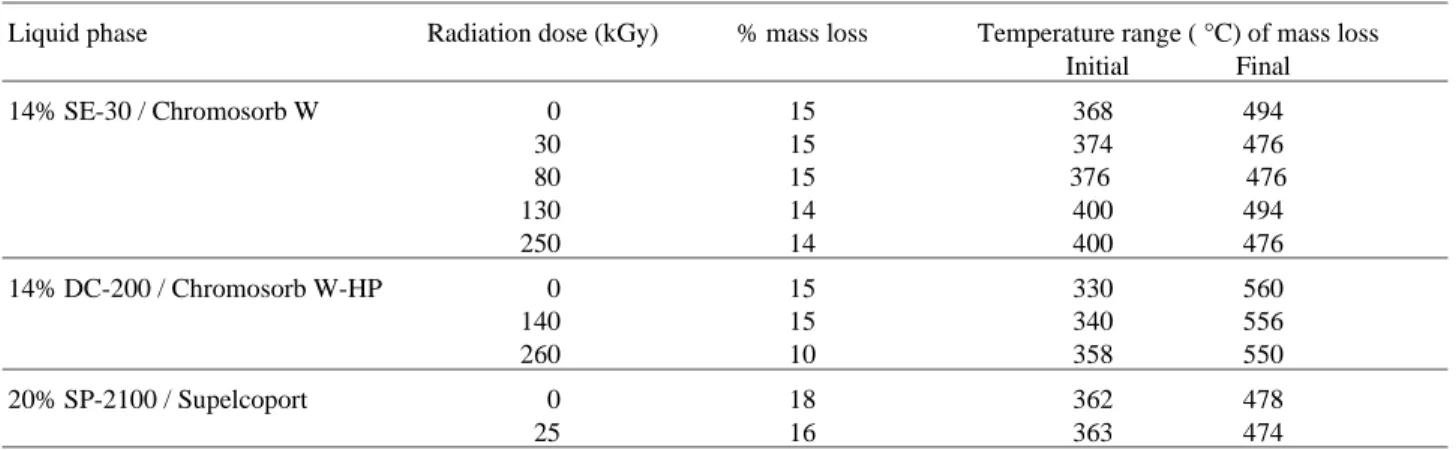
In contrast to the results obtained by extraction, thermo-gravimetry on the several packings did not indicate signifi-cant differences between unirradiated and irradiated packings (Table 2). On the other hand, thermal stability tests carried out on packed columns indicate significant increases in the temperature maximum of the irradiated (immobilized) packings, in comparison to unirradiated packings. The temperature maximum usually indicated22 for SE-30 is 300 °C, for DC-200, 250 °C and for SP-2100, 350 °C. As shown in Table 3, the immobilized packings have useful temperature ranges up to 50 °C higher than these values.
In order to see how much liquid stationary phase re-mained after this heat treatment, a portion of the packing was removed from the column after the 400 °C step for extraction. For the unirradiatedpacking, 62% of the quan-tity initially present was extracted after the heat treatment, indicating that part of the liquid SP had decomposed and/or volatilized, since infrared spectra taken after the extraction did not show the presence of residual polydimethylsilane. No evidence of volatilization was obtained for the irradi-ated phases after the heat treatment; both the extraction tests and the infrared spectra were the same as before the 400 °C thermal treatment.
Extensive column rinsing of radiation immobilized SE-30 packings did not significantly change their efficiencies, nor did it modify the infrared spectra (Fig. 3). Extraction of the unirradiated packing after rinsing removed 78% of the quantity originally present, indicating that up to 22% had been washed off in the rinsing test. By contrast, no change was observed in the amount extracted (and in the sub-sequent infrared spectra) for irradiated phases after the rinsing test. This enhanced stabilityproperty, which per-mits extensive rinsing of a packed column, has proved very useful in column recuperation when injecting reaction product mixtures having a wide range of properties and
Figure 2. Infrared spectra of 14% DC-200 on Chromosorb W-HP. A: before irradiation or extraction; B: unirradiated packing after extraction; C: packing irradiated to 260 kGy; D: packing irradiated to 260 kGy and subsequently extracted.
Table 1. Percentages of the liquid phases immobilized by different irradiation doses.
Liquid phase / support Radiation dose
(kGy)
%Extracted* (total)
% immobilized (total)
14% SE-30 / Chromosorb 0
30 80 130 250 100 28 15 12 12 0 72 85 88 88
17% SE-30 / Chromosorb W-HP 0
including high boiling materials where frequent column recuperation is required23.
Several different synthetic mixtures were analyzed on the packed columns. In the packing containing DC-200, both the plate number and the asymmetry factor were
Table 3. Thermal stability, as determined by column efficiency, after heating at different temperatures in the chromatograph oven.
Liquid phase / support Radiation dose (kGy) Theoretical plate number after heat treatment to given temperature
200 °C 250 °C 300 °C 350 °C 400 °C
14% SE-30 / Chromosorb W 0
250
1200 1200
1200 1200
900 900
900 900
700 1200
27% SE-30 / Chromosorb W-HP 0
280
700 1500
700 1400
600 1200
500 900
400 800
14% DC-200 / Chromosorb W-HP 0
260
1300 600
1300 600
1200 600
---Figure 3. Infrared spectra of 14% SE-30 on Chromosorb W. A . before irradiation or extraction; B: unirradiated packing after the rinsing test; C: packing irradiated to 80 kGy, after the rinsing test.
Figure 4. Chromatograms obtained with 14% DC-200 on Chromosorb W-HP. Column: 1.2 m x 2.0 mm (id); mobile phase: N2 at 30 mL/min; Tcol = 110 °C; Tinj = 220 °C; Tdet = 270 °C; 1 = 2-pentanone; 2 = aniline; 3 = 2 ethyl-1-hexanol; 4 = n-undecane; 5 = methyl octanate. A: unirradi-ated packing; B: packing irradiunirradi-ated to 260 kGy.
Table 2. Thermogravimetry on immobilized packings.
Liquid phase Radiation dose (kGy) % mass loss Temperature range ( °C) of mass loss
Initial Final
14% SE-30 / Chromosorb W 0
30 80 130 250
15 15 15 14 14
368 494
374 476
376 476
400 494
400 476
14% DC-200 / Chromosorb W-HP 0
140 260
15 15 10
330 560
340 556
358 550
20% SP-2100 / Supelcoport 0
25
18 16
362 478
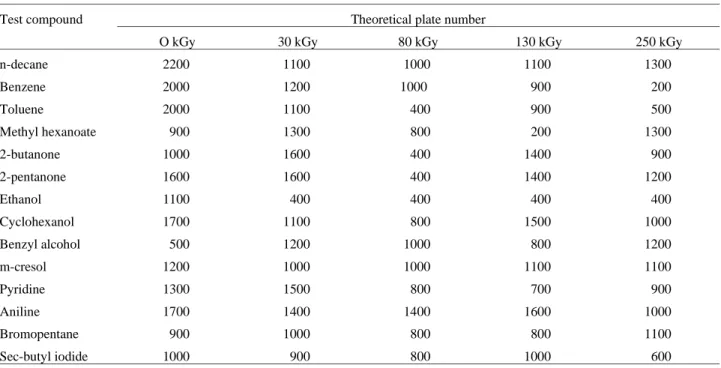
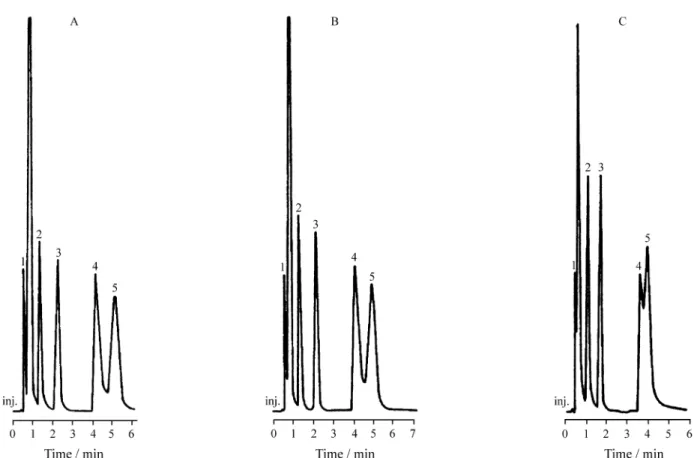
poorer after irradiation, although no change in resolution was observed (Fig. 4). On the other hand, the immobi-lization of SP-2100 produced a packing with better chro-matographic characteristics (Fig. 5). With SE-30 the chromatographic behavior appears to depend on the test compound, as summarized in Table 4.
As shown in Figs. 6 and 7, resolution improved after irradiation for SE-30 on Chromosorb W-HP, even through neither the retention times nor the plate numbers changed significantly. This improvement is related to the irradiation
dose received. However, as indicated in Fig. 7c, both reten-tion time and resolureten-tion decreased after a high dose. This may be related to a higher degree of crosslinking, which has produced a much more viscous phase, or to radiation de-composition of theSP.
It thus appears that, for each liquid stationary phase-support combination, there is an optimal dose which results in a high percentage of liquid stationary phase being immo-bilized without causing so much crosslinking that the phase
Table 4. Theoretical plate number for 14% SE-30 on Chromosorb W, without irradiation and after several irradiation doses for different test compounds.
Test compound Theoretical plate number
O kGy 30 kGy 80 kGy 130 kGy 250 kGy
n-decane 2200 1100 1000 1100 1300
Benzene 2000 1200 1000 900 200
Toluene 2000 1100 400 900 500
Methyl hexanoate 900 1300 800 200 1300
2-butanone 1000 1600 400 1400 900
2-pentanone 1600 1600 400 1400 1200
Ethanol 1100 400 400 400 400
Cyclohexanol 1700 1100 800 1500 1000
Benzyl alcohol 500 1200 1000 800 1200
m-cresol 1200 1000 1000 1100 1100
Pyridine 1300 1500 800 700 900
Aniline 1700 1400 1400 1600 1000
Bromopentane 900 1000 800 800 1100
Sec-butyl iodide 1000 900 800 1000 600
Figure 5. Chromatograms obtained with 20% SP-2100 on Supelcoport. Column: 1.7 m x 1.5 mm (id); mobile phase: N2 at 30 mL/min; Tcol = 110 °C; Tinj = 160 °C; Tdet = 160 °C; 1 = methyl hexanoate; 2 = aniline; 3 = n-decane; 4 = benzyl alcohol; 5 = m-cresol. A: unirradiated packing; B: packing irradiated to 25 kGy.
becomes too viscous to show good chromatographic behav-ior, or promoting polymer degradation. Irradiation immo-bilization of liquid stationary phases on supports can be carried out before packing the column, permitting an ex-traction test to evaluate the degree of immobilization ob-tained. Such immobilized packings show enhanced stability at higher temperatures and permit rinsing the col-umn for recuperation, when it becomes contaminated, with-out losing characteristic chromatographic properties.
Acknowledgements
The authors thank CNPq for fellowships, FAPESP, FAEP (UNICAMP) and Dow Química do Brasil for finan-cial support and IBRAS-CBO for invaluable cooperation.
References
1. Abel, E.W.; Polland, F.W.; Uden, P.C.; Nickless, G.D.
J. Chromatogr. 1966, 22, 23.
2. Grob, K.; Grob, G. J. High Resol. Chromatogr.
Chro-matogr. Commun. 1981, 4, 491.
3. Petsev, N.D.; Pekov, G.I.; Alexandrova, M.D.; Dimitrov, C. Chromatographia 1985, 20, 228. 4. Lai, G.; Mühlek, U.; Nicholson, G.J.; Schmid, J.;
Bayer, E. Chromatographia 1991, 32, 241.
5. Schneider, R.C.S.; Pizzutti, I.R.; Adaime, M. B. J.
Braz. Chem. Soc. 1997, 8, 3.
6. Cigánek, M.; Dressler, M.; Teply, J. J. Chromatogr. 1991, 588, 225.
7. Janák, K.; Horká, M.; Tesarík, K. J. Chromatogr. 1989, 471, 237.
8. Horká, M.; Kahle, V.; Krejá, M. J. Chromatogr. 1993,
637, 96.
9. Chuang, C.H.; Shanfield, H.; Zlatkis, A.
Chroma-tographia 1987, 3, 169.
10. Springston, S.R.; Dezaro, D.A. J. Chromatogr. 1989,
473, 79.
11. Markides, K.; Blomberg, L.; Buijten, J.; Wämmam, T.
J. Chromatogr. 1983, 267, 29.
12. Bertsch, W.; Pretorius, V.; Pearce, M.; Thompson, J.C.; Schnautz, N.G. J. High Resol. Chromatogr.
Chromatogr. Commun. 1982, 5, 432.
13. Schomburg, G.; Husmann, H.; Ruthe, S.; Herraiz, M.
Chromatographia 1982, 15, 599.
14. Barry, E.F.; Hubball, J.A.; DiMauro, P.R.; Chabot, G.E. J. High Resol. Chromatogr. Chromatogr.
Com-mun. 1983, 6, 300.
15. Hubball, J.A.; DiMauro, P.R.; Barry, E.F.; Lyons, E.A.; George, W.A. J. Chromatogr. Sci. 1984, 22, 185.
16. Vigh, G.; Etler, O. J. High Resol. Chromatogr.
Chro-matogr. Commun. 1984, 7, 620.
17. Tatar, V.; Mopl, M.; Matucha, M.; Pesek, M. J.
Chro-matogr. 1985, 328, 337.
18. Basso, M.A.; dos Santos, M.J.T.F.; Collins, K.E.; Col-lins, C.H. J. High Resol. Chromatogr. 1989, 12, 500. 19. Perrin, D.D.; Armarege, W.L.F.; Perrin, D.R.
“Purifi-cation of Laboratory Chemicals”, 2nd. ed., Pergamon Press, Oxford, 1980.
20. Sanchez, E.F.; Dominguez, J.A.G.; Muñoz, J.G.; Molera, M.J. J. Chromatogr. 1984, 299, 151. 21. Haken, J.K. J. Chromatogr. 1984, 300, 1. 22. Yancey, J.A. J. Chromatogr. 1985, 23, 161.
23. Carvalho, W.A.; Krähembühl, C.G.Z.; Collins, C.H.; Schuchardt, U.F. Anais of the 6th Brazilian Seminar on Catalysis, Instituto Brasileiro de Petróleo, 260, 1991.
Received: June 23, 1998