ABSTRACT: Directed Infrared Countermeasures (DIRCM) are used to protect aircrafts against missiles with infrared (IR) guidance. They are employed by military and civilian aircrafts, drawing away the guidance system of a missile as it attempts to lock onto the IR signature of the turbines. Unfortunately, the protection provided by these devices generates risks and challenges that must be overcome. In this paper, investigations on DIRCM risks to ighter aircraft pilots are carried out. Different kinds of lasers employed in actual DIRCMs are analyzed and the results show that, depending on their frequency (wavelength), damages can occur up to a distance of 4.8 km. The transmittance through the canopy of an F-5 ighter aircraft is evaluated and its effects on the IR propagation are predicted by the use of software called Counter-Measurements in PYTHON (CMePy). Results show that, even when there are interfaces between the pilot and the source of radiation, damages can occur, showing the importance of this investigation to the right understanding of this subject and future mitigations.
KEYWORDS: Aerospace, Safety, Defense systems, Laser, DIRCM, Infrared.
Investigations on Directed Infrared
Countermeasures Risks to Fighter
Aircraft Pilots
Lester de Abreu Faria1, Luciano Barbosa Magalhães2, Roberto d’Amore1
CONTEXTUALIZATION
Since September 11th, 2001, the entire world, but specially
the USA, focuses its attention on the use of man portable air defense system (MANPADS) as the main terrorist’s weapon for striking civilian and military aircrats. Today, there are approximately 500,000 shoulder-ired missiles in military arsenals around the world, while there are from 5,000 to 150,000 in the hands of up to 30 non-state organizations, according to a report by the Congressional Research Service (CRS) (Bolkcom et al., 2003). An analysis provided by the CRS indicates that, in the last 30 years, there were, at least, 35 civilian aircrat attacks through the use of MANPADS, of which 24 were shot down (Laurenzo, 2005; Nakagawara and Montgomery, 2008).
Since then, there has been a trend not only for military but also for civilian aircrats to be equipped with some kind of countermeasure that can draw away the guidance system of a missile as it attempts to lock onto the infrared (IR) signature of the turbines of the aircrat.
Flare-based C-MANPAD systems were a main solution for military aircrats, but the fear of collateral damage from these kinds of countermeasures, should the lares be deployed by mistake, makes it non-optimum. herefore, some alternative countermeasure systems were developed to be employed as infrared countermeasures (IRCM). hese systems disrupt the guidance systems of surface-to-air missiles (SAM), using multiple-wavelength lasers that emit radiation in the IR portion of the electromagnetic spectrum. Unfortunately, new
1.Instituto Tecnológico de Aeronáutica – São José dos Campos/SP – Brazil 2.Comando-Geral de Operações Aéreas – Rio de Janeiro/RJ – Brazil
Author for correspondence: Lester de Abreu Faria | Praça Marechal Eduardo Gomes, 50 – Vila das Acácias | CEP 12.228-900 São José dos Campos/SP – Brazil | Email: [email protected]
systems generate new risks and new challenges to scientiic and medical areas that must be overcome.
IR emissions from these laser systems can be hazardous to ocular tissues and skin under certain circumstances. Depending on factors like energy delivered per unit area, exposure time, and wavelength, several damages can occur.
he major danger in IR emissions to the human vision is the lack of response of the ocular system to this type of radiation. he human eye can detect only wavelengths in the visible optical range and, in the case of the IR radiation, it is only noticed when some kind of damage has already happened (Nakagawara and Montgomery, 2008).
Figure 1 indicates which wavelengths are mainly absorbed in the diferent parts of the eye: the cornea, the lens, or the retina (Brunetaud and Hill, 2012).
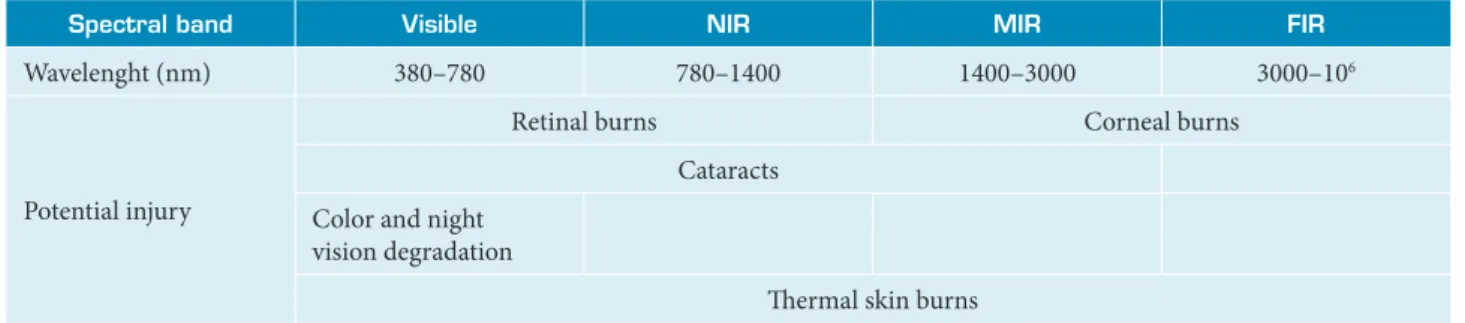
Concerning the IR wavelengths, if the source is within the nominal ocular hazard distance (NOHD) of the pilot, near-IR (NIR) (780–1400 nm) laser radiation may damage the retina, while middle-IR (MIR) and far-IR laser radiations (>1400 nm) can injure the cornea and, to a lesser extent, the crystalline lens.
On the other hand, although skin burns are not generally very serious if a person is able to feel the damage and leave the radiation area, it becomes much more serious if people cannot react to the exposure, as the situation where a pilot is engaged in a combat arena (Brunetaud and Hill, 2012).
Table 1 demonstrates the potential injuries resulting from the excessive exposure to visible and IR radiation.
Excessive exposure to optical radiation in diferent ranges is currently a concern to industrial hygienists, safety engineers, and public health oicials in many developed countries around the world for their potential hazard to health and safety (Nakagawara and Montgomery, 2008). In the literature, a lot of information and works can be found about dangers associated with exposure to excessive levels of visible and UV radiation in the USA National Airspace System (NAS) (Difey and Roscoe, 1990; Caidin, 1992; West et al., 1998) and other airspace systems (NASA, 1998; Wisegeek, 1999; Setlow, 2003). here are, as well, many studies on the transmittance of polycarbonate in diferent ranges of IR. However, only a few works conjugate both information and deal with the potential hazards to human health from the exposure to high levels of IR radiation, in free space or through an additional interface (Nakagawara and Montgomery, 2008). Above all, such kind of research has not yet been performed in Brazil, leading to a lack of information on professional diseases and impacting the performance of the pilots. he same results found in this work can be expandable to the “occupational health and safety”, for all of those who work with laser emissions.
This paper shows a study made by the Electronic Warfare Laboratory (LAB-GE), at Technological Institute of Aeronautics (ITA), Brazil, concerning to the IR and visible radiation risks to the pilot’s health and the protection provided by aircraft canopies. Transmittance properties of a fighter aircraft canopy from the visible to the IR range
Table 1. Potential injuries from excessive exposure to visible and infrared radiation.
Spectral band Visible NIR MIR FIR
Wavelenght (nm) 380–780 780–1400 1400–3000 3000–106
Potential injury
Retinal burns Corneal burns
Cataracts
Color and night vision degradation
hermal skin burns Figure 1. Parts of the eye at risk from different wavelengths
(adapted from Brunetaud and Hill, 2012).
cornea
retina
lens 0.4–1.4 µm
1.2–1.4 and 1.6–1.8 µm
(670–12000 nm) are presented. Further discussion on the electromagnetic spectrum leads to a “big picture” of the environment where the pilot operates and the risks to which he is submitted.
DIRECTED INFRARED
COUNTERMEASURES
Directed Infrared Countermeasures (DIRCM) is used to protect aircrat against missiles with IR guidance, especially the portable ones that can be shoulder-launched (also known as MANPADS). Its operation is given in conjunction with missile approach warning system (MAWS), which is responsible for the detection of an approaching missile, determining if it is a threat to the aircrat, and providing the approaching direction of threat to DIRCM. his signal activates the laser transmitter, which will engage the threat and transmit energy modulated beams to delect it from the aircrat.
hose equipments can be classiied in two kinds of systems: directional and non-directional. Considering this work, we will focus on the directional DIRCM, once they are the most advanced and the most eicient ones recently in use.
he directional DIRCM operates by emitting radiation beams with small angular apertures, as lasers. his feature leads to low operation power and low response time. Besides that, they show spectral and spatial power densities much higher than any other typical source, due to the low divergence found in the optical laser beam (order of milliradians). Its main disadvantage is the need of using turrets to direct the beam emission against the missile, requiring high pointing accuracy and integrated communication with the MAWS. An example of this kind of equipment is AN/AAQ-24(V) NEMESIS, from Northrop-Grumman (GlobalSecurity.org. 2011), which is shown in Fig. 2.
here are also multi-spectral DIRCMs, which can handle multiple threats ired from any direction, and are adaptable to threat changes. hese equipments are able to operate in diferent IR bands (Elbit Systems of America , 1999).
In order to analyze the emission of a directional DIRCM, it must be considered the main characteristics of a laser beam, such as: high spectral and spatial power density, high directivity, low operating power, low bandwidth beam, and pulse operation.
GENERAL CONSIDERATIONS
Given the possibility of physiological tissue damage, a study was performed considering the potential effects that IR countermeasure equipment radiation could cause not only to human vision but also to human skin. Therefore, initially, some actual DIRCM data were collected from the literature and their potential risks to human health were dimensioned. After that, the transmittance of the canopy of an F-5 fighter aircraft was measured from visible to IR band, since this structure can be perceived as a filter, or a first barrier, between the emitting source and the pilot. The measurements were performed in LAB-GE/ITA. In order to predict the potential risks before and after the insertion of interfaces (canopy or any others), it was developed and used a software called Counter-Measurements in PYTHON (CMePy) , which calculates the optical power that reaches the eye, or the skin, of a pilot, helping us to dimension the problem.
canopy is vital not only for the previous features but also for the enhancing and protecting of the pilot’s vision. High-performance aircrafts from the Brazilian Air Force use polycarbonate (plastic) as canopy compound. The transmittance of a canopy compound can affect pilot’s visual performance while providing protection from harmful electromagnetic radiation.
On the other hand, transmittance may be deined as the ratio of the total radiant lux that is transmitted, to that incident on the surface of the aircrat canopy. Higher is the ratio, higher is the transmittance.
MEASUREMENTS AND
EXPERIMENTAL RESULTS
Once it was understood how the energy generated by the DIRCM can interact with the human eye, it was necessary to perform some transmittance measurements of aircrat canopies, in order to igure out how radiation is transmitted through these interfaces.
To perform this, it was collected random samples of the material used in the canopy of the F-5 ighter aircrat. he measurements were performed using a Spectrum 400 spectrometer, manufactured by PerkinElmer. his is a device that relies on the concepts of the Michelson interferometer to perform the measurement of transmittance of the sample at the wavelengths of interest. It allows measurements in the band from 0.67 to 18 μm.
he measurements were conducted in a controlled environment in terms of temperature (23±0.1oC) and relative
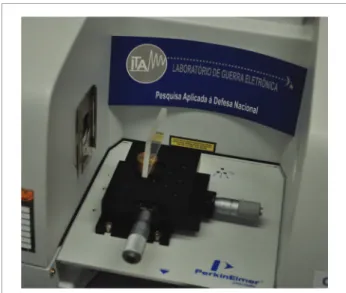
humidity (65±1%), for wavelengths from 0.67 to 12 μm. he samples were placed inside the spectrometer using a support, which was set an incidence angle of 90°. Figure 3 shows a sample being measured in the spectrometer.
he measurement results are calculated, as a function of wavelength, using the ratio between the intensity of radiation that reaches the detector and the one emitted by the source. A correction factor is applied considering the background emission. he actual result of the measurement performed is shown in Fig. 4.
As seen in Fig. 4, the canopy presents a high transmittance, from the initial wavelength (0.67 μm) up to 1.6 μm with some absorption valleys around 1.19 and 1.4 μm.
From 1.6 μm on, transmittance drops sharply close to zero, presenting peaks around 1.8 and 2 μm, showing a transmittance level around 40%. hereater, the measured values are almost zero, up to the limit of the measurement, 12 μm, although the graph is presented only up to 3 μm. We must highlight the presence of valleys in 1.19, 1.4, and 1.9 μm, which correspond to the wavelengths where a high absorption by the water molecules in the air occur (Hudson, 1969). On the other hand, it is estimated that the observed absorption at 1.7 μm refers to the polycarbonate, once, synthesized from hydrocarbons, it will present absorption bands around the wavelengths of 1.68, 1.70, 1.72, and 1.78 μm (Araújo and Kawano, 2001).
he results presented in Fig. 4 show that there is no transmission through the canopy for emission whose wavelengths are above 2.2 μm (except for a small region around 2.6 μm), because these wavelengths are completely absorbed or relected by the material. his result agrees with other ones found in the literature (Nakagawara and Montgomery, 2008). herefore, the canopy shows high efectiveness against directional DIRCM MIR emissions. However, if the DIRCM is multi-spectral and presents spectral components in the NIR, the canopy does not serve as protection, since the transmittance is around 90%, and only 10% of the incident power is relected or absorbed by it. Based on these results, a theoretical analysis was performed, focusing on possible damages to the pilot’s health.
THEORETICAL ANALYSIS
Due to the high transmissivity of the canopy in the NIR range, it was made a theoretical analysis of possible damages to the pilot’s vision, given the main features of well-known lasers and safety parameters for human vision. herefore, some deinitions are necessary, as shown in AS 2211:
• Maximum permissible exposure (MPE): maximum level of radiation to which human tissue can be exposed without sufering injury or damage immediately ater exposure or ater some time;
• Nominal ocular hazard distance (NOHD): minimum safety distance where the radiant intensity of the ocular tissue (retina) is considered to be below the level deined as MPE; and
• Nominal skin hazard distance (NSHD): minimum safety distance at which the radiant intensity on the skin is below the level deined as MPE.
Although the aim of this work is to analyze the possible damage to vision, some calculations on the potential damage to the human skin were included, once the procedure for
performing both calculations is similar and the used sotware (CMePy) provides the complete information on them (with appropriate changes in reference tables).
he analysis starts by using the equation that calculates the intensity of a laser beam (W/m²) at a distance z from the laser source, which is given by (Lelek, 2007):
)2
2
(
)
exp (
4 µ
z w
-z
P0 I
+ =
θ
π (1)
In Eq. 1, P0 is the power of the source (in Watts), or eventually the total energy carried by one pulse (in Joules), considering a Gaussian beam; w is the waist of the Gaussian beam (m) at a distance where the beam intensity is 1/e² of P0; θ is the divergence of the beam (rad); μ is the atmospheric absorption (usually neglected) (Nakagawara and Montgomery, 2008); and z is the distance between the source and the target.
Since, for safety reasons, it is necessary to calculate the NOHD of a laser with respect to the retina, variable z should be replaced by NOHD in Eq. 1; while the variable I must be replaced by MPE. hus, considering the transmittance of Figure 4. Experimental results of visible, near-infrared, and middle-infrared transmittance.
T
ra
ns
mi
tta
nc
e (%)
Wavelenght (microns) 100
0.6 0.8 1 1.2 1.4 1.6 1.8 2 2.2 2.4 2.6 2.8 3
80
60
40
20
any interfaces (such as the canopy) as τm and a multiplicative factor of 2.5 for non-Gaussian beams, one arrives to (AS 2211; Lelek, 2007):
-2 5 . 2 4
w MPE P0τm
NOHD=
θ
π (2)
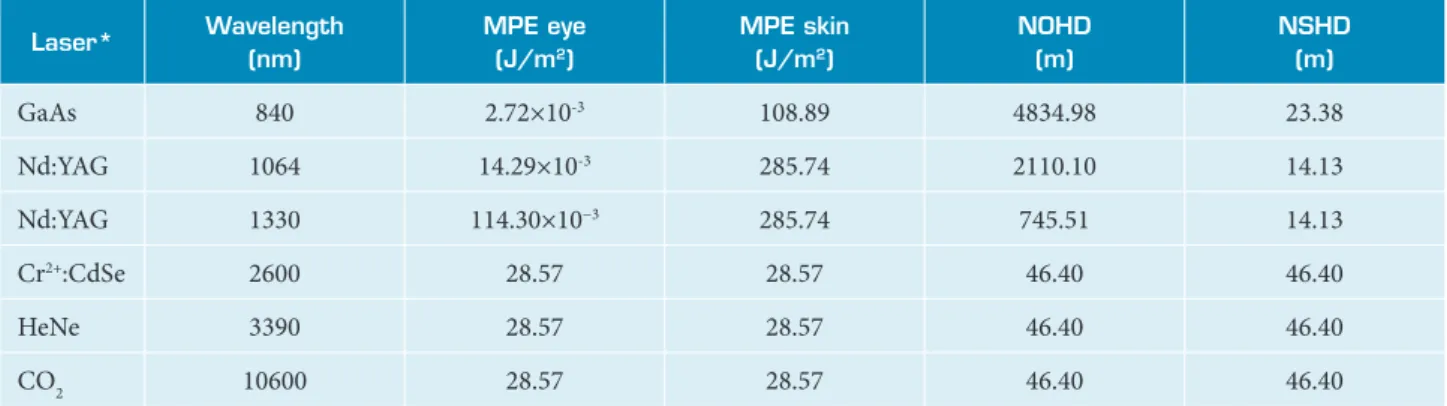
Equation 2 was applied on data of Table 2, achieving the results presented in Table 3. he calculation of the MPE is required for each one of the lasers. It was obtained by following the instructions and tables provided in AS 2211; Nakagawara and Montgomery (2008), Northwestern University (2012), and Fred Seeper (2012), considering always the most restrictive value of this parameter, as established by the AS 2211. In general, the procedures for the calculation of the MPE can be summarized as follows:
• For a continuous wave (CW) laser source, the wavelength of the CW laser beam, the duration time, and the size of the
laser source beam must be determined. By selecting the appropriate MPE table, use the laser wavelength (nm) and exposure time (t) to locate the MPE value or formula on the table and calculate it.
• For a pulsed laser source, the pulse length, the pulse repetition rate, the laser wavelength, the exposition time, and source beam size must be determined. Based on these data, (1) calculate the MPE for a single laser pulse, using the pulse length as the duration time. hen, (2) calculate the MPE for a repeated laser pulse by dividing the MPE for a single pulse by N0.25, where “N” is the actual
number of pulses. Finally, (3) calculate the single pulse MPE again, using the duration time and divide this result by the number of pulses (N) to determine the average MPE for the pulsed laser source. Choose the smallest of the three values as the MPE for the pulsed laser source.
Besides considering the parameters shown in Table 2 for the calculations of each one of the lasers, the following assumptions were made (Nakagawara and Montgomery, 2008):
Table 2. Lasers technical speciications used in simulations.
Laser* Wavelength (nm)
FRP (Hz)
P0
(W)
Beam divergence (mrad)
Pulse width (ns)
Beam waist (mm)
Exposition time (s)
Gaussian beam?
GaAs 840 15 300×10-3 1 12 0.4 10 No
Nd:YAG 1064 15 300×10-3 1 12 0.4 10 No
Nd:YAG 1330 15 300×10-3 1 12 0.4 10 No
Cr2+:CdSe 2600 15 300×10-3 1 12 0.4 10 No
HeNe 3390 15 300×10-3 1 12 0.4 10 No
CO2 10600 15 300×10-3 1 12 0.4 10 No
*Nakagawara and Montgomery (2008)
Table 3. Safety distances for the lasers under test.
Laser* Wavelength (nm)
MPE eye (J/m2)
MPE skin (J/m2)
NOHD (m)
NSHD (m)
GaAs 840 2.72×10⁻³ 108.89 4834.98 23.38
Nd:YAG 1064 14.29×10⁻³ 285.74 2110.10 14.13
Nd:YAG 1330 114.30×10⁻³ 285.74 745.51 14.13
Cr2+:CdSe 2600 28.57 28.57 46.40 46.40
HeNe 3390 28.57 28.57 46.40 46.40
CO2 10600 28.57 28.57 46.40 46.40
• Negligible atmospheric attenuation (equals to zero); • Transmittance of the optical interfaces equal to 100%; • he beam is stationary during each one of the analysis; and • Only one wavelength is emitted.
he previous assumptions were established in order to simplify the analysis. Although being slightly diferent from the ones found in an actual environment, they serve as a basis for the conclusions to which we want to reach.
he results presented in Table 3 were calculated with the aid of a program called CMePy developed speciically for this purpose, in a PYTHON environment. It is able to calculate both the MPE and NOHD for eye and skin in atmosphere transmission, with or without the presence of any interfaces, considering that the spectral transmissivity of that interface is known.
he analysis of Table 3 shows that lasers operating in the NIR (as may be the case for multi-spectral DIRCMs) present a high danger to the pilot’s eye, since the calculated NOHD shows that, even at distances of 4834.98 m (GaAs, 840 nm), the laser beam irradiance is suicient to cause damage to the retina. For higher wavelengths, the danger is reduced, since the NOHD and NSHD are much smaller and highly improbable to occur in actual situations. Although being improbable in an actual light situation, these data must be considered if a ground test is being conducted. his conclusion leads to the necessity of using speciic personal protection equipment (PPE) during the tests.
It is important to mention that the procedure followed for the calculation and analysis of results is the same of that one published by the Laser Institute of America (LIA) under number ANSI Z136.
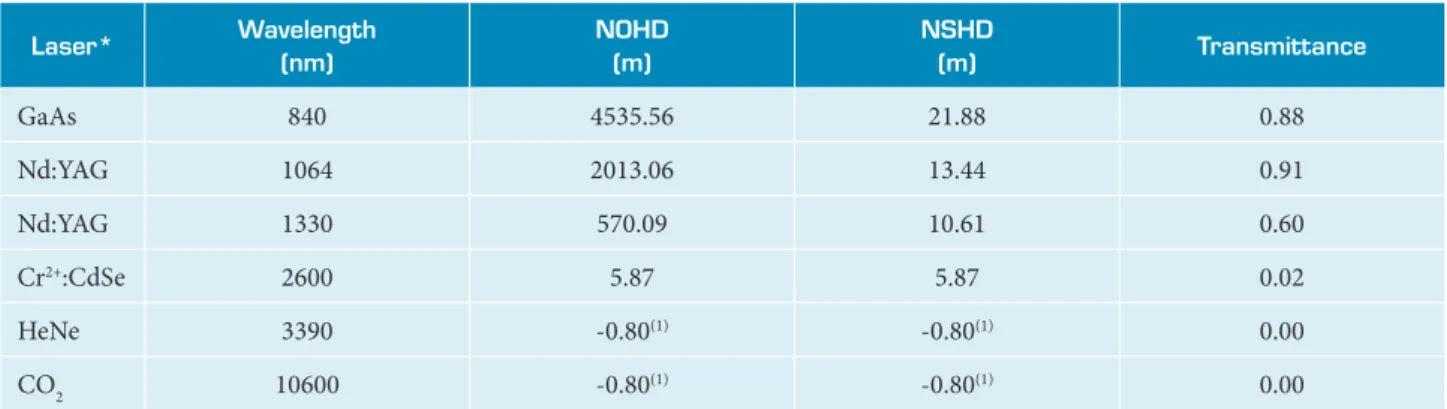
Once the NOHD and NSHD are known, in free space, it is important to calculate these parameters considering the influence of the canopy, according to Fig. 4, since it works as a filter. Therefore, the values of transmittance shown in Fig. 4 were inserted in Eq. 2 as the variable τm. The results are shown in Table 4.
he results show that the IR attenuation provided by the canopy reduces NOHD of the three diferent types of lasers operating in the region of danger to the retina (<1.4 μm) in only 10%, in average. On the other hand, for wavelengths above 2.2 μm, in regions of MIR and FIR, the canopy acts as a perfect ilter, protecting the pilot completely, except laser Cr2+:CdSe (2600 nm), which, despite of sufering a
strong attenuation, still presents some danger, depending on the distance of emission. he same conclusions can be extended to NSHD measurements. However, in this last case, the calculated distances are very low, showing to be highly improbable to occur in practice.
CONCLUSIONS
In this paper, we presented an investigation on the DIRCM risks to ighter aircrat pilots. hrough experimental results and using a computational tool, it was showed that the F-5 ighter aircrat canopy provides only partial protection against IR radiation.
Measurements performed using a spectrometer showed that the average transmittance for canopies in the NIR range (0.67–1.3 μm) was around 90% (around 10% of absorption and relection of canopy), presenting valleys at 1.19 and 1.4 μm.
Table 4. Safety distances for lasers when interfaced by the canopy.
Laser* Wavelength (nm)
NOHD (m)
NSHD
(m) Transmittance
GaAs 840 4535.56 21.88 0.88
Nd:YAG 1064 2013.06 13.44 0.91
Nd:YAG 1330 570.09 10.61 0.60
Cr2+:CdSe 2600 5.87 5.87 0.02
HeNe 3390 -0.80(1) -0.80(1) 0.00
CO2 10600 -0.80(1) -0.80(1) 0.00
(1)Negative values do not have physical meaning and must be considered “0”. For these mathematical results, laser is shown to be safe at any distance (AS 2211)
REFERENCES
Araújo, S.C. and Kawano, Y., 2001, “Espectro vibracional no infravermelho próximo dos polímeros poliestireno, Poli (Metacrilato de Metila) e Policarbonato”, Polímeros Vol.11, No. 4, pp. 213-221.
Bolkcom, C., Elias, B. and Feickert, A., 2003, “Homeland Security: Protecting airlines from terrorist missiles”, Congressional Research Service Report for Congress, The Library of Congress, USA, 27 p.
Brunetaud J.M. and Hill, S., 2012, “Risks from lasers”. Retrieved in July 20, 2012, from http://www3.univlille2.fr/safelase/english/ haza _en.html
Caidin, M., 1992, “Growing threat of UVR”, Aviation Safety, Vol. 12, No. 3, pp.1-15.
Diffey, B. L. and Roscoe, A. H., 1990, “Exposure to solar ultraviolet radiation in light”, Aviation Space and Environmental Medicine, Vol. 61, No. 11, pp. 1032-1035.
Elbyt Systems, 1999, “Sensor and electro-optics solutions. MUSIC”. Retrieved in July 04, 2013, from http://www.elbitsystems-us.com/ sensor-electro-optics-solutions/airborne-maritime/survivability/music
GlobalSecurity.org, 2011, “AN-AAQ-24 Directional Infrared Countermeasures (DIRCM)”. Retrieved in May 31, 2012, from http://www.globalsecurity.org/military /systems/aircraft/systems/ an-aaq-24.htm
Hudson, R.D., 1969, “Infrared system engineering”, New York: John Wiley & Sons, USA, 642 p.
Laurenzo, R., 2005, “Antimissile systems for airliners”. Aerospace America: American Institute of Aeronautics and Astronautics, Vol. 43, Ed. 3, pp. 33-37.
Lelek, M., 2007, “Laser and non-linear optics – Laser safety”. Retrieved in January 15, 2012, from http://www.optique-ingenieur. org/en/courses/OPI_ang_M01_C02
Nakagawara, V. B. and Montgomery, R. W., 2008, “Infrared radiation transmittance and pilot vision through civilian aircraft windscreens”, Federal Aviation Administration, (DOT/FAA/AM-08/15), 18 pp.
NASA, 1998, “Ask an Astrophysicist”. Retrieved in July 20, 2012, from http://imagine.gsfc.nasa.gov/docs/ask_astro/answers/ 980119b.html
Northwestern University, 2011, “Laser Safety Handbook”, 20pp. Retrieved in July 19, 2012, from http://www.research.northwestern. edu/ors/forms/laser-safety-handbook.pdf
Seeber, F., 2012, “Fundamentals of Photonics”, Module 1.2 - Light Sources and Laser Safety, Retrieved in July 19, 2012, from http://spie. org/Documents/Publications/00%20STEP%20Module%2002.pdf
Setlow, R.B., 2003, “The hazards of space travel”. Retrieved in July 20, 2012, from http://www.nature.com/embor/journal/v4/n11/ full/embor7400016.html
West, S.K., Duncan, D.D., Munoz, B., Rubin, G.S., Fried, L.P., Bandeen-Roche, K. and Schein, O.D.,1998, “Sunlight exposure and risk of lens opacities in a population-based study: the Salisbury Eye Evaluation project”. The Journal of the American Medical Association, Vol. 280, No. 8, pp. 714-718.
Wisegeek, 1999, “How Dangerous is UV Radiation?”. Retrieved in July 20, 2012, from http://www.wisegeek.com/how-dangerous-is-uv-radiation.htm
From 1.5μm on, transmittance drops sharply close to zero, presenting two peaks at 1.8 and 2 μm (around 40%). For wavelengths higher than 2.2 μm, transmittance show to be almost zero.
Due to the high transmissivity in NIR, additional theoretical calculations were performed, which showed that the safety distances for certain lasers operating in this range can reach up to 4.8 km, depending on some parameters of operation. Even with the canopy as an interface, this distance does not seem to be considerably reduced (≈4.5 km).