ISSN 0104-6632 Printed in Brazil
www.abeq.org.br/bjche
Vol. 33, No. 02, pp. 319 - 332, April - June, 2016 dx.doi.org/10.1590/0104-6632.20160332s20140237
*To whom correspondence should be addressed
Brazilian Journal
of Chemical
Engineering
DOLOMITE DESULFURIZATION BEHAVIOR IN A
BUBBLING FLUIDIZED BED PILOT PLANT FOR
HIGH ASH COAL
G. M. F. Gomes
1,2*, C. Philipssen
3, E. K. Bard
1and G. Souza
11Fundação de Ciência e Tecnologia do Estado do Rio Grande do Sul, (CIENTEC), Av. das Indústrias 2277,
Distrito Industrial, Laboratory of Combustion, Cachoeirinha - RS, Brasil.
2
Universidade do Vale do Rio dos Sinos, (UNISINOS), Av. Unisinos 950, Cristo Rei, Department of Engineering, São Leopoldo - RS, Brasil.
3
Programa de Pós-Graduação em Engenharia de Minas, Metalúrgica e Materiais, Universidade Federal do Rio Grande do Sul, (UFRGS), Av. Bento Gonçalves 9500, Setor 6,
Centro de Tecnologia, Laboratório de Siderurgia, Sala 222, Porto Alegre - RS, Brasil. Phone: + 55 (51) 34396351; Fax: + 55 (51) 33087116
E-mail: [email protected]; [email protected]
(Submitted: December 18, 2014 ; Revised: April 15, 2015 ; Accepted: May 15, 2015)
Abstract - Although fluidized bed in situ desulphurization from coal combustion has been widely studied, there are aspects that remain under investigation. Additionally, few publications address Brazilian coal desulphurization via fluidized beds. This study used a 250 kWth bubbling fluidized bed pilot plant to analyze different aspects of the dolomite desulphurization of two Brazilian coals. Superficial velocities of 0.38 and 0.46 m/s, flue gas recycling, Ca/S molar ratios and elutriation were assessed. Results confirmed the influence of the Ca/S molar ratio and superficial velocity – SO2 conversion up to 60.5% was achieved for one coal type,
and 70.9% was achieved for the other type. A recycling ratio of 54.6% could increase SO2 conversion up to
86.1%. Elutriation and collection of ashes and Ca-containing products did not present the same behavior because a lower wt. % of CaO was collected by the gas controlled mechanism compared to the ash.
Keywords: Fluidized bed; Coal; Desulphurization.
INTRODUCTION
Fluidized bed coal combustion has the advantage of creating SO2 treatment through a sulphation
reac-tion from the in situ injecreac-tion of dolomite or lime-stone. This procedure has been widely explored; however, some details and local behaviors based on coal characteristics are still under investigation. More-over, it should be noted that there is a lack of infor-mation concerning Brazilian coal in fluidized beds. Furthermore, according to Anthony and Granatstein (2001), dolomitic stones have not found widespread use in atmospheric fluidized bed combustors because
they are not particularly effective on a mass basis due to the inability of MgO to react with SO2.
However, the sulphation reaction is far from ideal. Typically, only a conversion of 30–40% of CaO is obtained. This relatively low utilization of limestone is one of the major limitations of the tech-nology (Anthony and Granatstein, 2001). The pres-ence of SO2 affects limestone particle size because it
320 G. M. F. Gomes, C. Philipssen, E. K. Bard and G. Souza
Brazilian Journal of Chemical Engineering
in fluidized bed combustors (Montanagro et al., 2010).
Because the molar volume of CaSO4 is 52.2
cm3/mol, which is greater than that of CaCO3 (36.9
cm3/mol), and no particle expansion occurs, the pos-sible maximum practical conversion is low. Con-sidering the bed temperature, it has been well es-tablished that the most favorable temperature for the sulphation reaction is located in the range of 800-850 °C, and the retention falls sharply as temperature increases (Yates, 1983). Moreover, excess air in-creases the changes in the gas composition in which the sorbent sulphates and the partial pressure of oxy-gen are increased; consequently, the partial pressure of CO2 is reduced (Ulerich et al., 1980).
Different aspects of the desulphurization mecha-nism have already been investigated and will be briefly discussed. Lyngfelt and Leckner (1989) in-vestigated the SO2 conversion relationship with
pro-cess conditions, especially temperature. The oxygen concentration was considered in Collar’s (2001) analysis, who evaluated pore structures in the reac-tivity of different limestones. It was observed that with an increase in the O2 concentration, the
desul-phurization reaction was worse due to the additional SO3 in the reaction. Tarelho et al. (2005) studied the
influence of operational parameters for fluidized bed desulphurization. A constant Ca/S molar ratio of 3.5 was used. Furthermore, excess air values of 10, 25 and 50% were applied.
Hlincik and Buryan (2013) reported that lime-stones with lower CaO content can provide a better desulphurization capacity. This result occurs because the desulphurization reactions of the combustion gases are significantly negatively affected by the reaction of CaO with the ballast oxides of ash and limestone.
The reaction kinetics were was studied by Irfan and Balci (2002). For temperatures of 850 °C and below, the reaction occurred with two mechanisms due to pore plugging and changes in the chemical composition of the solid. Bragança et al. (2003) stud-ied the influence of limestone characteristics to de-termine the kinetic parameters of desulphurization using a batch fluidized bed reactor.
Anthony and Granadstein (2001) investigated the fragmentation of sorbent particles. Furthermore, Bragança (1996) used dolomitic and magnesium limestone for the desulphurization of different parti-cle sizes. Scala et al. (2000) used a bench-scale flu-idized bed reactor to investigate the attrition behav-ior of two different limestones during calcination and sulphation. After sulphation of the pre-calcined lime, the attrition rate for both types of limestones tested
decreased dramatically until a new steady-state value was reached.
Furthermore, models for the description of the conversion mechanism have been evaluated. Suyadal et al. (2005) explored the SO2 breakthrough curves
in the presence of O2, CO2, and H2O steam and
tested one deactivation model description of these curves obtained in an integral fluidized bed reactor.
Additionally, and related to this study, due to the need for a minimum residence time of the calcinated particles, elutriation must be considered in the desul-phurization process in fluidized bed systems. Elutria-tion is referred to the separaElutria-tion or removal of fines from a mixture, and it occurs to a lesser or greater extent at all freeboard heights. However, the solid carryover is strongly affected by gas velocity, and the fraction of fines in the bed is only slightly af-fected by changing the size of the coarse material and the minimum fluidization velocity (Kunii and Levenspiel, 1991).
Altindag et al. (2004) demonstrated that the free-board sulphur-capture was enhanced significantly by recycling the elutriated sorbent particles. A limestone with 93.21 wt. % CaCO3 was used. In runs without
flue gas recycling, a significant majority of the sul-phur retention occured in the bed section. By intro-ducing flue gas recycling, freeboard sulphur capture increased from 3.5% to 19.5%. This result occurred because, for fuels rich in volatile matter and combus-tible sulphur content, such as the ones used in this study, freeboard sulphur capture is enhanced signifi-cantly with recycling because the sulphur release to the freeboard is significant.
Montanagro et al. (2010) investigated the influ-ence of temperature on the attrition of two lime-stones during desulphurization in a fluidized bed reactor. The experimental procedure was conducted at 900 °C with the goal of assessing the extent of the primary fragmentation. Furthermore, results were compared with those obtained at 850 °C for the same reactor. The fluidized bed desulphurization experi-ments were conducted using a synthetic gas with an SO2-O2-N2 mixture of 1800 ppmv-8.5%-N2 balance.
Dolomite Desulfurization Behavior in a Bubbling Fluidized Bed Pilot Plant for High Ash Coal 321
Brazilian Journal of Chemical Engineering Vol. 33, No. 02, pp. 319 - 332, April - June, 2016
products in the bed and change bed properties after long time runs.
Thus, Huda et al. (2006) demonstrated the influ-ence of four coal types on the in situ desulphuriza-tion process in a 71 MW Pressurized Fluidized Bed Combustor (PFBC) demonstration plant. Important information on the formation of the bed material was discussed. White and yellow particles were formed in the bed after the desulphurization tests. The white particles were calcium carbonate or calcium carbonate coated with calcium sulphate while the yellow parti-cles were calcium carbonate coated with calcium sulphate and Ca–aluminosilicate. Moreover, the CaSO4 particles formed agglomerate. Thus, fly ash
particles could be distinguished from one another through their morphologies.
Scala et al. (2011) studied the primary fragmenta-tion of two limestones in a 1-meter-height batch scale fluidized bed under air combustion and oxyfuel combustion. Synthetic gases were used to provide the atmospheres. Two types of limestone were used: CaCO3 over 96% and CaCO3 over 99%.
Addition-ally, the limestone type was determined to be a more important variable with respect to the fragmentation tendency. The particle size, bed temperature, and simultaneous occurrence of the sulphation reaction were found to have an insignificant influence on the limestone primary fragmentation under either atmos-phere. Again, the tendency of changes in the elutria-tion mechanism is one important result when con-trolling fragmentation.
However, according to Montanagro et al. (2010), an investigation of the effect of bed temperature on the limestone attrition and fragmentation phenom-ena, as well as their connection with the sulphation behavior and microstructural properties, is still lack-ing and appears to be of great practical interest.
Scala et al. (2013) tested the fluidized bed desul-phurization performance of lime particles obtained using a limestone slow calcination pre-treatment technique compared to the untreated material. Fur-thermore, the fragmentation and attrition processes were investigated. An externally heated stainless steel atmospheric bubbling fluidized bed reactor 40 mm in diameter and 1 m in height was used for the experiments. The pre-treatment technique appeared to induce a high mechanical strength in the sorbent particles (as opposed to the fragile lime generated after typical rapid fluidized bed calcination).
Thus, although this technology is regarded as a mature technology for in situ desulphurization, its dependence on local stone properties and interactions between the local stone/coal properties and the flu-idization conditions may require further research
(Altindag et al., 2004). Consequently, the use of coals from different regions is an aspect to be considered when studying desulphurization, especially Brazilian coals, which have poor data on fluidized bed com-bustion and desulphurization.
The primary objective of this study is to obtain fluidized bed operating parameters in a bubbling fluidized pilot plant for SO2 conversion using an in
situ dolomite feed. Different runs analyzed the fluid dynamic characteristics for two southern Brazilian coals, and the superficial velocity, flue gas recycling, elutriation behavior and stoichiometric analysis were investigated. Results may lead to the development of a fluidized bed desulphurization of Brazilian coals.
MATERIALS AND METHODS Materials
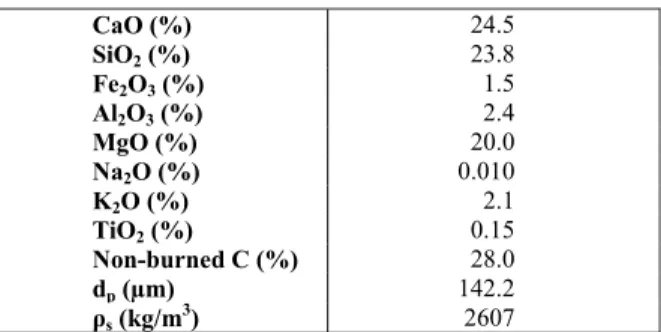
Table 1 presents ultimate and proximate analysis of the coals used as well as the low heating value (LHV), and Table 2 presents the dolomite characterization. All of the materials from Tables 1 and 2 originate from the southern region of Brazil. Coal A and Coal B are from two different Brazilian federative states, Rio Grande do Sul and Santa Catarina, respectively.
Table 1: Characterization of the coal used on a dry basis.
Coal A B
VM (%) 20.70 12.29
Cfixed (%) 25.13 37.52
H2O (%) 8.53 10.02
Cd.b. (%) 39.25 40.66
Hd.b. (%) 3.04 2.86
Sd.b. (%) 1.45 1.90
Nd.b. (%) 0.69 1.30
Od.b (%) 5.64 8.66
Ashd.b. (%) 49.93 44.63
LHV (MJ/kg) 15.978 15.697
dp (µm) 133.4 159.5
d.b.: dry basis
Table 2: Dolomite characterization.
CaO (%) 24.5
SiO2 (%) 23.8
Fe2O3 (%) 1.5
Al2O3 (%) 2.4
MgO (%) 20.0
Na2O (%) 0.010
K2O (%) 2.1
TiO2 (%) 0.15
Non-burned C (%) 28.0
dp (µm) 142.2
32 P p A (1 (5 co m g te T p fl in an ti y th op th ap P w o T 22 Pilot Plant
Figure 1 p ilot plant use As indicated
1) and (3), w 5), are inject
ombustion o material refr reater reside emperature f The gases exi re-heats the luidized bed. n the heat exc
nother cyclo ion occurs, g fuel combus he air entra
pened, the c he gas is rec pplied to pr P2 and P3 re within the sys f sand, with The freeboard
presents a flo ed for perfor
in the figure with rates co ed by gravity occurs. The g ractory cycl ence time for for the post it towards a e air that . After the te changer, the one (12). In t gases are rele stion occurs nce is close chimney is p circulated. A
ovide energy epresent the stem. The be
a width of 27 d height is 2.
Figure
Coal si Silo #1 #2; (12
G.
owchart of t rming the co e, solid fuels ontrolled by y into the fur generated ga one (7), w r the gases at t-combustion
heat exchan enters into emperature re
gases are con he sequence eased by the (not applied ed, the recy partially clos A forced drau y for the ga pressure co ed is rectang 7 cm and a le 0 m. Bed ch
1: Pilot pla ilo; (4) Coal 1; (9) Post co 2) Chimney 2
M. F. Gomes, C.
Brazilian Jou
the 0.25 MW ombustion ru s from the si screws (2) a rnace (6) wh ases flow int which allows t an appropri n chamber ( ger (10), wh the bubbl eduction occ nducted throu
, if air comb chimney. If d in this stud
ycling valve sed and part ught fan (14) ases. Points
ontrol locatio gular, compo
ength of 97 c aracteristics
nt flowchart Screw; (5) ombustion ch 2; (13) Heate
. Philipssen, E. K
urnal of Chemica
Wth uns. ilos and here to a s a iate (9). hich ling curs ugh bus- ox-dy), e is t of ) is P1, ons sed cm. are pro usi len con fee par po a c tot ash Ma #1 wa ana per mi
t: (1) Dolomi Coal feed; ( hamber; (10 er; and (14) F
K. Bard and G. So
al Engineering
ovided in Ta ing parallel ngth.
Tab
ρs (kg/m ρbulk (k dp (µm Umf (m Height
It should b ncern the san ed in the fur
rticle diamet Flue gases a int P2 and us continuous a tal mass ash h content for ass ash colle for each run as determine alysis for ea ratures, T04 ined continuo
ite silo; (2) D (6) Reactor;
) Heat excha Forced draug
ouza
able 3. A gas tubes with
ble 3: Bed ch
m3) kg/m3) m) m/s)
t (m)
be noted tha nd before co rnace, the b er and densit analysis was sing a HORI analysis of th h generation r each coal ected by Cyc n and determ ed using X-ach ash type. 4 and T05, ously using t
Dolomite scr (7) Cyclone anger; (11) C ght fan. s distributor holes dispo haracteristi 24 15 7 0
at such bed ombustion ru bed tends to ty due to ash s performed b
IBA PG 250 he combusti was calcula and the fuel clone #1 was mined in kg/h -Ray Fluores
Bed inlet an respectively thermocoupl
rew; (3) e #1; (8) Cyclone
is constructe osed along i
cs. 466 544 725 0.20 0.4 characteristi uns. After co change mea accumulatio by sampling equipment f on gases. Th ated using th l feed in kg/ s taken to Si h. CaO conte scence (XRF nd outlet tem y, were dete
er-Dolomite Desulfurization Behavior in a Bubbling Fluidized Bed Pilot Plant for High Ash Coal 323
Brazilian Journal of Chemical Engineering Vol. 33, No. 02, pp. 319 - 332, April - June, 2016
Experimental Procedure
For the combustion runs, heating the bed began with an auxiliary fuel, ethanol, in the plant heater (13) until the bed reached 600-650 °C, which is when coal was added and the auxiliary fuel was not fed anymore. Fuel and air are adjusted to reach and sta-bilize the bed temperature at 850 ± 15 °C, when the steady-state condition was considered, which is con-trolled by two thermocouples located in the bed inlet, T04, and the bed outlet, T05. For each coal feed, after stabilizing the bed temperature, dolomite is added based on the applicable Ca/S relation.
For gas recycling, in order to provide a controlled transition, the following procedure was developed after reaching the steady-state condition on combustion:
I. 100% recycling gas valve open (valve gas re-cycling is located after the chimney);
II. Partial chimney closing via damper control; and III. Progressive recycling valve closed to maintain positive pressure on point P2 of Figure 1.
Recycled gases were injected into the reactor en-trance in the same air duct and passed through the draught fan (14). For the gas air mass flow rate con-trol, to maintain the same conditions as applied to the air combustion without recycling with the Us value,
one valve located after the forced draught fan (Figure 1) was used to control the flow rate.
It is important to maintain a positive pressure un-til point P2 to prevent air leakage in the section reac-tor-P2 as gas sampling is performed in this section. The bubbling fluidization condition is controlled by the pressure drop, dP, in the bed, which must be main-tained between 4413-5197 Pa, and temperatures T04 and T05, that cannot present a difference higher than 5 °C between bed inlet and outlet. Furthermore, the fluidization conditions can be continuously visual-ized through one observation point located above the reactor.
Stoichiometric Analysis
For the desulphurization reactions from the dolo-mite calcination, CaO and SO2 are converted to
CaSO4 as described by Reactions 1 and 2. (Yates,
1983; Anthony and Granatstein, 2001).
2 3
CaO SO CaSO (1)
3 2 4
CaSO 1 / 2O CaSO (2)
However, as also described by other authors, the desulphurization mechanism can be represented as
the sum of Reactions 1 and 2, as expressed by Reac-tion 3 (Suyadal et al., 2005).
2 2 4
CaO SO 1 / 2O CaSO (3)
Average SO2 Conversion Rate
Equation (4) expresses the rate of the SO2
conver-sion, ξ, by taking its input and output and consider-ing the reactor as the volume control.
iSO2 oSO2
SO2
n n
ξ
υ
(4)
where
niSO2 = number of moles of SO2 into the system;
noSO2 = number of moles of SO2 out of the system;
and SO2
υ = SO2 stoichiometric coefficient.
SO2 was considered to be reacting based on Equation
(3).
Desulphurization Efficiency
The desulphurization efficiency, η, can be obtained from Equation (5) as follows:
iSO
iSO2 oSO2
2
n n
η( ) x100
n
% (5)
Reactants Consumption
Himmenblau and Riggs (2006) defined yield as the quantity of desirable product, CaSO4, divided by
the fed quantity of the reactant, CaO and SO2. Here,
the yield is considered as the CaSO4 molar formation
and is related to the molar quantity of reactant con-sumed, as CaSO4/moles SO2 feed and moles CaSO4/
moles CaO feed.
Elutriation
Elutriation is considered as representing the wt.% of non-reacted CaO particles and ash particles car-ried out of the system during steady state conditions, as expressed by Equations (6) and (7). The CaO and ash particles were collected in Cyclone #1 of Figure 1.
CaO CaO
mass elutriated % CaO Elutriated
mass fed into the bed
(6)
Ash Ash
mass elutriated % Ash Elutriated
mass fed into the bed
32 b it co za co tu fl by su an an co za C ti ar ti ci to fo b h th ti w te B 24 Because th e related to ts conversion
onsidered in
RE
The steady ation data w oncentration ures, T04 an luidization co y controlling ure drop, wh nd the heigh nd 5197 Pa. onditions can ation from th
Combustion, ion Results
The results re presented ions were ta ial velocities o the pressur or higher ap etween the b
Ta
Coal Conditio Air/Fuel Air exce Us (m/s) T05 (°C) T04 (°C) ΔP (Pa) P1 (Pa) Pf (Pa) tr (s)
CO (ppm SO2 (mg 6% O2
When usin igher air/fue he temperatu ionally, as a c was maintaine emperatures
Bed mater B runs. There
he exiting Ca
its residence n, this comp
the elutriatio
ESULTS AND
y state cond were conside n of the flue nd T05, wer onditions wer g the bed tem hich must ind ht used – 0. Moreover, t n be continu he freeboard
, Desulphuri
s from the co d in Table 4. aken by appl s (Us): 0.38 m
re in the rea pplied Us, an
bed entrance
able 4: Air co
on A1 l Ratio 6.
ess 75%
0.3
) 86
) 85
4884 769
19 0.7 FLUE
m) 11
g/Nm3), 3350
ng Coal B, a el ratios had ures between consequence ed in the flu in the bed. rial was the s
efore, the dif
G. aO particles e time and, c ponent was on analysis.
D DISCUSS
itions to obt ered to occur
gases and th re stabilized
re experimen mperatures an dicate, for the 4 m, values the fluidizatio uously contro
region.
ization and
ombustion of For each co lying two di m/s and 0.46 actor entranc
nd ΔP is the and the exit.
ombustion r A A2 5 8.7 % 82% 8 0.46 0 855 9 856 4 4756 8 9159 6 245 6 0.49 GASES 2 120 0.1 3276.2 and compare d to be appli n 850 °C and e of the latter e gases to ac
same in the C fferences be
M. F. Gomes, C.
Brazilian Jou are supposed consequently selected to SION tain desulphu r after the S he bed tempe . The bubbl ntally confirm nd the bed pr e bed propert s between 44 on and react olled by visu
Ash Compo
f the coals u oal, two con ifferent supe 6 m/s. P1 ref e and is hig e pressure dr . runs. B B1 B2 8.0 9. 65% 86% 0.38 0.4 860 87 855 86 5394 514 7178 912 196 25 0.61 0.6 75 10 3861.8 4222
ed with Coal ied to maint d 870 °C. Ad r, a higher O2
chieve the sa
Coal A and C tween ΔP w
. Philipssen, E. K
urnal of Chemica
d to y, to be uri-SO2 era-ling med res-ties 413 tion ali- osi-sed ndi- erfi-fers gher rop 2 .1 % 46 70 65 48 20 55 60 08 2.8 l A, tain
ddi-2 %
ame Coal were the ma to m/ com is lat dim les res reg u* * p d wh gas dit con As Ta Fig A2 (19
K. Bard and G. So
al Engineering
e result of a aintaining th
highlight th /s and Us = 0
mbustion air one of the m ted to solid el
According mensionless ss gas veloc spectively, ca gime. These p
2 g ρ u μ ρ s
g p p ρ ρ d shere “u” is g s density, “ρs In this way tions accord ndition prese s seen on Fig able 4 can be
gure 2: Flui 2, B1 and B3 991), with pe
ouza
ash accumul e bubbling f he values of 0.46 m/s. Th r pressure in t
most importa lutriation out
to Kunii an parameters, city and dim an be introdu
parameters ar
1/3 2 g g ρ g
1/3 g 2 ρ g μ s gas velocity,s” is solid den
y, Figure 2 sh ding to the d ented by Kun gure 2, all co
found in bub
idization ma 3. Adapted f ermission.
lation during fluidization. I pressure P1 his parameter the reactor en ant process p t of the bed an nd Levenspie
u*and dp*, th
mensionless uced to map t re defined as
“g” is the g nsity and µ is hows the flu diagram for nii and Leve ombustion co bbling fluidiz
apping for C from Kunii a
g the runs f It is importa for Us = 0.3
r expresses th ntrance, whic parameters r nd the reacto el (1991), tw
he dimensio particle siz the fluidizatio s follows: (8 (9
gravity, “ρg” s gas viscosit uidization co general flo enspiel (1991 onditions fro
zed beds.
b te m fr T p D ea th m te w co p ob co fe ru su an C af g ar ar 0 Dimension ecause it is s er, which was ment due to rom the prev That bed dia
osed only of
Desulphuriza
After stab ach run, dolo he desulphur mite, the bed emperature r was adjusted ontent for th roximately 3 bserved that ould achieve erent condit uns and the d uperficial ve nd 0.46 m/s Ca/S molar ra
Table 5
Condition Us (m/s) Ca/S Molar Ratio Dolomite (kg/h) SO2 (mg/Nm3), 6% O2 SO2 (g/106kcal Condition Us (m/s) Ca/S Molar Ratio Dolomite (kg/h) SO2 (mg/Nm3), 6% O2 SO2 (g/106kcal)
Table 5 als fter desulph ases. From s re presented re the units 8/1990. Thi
Dolomit
Brazi
nless particle strongly affe s considered t
the presence vious bed d ameter consi f sand before
ation Runs
bilizing air omite was fe rization runs d temperatur rapidly recup
based on the he required C
30 minutes t the SO2 con
e stabilizatio tions applied different coal elocities – U . Additionall atios were us
5: Desulphu
A3 A4 Us = 0.38 1.5 2.0
3.8 5.0
1591.3 1256.3
2754.2 2174.4
B3 B4 Us = 0.38 1.5 2.0
6.3 8.4
2432.9 1861.4
4883.5 3736.4
so presents SO hurization ru
such results, d for each d in the Brazi is regulation
te Desulfurization
ilian Journal of C
e diameter d ected by bed to be 530 µm e of coal as diameter show
idered the b e coal ash acc
combustion ed in differen s. Upon int re decreased perated. The e coal feed a Ca/S molar for each co ncentration in on. Table 5 p
d for the d ls tested. For Us – were ap
ly, for each sed: 1.5, 2.0 a
urization con
A5 A6
m/s U
2.5 1.5
6.3 6.0
3 988.3 1811
4 1710.5 3496
B5 B6
m/s U
2.5 1.5
10.5 6.8
4 1564.0 3006
4 3139.4 6404
O2 concentra
uns for 6% SO2 emissio
desulphurizat ilian Regulat n establishes
n Behavior in a B
Chemical Enginee
does not chan particle diam m from measu
hes, differen wn in Table bed being co cumulation.
conditions nt conditions troducing do . However, e dolomite fe
nd coal sulp ratio. After ondition, it w
n the flue ga presents the d desulphurizat
r each coal, t plied, 0.38 m Us value, th
and 2.5.
nditions.
6 A7 A Us = 0.46 m/s
2.0 2.
0 8.1 10
.7 1779.0 128
6.7 3433.6 247
B7 B Us = 0.46 m/s
2.0 2.
8 9.1 11
6.6 2195.8 222
4.3 4677.2 473
ation in mg/N O2 in the f
ons in g/106k tion run, wh tion CONAM s SO2 emiss
Bubbling Fluidize
ering Vol. 33, No
nge me- ure-ntly e 3. om-on for olo-the feed hur ap-was ases dif-tion two m/s hree A8 .5 0.0 81.0 72.4 B8 .5 .4 21.2 31.3 Nm3 flue kcal hich MA sion lim g Ta the bu the the De pli Us val fro ob Co ver F ver pro ter ne res rat par in mi de hig typ den dir ana du in pro rea pro
ed Bed Pilot Plant
o. 02, pp. 319 - 3
mits for coal SO2/106 kca
able 5 with S e necessity ubbling fluid e main objec e SO2 conce
esulphurizati Figure 3 pr ied to Coal A
= 0.46 m/ lues applied, om higher re
served. Add oal B, better rsion with C
Figure 3: SO Furthermor rsion depend operties, flui ristics. Accor sium limesto sidence time te depends o
rticles and th the bed. A inimum velo
sulphurizatio Generally, gher SO2 co
pes, which o nce times of rect fluid dy alyzing the ue to the sulp
the stoichio ovided a lo action rate w ovide a desu
t for High Ash Co
32, April - June,
power plant al. By comp
O2 range lim
of a CONA dized bed in
ctive of redu entration in
on equipmen resents the S A and Coal /s. When co
, a general tr sidence time ditionally, wh results were oal A.
O2 conversion
e, it should b ds on severa id dynamic c rding to Bra one is more es. However on the SO2
he mean resi higher fluid ocity for the on efficiencie for lower onversion wa occurs due to f the particle ynamic influ
influences o hur content, ometric analy ower SO2 co
was higher. T ulphurization
oal
2016
ts between 2 aring values mits, it is poss AMA 08/199 situ desulph ucing as muc order to red nt requireme SO2 conversi
B for Us =
omparing the rend for bette es with small hen comparin
achieved fo
n for Coal A
be noted that al factors, su conditions an agança et al. efficient for r, the sulph concentratio dence time o dization velo limestone p es.
fluidization as achieved o the resultin es within the ence can be of the coal as will be be ysis, even th onversion, t This result in n conversion
3 2000 and 500
s presented sible to realiz 90 update, hurization h ch as possib duce Flue G
nts. ion results a
0.38 m/s an e different U er conversion ler Us values
ng Coal A an r the SO2 co
A and Coal B.
t the SO2 co
uch as sorbe nd coal chara (2003), ma r short partic ation reactio on around th of the particl
ocity than th provides low
velocities, for both co ng higher res e bed. Here, e assessed. B
characteristi etter discusse hough Coal the sulphatio ndicates that
326 G. M. F. Gomes, C. Philipssen, E. K. Bard and G. Souza
Brazilian Journal of Chemical Engineering
of Coal A, the Ca/S relation must be increased to decrease the SO2 concentration around the sorbent
particles.
The influence of the SO2 concentration around
the sorbent particles on the conversion can be con-firmed by XRF analysis of the non-desulphurized ashes, A1 and B1, as indicated in Table 6. The alka-line and alkaalka-line earth components of the coal ashes influence the desulphurization behavior by providing self-desulphurization (Cheng et al., 2003). Table 6 indicates that the alkaline components of Coal B are higher compared to those for Coal A, especially for CaO. By considering that the dolomite characteris-tics were the same for both coals and taking the same superficial velocity, the SO2 concentration of the flue
gases is confirmed to provide higher influence on conversion than the coal ash characteristics.
By using mean diameter and the density of dolo-mite, as expressed in Table 2, the terminal velocity can be calculated as 0.62 m/s. If we compare this terminal velocity with the superficial velocities ap-plied in the experiments, the superficial velocities are 61.3% and 74.2% of the dolomite terminal velocity for Us = 0.38 and Us = 0.46 m/s, respectively.
Conse-quently, since the dolomite is fed just above the bed, the particles are prone to reach the bed and start the fragmentation and calcination process in the bub-bling bed. Moreover, it should be noted that a visual observation of the bed after the desulphurization runs indicated a concentration of white and yellow desul-phurization product particles, which confirmed the high dolomite and Ca-containing products within the bed as a result of the change in its properties after long runs and will be discussed later. Thus, in indus-trial plants, this result indicates the necessity of con-trolling the changes in bed properties after long runs for bed reposition.
Table 6: XRF analysis of Coal A1 and Coal B1 ashes.
Condition A1 B1
CaO (%) 2.2 6.91
SiO2 (%) 592 58.0
Fe2O3 (%) 8.51 5.64
Al2O3 (%) 23.6 19.0
MgO (%) 0.70 3.50
Na2O (%) 0.15 0.20
K2O (%) 1.93 2.68
TiO2 (%) 0.85 0.78
SO3 (%) 2.18 2.57
Non-burned C (%)
0.56 0.61
However, an increase in the diameter of the dolo-mite is not necessary to increase the terminal velocity because it would increase the mass transfer
re-sistance and decrease the SO2 conversion, as well as
increase the size and concentration of the desulphuri-zation products that accumulate in the bed.
Furthermore, as seen in the XRF analysis in Table 6, self-desulphurization had already occurred without the sorbent feed due to the CaSO4 formation because
SO3 appears significantly together with CaO. This
result occurs because the coal ashes present CaO in their composition that can react with SO2. However,
this self-desulphurization mechanism cannot only be predicted by the Ca in the ash composition due to the presence of other alkaline elements that are able to promote self-desulphurization (Cheng et al., 2003).
Desulphurization with Gas Recycling
The possibility of increasing the SO2 conversion
with flue gas recycling was analyzed. The same con-ditions applied for the desulphurization runs using Us = 0.38 m/s, and a Ca/S molar ratio of 2.0 was
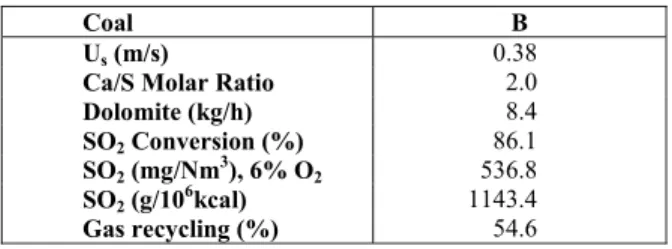
considered in the desulphurization with recycled gas. Table 7 presents the conditions and results obtained from these runs. To maintain the same superficial velocity as in condition B4, the total air plus gas flow rate was controlled by one valve located after both fluxes, i.e., just after the forced draught fan (Figure 1).
Table 7: Desulphurization results with gas recycling runs.
Coal B
Us (m/s) 0.38
Ca/S Molar Ratio 2.0
Dolomite (kg/h) 8.4
SO2 Conversion (%) 86.1 SO2 (mg/Nm3), 6% O2 536.8 SO2 (g/106kcal) 1143.4
Gas recycling (%) 54.6
Table 7 indicates that the SO2 conversion can be
strongly increased from 48.0% to 86.1% when recy-cling part of the flue gases. Consequently, some elu-triated and non-converted CaO particles are able to return to the reactor to react with SO2. Here, the
per-centage of gases recycled is referred to as the wt. % of gases returning to the fluidized bed from the total flue gas flow. In this way SO2 emission, according to
Brazilian regulations, can be reduced to 1143.4 g/106 kcal, far lower than the ones obtained in Table 5.
Dolomite Desulfurization Behavior in a Bubbling Fluidized Bed Pilot Plant for High Ash Coal 327
Brazilian Journal of Chemical Engineering Vol. 33, No. 02, pp. 319 - 332, April - June, 2016
sulphated recycled fine limestone-particles. Accord-ing to the authors, for fuels that are rich in volatile matter and combustible sulphur content, the free-board sulphur capture and release to freefree-board was significantly enhanced with recycling. These obser-vations could be applied to Brazilian coal due to its low fixed carbon content and high volatile matter.
Stoichiometric Analysis
The desulphurization reactions considered the re-lation of 1 mol CaSO4 per mol of SO2 reacted as well
as 1 mol CaSO4 per mol of CaO reacted.
Conse-quently, considering the results before, Table 8 pre-sents the values for a CaSO4 yield based on a SO2
and CaO feed. Table 8 also provides an average SO2
conversion rate for the number of moles of SO2
con-sumed/hour.
From Table 8, a comparison can be made between the runs obtained from one type of coal and different Us values, such as A4 x A7 and B4 x B7. It can also
be made for the same Us and different coals, such as
A4 x B4 and A7 x B7.
If we consider the reactant consumption, as ex-pressed by moles CaSO4/moles SO2 feed and moles
CaSO4/moles CaO feed, few differences can be
ob-served when comparing A4 x A7 and B4 x B7 condi-tions. For the same type of coal, the number of moles formed per SO2 and CaO moles consumed were
higher for the lower Us. Here, it can be observed that
reactants are consumed better at a higher residence time, as expected.
Table 8: Stoichiometric analysis of desulphuriza-tion runs for Ca/S = 2.0.
Condition moles CaSO4/moles
SO2 feed
moles CaSO4/moles
CaO feed
ξ (n°moles/h)
A4 0.625 0.333 -7.29
B4 0.518 0.322 -10.35
A7 0.457 0.225 -7.98
B7 0.480 0.273 -8.79
When comparing conditions A4 x B4 and A7 x B7, i.e., for the same fluid dynamic conditions but different coals, there are some few points that should be considered. Different values are observed for the average SO2 conversion rate. Even with lower SO2
conversion values for Coal B under conditions A4 x B4 and a similar conversion under conditions A7 x B7, Coal B presented higher conversion rate values; SO2 conversion can be observed in Figure 3. This
behavior is a result of the S wt.%, which is higher for Coal B and responsible for a higher reaction rate.
Moreover, for the same coal, the fluid dynamic con-ditions indicated an influence. For Us = 0.38 m/s, the
reaction extent was 10.35 moles SO2/h under
condi-tion B4 and – 8.79 moles SO2/h under condition B7.
This decrease in the conversion rate with Coal B, which was not observed for Coal A, could explain the behavior observed in Figure 3 for this coal with Us = 0.46 m/s.
Ash Characterization
During coal combustion, a part of the total sul-phur in the coal will be retained as solid compounds in the ash. This signifies that the coal ash has a sul-phur-retaining property, which makes a significant contribution to alleviating the problem of SO2
emis-sions (Sheng et al., 2000). According to the same authors, most of the calcium in coal is active and capable of participating in sulphur-retention reactions during coal combustion. Additionally, the content of calcium in most coals is generally significantly higher compared to that of other basic elements. Therefore, variations in the Ca/S molar ratio in coal can mark-edly affect the percentage of sulphur retained.
The X Ray Diffraction (XRD) patterns for the two coal ashes studied are illustrated in Figures 4 and 5. Both figures indicate non-desulphurized ashes, a Ca/S molar ratio of 2.0 for Us = 0.38 m/s and Ca/S
molar ratio 2.0 for Us = 0.46 m/s. For
non-desul-phurized coal ashes – A1 and B1 – the main phases are hematite (Fe2O3) and anhydrite (CaSO4) instead
of SiO2 and silicates. For better phase representation,
SiO2, which is the main ash phase, and silicates are
not identified in Figures 4 and 5. The main peaks of other phases are identified in the same figures.
Concerning SO42- based compounds, most organic
sulphur and pyrite in coal are oxidized and converted to SO2 gas during the combustion in furnaces. A
small part of the sulphur may be retained as solid compounds due to the contribution of alkaline com-ponents, such as CaO, MgO, Al2O3, K2O and Na2O
in the coal ash. The desulphurization property of the coal ash during combustion is primarily affected by the boiler shape, flame temperature, residence time in the furnace, initial molar ratio of Ca/S and reac-tion activity of the alkaline components. It is difficult for sulphates of other minor elements, such as MgSO4, Al2(SO4)3, Fe2(SO4)3, K2SO4 and Na2SO4,
which are less thermally stable than CaSO4, to act as
sulphation products during the coal combustion at high temperatures (Cheng et al., 2003).
Muscovite (KAl2(AlSi3O10)(OH)2) was the
3228
Figu
0.38
Figu
0.36
ure 4: XRD 8 m/s; and (A
ure 5: XRD 6 m/s; and (B
G.
patterns for A7) Ca/S 2.0,
patterns for B7) Ca/S 2.0
M. F. Gomes, C.
Brazilian Jou
Coal A ashe , Us = 0.46 m
Coal B ashe and Us = 0.4
. Philipssen, E. K
urnal of Chemica
es (A1) Witho m/s.
es (B1) Witho 46 m/s.
K. Bard and G. So
al Engineering
out desulphu
out desulphu ouza
urization; (A4
urization; (B4
4) Ca/S 2.0,
4) Ca/S 2.0, Us =
Dolomite Desulfurization Behavior in a Bubbling Fluidized Bed Pilot Plant for High Ash Coal 329
Brazilian Journal of Chemical Engineering Vol. 33, No. 02, pp. 319 - 332, April - June, 2016
A strong presence of hematite was observed in the Coal A ashes. By analyzing Figure 4, it is clear that differences exist between the ashes gen-erated with and without desulphurization. The an-hydrite peaks appear to be more intense after do-lomite (CaMg(CO3)2) and lime (CaO) additions
due to the desulphurization mechanism, as previ-ously discussed.
Considering the hematite formation, according to Brady et al. (1994), the dominant reaction for FeS contained in coals can be written as follows:
3 2 2 3 4 2
FeS CaCO 1 / 2O Fe O CaSO CO (10)
The presence of calcium sulphite in conditions A4, A7 and B4 indicates that the desulphurization reactions did not have time to be completed. This may have occurred because, as soon as the gases exited the reactor, they were captured by Cyclone #1, and the reactor’s temperature rapidly decreased.
The rate of formation of sulphur-containing solid components (sulphide, sulphite and sulphate) appears to be nearly independent of the presence of oxygen at temperatures below approximately 735 °C. At 830 °C, where calcium sulphite is unstable in the prevail-ing atmosphere, the rate of formation of sulphur-containing components is increased by the presence of oxygen (Dam-Johansen and Ostergaard, 1991). The same authors note that the formation of calcium sulphate from calcium oxide, sulphur dioxide and oxygen may occur through the formation of calcium sulphite and the subsequent disproportionation to calcium sulphate and calcium sulphide, oxidation to calcium sulphate, or through catalyzed or uncata-lyzed oxidation of sulphur dioxide to sulphur triox-ide and the subsequent reaction with calcium oxtriox-ide. Calcium sulphide was not observed in all of the ashes, which suggested that the disproportionation of calcium sulphite may not have occurred. The XRD patterns suggest that the formation of CaSO3 occurs
first and is then followed by oxidation to CaSO4, as
indicated by Reactions 1 and 2.
Elutriation
The elutriation behavior of the ashes and the de-sulphurization products was analyzed. Consequently, conditions A4 and A7 were compared, because the Ca/S relation was the same for both conditions but the superficial velocities applied were different. The elutriation analysis had the primary objective of as-sessing the desulphurization products’ partitioning behavior within the bed and Cyclone #1.
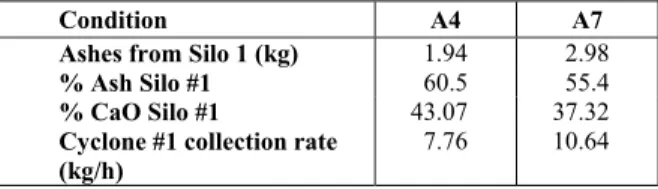
The XRF analysis of the ashes from conditions A4 and A7 are presented in Table 9. The goal was to consider the quantitative oxide analysis to serve as a basis for determining the CaO partitioning. Thus, Table 10 presents the mass collected and the ash mass flow within Cyclone #1 producing the ashes in Silo #1. Consequently, from the total ash generation, the wt. % ashes obtained in Silo #1 from the opera-tion of Cyclone #1 can be determined. Furthermore, by obtaining the CaO feed from the dolomite and the non-desulphurized ashes, the wt. % CaO collected in Cyclone #1 was also determined in Table 10.
From Table 10, it can be seen that 60.5 wt.% of the ashes in condition A4 were obtained in Silo #1 and 55.4 wt.% from condition A7 were obtained in the same silo. The values for the wt. % CaO fed into the reactor (dolomite + non-desulphurized ashes), elutriated and collected by Cyclone #1 and stored in Silo #1 were not within the same range; for condition A4, 43.07 wt.% of the fed CaO was collected by cyclone #1 whereas 37.32 wt.% was collected by the same cyclone under condition A7.
From the first analysis, it can be seen that the elu-triation and the collection of ashes and Ca-containing products do not present the same behavior.
Table 9: XRF for Coal A ashes.
Condition A4 A7
CaO (%) 6.80 6.96
SiO2 (%) 56.0 53.8
Fe2O3 (%) 7.03 7.23
Al2O3 (%) 19.5 21.5
MgO (%) 3.51 3.63
Na2O (%) 0.20 0.14
K2O (%) 1.72 1.57
TiO2 (%) 0.79 0.83
SO3 (%) 3.47 3.44
Table 10: Elutriation analysis of Coal A ashes and CaO obtained from Cyclone #1 under conditions A4 and A7.
Condition A4 A7
Ashes from Silo 1 (kg) 1.94 2.98
% Ash Silo #1 60.5 55.4
% CaO Silo #1 43.07 37.32
Cyclone #1 collection rate (kg/h)
7.76 10.64
The typical tendency is that the elutriation of sol-ids increases as Us increases. However, it can be seen
that the wt. % of CaO in Silo #1 was lower for con-dition A7 when a higher Us value was applied. This
33
su # p th S st el d d th ti
m co w 6 th th ca 30
Therefore, uch values fo
1 are the hi lied. This hy he elutriated
ilo #1 from tated that, ev lutriating be esulphurizat id not incre he bed behav ions showed
Consequen mainder ash oncentrated: which could n
presents the he Coal A de he dolomite
an be observ
, a hypothes or Ca-contain ighest indepe ypothesis is bed was see condition A ven upon incr
d fines, the ion products ase. Moreov vior during t slugging flu ntly, it can
and the Ca (i) in the be not be collec e XRD patter esulphurizati
addition for ved in the fi
Figure 6
G. sis can be ning solids c endent of th supported b en in the ash A7. In other w reasing the U Ca-containin s collected b ver, a visual the runs und uidization beh be asked w aO partitioni ed or (ii) by cted by Cycl rns of the be ion runs. The
the in situ d igure. These
: XRD patter
M. F. Gomes, C.
Brazilian Jou
developed t collected in S he Us value
by the fact t hes collected words, it can Us value and
ng products, by Cyclone
observation der such con havior. whether the
ing were m fragmentati lone #1. Fig ed material af
e products fr desulphurizat results sugg
rns for the be
. Philipssen, E. K
urnal of Chemica
that Silo ap-that d in n be the , or #1 n of
ndi- re-more
ion, gure fter rom tion gest
tha Cy the con ind pro vat pre lar ma com
the gre uct Mo and in vel sor
ed material a
K. Bard and G. So
al Engineering
at desulphur yclone #1, te ermore, this ncentration i dicated in T oducts tend t tion of the b esence of w rger than the aterial before
mposed of sa In fact, Sca e elutriation ess due to th
ts in the bed ontanagro et d fragmentat
a bubbling locity were rbents tested
after Coal A d ouza
rization prod end to be con result helps in Silo #1 co Table 10, be
to stay in th bed material white and ye bed sand co e the desulp and.
ala et al. (200 associated he formation d. Furthermo t al. (2010) d tion during c
bed operati moderate d.
desulphuriza
ducts, if not ncentrated in to explain t ompared with
ecause the he bed. From after the Co ellow materi
ould be obse phurization r
00) observed with the co of desulphu ore, it should discovered th calcination a ing at low g to negligibl
ation runs.
t collected b n the bed. Fu the lower Ca h the ashes, Ca-containin m visual obse oal A runs, th
als with siz erved. The be
runs was on
d a decrease onversion pr urization pro d be noted th hat the attritio
and sulphatio gas superfici le for all th
by ur-aO
as ng
er-he zes ed nly
in
ro- d-hat
Dolomite Desulfurization Behavior in a Bubbling Fluidized Bed Pilot Plant for High Ash Coal 331
Brazilian Journal of Chemical Engineering Vol. 33, No. 02, pp. 319 - 332, April - June, 2016
Additionally, Huda et al. (2006) observed white and yellow bed materials larger than 2.0 mm after the in situ desulphurization. They noted that the yel-low particles were CaCO3 coated with CaSO4 and
Ca-aluminosilicate while the white particles were CaCO3 or CaCO3 coated with CaSO4. Consequently,
the authors defined the Ca/S molar ratio of the fine sorbent formed by attrition (< 200 µm), which was significantly lower than the total Ca/S molar ratio.
From the elutriation analysis, it can be noted that, for long dolomite desulphurization runs on the bub-bling fluidized bed, there is a tendency of the bed properties to change for coal types similar to the Brazilian ones. It is important that this be controlled in industrial plants so that the fluidization quality is not affected.
CONCLUSIONS
After analyzing different aspects that involve in situ desulphurization in a bubbling fluidized pilot plant, some conclusions can be developed for the SO2 conversion, ash characteristics and elutriation
mechanisms.
Based on the stoichiometric analysis performed on the SO2 conversion, i.e., a comparison of one coal
under different fluid dynamics conditions, Coal B presented higher SO2 conversion rates. This was the
expected result for a higher S wt.% for this fuel. Additionally, better conversion was observed for lower Us values; however, Coal B presented lower
conversion rate values for SO2 consumed per hour
for Us = 0.46 m/s.
The fluidization slugging behavior when applying a higher superficial velocity, Us = 0.46 m/s, and a
bed height of 0.4 m for 0.262 m2, indicated a considerable decrease in the SO2 conversion, which
was most likely due to changes in the mass transfer mechanism. Together, the changes in the residence time must be considered to some extent. However, the residence time was not able to explain the SO2
conversion because, for example, in the Coal B con-ditions, it showed the same value for both superficial velocities applied. Consequently, the fluidization con-dition with a mass transfer mechanism can be a better path for achieving the SO2 conversion relations.
Mineralogical analyses for the ash characteriza-tion indicated the presence of CaSO4 and CaSO3 as
desulphurization products. Because no CaS was ob-served in the ashes, it can be suggested that the mechanism for CaSO4 formation occurs by the
for-mation and oxidation of CaSO3. This issue is
im-portant to be controlled when considering the use of ash. The formation of CaSO4 instead of CaSO3 is
often preferred when considering the different struc-tural uses of coal ashes.
The different fluid dynamic conditions applied clearly indicated a lower percentage of CaO in Cy-clone #1 than the quantity fed compared with the same relation for the ashes fed into the reactor. This behavior was explained by the tendency of desul-phurization products to accumulate in the bed during the use of dolomite. It was confirmed by visually detecting the desulphurization products as larger white particles in the bed. Again, it is an important issue to be considered in the continuous run of bub-bling fluidized bed plants working with in situ desul-phurization due to the strong tendency of changes in the bed properties. Consequently, some continuous bed control must be developed by an appropriate procedure. Moreover, property changes in long de-sulphurization runs are still an issue to be analyzed in future studies.
NOMENCLATURE
Cfixed fixed carbon
dp particle diameter (µm)
dp* dimensionless particle diameter
Pf freeboard pressure (mmH2O)
P Pressure (mmH2O)
T04 Inlet bed temperature (°C) T05 Outlet bed temperature (°C) tr residence time (s)
u gas velocity (m/s)
Umf minimum fluidization velocity (m/s)
Us superficial velocity (m/s)
u* dimensionless gas velocity VM volatile matter
XRD X-Ray Diffraction XRF X-Ray Fluorescence
ΔP bed pressure variation (mmH2O)
Greek Letters
ξ Average SO2 conversion rate (moles SO2/h) ρg gas density (kg/m3)
ρs solid density (kg/m3)
ρbulk bulk density (kg/m3)
µ gas viscosity (kg/m.s)
ACKNOWLEDGEMENTS
332 G. M. F. Gomes, C. Philipssen, E. K. Bard and G. Souza
Brazilian Journal of Chemical Engineering
Grande do Sul (CIENTEC/RS) for supplying the Campus’ plants for the combustion tests.
REFERENCES
Altindag, H., Gogebakan, Y. and Selçuk, N., Sulphur capture for fluidized-bed combustion of high-sul-phur lignite. Applied Energy, 79, 403 (2004). Anthony, E. J. and Granatstein, D. L., Sulphation
phenomena in fluidized combustion systems. Pro-gress in Energy and Combustion Science, 27, 215 (2001).
Brady, M. E., Burnett, M. G., Galwey, A. K., Murray, O. and Sharkey, R., Aspects of the chemistry of calcium sulphate in coal ash. Fuel, 73, 39 (1994). Bragança, S. R., Dessulphuração do Gás de
Combus-tão do Carvão Candiota em Leito Fluidizado: In-fluência da Razão Molar Ca/S, Granulometria e Composição Química do Sorbente. Ph.D. Thesis, Universidade Federal do Rio Grande do Sul (1996). (In Portuguese).
Bragança, S. R., Jablonski, A., Castellan, J. L., De-sulphurization kinetics of coal combustion gases. Brazilian Journal of Chemical Engineering, 26(2), 161-169 (2003).
Cheng, J., Zhou, J., Liu, J., Zhou, Z., Huang, Z., Cao, X., Zhao, X., Cen, K., Sulphur removal at high temperature during coal combustion in furnaces: A review. Progress in Energy and Combustion Science, 29, 381 (2003).
Collar, S. A. C., Influência da Estrutura de Poros e do Raio de Grão na Reatividade ao SO2 de
Calci-nados de Calcários Gaúchos. Ph.D. Thesis, Uni-versidade Federal do Rio Grande do Sul (2001). (In Portuguese).
CONAMA, (Conselho Nacional do Meio Ambiente), Regulation N°08 from 6-December-1990. Estab-lishes emission standards for external combustion systems.
Dam-Johansen, K., Ostergaard, K., High-temperature between sulphur dioxide and limestone – IV. A discussion of chemical reaction mechanism and kinetics. Chemical Engineering Science, 46(3), 588 (1991).
Deer, W. A., Howie, R. A., Zusmann, J., An Intro-duction to the Rock Forming Minerals. Addison Wesley Longman Limited, London (1992). Himmelblau, D. M., Riggs, J. B., Basic Principles
and Calculations in Chemical Engineering. Pear-son, New Jersey (2006).
Hlincik, T., Buryan, P., Evaluation of limestones for the purposes of desulphurization during the fluid
combustion of brown coal. Fuel, 104, 208 (2013). Huda, M., Mochida, I., Korai, Y., Misawa, N., The
influences of coal type on in-bed desulphurization in a PFBC demonstration plant. Fuel, 85, 1913 (2006).
Irfan, A., Balci, S., Sulphation reaction between SO2
and limestone: Application of deactivation model. Chemical Engineering and Processing, 41, 179 (2002).
Kunii, D., Levenspiel, O. Fluidization Engineering. Butterworth, Newton (1991).
Lyngfelt, A., Leckner, B., Sulphur capture in fluid-ized bed boilers: The effect of reductive decom-position of CaSO4. The Chemical Engineering
Journal, 40, 59 (1989).
Montangro, F., Salatino, P., Scala, F., The influence of temperature on limestone sulphation and attri-tion under fluidized bed combusattri-tion condiattri-tions. Experimental Thermal and Fluid Science, 34, 352 (2010).
Scala, F., Salatino, P., Boerefijn, R., Ghadiri, M., Attrition of sorbents during fluidized bed calcina-tion and sulphacalcina-tion. Powder Technology, 107, 153 (2000).
Scala, F., Lupíañez, C., Salatino, P., Romeo, L. M., Díez, L. I., Primary fragmentation of limestone under oxy-firing. Fuel Processing Technology, 92, 1449 (2011).
Scala, F., Chirone, R., Meloni, P., Carcangiu, G., Manca, M., Mulas, G., Mulas, A., Fluidized bed desulphurization using lime obtained after slow calcination of limestone particles. Fuel, 114, 99 (2013).
Sheng, C., Xu, M., Zhang, J. and Xu, Y., Comparison of sulphur retention by coal ash in different types of combustors. Fuel Processing Technology, 64, 1 (2000).
Suyadal, Y., Erol, M. and Oguz, H., deactivation model for dry desulphurization of simulated flue gas with calcined limestone in a fluidized-bed re-actor. Fuel, 84, 1705 (2005).
Tarelho, L. A. C, Matos, M. A. A. and Pereira, F. J. M. A., The influence of operational parameters on SO2 removal by limestone during fluidized bed
combustion. Fuel Processing Technology, 86, 1385 (2005).
Ulerich, N. H., Newby, R. A. and Keairns, D. L., A thermogravimetric study of the sulphation of lime-stone and dolomite – prediction of pressurized and atmospheric fluidized bed desulphurization. Ther-mochimica Acta, 36, 1 (1980).