NUTRI TI ONAL GUI DANCE DURI NG PRENATAL CARE I N PUBLI C HEALTH SERVI CES I N
RI BEI RÃO PRETO: DI SCOURSE AND CARE PRACTI CE
1Luzia Apar ecida dos Sant os2 Fabiana Villela Mam ede3 Mar ia José Clapis4 Juliana Villela Bueno Ber nar di5
Sant os LA, Mam ede FV, Clapis MJ, Ber nar di JVB. Nut r it ional guidance dur ing pr enat al car e in public healt h services in Ribeirão Pret o: discourse and care pract ice. Rev Lat ino- am Enferm agem 2006 set em bro- out ubro; 14( 5) : 689- 94.
This st udy aim ed t o verify if pregnant w om en at t ended in prenat al care services at Basic Healt h Unit s in Ribeirão Pret o- SP, Brazil, received nut rit ional guidance and if t his guidance w as pert inent t o t heir nut rit ional st at u s. Nin et y - on e p r eg n an t w om en p ar t icip at ed . Th e p r eg n an t w om en w er e classif ied accor d in g t o t h eir n u t r it ion al con dit ion , u sin g a w eigh t , h eigh t an d pr egn an cy st age t able est ablish ed by t h e Br azilian Healt h Minist ry’s t echnical prenat al care m anual. We found pregnant wom en wit h weight under ( 13.19% ) and exceeding norm al levels ( 37.36% ) . I ndependent ly of t heir nut rit ional condit ion, m ost of t hem ( 60.43% ) declared t hey did not receive nut rit ion guidance. The m ean num ber of prenat al visit s did not influence t he nut rit ional st at us. The r esu lt s r ev eal def icien cies in t h e con t en t s an d qu alit y of n u t r it ion al car e. Th is su ggest s t h e n eed f or car e changes so as t o t ur n discour se int o pr act ice.
DESCRI PTORS: pr egnancy ; pr enat al car e; nut r it ional st at us; nut r it ion educat ion; nur sing
ORI ENTACI ÓN NUTRI CI ONAL EN EL PRENATAL EN SERVI CI O PÚBLI CO DE SALUD DE LA
CI UDAD DE RI BEI RÃO PRETO: EL DI SCURSO Y LA PRÁCTI CA ASI STENCI AL
La finalidad del present e est udio fue verificar las orient aciones nut ricionales dadas a m uj eres gest ant es que recibían at ención en el prenat al de las Unidades Básicas de Salud de la ciudad de Ribeirão Pret o- SP, y si las or ient aciones er an per t inent es al est ado nut r icional. Par t icipar on de la invest igación 91 gest ant es. Clasificam os a las gest ant es de acuerdo con el est ado nut ricional, usando la t abla de peso/ alt ura según la edad gest acional sugerida por el m anual t écnico de asist encia prenat al del Minist erio de la Salud de Brasil. Encont ram os gest ant es con peso inferior ( 13,19% ) y superior al norm al ( 37,36% ) . I ndependient e del est ado nut ricional, la m ayoría de las gest ant es ( 60,43% ) r elat ó no haber r ecibido or ient ación sobr e nut r ición. El núm er o m edio de consult as no influenció el est ado nut ricional. Los result ados indican deficiencias en el cont enido y en la calidad de la at ención n u t r icion al, su gir ien do la n ecesidad de adecu ación de la at en ción , t r asfor m an do el discu r so en u n a pr áct ica r eal.
DESCRI PTORES: em bar azo; at ención pr enat al; est ado nut r icional; educación nut r icional; enfer m er ía
ORI ENTAÇÃO NUTRI CI ONAL NO PRÉ-NATAL EM SERVI ÇOS PÚBLI COS DE SAÚDE NO
MUNI CÍ PI O DE RI BEI RÃO PRETO: O DI SCURSO E A PRÁTI CA ASSI STENCI AL
O ob j et iv o d est e est u d o f oi v er if icar as or ien t ações q u e as g est an t es at en d id as n o p r é- n at al d as Un id ad es Básicas d e Saú d e d o Mu n icíp io d e Rib eir ão Pr et o- SP, Br asil r eceb iam sob r e n u t r ição, e se est as or ient ações er am per t inent es ao seu est ado nut r icional. Par t icipar am da pesquisa 91 gest ant es. Classificam os as gest ant es de acor do com o est ado nut r icional usando a t abela de peso/ alt ur a segundo a idade gest acional pr econizada pelo m anual t écnico de assist ência pr é- nat al do Minist ér io da Saúde do Br asil. For am encont r adas gest ant es t ant o com peso inferior ( 13,19% ) com o superior ao norm al ( 37,36% ) . I ndependent em ent e do est ado nut r icional a m aior ia das gest ant es ( 6 0 , 4 3 % ) r elat ou não t er r ecebido or ient ação sobr e nut r ição. O núm er o m éd io d e con su lt as n ão in f lu en ciou n o est ad o n u t r icion al. A m aior ia d as gest an t es in iciou o p r é- n at al em m om ent o adequado para realizar int ervenções nut ricionais. Os result ados apont am para deficiências no cont eúdo e na qualidade do cuidado nut r icional suger indo a necessidade de adequação da assist ência t r ansfor m ando o discur so em um a pr át ica r eal.
DESCRI TORES: gr av idez; cuidado pr é- nat al; est ado nut r icional; educação nut r icional; enfer m agem
1 Study presented at the 15t h I nt ernat ional Congress on Wom en’s Healt h I ssues ( I COWHI ) - I V Brazilian Obst et ric and Neonat al Nursing Congress ( COBEON)
and awarded t he 2nd place for t he Madre Marie Dom ineuc Award; 2 Nursing Facult y at t he Araraquara Universit y Cent er, Mast er’s st udent , e- m ail: [email protected] .br; 3 RN, PhD, Faculty, e- m ail: fam am [email protected]; 4 RN, PhD, Associate Professor, e- m ail: m [email protected]; 5 RN, Obstetric Nursing Specialist, Supervisor in the Specialization Course in Obstetric Nursing ( Residence m ode) , e- m ail: j [email protected]. University of São Paulo at Ribeirão Preto College of Nursing, WHO Collaborating Centre for Nursing Research Developm ent
I NTRODUCTI ON
A
dequ at e n u t r it ion is fu n dam en t al in an y st age of t he lifecycle t o prom ot e, prevent , m aint ain and r ecov er healt h( 1). Dur ing pr egnancy, nut r it ionalneeds change to perm it the developm ent of the fetus, as well as t o supply wom en’s nut rit ional needs.
Am o n g p r eg n an t w o m en w i t h n u t r i t i o n al alt er at ion s, t h e follow in g appear m or e fr equ en t ly : i n f e ct i o n s, p a r a si t o se s, h e m o p a t h i e s ( a n e m i a ) , h y p er t en si v e sy n d r o m es, p l acen t al i n su f f i ci en cy, o b esi t y ; g r ea t er ch a n ces o f h em o r r h a g e d u r i n g d el i v er y an d p u er p er al i n f ect i o n ; as w el l as t h e possibilit y of pr em at u r e in f an t s, w it h in t r au t er in e g r o w t h r e st r i ct i o n ( I UGR) , p r e se n t i n g g r e a t e r possibilities of neonatal infections, respiratory diseases and increasing perinat al deat h st at ist ics( 2).
Assessing body weight and surveying eat ing habit s during prenat al care are im port ant st rat egies to identify pregnant wom en’s nutritional conditions and perm it individualized nut rit ional guidance wit h a view to optim izing the m others’ nutritional status, im proving m at er n al con dit ion s f or deliv er y an d adapt in g t h e infant ’s weight( 3).
The Brazilian Health Ministry ( MS) determ ines t h e u n d e r st a n d i n g o f t h e m u l t i p l e m e a n i n g s o f pregnancy for t hese wom en and of t he cont ext t hey are inserted in. This m akes prenatal care a privileged m om ent t o discuss and clarify each wom an’s unique qu est ion s( 3 ). Th u s, n u t r it ion al gu idan ce sh ou ld be
offered in accordance wit h each pat ient ’s econom ic, social and cult ur al possibilit ies( 4), w hich im plies t he need t o adequat ely prepare healt h professions about t his subj ect( 1).
Healt h professionals in t his care cont ext can assum e an im portant role in guidance, in encouraging pregnant wom en about healt hy living and nut rit ional aspect s, in ident ifying pregnant wom en at nut rit ional risk by assessing t heir nut rit ional condit ion, as well as in referring pregnant wom en t o social assist ance program s when sit uat ions of need are diagnosed.
Du r in g car e d eliv er y t o p r eg n an t w om en taking part in the Nascer ( “ Birth” ) Proj ect m aintained b y t h e Rib eir ão Pr et o Mu n icip al Healt h Secr et ar y ( SMSRP) , w e id en t if ied a con sid er ab le n u m b er of w om en w ho m ent ioned t hey had not r eceiv ed any nutritional guidance until that stage in their pregnancy; as well as t he absence of nut rit ional st at us records on t he prenat al cards.
Th e m o t h e r ’ s n u t r i t i o n a l co n d i t i o n i s det er m inant for fet us gr ow t h and t he infant ’s ( RN)
weight . There is concret e evidence t hat weight gain during pregnancy serves as a prognosis for t he RN’s weight at birth, which can be affected by the m other’s nut rit ional st at us and size before pregnancy.
Th i s i s i m p o r t a n t f r o m a p u b l i c h e a l t h p e r sp e ct i v e , si n ce b i r t h w e i g h t i s o n e o f t h e param et ers t hat is m ost associat ed wit h RN survival, growt h and m ent al developm ent .
We d e p a r t e d f r o m t h e p r e m i se t h a t t h e pregnant wom en who were receiving prenatal care in the Ribeirão Preto public health services, were neither being assessed nor adequately advised about nutritional asp ect s. Ou r i n i t i at i v e t o r eal i ze t h i s st u d y w as m ot ivat ed by t he need t o int ensify nut rit ional act ions and care with a view to high-quality prenatal care.
OBJECTI VE
This study aim ed to verify if pregnant wom en attended in prenatal care services at Basic Health Units i n Ri b ei r ão Pr et o - SP, Br azi l , r ecei v ed n u t r i t i o n al guidance and if t his guidance was pert inent t o t heir nut rit ional st at us.
METHODOLOGY
This is a descript ive, explorat ory and cross-sectional study. Data were collected at a philanthropic m at ernit y hospit al locat ed in Ribeirão Pret o, a cit y in the interior of São Paulo State, Brazil, which was called the Airport Com plex Maternity - MATER. This institution exclusively attends wom en in the Single Health System ( SUS) . I t is accredited in the context of the SMSRP’s
Nascer Pr oj ect and const it ut es a r efer r al cent er for 13 Basic Healt h Unit s. MATER offers prenat al care t o low - r isk pr egnancies fr om t he 36t h w eek onw ar ds, a n d p r o v i d es i n t eg r a t i o n b et w een t h e p r en a t a l , delivery and puerperal periods.
Dat a were collect ed in January and February 2003, using a st ruct ured form , and obt ained direct ly f r om t h e pr egn an t w om en ( age, obst et r ic h ist or y, previously received nutritional orientation, use of food supplem ents and life habits) and from their pregnancy card (last m enstrual period, gestational age, laboratory t est result s ( hem oglobin and hem at ocrit ) , at t endance to prenatal care visits, size and gestational age in weeks during the first visit carried out at the service of origin, weight during the first prenatal visit at MATER.
After data collection, we analyzed the pregnant wom en’s nut rit ional condit ion, i.e. t he weight / height index, following t he weight - height t able according t o g est at ion al ag e est ab lish ed b y t h e MS w h en t h e pr egnant w om an does not k now her w eight befor e pregnancy, available from the Technical Prenatal Care Manual and from the Prenatal and Low- Birth Delivery Care Manual by t he Lat in Am erican Perinat ology and Hum an Developm ent Center (CLAP)(5-6). The nutritional
st at u s w as assessed aft er su r v ey in g t h e pr egn an t wom an’s size and weight during the first prenatal visit at t he m at ernit y hospit al, consult ing her pregnancy card, and after determ ining the gestational age ( from the 13th week of pregnancy onwards), observing weight (10th and 90th percentiles) on the intersection of m aternal
height and gestational week(5-6).
The pregnant w om en w ere divided in t hree g r ou p s, d ep en d in g on t h eir w eig h t / h eig h t in d ex , f o l l o w i n g t h e w e i g h t - h e i g h t t a b l e a cco r d i n g t o gest at ional age, as follows:
Gr oup 1: pregnant wom en whose weight was below nor m al lev els for t heir gest at ional age ( below 10t h
per cent ile) ;
Gr oup 2: pregnant wom en whose weight was wit hin st andard levels for t heir gest at ional age ( wit hin t he 10th t o 90th percentile) ;
Gr ou p 3 : pr egnant w om en w hose w eight ex ceeded nor m al lev els for t heir gest at ional age ( abov e 90t h per cent ile) .
Data related to nutritional status assessm ent a n d t h e p r eg n a n t w o m en ’ s ch a r a ct er i st i cs w er e analyzed using frequencies. We also analyzed m eans and st andard deviat ions for t he num ber of prenat al visit s which t hese wom en at t ended.
Ethical aspects of research were respected, in accordance with Resolution 196/ 96. All participants received the free and informed consent term before data collection, and anonymity was guaranteed. The study was approved by the Research Ethics Committee at the University of São Paulo at Ribeirão Preto College of Nursing.
RESULTS
The result s are relat ed t o t he assessm ent of t h e w o m e n ’ s n u t r i t i o n a l co n d i t i o n , t o t h e i r characterization according to age and obstetric history and, finally, t o t he nut rit ional guidance t hey received in prenat al care.
Nut rit ional Condit ion of t he Pregnant Wom en
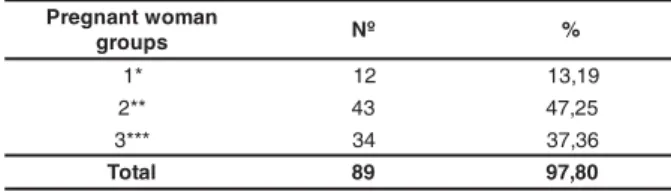
The st udy par t icipant s w er e div ided in t he g r o u p s d e s c r i b e d a b o v e ( Gr o u p s 1 , 2 a n d 3 ) , depen din g on t h eir w eigh t / h eigh t in dex accor din g t o t h e t ab le of w eig h t - h eig h t f or g est at ion al ag e ( Table 1 ) .
Table 1 - Dist ribut ion of pregnant wom en according t o t heir weight and height for gest at ional age, Public Healt h Services, Ribeirão Pret o, 2002
n a m o w t n a n g e r P
s p u o r
g Nº %
*
1 12 13,19
* *
2 43 47,25
* * *
3 34 37,36
l a t o
T 89 97,80
Two wom en were not included because their gestational age was questioned. * Weight below norm al st andards for gest at ional age
* * Standard weight for gestational age
* * * Weight above norm al standards for gestational age
Characterization of pregnant wom en according to age and obst et ric hist ory
The sam ple included m or e adult ( 74. 72% ) t han adolescent pr egnant w om en ( 23.07% ) . I n t he group of adolescent s, 14.28% belonged t o Gr ou p l,
38.09% t o Gr oup 2 and 47.61% t o Gr oup 3. Am ong ad u lt p ar t icip an t s, 1 3 . 2 3 % b elon g ed t o Gr o u p l, 57.47% t o Group 2 and 35.29% to Group 3.
We f o u n d m o r e m u l t i - ( 6 5 . 9 3 % ) t h a n pr im igr av idas ( 31. 81% ) . Am ong t he pr im igr av idas, 10. 34% w er e in Gr ou p 1, 55. 17% in Gr ou p 2 and
3 4 . 4 8 % i n Gr o u p 3. Fi f t e e n p e r ce n t o f t h e
m ult igravidas belonged t o Gr oup 1, 45% t o Gr oup 2
and 40% t o Group 3.
Table 2 - Nut rit ional Condit ion and St art of Prenat al Care, Public Healt h Services, Ribeirão Pret o, 2002
s p u o r
G Firsttrimester Second
r e t s e m i r
t Thirdtrimester
*
1 10,52% 17,39% 0% *
*
2 47,36% 47,82% 60,0% *
* *
3 42,10% 34,78% 40,0%
* Weight below norm al st andards for gest at ional age * * Standard weight for gestational age
* * * Weight above norm al standards for gestational age
Pr egnant w om en in all gr oups pr esent ed a sim ilar m ean num ber of prenat al visit s: 4.9 in Gr oup 1, 5.3 in Group 2 and 5.0 in Group 3, with standard deviat ions of 1.31 in Gr oup 1, 1.83 in Gr oup 2 and 1.96 in Group 3.
Nut rit ional Guidance
We ident ified t hat 37.36% of t he pr egnant w o m en w e i n t er v i ew ed h a d r ecei v ed n u t r i t i o n a l guidance, whereas 60.43% had not. When looking at the groups, 75% of wom en in Group 1 had not received any guidance, against 58.13% in Group 2 and 61.78% in Group 3.
Pr eg n an t w om en in Gr ou p 1 r eceiv ed t h e f ollow in g ad v ice: “ Do n ot eat f r ied f ood or lig h t products* ”, “ Eat vegetables” and “ Consum e a healthy diet ”.
Tables 3 and 4 show t he advice received in t he ot her groups.
Table 3 - Nut rit ional guidance received by pregnant wom en in Group 2, Public Healt h Services, Ribeirão Pret o, 2002
* Light Foods: are food product s wit h a m inim um reduct ion of 25% in calories or anot her com ponent ( fat , carbohydrat e, prot ein, et c.) , in com parison wit h the norm al version(7)
s k n i r d t f o s d n a a t s a p s s e l e m u s n o C s t e e w s t a e t o n o d d n a s e l b a t e g e v , k li m , t i u r f t a E s d o o f y t t a f e m u s n o c t o n o d d n a s r e b if , s e l b a t e g e v , k li m , t i u r f t a E t e i d y h tl a e h a e m u s n o C , s k n i r d t f o s d n a s t e e w s e m u s n o c t o n o d d n a t i u r f d n a s e l b a t e g e v t a E e k a t n i tl a s e c u d e r t i u r f d n a s e l b a t e g e v t a E e k a t n i tl a s e s a e r c e d d n a s k n i r d t f o s , s d o o f d e i r f d i o v a , s e l b a t e g e v t a E t h g i e w e v i s s e c x e o t e u d d o o f e s a e r c e D t o l a k n i r D s d o o f d e i r f d i o v a d n a h c u m o o t t a e t o n o D s k n i r d t f o s d n a a t s a p e m u s n o c t o n o D t u o b a r e d l o f a d e v i e c e r g n i v a h s n o it n e m d n a t i u r f , s e l b a t e g e v t a E y c n a n g e r p g n i r u d n o it i r t u n t i u r f d n a s e l b a t e g e v t a E n o r i n i h c i r s d o o f e m u s n o C d o o f d e i r f r o s k c a n s s t a e t o n o d d n a s t i u r f t a E e k a t n i tl a s d n a d o o f e c u d e R s d o o f e c u d e r d n a s l a e m e d i v i d , a t s a p t a e t o n o d , s t i u r f t a E y h tl a e h t o n s i t a h w t a e t o n o d d n a y h tl a e h t a E s n a e b d n a e c i r , s e l b a t e g e v , t i u r f t a E t a e m d n a s e l b a t e g e v , t i u r f t a E t f o s k n i r d t o n o d , e c i u j l a r u t a n k n i r d d n a t i u r f t a e , s l a v r e t n i r a l u g e r t a t a E s k n i r d s r e b if t a E ll e w t a E t i u r f d n a s e l b a t e g e v t a E s n i m a t i v d n a s n i e t o r p n i h c i r s d o o f e m u s n o C s t e e w s t a e t o n o d d n a t a e m d e r , s e l b a t e g e v t a E k li m d n a s g g e , s e l b a t e g e v t a E s t c u d o r p d e n n a c t a e t o n o d d n a t i u r f , s e l b a t e g e v , k li m , s e l b a t e g e v t a E n o r i n i h c i r s d o o f e m u s n o C s d o o f d e i r f t a e t o n o D s l a e m p i k s r o s d o o f d e i r f t a e t o n o d d n a t i u r f , s e l b a t e g e v t a E
Table 4 - Nut rit ional guidance received by pregnant wom en in Group 3, Public Healt h Services, Ribeirão Pret o, 2002
We found that 8.77% of the study participants w er e anem ic, i.e. blood hem oglobin under 11m g/ dl and hem atocrit levels under 33% . All anem ic pregnant wom en were receiving iron sulphat e when t hey were r efer r ed t o pr enat al car e at t he m at er nit y hospit al. No blood h em oglobin an d h em at ocr it r esu lt s w er e m entioned on 7.01% of the pregnancy cards. Anem ia levels corresponded to 11.11% in Group 1, 7.69% in
Group 2 and 10% in Group 3.
As t o su p p l e m e n t s, 5 4 . 3 8 % o f t h e int erviewees received iron sulphat e, while 42.10% of them neither received this nor any other supplem ent. Su p p l e m e n t s w e r e m o r e f r e q u e n t i n Gr o u p 1
( 99.10% ) , against 53.48% in Group 2 and 35.29% in
Gr oup 3.
I n the study group, 83.51% denied unhealthy lif e h abit s, 1 2 . 0 8 % in dicat ed sm ok in g an d 2 . 1 9 % al co h o l i sm . We d i d n o t i d en t i f y an y i l l eg al d r u g consum ption. I n Group 1, 41.66% m entioned sm oking,
58.33% denied unhealt hy habit s and we did not find any cases of alcoholism . I n Gr oup 2, 88.37% of t he
pr egnant w om en denied unhealt hy habit s, 11. 62% were sm okers and no alcoholics were found. I n Group 3, 91.17% denied unhealthy habits, 2.94% m entioned
sm oking and 5.88% alcoholism .
DI SCUSSI ON
t o t heir nut rit ional st at us involves t he need t o weigh nut rit ional care act ions and act ivit ies, wit h a view t o r ev ealing possible deficiencies, as w ell as t he need for reflect ion t o direct or redirect t hese act ions and act iv it ies.
I n t h is st u dy, w e per ceiv ed t h at pr egn an t wom en are m ore predisposed to nutritional alterations, pr esent ed by m or e t han half of our sam ple. Ot her st udies t hat assessed nut r it ional alt er at ions dur ing pr egn an cy also ev iden ced a sign if ican t n u m ber of w om en w it h nut r it ional alt er at ions in t his per iod of t he lifecycle( 8- 9).
Pregnant adolescent s are m ore predisposed t o weight / height alt erat ions for t heir gest at ional age. They pr esent differ ent nut r it ional needs, depending on the growth rate and the m aturity status. Pregnant adolescen t s w h ose w eigh t is below or su per ior t o norm al levels for their gestational age can harm their own health and cause dam age for the fetus as well( 10).
How ev er, adult pr egnant w om en ar e not fr ee fr om t his dam age eit her( 11- 12).
Pr enat al v isit s st ar t ed at an ideal m om ent ( first and second sem est er of pregnancy) t o assess and realize nut rit ional int ervent ions, w it h a view t o adequate fat accum ulation in the m other’s tissues and optim al fetal growth( 13). The num ber of prenatal visits
is in accordance wit h MS recom m endat ions( 5). These
data suggest that nutritional status alterations are not relat ed t o prenat al coverage, but deficiencies in t he cont ent s and qualit y of prenat al care, in line wit h an earlier st udy( 13).
Th er e is a n eed t o r et h in k t h e q u alit y of nut r it ional car e, i.e. t he adequacy of pr enat al car e q u al i t y f r om t h e p er sp ect i v e of n u t r i t i on al car e, r einfor ced by som e st udies car r ied out in pr enat al SUS services( 14- 15).
An a d e q u a t e q u a l i t y o f p r e n a t a l ca r e presupposes healt h professionals prepared t o ident ify pr egn an t w om en at n u t r it ion al r isk , t h r ou gh ear ly n u t r it ion al st at u s assessm en t , as w ell as t h r ou gh p er son alized n u t r it ion al g u id an ce t o im p r ov e t h e m ot h er ’s n u t r i t i on al an d d el i v er y con d i t i on s an d adequate the infant’s birth weight. These orientations sh o u l d b e o f f e r e d a cco r d i n g t o e a ch p a t i e n t ’ s econom ic, social and cult ural possibilit ies( 4). Pregnant
w o m en n eed t o b e r ef er r ed t o so ci al assi st an ce pr ogr am s w henev er necessar y.
A st u d y of n u t r it ion al ed u cat ion in p u b lic healt h ser v ices r ev ealed t hat nut r it ional t r aining is deficient am ong physicians and nurses, with difficulties
to identify and deal with the patients’ food problem s, as well as wit h t heir own food problem s. The sam e research indicated that nutritional deficiencies are not seen as a problem to be solved by health service, but as an econom ic issue( 1).
Th e se d a t a d e m o n st r a t e t h a t , o n so m e o cca si o n s, p r e g n a n t w o m e n r e ce i v e n u t r i t i o n a l g u i d a n ce w i t h l i t t l e m e n t i o n o f a h e a l t h y, com pr ehensive and var ied diet . On ot her s, t hey do n o t r e ce i v e a n y g u i d a n ce o r e n co u r a g e m e n t w hat soev er dur ing pr enat al car e, nor ir on sulphat e supplem ent s.
St u d ies h av e sh ow n t h at , w h en p r eg n an t wom en receive nut rit ional guidance, t heir nut rit ional condition im proves. This is the case for over- as well as underweight wom en, i.e. nutritional alterations are knowledge- relat ed( 13- 16).
Nut r it ional guidance should be per t inent t o t h e p r eg n an t w o m en ’s n u t r i t i o n al n eed s. Du r i n g pregnancy, t hese needs change depending on weight b ef or e p r eg n an cy, w eig h t g ain d u r in g p r eg n an cy, pregnancy st age and level of physical act ivit y.
Nut rit ional recom m endat ion inst rum ent s, i.e. w h ich clar if y t h e n u t r ien t g r ou p s ( car b oh y d r at es, vitam ins, m inerals, fibers, proteins and lipids) needed for balanced nutrition, and also determ ine the quantity t o be in gest ed, can be v er y u sef u l f or n u t r it ion al guidance.
During pregnancy, t he specific food pyram id for the gestational period can be a strategic instrum ent when it is used individually, as it shows food products, quant it ies t o be consum ed and foods t o be avoided by pregnant wom en( 4).
FI NAL CONSI DERATI ONS
We b e l i e v e t h a t p r e g n a n t w o m e n n e e d support in term s of nutritional adaptation, from health pr ofessionals as w ell as policy m aker s. Ther e is an ur gent need t o adequat e nut r it ional car e so as t o t ransform discourse int o act ual pract ice.
Other suggestions include: the elaboration of prenat al healt h educat ion program s about nut rit ional assessm en t an d g u id an ce, t o t h e ex am p le of t h e pregnancy course, waiting room , and recycling for the nursing and m edical team active in prenatal care. We also highlight t he need t o dem and healt h policies in
favor of food and supplem ent distribution to pregnant wom en in need. This can contribute to the im provem ent of wom en’s nut rit ional healt h in t he gravid- puerperal cycle, as well as to newborn health, and collaborate to put t he syst em izat ion of nut rit ional assessm ent and guidance of pregnant wom en int o pract ice.
REFERENCES
1. Boog MCF. Educação nut ricional em serviços públicos de saúde. Cad Saúde Pública 1999; 15( 2) : 139- 47.
2. Nem e B. Obst et rícia Básica. 2ª ed. São Paulo ( SP) : Sarvier; 2 0 0 0 .
3. Minist ério da Saúde ( BR) . Program a de Hum anização do Par t o. Hum anização no Pr é- Nat al e Nascim ent o. Secr et ar ia de Polít icas de Saúde. Br asília ( DF) : Minist ér io da Saúde; 2 0 0 2 .
4. Cordelini S., Goulart SC. Aspect os nut ricionais na Gravidez. I n: Spallicci M.D.B. Gravidez & Nascim ent o. São Paulo ( SP) : Edusp: 2002. p. 59- 70.
5. Minist ério da Saúde ( BR) . Assist ência Pré- nat al. Secret aria de Polít icas de Saúde Br asília ( DF) : Minist ér io da Saúde; 2 0 0 0 .
6. Schwarcz R, Díaz AG, Fescina R, De Mucio B, Belizt zky R, Delgado LR. At ención pr enat al y del par t o de baj o r iesgo. Mon t ev id eo: Cen t r o Lat in oam er ican o d e Per in at olog ía y Desar r ollo Hum ano ( CLAP - OPS/ OMS) ; 1996.
7. CREMESP [ Hom epage na I nt ernet ] . São Paulo: Conselho Regional de Medicina do Est ado de São Paulo, c2001- 2006 [ upt aded 2004 out ubr o; acesso em 2006 abr il 01] . Canal Ci d a d ã o . D i sp o n ív e l e m : h t t p : / / w w w . cr e m e sp . co m . b r / ?sit eAcao= Can alCid ad aof u ll&id = 4 6
8 . Fu j im or i E, Cassan a LMN, Szar f ar c SC, Oliv eir a I MV, Gu er r a- Sh in oh ar a EM. Ev olu ção do est ado n u t r icion al de gr ávidas at endidas na r ede básica de saúde, Sant o Andr é, Br a si l . Re v La t i n o - Am En f e r m a g e m 2 0 0 1 m a i o - j u n h o ; 9 ( 3 ) : 6 4 - 8 .
9. Nascim ent o E, Souza SB. Avaliação da diet a de gest ant es com sobr epeso. Rev Nut r Cam pinas 2002; 15( 2) : 173- 9. 1 0 . An der son L. Nu t r ição n a gest ação e n a lact ação. I n : Ander son L, Dibble MV, Tur kki PR., Mit chell HS, Rynber gen HJ. Nut rição. 17 ed. Rio de Janeiro ( RJ) : Guanabara Koogan; 1 9 8 8 . p. 2 6 9 - 7 3 .
11. Ohlin A, Rossner S. Mat ernal Boby weight developm ent aft er pr egnancy. I nt J Obesit y 1990; 14: 159- 73.
12. Kac G. Fat or es det er m inant es da r et enção de peso no pós- part o: um a revisão da lit erat ura. Cad Saúde Publica 2001 j unho; 17( 3) : 81- 93.
13. Soares L. Avaliação do Est ado Nut ricional na Gest ação: e x p e r i ê n ci a co m a p l i ca çã o d o g r á f i co d e Ro sso n u m a população de gest ant es. Rev Cient ifica 1990 j ulho- dezem bro; 9 ( 2 ) : 2 8 - 3 3 .
14. Cout inho T. Adequação do processo de assist ência pré-nat al ent re as usuárias do Sist em a Único de Saúde em Juiz d e Fo r a MG. Re v Br a s Gi n e co l Ob st 2 0 0 3 n o v e m b r o -dezem br o; 2 5 ( 1 0 ) : 5 6 - 6 0 .
15. Trevisan MR, De Lorenzi, DRS, Araúj o NM, Ésber K. Perfil da assist ência pré- nat al ent re usuárias do Sist em a Único de Saúde em Caxias do Sul. Rev Bras Ginecol Obst 2002 j unho; 2 4 ( 5 ) : 7 8 - 8 1 .
16. Barros DC, Perreira RA, Gam a SGN, Leal MC. O consum o alim ent ar de gest ant es adolescent es no m unicípio do Rio de Janeir o. Cad Saúde Pública 2004; 20( 1) : S121- 9.