ISSN 0104-6632 Printed in Brazil
www.abeq.org.br/bjche
Vol. 32, No. 01, pp. 99 - 106, January - March, 2015 dx.doi.org/10.1590/0104-6632.20150321s00003103
Brazilian Journal
of Chemical
Engineering
COMBINING A SEQUENCING BATCH REACTOR
WITH HETEROGENEOUS PHOTOCATALYSIS
(TiO
2
/UV) FOR TREATING A PENCIL
MANUFACTURER'S WASTEWATER
R. N. Padovan and E. B. Azevedo
*Molecular Physics and Chemistry Department, Institute of Chemistry of São Carlos, University of São Paulo (USP), Av. Trabalhador São-Carlense 400, Centro, P.O. Box 780, 13560-970, São Carlos - SP, Brazil.
Phone: + (55) 16 3373 9962, Fax: + (55) 16 3373 9975 E-mail: [email protected], *[email protected]
(Submitted: November 9, 2013 ; Revised: June 3, 2014 ; Accepted: June 3, 2014)
Abstract - A Sequencing Batch Reactor (SBR) was combined with heterogeneous photocatalysis (TiO2/UV)
as a tertiary treatment for a pencil manufacturer's wastewater. The SBR removed almost all Chemical Oxygen Demand (COD) from the wastewater, although color was barely removed. Photocatalysis was optimized using a factorial design. Final COD, Dissolved Organic Carbon (DOC), and color removals were 95%, 80%, and 93%, respectively. Treated wastewater showed no ecotoxicity towards Lactuca sativa. Color removal kinetics (photocatalysis) followed a pseudo-first order model. The SBR + AOP (Advanced Oxidation Process, TiO2/UV) combination was a feasibility choice for removing both COD and color from this wastewater.
Keywords: SBR; AOP; Photocatalysis; TiO2; Color removal; Toxicity.
INTRODUCTION
Biological processes are the best choice for treating high concentrations of organic matter and high vol-umes of wastewater. There are many kinds of bio-logical processes, one of them being the Sequencing Batch Reactor (SBR). SBRs are a kind of Activated Sludge Process (ASP), where all steps (feed, reac-tion, settling, decantareac-tion, and inactivation) are car-ried out in the same compartment in a cyclic opera-tion (Khouni et al., 2012).
On the other hand, ASPs present limitations for treating compounds with low biodegradability and their efficiency can be drastically reduced by toxic compounds (Mantzavinos and Psillakis, 2004). A possible tool for minimizing this effect is combining ASRs with another treatment, such as Advanced
Oxidation Processes (AOPs).
AOPs are based on the “in situ” generation of hy-droxyl radicals (•OH). This radical is the second best oxidant in nature, fluorine being the first one (Legrini
et al., 1993; Hoffmann et al, 1995). The most studied AOP is heterogeneous photocatalysis. Many kinds of photocatalysts have been studied, among them: TiO2, ZnO, CeO2, CdS, and ZnS (Gogate and Pandit, 2004). Titanium dioxide is the most used photocata-lyst due to its low cost and toxicity, photo-stability, and the wide range of pHs in which it can be used (Nakata and Fujishima, 2012).
100 R. N. Padovan and E. B. Azevedo
(Hai et al., 2007). Such combinations may present a synergistic effect rather than an additive one (Oller et al., 2011).
There are few studies regarding the combination of those two technologies. Most of them use the biological reactor only to observe the wastewater bio-degradability increase after photocatalysis (Hincapié
et al., 2005; Arques et al., 2007; García-Ripoll et al., 2007; Oller et al., 2007). Studies that assessed both processes in tandem showed promising results for organic matter removal, ranging from 90-100% (Essam
et al., 2007; L’Amour et al., 2008).
According to Scott and Ollis (1995), there are four major groups of wastewaters whose degradation could be potentially improved by combining those processes: wastewaters with (1) recalcitrant or non-biodegradable compounds; (2) a large share of bio-degradable compounds, but with compounds that require a final polishing; (3) toxic or inhibitory com-pounds; and (4) non-biodegradable organic metabo-lites. For types (1) and (3), the best approach is to use chemical oxidation as a pretreatment. For type (2), it should be used as a post-treatment. For type (4), chemical oxidation between biological processes is indicated.
The wastewater studied in this work came from a pencil manufacturer – Chemical Oxygen Demand (COD) ≅ 670 mg O2 L
–1
and Dissolved Organic Car-bon (DOC) ≅ 105 mg C L–1. It is a mixture between cleaning procedure wastewaters from the production room and the sanitary wastewater produced by over 2,200 employees. It comprises a 1:1 mixture of in-dustrial and sanitary sewage with a typical flow rate of approximately 30 m3 h−1. It presents biodegrad-ability, with more than 90% organic matter removal in the industrial SBR. However, removing color is a real challenge. This is a type 2 wastewater (Scott and Ollis, 1995).
The main goal of this work was to remove color from this wastewater by combining an SBR with an AOP (photocatalysis, TiO2/UV), as well as optimiz-ing the AOP regardoptimiz-ing photocatalyst content, tem-perature, and pH. That is the first step in developing a sound coupled treatment for this kind of wastewater.
MATERIALS AND METHODS
Wastewater
Ten samples of the wastewater were collected at the entrance of the biological reactors in decontami-nated 4-L glass bottles and immediately refrigerated
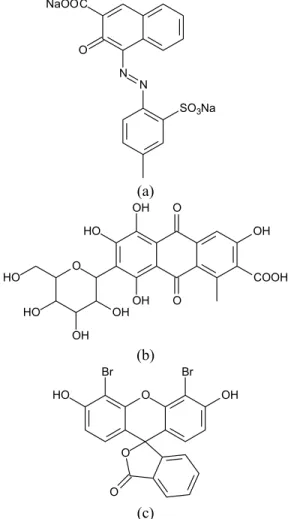
at 5 °C on different days, then mixed together to obtain a composite sample. After collection, the pH was adjusted to less than 2, using H2SO4, to avoid microbial degradation. Sanitary sewage was col-lected at the same plant and stored at 5 °C. The stud-ied wastewater comprised a 1:1 mixture of wastewater and sewage, which simulates the plant procedure when feeding the biological reactors. The wastewater contained, mainly, the following dyes: Red 6 (C.I. 15850), Carmine (C.I. 75470), and Orange 5 (C.I. 45370:1) (Figure 1).
NaOOC
O
N N
SO3Na
(a)
OH
COOH O
O OH
OH HO
O
OH
OH HO HO
(b)
O
Br Br
OH HO
O
O
(c)
Figure 1: Structures of the dyes: (a) Red 6 (C.I. 15850), (b) Carmine (C.I. 75470) and (c) Orange 5 (C.I. 45370:1).
Sequencing Batch Reactor
experiments. Air was provided by an air compressor, with a flow rate of 100 L h–1.
The reactor Hydraulic Residence Time (HRT) was 3 h (react phase). The sludge was obtained from the plant biological reactors, presenting proper fea-tures, such as: few filamentous microorganisms, well-formed flakes, and feasible settling characteristics.
To assess reactor performance, the following analyses were performed: Total Solids (TS), Volatile Solids (VS), Settled Sludge Volume (SSV), and Sludge Volume Index (SVI) (APHA, 2005).
Photocatalytic Reactor
The experiments were performed in a 250 mL open cylindrical Pyrex® reactor. 100 mL of the SBR effluent were irradiated with a Philips HPL-N 250 W medium-pressure mercury-vapor lamp, with the outer bulb removed. The lamp was positioned 20 cm above the liquid layer. Figure 2 shows its emission spectrum measured with a StellarNet EPP2000C spectroradiometer. Temperature was controlled at the desired levels and air was continuously pumped into the suspension at approximately 100 L h–1. The TiO2 photocatalyst used in this work was P25 from Evonik.
200 300 400 500 600 700
0 10 20 30 40 50 60
Irr
a
d
ia
n
ce
(
μ
W
c
m
–
2)
λ (nm)
Figure 2: Emission spectrum of the medium-pres-sure mercury-vapor lamp used.
Wastewater Assays
COD and DOC analyses followed standard proto-cols (APHA, 2005), the latter using a Shimadzu Vcph TOC-Total Organic Carbon Analyzer. Prior to analyses, samples were filtered (0.45 μm).
By using COD and TOC analyses, it is possible to calculate the Mean Oxidation Number of Carbon (MOC) (Eq. 1). With this number, the average level of oxidation of the organic matter remaining in
solu-tion is estimated (Vogel et al., 2000). Because the photocatalyst is removed by filtration after photo-catalysis, DOC was used instead of TOC, yielding a slightly modified MOC.
COD
MOC 4 1.5
TOC
= − × (1)
Color removal was monitored with a Varian Cary Win UV/Visible spectrophotometer. Spectra from 400 to 700 nm were obtained and integrated, there-fore producing an indirect measure of color.
Ecotoxicity tests (120 h) were performed to assess the possible generation of ecotoxicity after photo-catalysis. The methodologies proposed by Ortega et al. (1996) and Beltrami and Rossi (1998) were fol-lowed, where the test organisms are seedlings of lettuce, Lactuca sativa. The half maximal effective concentration (EC50) was calculated using the ad-justed Spearman-Karber method (Hamilton et al., 1977).
RESULTS AND DISCUSSION
Sequencing Batch Reactor
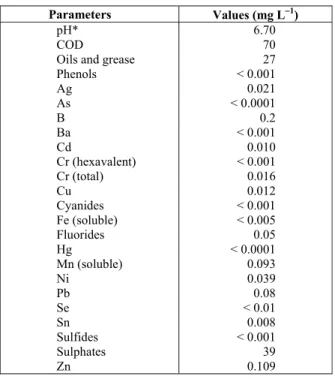
The SBR achieved good organic matter removals, with average COD and DOC removals of 90 and 75%, respectively, within 3 hours of aeration (COD from 670 to 63 mg L–1 and DOC from 105 to 27 mg L–1, approximately). Operational conditions were: TS 8.1 g L–1, VS 4.6 g L–1, SSV 350 mL, and SVI 76 mL mg–1. SSV and SVI complied with the sugges-tions of Grady et al. (1999) for good sedimentation conditions. TS and VS were slightly lower; however, other authors achieved good results with similar VS values (Jungles et al., 2014). Table 1 presents the full characterization of the wastewater after the biological reactor.
102 R. N. Padovan and E. B. Azevedo
Table 1: Full characterization of the wastewater after the biological reactor.
Parameters Values (mg L−1)
pH* 6.70 COD 70
Oils and grease 27
Phenols < 0.001
Ag 0.021
As < 0.0001
B 0.2
Ba < 0.001
Cd 0.010
Cr (hexavalent) < 0.001
Cr (total) 0.016
Cu 0.012
Cyanides < 0.001
Fe (soluble) < 0.005
Fluorides 0.05
Hg < 0.0001
Mn (soluble) 0.093
Ni 0.039 Pb 0.08
Se < 0.01
Sn 0.008
Sulfides < 0.001
Sulphates 39 Zn 0.109
* dimensionless
TiO2/UV
Heterogeneous photocatalysis was then assessed, as a post-treatment, for color removal purposes. A factorial design was performed. Temperature levels were: 30 °C (−1), the usual wastewater temperature and 40 °C (+1), the maximum legal discharge tempera-ture; TiO2 contents were: 0.1 (−1) and 1.0 (+1) mg L−1
(common range observed in the literature); and pH 5.0 (−1) and 9.0 (+1), acidic and basic pHs around 7.0.
Figure 3a shows the results of the factorial design performed. The greatest color removals were ob-tained in acidic pH and with 1.0 g TiO2 L–1. All sam-ples were irradiated for 25 min. Adsorption (dark) experiments showed no statistically significant removals.
Temperature presented a statistically insignificant effect on the process (Figure 3b) and, within the studied range, high TiO2 content and low pH favor color removal. Additional photocatalytic experi-ments were then performed varying only the pH (5.0, 7.0, and 9.0) and TiO2 content (0.1 and 1.0 g L
–1 ). Temperature was set at 25 °C, which is the average temperature of the wastewater. No significant differ-ences were observed in the process efficiency from neutral to acidic pH. So, pH 7 was chosen, since: (a) it is the secondary wastewater pH and (b) there would be no need for pH adjustments for final dis-posal. Finally, the studied range of TiO2 contents was expanded (0.25, 0.5, 1.0, 1.5, 2.0, and 2.5 g L–1) with 2 g TiO2 L–1 being the best value.
At the fixed treatment conditions (pH = 7, T = 25 °C, and 2 g TiO2 L–1), kinetic experiments were performed (Figure 4). All experiments were per-formed in triplicate (18 independent experiments). After 10 min, color removal followed a pseudo-first order model: k = (5.4 ± 0.92) × 10–2 min–1, R2 = 0.991. In the first 10 min of photocatalysis, there is only a very small color removal (5%, approximately). That fact can probably be ascribed to the preferred degra-dation of colorless organic compounds.
-0.0659 0.426 0.442
2.17
-12.1
16.6
p = 0.05
Standardized Effect Estimate (Absolute Value) 1by2
2by3 1by3 (3)T emperature (°C) (1)pH (2)T iO2, g L–1
0.426 0.442
2.17
(a) (b) Figure 3: Results of the 23 experimental design: (a) cube plot of predicted means (confidence interval at
10 20 30 40 50 60 0.0
0.2 0.4 0.6 0.8 1.0
Time (min)
C
o
lo
r/
C
o
lo
r0
Figure 4: Color removal kinetics (photocatalysis) with the 95% confidence interval (gray). Conditions: pH 7.0, T = 25 °C, 2.0 g TiO2 L−1; kinetic parame-ters: k = (5.4 ± 0.92) × 10–2 min–1, R2 = 0.991.
After 60 min of irradiation (photocatalysis), color removal increased approximately 71%. Photolytic tests (without catalyst) for the same period of time were performed. Only 20% of color removal was achieved.
Figure 5 shows the visible absorption spectra of the raw wastewater (COD0 = 700 mg L−1) after the SBR, and after coupling the SBR to photolysis (pH 7.0, T = 25 °C) or to photocatalysis (pH 7.0, T = 25 °C, 2.0 g TiO2 L-1), for 60 min of irradiation. One can easily observe the huge improvement obtained for the coupling SBR + photocatalysis, regarding color removal.
400 450 500 550 600 650 700
0.0 0.3 0.6 0.9 1.2 1.5
Ab
so
rb
a
n
ce
Wavelength (nm)
Raw Wastewater SBR SBR + Photolysis SBR + Photocatalysis
Figure 5: Absorption spectra of the raw wastewater, after the SBR, photolysis (pH 7.0, T = 25 °C), and photocatalysis (pH 7.0, T = 25 °C, 2.0 g TiO2 L
-1 ). COD0 = 700 mg L−1.
As the dyes were degraded, the occurrence of
photosensitization is possible, which would increase the efficiency of the excitation process (Linsebigler
et al., 1995). No works dealing with TiO2 photosen-sitization by Red 6 or Orange 5 were found. On the other hand, Carmine does sensitize titanium dioxide. The band-gap energy is reduced from 3.16 to 2.99 eV, promoting a red shift and increasing visible light excitation (Rosu et al., 2013).
Organic Matter Removal
Figure 6 shows the results from COD and DOC analyses during the photocatalytic treatment. While color removal increased 71%, COD and DOC re-movals increased 40 and 30%, approximately. Those differences are probably due to the fact that remov-ing color requires only the degradation of the dyes' chromophore groups, while COD (and especially DOC) removal requires an extensive oxidation of the whole molecules.
0 10 20 30 40 50 60
-4 -3 -2 -1 0 + 1 + 2 + 3 + 4 0 10 20 30 40 50 60 70
COD DOC
C
O
D
(m
g
O
2
L
–
1)
D
O
C
(
m
g
C
L
–
1)
MO
C
Time (min)
Figure 6: COD and DOC removals and MOC evo-lution during photocatalysis.
The MOC slightly increased (from +0.9 to +1.5). The photocatalyzed wastewater was already biologi-cally treated. Therefore, the present compounds were somewhat stabilized (oxidized). Nevertheless, the MOC clearly indicates the wastewater oxidation during photocatalysis. Moreover, there is no use in extending the treatment time beyond 60 min, since the MOC is relatively stable from 50 min on.
Comparison with Previous Works
104 R. N. Padovan and E. B. Azevedo
Table 2: Comparison between previous works and the present one.
Processes and Conditions Authors Wastewater
c d Removals
Typea: 3 Photocatalysis: SBRb:
Elmolla and Chaudhuri (2011)
AMX and CLXc •1 g TiO2 L–1
•250 mg H2O2 L–1
•pH 5
•5 h
•48 h •100% AMX/CLX
•57% sCODd (670 to 236 mg L–1)
Typea: 1 Photocatalysis: SBR:
Xu et al. (2012)
Dyes •2 g SDS e -CuO/TiO2 L–1
•40 min
•12 h •94% COD (1,134 to 71 mg L–1) •95% BODf (384 to 18 mg L–1)
Typea: 1 Solar photo-Fenton: ASi:
Silva et al. (2013)
Leachate •13 h •450 h •90% DOC (1,000 to 90 mg L–1)
Typea: 2 ABRh-ASi: UV/H
2O2:
Bustillo- Lecompte
et al. (2014) Slaughterhouse
Wastewater •46 h •3 h •
92% DOC (1,000 to 80 mg L-1)
Typea: 2 SBR: Photocatalysis:
This work Dyes •3 h •2 g TiO2 L–1
•pH 7
•1 h
•95% COD (700 to 37 mg L–1) •80% DOCg (105 to 27 mg L–1) •93% color
a According to Scott and Ollis (1995); b SBR: Sequencing Batch Reactor; c AMX: amoxicillin; CLX: cloxacillin; d sCOD: soluble Chemical
Oxygen Demand; e Sodium dodecyl sulfate; f BOD: Biochemical Oxygen Demand; g DOC: Dissolved Organic Carbon; h Anaerobic Baffled
Reactor; i Activated Sludge
Elmolla and Chaudhuri (2011) studied the treat-ment of a wastewater containing antibiotics (amox-icillin and cloxacillin). Although long treatment times (5 h of photocatalysis + 48 h of SBR), addi-tional oxidant (H2O2), and acidic pH (5) were used, organic matter removal (COD) was low (57%). They concluded that the feasibility of using the com-bined UV/H2O2/TiO2-SBR process for treatment of this wastewater was limited.
Xu et al. (2012) achieved high organic matter re-movals (94% COD and 95% BOD) from a dyestuff wastewater. However, the SBR stage took 12 h.
Other works can be found in the literature using different kinds of coupled treatments and wastewa-ters, as the one studied by Silva et al. (2012) that used solar-photo-Fenton on a pre-industrial scale coupled with activated sludge to treat sanitary land-fill leachate (Type 1, COD = 1,000 mg O2 L–1). The process presented promising results, achieving more than 90% of DOC removal.
Bustillo-Lecompte et al. (2014) studied the deg-radation of a slaughterhouse wastewater (COD = 1,000 O2 mg L–1), coupling an anaerobic-aerobic reactor with the UV/H2O2 process. That combination removed 92% of COD in 46 h with a total cost of $1.25/kg of TOC removed and $11.60/m3 of treated wastewater. In that case, the AOP was used after the biological process (Type 2).
Elmolla and Chaudhuri (2011) and Xu et al. (2012) dealt with type 1/3 wastewaters, requiring the sequence: Photocatalysis → SBR (Scott and Ollis 1995). On the contrary, this work studied the
treat-ment of a type 2 wastewater (SBR → Photocatalysis). Nevertheless, high organic matter removals were also achieved (95% COD and 80% DOC), along with an almost complete decolorization. The use of short treatment times (3 h of SBR + 1 h of photocatalysis) and neutral pH must be emphasized.
Figure 7 compares the efficiency of combining the SBR to photocatalysis regarding COD, DOC, and color removals. One can see the successful combina-tion of two complementary processes: SBR removes carbon and the AOP removes color, substantially improving the wastewater quality, making it probably safe to be discharged.
Color DOC COD
0% 20% 40% 60% 80% 100%
SBR Photocatalysis
Ecotoxicity
After 60 min of photocatalysis, the wastewater was non-toxic to the test-organism. This is an im-portant and promising result, since it suggests that it is probably safe to dispose of the photocatalytically treated wastewater.
CONCLUSIONS
The SBR alone was capable of removing 90% of COD, 75% of DOC, and only 22% of color in 3 hours. When it was combined with one hour of het-erogeneous photocatalysis (TiO2/UV), COD, DOC, and color removals improved to 95%, 80%, and 93%, respectively. Therefore, the wastewater quality was substantially improved, making it probably safe to be discharged.
The best photocatalytic conditions (factorial de-sign) were: pH 7.0, T = 25 °C (which are, approxi-mately, the wastewater natural conditions after bio-logical treatment) and 2.0 g TiO2 L–1. Those are promising conditions, as costs would be significantly reduced. Color removal followed a pseudo-first order model: k = (5.4 ± 0.92) × 10–2 min–1, R2 = 0.991. On the other hand, photolysis removed only 20% of color in 1 h.
By the end of the treatment process, the waste-water was non-toxic to the test-organism (seedlings of lettuce, Lactuca sativa). This is an important and promising result, since it also suggests that it is probably safe to dispose of the photocatalytically treated wastewater.
ACKNOWLEDGEMENTS
The authors thank the Federal Agency for Support and Evaluation of Postgraduate Education (CAPES), Brazil, for financial support.
NOMENCLATURE
AOP Advanced Oxidation Process
ASP Activated Sludge Process SBR Sequencing Batch Reactor
COD Chemical Oxygen Demand mg L−1 DOC Dissolved Organic Carbon mg L−1
EC50 Effective Concentration %
HRT Hydraulic Residence Time h
MOC Mean Oxidation Number of Carbon
dimensionless
SSV Settle Sludge Volume mg L−1
SVI Sludge Volume Index mL g−1
VS Volatile Solids mg L−1
TS Total Solids mg L−1
REFERENCES
Arques, A., Amat, A. M., García-Ripoll, A. and Vicente, R., Detoxification and/or increase of the biodegradability of aqueous solutions of dimetho-ate by means of solar photocatalysis. J. Hazard. Mater., 146(3), 447 (2007).
American Public Health Association (APHA), Stan-dard Methods for the Examination of Water & Wastewater. 21st Ed., APHA, Washington (2005). Beltrami, M. and Rossi, D., Sediment ecological risk
assessment: In situ and laboratory toxicity testing of Lake Orta sediments. Chemosphere, 37(14-15), 2885 (1998).
Bustillo-Lecompte, C. F., Mehrvar, M. and Quiñones-Bolaños, E., Cost-effectiveness analysis of TOC removal from slaughterhouse wastewater using combined anaerobic–aerobic and UV/H2O2 proc-esses. J. Environ. Manage., 134, 145 (2014). Chen, J. and Zhu, L., Heterogeneous UV-Fenton
catalytic degradation of dyestuff in water with hydroxyl-Fe pillared bentonite. Catal. Today, 126 (3-4), 463 (2007).
Elmolla, E. S. and Chaudhuri, M., The feasibility of using combined TiO2 photocatalysis-SBR process for antibiotic wastewater treatment. Desalination, 272(1-3), 218 (2011).
Essam, T., Amim, M. A., Tayeb, O., Mattiasson, B. and Guieysse, B., Solar-based detoxification of phenol and p-nitrophenol by sequential TiO2 photocatalysis and photosynthetically aerated biological treatment. Water Res., 41(12), 1697 (2007).
García-Ripoll, A., Amat, A. M., Arques, A., Vicente, R., López, M. F., Oller, I., Maldonado, M. I. and Gernjak, W., Increased biodegradability of Ul-tracidTM in aqueous solutions with solar TiO2 photocatalysis. Chemosphere, 68(2), 293 (2007). Gogate, P. R. and Pandit, A. B., A review of
impera-tive technologies for wastewater treatment I: Oxidation technologies at ambient conditions. Adv. Environ. Res., 8(3-4), 501 (2004).
106 R. N. Padovan and E. B. Azevedo
Hai, F. I., Yamamoto, K. and Fukushi, K., Hybrid treatment systems for dye wastewater. Crit. Rev. Env. Sci. Technol., 37(4), 315 (2007).
Hamilton, M. A., Russo, R. C. and Thurston, R. V., Trimmed Spearman-Karber method for estimat-ing median lethal concentrations in toxicity bio-assays. Environ. Sci. Technol., 11(7), 714 (1977). Hincapié, M., Maldonado, M. I., Oller, I., Gernjak,
W., Sánchez-Pérez, J. A., Ballesteros, M. M. and Malato, S., Solar photocatalytic degradation and detoxification of EU priority substances. Catal. Today, 101(3-4), 203 (2005).
Hoffmann, M. R., Martin, S. T., Choi, W. and Bahnemann, D. W., Environmental applications of semiconductor photocatalysis. Chem. Rev., 95(1), 69 (1995).
Jungles, M. K., Campos, J. L. and Costa, R. H. R., Sequencing batch reactor operation for treating wastewater with aerobic granular sludge. Braz. J. Chem. Eng., 31(1), 27 (2014).
Kapdan, I. K. and Ozturk, R., Effect of operating parameters on color and COD removal perform-ance of SBR: Sludge age and initial dyestuff concentration. J. Hazard. Mater., 123(1-3), 217 (2005).
Khouni, I., Marrot, B. and Amar, R. B., Treatment of reconstituted textile wastewater containing a reac-tive dye in an aerobic sequencing batch reactor using a novel bacterial consortium. Sep. Purif. Technol., 87, 110 (2012).
L’Amour, R. J. A., Azevedo, E. B., Leite, S. G. F. and Dezotti, M., Removal of phenol in high salinity media by a hybrid process (activated sludge + photocatalysis). Sep. Purif. Technol., 60(2), 142 (2008).
Legrini, O., Oliveros, E. and Braun, A. M., Photo-chemical processes for water treatment. Chem. Rev., 93(2), 671 (1993).
Linsebigler, A. L., Lu, G. and Yates Junior, J. T., Photocatalysis on TiO2 surfaces: Principles, mecha-nisms, and selected Results. Chem. Rev., 95(3), 735 (1995).
Mantzavinos, D. and Psillakis, E., Enhancement of biodegradability of industrial wastewaters by
chemical oxidation pre-treatment. J. Chem. Tech-nol. BiotechTech-nol., 79(5), 431 (2004).
Nakata, K. and Fujishima, A., TiO2 photocatalysis: Design and applications. J. Photochem. Photobiol. C: Photochem. Rev., 13(3), 169 (2012).
Oller, I., Malato, S. and Sánchez-Pérez, J. A., Com-bination of advanced oxidation processes and bio-logical treatments for wastewater decontamina-tion – A review. Sci. Total Environ., 409(20), 4141 (2011).
Oller, I., Malato, S., Sánchez-Pérez, J. A., Maldonado, M. I. and Gassó, R., Detoxification of wastewater containing five common pesticides by solar AOPs-biological coupled system. Catal. Today, 129(1-2), 69 (2007).
Ortega, M. C., Moreno, M. T., Ordovás, J. and Aguado, M. T., Behaviour of different horticul-tural species in phytotoxicity bioassays of bark substrates. Sci. Hortic. (Amsterdam, Neth.), 66(1-2), 125 (1996).
Rosu, M.-C., Suciu, R.-C., Mihet, M. and Bratu, I., Physical–chemical characterization of titanium dioxide layers sensitized with the natural dyes carmine and morin. Mater. Sci. Semicond. Process., 16(6), 1551 (2013).
Scott, J. P. and Ollis, D. F., Integration of chemical and biological oxidation processes for water treat-ment: Review and recommendations. Environ. Prog., 14(2), 88 (1995).
Silva, T. F. C. V., Silva, M. E. M. F., Cunha-Queda, A. C., Fonseca, A., Saraiva, I., Boaventura, R. A. R. and Vilar, V. J. P., Sanitary landfill leachate treat-ment using combined solar photo-Fenton and biological oxidation processes at pre-industrial scale. Chem. Eng. J., 228, 850 (2013).
Vogel, F., Harf, J., Hug, F. and Rohr, P. R. V., The mean oxidation number of carbon (MOC) – A useful concept for describing oxidation processes. Water Res., 34(10), 2689 (2000).