Optimal paths for minimizing lost available work during heat transfer processes with a generalized
heat transfer law
Shaojun Xia, Lingen Chen,∗ and Fengrui Sun
Postgraduate School, Naval University of Engineering, Wuhan 430033, P. R. China
(Received on 21 December, 2008)
A common of finite-time heat transfer processes between high- and low-temperature sides with a generalized heat transfer law [q∝(∆(Tn))m] are studied in this paper. The optimal heating and cooling configurations
for minimizing lost available work are derived for the fixed initial and final temperatures of the working fluid of the system (low-temperature side). Optimal paths are compared with the common strategies of constant heat flux, constant source (reservoir) temperature and the minimum entropy generation operation by numerical examples. The condition corresponding to the minimum lost available work strategy is that corresponding to a constant rate of lost available work, not only valid for Newton’s heat transfer law [q∝ ∆T] but also valid for the generalized convective heat transfer law [q∝(∆T)m]. The obtained results are more general and can provide
some theoretical guidelines for the designs and operations of practical heat exchangers.
Keywords: Finite time thermodynamics; Lost available work; Optimal control; Heat transfer process; Heat transfer law
1. INTRODUCTION
Since the mid 1970s, finite-time thermodynamics [1-10] has been applied to optimize the performance of various ther-modynamic systems and processes. Heat exchanger is used in modern industry widely. With optimizing the performance of the heat exchanger, the energy utilization efficiency could be improved and the total volume and weight of the heat transfer equipment could be reduced, so the heat exchanger is always one of the main research subjects in finite time thermodynam-ics. Bejan [11] first analyzed the least combined entropy pro-duction induced by the heat transfer and the fluid viscosity as the objective function to optimize the geometry of heat trans-fer tubes and to find optimum parameters for heat exchangers. Lineskin and Tsirlin [12], Andresen and Gordon [13] showed that the counter-flow heat exchanger could represent the op-timal solution for minimizing entropy generation, in which heat transfer between high- and low-temperature sides obeyed Newton’s heat transfer law [q∝(∆T)]. Badescu [14] further showed that the counter-flow heat exchanger could also rep-resent the optimal solution for minimizing lost available work. In general, heat transfer is not necessarily Newton’s heat trans-fer law and also obeys other laws. Heat transtrans-fer laws not only have significant influences on the performance of the given thermodynamic process [15-19], but also have influences on the optimal configurations of thermodynamic process for the given optimization objectives [20-23]. Nummedal and Kjel-strup [24] considered the reciprocal temperature difference ∆(1/T) as the driving force for heat transfer in irreversible thermodynamics (i.e. the linear phenomenological heat trans-fer law [q∝ ∆(T−1)]), and optimized the heat transfer pro-cess for minimizing entropy generation. The results show that the reciprocal temperature difference∆(1/T)is a constant, i.e. the principle of equipartition of forces (EoF). Based on Ref. [24], Johannessenet al. [25] further considered that the heat transfer coefficient is related to the local temperature changes, and showed that the local entropy generation rate is constant, i.e. equipartition of entropy production (EoEP). For a common class of finite-time heat transfer processes between high- and
∗Electronic address:
[email protected]/[email protected]
low-temperature sides with generalized radiative heat transfer law [q∝ ∆(Tn)], Andresen and Gordon [26] derived optimal heating and cooling strategies for minimizing entropy genera-tion. Optimal paths are compared with the common strategies of constant heat flux and constant source (reservoir) tempera-ture operation. For a system of uniform temperatempera-ture in contact with a thermal bath, in which heat transfer between high- and low-temperature sides obeys generalized radiative heat transfer law, Badescu [27] derived optimal heating and cooling strate-gies for minimizing lost available work. Optimal paths are also compared with the conventional strategies of constant heat-flux, constant source (reservoir) temperature operation and the optimal strategies for minimizing entropy generation. Chen et al. [28] and Li et al. [29,30] investigated the optimal performances of irreversible Carnot heat engine, refrigerator and endoreversible Carnot heat pump with a generalized heat transfer law [q∝(∆(Tn))m], which included the results with Newton’s heat transfer law, the linear phenomenological heat transfer law, the radiative heat transfer law [q∝ ∆(T4)], the Dulong-Petit heat transfer law [q∝(∆T)1.25][31], the general-ized convective transfer law [q∝(∆T)m] and the generalized radiative transfer law. One of aims of finite time thermody-namics is to pursue generalized rules and results. This paper will extend the previous work [12,13,14,26,27] by using the generalized heat transfer law [q∝(∆Tn)m], in the heat trans-fer processes between high- and low-temperature sides, to find the optimal heating or cooling strategies for minimizing lost available work. The obtained results are more general and can provide some theoretical guidelines for the designs of practical exchangers.
2. HEAT TRANSFER PROCESS MODEL
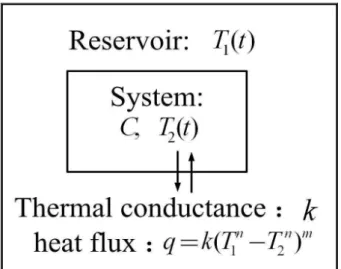
FIG. 1: Schematic of one-node thermal model for a system exchang-ing heat with a variable-temperature reservoir
presentation, only the caseT1(t)>T2(t)is explicitly consid-ered here (i.e., the system is heated). System cooling involves a change of sign for the heat fluxq. Consider that the heat transfer between the system and the reservoir follows a gener-alized law, including genergener-alized convective heat transfer law and generalized radiative heat transfer law, [q∝(∆Tn)m ][28-30]. Then
q=k(T1n−T2n)m (1) As the existence of heat resistance, the entropy generation rate associated with the heat fluxqis denoted ˙Sand is given by:
˙
S=q(1/T2−1/T1) (2) The total entropy generation for the durationτof the heat trans-fer process is:
S=k Z τ
0
(T1n−T2n)m(T−1
2 −T1−1)dt (3) According to Ref. [27], the lost available work rate is given by:
˙
Wl=T1S˙=k(T1n−T2n)
m T
1T2−1−1 (4) The total lost available workWlis obtained by integrating Eq. (4) during the heating process:
Wl=k
Z τ
0 (
T1n−T2n)m(T1T2−1−1)dt (5) In terms of the first law of thermodynamics, the change of sys-tem sys-temperatureT2(t)is governed by
q=k(T1n−T2n)m=CT2˙ (6) whereCis the heat capacity of the working fluid in the system and ˙T2=dT2/dt.
3. OPTIMAL CONFIGURATION
In a fixed timeτ, the system must be heated from a known initial temperature T2(0)to a known final temperatureT2(τ). Our problem now is to determine the optimal configuration of the reservoir temperature T1(t)for minimizing lost available work subjected to the constraint of Eq. (6). Apparently, it is an optimal control problem. Correspondingly, the modified Lagrangian L with a time-dependent Lagrange multiplierλ(t) is given by:
L=k(T1n−T2n)m(T1T2−1−1)−λ(t)[k(T
n
1−T2n)m−CT˙2] (7) The independent variables areT1,T2, and ˙T2(and in prin-ciple ˙T1, which does not appear in L). The Euler-Lagrange equations to determine the optimal strategy are then
∂L ∂T
2− d dt(
∂L ∂T˙2) =0,
∂L ∂T
1 =0 (8)
Substituting Eq. (7) into Eq. (8) yields: ˙
λ= (T1−n
1 T
n−2 2 −T1T
−2
2 )T2˙ (9)
λ= (mn+1)T1/(mnT2)−(T2/T1)n−1/(mn)−1 (10) Differentiating Eq. (10) with respect to timetyields:
˙
λ= [(1+ 1
mn) 1 T2
+(n−1)T n−1 2 mnT1n ]T1˙
−[(1+ 1
mn) T1 T2 2
+(n−1)
mn T2n−2 T1n−1]
˙
T2 (11)
Eliminating ˙λby using Eqs. (9) and (11) yields:
dT1 dT2
=(mn+n−1)T
1−n
1 T
n−1 2 +T1T
−1 2
mn+1+ (n−1)T1−nT2n (12) The detailed analytical expressions of the optimal paths will be shown here in dimensionless form. This will make the approach more flexible, increases the generality of the results and allows easy implementation. The following dimensionless variables and constants are defined:
ω=t/τ, z=T2(t)/T2(0), u=T1(t)/T2(t)
y=zu=T1(t)/T2(0) zf =T2(τ)/T2(0), A=kτ[T2(0)]mn−1/C (13)
wherezis the dimensionless system temperature,uis the ra-tio of the reservoir temperature to the system temperature,yis the dimensionless reservoir temperature,zf is the final dimen-sionless system temperature. A is a special constant, which depends on the parametersk,τ,T2(0),mandn. The following relationships exist for the independent and dependent dimen-sionless variables:
0≤ω≤1, 0≤z≤zf, z≤u≤y (14) By using the notion Eq. (13), one can define the dimension-less entropy generation rate ˜˙S and the entropy generation ˜S, respectively:
˜˙
S= S˙
k[T2(0)]mn−1
=z mn−1
u (u
n−1)m(u
−1) (15)
˜
S= S˜
k[T2(0)]mn−1τ
=
Z 1
0 zmn−1
u (u
n−1)m(u −1)dω
Here, Eqs. (2) and (3) are used. Similarly, the dimensionless rate of lost available work ˜˙Wland the dimensionless lost avail-able work ˜Wlare defined, respectively:
˜˙ Wl=
˙ Wl k[T2(0)]mn
=zmn(un−1)m(u−1) (17) ˜
Wl=
Wl
k[T2(0)]mnτ=
Z 1
0
zmn(un−1)m(u−1)dω (18)
Here, Eqs. (4), (5) and (13) are used. By using the notation Eq. (13), the new forms of Eqs. (6) and (12) are, respectively,
dzdω=Azmn(un−1)m
(19) (mn+1)un+ (n−1)
u(un−1) du=−mn
dz
z (20)
Eq. (19) gives through integration:
zmn(un−1)m+1−CWun−1=0 (21) whereCW is an integration constant, which is determined by
T2(0)andzf. From Eqs. (20) and (21) one obtains:
du dω=
−mnACW(mn−1)/(mn)u(mn2−n+1)(mn)(un−1)(m+1)/(mn) (mn+1)un+n−1
(22) The optimal heating paths are obtained by solving Eqs. (21) and (22). Inputs are the values ofm,n,Aandzf.
4. DISCUSSIONS
4.1. Effects of heat transfer laws
Whenm=1, the heat transfer law becomes the generalized radiative heat transfer law, Eqs. (21) and (22) become
zn(un−1)2−CWun−1=0 (23)
du dω=
−nACW(n−1)/nu(n2−n+1)
n(un−1)2/n
(n+1)un+n−1 (24) They are the same results as those obtained in Ref. [27]. If n=1 further, Equations (23) and (24) are the results of the heat transfer process with Newton’s heat transfer law [14, 27]. Ifn=−1 further, Equations (23) and (24) are the results of the heat transfer process with the linear phenomenological heat transfer law [27]. Ifn=4 further, Equations (23) and (24) are the results of the heat transfer process with the radiative heat transfer law [27].
Whenn=1, the heat transfer law becomes the generalized convective heat transfer law. Eqs. (21) and (22) take the form
zm(u−1)m+1=CW (25)
du dω=
−mACW(m−1)/m(u−1)(m+1)/m
m+1 (26)
Ifm=1 further, Equations (25) and (26) are the results of the heat transfer process with Newton’s heat transfer law [14, 27]. Ifm=1.25 further, Equations (14) and (15) are the results of
the heat transfer process with the Dulong-Petit heat transfer law, which become:
z(ω) =h1+ (z5/9 f −1)ω
i9/5
(27)
u(ω) =1+ "
4A 9(z5f/9−1)
#9/20" 4Aω
9 +
4A 9(z5f/9−1)
#−5/4 (28)
Substituting Eqs. (27) and (28) into Eqs. (17) and (18) yields:
˜˙ Wl=
h
9(z5f/9−1).(4A)i9/5, W˜l= h
9(z5f/9−1).(4A)i9/5 (29) From Eq. (29), it can be concluded that the condition corre-sponding to the minimum lost available work strategy with the Dulong-Petit heat transfer law is that corresponding to a con-stant rate of lost available work.
Whenm=1.25 andn=4, the heat transfer law becomes a complex heat transfer lawq∝(∆(T4))1.25. There is no analyti-cal solution for this case, so a numerianalyti-cal approach is necessary. Salamonet al. [32] proved that for any linear finite-time process, the strategy that minimizes entropy generation was the one that corresponds to a constant rate of entropy gener-ation. Andresen and Gordon [26] further showed that only for the specific cases of Newton’s and linear phenomenolog-ical transfer laws was the observation of Salamonet alvalid. Meanwhile, they proved that for general non-linear problems, a constant rate of entropy generation was not the optimal strat-egy. Badescu [27] showed that the optimum rate of lost avail-able work is constant over time in the case of the minimum lost available work strategy with Newton’s heat transfer law.
Whenn=1, Eq. (17) becomes ˜˙
Wl=zm(u−1)m+1 (30) Evidently, the right side of Eq. (30) is the same as the left side of Eq. (25). Hence, the condition corresponding to the minimum lost available work strategy is that correspond-ing to a constant rate of lost available work, not only valid for Newton’s heat transfer law but also valid for the generalized convective heat transfer law, in which the conclusions in Refs. [14, 27] are included.
4.2. Other heating and cooling strategies
Besides the optimal strategy for minimizing lost available work, there are other cases, such as the optimal strategies for minimizing entropy generation, the strategies of constant heat flux and constant reservoir temperature operation and so on.
4.2.1. Optimal strategies for minimizing entropy generation
According to Ref. [33], the optimal strategies for minimiz-ing entropy generation are:
yn−CSy(n+1)/(m+1)−zn=0 (31)
dy dω=
nCSmAym(n+1)/(m+1)(yn−CSy(n+1)/(m+1))(n−1)/n
whereCS is an integration constant, which is determined by
T2(0)andzf.
4.2.2. Constant reservoir temperature operation
Wheny=const, the unknownyis determined by the fol-lowing implicit equation:
Z zf
1 1/(
yn−zn)mdz=A (33) Onceyis found from Eq. (33),z(ω)is obtained by substituting
yinto the following equation: Z z(w)
1
1
(yn−zn)mdz=Aω (34) Finally, The value ofu(ω)is obtained byu(ω) =y/z(ω). Whenm=1 andn is equal to 1,−1, and 4, respectively, the results with Newton’s, the linear phenomenological and radia-tive heat transfer laws are obtained in Refs. [26, 27]. When m=1.25 andn=1, the result with the Dulong-Petit heat trans-fer law is obtained. In this case, Eqs. (33) and (34) become
(y−zf)−1/4−(y−1)−1/4=A
4 (35)
z(ω) =y−hAω.4+ (y−1)−1/4i−4 (36) Whenm=1.25 andn=4, the result with the complex heat transfer law [q∝(∆(T4))1.25] is obtained. In this case, Eqs. (33) and (34) become
zf (y4−z4
f)1/4
− 1
(y4−1)1/4−Ay
4=0 (37)
z(ω) (y4−z(ω)4)1/4−
1
(y4−1)1/4−Ay
4ω=0 (38)
4.2.3. Constant heat flux operation
Whenq=const, from Eqs. (1) and (13), one can obtain
z(ω) =1+ (zf−1)ω (39)
u(ω) = (
1+
z
f−1
A[1+ (zf−1)ω]mn
1/m)1/n (40)
Whenm=1 andnis equal to 1, −1, and 4, respectively, the results with Newton’s, the linear phenomenological and ra-diative heat transfer laws are obtained in Refs. [26, 27]. When m=1.25 andn=1, the result with the Dulong-Petit heat trans-fer law is obtained. In this case, Eq. (40) becomes
u(ω) =1+
(zf−1)A
4/5
[1+ (zf−1)ω] (41) When m=1.25 and n=4, the result with the complex heat transfer law [q∝(∆(T4))1.25] is obtained. In this case, Eq. (40) becomes
u(ω) =
1+
(
zf−1
A[1+ (zf−1)ω]5 )4/5
1/4
(42)
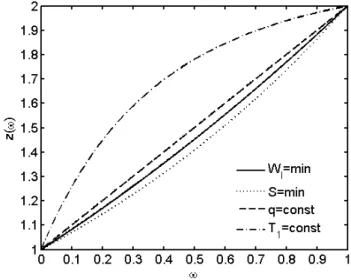
FIG. 2: Dependence of the dimensionless system temperaturez(ω) on the dimensionless timeωin case of the Dulong-Petit heat transfer law
5. NUMERICAL EXAMPLES
For the convenience of analysis, Wl = mindenotes the optimal strategy for minimizing lost available work, S = mindenotes the optimal strategy for minimizing entropy gener-ation,q=constdenotes the strategy of constant heat flux oper-ation, andT1=constdenotes the strategy of constant reservoir temperature operation.
5.1. Numerical example for the Dulong-Petit heat transfer law
In this case,A=2.5 andzf =2 are set. Fig. 2 shows de-pendence of the dimensionless system temperaturez(ω)on the dimensionless timeωin case of the Dulong-Petit heat transfer law. The most abrupt variation ofz(ω)at the starting time cor-responds to the strategy of T1=const. It is associated with the highest rate of entropy generation. The other three strate-gies show an almost linear increase of system temperature over time. Fig. 3 shows dependence of the ratio of the reservoir temperature to the system temperatureu(ω)on the dimension-less timeωin case of the Dulong-Petit heat transfer law. The strategies ofS=min andWl=minshow a slight functionu(ω) decreasing over time. Both the final reservoir temperature and the final system temperature for the strategies ofq=constare equal to those for the strategies ofWl=min, but the initial reservoir temperature for the strategies ofq=const is larger than that for the strategies ofWl=min, i.e. the temperature dif-ference between the reservoir and the system for the strategies ofq=const is larger than that for the strategies ofWl=min. Hence the entropy generation for the strategies of q=const is larger than that for the strategies ofWl=min. The temper-ature difference between the reservoir and the system for the strategies ofT1=constduring the heat transfer processes is the largest among various strategies, so the strategies ofT1=const leads to the largest entropy generation [26, 27, 33].
FIG. 3: Dependence of the ratio of the reservoir temperature to the system temperatureu(ω)on the dimensionless timeωin case of the Dulong-Petit heat transfer law
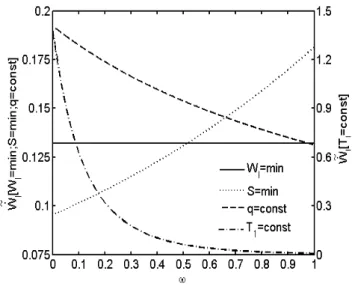
FIG. 4: Dependence of the dimensionless rate of lost available work ˜˙
Wlon the dimensionless timeωin case of the Dulong-Petit heat
trans-fer law
available work ˜˙Wl on the dimensionless timeωin case of the Dulong-Petit heat transfer law. From Fig. 4, it can be seen that the profiles of ˜˙Wlfor various heating strategies are differ-ent. The strategy ofq=const shows a function ˜˙Wl decreasing over time, while the strategy ofS=min shows a function ˜˙Wl increasing over time. The strategy ofT1=const shows a fast function ˜˙Wl decreasing at the beginning of the heat transfer process, but ˜˙Wlvaries little at the end of the heat transfer pro-cess. Also from Fig. 4, the rate of lost available work ˜˙Wl for the strategy ofWl=min is constant in the case of the Dulong-Petit heat transfer law, which is the same as the result with Newton’s heat transfer law [27]. As is discussed in section 4.1, both Newton’s and the Dulong-Petit heat transfer laws be-long to special cases of the generalized convective heat transfer law, so the condition corresponding to the minimum lost
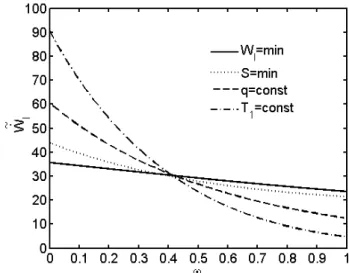
avail-FIG. 5: Dependence of the dimensionless lost available work ˜Wlon
the dimensionless system final temperaturezf in case of the
Dulong-Petit heat transfer law
able work strategy is that corresponding to a constant rate of lost available work, not only valid for Newton’s heat transfer law but also valid for the Dulong-Petit heat transfer law. Fig. 5 shows dependence of the dimensionless lost available work
˜
Wlon the dimensionless system final temperaturezf in case of the Dulong-Petit heat transfer law. The strategies ofWl=min,
S=min andq=const show similar results of the lost avail-able work ˜Wl, i.e. all of the values of ˜Wl increases with the increase ofzf. Also from Fig. 5, it can be seen that keeping a constant reservoir temperature is the worst strategy as far as the lost available work is concerned.
5.2. Numerical example for the heat transfer law q∝(∆(T4))1.25
In this case, A=0.02 andzf =2 are set. Fig. 6 shows dependence of the dimensionless system temperaturez(ω)on the dimensionless time ω in case of the heat transfer law
FIG. 6: Dependence of the dimensionless system temperaturez(ω) on the dimensionless time ωin case of the heat transfer law q∝ (∆(T4))1.25
FIG. 7: Dependence of the ratio of the reservoir temperature to the system temperatureu(ω)on the dimensionless timeωin case of the heat transfer lawq∝(∆(T4))1.25
results with the Dulong-Petit heat transfer law, the differences of the time variations of ˜˙Wl among the strategies ofq=const,
S=min andT1=constare smaller. The strategy ofWl=min shows a slow and almost linear time variation of ˜˙Wl, i.e. at the beginning of heat transfer process, the rate of lost available work ˜˙Wlfor the strategy ofWl=min is smaller than those for the other strategies, while at the end of heat transfer process, the rate of lost available work ˜˙Wl for the strategy ofWl=min is larger than those for the other strategies.
FIG. 8: Dependence of the dimensionless rate of lost available work ˜˙
Wl on the dimensionless timeωin case of the heat transfer lawq∝
(∆(T4))1.25
5.3. Performance comparisons for special heat transfer laws
According to Ref. [27], the parameters in Newton’s, the linear phenomenological and radiative heat transfer laws are used.A=10 andzf =2 are set for Newton’s heat transfer law.
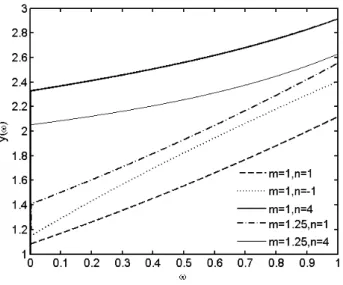
FIG. 9: Dependence of the dimensionless system temperaturez(ω) on the dimensionless timeωin case of the minimum lost available work with the special heat transfer laws
FIG. 10: Dependence of the dimensionless reservoir temperature
y(ω)on the dimensionless timeωin case of the minimum lost avail-able work with the special heat transfer laws
Besides, the variation of the optimal reservoir temperature for the linear phenomenological heat transfer law is different from those for the other heat transfer laws. This shows that the heat transfer laws also have effects on the optimal configuration of the reservoir temperature.
6. CONCLUSION
A common of finite-time heat transfer processes between high- and low-temperature sides with a generalized heat
trans-fer lawq∝(∆(Tn))mis studied in this paper. The optimal heat-ing and coolheat-ing configurations for minimizheat-ing lost available work are derived for the fixed initial and final temperatures of the low-temperature side working fluid of the system, the ob-tained results are general, including those results with special heat transfer laws. A more general conclusion is formed: the condition corresponding to the minimum lost available work strategy is that corresponding to a constant rate of lost available work, not only valid for Newton’s heat transfer law but also valid for generalized convective heat transfer lawq∝(∆T)m, in which the results in Refs. [14, 27] are included. Numerical examples for minimizing lost available work with the Dulong-Petit heat transfer law and the heat transfer lawq∝(∆(T4))1.25 are provided, and the results are also compared with optimal strategy for minimizing entropy generation, and the common strategies of constant heat flux and constant reservoir temper-ature operation. Numerical calculations show that the constant reservoir temperature strategy leads to the largest lost available work, the strategies of minimum entropy generation and con-stant heat flux produce less lost available work. Performance comparisons for special heat transfer laws are also provided, and the results show that the heat transfer laws have effects on the optimal time path of heat transfer processes. As has been stated in Refs. [14, 27], optimizing the thermodynamic systems for minimizing lost available work is different from that for minimizing entropy generation when choosing differ-ent reference states. Certainly, the two methods are equivaldiffer-ent when the universe environment is chosen to be the reference state. Choosing between the two optimum criteria (i.e. mini-mum entropy generation and minimini-mum lost available work) de-pends on the particular implementation of the heating/cooling process. The method based on the entropy generation mini-mization could be used, for example, in the case of a chemical factory that delivers various products and secondary utilities as flows of heat and power. The entropy generation should be seen in this case as a common measure for the cost of produc-tion of all these outputs of different nature, allowing an overall optimization. The method based on lost available work mini-mization could be used for example during the design of some power plants or in those cases where the main interest is in de-livering a maximum output power. The obtained results in this paper are general and can provide some theoretical guidelines for the designs of practical heat exchangers.
Acknowledgements
This paper is supported by the Program for New Century Excellent Talents in University of P. R. China (Project No. 20041006) and The Foundation for the Author of National Excellent Doctoral Dissertation of P. R. China (Project No. 200136).
[1] B. Andresen.Finite-Time Thermodynamics. Physics Laboratory II, University of Copen- hagen, 1983.
Thermo-dynamics for processes in finite time. Acc. Chem. Res. 1984, 17 (8): 266-271.
[3] S. Sieniutycz and P. Salamon (ed.).Advances in Thermodynam-ics. Volume 4: Finite Time Thermodynamics and Thermoeco-nomics. New York: Taylor & Francis, 1990.
[4] A. De Vos.Endoreversible Thermodynamics of Solar Energy Conversion. Oxford: Oxford University, 1992.
[5] A. Bejan.Entropy generation minimization: The new thermo-dynamics of finite-size device and finite-time processes. J. Appl. Phys., 1996, 79 (3): 1191-1218.
[6] R.S. Berry, V. A. Kazakov, S. Sieniutycz, Z. Szwast and A.M. Tsirlin.Thermodynamic Optimization of Finite Time Processes.
Chichester: Wiley, 1999.
[7] L. Chen, C. Wu, F. Sun.Finite time thermodynamic optimization or entropy generation minimization of energy systems.J. Non-Equilib. Thermodyn., 1999, 24 (4): 327-359.
[8] K.H. Hoffman, J. Burzler, A. Fischer, M. Schaller, S. Schu-bert.Optimal process paths for endoreversible systems.J. Non-Equilib. Thermodyn., 2003, 28 (3): 233-268.
[9] L. Chen, F. Sun. Advances in Finite Time Thermodynamics: Analysis and optimization.New York: Nova Science Publish-ers, 2004.
[10] G. Aragon-Gonzalez, A. Canales-Palma, A. Leon-Galicia, J.R. Morales-Gomez.Maximum power, ecological function and effi-ciency of an irreversible Carnot cycle. A cost and effectiveness optimization.Brazilian J. Physics, 2008, 38 (4): 1-8.
[11] A. Bejan.Entropy Generation through Heat and Fluid Flow.
New York: Wiley, 1982: 135-145.
[12] S.B. Linetskii, A.M. Tsirlin. Evaluating thermodynamic effi-ciency and optimizing heat exchangers. Thermal Engineering, 1988, 35(10): 593-597.
[13] B. Andresen, J.M. Gordon.Optimal heating and cooling strate-gies for heat exchanger design.J. Appl. Phys., 1992, 71 (1): 76-80.
[14] V. Badescu.Optimal strategies for steady state heat exchanger operation. J. Phys. D: Appl. Phys., 2004, 37 (16): 2298-2304. [15] A. De Vos.Efficiency of some heat engines at maximum power
conditions.Am. J. Phys., 1985, 53(6): 570-573
[16] L. Chen, F. Sun, C. Wu.The influence of heat transfer law on the endoreversible Carnot refrigerator.J. Institute Energy, 1996, 69 (479): 96-100.
[17] L. Chen, F. Sun, C. Wu.Effect of heat transfer law on the per-formance of a generalized irreversible Carnot engine.J. Phys. D: Appl. Phys., 1999, 32 (2): 99-105.
[18] M. Huleihil, B. Andresen.Convective heat transfer law for an endoreversible engine. J. Appl. Phys., 2006, 100 (1): 014911. [19] X. Qin, L. Chen, F. Sun, L. He.Model of real absorption heat
pump cycle with a generalized heat transfer law and its
perfor-mance.Proc. IMechE, Part A: Power & Energy, 2007, 221(A7): 907-916.
[20] L. Chen, F. Sun, C. Wu.Optimal expansion of a heated work-ing fluid with phenomenological heat transfer.Energy Convers. Mgmt., 1998, 39 (3/4): 149-156.
[21] S. Sieniutycz, P. Kuran.Modeling thermal behavior and work flux in finite-rate systems with radiation.Int. J. Heat Mass Trans-fer, 2006, 49 (17-18): 3264-3283.
[22] H. Song, L. Chen, J. Li, F. Sun, C. Wu.Optimal configuration of a class of endoreversible heat engines with linear phenomeno-logical heat transfer law [q∝ ∆(T−1)].J. Appl. Phys., 2006,
100 (12): 124907
[23] H. Song, L. Chen, F. Sun.Optimal expansion of a heated work-ing fluid for maximum work output with generalized radiative heat transfer law. J. Appl. Phys., 2007, 102 (9): 094901. [24] L. Nummedal, S. Kjelstrup.Equipartition of forces as a lower
bound on the entropy production in heat exchange. Int. J. Heat & Mass Transfer, 2001, 44 (15): 2827-2833.
[25] E. Johannessen, L. Nummedal, S. Kjelstrup.Minimizing the en-tropy production in heat exchange.Int. J. Heat & Mass Transfer, 2002, 45 (13): 2649-2854.
[26] B. Andresen, J. M. Gordon.Optimal paths for minimizing en-tropy generation in a common class of finite time heating and cooling processes.Int. J. Heat & Fluid Flow, 1992, 13 (3): 294-299.
[27] V. Badescu.Optimal paths for minimizing lost available work during usual heat transfer processes.J. Non-Equilib. Thermo-dyn., 2004, 29 (1): 53-73.
[28] L. Chen, J. Li, F. Sun.Generalized irreversible heat-engine ex-periencing a complex heat-transfer law.Appl. Energy, 2008, 85 (1): 52-60.
[29] J. Li , L. Chen, F. Sun.Heating load vs. COP characteristic of an endoreversible Carnot heat pump subjected to heat transfer law q∝(∆Tn)m.Appl. Energy, 2008, 85(2-3): 96-100.
[30] J. Li, L. Chen, F. Sun. Cooling load and coefficient of per-formance optimizations for a generalized irreversible Carnot refrigerator with heat transfer law q∝(∆Tn)m. Proceedings
IMechE, Part E: J. Process Mech. Engineering, 2008, 222 (1): 55-62.
[31] C .T. O’Sullivan.Newton’s law of cooling-A critical assessment.
Am. J. Phys., 1990, 58 (12): 956-960.
[32] P. Salamon, A. Nitan, B. Andresen, R.S. Berry.Minimum en-tropy production and the optimization of heat engines.Phys. Rev. A, 1980, 21 (6): 2115-2129.