Article
Printed in Brazil - ©2016 Sociedade Brasileira de Química0103 - 5053 $6.00+0.00*e-mail: [email protected]
An Efficient and Chemoselective Deprotection of Aryl
tert
-Butyldimethylsilyl
(TBDMS) Ethers by NaCN
Xue-jun Qiao, Xiao Hou, Wu-hong Fang, Xue-fei Bao and Guo-liang Chen*
Key Laboratory of Structure-Based Drug Design & Discovery, Ministry of Education, Shenyang Pharmaceutical University, 110016 Shenyang, China
Phenolic tert-butyldimethylsilyl (TBDMS) ethers can be deprotected to yield phenols in excellent yield using sodium cyanide (NaCN) as catalyst in ethanol. The deprotectation of various phenolic TBDMS ethers were found to be very convenient, fast, high yielding and chemoselective.
Keywords: deprotectection, tert-butyldimethylsilyl, sodium cyanide
Introduction
As the hydroxyl group can devote in various organic transformations under mild reaction conditions, a crucial problem in organic synthesis is to ensure that the hydroxyl function group in a multifunctional molecule is protected from undesired reactions altogether or until such time as it’s inherent reactivity is demanded. The chloro(1,1-dimethylethyl)dimethylsilane (TBDMS-Cl) is applied widely for the protection of hydroxyl group in organic synthesis due to their ease of installation, stability towards various reactions, such as reduction and Wittig and Grignard reaction and, finally, remove easily without affecting other organic functional groups.1,2 Therefore,
the efficiency of reaction, the selectivity of deprotection and the stability under the intend reaction conditions, all should be took into consideration in the desilylation reactions. Various methods of desilylation have had a great improvement in silylation chemistry in past years, especially using tetrabutylammonium fluoride (TBAF). However, due to its strong basicity, TBAF can lead to side reactions, which restrict the wide application of this reagent for this purpose.3,4 Thus, momentous alternative
methods, such as Lewis acid/based media protocols, like sulfuric acid (H2SO4), pytidinium p-toluenesulfonate
(PPTS), trifluoroacetic acid (TFA), tosylic acid (TsOH), boron trifluoride etherate (BF3–OEt2), boron trichloride
(BCl3), scandium trifluoromethanesulfonate [Sc(OTf)3],
ceric triflate [Ce(OTf)4], indium(III) chloride (InCl3),
sodium hydroxide/tetrabutylammonium hydrogensulfate
(NaOH/Bu4NHSO4), tetrabutylammonium tribromide
(TBATB), potassium carbonate (K2CO3), cesium carbonate
(Cs2CO3),5-17 halide-source protocols (in particular
fluoride); oxidative protocols, like DDQ (2,3-dichloro-5,5-dicyanobenzoquinone),18 potassium permanganate
(KMnO4),19 barium manganate (BaMnO4);20 and reductive
protocols, like diisobutylaluminium hydride (DIBALH), lithium aluminium hydride (LiAlH4), sodium hydride
(NaH),21,22 have been developed for the deprotection of
silyl ethers. However, most of these reagents have synthetic limitations, such as longer reaction time, harsh reaction conditions, use of expensive and corrosive reagents, non-selectivity of deprotection reactions as well as cumbersome work-up procedures. Herein we report a new method for the selective deprotection of phenol TBDMS ethers using NaCN as a catalyst in ethanol solvent in relative short reaction time, as shown in Scheme 1, which utilizes conventional laboratory reagents and equipments, only require a simple work-up and tolerate a wide variety of other functional groups.
Experimental
The nuclear resonance magnetic (NMR) spectra were recorded on a Bruker Ascend 400 (Billerica, MA, USA) using tetramethylsilane (TMS) as an internal standard. Electrospray ionization mass spectrometry
0.1 eq NaCN
Ethanol
R–O–TBDMS R–OH
(ESI-MS) analyses was recorded in an Agilent 1100 Series MSD Trap SL (Santa Clara, CA, USA). The reactions were monitored by thin-layer chromatography (TLC; HG/T2354-92, GF254), and the products were purified by column chromatography on silica gel (200-300 mesh) made by Qingdao Puke Parting Materials Co., Ltd. (Qingdao, China).
Typical experimental procedure for preparation of tert -butyldimethylsilyl ethers
All the tert-butyldimethylsilyl ethers were prepared as previously reported in the respective literature.23 Taking the
1-[[(1, 1-dimethylethyl)dimethylsilyl]oxy]-4-nitrobenzene for example, a 100 mL three-neck flask was equipped with a thermometer, condenser. Chloro(1,1-dimethylethyl) dimethylsilane (2.1 g, 14 mmol) and imidazole (0.476 g, 7 mmol) were added into a mixture of 4-nitrophenol (3 g, 14 mmol) in 20 mL of N,N-dimethylformamide (DMF). Then, the mixture was continually stirred at 50 oC and the
reaction progress was monitored by TLC. After completion, the reaction mixture was concentrated in vacuo to obtain crude product, which was purified by silica column chromatography. Other tert-butyldimethylsilyl ethers were prepared in similar methods.
Typical experimental procedure for deprotection of tert -butyldimethylsilyl ethers
Also taking the 1-[[(1,1-dimethylethyl)dimethylsilyl] oxy]-4-nitrobenzene for example, a 100 mL three-neck flask was equipped with a thermometer, condenser. NaCN (0.04 g, 0.8 mmol) was added into a mixture of 1-[[(1,1-dimethylethyl)dimethylsilyl]oxy]-4-nitrobenzene (2 g, 8 mmol) in anhydrous ethanol (15 mL) and H2O
(1 mL). Then, the mixture was continually stirred at 30 oC and the reaction progress was monitored by TLC.
After completion, the reaction mixture was concentrated
in vacuo, and then the residue was dissolved in water, extracted with dichloromethane three times. The combined organic layer was washed with saturated sodium chloride solution and dried over anhydrous sodium sulfate. After, the desiccant was filtered off, the filtrate was evaporated to obtain crude product, which was purified by column chromatography on silica gel (86.4% yield).
1-[[(1,1-Dimethylethyl)dimethylsilyl]oxy]-4-nitrobenzene (1)
1H NMR (400 MHz, CDCl
3) d 8.16 (d, 2H, J 9.2 Hz,
Ar-H), 6.90 (d, 2H, J 9.2 Hz, Ar-H), 1.00 (t, 9H, J 2, CH3),
0.26 (t, 6H, J 1.2 Hz, CH3).24
1-Bromo-4-[[(1,1-dimethylethyl)dimethylsilyl]oxy]benzene (2)
1H NMR (400 MHz, CDCl
3) d 7.32 (d, 2H, J 9.2 Hz,
Ar-H), 6.90 (d, 2H, J 9.2 Hz, Ar-H), 0.97 (t, 9H, J 2.8 Hz, CH3), 0.18 (t, 6H, J 2.8 Hz, CH3).25
1-[[(1,1-Dimethylethyl)dimethylsilyl]oxy]-3-methylbenzene (3)
1H NMR (400 MHz, CDCl
3) d 7.12 (d, 1H, J 7.6 Hz,
Ar-H), 7.05 (t, 1H, J 6.4 Hz, Ar-H), 6.85 (t, 1H, J 6.4 Hz, Ar-H), 6.75 (d, 1H, J 7.6 Hz, Ar-H), 2.21 (s, 3H, CH3), 1.02
(t, 9H, J 2.8 Hz, CH3), 0.21 (t, 6H, J 2.8 Hz, CH3), ESI-MS m/z: 261.2 [M + K]+.26
1-[[(1,1-Dimethylethyl)dimethylsilyl]oxy]-3-fluorobenzene (4)
1H NMR (400 MHz, CDCl
3) d 7.99-7.97 (m, 1H,
Ar-H), 7.85-7.83 (m, 1H, Ar-H), 7.53-7.50 (m, 1H, Ar-H), 6.99-6.90 (m, 1H, Ar-H), 1.00 (t, 9H, J 2.8 Hz, CH3), 0.19
(t, 6H, J 2.4 Hz, CH3).
1-[[(1,1-Dimethylethyl)dimethylsilyl]oxy]-2-methylbenzene (5)
1H NMR (400 MHz, CDCl
3) d 7.12 (d, 1H, J 8 Hz,
Ar-H), 7.07-7.03 (m, 1H, Ar-H), 6.87-6.83 (m, 1H, Ar-H), 6.76 (d, 1H, J 8.0 Hz, Ar-H), 2.21 (s, 3H, CH3), 1.02 (t,
9H, J 2.8 Hz, CH3), 0.21 (t, 6H, J 2.8 Hz, CH3), ESI-MS m/z: 261.2 [M + K]+.
1 [ [ ( 1 , 1 D i m e t h y l e t h y l ) d i m e t h y l s i l y l ] o x y ] 4 -trifluoromethoxybenzene (6)
1H NMR (400 MHz, CDCl
3) d 7.07 (d, 2H, J 8.4 Hz,
Ar-H), 6.90 (d, 2H, J 9.2 Hz, Ar-H), 0.98 (t, 9H, J 2.8 Hz, CH3), 0.20 (t, 6H, J 2.8 Hz, CH3).
1-[[(1,1-Dimethylethyl)dimethylsilyl]oxy]-2-(trifluoromethyl) benzene (7)
1H NMR (400 MHz, CDCl
3,) d 7.55 (dd, 1H, J 1.2,
8 Hz, Ar-H), 7.40-7.35 (m, 1H, Ar-H), 6.97 (t, 1H, J 7.6 Hz, Ar-H), 6.91 (d, 1H, J 8 Hz, Ar-H), 1.01 (t, 9H, J 2.8 Hz, CH3), 0.27 (t, 6H, J 2.8, CH3).
1-Bromo-2-chlorophenoxy-4-[[(1,1-dimethylethyl)dimethyl-silyl]oxy]benzene (8)
1H NMR (400 MHz, CDCl
3) d 7.51 (d, 1H, J 2.4 Hz,
Ar-H), 7.13 (q, 1H, J 2.8, 8.8 Hz, Ar-H), 6.79 (d, 1H,
J 8.8 Hz, Ar-H), 1.03 (t, 9H, J 2.8 Hz, CH3), 0.24 (t, 6H, J 2.8 Hz, CH3).
N-[4-[[(1,1-Dimethylethyl)dimethylsilyl]oxy]phenyl] acetamide (9)
1H NMR (400 MHz, CDCl
Ar-H), 6.79 (d, 2H, J 8.8 Hz, Ar-H), 7.04 (s, 1H, CH3), 0.97
(t, 9H, J 2.8 Hz, CH3), 0.18 (t, 6H, J 2.8 Hz, CH3), ESI-MS m/z calc. for C14H23NO2Si [M + H]+: 266.2.27
4-[[(1,1-Dimethylethyl)dimethylsilyl]oxy]benzenamine (10)
1H NMR (400 MHz, CDCl
3) d 6.65 (dq, 2H, J 8.4,
3.2 Hz, Ar-H), 6.57 (dq, 2H, J 8.8, 3.2 Hz, Ar-H), 3.37 (s, 2H, NH2), 0.97 (s, 9H, CH3), 0.15 (s, 6H, CH3), ESI-MS m/z: 224.2 [M + H]+.28
4-[[(1,1-Dimethylethyl)dimethylsilyl]oxy]-1-benzoatephenol (11)
1H NMR (400 MHz, CDCl
3) d 8.20 (d, 2H, J 7.2 Hz,
Ar-H), 7.63 (q, 1H, J 7.2 Hz, Ar-H), 7.51 (q, 2H, J 7.2 Hz, Ar-H), 7.08 (d, 2H, J 8.8 Hz, Ar-H), 6.88 (d, 2H, J 8.0 Hz, Ar-H),1.00 (s, 9H, CH3), 0.21 (s, 6H, CH3).
4-[[[(1,1-Dimethylethyl)dimethylsilyl]oxy]methyl]-1,2-dimethoxybenzene (12)
1H NMR (CDCl
3, 400 MHz) d 7.51 (d, 1H, J 2.4 Hz,
Ar-H), 7.13 (dd, 1H, J 2.4, 8.8 Hz, Ar-H), 6.79 (d, 1H, J 8.8 Hz, Ar-H), 4.68 (s, 2H, CH2), 1.03 (t, 9H, J 2.8 Hz, CH3), 0.24
(t, 6H, J 2.8 Hz, CH3), ESI-MS m/z: 304.9 [M + Na]+.
2-[2-[[(1,1-Dimethylethyl)dimethylsilyl]oxy]ethyl]thiophene (13)
1H NMR (400 MHz, CDCl
3) d 7.11 (dd, 1H, J 1.2,
5.2 Hz, Ar-H), 6.91 (dd, 1H, J 3.6, 5.2 Hz, Ar-H), 6.82 (dd, 1H, J 0.8, 3.2 Hz, Ar-H), 3.82 (t, 2H, J 6.4 Hz, CH2), 3.02
(t, 2H, J 6.8 Hz, CH2), 0.97 (t, 9H, J 2.4 Hz, CH3), 0.025
(t, 6H, J 2.8 Hz, CH3).
Results and Discussion
Optimization of reaction conditions
In our former work, we optimized molar ratios of the reagents by using the reaction of 1-[[(1,1-dimethylethyl) dimethylsilyl]oxy]-4-nitrobenzene (1) as a model reaction (Table 1). A mixture of 1 (20 mmol), NaCN (2 mmol) in anhydrous ethanol (15 mL) with H2O (1 mL) was stirred
at 30 °C for 2.7 h to give the desired product 1a in 86.4% yield (Table 1, entry 1). Although double or triple amount of NaCN was used under the same reaction conditions, the yield of 1a did not increase significantly (Table 1, entries 2 and 3). Besides, the yield of 1a decreased obviously to 40.1% ∼ 65.3% along with one fifth or one tenth amount of NaCN (Table 1, entries 4 and 5). In consideration of reaction efficiency and safety, a model using 0.1 eq of NaCN was chosen for the desilylation reaction.
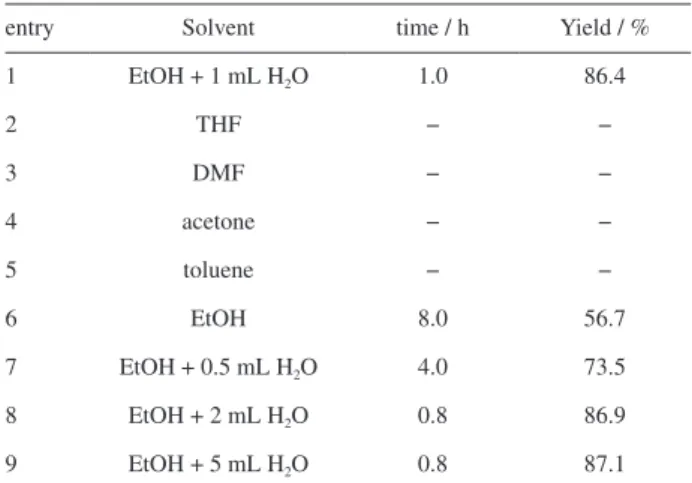
Based on these results, the molar ratios of NaCN in 0.1 eq for deprotection reaction was established to optimize other reaction conditions. In an effort to obtain improved yields, various solvents were screened (Table 2). Non-polar solvent, such as toluene; and polar aprotic solvents, such as DMF, acetone and tetrahydrofuran (THF), did not present the formation of product (Table 2, entries 2-5) and the reaction in anhydrous ethanol provided poor yields of deprotection of TBDMS (Table 2, entry 6). Mixed solvents with different anhydrous ethanol and water ratios were investigated. The yield could be improved when added little amount of H2O, but the amount of H2O did not have
significant effect on yield (Table 2, entries 1 and 6-9). Moreover, the reaction took longer time when less water was used and workup was more difficult if more water was used due to the solubility of some phenols in water. Herein, anhydrous ethanol with 1 mL H2O was chosen as a good
solvent for the deprotection reaction.
Table 1. Deprotection of 1 using sodium cyanide (NaCN)
OTBDM S
NO2
NaCN
EtOH, H2O
OH
NO2
1 1a
entry 1:NaCN time / h Yield / %
1 0.10 2.7 86.4
2 0.20 2.4 87.8
3 0.30 2.2 88.1
4 0.01 7.5 40.1
5 0.05 4.8 65.3
Table 2. Optimization of reaction solvent
entry Solvent time / h Yield / %
1 EtOH + 1 mL H2O 1.0 86.4
2 THF − −
3 DMF − −
4 acetone − −
5 toluene − −
6 EtOH 8.0 56.7
7 EtOH + 0.5 mL H2O 4.0 73.5
8 EtOH + 2 mL H2O 0.8 86.9
9 EtOH + 5 mL H2O 0.8 87.1
Procedure of deprotection
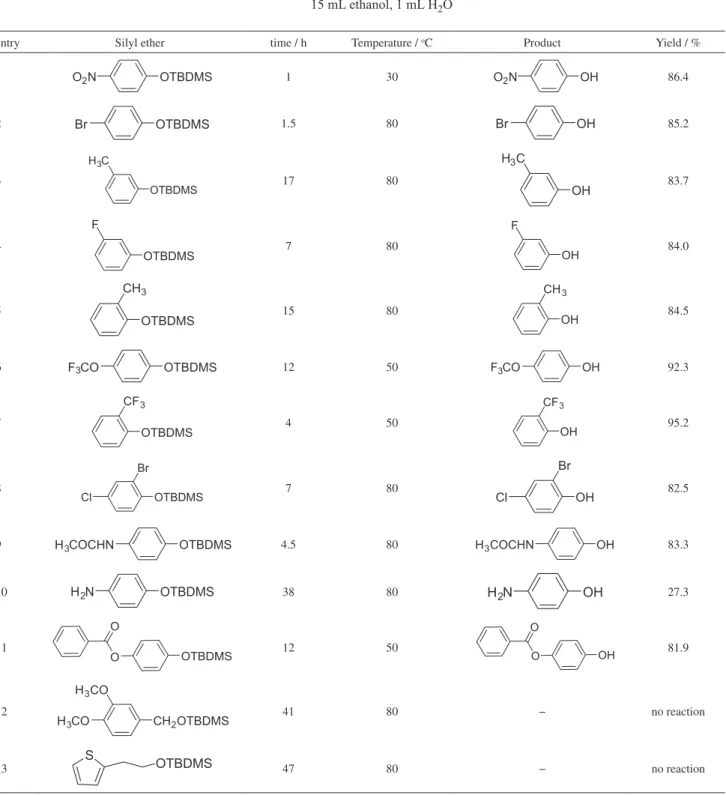
We examined a variety of substrates, including electron-withdrawing groups and electron-donating groups containing compounds. As shown in Table 3, most
phenol TBDMS ethers could be removed quickly (Table 3, entries 1-9).
Besides, we also found that the rate of cleavage of phenolic TBDMS ethers was accelerated if the molecule includes electron-withdrawing groups (Table 3,
Table 3. Deprotection of substituted phenol tert-butyldimethylsilyl (TBDMS) ethers using 0.1 eq solid sodium cyanide (NaCN)
0.1 eq NaCN 15 mL ethanol, 1 mL H O2
R–O–TBDMS R–OH
entry Silyl ether time / h Temperature / oC Product Yield / %
1 O2N OTBDMS 1 30 O2N OH 86.4
2 Br OTBDMS 1.5 80 Br OH 85.2
3
OTBDMS H3C
17 80
OH H3C
83.7
4
OTBDMS F
7 80
OH F
84.0
5
OTBDMS
CH3
15 80
OH
CH3
84.5
6 F3CO OTBDMS 12 50 F3CO OH 92.3
7
OTBDMS
CF3
4 50
OH CF3
95.2
8
OTBDMS Br
Cl 7 80 OH
Br
Cl 82.5
9 H3COCHN OTBDMS 4.5 80 H3COCHN OH 83.3
10 H2N OTBDMS 38 80 H2N OH 27.3
11
OTBDMS O
O
12 50
OH O
O
81.9
12
CH2OTBDMS
H3CO
H3CO
41 80 − no reaction
13
S
entries 1 and 7). In addition, the sequence of increasing rate is consistent with the strength of electron-withdrawing groups (Table 3, entries 1, 2, 6 and 8-10). At the same time, it could be observed that the steric effects have influence on the rate of deprotection reaction (Table 3, entries 3 and 5). The rate of deprotection of 1-[[(1,1-dimethylethyl) dimethylsilyl]oxy]-2-methylbenzene was faster than that of 1-[[(1,1-dimethylethyl)dimethylsilyl]oxy]-3-methylbenzene. Moreover, the alkyl silyl ethers of alcohols or benzyl alcohols cannot be deprotected by NaCN (Table 3, entries 12 and 13).
As for reaction mechanism, we supposed these results to be most conveniently explained by a reaction sequence (Scheme 2). Probably, silylation of the ether 1 transforms into its anion 2 viathe nucleophilic substitution reaction of base (CN–), generating silane carbonitrile 4 at the
same time. Then, through the nucleophilic substitution reaction with hydroxide,silane carbonitrile 4,which is inherently unstable to both nucleophiles and aqueous media transforms into silanol 5 giving CN−, which continue the
next circulation reaction. Meanwhile, phenolate anion 2
rapidly intercepts hydrogen ion into phenol. However, the alcohols do not present the formation of product using NaCN as the alkalinity of sodium alcoholate is stronger than NaCN.
Conclusions
In summary, we have developed a mild, efficient, inexpensive and selective procedure for the deprotection of aryl silyl ethers in the presence of alkyl silyl ethers using 0.1 eq of NaCN in ethanol. Moreover, this catalytic system was compared with the other organic catalyst, and results showed that NaCN catalyst having high
performance ability in short reaction time in phenolic desilylation reaction.
Supplementary Information
Supplementary data are available free of charge at http://jbcs.sbq.org.br as PDF file.
Acknowledgments
This work was financially supported by Discipline Construction Program of Shenyang Pharmaceutical University (No. 52134606).
References
1. Arvind, H. J.; Hern, K.; Tetrahedron Lett.2012, 53, 5338. 2. Lalonde, M.; Chan, T. H.; Synthesis1985, 9, 817.
3. Corey, E. J.; Snider, B. B.; J. Am. Chem. Soc.1972, 94, 2549. 4. Clark, J. H.; Chem. Rev. (Washington, DC, U. S.)1980, 80, 429. 5. Nakamura, T.; Shiozaki, M.; Tetrahedron Lett. 2001, 42,
2701.
6. Corey, E. J.; Roberts, B. E.; J. Am. Chem. Soc.1997, 119, 12425. 7. Furstner, A.; Albert, M.; Mlynarski, J.; Metheu, M.; DeClerq,
E. J.; J. Am. Chem. Soc.2003, 125, 13132.
8. Shahid, K. A.; Mursheda, J.; Okazaki, M.; Shuto, Y.; Goto, F.; Kiyooka, S.; Tetrahedron Lett. 2002, 43, 6377.
9. Jackson, S. R.; Johnson, M. G.; Mikami, M.; Shiokawa, S.; Carreira, E. M.; Angew Chem. 2001, 40, 2694.
10. Yang, Y. Y.; Yang, W. B.; Teo, C. F.; Lin, C. H.; Synlett 2000,
11, 1634.
11. Oriyama, T.; Kobayashi, Y.; Noda, K.; Synlett1998, 10, 1047. 12. Bartoli, G.; Cupone, G.; Dalpozzo, R.; Nino, A. D.; Maiuolo, L.; Procopio, A.; Sambri, L.; Tagarelli, A.; Tetrahedron Lett.2002,
43, 5945.
13. Jadav, J. S.; Reddy, B. V. S.; Madan, C.; New J. Chem. 2000,
24, 853.
14. Crouch, R. D.; Stieff, M.; Frie, J. L.; Cadwallader, A. B.; Bevis, D. C.; Tetrahedron Lett. 1999, 40, 3133.
15. Gopinath, R.; Patel, B. K.; Org. Lett.2000, 2, 4177. 16. Wilson, N. S.; Keay, B. S.; Tetrahedron Lett.1997, 38, 187. 17. Jiang, Z. Y.; Wang, Y. G.; Tetrahedron Lett.2003, 44, 3859. 18. Tanemura, K.; Suzuki, T.; Horaguchi, T.; J. Chem. Soc.1992,
1, 2997.
19. Firouzabadi, H.; Etemadi, S.; Karimi, B.; Jarrahpour, A. A.;
Phosphorus, Sulfur Silicon Relat. Elem. 1999, 152, 141. 20. Corey, E. J.; Jones, G. B.; J. Org. Chem.1992, 57, 1028. 21. Brussee, J.; Dofferhoff, F.; Kruse, C. G.; Avander, G.;
Tetrahedron1990, 46, 1653.
22. Shekhani, M. S.; Khan, K. M.; Mahmood, K.; Tetrahedron Lett.
1988, 29, 6161. Scheme 2. Possible mechanism of deprotection reaction.
O Si R1
R2
R3
O R1
R2
R3
H2O
CN
Si CN
OH OH
Si OH
1
2
3 4
5
R1 R2
23. Samuel, I. N.; Julien, P.; Romain, D.; Mostafa, E. H.; Mohamed, A.; Alain, D.; Jérôme, T.; Adv. Synth. Catal.2003,
355, 2936.
24. Blechta, V.; Sabata, S.; Sykora, J.; Hetflejs, J.; Soukupova, L.; Schraml, J.; Magn. Reson. Chem.2012, 5, 128.
25. Marzena, O. Z.; Volker, W.; Matthias, F.; Burkhard, Z.; Eur. J. Org. Chem. 2001, 8, 1549.
26. Valentina, D.; Maurizio, F.; Angelo, A.; Angew. Chem., Int. Ed.
2007, 46, 6495.
27. Assadi, M. G.; Golipour, N.; Main Group Met. Chem.2006, 5, 179.
28. Knaggs, S.; Malkin, H.; Osborn, H. M. I.; Williams, N. A. O.; Yaqoob, P.; Org. Biomol. Chem.2005, 3, 4002.