231
Abstract
Starches are widely used as depressant in froth lotation operations in Brazil due to their eficiency, increasing the selectivity in the inverse lotation of quartz, depressing iron ore. The starch market has been growing and improving in recent years, leading to better products attending the requirements of the mineral indus-try. The major source of starch used for iron ore is the cornstarch, which needs to be gelatinized, by heat or sodium hydroxide (NaOH) addition (also known as caustisized starch), prior its use. This stage has a direct impact on industrials costs, since the lower consumption of NaOH in gelatinization provides better control of the pH in the froth lotation and reduces the amount of electrolytes present in the pulp. In order to evaluate the inluence of temperature on the NaOH consumption, gelatinization tests were carried out with temperatures ranging from 25 to 65 °C, measuring the volume of NaOH. All tests were performed in triplicate. A linear model correlating the temperature and the NaOH need for the cornstarch gelatinization has been stablished. This model can allow mineral industries to optimize the NaOH amount used to prepare the depressant used in froth lotation. For example, the reduction in NaOH could easily reach 480 L per ton of cornstarch when performing gelatinization with the cornstarch solution at 35 °C instead of 25 °C (reduction of approximately 34% in the NaOH consumed).
Keywords: froth lotation, gelatinization, cornstarch, sodium hydroxide, temperature. André Carlos Silva
Professor Adjunto IV
Universidade Federal de Goiás - UFG
Departamento de Engenharia de Minas - DEMIN [email protected]
Elenice Maria Schons Silva
Professora Adjunta I
Universidade Federal de Goiás - UFG
Departamento de Engenharia de Minas - DEMIN [email protected]
Antônio Eduardo Clark Peres
Professor Emérito
Universidade Federal de Minas Gerais - UFMG Departamento de Engenharia Metalúrgica - DEMET [email protected]
Débora Nascimento Sousa
Professora DII
Instituto Federal Goiano - IFGoiano [email protected]
Temperature influence in
cornstarch gelatinization
for froth flotation
Mining
Mineração
http://dx.doi.org/10.1590/0370-44672016700085
1. Introduction
According to Peres and Corrêa (1996), cornstarch has been Brazil’s de-fault depressant for iron ore since 1978. Modiied cornstarches are composed of amylopectin (70-80%) and amylose (20-30%) without impurities such as ibers, mineral matter, oils and proteins nor-mally present in conventional starches. The authors point out that oil (triglyc-erides) present in conventional starch act as an antifoam agent spoiling the lotation process if its content exceeds 1.8%. Several adsorption mechanisms for starches on mineral surfaces have been investigated, such as hydrogen bonding, electrostatic interactions, chemical adsorption, salt formation and hydrophobic bonding (Pinto, Araújo and Peres, 1992).
Turrer and Peres (2010) showed
the importance of the amylose/amylo-pectin ratio in starch during hematite depression and point out that amylopec-tin reduces the hematite froth lotation more profoundly than amylose when a primary ether amine is used as a collec-tor. According Iwasaki and Lai (1965) and Fillipov, Severov and Fillippova (2014) the effectiveness of the alkali gelatinization is strongly affected by the starch/NaOH ratio used in the ge-latinization. The last authors even sug-gest that alkali gelatinization has been studied less than the thermal method. Leal Filho et al (1993) showed that the
alkali gelatinization is also affected by the dissolution technique.
The typical starch/NaOH ratio is 5:1 (Iwasaki and Lai, 1965, Fillipov, Severov and Fillippova, 2013).
Iwa-saki, Carlson and Parmeter (1969) and Guimarães, Araújo and Peres (2005) suggested that the starch solution was designed to yield a maximum concentra-tion of 0.1% w/w and must be prepared daily to avoid retrogradation. However, this is not well stablished and other au-thors, as Cooke, Schultz and Lindroos (1952) disagree, using concentrations up to 3%.
232
due to the addition of caustic soda is still not clear and is subject to further research. Larger starch molecules need more gelatinization time compared to smaller starch molecules. Liu, Zhang and Laskowski (2000) showed that the temperature needed for gelatinization decreases when increasing the amylo-pectin content. Retrogradation occurs spontaneously when starch solutions are stored at low temperatures at neutral pH. The same authors showed that amy-lose’s retrogradation might occur within a period of four to ive hours after the gelatinization, while the amylopectin retrogrades only 10% within 100 days.
The primary adsorption mecha-nisms of starch on hematite were proposed as non-selective hydrogen bonding and electrostatic forces, mainly because of the presence of a large number of hydroxyl groups in starch molecules and on hematite surface. As conirmed by Mikhailova (1972), starch adsorbs more on a hematite surface than on a quartz one. According to Brandão, Caires and Queiroz (1994) the adsorption density of starch on a quartz
surface is approximately 10 times less than that on hematite. For pH’s higher than 8, the starch adsorption is almost nonexistent on the non-activated quartz surface, while it is noticeable on the hematite surface. According to Turrer and Peres (2010), the reasons for this selectivity are a better ability of the he-matite surface to form hydrogen bonds with the depressant and the fact that a quartz surface is more negative than hematite, being the macromolecules slightly negative because of OH- ad-sorption. On the other hand, Iwasaki, Carlson and Parmeter (1969) proposed that the starch adsorption on hematite increases as the pH value decreases. Kar et al. (2013) tested four different
starches (soluble starch, cornstarch, potato starch and rice starch) as iron ore depressants. According to the authors, the maximum adsorption for all the four starches with hematite occurs at the pH ranging 5-9. However, soluble starch was found to be the better depressant at slightly alkaline pH. An iron grade of 63-65% Fe with 85-88% recovery at a starch concentration of 400 g/t was
achieved by the authors.
Other vegetable species, such as cassava, potato, wheat, rice, arrowroot, can produce starch with potential to be used in lotation. The most attractive among them, considering the cost of production, is cassava, which grows widely in warm weather countries, with no need of fertilizers or soil cor-rection. The major obstacle to its use is the absence of major suppliers. The starch fraction content (amylopectin + amylose) extracted from cassava is higher than in corn because proteins and oil contents are lower in cassava, which prevents the risk of froth sup-pression. According to Fillipov, Severov and Fillippova (2013) cassava starch shows higher viscosities than corn-starch, which is an indication of higher molecular weight that can lead to more effective depressant action. Potato lour has been used industrially in Europe, but there are no records of its use in the mining industry so far, mainly due the fact that potato degrades much faster than corn and has a high price (Ibrahim and Abdel-Khalek, 1992).
2. Methodology
The irst stage aimed to character-ize the cornstarch sample (donate by Cargill) in order to better understand its gelatinization. The cornstarch mor-phology was analyzed using a SEM, model Jeol JSM 6610. To determine the amylose content, a method proposed by the American Association of Cereal Chemists (AACC) number 1995 was used, which is a simple colorimetric procedure. Samples of cornstarch were added to a solution of 1 mL of acetic acid at 1 mol.L-1 and 2 mL of solution
of iodine-potassium iodide, which re-acts with starch to form a blue colored complex. This complex is developed due to the imprisonment of iodine inside the chain of amylose. The solution was then stored for 30 minutes in a dark room and then using a spectrophotometer Biospectro, model SP220, we read the absorbance at 620 nm. The content of amylose was calculated using the absorbance values read and a calibra-tion curve was made with pure amylose (supplied by Sigma-Aldrich) in the range of 0.004-0.024 mg.mL-1 (for this curve
the obtained it was r2 = 0.998). The
results were expressed in mg.mL-1 and
performed in triplicate.
Cornstarch swelling power and solubility were also measured to calcu-late the amylose content in it. Accord-ing to Denardin and Silva (2009) when starch molecules are heated in water, the crystalline structure is broken and the water molecules form hydrogen bonds between amylose and amylopectin, ex-posing its hydroxyl groups, causing an increase in the granule size (a swelling) and in its solubility. This swelling power and solubility varies according to the starch source, providing evidence of the interaction between the starch chains within the amorphous and crystalline domains. According to Leach, Mc-Cowen and Schoch (1959) the extension of these interactions is inluenced by the ratio amylose/amylopectin due to molecular features distributed, molecu-lar weight, degree, length of branches. The swelling power was obtained by the relationship between the inal mass swelled and the starch initial mass. The starch solubility was calculated by the relationship between the soluble mass and initial amount of starch (expressed in percentage).
Finally, the temperature inluence in the NaOH consumption was
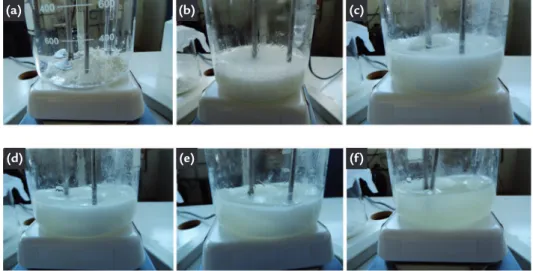
233 Figure 1
Six steps in the starches and flours alkaline gelatinization process. (a) starch sample, (b) starch solution after
complete solubilization, (c), (d) and (e) steps in the titration process and (f) complete gelatinization of the sample.
3. Results and discussion
Figure 2 shows the SEM results for the size and morphology of the cornstarch. The average grain diameter was 15 µm, with values ranging from 11 to 17 µm. No protein ribbons were visualized and some broken grains were detected. As expected, the cornstarch samples showed 71.62% of amylose and amylopectin 28.38%. Cornstarch samples showed a solubility equal to 12.57% and a swelling power of 22.85%. These values are signiicantly low compared to other starches. Weis-senborn (1996) showed that high amy-lose starches show limited solubility and swelling power, even after a prolonged heating time.
Figure 3 shows the NaOH volume
consumed in the cornstarch gelatinization at different solution temperatures. As ex-pected, the NaOH volume needed for the cornstarch gelatinization decreases with the increase of the temperature. An experi-ment at 65° C was performed in absence of NaOH, being this the minimum tempera-ture required for cornstarch gelatinization in absence of NaOH. Temperatures lower than 25° C were not considered. It is well known in literature that the greater the proportion of amylopectin, the lower the temperature required for the starch gelatinization (Liu, Zhang and Laskowski, 2000). A linear model was obtained with it (r2) around 98%, which can be
consid-ered adequate.
Table 1 shows the average initial and inal pH for the gelatinization tests and the average NaOH consumed at the turning point. It is possible to notice that cornstarch acidiies the solution after its dilution in the begging of the process. At the turn-ing point, the average pH of the solution was above 12 for all tested temperatures, except for 65° C. This happened because no NaOH was added to the solution and therefore the pH remained the same. It is also possible to notice that the experimen-tal errors (represented by the standard deviation) in the NaOH consumed where lower than 10%, being the higher experi-mental error obtained for temperature of 55° C with error of 0.62 mL.
(a)
(f)
(b) (c)
(e) (d)
(a) (b)
(c) (d)
234
Equation y = a + b*x Weight No Weighting Residual Sum of Squares 10.49516
Pearson's r -0.99229 Adj. R-Square 0.98244
Value Standard Error Intercept 43.38533 1.48009
Slope -0.6696 0.03162
(a) (b)
Figure 3 (a) Influence of
the temperature in the NaOH
consumption for cornstarch gelatinization and (b) linear regression parameters.
Temperature (° C)
Average initial pH
Average pH at turning
point
Average NaOH consumed at
the turning point (mL)
Standard deviation of NaOH consumption
(mL) (%)
25 5.53 12.87 28.3 0.32 1.14
30 5.36 12.73 24.0 0.21 0.88
35 5.19 12.91 18.7 0.30 1.62
40 5.17 12.83 15.0 0.20 1.33
45 5.29 12.77 12.3 0.47 3.79
50 5.32 12.46 10.0 0.58 5.77
55 5.52 12.09 6.3 0.62 9.86
60 5.31 12.01 4.7 0.19 4.02
65 5.21 5.21 0.0 -
-Table 1
Average initial and final pH for the gelatinization tests and
average NaOH consumed at turning point.
Studies aiming the starch gelatiniza-tion process and its implicagelatiniza-tion in lotagelatiniza-tion are still incipient in the literature. How-ever, extensive work have been done in the food area. Santiago-Ramos et al (2017)
studied the thermal properties of three dif-ferent Mexican maize starches regarding the grain hardness (hard, intermediate and soft). According to the authors the starches gelatinization process started in 59.79 °C
for soft, 61.67 °C for intermediate and 63.28 °C for hard grains being the peak gelatinization temperature at 67.64, 69.88 and 72.33 °C, respectively, which agree with the found results.
4. Conclusions
The cornstarch used in the experi-ments had characteristics similar to that described in literature. Although some broken and irregular grains where seen in SEM images no protein ribbons were noted. Regarding the amylose/ amylopectin ratio, the cornstarch was similar to results found for natural (or non-modiied) starches.
The use of NaOH titration present-ed itself as an easy, but powerful, tool for studying the NaOH consumption needed in the gelatinization of the cornstarch,
showing a linear relationship between temperature and NaOH consumption. Understanding this relationship is criti-cal for mineral processing, speciicriti-cally for froth lotation, since it may be pos-sible to achieve a complete gelatinization of cornstarch with lower amounts of NaOH by changing the temperature. A temperature difference of 5° C (from 25 to 30° C, acceptable for Brazilian weather) means that it is possible to re-duce around 215 L of NaOH (or 496.65 kg of NaOH) per ton of cornstarch in its
gelatinization. This represents 15% of the NaOH consumption in the process, leading to a reduction of US$ 273.16 per ton of cornstarch, considering the price of NaOH as US$ 550.00 per ton. If the temperature variation is even higher, for example a temperature possible to be reached in Brazil’s summer such as 35° C during the day and 25° C or lower at night, the reduction in NaOH could easily reach 480 L (or 1108.80 kg of NaOH) per ton of cornstarch (reduction of approximately 34%).
Acknowledgements
The authors thank inancial sup-port from the Brazilian agencies CNPq,
CAPES, FAPEG and FUNAPE. In ad-dition, we like to thank Cargilll for the
235
References
BRANDÃO, P. R. G., CAIRES, L. G., QUEIROZ, D. S. B. Vegetable lipid oil based collectors in the lotation of apatite ores. Minerals Engineering, v.7, n.7, p.917-925,
1994.
COOKE, S. R. B., SCHULTZ, N. F., LINDROOS, E. W. The effect of certain star-ches on quartz and hematite suspensions. Trans. AIME, v.193, p.697-698, 1952.
DENARDIN, C. C., SILVA, L. P. Estrutura dos grânulos de amido e sua relação com propriedades físico-químicas. Revista Ciência Rural, v.39, n.3, p.945-954, 2009.
FILLIPOV, L. O., SEVEROV, V. V., FILLIPPOVA, I. V. Mechanism of starch
adsorp-tion on Fe-Mg-Al-bearing amphiboles. International Journal of Mineral
Proces-sing. v.123, p.120-128, 2013.
FILLIPOV, L. O., SEVEROV, V. V., FILLIPPOVA, I. V. An overview of the benei-ciation of iron ores via reverse cationic lotation. International Journal of Mineral Processing. v.127, p.62-69, 2014.
GUIMARÃES, R. C., ARAÚJO, A. C., PERES, A. E. C. Reagents in igneous phos-phate ores lotation. Minerals Engineering. v.18, n.2, p.199-204, 2005.
IBRAHIM, S. S., ABDEL-KHALEK, N. A. The action of different types of cornstarch on the locculation of phosphate slimes. Minerals Engineering. v.5, n.8, p.907-916,
1992.
IWASAKI, I., CARLSON, W. J., PARMETER, S. M. The use of starches and starch derivatives as depressants and locculants in iron ore beneiciation. Trans. ASME – AIME. v. 224, p.88-98, 1969.
IWASAKI, I., LAI, R. W. Starches and starch products as depressants in soap lotation of activated silica from iron ores. Trans. Am. Inst. Min. Metall. Pet. Eng. v.232, n.
364, p.364-371, 1965.
KAR, B., SAHOO, H., RATH, S. S., DAS, B. Investigations on different starches as depressants for iron ore lotation. Minerals Engineering. v.49, p.1-6, 2013.
LEACH, H. W., MCCOWEN, L. D., SCHOCH, T. J. Structure of starch granule - I. Swelling and solubility patterns of various starches. Cereal Chemistry. v.36, n.6,
p.534-544, 1959.
LEAL FILHO, L. S., ASSIS, S. M., ARAÚJO, A. C., CHAVES, A. P. Process minera-logy studies for optimizing the lotation performance of two refractory phosphate ores. Minerals Engineering. v.6, n.8-10, p.907-917, 1993.
LIU, Q., ZHANG, Y., LASKOWSKI, J. S. The adsorption of polysaccharides onto mineral surfaces: an acid/base interaction. International Journal of Mineral Pro-cessing. v.60, n.3-4, p.229-245, 2000.
MIKHAILOVA, N. S. Research of interaction of starch with oxides and silicates.
Obogashenie Rud. v.6, p.20-23, 1972.
PERES, A. E. C., CORRÊA, M. I. Depression of iron oxides with cornstarches.
Mi-nerals Engineering. v.9, n.12, p.1227-123, 1996.
PINTO, C. L. L., ARAÚJO, A. C., PERES, A. E. C. The effect of starch, amylose and amylopectin on the depression of oxi-minerals. Minerals Engineering. v.5, n.3-5,
p.469-478, 1992.
SANTIAGO-RAMOS, D., FIGUEROA-CÁRDENAS, J. D., VÉLES-MEDINA, J. J., MARISCAL-MORENO, R. M. Changes in the thermal and structural properties of maize starch during nixtamalization and tortilla-making processes as affected by grain hardness. Journal of Cereal Science. 2017. (In press).
SHRIMALI, K., MILLER, J. D. Polysaccharide depressants for the reverse lotation of iron ore. Transactions of the Indian Institute of Metals. v.69, n.1, p.83-95, 2016.
TURRER, H. D. G., PERES, A. E. C. Investigation on alternative depressants for iron ore lotation. Minerals Engineering. v.23, v.11-13, p.1066-1069, 2010.
WEISSENBORN, P. K. Behaviour of amylopectin and amylose components of starch in the selective locculation of ultraine iron ore. International Journal of Mineral Processing. v.47, n.3-4, p.197-211, 1996.