www.eerp.usp.br/rlae
Corresponding Author:
Maria Helena Baena Moraes Lopes
Universidade Estadual de Campinas. Faculdade de Ciências Médicas Departamento de Enfermagem
Rua Tessália Vieira de Camargo, 126. Caixa Postal 6111 Cidade Universitária “Zeferino Vaz”
CEP: 13083-887, Campinas, SP, Brasil E-mail: [email protected]
Nursing diagnoses related to skin: operational definitions
Maria Andréia Silva Ribeiro
1Julieth Santana Silva Lages
2Maria Helena Baena Moraes Lopes
3Objective: to validate the operational definitions of the defining characteristics and risk factors
of the three NANDA International (NANDA-I) nursing diagnoses and to revise these diagnoses’
definitions. Method: content validation of nursing diagnosis. 146 defining characteristics and risk
factors were identified in the literature in Brazilian and international databases. This was followed
by content validation of the definitions of these diagnoses (presented by NANDA-I) and of the
operational definitions (developed by the researchers) of the defining characteristics and risk
factors, carried out by six expert nurses, regarding relevance, clarity and comprehensiveness.
Result: of the 146 defining characteristics and risk factors, 22 were considered redundant and
were excluded. The experts proposed changing the definitions of the diagnoses of Impaired
Tissue Integrity and Risk for Impaired Skin Integrity. It was possible to identify various defining
characteristics and risk factors which are not present in the NANDA-I taxonomy but which
are indicated in the literature. Conclusion: the process attained its objective of producing
valid operational definitions for defining characteristics and risk factors, which will permit the
undertaking of validation studies for these diagnoses. The study’s contribution to advancing
scientific knowledge consists in its presenting clearer operational definitions for these diagnoses
and a higher number of defining characteristics and risk factors, which will assist the nurses in
the identification and use of the same with greater accuracy in clinical practice.
Descriptors: Nursing; Nursing Diagnosis; Validation Studies.
1 RN, Hospital Municipal Dr. Mário Gatti, Campinas, Brazil. Doctoral Student, Departamento de Enfermagem, Faculdade de Ciências Médicas, Universidade Estadual de Campinas, Brazil.
Diagnósticos de enfermagem relacionados à pele: deinições operacionais
Objetivo: validar as deinições operacionais das características deinidoras e fatores de risco dos três diagnósticos de enfermagem, relacionados à pele, da NANDA International (NANDA-I), e revisar as deinições desses diagnósticos. Método: validação de conteúdo de diagnóstico de enfermagem. Identiicaram-se 146 características deinidoras e fatores de risco na literatura, nas bases de dados nacionais e internacionais. Em seguida, realizou-se a validação de conteúdo das deinições desses diagnósticos, apresentadas pela NANDA-I e das deinições operacionais, elaboradas pelas pesquisadoras, das características deinidoras e fatores de risco, por seis enfermeiras peritas, quanto à pertinência, clareza e abrangência. Resultados: das 146 características deinidoras e fatores de risco, 22 foram considerados redundantes e excluídos. Os peritos propuseram mudar a deinição dos diagnósticos de Integridade Tissular Prejudicada e Risco de Integridade da Pele Prejudicada. Foi possível identiicar várias características deinidoras e fatores de risco que não estão presentes na taxonomia da NANDA-I, mas que foram apontados pela literatura. Conclusão: o processo atingiu o objetivo de produzir deinições operacionais válidas para características deinidoras e fatores de risco, o que permitirá realizar estudos de validação desses diagnósticos. A contribuição do estudo para o avanço do conhecimento cientíico consiste em apresentar deinições operacionais mais claras desses diagnósticos e número maior de características deinidoras e fatores de risco que poderão contribuir para que os enfermeiros identiiquem e se utilizem dos mesmos com maior acurácia na prática clínica.
Descritores: Enfermagem; Diagnóstico de Enfermagem; Estudos de Validação.
Diagnósticos de enfermería relacionados a la piel: deiniciones operacionales
Objetivo: validar las deiniciones operacionales de las características deinidoras y factores de riesgo de los tres diagnósticos de enfermería relacionados a la piel de la NANDA International (NANDA-I) y revisar las deiniciones de eses diagnósticos. Método: validación de contenido de diagnóstico de enfermería. Se identiicaron 146 características deinidoras y factores de riesgo en la literatura en las bases de datos nacionales e internacionales. Enseguida, se realizó la validación de contenido de las deiniciones de estos diagnósticos, presentadas por la NANDA-I y de las deiniciones operacionales, elaboradas por las investigadoras, de las características deinidoras y factores de riesgo, por seis enfermeras expertas, en cuanto a la pertinencia, clareza y abarcamiento. Resultado: de las 146 características deinidoras y factores de riesgo, 22 fueron considerados redundantes y excluidos. Los peritos propusieron alterar la deinición de los diagnósticos de Integridad Tisular Dañada y Riesgo de Integridad de la Piel Dañada. Fue posible identiicar varias características deinidoras y factores de riesgo que no están presentes en la taxonomía de la NANDA-I, pero, que fueron apuntados por la literatura. Conclusión: el proceso alcanzó el objetivo de producir deiniciones operacionales válidas para características deinidoras y factores de riesgo, lo que permitirá realizar estudios de validación de estos diagnósticos. La contribución del estudio para el avance del conocimiento cientíico consiste en presentar deiniciones operacionales más claras de estos diagnósticos y un número mayor de características deinidoras y factores de riesgo que podrá aportar con los enfermeros en la identiicación y utilización de los mismos con mayor precisión en la práctica clínica.
Descriptores: Enfermería; Diagnósticos de Enfermería; Estudios de Validación.
Introduction
Research in the area of nursing has grown signiicantly in recent decades, including on Nursing Diagnoses (ND). Validation of nursing diagnoses comprises the degree to which a group of deining characteristics describes a reality which may be observed
in the client-environment interaction(1).
Various validation methods exist, among which are
three models set out by Fehring(2) which are: Diagnostic
Content Validation (DCV), Clinical Diagnostic Validity
(CDV) – and Differential Diagnostic Validation (DDV).
These methods are still the most used.
in the 1990’s, due to greater concern about improving
and legitimating the diagnoses described in the
NANDA-International Taxonomy (NANDA-I)(3).
The NANDA-I(4) describes three nursing diagnoses
related to the skin: Impaired Skin Integrity and Risk for
Impaired Skin Integrity, approved in 1975, and Impaired
Tissue Integrity, approved in 1986. These were last
updated in 1998.
The principle international studies on the validation
of these diagnoses occurred in the 1990s. In Brazil, there
are several publications describing and discussing the
presence, incidence and prevalence of these diagnoses, their deining characteristics (DCs), risk factors (RFs) and related factors, but until recently there were no
validation studies.
Bear in mind that deining characteristics are observable indications/inferences which may be
grouped as manifestations of an actual ND or of
well-being, and that risk factors are environmental factors
and physiological, psychological, genetic or chemical
elements which increase the vulnerability of an
individual, family or community to an unhealthy event(4).
In 2010 and 2011, two master’s degree
dissertations were published on diagnoses of Impaired
Tissue Integrity and Impaired Skin Integrity. One was
about validation, and the objective of the other was to
verify the occurrence of these diagnoses in patients with
vasculogenic ulcers(5-6).
No studies were found addressing the validation
of the three diagnoses together, with discussion about each’s deinition and scope. In addition, the two most recent studies explored – in a way which would describe these diagnoses better – few deining characteristics and risk factors reported in the literature other than
those described in the NANDA-I taxonomy. Accordingly, if nurses are to be offered scientiic support to facilitate the use of these diagnoses in their clinical practice, it is
necessary to develop studies addressing this issue.
Before carrying out any study on validation,
a literature review is recommended, to provide
theoretical support, both for the diagnoses and the DCs/ RFs, beneitting the development of the operational deinitions(2).
Based on these considerations, the authors’ proposal was to validate the operational deinitions of the DCs and RFs of the skin-related nursing diagnoses
in NANDA-I described in the literature and to revise these diagnoses’ deinitions, that is, to ascertain if these diagnoses are appropriate and, if necessary, to propose new deinitions.
Method
This was methodological research, on the content
validation of DCs/RFs of the diagnoses of Impaired Skin
Integrity, Risk for Impaired Skin Integrity and Impaired
Tissue Integrity.
The period researched included the publications on
the issue from 1975 until March 2009, as it was in 1975
that the diagnoses of Impaired Skin Integrity and Risk of
Impaired Integrity were approved by NANDA-I.
To identify what the DCs/RFs of these diagnoses
were, a bibliographic survey was undertaken in Brazilian
and international health databases, namely: the Latin
American and Caribbean Center on Health Sciences
Information (LILACS), Brazilian Nursing databank
(BDENF), Medical Literature Analysis and Retrieval System Online (Medline), the State University of São Paulo’s bibliographic database (Dedalus), the National
Library of Medicine and the National Institute of Health
(Pubmed), the Cumulative Index to Nursing Allied
Health Literature (Cinahl) and also the library system of
the University of Campinas (SBU).
The NANDA-I periodical, currently termed the
International Journal of Nursing Knowledge, butformerly
known as Nursing Diagnoses, was also consulted.
Further, research was carried out manually by
reading the titles and abstracts in the proceedings of the
NANDA-I conferences held in Brazil, and in the Annals
of the National Symposiums on Nursing Diagnoses
(Sinadens) which were arranged and made available by
the Brazilian Association of Nursing (ABEn). Two books
on nursing diagnoses, both considered classics, were
also used(4,7).
The survey was undertaken with the following
descriptors, using the Boolean operator AND: diagnóstico
de enfermagem/nursing diagnosis AND estudos de
validação/validation studies, as recommended in the list
of Descriptors in Health Sciences (DeCS) of the Regional
Library of Medicine (Bireme) and in the list of Medical
Subject Headings (MeSH) of the National Library of
Medicine (NLM).
In addition to these descriptors, the following terms
were used: diagnosis validation, nursing diagnosis
of Impaired Skin Integrity, nursing diagnosis of Risk
for Impaired Skin Integrity, and nursing diagnosis of
Impaired Tissue Integrity.
The inclusion criteria for the selection of articles
found in the databases were: to be an article about
nursing diagnosis which involves the process of
Rev. Latino-Am. Enfermagem 2012 Sept.-Oct.;20(5):863-72.
of the three diagnoses researched, and to be available,
in full, either online or in printed form. As shown in
Databases: Lilacs, DBENF, Dedalus, Medline, Pubmed, Cinahl, SBU, Proceedings – NANDA-I, Sinaden, International Journal of Nursing Knowledge
Total of Articles found=4,938
Articles selected by title=1,283
Articles selected by abstract=197
Articles selected after reading of complete text = 36
Figure 1, after reading the texts in their entirety, 36
articles were selected.
Figure 1 – Summary of the search for articles in the
literature review
Articles, authors, periodicals DCs/RFs – diagnosis
1 - Carpenter-Iverson M. A descriptive study of the etiologies and defining characteristics of pressure sores. In: Carroll-Johnson RM; J.B. Lippincott Classification of nursing diagnoses: proceedings of the eighth conference held in St. Louis, MO, March, 1988. St. Louis,1989. p 275-80.
Impaired Skin Integrity (DC)
2 - Iverson-Carpenter MS. Impaired skin integrity. Journal of Gerontological Nursing.1988;14(3):25-9. Impaired Skin Integrity (DC)
3 - Levin RF, Krainovitch BC, Bahrenburg E, Mitchell CA. Diagnostic content validity of nursing diagnoses.
Image J Nurs Sch.1989; 21(1): 40-4. Impaired Skin Integrity (DC)
4 - Schappler N. Impaired skin integrity: actual and potential in orthopedic patients. In: Carroll-Johnson RM; J.B. Lippincott. Classification of nursing diagnoses: proceedings of the eighth conference held in St. Louis, MO, March, 1988. 1989. p. 345-8.
Impaired Skin Integrity (DC/RF)
5 - Schue RM, Langemo DK. Pressure ulcer prevalence and incidence and a modification of the Braden Scale
for a rehabilitation unit. J Wound Ostomy Continence Nurs.1998; 25(1): 36-43. Impaired Skin Integrity (RF) 6 - Hardy MA. A pilot study of the diagnosis and treatment of impaired skin integrity: dry skin in older persons.
Nursing Diagnosis.1990;1(2):57-63. Impaired Skin Integrity (DC) 7 - Anderson J, Thomson A. Impaired skin integrity: clinical validation of the defining characteristics. In:
Carroll-Johnson RM; J.B. Lippincott. Classification of nursing diagnoses: proceedings of the ninth conference held in Orlando, FL, 1990. Orlando. 1991 p.126-32.
Impaired Skin Integrity (DC)
8 - Lewis-Abney K, Rosenkranz CF. Content validation of impaired skin integrity and urinary incontinence in
the home health setting. Nurs. Diag.1992; 5(1):36-42. Impaired Skin Integrity (DC) 9 - Piloian BB. Defining characteristics of the nursing diagnosis “high risk for impaired skin integrity”.
Decubitus: The Journal of Skin Ulcers.1992; 5(5): 32-47. Impaired Skin Integrity (RF) 10 - Sparks SM. Nurse validation of pressure ulcer risk factors for a nursing diagnosis. Decubitus The Journal
of Skin Ulcers.1992; 5(1): 26-35. Impaired Skin Integrity (RF) 11 - Sparks SM. Clinical validation of pressure ulcer risk factors. Ostomy Wound Management.1993;
39(4):40-51. Impaired Skin Integrity (RF)
12 - Wieseke A; Twibell KR; Bennett S; Marine M; Schoger J. A content validation study of five nursing
diagnoses by critical care nurses. Heart & Lung.1994; 23(4): 345-51. Impaired Skin Integrity (DC) 13 - Digloria- Harness- D. Charles G. Risk for Impaired Skin Integrity: Incorporation of the Risk Factors from
AHCPR Guidelines classification of nursing diagnoses: proceeding of the eleventh conference/North American Nursing Diagnosis Association. Nashville. March 1994. p 204-08.
Risk of Impaired Skin Integrity (RF)
14 - Pasini D, Alvim I, Kanda L, Mendes RSP, Cruz, DALM. Diagnósticos de enfermagem de pacientes em
unidades de terapia intensiva. Rev. esc. enferm. USP.1996; 30(32):501-18. Impaired Skin Integrity (DC) 15 - Cesaretti IUR. Dermatite periestoma: da etiologia ao tratamento e assistência de enfermagem. Acta paul.
enferm. 1997; 10 (2): 80-7. Impaired Skin Integrity (DC) 16 - Freitas MC, Guedes MVC, Silva LF. Diagnósticos de enfermagem em pós-operatórios de cirurgias
traumato-ortopédicas. Rev.bras.enferm.1997; 5 (2): 439-48. Impaired Skin Integrity (DC)
Articles, authors, periodicals DCs/RFs – diagnosis
17- Cuddigan J. Carl l. Clarke M. Maklebust J. Ratliff J. Johnson J. Sparks S. Droste L. Sieggreen M. Wieseke A. Twibell R. Impaired Tissue Integrity. classification of nursing diagnoses: proceeding of the 12 conference/ North American Nursing Diagnosis Association.
The three NDs under study (DC/RF)
18 - Schue RM, Langemo DK. Pressure ulcer prevalence and incidence and a modification of the Braden
Scale for a rehabilitation unit. J Wound Ostomy Continence Nurs. 1998; 25(1): 36-43. Impaired Skin Integrity (RF) 19 - Faro ACM. Fatores de risco para úlcera de pressão: subsídios para a prevenção. Rev.esc.enfem USP.
1999; 33(3):279-83. Impaired Skin Integrity (RF) 20 - Rossi LA, Torrati FG, Manfrim A, Silva DF. Diagnósticos de enfermagem do paciente no período pós-
operatório imediato. Rev. esc. enf. USP. 2000; 34(2): 154-64. The three NDs under study (DC/RF)
21 - Murdoch V. Pressure care in the pediatrics intensive care unit. Nurs Stand. 2002; 17(6):71-6. Impaired Skin Integrity (RF)
22 - Guerreiro ALS, Almeida FA, Guimarães HCQCP. Diagnósticos de enfermagem infantil no primeiro pós-
operatório de cirurgia cardíaca. Acta paul. enferm. 2003; 16(1): 14-21. Impaired Skin Integrity (RF/DC) 23 - Cafer CR, Barros ALBL, Lucena AF, Mahl MLS, Michel JLM. Diagnósticos de enfermagem e proposta de
intervenções para pacientes com lesão medular. Acta paul. enferm. 2005; 18(4): 347-53. Impaired Skin Integrity (RF/DC) 24 - Costa JN, Oliveira MV. Fenômenos de enfermagem em portadores de lesão medular e o desenvolvimento
de úlceras por pressão. Rev. Enferm. UERJ. 2005; 13(3): 367-73 Impaired Skin Integrity (DC/RF) 25 - Dalri CC, Rossi LA, Dalri MCB. Diagnósticos de enfermagem de pacientes em período pós-operatório
imediato de colecistectomia laparoscópica. Rev. Latino-Am. Enfermagem. 2006; 14(3): 389-96. Impaired Tissue Integrity (DC) 26 - Noonan C, Quigley S, Curley MAQ. Skin integrity in hospitalized infants and children a prevalence survey.
Journal of Pediatric Nursing. 2006; 21(6): 445–53. Impaired Skin Integrity (DC/RF) 27 - Silvia VM, Oliveira TC, Guedes NG, Moreira RP, Cavalcante TF. Estabelecimento dos diagnósticos de
pacientes com diabetes mellitus. In Elizalva FO; Maria Mirian LN; Maria Julia GOS, organizadores. Trilhando caminhos na construção de uma terminologia brasileira de enfermagem. 8th National Symposium of Nursing Diagnoses (Sinaden); 23-26th May 2006; João Pessoa, Paraíba. João Pessoa: UFPB; 2006. CD ROM
Impaired Skin Integrity (DC)
28 - Morias AKJ, Lopes Neto A, Andrade JS, Vieira MJ. Diagnósticos de enfermagem em pacientes cirúrgicos. In Elizalva FO; Maria Mirian LN; Maria Julia GOS, organizers. Trilhando caminhos na construção de uma terminologia brasileira de enfermagem. 8th National Symposium of Nursing Diagnoses (Sinaden); 23-26th May 2006; João Pessoa, Paraíba. João Pessoa: UFPB; 2006. CD ROM.
Impaired Skin Integrity (DC)
29 - Silvia CC, Lucena KD, Vieira MSE, Passos RS, Rocha VC, Gomes SKA. Sistematização da assistência de enfermagem a uma cliente acometida por acidente vascular encefálico. In: Elizalva FO; Maria Mirian LN; Maria Julia GOS, organizers. Trilhando caminhos na construção de uma terminologia brasileira de enfermagem. 8th National Symposium of Nursing Diagnoses (Sinaden); 23-26th May 2006; João Pessoa, Paraíba. João Pessoa: UFPB; 2006. CD ROM.
Impaired Skin Integrity (DC)
30 - Bassoli, SRB, Guimarães HCQC, Virmond MCL. Identificação dos diagnósticos de enfermagem em uma clínica dermatológica. In Elizalva FO; Maria Mirian LN; Maria Julia GOS, organizers. Trilhando caminhos na construção de uma terminologia brasileira de enfermagem. 8th National Symposium of Nursing Diagnoses (Sinaden); 23-26th May 2006; João Pessoa, Paraíba. João Pessoa: UFPB; 2006. CD ROM.
Impaired Skin Integrity (DC/RF)
31 - Baldissera VDA, Nogueira AMA, Fernandes FO, Araújo RD. Diagnósticos de enfermagem relacionados a complicação periostomal segundo NANDA: análise crítica das habilidades necessárias ao enfermeiro. Arq. Ciênc. Saúde Unipar. 2007; 11(1): 63-0.
Impaired Skin Integrity (DC)
32 - Schindler CA, Mikhailov TA, Fischer K, Lukasiewicz G, Kuhn EM, Duncan L. Skin integrity in critically ill
and injured children. American journal of critical care. 2007; 16(6):568-74. Impaired Skin Integrity (RF) 33 - Collen TB Pediatric Skin Care: Guidelines for Assessment, Prevention, and Treatment. Dermatology
Nursing. 2007:19(5):471-85. Impaired Skin Integrity (RF) 34 - Galiza FT, Bastos NP, Teixeira SC, Freitas MC, Gudes, MVC, Gomes LDP. Risco de integridade da pele
prejudicado no idoso: Cuidado clínico de enfermagem. Contribuição Brasileira para o desenvolvimento das Classificações de Enfermagem. 9th National Symposium of Nursing Diagnoses (Sinaden); 26-29th May 2008; Porto Alegre, Rio Grande do Sul: HC Porto Alegre; 2008. nº 42. CD ROM.
Impaired Skin Integrity (RF)
35 - Zamberlan, C. O cuidado da enfermagem em pacientes com úlcera de pressão. Contribuição Brasileira para o desenvolvimento das Classificações de Enfermagem. 9th National Symposium of Nursing Diagnoses (Sinaden); 26-29th May 2008; Porto Alegre, Rio Grande do Sul: HC Porto Alegre; 2008. nº 32. CD ROM.
Impaired Skin Integrity (DC)
36 - Malaquias SG, Bachion. MM, Nakatani, AYK. Avaliação da ocorrência de risco de integridade da pele prejudicada em idosos hospitalizados. Contribuição Brasileira para o desenvolvimento das Classificações de Enfermagem. 9th National Symposium of Nursing Diagnoses (Sinaden); 26-29th May 2008; Porto Alegre, Rio Grande do Sul: HC Porto Alegre; 2008. nº 39. CD ROM
Impaired Skin Integrity (RF)
37 - Carpenito-Moyet LJ. Manual de Diagnósticos de Enfermagem. 11ed. São Paulo: Artmed, 2008. 306p. The three NDs under study (DC/RF)
38 - Diagnósticos de enfermagem da NANDA: Definições e Classificação 2009-2011/NANDA Internacional;
translation Regina Machado Garcez. Porto Alegre: Artmed; 2010. 456p. The three NDs under study (DC/RF)
Figure 2 – List of articles selected according to author, periodical and diagnoses studied
After closing the article search, the DCs and RFs were identiied and organized into a list. At this point, each one’s operational deinition (OD) was constructed, using literature relevant to the issue. After this, the
content validation was carried out.
Six nurses with known expertise in the areas of
dermatology and stomal therapy were intentionally
invited to be the judges in validating the ODs. All were
female, with an average age of 46 years (38 to 49 years)
and an average professional experience of 22.8 years
(13 to 26 years).
Rev. Latino-Am. Enfermagem 2012 Sept.-Oct.;20(5):863-72.
nursing diagnosis, two of them (33%) worked in both
areas (dermatology and stomal therapy), three (50%)
worked only with dermatology and one (17%) worked only with stomal therapy. Regarding their qualiications, four (66.6%) were PhDs, one had an M.A, and one was
a specialist.
The deinitions of the diagnoses proposed by NANDA-I and the operational deinitions elaborated by the researchers were evaluated for relevance, clarity
and comprehensiveness, according to the model used in
a previous study(8).
The relevance indicated that the OD elaborated was
in line with the DC/RF of the diagnosis studied. Each item
was evaluated as: (-1) not relevant; (0) not possible to
evaluate/don’t know; and (+1) relevant.
The clarity referred to the fact of the OD being
clear and easy to understand, principally by nurses who
are not specialists on the subject. Thus, the operational deinitions were evaluated as: (-1) not clear; (0) not possible to evaluate/don’t know and (+1) clear.
The comprehensiveness referred to the OD being suficiently broad and comprehensive for the DC/ RF studied. For the evaluation of comprehensiveness,
each item was evaluated as: (-1) not comprehensive;
(0) not possible to evaluate/don’t know, and (+1)
comprehensive. In addition to this, the judges were
requested to ascertain if there was any redundancy
between DCs/RFs, or if there was any need for additions.
Excel (version 2007 Microsoft), was used for
tabulation and analysis of the data. The percentage
agreement was used for calculating the content validity,
a method used for calculating agreement between
the judges. This is calculated based on the number of
participants who agree, divided by the total number
of participants and multiplied by 100(9). A percentage
agreement equal to or greater than 80% is considered adequate, that is, ive of the six judges would have to agree on the deinition presented, as recommended in the literature(10).
The project was approved by the Research Ethics
Committee of the Dr. Mário Gatti hospital under protocol
number 029/2010.
Results
As may be observed in Figure 2, 72.2% (26/36)
of the articles dealt either with diagnoses of Impaired
Skin Integrity or Risk for Impaired Skin Integrity, while
16.7% (6/36) discussed both these diagnoses jointly,
8.3% (3/36) addressed all three diagnoses, and only
one (2,8%) referred to the diagnosis of Impaired Tissue
Integrity. The two books consulted presented the three diagnoses’ DC/RF.
Of the articles, 53% (19/36) were international, 14% (5/36) were studies on validation of diagnoses
of Impaired Skin Integrity and Risk for Impaired Skin Integrity published in 1989 and 1992. No study
was found on validation of the diagnosis of Impaired Tissue Integrity, and the others were on the incidence
and prevalence of these diagnoses among varying populations.
The most commonly used methods (60% or 3/5) were content validation and clinical validation(2) and the
nurses who participated in the studies, as experts, were those with professional registration. Only one study
adopted as a criteria being an intensive care nurse, a member of the American Association of Critical Care Nurses. The other two were clinical, with data collected
from medical records and retrospective validation of the diagnosis(11).
Practically all the studies selected presented other DCs and RFs, in addition to those described by NANDA-I
– such as, for example, hyperemia, pain, cellulitis and blisters. Only one presented the ODs used, but without
informing whether they were validated or not.
Regarding the result of the validation of the deinitions of the diagnoses by the six judges, the deinition of the diagnosis of Impaired Skin Integrity obtained a percentage agreement of 83%, and the judges made no suggestions for modifying it.
Although the diagnosis of Risk for Impairment of Skin Integrity also received a percentage agreement of 83%, the judges suggested that its deinition be modiied from “at risk for skin being adversely altered” to “Risk of loss of skin integrity”.
The deinition of the diagnosis “Impaired Tissue Integrity” presented a percentage agreement of 83%,
and the judges suggested modifying it. Thus, the original deinition of “damage to mucous membrane, corneal, integumentary, or subcutaneous tissues” was modiied by the researchers to: “damage to the mucous membranes (oral, nasal, ocular, anal, urethral or vaginal), ocular cornea, skin, subcutaneous tissue
(hypodermis), muscular fascia, muscle, tendons and bone”.
After further evaluation by the judges, one suggested removing the word “skin”, and the deinition became: “damage to the mucous membranes (oral, nasal, ocular, anal, urethral or vaginal), ocular cornea,
As the skin is also involved when Tissue Integrity
is impaired, the researchers decided to keep the two deinitions, in addition to the original proposed by NANDA-I, so that they might be validated by future
studies.
Regarding the operational deinitions of the deining characteristics of the diagnosis of Impaired Skin Integrity,
22 (46%) obtained a percentage agreement over 80%,
and 26 (54%) obtained a percentage agreement of less
than 80%.
The diagnosis of Risk for Impaired Skin Integrity had 37 (48%) operational deinitions of the risk factors with a percentage agreement over 80%, and 40 (52%)
with a percentage agreement of less than 80%.
The diagnosis of Impaired Tissue Integrity presented 10 (48%) operational deinitions of DCs with a percentage agreement over 80% and 11 (52%) with
less than 80%.
In the face of these results, the operational deinitions were revised and modiied in line with the judges’ suggestions and the literature review, and were
again submitted for the judges’ evaluation. Four judges
participated in this new evaluation.
In this second evaluation, adjustments were
necessary only for three ODs of the diagnosis of
Impaired Skin Integrity, 19 ODs of the diagnosis of Risk
for Impaired Skin Integrity, and 7 ODs of the diagnosis
of Impaired Tissue Integrity. These adjustments - due
either to percentage agreements below 80%, or to suggestions for modiications put forward by the judges - were carried out by the researchers. The remaining
ODs obtained percentage agreements of 100%.
The ODs being considered adequate – that is, having
achieved a percentage agreement of over 80% - it was
therefore decided to cease the validation process at this
point. The few that had not achieved this percentage were modiied as suggested.
Regarding the presence of redundant DCs/RFs, the judges identiied 13 DCs for the diagnosis of Impaired Skin Integrity and 9 RFs for the diagnosis of Risk for Impaired Skin Integrity. Of the 146 deining characteristics/risk factors, 22 were considered redundant and excluded.
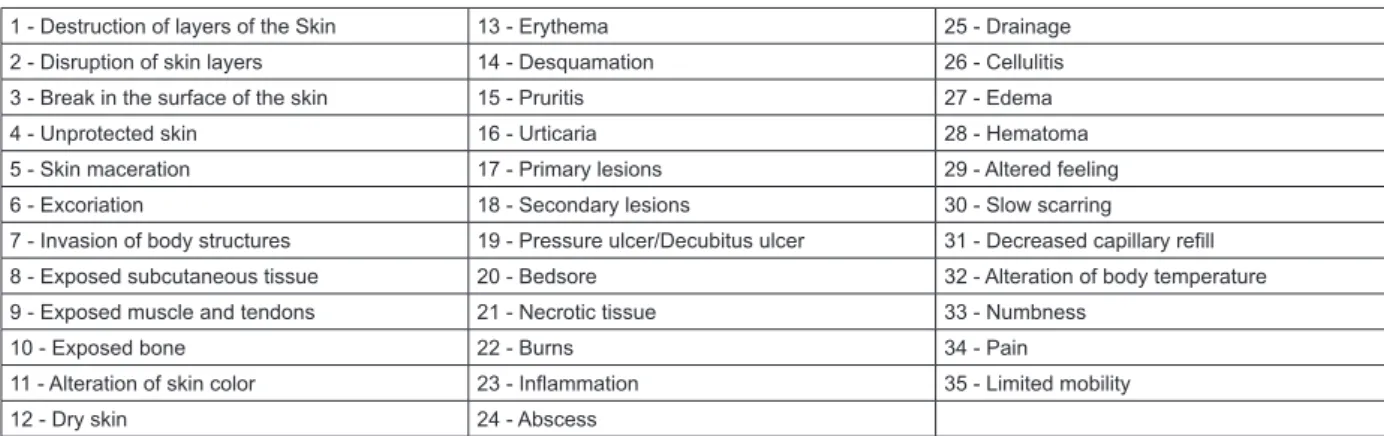
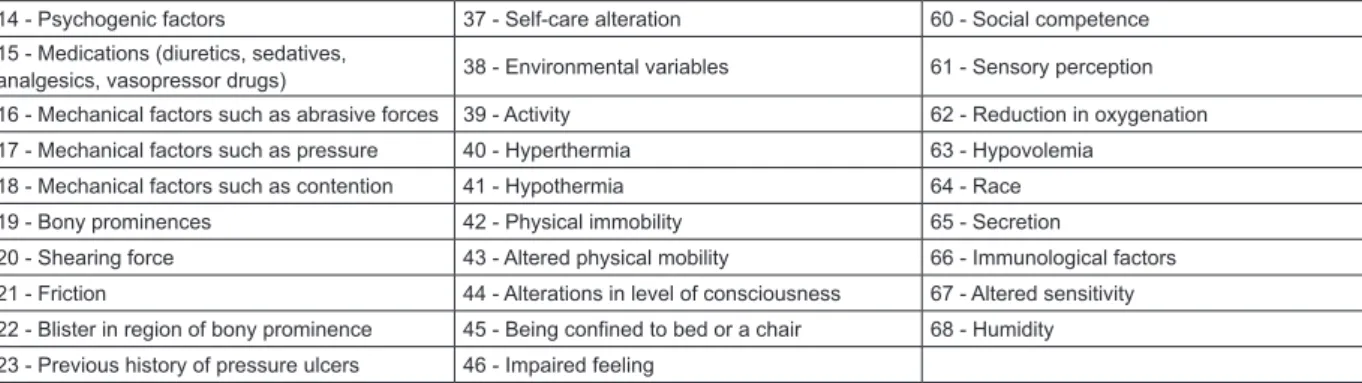
Thus, 35 DCs for the diagnosis of Impaired Skin
Integrity, 68 RFs for the diagnosis of Risk for Impaired Skin
Integrity, and 21 DCs for the diagnosis of Impaired Tissue
Integrity remained, as may be seen in Figures 3, 4 and 5.
1 - Destruction of layers of the Skin 13 - Erythema 25 - Drainage
2 - Disruption of skin layers 14 - Desquamation 26 - Cellulitis
3 - Break in the surface of the skin 15 - Pruritis 27 - Edema
4 - Unprotected skin 16 - Urticaria 28 - Hematoma
5 - Skin maceration 17 - Primary lesions 29 - Altered feeling
6 - Excoriation 18 - Secondary lesions 30 - Slow scarring
7 - Invasion of body structures 19 - Pressure ulcer/Decubitus ulcer 31 - Decreased capillary refill
8 - Exposed subcutaneous tissue 20 - Bedsore 32 - Alteration of body temperature
9 - Exposed muscle and tendons 21 - Necrotic tissue 33 - Numbness
10 - Exposed bone 22 - Burns 34 - Pain
11 - Alteration of skin color 23 - Inflammation 35 - Limited mobility
12 - Dry skin 24 - Abscess
Figure 3 – Deining characteristics of the diagnosis of Impaired Skin Integrity, validated by the judges
1 - Damp skin 24 - Changes in metabolic state 47 - Alterations in consciousness level
2 - Conditions of skin (maceration) 25 - Development factors 48 - Use of incontinence pads
3 - Skin structures broken 26 - Unbalanced nutritional status (obesity) 49 - Family support
4 - Changes in the skin’s turgor 27 - Unbalanced nutritional status (weight loss) 50 - Peripheral vascular disorder/impairment
5 - Drying of the skin 28 - Nutritional status (dehydration) 51 - Impaired circulation
6 - Little thickness of skin 29 - Diastolic blood pressure below 60mmHg 52 - Alteration in levels of hemoglobin and hematocrit
7 - Changes in pigmentation 30 - Diabetes Mellitus 53 - Decrease in serum albumin
8 - Excretions 31 - Neurological illness 54 - Immunosupression
9 - Chemical substance 32 - Cardiopulmonary disorders 55 - Fecal incontinence
10 - Radiation 33 - Medical diagnosis 56 - Urinary incontinence
11 - Infection 34 - Cancer 57 - Pressure relief device
12 - Edema 35 - Smoking 58 - Length of hospitalization
13 - Anemia (hemoglobin below 10) 36 - Extremes of age 59 - Behavioral Interventions
Rev. Latino-Am. Enfermagem 2012 Sept.-Oct.;20(5):863-72.
14 - Psychogenic factors 37 - Self-care alteration 60 - Social competence
15 - Medications (diuretics, sedatives,
analgesics, vasopressor drugs) 38 - Environmental variables 61 - Sensory perception
16 - Mechanical factors such as abrasive forces 39 - Activity 62 - Reduction in oxygenation
17 - Mechanical factors such as pressure 40 - Hyperthermia 63 - Hypovolemia
18 - Mechanical factors such as contention 41 - Hypothermia 64 - Race
19 - Bony prominences 42 - Physical immobility 65 - Secretion
20 - Shearing force 43 - Altered physical mobility 66 - Immunological factors
21 - Friction 44 - Alterations in level of consciousness 67 - Altered sensitivity
22 - Blister in region of bony prominence 45 - Being confined to bed or a chair 68 - Humidity
23 - Previous history of pressure ulcers 46 - Impaired feeling
Figure 4 – Risk factors for the diagnosis of Risk for Impaired Skin Integrity, validated by the judges
Figure 5 – Deining characteristics for the diagnosis of Impaired Tissue Integrity, validated by the judges
1 - Tissue destroyed 8 - Surgical incision 15 - Cellulitis
2 - Damaged tissue (for example, cornea,
mucosa, skin or subcutaneous tissue) 9 - Dry mucosa 16 - Exposure of subcutaneous tissue 3 - Rupture of mucosal tegumentary or corneal
tissue 10 - Coated tongue 17 - Exposure of muscle and tendon
4 - Primary lesions 11 - Leucoplakia 18 - Exposure of bone
5 - Secondary lesions 12 - Ulceration 19 - Destruição mecânica dos tecidos
6 - Edema 13 - Pressure ulcer/decubitus ulcer 20 - Bedsore
7 - Erythema 14 - Elementary lesion secondary to loss of
substance 21 - Surgical procedure
Discussion
The literature review shows that nurses have
researched and published much more on the subject
of the diagnoses of Impaired Skin Integrity and Risk of
Impaired Skin Integrity(12-16) than on the diagnosis of
Impaired Tissue Integrity.
This fact relects nurses’ clinical practice, as when the diagnosis of Impaired Tissue Integrity appears little
in the studies of incidence and prevalence of nursing
diagnoses, this may mean that either the nurse has not identiied this diagnosis in clinical practice, or that it is being diagnosed as Impaired Skin Integrity and treated
as such. This last supposition is corroborated by a study
on pressure ulcers(17), in which the diagnosis of Impaired
Skin Integrity was present but that of Impaired Tissue
Integrity was not.
However, this reality may be changing, as in a recent study on clinical proiles and nursing diagnoses of patients at risk of pressure ulcers(18), the diagnosis
of Impaired Tissue Integrity was the eleventh most
frequent, with 13%.
The low number of articles on Impaired Tissue Integrity made its analysis dificult, but allowed the identiication of a knowledge gap in relation to the same, which indicates the need for developing further studies
on this diagnosis.
Another aspect which attracted attention was
the low number of studies on the validation of these
diagnoses and the period in which they were carried out,
that is, in the 1990s, even with the suggestion by some
of these studies’ authors that other research involving
the issue be undertaken(12-16). However, this scenario
has changed, as new studies were found on validation
and the occurrence of these diagnoses, undertaken in
2010 and 2011(5-6) in Brazil, in addition to the present
investigation.
Varying numbers of DCs/RFs were found, different
from those presented by NANDA-I, as under that
taxonomy the diagnosis of Impaired Skin Integrity has
only three DCs, the diagnosis of Risk for Impaired Skin
Integrity presents 22 RFs, and the diagnosis of Impaired
Tissue Integrity has two DCs(4).
This result conirms what had already been indicated by the literature, as all the articles selected
presented DCs and RFs different from NANDA-I. This
may be interpreted to mean that the studies’ results
evidence that nurses, in their care practice, have used
DCs and RFs which are not described or approved by
NANDA-I to establish the diagnoses referred to.
In relation to the process of validation of the ODs, in the irst evaluation it was not possible to validate all of them, it being necessary to undertake a further
deinitions, prior to submitting them to a second evaluation by the judges. This is perfectly acceptable in this type of study, as it is very dificult to achieve consensus among all the judges in the irst round. The modiications made improved the qualiication of the operational deinitions, assisting the validation process. One very important aspect in this process of the
validation of the ODs was the suggestion made by the judges to modify the deinitions of the diagnoses of Risk for Impaired Skin Integrity and Impaired Tissue
Integrity, as, if the process of change really should be carried through after other studies, this will be relected directly in nurses’ clinical practice, because more precise deinition of these diagnoses would permit them to distinguished from the others.
Further, a higher number of DCs/RFs representing these diagnoses will probably allow them to be identiied more accurately, although caution is necessary here
because when DCs/RFs are shared by more than one
diagnosis, the fact may create doubts; in addition to
this, an excessively high number of DCs/RFs may lead to a less accurate diagnosis, when in a speciied clinical situation, only secondary DCs or RFs are identiied.
Conclusion
It was possible to identify various deining characteristics and risk factors which are not present in
the NANDA-I taxonomy but which were indicated by the
literature.
The use of a rigorous methodology for evaluating and reining allowed the construction of operational deinitions for DCs/RFs which were relevant, clear and comprehensive, as well as the proposing of new deinitions for two diagnoses, Impaired Tissue Integrity and Risk for Impaired Skin Integrity, which will be
evaluated in future studies.
By presenting clearer deinitions for these diagnoses, and a higher number of DCs/RFs, the hope
is to assist nurses in identifying them with greater
accuracy in clinical practice.
This study’s contribution consists of presenting clearer operational deinitions and a higher number of DCs/RFs, which may assist nurses in the identiication and use of the same with greater accuracy in clinical
practice.
References
1. Gordon M. Implementation of nursing diagnoses: na
overview. Nurs Clin North Am.1987;22(4):875-9.
2. Fehring RJ. The Fehring Model. In: Carrol-Johnson,
RM; Paquete M. ed. Classification of nursing diagnoses:
Proceedings of the Tenth conference. Philadelphia: JB
Lippincott; 1994. p. 55-62.
3. Pompeo DA, Rossi LA, Galvão MC. Revisão Integrativa: etapa inicial de processo de validação de diagnóstico de enfermagem. Acta Paul Enferm. 2009;22(4):434-8. 4. Diagnósticos de enfermagem da NANDA: Definições e Classificação 2009-2011/NANDA Internacional; tradução Regina Machado Garcez. Porto Alegre: Artmed; 2010. 456 p.
5. Malaquias GS. Validação clínica de Integridade da Pele de área perilesional e Integridade Tissular Prejudicada relacionada à circulação alterada em pessoas com úlceras vasculogênicas. [dissertação]. Goiânia: Universidade Federal de Goiás; 2010.
6. Costanzi PA. Validação clínica dos diagnósticos de Mobilidade Física Prejudicada, Integridade Tissular Prejudicada e Integridade da Pele Prejudicada, e em pacientes submetidos a cateterismo cardíaco. [dissertação]. Porto Alegre: Escola de Enfermagem da Universidade Federal do Rio Grande do Sul; 2011.
7. Carpenito-Moyet LJ. Manual de Diagnósticos de Enfermagem. 11ed. São Paulo: Artmed; 2008. 306 p. 8. Silva VA. Associação entre incontinência urinária de fragilidade em idoso em atendimento ambulatorial. [dissertação]. Campinas: Faculdade de Ciências Médicas da Universidade Estadual de Campinas; 2010.
9. Alexandre NMC, Coluci MZO. Validade de conteúdo nos processos de construção e adaptação de instrumentos de medidas. Ciência e Saúde Coletiva [periódico na Internet]. 2011[acesso 26 set 2011]; 16(7):3061-8. Disponível em: http://dx.doi.org/10.1590/S1413-81232011000800006.
10. Lenny MR. Determination and quantification of
content validity. Nurs Res. 1986;35(6):382-5.
11. Gordon M, Sweeney MA. Methodological problems
and issues in identifying and standardizing nursing
diagnosis. Adv Nurs Sci. 1979;2(1):1-15.
12. Lewis-Abney K, Rosenkranz CF. Content validation of
impaired skin integrity and urinary incontinence in the
home health setting. Nurs Diag. 1992;5(1):36-42.
13. Wieseke A, Twibell KR, Bennett S, Marine M, Schoger
J. A content validation study of five nursing diagnoses by
critical care nurses. Heart & Lung. 1994;23(4):345-51.
14. Levin FR, Krainovitch CB, Bahrenburg E, Mitchell CA.
Diagnostic content validity of nursing diagnoses. Image
J Nurs Sch. 1989;21(1):40-4.
15. Anderson J, Thomson A. Impaired skin integrity:
Rev. Latino-Am. Enfermagem 2012 Sept.-Oct.;20(5):863-72.
Classification of nursing diagnoses: proceedings of the
ninth conference held in Orlando, FL, 1990.
Carroll-Johnson RM; JB Lippincott; 1991. p. 126-32.
16. Schappler N. Impaired skin integrity: actual and
potential in orthopedic patients. In: Classification of
nursing diagnoses: proceedings of the eight conference
held in St. Louis, MO, March, 1988. Carroll-Johnson RM;
JB Lippincott; 1989. p. 345-8.
17. Costa JN, Oliveira MV. Fenômenos de enfermagem em portadores de lesão medular e o desenvolvimento de úlcera por pressão. Rev Enferm UFRJ. 2005;13(3):367-73.
18. Lucena AF, Santos CT, Pereira AGS, Almeida AA, Dias VLM, Friedrich MA Perfil clínico e diagnósticos de enfermagem de pacientes em risco para úlcera por pressão. Rev. Latino-Am. Enfermagem. 2011;19(3):523-30.
Received: Oct. 16th 2011