Journal of Krishna Institute of Medical Sciences University
JKIMSU, Vol. 3, No. 2, July-Dec 2014
SHORT COMMUNICATION
ISSN 2231-4261
Ó
Ó
Abstract:
Background: Coconut water has many beneficial effects on health since it contains electrolyte, vitamins, sugar, protein, antioxidants, minerals, cytokinins and dietary fiber. Actually it is fat free and has zero choles-terol. It has antiviral and antibacterial properties, helps to lose weight, very beneficial to a person with kidney stones due to its minerals, potassium, and magnesium content and it has different effects in the sex organ. Aim and Objectives: This present study was carried out to investigate the effect of consumption of coconut water on the concentration of some serum sex hormones (Testosterone, Follicle Stimulating Hormone (FSH), Luteinizing Hormone (LH), and Prolactin) in rats. Materials and Methods: Twenty (20) female Albino Wistar rats (200-220 g final body weight) were randomly assigned into 2 groups of 10 rats each. Group I served as Control while Group II was administered 3 ml of coconut water for 28 days. Results: The levels of testosterone, FSH and LH were significantly incre-ased, while prolactin was significantly decreased when compared with the control (P<0.05). Conclusion: This result implies probably that the consumption of coconut water could enhance reproductive functions in Albino Wistar rats and likely to increase the fertility.
Keywords: Coconut Water, Fertility, Rats, Reproduc-tion, Sex Hormones.
107
Coconut Water Consumption and Its Effect on Sex Hormone Concentrations
1* 2 3 1
Nnodim Johnkennedy , Elendu Humphrey Ndubueze , Ihim Augustine , Dimeke Chioma 4
Ezekwesiri Cletus Okey
1
Department of Medical Laboratory Science, Faculty of Health Science, Imo State University
2
Owerri, Imo State, Nigeria, Education Registration And Regulation Department, Medical Laboratory Science Council of Nigeria Headquarters Asokoro, Abuja, Nigeria,
3
Department of Medical Laboratory Science, Faculty of Health Sciences and Technology, College of Health Sciences, Nnamdi Azikiwe University Nnewi Campus Nigeria
4
Department of Chemical Pathology Federal Medical Centre Owerri Nigeria
Introduction:
actually fat free and has zero cholesterol. Some studies stated that coconut water increases High density lipoprotein levels in the body. Coconut water helps to lose weight as it is low in fats. It is a storehouse of important nutrients and B complex vitamins. It has antiviral and antibacterial proper-ties. It is generally recommended during preg-nancy as it helps in constipation, heart burn and slow digestion. The lauric acid present in coconut water has antifungal, antibacterial and antiviral properties which boost the body's immune system [7]. Tender coconut water is very beneficial to a person with kidney stones due to its minerals, potassium, and magnesium content. It also acts as a diuretic as it increases the flow and production of urine. In the same vein, when coconut water is applied to affected skin areas with acne, wrinkles, stretch marks, cellulite and eczema, it clears up the skin and gives it youthful smooth looking skin [8]. However, coconut water can have different effect in the sex organ. Fertility and reproductive health are regulated and maintained by the levels of serum sex hormones. Sex hormones are steroid hormones that are produced especially by the ovaries, testes or adrenal cortex and affect the growth or function of reproductive organs. It also stimulates the development of secondary sexual characteristics [9].
In the light of the above findings, this work was conducted to monitor the effect of coconut water on hormonal concentrations in rats.
Material and Methods:
Coconut Water: Coconuts of 7 to 8 months of age were harvested from the coconut trees grown at Ndibinama Duruewuru Amucha, Njaba LGA of Imo State Nigeria. The coconuts were dehusked, broken carefully and the liquid endosperm (coconut water) was collected and was used in the experiment.
JKIMSU, Vol. 3, No. 2, July-Dec 2014 Nnodim Johnkennedy et. al.
Journal of Krishna Institute of Medical Sciences University
Ó
Ó
108Experimental Animals: Albino Wistar rats weighing between 200 to 220 g were used for the study. The Wistar rats were kept in a laboratory animal unit with a 12 hour light/dark cycle. Throughout the experiment, the room temperature was maintained. Also, the rats were maintained on a standard chow diet and water ad libitum. After acclimatization, the rats were randomly grouped into 2 groups of ten rats each. The first group of animals which served as normal control was given distilled water. Group II was given 3 ml of coconut water. The duration of experimental period was 28 days. In both groups, the administration of coco-nut water was through oral route. This treatment was by oral compulsion. All animals were allowed free access to food and water throughout the experiment.
Ethics: All experiments were conducted in accor-dance with the National Institute of Health Guide for the Care and Use of Laboratory Animals [10].
Blood Collection: Twenty four hours after the last dose of coconut water was administered, the animals were anaesthetized with chloroform vapour, quickly brought out of the jar and sacri-ficed. Whole blood was collected by cardiac puncture from each animal into clean dry test tubes. The blood was allowed to stand for about 15 minutes to clot and further spun in a wester fuge centrifuge (model 1384) at 10,000 g for 5 minutes. Serum was separated from the clot with Pasteur pipette into sterile sample tubes for the measure-ment of the hormonal concentrations.
Biochemical Analysis: Serum level of FSH, Testosterone, LH, and prolactin was estimated using enzyme immunoabsorbent assay through kits.
production of testosterone in Leydig cells [13], which in turn may act on the Sertoli cells and peritubular cells of the seminiferous tubules and also stimulates spermatogenesis in males. On the
other hand, FSH and LH play an important role in the control of reproductive function in females. In females, FSH stimulates ovarian follicle growth and maturation, as well as E2 synthesis by granulosa cells, whereas LH stimulates androgen production by theca cells and ovulation of the dominant follicle. Females with loss-of function due to mutations in the Follicle Stimulating Hormone Receptor (FSHR) genes present clini-cally with primary or secondary amenorrhea and associated arrest in follicle development at the pre-antral stage [14]. Hence, consumption of coconut water may be of immense benefits, since it will help ameliorate thermal function.
In this study it was observed that the level of prolactin was significantly decreased. There is usually an inverse relationship between prolactin levels and the levels of testosterone. As prolactin levels decrease, the levels of testosterone, increases. This is in line with the work of Ofem et al [15].
Conclusion:
Increase in serum levels of testosterone, FHS and LH produced by coconut water may improve reproductive health in Albino Wistar rats.
Results:
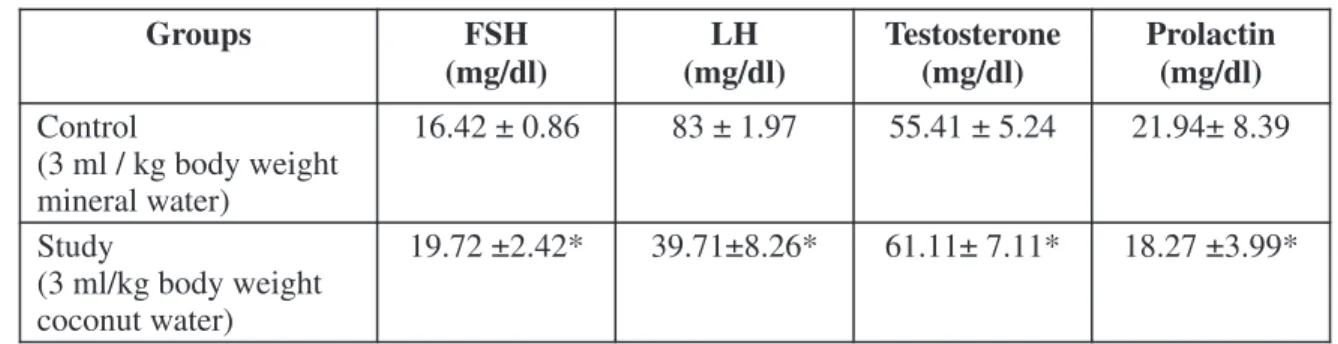
Table 1 shows the effect of coconut water on serum FSH, LH, testosterone, and prolactin in rats.
Discussion:
The application of some plants constituents in pharmaceutical industries has gone long way in the elevation of the status of the herbal medicine in Nigeria [11]. The need for fertility stimulation in men and women cannot be overemphasized especially when a marriage is childless in Igbo communities. While chemical methods for fertility stimulation may have some side effects and are not readily available.
In this study, the results obtained showed that the level of serum LH, FSH and testosterone were significantly increased in rats administered with coconut water when compared with the controls. This is in contrast to the work of Nnodim et al [12] in which xylopia aethiopica caused reproductive dysfunction. This probably implies that coconut water plays important role in regulation of hor-monal level which in other words improves reproductive health. The increase in FSH, LH and testosterone levels could be as result of some potent agents in the coconut water that stimulate the synthesis and subsequent release of these hormones in the anterior pituitary gland / ovary. FSH is an important hormone that stimulates spermatogenesis while LH stimulates the
Groups FSH
(mg/dl) (mg/dl)LH Testosterone (mg/dl) Prolactin (mg/dl) Control
(3 ml / kg body weight mineral water)
16.42 ± 0.86 83 ± 1.97 55.41 ± 5.24 21.94± 8.39
Study
(3 ml/kg body weight coconut water)
19.72 ±2.42* 39.71±8.26* 61.11± 7.11* 18.27 ±3.99*
Table 1: Effect of Coconut Water on Serum Follicle Stimulating Hormone (FSH), Luteinizing Hormone (LH), Testosterone, and Prolactin in Rat
*Significantly different from control at P<0.05
JKIMSU, Vol. 3, No. 2, July-Dec 2014 Nnodim Johnkennedy et. al.
Journal of Krishna Institute of Medical Sciences University
Ó
1. Mohan VR, Balamurugan K, Sakthidevi G.Fertility Enhancement of Polycarpaea Corymbosa (L.) Lam (Caryophyllaceae) Whole Plant on Male Albino Rats.
Asian J Pharm Clin Res 2013; 6 (Suppl 5):151-155. 2. Oyedeji KO, Bolarinwana AF. Evaluation of
antifertility and teratogenic effects of crude extracts of
Portulaca oleracea in male and female albino rats.
Asian J Pharm Clin Res 2013; 6: 217-220.
3. Nnodim JK, Dike-Ndudim J, Elendu HN, Nwagbaraocha M, Egbuobi R, Onyeze V. Antioxidant and Cardioprotective Effect of Coconut Water against Doxorubicin Induced Cardiomyopathy. JKIMSU
2013; 2(2): 38-41.
4. Bhagya D, Prema L,Rajamohan T. Beneficial effect of tender coconut water on blood pressure and lipid levels in experimental hypertension. Journal of Cell and Tissue Research 2010; 10(1): 2139-2144.
5. Yong JWH, GeL, Ng TF, Tan SN. The chemical composition and biological properties of Coconut water. Molecules 2009. 14(12) 5144-5164.
6. CampbellFack D, Thomas T, Falck TM,Tutuo N, Clem K. The intravenous use of coconut water. Am J Emerg Med 2000; 18(1):108-111.
7. Moura CC, Soares PB, Depaulareis MV, Fernandes NAJ, Zanetta BD, Soares CJ. Potential of coconut water and soy milk for viability of periondontal ligament cells, an in vivo study. Dent Traumatol 2104; 30(1)22-26.
References:
*Author for Correspondence: Dr. Nnodim Johnkennedy, Department of Medical Laboratory Science,
Faculty of Health Science, Imo State University Owerri, Imo State, Nigeria. Tel No: +238034237000, E-mail: [email protected]
JKIMSU, Vol. 3, No. 2, July-Dec 2014 Nnodim Johnkennedy et. al.
Journal of Krishna Institute of Medical Sciences University
Ó
Ó
1108. Sekar N, Veetil SK, Neerathilingam M. Tender coconut water an economical growth medium for the produc-tion of recombinant proteins in Escherichia coli. BMC Biotechnol 2013, 2(13):70.
9. Thakur MK, Paramanik V. The role of steroid hormone coregulators in health and disease. Hormone Research
2009; 71(4)194-200.
10. Ochei J and Kolhatkar A. Care and use of experimental animals. In: Medical Laboratory Science Theory and practice, Tata McGraw-Hill India; 2007: 1213-1232. 11. Edeoga, HO, Okwu DE, Mbaoble BO. Phytochemical
constituents of some Nigerian Medicinal Plants.
African J Biotechnol 2005; 4(7): 685-688.
12. Nnodim JK, Nwanjo HU, Okolie NJ, Opara AU, Nwosu DC, OKoroiwu I, Dike J, Okorie H, Nwadike CN and Uduji HI. Effects of Xylopia aethiopica fruits on reproductive hormonal level in rats. Global Journal of Medicinal Plant Research 2013; 1(1): 29-31.
13. Bernard DJ. Mechanisms of FSH synthesis. Fertil Steril 2010; 93:2465-2485.
14. Tietz NW. Foundamental in Clinical Chemistry, W. B Saunders Company, Philadelphia; 1st Edition, 1994:1354-1373.
15. Ofem OE, Antai AB, Essien NM, Oka VO. Enhance-ment of some sex hormones concentrations by consumption of leaves extract of Viscum album
(mistletoe) in rats. Asian Journal of Medical Sciences