http://dx.doi.org/10.1590/s2175-97902017000216083
A
r
*Correspondence: A. M. Rubim. Laboratório de Controle de Qualidade de Medicamentos. Centro Universitário Franciscano. 97010032 - Santa Maria - RS, Brasil. E-mail: [email protected]
Inclusion complex of amiodarone hydrochloride with cyclodextrins:
preparation, characterization and dissolution rate evaluation
Alexandre Machado Rubim*
1,2, Jaqueline Bandeira Rubenick
1, Marcela Maurer
2,
Luciane Varini Laporta
1,2, Clarice Madalena Bueno Rolim
11Postgraduate Program in Pharmaceutical Sciences, Federal University of Santa Maria, Santa Maria, RS, Brazil, 2Laboratory Drug Quality Control, Franciscan University Center, Santa Maria, RS, Brazil
This study aimed to improve the water solubility of amiodarone hydrochloride (AMH) via inclusion complexes with β-cyclodextrin, methyl-β-cyclodextrin and 2-hydroxypropyl-β-cyclodextrin. Inclusion complexes were developed by physical mixture, coevaporation, spray-drying and freeze-drying. Solid state analysis was performed using X-ray powder difraction, diferential scanning calorimetry and scanning electronic microscopy. Thermodynamic studies demonstrate that the inclusion complexes of drug into diferent cyclodextrins were an exothermic process that occurred spontaneously. Water solubility and drug dissolution rates were signiicantly increased after the formation of inclusion complexes with the cyclodextrins evaluated in relation to the physical mixture and pure drug. The present study provides useful information for the potential application of complexation with amiodarone HCl. This may be a good strategy for the development of solid pharmaceutical dosage forms.
Uniterms: Amiodarone HCl/evaluation. Amiodarone HCl/solubility. Cyclodextrins/inclusion complexes. Cyclodextrins /thermodynamic studies. Dissolution rate.
INTRODUCTION
Amiodarone hydrochloride (AMH), chemically known as (2-butylbenzofuran-3-yl)[4-[2-(diethylamino) ethoxy]-3,5-diiodophenyl]methanone hydrochloride, used for the treatment of both supraventricular and ventricular arrhythmias (Lafuente-Lafuente et al., 2009). AMH is a white or almost white, crystalline powder and is very slightly soluble in water (0.2 – 0.5 mg mL-1) (British Pharmacopoeia, 2012; Eghrary et al.,2012). According
to the Biopharmaceutical Classiication System (BCS), AMH is a class II. Class II drugs are those with low
solubilities and high permeabilities (Amidon et al., 1995; Benet, 2005).
For drugs with low gastrointestinal solubility and
high permeability, dissolution in physiological luids is
the limiting step for oral bioavailability. These properties are a challenge for the pharmaceutical industry, since more than 70% of the new drugs have low solubility showing
deicient biopharmaceutical properties (Ku, Dublin, 2012;
Leuner, Dressman, 2000; Riekes et al.,2010; Svenson, 2009; Vasconcelos, Sarmento, Costa, 2007).
In order to improve drug solubility in physiological
fluids, their effectiveness should be increased, and the doses administered and toxic effects reduced. Several strategies can be employed, such as development of solid dispersion, inclusion complexes containing cyclodextrin, chemical modification, particle micronization, pH
adjustment, micellar solubilization and supercritical luid
(Adeli, 2014; Alves et al., 2014; Chaudhary et al., 2012; Frizon et al., 2013; Gursoy, Benita, 2004; Jagdale et al., 2012; Li-hong et al., 2013; Lu et al., 2012; Maulvi et al., 2011; Patel et al., 2008; Sathigari et al., 2009).
Cyclodextrins (CDs) are cyclic organic compounds composed of different D-glucopyranose units. CDs containing six, seven or eight natural glucose units
obtained in high quantity called α-cyclodextrin (α-CD), β-cyclodextrin (β-CD) and γ-cyclodextrin (γ-CD),
This work aimed to develop inclusion complexes using cyclodextrins for the purpose of improving water solubility and dissolution rate of AMH. The solid state physicochemical properties were assessed using powder X-ray diffraction, differential scanning calorimetry, Fourier-transform infrared spectroscopy and scanning electron microscopy. Furthermore, in vitro dissolution
proiles using diferent dissolution media were performed
to investigate the increased solubility of this drug.
MATERIAL AND METHODS
Material
AMH (purity > 99%) was obtained from Brazilian Pharmacopeia, batch 1040. The raw material AMH batch: CAD20131006 (purity>99%) was purchased from Zhejiang Pharmaceutica® (Hong Kong, China). β-Cyclodextrin
(β-CD), methyl-β-cyclodextrin, (Methyl-β-CD) and hydroxypropyl-β-cyclodextrin (HP-β-CD), with an average
degree of molar substitution per anhydroglucose unit of 0.6, purchased from Sigma-Aldrich® (St. Louis, MO, USA). Ultra-pure deionized water was generated from a Millipore Milli-Q Gradient System (Billerica, MA, USA). Other reagents and solvents used were of analytical grade.
Preparation of physical mixture and inclusion complexes
Physical mixture and inclusion complexes of AMH
and CDs at a 1:1 molar ratio were performed by diferent
techniques:
Physical mixture (PM): The PM was prepared by mixing previously weighed powders in a ceramic mortar for 10 min.
Coevaporation (CE): The product was prepared by dissolving a known amount of AMH and CDs in suitable volumes of water:ethanol (1:1) solution. The mixture was stirred for 2 hours and then solvent was removed in a vacuum oven at 40 ºC for 72 hours.
Freeze-drying (FD): The product was prepared by dissolving the CDs in water:ethanol (1:1) solution and adding a known amount of AMH. The mixture was agitated for 5 h at 40 ºC and organic solvent was evaporated by rotary evaporation at 40 ºC under reduced pressure (-700 mm Hg) (Fisatom®, model 802). The solution was placed in a freezer at –80 ºC for 24 hours and lyophilized in a Jouan LP3 (model 60) freeze-dryer for 24 hours.
Spray-drying (SD): The product was prepared by dissolving the CDs in water:ethanol (1:1) solution and adding a known amount of AMH. The mixture was agitated for 24 h at 25 ºC. The mixture was spray-dried using a LabMaq Brazil ® (model MSDi 1.0 ) spray dryer under the following conditions: sample feed rate of 4 mL/ min, inlet temperature 135 ºC, outlet temperature 105 ºC
and air low rate of 45 L/min.
pH-Dependent solubility and Phase solubility studies
T he pH-de pe nde nt sol ubi l i t y st udi e s we re determined in pH 1.2, 4.5 and 6.8 buffer solution and distilled water at 37 ºC ± 0.5 ºC. An excess quantity of
AMH was placed in an erlenmeyer lask containing 10 mL of diferent solutions. The samples were covered to
avoid solvent loss and then shaken at 140 rpm in an orbital shaking incubator (Novatecnica®, NT712) for 24 hours. After equilibrium, samples were centrifuged at 4000 rpm for 10 minutes, and then the concentration of AMH in supernatant liquid was determined by HPLC (Rubim et al., 2015).
The phase solubility studies were performed according to the method reported by Higuchi and
Connors (1965). Briely, an excess amount of AMH was
transferred to an erlenmeyer flask containing 10 mL cyclodextrins in aqueous solutions at concentrations ranging from 0 to 10.0 mM. The flasks were covered to avoid solvent loss and then shaken at 140 rpm in an orbital shaking incubator for 24 hours at different temperatures 25 ºC and 37 ºC ± 0.5 ºC. After equilibrium, samples were centrifuged at 4000 rpm for 10 minutes, and then the concentration of AMH in supernatant liquid was determined by HPLC. All the experiments were performed in triplicate. The apparent complexation
constants (K1:1, M-1) of the complexes were determined in accordance with Eq. (1) from phase solubility slope, where the intercept is the intrinsic solubility of drug absence of cyclodextrins.
(1)
Thermodynamic parameters were obtained as a function of the temperature and complexation constant.
The changes in Gibb’s free energy (ΔG), enthalpy (ΔH)
and entropy (ΔS) were determined using (Eq (2), (3) and (4)), respectively, where R is the gas constant (8.314 J mol-1 K-1) and T is temperature in Kelvin.
(3)
(4)
Characterization of the inclusion complex
X-ray powder diffraction analysis (XRD)
The difraction patterns of samples were obtained with a X-ray difractometer (Rigaku®, Minilex 300), using Cu as an anode material, operated at a voltage of 10 mA, 30 kV, monochromatic radiation (λ = 1.54051 Å). The
samples were analyzed from 5º to 50º in the range of 2θ,
in increments of 0.09 º/s.
Differential Scanning Calorimetry (DSC)
The DSC studies were obtained in a DSC-60 cell (Shimadzu®) with a sensibility of 0.1 oC, using aluminum crucibles with about 2 mg of sample. The temperature of analysis was 30 to 300 ºC, with a heating rate of 10 ºC min-1
in a nitrogen atmosphere with a low rate of 100 mL min-1.
Scanning Electron Microscopy (SEM)
With the help of the scanning electron microscope
(Philips, Model XL 30) at an intensity of 10 kV, the samples were mounted onto a metallic base using double-sided adhesive tape vacuum-coated with gold.
Dissolution studies
The dissolution studies were performed in 500 mL
dissolution medium (i.e. water, acid bufer pH 1.2, acetate bufer pH 4.5 and phosphate bufer 6.8) at 37 ºC ± 0.5 ºC using USP Apparatus 2 at 50 rpm. Briely, AMH (50 mg),
the physical mixture (PM) and inclusion complexes containing equivalent amount of AMH were separately
added into vessel at a rotation speed of 50 rpm. At a
pre-speciied interval time, samples (10 mL) were collected
and replaced with an equal volume of fresh medium to maintain a constant total volume. The percentage of drug dissolved was determined using the HPLC method.
RESULTS AND DISCUSSION
pH-Dependent solubility and Phase solubility studies
The solubility of AMH as a function of pH was
determined in various aqueous media (water, acid bufer pH 1.2, acetate bufer pH 4.5 and phosphate bufer pH
6.8). The solubility values found were: in water, 21.86 ± 1.6011 µg mL-1; in acid bufer pH 1.2, 8.33 ± 0.1162 µg mL-1; in acetate bufer pH 4.5, 26.93 ± 0.2944 µg mL-1; in phosphate buffer pH 6.8, 1.18 ± 0.0877 µg mL-1. In solutions with low pH the AMH has appreciable solubility due to its basic nature and ionization (6.56 ± 0.06). On the other hand it is obvious that AMH shows low solubility in a higher pH solution in which it remains in a unionized form (Lamprecht, Bouligand, Benoit, 2002; Paduraru et al., 2013).
The solubility behaviors found are according to the
low solubility obtained with acid bufer pH 1.2. This can
be explained as due to the formation of insoluble complex between drug and anions dissolved in buffer solution (Avdeef, 2007; Boury et al., 2001; Ravin, Shami, Rattie, 1975).
Phase solubility studies were used for the evaluation
of AMH behavior in an aqueous solution of β-CD, methyl-β-CD and HP-β-CD at 25 and 37 ºC. The results
are shown in Figure 1. AMH solubility linearly increased with increasing concentrations of cyclodextrins over the concentration range evaluated.
The diagrams obtained were classified as AL type, according to Higuchi and Connors (1965). This classification is observed when the guest solubility increases linearly with the cyclodextrin concentration, over the concentration range evaluated, indicating a 1:1 molecular complex formation between AMH and
diferent cyclodextrins. The solubility of AMH in water increased signiicantly (more than 7, 14 and 9-fold at 25 ºC) for β-CD, Methyl-β-CD and HP-β-CD at 10
mM, respectively and (more than 4, 8 and 5-fold at
37 ºC) for β-CD, Methyl-β-CD and HP-β-CD at 10
mM, respectively. This increased solubility can be explained by the formation of an inclusion complex with cyclodextrins. The thermodynamics parameters
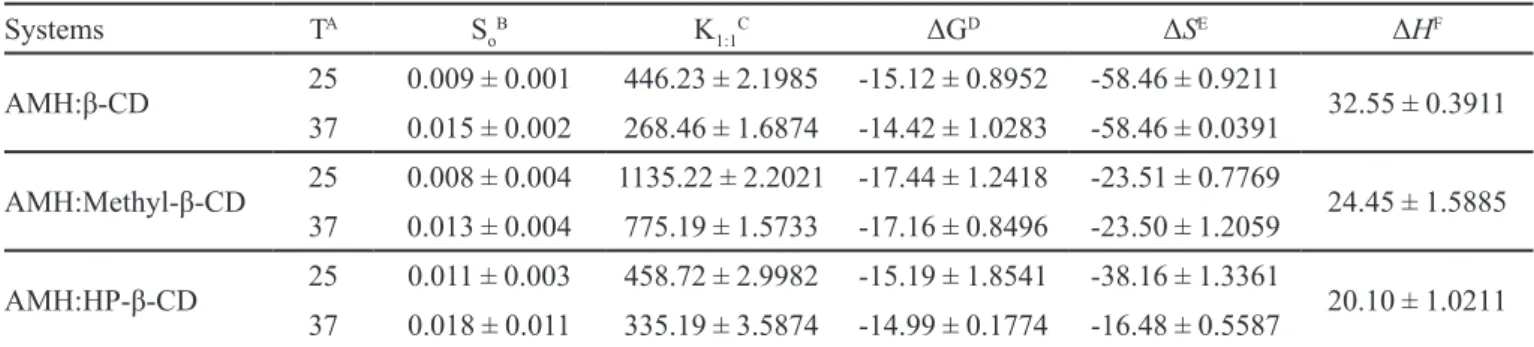
(K1:1, ΔG, ΔH, ΔS) were calculated from the slopes of the linear phase-solubility plots, and are summarized in
Table I.
The high (K1:1) values were observed for all
cyclodextrins evaluated in this study, indicating the formation of a stable complex. The stability constants
were highest for the complex formed with Methyl-β-CD, followed by HP-β-CD and β-CD. It has been suggested
that the steric effect, which depends on the size of cyclodextrins, is one of the main factors of inclusion complex formation (Del Valle, 2004).
Furthermore the ΔG values were negative for all
complexes, indicating that the inclusion of AMH in the different cyclodextrins is a spontaneous process and thermodynamically favorable. This increase in solubility
is directly associated with values of ΔGtr<0 being proportional to the increased carrier concentration (Patel
et al., 2008). The values of the enthalpy change (ΔH) were
negative, indicating that the interaction between AMH and cyclodextrins is an exothermic process, nonetheless the magnitude of the change suggests that the interactions were of the low energy type.
Characterization of the complexes
X-ray powder diffraction analysis
X-ray analysis is a tool utilized to characterize
the crystalline state, to evaluate the diferent crystalline
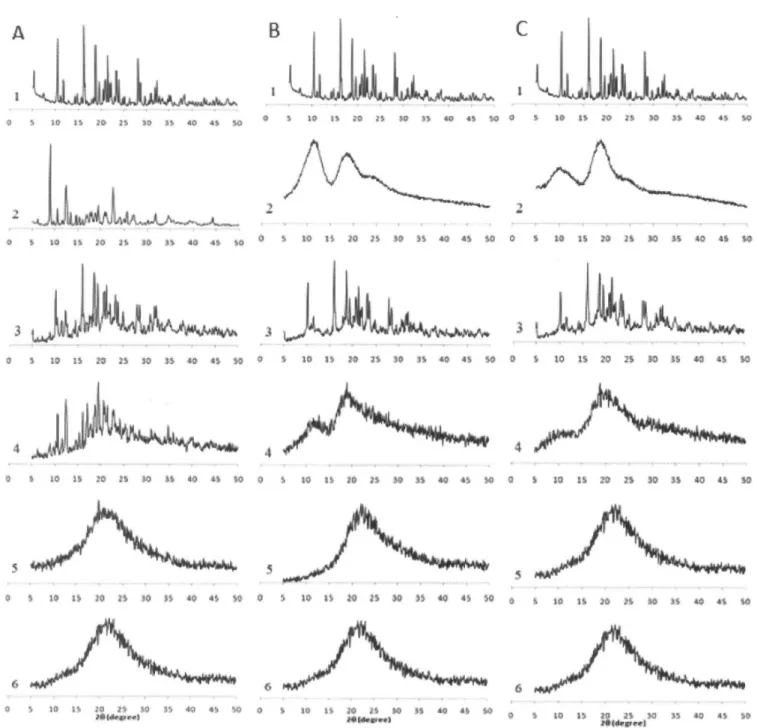
forms and also to confirm the formation of host-guest inclusion complexes. The solid state form of the particles as amorphous, crystalline or polymorphic is a parameter that determines the solubility and dissolution rate of drugs (Markovich et al., 1997). Figure 2 shows the difractogram
pattern of AMH and corresponding inclusion complexes
with CDs prepared by diferent methods.
Figure 2 shows the intense peaks of crystalline
state of the drug structure and the inluence that each
CD and preparation method can have on the crystalline state of the drug. The PM product using the three carriers showed a diffractogram pattern similar to that of the
pure drug. The CE method using β-CD showed a similar
diffractogram to that of PM, while those obtained by SD and FD methods showed the absence of any peaks indicating a transition from crystalline to an amorphous
state. Similar results were observed with Methyl-β-CD and HP-β-Methyl-β-CD by spray-drying and freeze-drying
methods. This solid state form transition was also observed by Bankar and Mahatma (2012), Paduraru et al. (2013) and Riekes et al. (2010), when the amorphization of the compounds after complexation with cyclodextrins was demonstrated.
Thermal analysis
DSC is a tool utilized in the pharmaceutical industry for the purpose of evaluating the physicochemical properties of drugs and excipients, evaluation of degradation kinetics and stability. Furthermore, these analyses are commonly used to characterize the solid state inclusion complexes (Vecchio et al., 2001;
TABLE I - Thermodynamic parameters obtained from phase solubility studies with AMH and cyclodextrins at diferent temperatures (values are the mean ± SD of triplicate experiments)
Systems TA S
oB K1:1C ΔGD ΔSE ΔHF
AMH:β-CD 25 0.009 ± 0.001 446.23 ± 2.1985 -15.12 ± 0.8952 -58.46 ± 0.9211 32.55 ± 0.3911
37 0.015 ± 0.002 268.46 ± 1.6874 -14.42 ± 1.0283 -58.46 ± 0.0391
AMH:Methyl-β-CD 25 0.008 ± 0.004 1135.22 ± 2.2021 -17.44 ± 1.2418 -23.51 ± 0.7769 24.45 ± 1.5885
37 0.013 ± 0.004 775.19 ± 1.5733 -17.16 ± 0.8496 -23.50 ± 1.2059
AMH:HP-β-CD 25 0.011 ± 0.003 458.72 ± 2.9982 -15.19 ± 1.8541 -38.16 ± 1.3361 20.10 ± 1.0211
37 0.018 ± 0.011 335.19 ± 3.5874 -14.99 ± 0.1774 -16.48 ± 0.5587
A Temperatures evaluated in (ºC); B Solubility of AMH in the absence of cyclodextrins (mM); C Apparent complexation constant
Yoshida et al., 2011). The thermal behavior of the drug, cyclodextrins and inclusion complexes are presented in Figure 3.
The DSC curve shows that AMH has a sharp melting endothermic peak at about 163.47 ºC, indicating a typical behavior of the anhydrous crystalline state. This DSC curve was similar to those in other studies (Paduraru et al., 2013, Riekes et al., 2010). During the
DSC analysis the thermogram of HP-β-CD showed a very
broad endothermic peak between 60 ºC and 110 ºC. The
formulations produced by diferent methods containing the
three cyclodextrins showed a reduction of intensity and an alteration in position of the endothermic peak of the drug.
When the spray-drying method was utilized, the complete
disappearance of the endothermic peak corresponding to AMH was evident, indicating the formation of an
amorphous inclusion complex that was conirmed by the
results obtained after XRD analysis.
FIGURE 2 - X-ray difractograms corresponding to: (A): 1 – AMH, 2 - β-CD, 3 – CD/PM, 4 – CD/CE, 5 –
Scanning electron microscopy
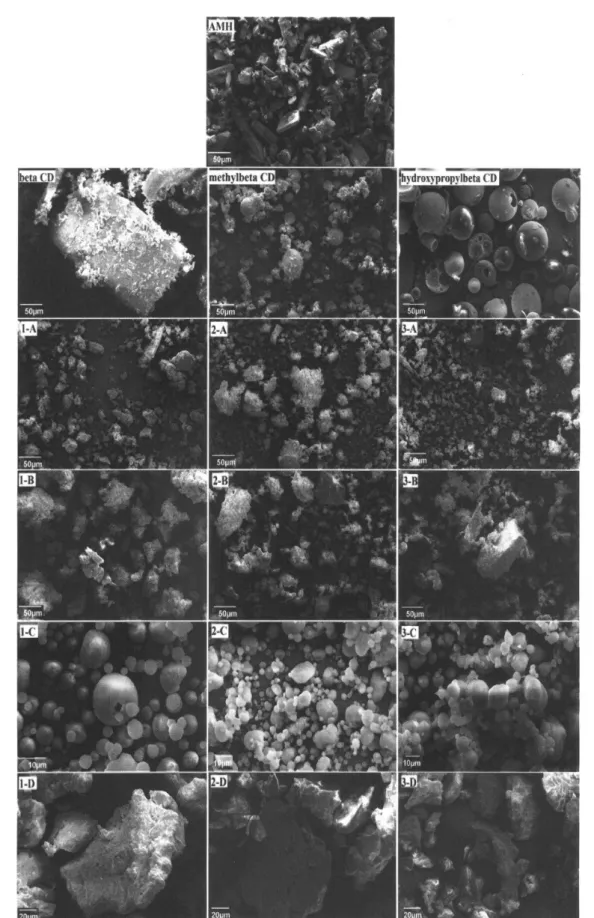
The images obtained for the formulations are presented in Figure 4. The micrographs are used to evaluate the morphological aspects of polymers, solid dispersions, drugs, cyclodextrins and inclusion complexes (Naidu et al., 2004).
AMH showed the irregular size and characteristic morphology of drug crystals, which is in accordance with the X-ray analysis that showed the crystalline nature
of AMH. It was also evident that β-CD is a crystalline solid while Methyl-β-CD and HP-β-CD are regular and
spherical particles.
In the physical mixtures and coevaporation method
the AMH crystals were clearly detectable on the surface of cyclodextrins indicating little complexation between
compounds. All spray dried powders showed an interaction between drug and cyclodextrins, indicated by the complete disappearance of the crystalline morphology of AMH. This drastic change of morphology and particle shape was indicative of the formation of the new solid phase. Results obtained by others evaluations, DSC and X-ray powder corroborated the formation of an amorphous system.
Dissolution rate studies
In drugs that present low gastrointestinal solubility
and high permeability, in this case AMH, the oral drug release is a limiting step for bioavailability. The bioavailability depends on a series of factors, including the physicochemical properties of its formulation, and the physiological state of the patients (Fernandes, Vieira, Veiga, 2002).
To evaluate whether the inclusion complexes
afected the dissolution rates of AMH, dissolution proiles
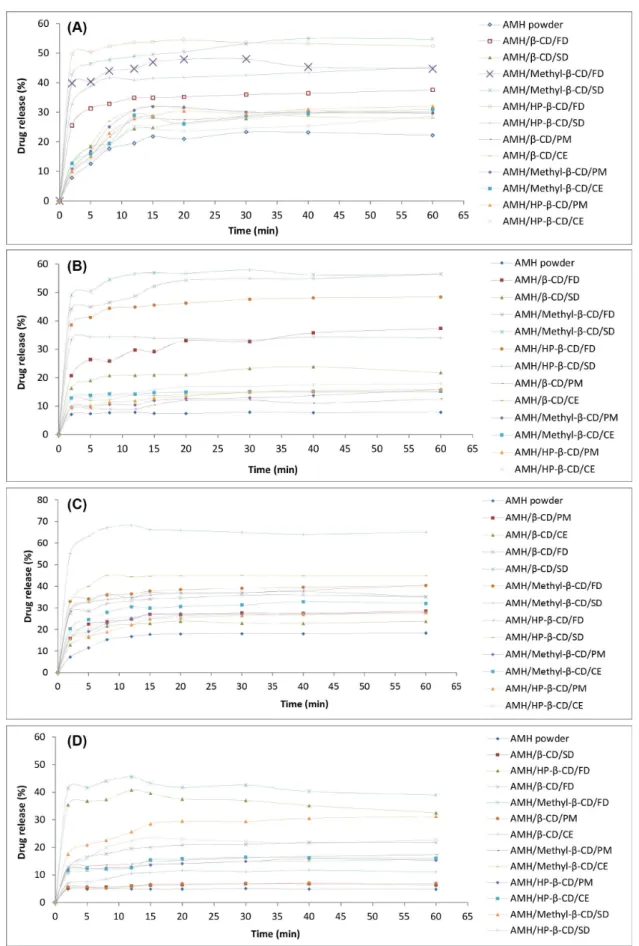
were performed on pure drug, physical mixtures and inclusion complexes with cyclodextrins, with three pH values and water. Rapid dissolution rate as compared with the pure drug is the characteristic behavior of inclusion
complexes (Baboota, Dhaliwal, Kohli, 2005). Dissolution proiles for the pure AMH, physical mixture of the drug and inclusion complexes obtained by diferent methods
are presented in Figure 5.
Pure AMH shows about 22.20% dissolution in water,
7.83%, 18.31% and 4.82% dissolution in acid bufer pH 1.2, acetate bufer pH 4.5 and phosphate bufer pH 6.8,
respectively after 60 minutes of study. As expected, AMH is a drug that depends on the pH value due to the presence
of a tert-amine ionizable in diferent luids (Paduraru et al., 2013).
The physical mixtures containing the three cyclodextrins show a similar dissolution rate of about 30% at 60 minutes in water and acetate buffer pH 4.5. The increment in the dissolution rate of AMH with the physical mixture can be explained by improved drug wettability due to the presence of the cyclodextrins, which can reduce the interfacial tension between particle and dissolution medium. The coevaporation, spray-drying
and freeze-drying methods of β-CD, Methyl-β-CD and HP-β-CD showed a signiicant increase in drug dissolution
compared to physical mixture. This can be attributed to the
better interaction between drug and CDs, as conirmed by
physicochemical characterization.
The spray-drying products with methyl-β-CD
showed about 55%, 56%, 65% and 38% dissolution in water, acid buffer pH 1.2, acetate buffer pH 4.5 and
phosphate bufer pH 6.8, respectively. The great inluence of methyl-β-CD can be explained based on its good
FIGURE 3 - DSC thermograms: 1: (A) AMH powder, (B)
solubility, higher amorphization, wettability and capacity of complexation in solid state (Fernandes, Vieira, Veiga, 2002).
CONCLUSIONS
In the present work, the complex formed between
AMH and CDs presented an enhanced solubility and dissolution rate for all complexes formed other than either physical mixture or pure drug. AMH solubility linearly increases with increasing concentrations of CDs of both temperatures indicating an AL-type diagram over the
entire concentration range evaluated. The ΔGtr values were negative for all formulations indicating a spontaneous process which was thermodynamically favorable to
drug solubility. The Kc result suggests good stability for
both temperatures evaluated of the inclusion complex
formed by AMH-Methyl-β-CD. The characterization of physicochemical results conirmed the formation of complexes with diferent cyclodextrins. The dissolution proiles of formulations demonstrated the great inluence
on drug solubility especially when prepared by the
spray-drying method with methyl-β-CD for all dissolution mediums evaluated. After studies using diferent CDs and
complexation process, the results obtained demonstrated that the CDs are good excipients to increase molecule solubility.
ACKNOWLEDGEMENTS
The authors acknowledge the support of this work by Centro Universitário Franciscano, Santa Maria, Brazil and Prof. Marcos Segatto and Raphael Nicolay of the Federal University of Santa Catarina, Florianópolis, Brazil who performed microscopic and thermal analysis.
REFERENCES
ADELI, E. A comparative evaluation between utilizing SAS supercritical fluid technique and solvent evaporation method in preparation of Azithromycin solid dispersions for dissolution rate enhancement. J. Supercrit. Fluids, v.87, p.9-21, 2014.
ALVES, L.D.S.; SOARES, M.F.R.; ALBUQUERQUE, C.T.; SILVA, E.R.; VIEIRA, A.C.C.; FONTES, D.A.; FIGUEIREDO, C.B.; SOBRINHO, J.L.; NETO, P.J. Solid dispersion of efavirens in PVP K-30 by conventional solvent and Kneading methods. Carbohydr. Polym., v.104, p.166-174, 2014.
AMIDON, G.L.; LENNERNÃS, H.; SHAH, V.P.; CRISON, J.R. A theoretical basis for a biopharmaceutic drug classiication: the correlation of in vitro drug product dissolution and in vivo bioavailability. Pharm. Res., v.12, n.3, p.413-420, 1995.
AVDEEF, A. Solubility of sparingly-soluble ionizable drugs. Adv. Drug. Deliv. Rev., v.59, n.7, p.568-590, 2007.
BABOOTA, S.; DHALIWAL, M.; KOHLI, K. Physicochemical characterization, in vitro dissolution behavior, and pharmacodynamic studies of rofecoxib-cyclodextrin inclusion compounds. Preparation and properties of rofecoxib hydroxypropyl β-cyclodextrin inclusion complex: a technical note. AAPS, v.6, n.1, p.83-90, 2005.
BANKAR, P.V.; MAHATMA, O.P. Improved dissolution rate of lelunomide using hydroxypropyl-β-cyclodextrin inclusion complexation by Freeze-Drying Method. Int. J. Drug Deliv., v.4, n.4, p.498-506, 2012.
BENET, L.Z. There are no useful CYP3A probes that quantitatively predict the in vivo kinetics of other CYP3A substrates and no expectation that one will be found. Mol. Interv., v.5, n.2, p.79-83, 2005.
BOURY, F.; GAUTIER, J.; BOULIGAND, Y.; PROUST, J. Interfacial properties of amiodarone: the stabilizing efect of phosphate anions. Coll. Surf. B., v.20, n.3, p.219- 227, 2001.
BRITISH PHARMACOPOEIA. London: The Stationary Oice, 2012. v.1, p.137-138.
CHAUDHARY, A.; NAGAICH, U.; GULATI, N.; SHARMA, V.K.; KHOSA, R.L. Enhancement of solubilization and bioavailability of poorly soluble drugs by physical and chemical modiications: a recent review. J. Adv. Pharm. Edu. Res., v.2, n.1, p.32-67, 2012.
DEL VALLE, E.M.M. Cyclodextrins and their uses: a review. Process Biochem., v.39, n.9, p.1033-1046, 2004.
FERNANDES, C.M.; VIEIRA, M.T.; VEIGA, F.J.B. Physicochemical characterization and in vitro dissolution behavior of nicardipine-cyclodextrins inclusion compounds. Eur. J. Pharm. Sci., v.15, n.1, p.79-88, 2002.
FRIZON, F.; ELOY, J.O.; DONADUZZI, C.M.; MITSUI, M.L.; MARCHETTI, J.M. Dissolution rate enhancement of loratadine polyvinylpyrrolidone K-30 solid dispersion by solvent methods. Powder Technol., v.235, p.532-539, 2013.
GURSOY, R.N.; BENITA, S. Self-emulsifying drug delivery systems (SEDDS) for improved oral delivery of lipophilic drugs. Biomed. Pharmacother., v.58, n.3, p.173-182, 2004.
HIGUCHI, T.; CONNORS, K.A. Phase solubility techniques. Adv. Anal. Chem. Instr., v.4, p.117-122, 1965.
JAGDALE, S.F.; JADHAV, V.N.; CHABUKSWAR, A.R.; KUCHEKAR, B.S. Solubility enhancement, physicochemical characterization and formulation of fast-dissolving tablet of nifedipine-betacyclodextrin complexes. Braz. J. Pharm. Sci.,v.48, n.1, p.131-145, 2012.
KU, M.S.; DUBLIN, W. A biopharmaceutical classiication-based right-first-time formulation approach to reduce human pharmacokinetic variability and project cycle time from irst-in-human to clinical proof-of-concept. Pharm. Dev. Technol., v.17, n.3, p.285-302, 2012.
LAFUENTE-LAFUENTE, C.; ALVAREZ, J.C.; LEENHARDT, A.; MOULY, S.; EXTRAMIANA, F.; CAULIN, C.; FUNCK-BRENTANO, C.; BERGMANN, J. Amiodarone concentrations in plasma and fat tissue during chronic treatment and related toxicity. Brit. J. Clin. Pharmacol., v.67, n.5, p.511-519, 2009.
LAMPRECHT, A.; BOULIGAND, Y.; BENOIT, J. New lipid nanocapsules exhibit sustained release properties for amiodarone. J. Control Rel., v.84, n.1-2, p.59-68, 2002.
LEUNER, C.; DRESSMAN, J. Improving drug solubility for oral delivery using solid disperions. Eur. J. Pharm. Biopharm., v.50, n.1, p.47-60, 2000.
LI-HONG, W.; XIN, C.; HUI, X.; LI-LI, Z.; JING, H.; MEI-JUAN, Z.; JIE, L.; YI, L.; JIN-WEN, L.; WEI, Z.; GANG, C. A novel strategy to design sustained-release poorly water-soluble drug mesoporous silica microparticles based on supercritical luid technique. Int. J. Pharm., v.454, n.1, p.135-142, 2013.
LOFTSSON, T.; BREWSTER, M.E. Pharmaceutical applications of cyclodextrins. 1. drug solubilization and stabilization. J. Pharm. Sci., v.85, n.10, p.1017-1025, 1996.
LU, Y.; GUO, T.; QI, J.; ZHANG, J.; WU, W. Enhancement dissolution and stability of lansoprazole by cyclodextrin inclusion complexation: preparation, characterization and molecular modeling. AAPS, v.13, n.4, p.1222-1229, 2012.
MARKOVICH, R.J.; EVANS, C.A.; COSCOLLUELA, C.B.; ZIBAS, S.A.; ROSEN, J. Spectroscopic identification of an amorphous-to-crystalline drug transition in a solid dispersion SCH 48461 capsule formulation. J. Pharm.. Biomed., v.16, n.4, p.661-673, 1997.
MAULVI, F.A.; DALWADI, S.J.; THAKKAR, V.T.; SONI, T.G.; GOHEL, M.C.; GANDHI, T.R. Improvement of dissolution rate of aceclofenac by solid dispersion technique. Powder Technol., v.207, n.1-3, p.47-54, 2011.
NAIDU, N.B.; CHOWDARY, K.P.; MURTHY, K.V.; SATYANARAYANA, V.; HAYMAN, A.R.; BECKET, G. Physicochemical characterization and dissolution properties of meloxican–cyclodextrin binary systems. J. Pharm. Biomed., v.35, n.1, p.75-86, 2004.
PADURARU, O.M.; BOSÎNCEANU, A.; TÂNTARU, G.; VASILE, C. Efect of hydroxypropryl-β-cyclodextrin on the solubility of an antiarrhythmic agent. Ind. Eng. Chem. Res., v.52, n.5, p.2174-2181, 2013.
PATEL, R.P.; PATEL, D.J.; BHIMANI, D.B.; PATEL, J.K. Physicochemical characterization and dissolution study of solid dispersions of furosemide with Polyethylene Glycol 6000 and Polyvinylpyrrolidone K30. Dissolut. Technol., v.15, n.3,p.17-25, 2008.
RAJEWSKI, R.A.; STELLA, V.J. Pharmaceutical applications of cyclodextrins. 2. In vivo drug delivery. J. Pharm. Sci., v.85, n.11, p.1142-1169, 1996.
RIEKES, M.K.; TAGLIARI, M.P.; GRANADA, A.; KUMINEK, G.; SILVA, M.A.S.; STULZER, H. K. Enhanced solubility and dissolution rate of amiodarone by complexation with β-cyclodextrin through diferent methods. Mater. Sci. Eng. C.: Mater Biol. Appl., v.30, n.7, p.1008-1013, 2010.
RUBIM, A.M.; RUBENICK, J.B.; GREGOLIN, E.; LAPORTA, L.V.; LEITENBERG, R.; ROLIM, C.M.B. Amiodarone Hydrochloride: enhancement of solubility and dissolution rate by solid dispersion technique. Braz. J. Pharm. Sci., v.51, n.4, p.957-966, 2015.
SATHIGARI, S.; CHADHA, G.; LEE, P.; WRIGHT, N.; PARSONS, D.L.; RANGARI, V.K. Physicochemical characterization of efavirenz-cyclodextrin inclusion complexes. AAPS, v.10, n.1, p.81-87, 2009.
SVENSON, S. Dendrimers as versatile platform in drug delivery application. Eur. J. Pharm. Biopharm., v.71, n.3, p.445-462, 2009.
UEKAMA, K. Design and evaluation of cyclodextrin-based drug formulation. Chem. Pharma. Bull.,v.52, n.8, p.900-915, 2004.
VASCONCELOS, T.; SARMENTO, B.; COSTA, P. Solid dispersions as strategy to improve oral bioavailability of poor water soluble drugs. Drug Discov. Today, v.12, n.23-24, p.1068-1075, 2007.
VECCHIO, S.; RODANTE, F.; TOMASSETTI, M. Thermal stability of disodium and calcium phosphomycin and the efects of the excipents evaluated by thermal analysis. J. Pharm.. Biomed., v.24, n.5-6, p.1111-1123, 2001.
YOSHIDA, M.I.; GOMES, E.C.L.; SOARES, C.D.V.; OLIVEIRA, M.A. Thermal behavior study and decomposition kinetics of Amiodarone Hydrochloride under isothermal conditions. Drug. Dev. Ind. Pharm., v.37, n.6, p.638-647, 2011.
Received for publication on 11st April 2016